Risks posed by hole in protective shell over Chernobyl
Lilia Rzheutska, DW, March 29, 2025,
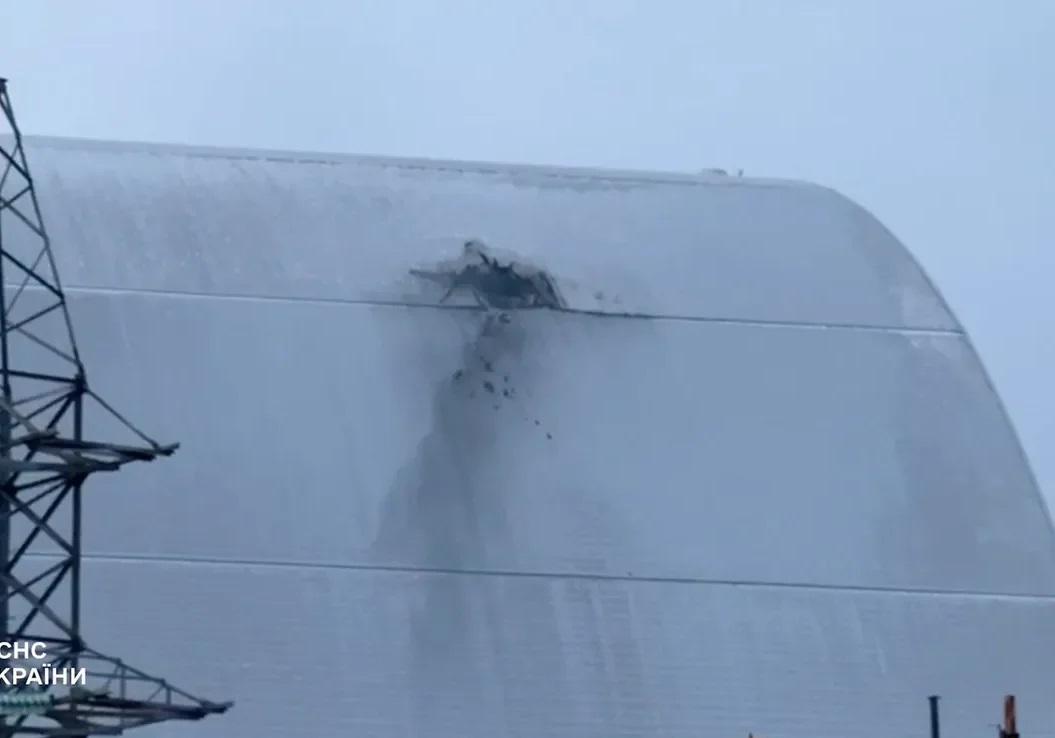
When it was erected in 2019, the giant shell over the damaged nuclear reactor in Chernobyl was one of the biggest structures ever moved by humans. In February a Russian drone put a hole in it.
For weeks, the Ukrainian authorities have been looking for ways to repair a large hole in the protective shell that covers the fourth reactor of the decommissioned Chernobyl nuclear plant. On February 14, a Russian drone hit the structure, which is called the New Safe Confinement, or NSC, because it is meant to “confine” the reactor’s radioactive remains. The drone started a fire that caused considerable damage and was only extinguished three weeks later on March 7.
“The main mission is to close the hole, which is about 15 square meters [around 162 square feet] in size, but also the more than 200 small holes that the State Emergency Service of Ukraine drilled into the shell during firefighting operations,” said Hryhoriy Ishchenko, the head of the State Agency of Ukraine on Exclusion Zone Management, which is responsible for the area around the Chernobyl power plant.
He told DW that experts would soon be arriving on site to examine the structure and that “preliminary recommendations on the repair work should be available within a month.”
A €1.5 billion megaproject
The NSC was erected over a pre-existing protective shell called the sarcophagus, which is there to prevent the release of radioactive contaminants from the reactor, which exploded in 1986. The NSC was built after 45 donor countries came together and gathered around €1.5 billion for the project. Eventually 10,000 people from 40 countries would play a part in the shell, which took 12 years, from the signing of contracts to the moment the NSC was ready in 2019. …………………………
Although experts say the drop in pressure in the NSC does not pose any immediate threat, there are other dangers. Dmytro Humeniuk, a safety analysis expert at Ukraine’s State Scientific and Technical Center for Nuclear and Radiation Safety said it was currently impossible to dismantle the old sarcophagus. The NSC was built in part to replace the old shell but inside the old shell, there are still 18 unstable beams. Three of the main beams could reportedly collapse at any time. If this were to happen under the new-but-now-damaged protective structure, radioactive dust could be stirred up and radioactivity released, Humeniuk said. “The protective shell is currently not fulfilling its function, which is to contain the nuclear fission products beneath it.”………………………….
For Jan Vande Putte, a nuclear expert at Greenpeace Ukraine, there are very few options. “Due to the high radiation levels above the sarcophagus, the entire Chernobyl protective shell will probably have to be moved back to the place where it was built on rails before the expensive repairs can be carried out,” he said adding that the costs of doing this were completely unknown.
Representatives of the European Bank for Reconstruction and Development visited Chernobyl on March 18 and spoke with the power plant’s directors, according to a report on the power plant’s website. They also inspected the technical units of the NSC and the area under the protective shell.
After the meeting, €400,000 from the International Chernobyl Cooperation Account, which the European Bank manages, was approved for a specialist-led damage assessment. https://www.dw.com/en/risks-posed-by-hole-in-protective-shell-over-chernobyl/a-72078360?fbclid=IwY2xjawJV0VZleHRuA2FlbQIxMQABHfhIgvFmxHhPebzUFjc8wxY4HEGBSRbgMxQdAOL2rCSoRY-S4A1j5U8wvw_aem_qeZu8AA
No comments yet.
1 This Month

Petition to revoke the licensing of the Near Surface Nuclear Disposal Facility (NSDF) at Chalk River. https://www.ourcommons.ca/petitions/en/Petition/Details?Petition=e-7247


of the week – STOP SMALL MODULAR REACTORS IN CANADA
To see nuclear-related stories in greater depth and intensity – go to https://nuclearinformation.wordpress.com
-
Archives
- March 2026 (153)
- February 2026 (268)
- January 2026 (308)
- December 2025 (358)
- November 2025 (359)
- October 2025 (376)
- September 2025 (258)
- August 2025 (319)
- July 2025 (230)
- June 2025 (348)
- May 2025 (261)
- April 2025 (305)
-
Categories
- 1
- 1 NUCLEAR ISSUES
- business and costs
- climate change
- culture and arts
- ENERGY
- environment
- health
- history
- indigenous issues
- Legal
- marketing of nuclear
- media
- opposition to nuclear
- PERSONAL STORIES
- politics
- politics international
- Religion and ethics
- safety
- secrets,lies and civil liberties
- spinbuster
- technology
- Uranium
- wastes
- weapons and war
- Women
- 2 WORLD
- ACTION
- AFRICA
- Atrocities
- AUSTRALIA
- Christina's notes
- Christina's themes
- culture and arts
- Events
- Fuk 2022
- Fuk 2023
- Fukushima 2017
- Fukushima 2018
- fukushima 2019
- Fukushima 2020
- Fukushima 2021
- general
- global warming
- Humour (God we need it)
- Nuclear
- RARE EARTHS
- Reference
- resources – print
- Resources -audiovicual
- Weekly Newsletter
- World
- World Nuclear
- YouTube
-
RSS
Entries RSS
Comments RSS
 nuclear-news
Leave a comment