The “Great Era of Nuclear Decommissioning” begins – well, sort of, even in Australia.
https://theaimn.net/the-great-era-of-nuclear-decommissioning-begins-well-sort-of-even-in-australia/ 20 Mar 25
Nuclear is big news for Australia. For the coming election, the federal Opposition party – the Liberal-National Coalition, has as its major, indeed, pretty much its only, policy – to establish the nuclear power industry at 7 sites across the continent. At the same time, a Liberal group has sprung up – Liberals Against Nuclear, vowing to ditch that policy.
Meanwhile the AUKUS plan, (beloved of both major parties) to buy super-expensive nuclear submarines, has run into problems, and is at risk of being ditched.
Also now, on March 4th the Australian Nuclear Science and Technology Organisation (ANSTO) announces that it is embarking on a major decommissioning project , getting into the wonderful new Era of Nuclear Decommissioning. This Era was predicted by The Ecologist, back in 2019, but only now is it reported to be getting underway.
Japan, one of the top nuclear nations, has just announced the first dismantling of a commercial nuclear reactor – ‘signifying that the so-called “great era of decommissioning” has begun in earnest in Japan.’ They have another 59 to go (10 cleared for operation, 23 described as “operable” , and 26 shut-down ones).
So what indeed is the “great era of decommissioning”? What does “decommissioning” actually mean?
According to the European Union – “ It involves all activities starting from the shutdown of the facility and the removal of all nuclear material right down to the environmental restoration of the site. The whole process is complex and typically takes 20 to 30 years to complete.“
So, in Japan, they really mean business – “dismantling of the reactor, which began on March 17, is considered the main part of the decommissioning work“
In Australia -not so much. It means that ANSTO, a few weeks ago, got a licence from the Australian Radiation Protection and Nuclear Safety Agency (ARPANSA), to begin Phase A, Stage 1, and is now beginning to remove peripheral equipment from the the 67 year old Hifar nuclear reactor, now 18 years out of action. More Phases and Stages to go.
Both the Japanese and Australian news items give short shrift to that final problem – nowhere to put the radioactive remains. ANSTO’s at pains to stress how small an amount it is “be managed and stored safely onsite at Lucas Heights” . The Japanese article concludes “While Japan has entered an era of decommissioning, decommissioning plans continue to be postponed due to the lack of a finalized waste disposal site.”
The World Nuclear Association goes into much detail on the decommissioning of 700 nuclear reactors, but only a few of these have been completely dismantled, and still no way of permanently disposing of their radioactive remains.
Meanwhile the International Atomic Energy Agency, and the governments of the most powerful nations are all complacently touting the need for new nuclear reactors. Australian authorities, keen to stress Australia’s nuclear know-how are joining in this happy disregard of the importance of dangerous radioactive trash.
That famous old Australian character “blind Freddy” would immediately know that this is an unreasonable and immoral attitude.
The “era of nuclear decommissioning” is not really underway at all. If it were happening, there’d be no more hype about new nuclear. I fear that the sad reality is that the men in charge realise that nuclear decommissioning is just too expensive, too fraught with problems “best to just leave it alone, until we are comfortably superannuated out, or dead. “
The Phony Ceasefire

European leaders, who’ve staked their reputations on not losing in Ukraine, can apparently see no other way than to scaremonger a Russian threat and meet it by unnecessarily militarizing the continent. They need their publics to support this.
Knowing well in advance that Russia would reject it, the U.S. and Ukraine announced with fanfare that its ceasefire deal was in “Russia’s court” in what was an exercise of pure public relations, writes Joe Lauria.
by Joe Lauria, Consortium News, 16 Mar 25 more https://consortiumnews.com/2025/03/16/the-phony-ceasefire/
Nothing could have been clearer than Russia’s repeated conditions for a permanent end of the war, rather than a temporary ceasefire: Ukraine’s neutrality, its demilitarization and denazification, the inclusion of four Russian-speaking oblasts into the Russian Federation and treaties establishing a new security architecture in Europe.
Equally clear was Ukraine’s utter rejection of these conditions, demanding instead the return of every inch of its territory, including Crimea, and Ukraine’s membership in NATO.
It is the reason the two sides are still fighting a war. It is a war, however, that Ukraine is badly losing. Obscuring that fact is an important aim of Ukraine and its European allies to keep their publics onside.
But it isn’t only their publics that need convincing to continue supporting Ukraine, but the president of the United States too.
After the Oval Office dustup, in which Donald Trump and J.D. Vance laid it on the line to Zelensky in public, the Europeans held two summits. At both they made loud noises about continuing to support Zelensky, but also made clear they couldn’t do it without the United States.
Much as they loathe him, Zelensky and the European leaders need Donald Trump. So they set Zelensky up to writing a letter sucking up to Trump, a man clearly susceptible to flattery.
Very likely also influenced by his Secretary of State Marco Rubio and National Security Advisor Michael Waltz, both of whom had previously expressed neocon support for Ukraine and condemnation of Russia, Trump was apparently turned around, convinced to propose the 30-day ceasefire.
Trump then somehow got the notion that Vladimir Putin, despite his oft repeated conditions for ending the war, would yield to pressure. It could be Trump thinks he is a neutral mediator who needs to bully both sides to force them to do a deal.
So after the ceasefire was floated, Trump resumed arms and intelligence flows to Ukraine, new sanctions on Russia were threatened and Ukraine fired 350 drones at residential areas of Moscow just as Trump’s envoy Steve Witkoff was arriving in Moscow to discuss the ceasefire.
Like Casting a Lone Veto
All this was designed to push Putin to accept it or appear like a man guilty of rejecting peace. If U.S. arms, intelligence and sanctions had not deterred Putin before, why would it now?
Putin saw this as the public relations exercise that it is and treated it as such. He responded with public relations of his own.
Instead of firmly saying the expected, “No,” he said, “Yes,” followed by “nuances,” such as who would monitor such a ceasefire along a 2,000-kilometer front?
He said such a ceasefire could not begin as occupying Ukrainian troops were encircled on Russian territory; and, crucially, that a 30-day ceasefire — with no Ukrainian rearmament — could only mark the start of talks for a permanent settlement. Putin exposed the motive to give Ukrainian troops on the run a chance to regroup.
Just as designed, Zelensky and European leaders blasted Putin for being a man who loves war, and hates peace.
At the U.N. Security Council, which I covered as a correspondent for a quarter of a century, I often saw countries introduce resolutions for a vote even though they were certain one of the five permanent members would veto it.
Diplomats explained that this was done on purpose to force the arm of that nation’s ambassador to be the lone one raised in opposition to the measure for all the world to see, causing it maximum public embarrassment.
That is precisely the exercise we have seen with this phony ceasefire proposal. The Europeans and the Ukrainians are trying to milk it for all it’s worth. Zelensky did a selfie video to call Putin a “manipulator” of world leaders.
British Prime Minister Keir Starmer said: “The Kremlin’s complete disregard for President Trump’s cease-fire proposal only serves to demonstrate that Putin is not serious about peace.”
Starmer deployed the scare tactic that Putin is bent on European conquest, saying: “Russia’s appetite for conflict and chaos undermines our security back here in the United Kingdom.” He even tried to blame his political difficulties at home on Russia for “driving up energy costs.”
Meanwhile Starmer says a European peacekeeping force is moving to “operational phase” ahead of a Thursday meeting of European leaders. Only with a ceasefire and Russia’s consent could such a force be deemed “peacekeepers” however.
European leaders, who’ve staked their reputations on not losing in Ukraine, can apparently see no other way than to scaremonger a Russian threat and meet it by unnecessarily militarizing the continent. They need their publics to support this.
In the end, the “ceasefire” gambit may indeed create more public sympathy for Ukraine and more irrational fear of Russia. But the big question is whether it will harden Trump against Russia by continuing arms shipments and intelligence and perhaps levelling new sanctions against Moscow.
All that would do, however, is prolong the death and destruction. Without NATO’s direct participation in the war against Russia, which would risk nuclear annihilation, the outcome of the war is certain. Because of that, Trump could resume pressure on Zelensky to essentially give up instead.
The ball is now in Trump’s court. On Sunday he told reporters he would be discussing land and control of powet plants in telephone call with Putin scheduled for Tuesday. “We want to see if we can bring that war to an end,” he said. “Maybe we can. Maybe we can’t, but I think we have a very good chance.”
The course of this three-year conflict since Russia’s intervention makes clear that the longer Ukraine tries to fight, the worse deal it will get, no matter how many public relations points it might win along the way.
Joe Lauria is editor-in-chief of Consortium News and a former U.N. correspondent for The Wall Street Journal, Boston Globe, and other newspapers, including The Montreal Gazette, the London Daily Mail and The Star of Johannesburg. He was an investigative reporter for the Sunday Times of London, a financial reporter for Bloomberg News and began his professional work as a 19-year old stringer for The New York Times. He is the author of two books, A Political Odyssey, with Sen. Mike Gravel, foreword by Daniel Ellsberg; and How I Lost By Hillary Clinton, foreword by Julian Assange.
Britain wants Ukraine’s minerals too
It’s not just Trump. The UK views critical minerals as a government priority and wants to open up Ukraine’s vast resources to British corporations.
MARK CURTIS, 11 March 2025,
more https://www.declassifieduk.org/britain-wants-ukraines-minerals-too/?utm_source=Email&utm_medium=Button&utm_campaign=ICYMI&utm_content=Button
When UK officials signed a 100 year partnership with Ukraine in mid-January, they claimed to be Ukraine’s “preferred partner” in developing the country’s “critical minerals strategy”.
Yet within a month, Donald Trump had presented a proposal to Ukraine’s President Volodymr Zelensky to access the country’s vast mineral resources as “compensation” for US support to Ukraine in the war against Russia.
Whitehall was none too pleased about Washington muscling in.
When foreign secretary David Lammy met Zelensky in Kyiv last month he reportedly raised the issue of minerals, “a sign that Starmer’s government is still keen to get access to Ukraine’s riches”, the iPaper reported.
Lammy earlier said, in a speech last year: “Look around the world. Countries are scrambling to secure critical minerals, just as great powers once raced to control oil”.
The UK foreign secretary was correct, but Britain itself is one of those powers, and Ukraine is one of the major countries UK officials – as well as the Trump administration – have their eyes on.
It’s no surprise why. Ukraine has around 20,000 mineral deposits covering 116 types of minerals such as beryllium, manganese, gallium, uranium, zirconium, rare earth metals, and nickel.
The country, whose economy has been devastated by Russia’s brutal war, also possesses one of the world’s largest reserves of graphite, the largest titanium reserves in Europe, and a third of the continent’s lithium deposits.
These resources are key for industries such as military production, high tech, aerospace, and green energy.
In recent years, the Ukrainian government has sought to attract foreign investment to develop its critical mineral resources and signed strategic partnerships and held investment fora to showcase its mining opportunities.
The country has also begun auctioning exploration permits for minerals such as lithium, copper, cobalt and nickel, offering lucrative investment opportunities.
Media narratives largely parrot the UK government’s interests in Ukraine being about standing up to aggression. But Whitehall has in the past few years stepped up its interest in accessing the world’s critical minerals, not least in Ukraine. www.liberalsagainstnuclear.au
Red light for the greenway

A wildlife corridor plans to connect two Superfund sites at the former Rocky Flats plutonium plant and the Rocky Mountain Arsenal that once produced chemical weapons. Locals fear residual contamination could spread.
John Abbotts, March 14, 2025, https://thebulletin.org/2025/03/red-light-for-the-greenway-locals-oppose-wildlife-corridor-at-plutonium-contaminated-rocky-flats-site/?utm_source=ActiveCampaign&utm_medium=email&utm_content=Plutonium-contaminated%20wildlife%20corridor%3F%20Colorado%20locals%20say%20no&utm_campaign=20250317%20Monday%20Newsletter
n September, the city council of Westminster, Colorado voted not to fund a pedestrian bridge and underpass at the Rocky Flats site due to concerns about residual soil contamination from plutonium and other hazardous materials. In the process, the city council withdrew about $200,000 in financial support for the development of the project, known as the Rocky Mountain Greenway.
The US Fish and Wildlife Service proposed the greenway to connect wildlife refuges at the Rocky Mountain Arsenal through hiking trails via the Two Ponds refuge to Rocky Flats, with plans to eventually connect to the Rocky Mountain National Park. But the plan is controversial: Both Rocky Flats and the Arsenal are still on the US Environmental Protection Agency’s National Priorities List, identified since 1987 as “Superfund” cleanup sites that contain residual contamination.
The US Army established the Arsenal to produce chemical weapons to support World War II efforts, and in the 1990s, the federal government leased part of the Arsenal to Shell Chemical Co. to manufacture fertilizer and pesticides. In 1952, the Atomic Energy Commission began operations at Rocky Flats as a federal atomic weapons facility, producing plutonium triggers for hydrogen bombs. (A hydrogen bomb or H-bomb uses fission in the primary—uranium or plutonium—to trigger the secondary into a fusion reaction that combines two atomic nuclei to form a single heavier nucleus, releasing a much larger amount of energy.) Operations started largely in secret at Rocky Flats, located in a sparsely populated area 16 miles upwind and upslope of the city of Denver. But in the late 1970s, the public became more informed about plant operations, and the movement opposing atomic weapons began to focus on the facility, organizing protests and civil disobedience actions.
By the late 1980s, when the federal cleanup program at both sites had been initiated, work had already begun on the new Denver International Airport on Rocky Mountain Arsenal lands, and the Denver suburbs had steadily spread west toward Rocky Flats. Accordingly, there was consensus at each site that expedited cleanup would most effectively protect the metropolitan area, and cleanup standards were looser than “unrestricted use” to develop national wildlife refuges at each site. The consequences were residual contamination, especially at Rocky Flats, where there was no limit on how much plutonium remained below six feet of soil in an industrial area fenced off from the public and with the surrounding land converted to a wildlife refuge. This “cleanup on the cheap” at Rocky Flats, plus a record of cover-ups of accidents at the site, created continuing distrust and controversy over post-remediation uses near Rocky Flats. Cities and citizens opposed different proposals for re-use, even over the issue of public access to the refuge. Now there are concerns that the proposed greenway—a trail between the two tracts—may facilitate cross-contamination, taking radioactive material from the Rocky Flats site to the chemically hazardous Arsenal property, and vice versa.
Contamination—then a raid
Each of the two Rocky Mountain sites has a controversial history. At Rocky Mountain Arsenal, chemical contaminants have been identified as organochlorine pesticides, akin to DDT and its chemical cousins, of which Rachel Carson warned in her classic 1962 book Silent Spring. Other contaminants at the site include heavy metals, organophosphate, and carbamate pesticides—with each of these pesticide classes known to be neurotoxic—along with a potpourri of other chemical contaminants in groundwater.
As for Rocky Flats, a 1972 paper from radiochemist Edward Martell and one of his colleagues at the National Center for Atmospheric Research in Boulder, Colorado reported that just east of the site boundary levels of radioactive plutonium 239 and americium 241 ranged “up to hundreds of times that from nuclear tests.” In 1969, a highly visible fire at the site’s plutonium processing facility sparked off-site monitoring; at the time, the fire was assumed to be the source of the detected contamination. Later, the Atomic Energy Commission was forced to admit that a 1957 fire in a separate plutonium recovery building or leaks from drums containing plutonium-contaminated waste were more likely the source of off-site soil contamination.
When the Rocky Flats facility was still operating, it accepted contaminated metal from another Atomic Energy Commission facility. In the process of treating and burying the waste, Rocky Flats released tritium into a nearby stream, contaminating the drinking water source for the city and county of Broomfield, five miles west of the facility. The contamination occurred for more than a decade leading up to 1970; the tritium remained undetected until 1973.
In 1986, amendments to Superfund legislation expanded the authority of the Environmental Protection Agency (EPA) to oversee the cleanup of contaminated federal facilities. The following year, the agency designated Rocky Mountain Arsenal as a Superfund site.
Then, in June 1989, the FBI and EPA raided the Rocky Flats plant in response to allegations of multiple environmental crimes at the site. After an investigation, plutonium production ended, the EPA designated Rocky Flats a Superfund site in the same year. In 1992, Rockwell International, the contractor in charge of managing the site, pleaded guilty to environmental crimes and paid a fine of $18.5 million.
Contested cleanup plans
The regulatory agencies responsible for environmental cleanup—the EPA’s Region 8 office, based in Denver, and the Colorado Department of Public Health and Environment—have certified cleanup as partially complete at each site. The “responsible parties” are now the US Army for the Arsenal and the US Department of Energy for Rocky Flats.
At the Rocky Mountain Arsenal, cleanup extended to 10 feet below the surface, considered a sufficient depth to prevent burrowing animals from spreading the widespread chemical contamination there. In 2010, the regulatory agencies determined parts of the Arsenal sufficiently remediated to serve as a National Wildlife Refuge and transferred the management of the designated property to the US Fish and Wildlife Service. That service transferred a small herd of bison from a national range in Montana, and bison continue to inhabit the refuge.
The Army retains responsibility for a central area, along with smaller contaminated locations covered for monitoring and groundwater remediation. In 2019, the Colorado Department of Public Health sued Shell and the Army in the US District Court for hazardous chemicals from the Arsenal leaking into groundwater. The suit alleged that unsafe levels of organochlorine pesticides, heavy metals, chlorinated and aromatic solvents, and chemical agent degradation products and manufacturing byproducts had been found in groundwater. Litigation on that case is still ongoing.
At Rocky Flats, the controversy over the site’s past activities extended into its cleanup, with some opponents characterizing the proposed plans as “bait-and-switch.” Early in the cleanup process, the Energy Department funded an advisory committee that, in turn, established a “future site uses” working group. One of the working group’s recommendations was for residual plutonium contamination to be cleaned down to background level, to protect future area residents, no matter how long it would take. However, state officials assessed that a speedy cleanup that converted some areas into a National Wildlife Refuge was the desirable approach to protect outer metropolitan areas expanding toward the site boundaries.
The Energy Department and the site’s federal and state regulators agreed to limit the total costs of remediation and established a residual plutonium contamination limit in the top three feet of soil and a higher limit between three and six feet. (There was no contamination limit below six feet.) These limits were sufficient to qualify outer areas of Rocky Flats as a National Wildlife Refuge, and those areas were released to the Fish and Wildlife Service in 2006. Since then, the controversy has remained because the residual contamination is too high for unlimited uses of Rocky Flats.
Opposing the greenway
The city of Westminster is now the third municipal government to express concern over residual contamination at Rocky Flats. In 2016, the town of Superior, north of the site, voted to withdraw from the Rocky Mountain Greenway, a Federal Lands Access Program grant and project. The city and county of Broomfield followed suit in October 2020, unanimously approving a resolution for the withdrawal from the greenway. The Broomfield city council hired an environmental consultant to conduct soil sampling along the proposed Greenway, and the resolution expressed concern over the high levels of plutonium detected in the soil. After the resolution, the city stated that it would not contribute the $105,000 that was supposed to go to the Greenway project and would not allow Greenway-related construction work on Broomfield property.
The city of Broomfield also opposed another post-cleanup proposal—the Jefferson Parkway Highway Authority—described on its web page as a “privately-funded, publicly-owned regional toll road.” The proposed road would pass just outside the wildlife refuge, which was the eastern boundary of the former plutonium facility. The parkway authority had no plans to sample soil nearby until both Broomfield and a citizens advisory board recommended doing so before construction began. The authority then started sampling and, in September 2019, reported a sample containing 264 picocuries of plutonium per gram. (A picocurie is one trillionth of a curie, a measure of radioactivity.) This was much higher than the maximum limit of 50 picocuries per gram for surface contamination within the former industrial zone. Although this was the only sample above the limit, given the authority’s earlier resistance to sampling, the community lost faith in the project’s safety.
The Broomfield city council voted unanimously in February 2020 to withdraw from the Jefferson Parkway Association, removing a $70,000 annual payment in the process. In 2022, the county of Jefferson and city of Arvada sued Broomfield in response, claiming the parkway could not continue without that county’s continued participation. But a Colorado District Court judge dismissed that suit in December 2023, urging the parties to negotiate over Broomfield’s participation. The city and county of Broomfield expressed satisfaction with that decision, and the parkway’s future was described as “uncertain.”
In an escalatory move, in January 2024, the Colorado state chapter of the Physicians for Social Responsibility and five other groups filed a federal lawsuit in Washington D.C., seeking to prevent the greenway from coming through Rocky Flats. The plaintiffs sought to enjoin the US Federal Highway Administration, US Fish and Wildlife Service, and their respective cabinet departments (Transportation and Interior), from constructing an eight-mile trail through the most heavily plutonium-contaminated area of the wildlife refuge. (The filing assumed that the greenway would proceed from Westminster, but that city’s most recent decision to withdraw funds seems to require a different route.) According to the complaint, the city of Boulder has suggested since at least 2016 that the greenway path avoid Rocky Flats entirely.
The presiding judge, Timothy J. Kelley, denied the plaintiffs’ motion for a preliminary injunction in September 2024. The case now awaits trial.
So far, concerns over Rocky Flats and its wildlife refuge have already limited public access to the refuge. Since April 2018, the Denver School District, the largest in the area, has forbidden its nearly 100,000 students from visiting Rocky Flats on field trips. Other school districts, including Boulder’s, had previously issued similar orders to protect their students.
It is still uncertain how the Trump administration will regard public participation, public protest, and the rule of law at Rocky Flats and other Superfund sites. The new Energy Secretary, Chris Wright, is the former chief executive of a fracking company based in Denver, a known climate change denier, and was on the boards of EMX Royalty, a Canadian company that seeks royalties from extractive mineral mining, and Oklo, Inc., which designs small modular nuclear reactors. Wright is now responsible for overseeing atomic weapons production, cleanup of former weapons facilities, and US energy policy in general. How Wright will interact with Colorado peace activists and environmental protection groups concerned about the defunct plutonium-contaminated weapons facility at Rocky Flats is unclear. But the fight over the future of this legacy site appears far from over.
Walt Zlotow: Trump pushing Ukraine peace for simple reason: he has no cards to play either.
Walt Zlotow, West Suburban Peace Coalition, Glen Ellyn IL 17 Mar 25
At his Oval Office kerfuffle with Ukraine President Zelensky, President Trump told Zelensky he had to make peace with Russia. This followed Zelensky’s plea for more US weapons to keep the war going till Ukraine prevails. Trump disabused him of that notion by saying “You have no cards to play”, colloquial for ‘Make peace, not war.’
Trump knows he has no cards to play as well in the ongoing peace negotiations in Saudi Arabia. That’s why he is anxious to end the war. He knows predecessor Biden made a catastrophic mistake provoking the war over 3 years ago. He knows Ukraine is on the brink of military collapse in spite of the $175 billion in weapons Biden poured into Ukraine that has merely turned it into a failed state. Trump knows Biden sabotaged the imminent peace treaty Putin and Zelensky were prepared to sign ending the war in its first 2 months.
He wants none of that disastrous Biden war policy attached to his foreign policy resume.
Every American, every Ukrainian, every Russian should support the Trump peace initiative that could end the war, bring security to the region, allow reconstruction of the 80% of what’s left of Ukraine, provide resumption of normal US Russia diplomatic relations. Most importantly, it will end the risk of this war going nuclear, a threat hanging over peoplekind every one of the 1,120 days of this totally unnecessary, lost war.
Trump didn’t change sides. He’s not abandoning an ally. He’s not a Russian agent. He’s not a traitor. Unlike Biden, he’s merely a realist who looked at his empty hand, saw Russian President Putin was holding 4 aces, and decided to walk away lest another 100,000 Ukrainians are needlessly sacrificed for America’s lust to control European geopolitics.
On this issue President Trump deserves our support.
Nuclear plant boss Julia Pyke: ‘It’s a tough gig, developing big infrastructure projects in the UK’.

Julia Pyke is on a mission to show the nuclear industry is filled with “nice, normal people”. As joint managing director of Sizewell C, a planned nuclear power station on
England’s Suffolk coast, she has to win over campaigners, as well as the
UK government, which has already committed billions of pounds towards the
project.
Her attempts have included an unconventional move to set up a
choir at the facility. “We want to make ourselves much more
accessible,” says Pyke, herself a former choral scholar. She brought the
singers to London for the nuclear industry’s annual bash to perform
“Let it Be, Sizewell C”, a take on The Beatles’ song, to assembled
dignitaries. “It made me laugh,” she says. “Obviously people were
drunk, but by the end of it they were waving their phones in the air.”
Pyke’s affability, she hopes, is an advantage as the company seeks to
improve the perception of the nuclear industry — which she says has
“really undersold itself”.
Amid fierce opposition from many in the
local community, Pyke must convince detractors not just of the importance
of Sizewell C in Britain’s transition to cleaner energy but also as an
economic hub that creates jobs.
The stakes are high as officials are set to
make the final funding decision within months. Industry and Whitehall
figures estimate build costs could rise to as much as £40bn, double the
£20bn estimate given by developer EDF and the UK government in 2020. Pyke
points to the government’s earlier statement that it does not recognise
the figure.
Sizewell’s sister project, the Hinkley Point C plant in
Somerset, is billions of pounds over budget and several years delayed,
contributing to widespread scepticism about the nuclear industry’s
ability to deliver. Meanwhile, the UK’s reputation for building big
infrastructure projects has been tarnished by delays and high costs on
other developments.
FT 16th March 2025,
https://www.ft.com/content/8613326a-213c-44a3-9e01-a2c8db078919
Star wars: alarm at space agency’s 130 meetings with Ministry of Defence
Rob Edwards, March 16, 2025, The Ferret
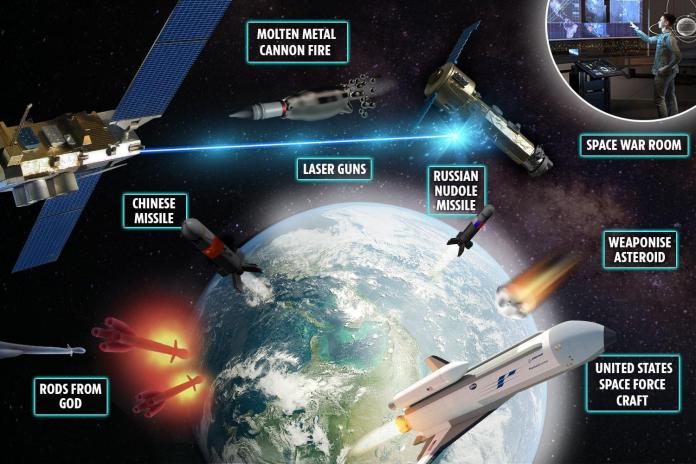
Senior officials from the UK Space Agency held over 130 meetings with the Ministry of Defence in 2024, prompting renewed concerns about the “weaponisation” of space.
The meetings discussed the spaceport being built at SaxaVord on Shetland, using nuclear reactors in space and collaboration with the US, NATO and arms companies. Two members of the agency’s advisory board also work for the Ministry of Defence (MoD).
The subject of one meeting was kept secret because it was about a project that was “highly confidential and not in the public domain”. Releasing its title risked “compromising our nation’s security”, said the agency.
The meetings, revealed in response to a freedom of information request, have been criticised by campaigners. Though Scotland’s bid to build spaceports is marketed as scientific research, it is driven by the defence industry, they say.
They warn that space could become a “new frontier of conflict” that would put humanity at risk. They fear that spaceports could be “a trojan horse for the arms industry” and demand transparency……………………………………………….
………………………………………………………………………………………………. Naming space project would ‘compromise national security’
The name of one company involved in a meeting was kept secret to protect its “commercial interests”. The title of another meeting was redacted “for the purposes of safeguarding national security”, the Space Agency said.
It added: “This meeting title references an area of work which is highly confidential and not in the public domain. Releasing this information into the public domain would undermine our position with defence colleagues and any damage to these relationships with our partner departments could compromise our nation’s security.”
The freedom of information request was made by the campaign group, Space Watch UK. “Although the space industry presents itself as being about science, discovery, and inspiration, the reality is that much of the work in the sector is military related,” said the group’s Peter Burt.
“The information released by the Space Agency shows that it works hand-in-hand with the MoD over virtually the whole remit of the agency’s work – launch programmes, satellite communication, earth observation, and international co-operation.”
Burt pointed out that space technologies were born out of weaponry developed by the Nazis in World War Two. “Nowadays these technologies are still being developed, not for the collective benefit of humankind, but largely for their military applications,” he told The Ferret.
“When space programmes become indistinguishable from military agendas we accelerate a new frontier of conflict. Space should be a realm of shared scientific endeavour, not a battleground for geopolitical dominance.”
He added: “Military space projects divert resources from humanitarian needs and normalise the weaponisation of the cosmos – increasing the risks we all face from warfare. We need to see more transparency from the UK Space Agency about co-operation with the MoD.” https://theferret.scot/space-agency-130-meetings-mod/
Regulators get targets to cut red tape and boost the economy
Ministers will make Britain’s 16 biggest regulators undergo twice-yearly performance reviews as part of a strategy to speed up big infrastructure projects.
Rachel Reeves will meet UK regulators on Monday after calling for more
action to restrict red tape and spur economic growth. The chancellor argued
that government plans would reduce costly delays and disputes, saving
businesses billions, and said regulators must accept a more streamlined
decision-making process. Reeves is expected to use the meeting to announce
more detail on how the government will cut the cost of regulation by a
quarter and set out plans to slim down or abolish regulators themselves.
High on the chancellor’s target list are the costly hold-ups to major
infrastructure projects when environmental concerns are raised.
Guardian 17th March 2025, https://www.theguardian.com/business/2025/mar/17/reeves-to-outline-plan-to-cut-regulation-costs-and-boost-growth
Nuclear and related news – not just industry handouts.

Some bits of good news –New Zealand launches largest-ever island rewilding to rescue 300+ species. Naturally Native-Water Vole Restoration. Merely Watching Scenes of Nature Can Reduce Pain, Says New StudyTOP STORIES
.
Towards a Eurobomb: The Costs of Nuclear Sovereignty. Europe’s ‘nuclear umbrella’ risks catastrophic escalation.
14 years since Fukushima nuclear disaster: Greenpeace Japan statement.
Nuclear power’s global stagnation.
Poisoning the well – The toxic legacy of Cold War uranium mining in western New Mexico.
The forever wars may be over, but Trump is no peacemaker.
Climate. ‘Global weirding’: climate whiplash hitting world’s biggest cities, study reveals.
AUSTRALIA.
- Australia’s Trump cards.
- Greens leader Adam Bandt says Australia should walk away from AUKUS in wake of Trump’s tariffs.
- Coalition’s nuclear plan most expensive option for Australia, former US climate official says.
- “Nothing but broken promises”: ICAN Ambassador, Karina Lester calls out Australia’s inaction on the Treaty for the Prohibition of Nuclear Weapons.
- More Australian nuclear news at https://antinuclear.net/2025/03/11/australian-nuclear-news-10-17-march/
NUCLEAR ITEMS.
| ATROCITIES. Chris Hedges: On the Precipice of Darkness – Normalizing genocide and the new world order. |
| ECONOMICS. US makes fresh push for World Bank to back nuclear power. |
| EDUCATION. The nuclear industry continues to infiltrate education. |
| ENVIRONMENT. Some Small Nuclear Reactors could bypass environmental review step under Arizona bill.EDF unveils fresh details on new fish deterrent technology to be used at Hinkley Point C. EDF’s salt marsh plans pause met with ‘great relief’ on either side of the Severn. |
| ETHICS and RELIGION. Why is an ‘ethical’ investor funding arms companies? |
| HEALTH. They had a fairytale American childhood – but was radiation slowly killing them?Families sickened by radiation exposure want Congress to revive this key compensation – program https://www.youtube.com/watch?v=0icfLF6AVEQ |
| INDIGENOUS ISSUES. Uranium fever collides with industry’s dark past in Navajo country. |
| LEGAL.14 years on: Justice at Fukushima remains denied. Court upholds two legal challenges to the Chalk River Radioactive Megadump. |
| OPPOSITION to NUCLEAR . Rainbow Warrior arrives in Marshall Islands to call for nuclear and climate justice on 40th anniversary of Rongelap evacuation.Councillors oppose nuclear dump site near Louth. |
| PERSONAL STORIES. Life as a “displaced person” |
| POLITICS.High stakes as Iran nuclear issue reaches crunch moment. Great British Nuclear explains how it will mitigate risks to SMR programme – ALSO AT https://nuclear-news.net/2025/03/15/1-b1-great-british-nuclear-explains-how-it-will-mitigate-risks-to-smr-programme/Canada Unveils $490-Million Push Towards Nuclear Energy.Anas Sarwar U-turns on Scottish Labour nuclear weapons policy.Alarmed by Trump, South Korea mulls Japan-style nuclear option. |
| POLITICS INTERNATIONAL and DIPLOMACY. ‘Ukraine will not recognize any territory occupied by Russia’: Zelensky. NATO-Russia Ukrainian War Ceasefire: To Be Or Not To Be? Putin Signals He’s Open to Ceasefire as Witkoff Arrives for Talks.Dialogue only viable option to solve Iranian nuclear issue.China, Russia back Iran as Trump presses Tehran for nuclear talks.Russia, China discuss Tehran’s nuclear programme at Beijing meeting. |
SAFETY. ‘Nervous and rushed’: Massive Fukushima plant cleanup work involves high radiation and stress.
What if a Fukushima-sized nuclear accident happened in Australia? –https://www.youtube.com/watch?v=FrScaM8ChXk US report discusses possibility of nuclear submarine accident, if subs supplied to Australia.
State Police to Hold Major Radiological Incident Exercise with International, Federal, State and Local Partners.
Incident: Human error leads to water spill at Finnish EPR
| SPACE. EXPLORATION, WEAPONS. Risk of Radiation Carcinogenesis. |
| SPINBUSTER. Let’s hear it for the ‘blockers’ – support common sense, not nonsense! Continued Propaganda About AI and Nuclear Power. |
| TECHNOLOGY. Delusional, ruinous and obsolete -the ITER nuclear fusion project.Elon Musk Announces ‘Massive Cyberattack’ Causing X Outage.Book Review: How Our Digital Infatuation Undermines Discourse.The Volunteer “Data Hoarders” Resisting Trump’s Purge. |
| URANIUM. Fukushima Remembered At URENCO’s Uranium Enrichment Plant Today in Cheshire. |
| WASTES. Governor urges contaminated soil be disposed of outside Fukushima by 2045. |
| WAR and CONFLICT. WSJ’s Chief Foreign Correspondent Declares It’s Over For Ukraine In Kursk. Chris Hedges: Trump’s Christian Fascists and the War on Palestine. |
WEAPONS and WEAPONS SALES.
- Labour’s arms exports to Israel exposed Labour allowed dozens of arms exports to Israel after weapons sanctions.
- How multi-billion nuclear weapons facility aims to overcome challenge of limited supply chain.
- Royal Navy: Powerful new nuclear submarines being built costing £41bn – when will they enter the fleet?
- Qatar calls for Israel’s nuclear facilities to be under IAEA supervision.
- The nuclear testing revival: Global fallout with deadly consequences. How many nuclear weapons does the United States have in 2025? – https://www.youtube.com/watch?v=3vsNKk9vkIE.
- We’re #1 in Selling Weapons!
- Europe going nuclear would be a catastrophic mistake. Could Poland and Germany acquire nuclear bombs?- ALSO AT https://nuclear-news.net/2025/03/15/1-b1-could-poland-and-germany-acquire-nuclear-bombs/ Poland’s president urges U.S. to move nuclear warheads to Polish territory. The Script of Anxiety: Poland’s Nuclear Weapons Fascination.
- FT reports. Movements across the world call for an end to all US military exercises on the Korean peninsula.
- Chinese nuclear weapons, 2025.
- An Unreliable America Means More Countries Want the Bomb.
- Canada to review the purchase of US-made F-35 fighter jets in light of Trump’s trade war.
Chris Hedges: On the Precipice of Darkness – Normalizing genocide and the new world order.
SCHEERPOST, By Chris Hedges / The Chris Hedges Report, March 16, 2025
This was a talk I gave at the Sanctuary for Independent Media.
Text of the talk:
My old office in Gaza is a pile of rubble. The streets around it, where I went for a coffee, ordered maftool or manakish, had a haircut, are flattened. Friends and colleagues are dead, or more often have vanished, last heard from weeks or months ago, no doubt buried somewhere under the broken slabs of concrete. The uncounted dead. In the tens perhaps hundreds of thousands.
Gaza is a wasteland of 50 million tons of rubble and debris. Rats and dogs scavenge amid the ruins and fetid pools of raw sewage. The putrid stench and contamination of decaying corpses rises from beneath the mountains of shattered concrete. There is no clean water. Little food. A severe shortage of medical services and hardly any habitable shelters. Palestinians risk death from unexploded ordnance, left behind after over 15 months of air strikes, artillery barrages, missile strikes and blasts from tank shells, and a variety of toxic substances, including pools of raw sewage and asbestos.
Hepatitis A, caused by drinking contaminated water, is rampant, as are respiratory ailments, scabies, malnutrition, starvation and the widespread nausea and vomiting caused by eating rancid food. The vulnerable, including infants and the elderly, along with the sick, face a death sentence. Some 1.9 million people have been displaced, amounting to 90 percent of the population. …………………………………………
Israel’s banning of the United Nations Relief and Works Agency for Palestine Refugees in the Near East — which estimates that clearing Gaza of the rubble left behind will take 15 years — and blockage of aid trucks into Gaza ensures that Palestinians in Gaza will never have access to basic humanitarian supplies, adequate food and services.
The United Nations Development Program estimates that it will cost between $40 billion and $50 billion to rebuild Gaza and will take, if the funds are made available, until 2040. It would be the largest post-war reconstruction effort since the end of World War Two.
Israel, supplied with billions of dollars of weapons from the U.S. Germany, Italy and the U.K., created this hell. It intends to maintain it. Gaza is to remain under siege. Gaza’s infrastructure will not be restored. Its basic services, including water treatment plants, electricity and sewer lines, will not be repaired. Its destroyed roads, bridges and farms will not be rebuilt. Desperate Palestinians will be forced to choose between living like cave dwellers, camped out amid jagged chunks of concrete, dying in droves from disease, famine, bombs and bullets, or permanent exile. These are the only options Israel offers…………………………………………………………………………………………………………………..
Washington and its allies in Europe do nothing to halt the live-streamed genocide. They will do nothing to halt the wasting away of Palestinians in Gaza from hunger, disease and bombs and their eventual depopulation. They are partners in this genocide. They will remain partners until the genocide reaches its grim conclusion.
But the genocide in Gaza is only the start. The world is breaking down under the onslaught of the climate crisis, which is triggering mass migrations, failed states and catastrophic wildfires, hurricanes, storms, flooding and droughts. As global stability unravels, industrial violence, which is decimating the Palestinians, will become ubiquitous. These assaults will be committed, as they are in Gaza, in the name of progress, Western civilization and our supposed “virtues” to crush the aspirations of those, mostly poor people of color, who have been dehumanized and dismissed as human animals.
Israel’s annihilation of Gaza marks the death of a global order guided by internationally agreed upon laws and rules, one often violated by the U.S. in its imperial wars in Vietnam, Iraq and Afghanistan, but one that was at least acknowledged as a utopian vision. The U.S. and its Western allies not only supply the weaponry to sustain the genocide, but obstruct the demand by most nations for an adherence to humanitarian law.
The message this sends is clear: We have everything. If you try and take it away from us we will kill you.
The militarized drones, helicopter gunships, walls and barriers, checkpoints, coils of concertina wire, watch towers, detention centers, deportations, brutality and torture, denial of entry visas, apartheid existence that comes with being undocumented, loss of individual rights and electronic surveillance are as familiar to the desperate migrants along the Mexican border or attempting to enter Europe as they are to the Palestinians.
Israel, which as Ronen Bergman notes his book “Rise and Kill First” in has “assassinated more people than any other country in the Western world,” employs the Nazi Holocaust to sanctify its hereditary victimhood and justify its settler-colonial state, apartheid, campaigns of mass slaughter and Zionist version of Lebensraum.
Primo Levi, who survived Auschwitz, saw the Shoah, for this reason, as “an inexhaustible source of evil” which “is perpetrated as hatred in the survivors, and springs up in a thousand ways, against the very will of all, as a thirst for revenge, as moral breakdown, as negation, as weariness, as resignation.”
Genocide and mass extermination are not the exclusive domain of fascist Germany. Adolf Hitler, as Aimé Césaire writes in “Discourse on Colonialism,” appeared exceptionally cruel only because he presided over “the humiliation of the white man.” But the Nazis, he writes, had simply applied “colonialist procedures which until then had been reserved exclusively for the Arabs of Algeria, the coolies of India, and the blacks of Africa.”……………………………………………………………………………………………………………………………………………………
The idea that America is a defender of democracy, liberty and human rights would come as a huge surprise to those Frantz Fanon called “the wretched of the earth” who saw their democratically elected governments subverted and overthrown by the United States in Panama (1941), Syria (1949), Iran (1953), Guatemala (1954), Congo (1960), Brazil (1964), Chile (1973), Honduras (2009) and Egypt (2013). And this list does not include a host of other governments that, however despotic, as was the case in South Vietnam, Indonesia or Iraq, were viewed as inimical to American interests and destroyed, in each case inflicting death and immiseration on millions.
Empire is the external expression of white supremacy.
But antisemitism alone did not lead to the Shoah. It needed the innate genocidal potential of the modern bureaucratic state……………………………………………………
………………………………………………………………..Israel embodies the ethnonationalist state the far-right in the U.S. and Europe dreams of creating for themselves, one that rejects political and cultural pluralism, as well as legal, diplomatic and ethical norms. Israel is admired by these proto-fascists, including Christian nationalists, because it has turned its back on humanitarian law to use indiscriminate lethal force to “cleanse” its society of those condemned as human contaminants. Israel is not an outlier, but expresses our darkest impulses, ones being turbo-charged by the Trump administration.
I covered the birth of Jewish fascism in Israel. ………………………………………………………………………………….
Netanyahu, who first became prime minister in 1996, has spent his political career nurturing Jewish extremists including Avigdor Lieberman, Gideon Sa’ar, Naftali Bennett, and Ayelet Shaked. His father, Benzion — who worked as an assistant to the Zionist pioneer Vladimir Jabotinsky, who Benito Mussolini referred to as “a good fascist” — was a leader in the Herut Party that called on the Jewish state to seize all the land of historic Palestine. Many of those who formed the Herut Party carried out terrorist attacks during the 1948 war that established the state of Israel. Albert Einstein, Hannah Arendt, Sidney Hook and other Jewish intellectuals, described the Herut Party in a statement published in The New York Times as a “political party closely akin in its organization, methods, political philosophy and social appeal to Nazi and Fascist parties.”,…………………………………………………………………………………………
The decision to obliterate Gaza has long been the dream of far right Zionists, heirs of Kahane’s movement. Jewish identity and Jewish nationalism are the Zionist versions of the Nazi’s blood and soil. Jewish supremacy is sanctified by God, as is the slaughter of the Palestinians, who Netanyahu compared to the Biblical Amalekites, massacred by the Israelites. Euro-American settlers in the American colonies used the same Biblical passage to justify the genocide against Native Americans. Enemies — usually Muslims — slated for extinction are subhuman who embody evil. Violence and the threat of violence are the only forms of communication those outside the magical circle of Jewish nationalism understand. Those outside this magic circle, including Israeli citizens, are to be purged.
Messianic redemption will take place once the Palestinians are expelled. …………………………………
There are over 65 laws which discriminate directly or indirectly against Palestinian citizens of Israel and those living in the occupied territories. The campaign of indiscriminate killing of Palestinians in the West Bank, many by rogue Jewish militias who have been armed with 10,000 automatic weapons, along with house and school demolitions and the seizure of remaining Palestinian land is exploding.
Israel, at the same time, is turning on “Jewish traitors” who refuse to embrace the demented vision of the ruling Jewish fascists and who denounce the horrific violence of the state. ………………………………………………………………………………….
Israel and its western allies, James Baldwin saw, is headed towards the “terrible probability” that the dominant nations “struggling to hold on to what they have stolen from their captives, and unable to look into their mirror, will precipitate a chaos throughout the world which, if it does not bring life on this planet to an end, will bring about a racial war such as the world has never seen.”
………………………………………………………………………………………………………………………………………………………I know how killers talk. The black humor. “Pint sized terrorists” they say of Palestinian children. They are proud of their skills. It gives them cachet. They cradle their weapon as if it is an extension of their body. They admire its despicable beauty. This is who they are. Their identities. Killers.
In the hypermasculine culture of Israel and our own emergent fascism killers, lauded as exemplars of patriotism, are respected, rewarded, promoted. They are numb to the suffering they inflict. Maybe they enjoy it. Maybe they think they are protecting themselves, their identity, their comrades, their nation. Maybe they believe the killing is a necessary evil, a way to make sure Palestinians die before they can strike. Maybe they have surrendered their morality to the blind obedience of the military, subsumed themselves into the industrial machinery of death. Maybe they are scared to die. Maybe they want to prove to themselves and others that they are tough, they can kill. Maybe their mind is so warped that they believe killing is righteous.
They, like all killers, are intoxicated by the god-like power to revoke another person’s charter to live on this earth. ……………………………………………………………………………………………………………………………
……………Of course, they do not talk about what they did to those around them, certainly not to their families. They are feted as heroes. But they know, even if they do not say it, that this is a lie.
…………………………………………………………………………………………………………………………..Shooting unarmed people is not bravery. It is not courage. It is not even war. It is a crime. It is murder. And Israel runs an open-air shooting gallery in Gaza and the West Bank as we did in Iraq and Afghanistan. Total impunity. Murder as sport…………………………………….
………………………………………………..We must see through the empty jingoism of those who use the abstract words of glory, honor, and patriotism to mask the cries of the wounded, the senseless killing, war profiteering, and chest-pounding grief.
…………………………………………..We must find the courage to name our darkness and repent. This willful blindness and historical amnesia, this refusal to be accountable to the rule of law, this belief that we have a right to use industrial violence to exert our will marks, I fear, the start, not the end, of campaigns of mass slaughter by the Global North against the world’s growing legions of the poor and the vulnerable. It is the curse of Cain. And it is curse we must remove before the genocide in Gaza becomes not an anomaly but the norm. https://scheerpost.com/2025/03/16/chris-hedges-on-the-precipice-of-darkness/
Europe’s ‘nuclear umbrella’ risks catastrophic escalation

political leaders need to get a grip on reality. Bankrupting Britain and Europe in some desperate attempt to replace the US’s $800 billion military spending in Nato will destroy our societies and worsen all these global crises.
Morning Star 15th March 2025,
https://morningstaronline.co.uk/article/europes-nuclear-umbrella-risks-catastrophic-escalation
As Macron and Merz propose French nuclear-armed jets be stationed in Poland and Germany, the dangerous implications for peace and the possibility of nuclear confrontation grow, warns SOPHIE BOLT
AS Trump brutally hammers out a settlement for Ukraine and Russia, he’s also been hammering Europe for vast, cold-war levels of military spending. And European leaders seem very keen to oblige.
Along with Keir Starmer’s so-called peace plan for a 30,000-strong European army, France’s Emmanuel Macron and Germany’s chancellor-in-waiting Friedrich Merz are pushing for a European “nuclear umbrella” — where France could deploy its nuclear-capable jets outside its borders. Merz also wants Britain to step up and deploy its British nuclear submarines to “defend” Europe against Russian aggression.
So what does this “nuclear umbrella” really mean in practice — and what are the risks?
Currently, France has 290 warheads that can be launched by nuclear-capable fighter jets and nuclear-powered submarines. While France’s nuclear weapons doctrine states the weapons are to “defend” its “vital interests,” in 2020, Macron announced that France’s “vital interests now have a European dimension.”
However, he also stated in 2022 that France’s vital interests “would not be at stake if there was a nuclear ballistic attack in Ukraine or in the region.” So, Macron would have to radically shift French nuclear doctrine if the “defence” of Ukraine was to be incorporated. It would mean France being prepared to launch a nuclear strike on Russia, a country that currently possesses over 5,000 nuclear weapons.
Speculation about how this nuclear umbrella would work includes the possibility of nuclear-armed jets being stationed in Germany or Poland (both countries have expressed interest).
Stationing nuclear weapons in countries that don’t have them — known as nuclear sharing — is in violation of the Nuclear Non-Proliferation Treaty. If a nuclear-sharing agreement was secured between France and Poland, nuclear-armed jets could be deployed along Poland’s 130-mile border with Russia.
If a future ceasefire arrangement was breached, could French nuclear jets deployed in Germany and Poland be used against Russia?
Another suggestion is that these French bombers could patrol European borders. Would such borders also include Ukraine’s? In the event of a ceasefire breach, would nuclear-armed French bombers also be deployed in Ukraine?
While Macron’s “nuclear umbrella” idea is getting widespread coverage, these terrifying scenarios — and the human cost of such confrontations — are not.
Behind these wild proposals is the speculation that the US under Trump will withdraw its military and nuclear presence in Europe — and turn off the nuclear tap for its “critical” partner, Britain.
In Britain, figures like former defence secretary Malcolm Rifkind are arguing that Britain has to work more closely with France in case “US reliability ever came into question” in “defending Europe against Russian aggression.”
It has also prompted more challenges to Britain’s so-called special relationship with the US. And shone a welcome spotlight on Britain’s nuclear dependence, with widespread reporting that the ballistic missiles launched from Britain’s nuclear submarines are leased from the US, and that the warheads are a US design.
In fact, the whole nuclear weapons system is under US-led Nato command. So, if Britain wanted its nuclear-armed submarines to be part of a European nuclear umbrella, it would effectively have to get permission from US President Donald Trump.
In response, military analysts like Marion Messmer argue that to end its nuclear dependence on the US, Britain should build an entirely new, air-launching nuclear weapons system. Paid for, no doubt, by British and French taxpayers.
This would be on top of the £205 billion the British government is already wasting on the system’s replacement. A programme the government’s own watchdog has labelled as “unachievable” and unaffordable.
Prime Minister Keir Starmer is silent on the European nuclear umbrella. Having positioned himself against Trump, as champion of Ukraine’s Nato membership, he shifted rapidly to parroting Trump’s “peace through strength” rhetoric.
He now argues that his “peace plan” should be made “in conjunction with the US” because “it’s that ability to work with the US and our European partners that has kept the peace for 80 years now.”
Such an alliance has, of course, totally failed to keep peace, and instead has driven war and poverty globally, causing humanitarian catastrophe, economic crises and environmental devastation.
Instead, political leaders need to get a grip on reality. Bankrupting Britain and Europe in some desperate attempt to replace the US’s $800 billion military spending in Nato will destroy our societies and worsen all these global crises.
Sustainable peace for Europe, Ukraine and Russia cannot be achieved by troops and missiles, backed by the constant, looming threat of nuclear war. That means developing a sustainable security architecture that can ensure long-term peace and prosperity for the entire region.
It means withdrawing US nukes from Europe and Russian ones from Belarus. And it means the US, Russia, Britain and France developing programmes to get rid of their own nuclear weapons. As Trump has said he wants nuclear disarmament, Starmer should be working with him to do so.
Sophie Bolt is general secretary of the Campaign for Nuclear Disarmament.
27-year-old chemist discovers a process for recycling rare earths.

Gordon Edwards, 17 Mar 25 – The article copied below, translated by Google Translate, adds an optimistic note to the rise of renewables as the most affordable choice for rapidly reducing greenhouse gas emissions.
Toxic materials are often used in the construction and operation of industrial infrastructure of many kinds. This includes renewable energy equipment such as wind, solar, geothermal and other renewables.
The so-called “rare earths” (also named “lanthanides”) are a group of 17 metals in the
periodic table that have unusual properties that are ideal for use in electronic and electricity generating devices. Mining these metals is very dangerous for the workers and the environment. The metals themselves have a high chemical toxicity. But they are needed for renewable energy systems as well as many other electronic applications.
Note, however, that wind and solar do not create toxic waste. They simply make use of these naturally-occurring toxic materials that can, in principe, be recycled and used again and again. Recycling and reusing such toxic materials ought to be an essential built-in requirement of renewable energy systems.
Nuclear power, on the other hand, literally creates hundreds of highly toxic new elements that cannot be recycled or re-used for civilian purposes simply because they are too radioactive – meaning their atoms are unstable and will spontaneously disintegrate, giving off biologically damaging atomic radiation. A radioactive variety (“isotope”) of any given element is always much more toxic than the non-radioactive variety of the same element.
Even the finest stainless steal and zirconium-alloy structures used in the core of a nuclear reactor will have to be kept out of the environemnt of living things for thousands of years as radioactive waste. These originally non-radioactive metals have become intensely radioactuve.
Such is not the case with materials used in wind and solar. No new toxic materials are created, and those toxics that are used can be recycled and reused many times.
Ironically, one of the reasons why rare earths are so dangerous to mine is because of the inevitable presence of radioactive elements – uranium, thorium and their decay products – leading to excessive exposure to radon gas and radioactive dust that can be very harmful over the long term. It turns out that rare earths have a strong geochemical affinity with uranium and thorium, the two principle primordial radionuclides on Earth.
P.S.
One of the reasons why Donald Trump wants to acquire Greenland is because there is a mountain of rare earth ores near the Inuit community of Narsaq. Thanks to Nancy Covington and the International Physicians for the Prevention of Nuclear War, Canada (IPPNWC) (then called Physicians for Global Survival) I was sent to Narsaq in 2016 to explain the radioactive dangers of mining that mountain, called Kvanefjeld in Danish or Kuannersuit in Greenlandic (the native Inuit language).
ETH Chemist Discovers Process for Recycling Rare Earths
The mining of rare earths is environmentally harmful and controlled by China. Chemist Marie Perrin (27) has developed a method that could solve both problems.
“Why is the sky blue? How do clouds form?” Marie Perrin asked herself as a child. “Even then, I was very curious,” she recalls. Her curiosity not only ensured that the daughter of two scientists understood the world around her better with each passing year. It could also soon be a reason why this world is changing. The now 27-year-old and her team at ETH Zurich have developed a method for recycling rare earths.
Important Resource for the Energy Transition
Rare earths are 17 metals that are used in all modern devices: in batteries, smartphones and computers, in wind turbines and electric cars. “They’re all around us,” says Perrin, “but only one percent of all rare earths are recycled.” Recycling is important because the energy transition is requiring ever more rare earths. Their extraction is not only expensive but also highly harmful to the environment and often releases radioactivity.
There’s also a geopolitical problem looming over them: Around 70 percent of rare earths are mined in China. What this could mean for the rest of the world became clear in 2010, when a conflict arose between China and Japan. China informally stopped exports of rare earths to Japan. Prices rose by over 1,000 percent, and supply shortages arose around the world. “If you compare it to oil, the largest exporting countries have a market share of 30 to 40 percent,” explains Marie Perrin.
Lightbulbs made from ETH waste
“We were lucky to have discovered this method,” recalls Perrin. Originally, her research had nothing to do with the recycling of rare earths. But she discovered that the molecules she was studying had the potential to do just that. The chemist devoted herself to her research: “I fished old energy-saving light bulbs out of the ETH recycling bins and experimented with them in the lab,” says Perrin. Until she succeeded in separating the rare earth europium from the light bulb.
Perrin compares the process to baking pizza: Imagine mixing a pinch of salt into pizza dough. How can you recover the salt that has now dispersed throughout the dough? You need something that can distinguish and separate the elements in the dough from those in the salt.
In Marie Perrin’s case, this ingredient is called tetrathiometalate. “Using the known methods, this process had to be repeated several times,” explains Perrin. “This requires an enormous amount of resources.” With Perrin’s process, the rare earth europium can be separated from the other elements in a light bulb in a high degree of purity in a single step.
Initiative Required
Perrin’s research team published their results in the journal Nature Communications, filed a patent, and was faced with the question: What next? “Either you sell the license to larger chemical companies or you develop the technology further in-house,” explains Perrin. “It was clear to me that I wanted to do it myself.” The risk of the process gathering dust in a drawer at a large company was too great for her – as was her curiosity to find out where the technology could lead her.
Together with an old school friend and her doctoral supervisor, Marie Perrin founded the startup REEcover. The goal: to make the process scalable with light bulbs in a first step. In a second step, it will be expanded to include other of the 16 remaining rare earths. “I’m a researcher and had no entrepreneurial experience,” says the Frenchwoman. But her curiosity drives her forward here too: “There’s something new every day, which is fun.
“A Promising Future“
Our timing is good,” Perrin is aware. The European Union passed a law on critical raw materials in 2024. One of the goals of the law is to reduce dependence on rare earths from China. This is another reason why REEcover is considered one of the most promising startups at ETH.
The Script of Anxiety: Poland’s Nuclear Weapons Fascination
we can only assume that the desire to have massively lethal weapons on one’s own soil that would risk obliterating life, limb and everything else is but a sporting parlour game of misplaced assumptions.
March 17, 2025 Dr Binoy Kampmark , https://theaimn.net/the-script-of-anxiety-polands-nuclear-weapons-fascination/
With the Ukraine War and the retreat of the United States from what has routinely been called Europe’s security architecture, states are galloping to whatever point of presumed sanctuary is on offer. The general presumption is that the galloping is done in the same step and rhythm. But Europe, for all the heavy layers of union driven diplomacy, retains its salty differences.
Poland is particularly striking in this regard, having always positioned itself as a defender against the continent’s enemies, perceived or otherwise. This messianic purpose was well on show with the exploits of King John III Sobieski in his triumphant defence of Vienna against the Ottoman Empire in 1683. The seemingly endless wars against Russia, including the massacres and repressions, have also left their wounding marks on a fragile national psyche. These marks continue to script the approach of Warsaw’s anxiety to its traditional enemy, one that has become fixated with a nuclear option, in addition to a massive buildup of its armed forces and a defence budget that has reached 4.7% of its national income. While there is some disagreement among government officials on whether Poland should pursue its own arsenal, a general mood towards stationing the nuclear weapons of allies has taken hold. (As a matter of interest, a February 21 poll for Onet found that 52.9 percent of Poles favoured having nuclear weapons, with 27.9 percent opposed.)
This would mirror, albeit from the opposite side, the Cold War history of Poland, when its army was equipped with Soviet nuclear-capable 8K11 and 3R10 missiles. With sweet irony, those weapons were intended to be used against NATO member states.
The flirtatious offer of French President Emmanual Macron to potentially extend his country’s nuclear arsenal as an umbrella of reassurance to other European states did make an impression on Poland’s leadership. Prudence might have dictated a more reticent approach, but Prime Minister Donald Tusk would have none of that before the Polish parliament. In his words, “We must be aware that Poland must reach for the most modern capabilities also related to nuclear weapons and modern unconventional weapons.” According to the PM, “this is a race for security, not for war.”
The Polish President, Andrzej Duda, is also warm to the US option (he has been, over his time in office, profoundly pro-American), despite Tusk’s concerns about a “profound change in American geopolitics.” He was already ruminating over the idea in 2022 when he made the proposal to the Biden administration to host US nuclear weapons, one that was also repeated in June 2023 by then-Prime Minister Mateusz Morawiecki. To have such weapons in Poland was a necessary “defensive tactic […] to Russia’s behaviour, relocating nuclear weapons to the NATO area,” he explained to the BBC. “Poland is ready to host this nuclear weapon.”
Duda then goes on to restate a familiar theme. Were US nuclear weapons stored on Polish soil, Washington would have little choice but to defend such territory against any threat. “Every kind of strategic infrastructure, American and NATO infrastructure, which we have on our soil is strengthening the inclination of the US and the North Atlantic Alliance to defend this territory.” To the Financial Times, Duda further reasoned that, as NATO’s borders had moved east in 1999, “so twenty-six years later there should also be a shift of the NATO infrastructure east.”
Much of this seems like theatrical, puffy nonsense, given Poland’s membership of the NATO alliance, which has, as its central point, Article 5. Whether it involves its protection by a fellow NATO ally using conventional or nuclear weapons, hosting such nuclear weapons is negated as a value. Poland would receive collective military aid in any case should it be attacked. But, as Jon Wolfsthal of the Federation of American Scientists reasons, an innate concern of being abandoned in the face of aggression continues to cause jitters. Tusk’s remarks were possibly “a signal of concern – maybe to motivate the United States, but clearly designed to play on the French and perhaps the British.”
The crippling paranoia of the current government in the face of any perceived Russian threat becomes even less justifiable given the presence of US troops on its soil. According to the government’s own information, a total of 10,000 troops are present on a rotational basis, with US Land Forces V Corps Forward Command based in Poznań. In February, Duda confirmed to reporters after meeting the US envoy to Ukraine Gen. Keith Kellogg that there were “no concerns that the US would reduce the level of its presence in our country, that the US would in any way withdraw from its responsibility or co-responsibility for the security of this part of Europe.”
Duda goes further, offering a sycophantic flourish. “I will say in my personal opinion,America has entered the game very strongly when it comes to ending the war in Ukraine. I know President Donald Trump, I know that he is an extremely decisive man and when he acts, he acts in a very determined and usually effective way.” With those remarks, we can only assume that the desire to have massively lethal weapons on one’s own soil that would risk obliterating life, limb and everything else is but a sporting parlour game of misplaced assumptions.
Most Scots disagree with Anas Sarwar about building new nuclear plants
The National 16th March 2025 https://www.thenational.scot/politics/25012201.scots-disagree-anas-sarwar-building-new-nuclear-plants/
DOESN’T the government wanting to build new nuclear plants in Scotland (Sunday National, Mar 16) betray why the UK subjugates Scotland as a vassal state to dump the nuclear garbage it doesn’t want polluting England onto we Scots? Like their dangerous weapons of mass destruction that Westminster doesn’t want located adjacent to the cossetted wealthy south-east; let’s just dump it on the Scots.
NO! NO! NO!
Not only don’t we want nuclear plants here in Scotland, we want England to bear the burden and risk of the obscenity that is nuclear weapons.
Anas Sarwar says it’s not the archaic planning rules that restrict development of nuclear plants, but the “intransigence of the ideologically rigid Scottish Government”. Sarwar fails to understand that this policy of the Scottish Government is widely supported by Scots; it is he who is out of step promoting a polluting, dangerous technology that is so 20th century. Here in the 21st century we’re already well served by hydro, wind and solar power with huge potential for further development. And there are hydrogen and tidal technologies among others to be developed, to build the broad mix of green energy without any need for nuclear power.
Isn’t Scottish Labour MPs changing their minds to accord with Starmer and Milliband’s diktat a clear case of them placing their own personal political careers before the wishes of the people they are supposed to represent and take instruction from? How is this democracy?
Who is surprised about anything emanating from this group of shape-shifting Labour MPs who lied to voters to get elected? Scots voted for them in desperation to rid us of the worst Tory government in history, sick fed up of being continually hammered by draconian policies that created financial hardship for those least well-off. Their reward for placing trust in Labour was to get a government that simply picked up the Tories’ baton of austerity hardship and is intent to press on and finish the race to bottom for ordinary folks, pensioners, those on fixed income and benefits, while ensuring that the wealthy who should and can afford to make a just contribution are left unscathed.
This desire of Starmer and his henchmen to dump nuclear plants on Scotland should prove to Scots that Westminster will never willingly allow us to secede from this iniquitous union that values Scotland only as a cash cow, somewhere to dump the dangerous stuff they don’t want in their back yard. If we want to live in a just land, won’t we have to prise ourselves from this UK union? We will have to take back our independence despite Westminster.
At the General Election, Scots voted in a poor electoral system for Labour. We received more tory; this time red-tory Labour.
If we are to benefit from real change, the Scottish Parliament elections in 2026 have got to be used as a concerted effort, with all pro-indy interests working together to demonstrate we’ve had enough of more than 300 years of failure and use the strength of feeling for indy to justify us taking back our independence.
One issue: independence. We vote SNP 1 with no SNP candidates on the list. Other indy-supporting parties under an umbrella group created for the election on the list, position by agreement, to achieve the supermajority that makes the case for indy irresistible.
They had a fairytale American childhood – but was radiation slowly killing them?

Decades later, federal investigators acknowledged an increased cancer risk for some people who played in the creek as children,
Sophie Williams, BBC News, Washington DC, 16 Mar 25
After Kim Visintine put her son to bed every night at a hospital in St Louis, Missouri, she spent her evening in the hospital’s library. She was determined to know how her boy had become seriously ill with a rare brain tumour at just a week old.
“Doctors were shocked,” she says. “We were told that his illness was one in a million. Other parents were learning to change diapers but I was learning how to change chemotherapy ports and IVs.”
Kim’s son Zack was diagnosed with a glioblastoma multiforme. It is a brain tumour that is very rare in children and is usually seen in adults over 45.
Zack had chemotherapy treatments but doctors said there was no hope of him ever recovering. He died at just six years old.
Years later, social media and community chatter made Kim start to think that her son was not an isolated case. Perhaps he was part of a bigger picture growing in their community surrounding Coldwater Creek.
In this part of the US, cancer fears have prompted locals to accuse officials of not doing enough to support those who may have been exposed to radiation due to the development of the atomic bomb in the 1940s.
A compensation programme that was designed to pay out to some Americans who contracted diseases after exposure to radiation expired last year – before it could be extended to the St Louis area.
This Radiation Exposure Compensation Act (Reca) provided one-time payouts to people who may have developed cancer or other diseases while living in areas where activities such as atomic weapons testing took place. It paid out $2.6bn (£2bn) to more than 41,000 claimants before coming to an end in 2024.
Benefits were paid to such neighbours, frequently called “downwinders”, in Arizona, Utah and Nevada, but not New Mexico, where the world’s first test of a nuclear weapon took place in 1945. Research published in 2020 by the National Cancer Institute suggested that hundreds of cancers in the area would not have occurred without radiation exposure.
St Louis, meanwhile, was where uranium was refined and used to help create the atomic bomb as part of the Manhattan Project. After World War Two ended, the chemical was dumped near the creek and left uncovered, allowing waste to seep into the area.
Decades later, federal investigators acknowledged an increased cancer risk for some people who played in the creek as children, but added in their report: “The predicted increases in the number of cancer cases from exposures are small, and no method exists to link a particular cancer with this exposure.”
The clean-up of the creek is still ongoing and is not expected to finish until 2038.
A new bill has been put forward in the House, and Josh Hawley, a US senator representing Missouri, says he has raised the issue with President Donald Trump.
When Kim flicks through her school yearbook, she can identify those who have become sick and those who have since passed away. The numbers are startling.
“My husband didn’t grow up in this area, and he said to me, ‘Kim, this is not normal. It seems like we’re always talking about one of your friends passing away or going to a funeral’,” she says.
Just streets away from the creek, Karen Nickel grew up spending her days near the water picking berries, or in the nearby park playing baseball. Her brother would often try and catch fish in Coldwater Creek.
“I always tell people that we had just the fairytale childhood that you would expect in what you consider suburban America,” says Karen. “Big backyards, big families, children playing out together until the street lights came on at night.”
But years later, her carefree childhood now looks very different.
“Fifteen people from the street I grew up on have died from rare cancers,” she says. “We have neighbourhoods here where every house has been affected by some cancer or some illness. We have streets where you can’t just find a house where a family has not been affected by this.”
When Karen’s sister was just 11 years old, doctors discovered that her ovaries were covered in cysts. The same had happened to their neighbour when she was just nine. Karen’s six-year-old granddaughter was born with a mass on her right ovary.
Karen helped found Just Moms STL, a group that is dedicated to protecting the community from future exposures that could be linked to cancers – and which advocates for a clean-up of the area.
“We get messages every day from people that are suffering from illnesses and are questioning whether this is from exposure,” she says. “These are very aggressive illnesses that the community is getting, from cancers all the way to autoimmune diseases.”
Teresa Rumfelt grew up just a street away from Karen and lived in her family home from 1979 until 2010. She remembers every one of her animals passing away from cancer and her neighbours getting ill from rare diseases.
Years later, her sister Via Von Banks was diagnosed with amyotrophic lateral sclerosis (ALS), a form of motor neurone disease. Some medical studies have suggested there could be a link between radiation and ALS, but this is not definitive – and more research needs to be done to firm it up.
That does not reassure people like Teresa who are concerned that more needs to be done to understand how locals are being affected.
“ALS took my sister at 50,” Teresa says. “I think it was the worst disease ever of mankind. When she was diagnosed in 2019, she’d just got her career going and her children were growing. She stayed positive through all of it.”
Like Hawley, Just STL Moms and other community members want the government’s compensation act to be expanded to include people within the St Louis area, despite the programme being in limbo after expiring.
Expanding it to the Coldwater Creek community would mean that locals could be offered compensation if they could prove they were harmed as a result of the Manhattan Project, during which the atomic bomb was developed with the help of uranium-processing in St Louis. It would also allow screenings and further study into illnesses other than cancer.
In a statement to the BBC, the US government’s Environmental Protection Agency (EPA) said it took concerns very seriously and had actively worked with federal, state and local partners – as well as community members – to understand their health concerns, and to ensure community members were not exposed to the Manhattan Project-era waste.
The BBC has also contacted the US Army Corps of Engineers, which is leading the clean-up – but has not received a response to a request for comment.
“My sister would have loved to be part of the fight. She’d be the first to picket,” says Teresa of her efforts to get greater support from the government.
The trend in people around Coldwater Creek getting unwell has not gone unnoticed among healthcare professionals.
Dr Gautum Agarwal, a cancer surgeon at Mercy Hospital in St Louis, says he has not noticed a “statistical thing”, but notes that he has seen husbands and wives and their neighbours presenting cancers.
Now, he ensures that his patients are asked where they live and how close they are to Coldwater Creek.
“I tell them that there’s a potential that there’s a link. And if your neighbours or family live near there, we should get them screened more often. And maybe you should get your kids screened earlier.”
He hopes that over time more knowledge will be gained about the issue, and for a study into multi-cancer early detection tests to be introduced that could help catch any potential cancers, and help reassure people in the area……….. https://www.bbc.com/news/articles/c2e7011n03vo
1 This Month
Chernobyl: The Lost Tapes – A good documentary on Chernobyl on SBS available On Demand for the next 3 weeks– https://www.sbs.com.au/ondemand/tv-program/chernobyl-the-lost-tapes/2352741955560

of the week–London Campaign for Nuclear Disarmament

Tell the Ukrainian Government to Drop Prosecution of Peace Activist Yurii Sheliazhenko
To see nuclear-related stories in greater depth and intensity – go to https://nuclearinformation.wordpress.com
-
Archives
- April 2026 (152)
- March 2026 (251)
- February 2026 (268)
- January 2026 (308)
- December 2025 (358)
- November 2025 (359)
- October 2025 (376)
- September 2025 (257)
- August 2025 (319)
- July 2025 (230)
- June 2025 (348)
- May 2025 (261)
-
Categories
- 1
- 1 NUCLEAR ISSUES
- business and costs
- climate change
- culture and arts
- ENERGY
- environment
- health
- history
- indigenous issues
- Legal
- marketing of nuclear
- media
- opposition to nuclear
- PERSONAL STORIES
- politics
- politics international
- Religion and ethics
- safety
- secrets,lies and civil liberties
- spinbuster
- technology
- Uranium
- wastes
- weapons and war
- Women
- 2 WORLD
- ACTION
- AFRICA
- Atrocities
- AUSTRALIA
- Christina's notes
- Christina's themes
- culture and arts
- Events
- Fuk 2022
- Fuk 2023
- Fukushima 2017
- Fukushima 2018
- fukushima 2019
- Fukushima 2020
- Fukushima 2021
- general
- global warming
- Humour (God we need it)
- Nuclear
- RARE EARTHS
- Reference
- resources – print
- Resources -audiovicual
- Weekly Newsletter
- World
- World Nuclear
- YouTube
-
RSS
Entries RSS
Comments RSS
 nuclear-news