NATO-Russia Ukrainian War Ceasefire: To Be Or Not To Be?
RUSSIAN and EURASIAN POLITICS, by Gordonhahn, March 14, 2025
On March 13th Russian President Vladimir Putin stated Moscow is open to a ceasefire leading to peace treaty talks, generally speaking. However, he stressed tghat there are “nuances” that need to be addressed before any ceasefire agreement could be concluded. The ‘nuances’ were really counteroffers made for practical reasons but also having the effect of returning the ball to the US-Ukrainian court, paraphrasing US Secretary of State Marco Rubio’s assertion after the Ukrainians’ agreement to a ceasefire that ‘the ball is now in Moscow’s court.’
Highlighting what is or was missing from the American proposal to his knowledge at the time he was speaking (before meeting with US envoy Steven Witkoff, Putin said the issues in need of resolution are: (1) the remaining Ukrainian troops in Kursk, Russia; (2) Ukraine’s military mobilization and training of those mobilized; (3) arms sales to Ukraine; and (4) verification of any ceasefire covering the long ‘line of contact’ or frontlines needed to be resolved (http://kremlin.ru/events/president/news/76450). The first issue is being resolved by the Russian army which has re-taken Sudzha and probably will have killed, captured, or pushed all Ukrainian troops out of Kursk Oblast within a week or so.
…………………………………………………..Putin’s public statements probably reflect what were communicated to U.S. negotiator Steven Witkoff more as requirements or conditions before any Russian agreement to a ceasefire. Pressing Kiev to halt mobilization and training, puts Zelenskiy in a difficult position, and Washington and or Kiev will likely respond that if Kiev is required to halt these activities, then Moscow must halt them or something analagous. This will highlight the coercive, violent aspect of what Ukrainians call ‘Ze-mobilization’—‘Ze’ referring to Zelenskiy.
…………………………….At the same time, the U.S. weapons to be supplied to Kiev are numbered. The Ameerican-Ukrainian statement on the ceaefire agreement declares that the U.S. “will immediately lift the pause on intelligence sharing and resume security assistance to Ukraine” (www.state.gov/joint-statement-on-the-united-states-ukraine-meeting-in-jeddah/).
……………………..Trump has not and may not use PDA to support in Ukraine in future, perhaps depending on Kiev’s willingess to negotiate, despite the inherent contradiction in demanding peace talks while supplying weapons. For Ukraine, this is a contradiction with an opportunity: to drag out talks while it rearms its forces along the contact line.
Not surprisingly then, Russian officials have repeatedly stated they will not accept a ceasefire agreement and will continue fighting until a full-fledged peace agreement is reached. Their previous rejections of any ceasefire were precisely based on Russians’ suspicion that any pause in the fighting will be used to halt Russia’s mounting offensives, rearm Ukraine, and then resume the war with Kiev’s forces in a more robust state.
……………………… Putin may find his political position weakened in comparison with more hardline elements if seen as having fallen again for a another Western deception. This means he cannot accept continued arms supplies to Ukraine during a ceasefire.
……………………………………………………………………..Putin understands negotiating the details and mechanisms for implementing the ceasefire likely will take months. Meanwhile Russian troops can complete the process of expelling Ukrainian troops from the areas which the latter hold in at least two (Luhansk and Donetsk) of the four Donbass regions claimed by Russia and extending areas it holds in other Ukrainian regions. While these and Crimea are settled issues militarily and in terms of sovereignty—they are Russian; Kiev will not win them back for decades, a century, if ever.
The situation with regard to the other two Russia-annexed but still not fully taken regions – Kherson and Zaporozhe’ – is more fluid. Russian forces control less than half of each’s territory and will have an extraordinarly difficult time seizing their capitol cities of the same name. Thus, the negotiations on territories, which, accordoing to Trump was under discussion at Riyadh with the Ukrainians, is likely to center around a possible trade with Moscow withdrawing its troops from areas it occupies in regions outside the four regions it claims for the remainder of the territory of the claimed regions still not held by Russian troops most likely in Kherson and Zaporozhe. All of this will be incredibly difficult to navigate politically, particularly for Zelenskiy and Ukraine. Moreover, it is unlikely that Kiev has more than half a year before the collapse begins of one or more of the following: the entire front, army, oligarch-neofascist Maidan regime, and Ukrainian state.
Now we get to the most disconcerting fact hanging over the ceasefire endeavor. It was hinted at by Putin’s raising the vexing issue of verifying and monitoring the ceasefire……………………………………………………….. it will be a long, rocky road before any agreement is achieved, and failure could lead to an explosive doubling down on the disastrous NATO-Russia Ukrainian War and the destructive chaos of our new multipolar world. https://gordonhahn.com/2025/03/14/nato-russia-ukrainian-war-ceasefire-to-be-or-not-to-be/
Continued Propaganda About AI and Nuclear Power
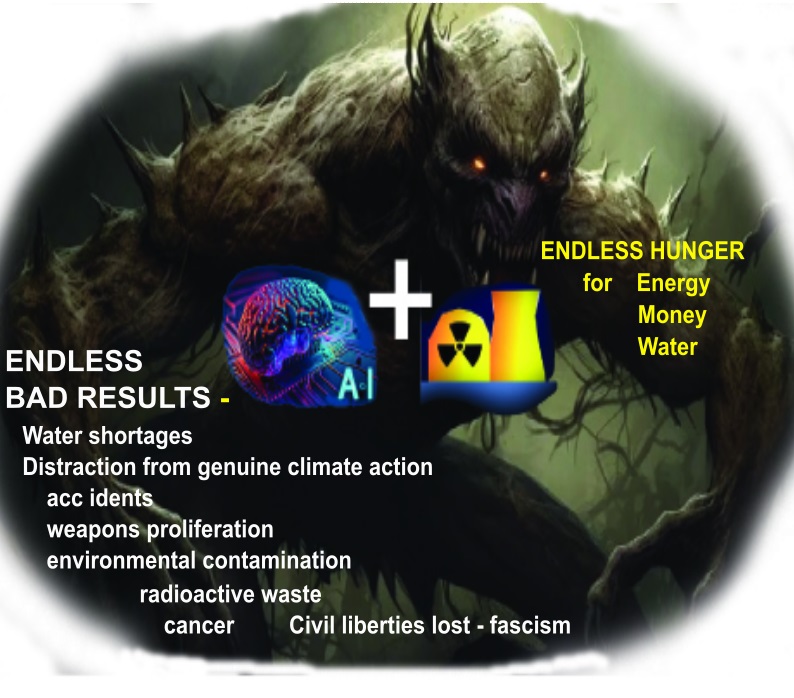
One effect of this slew of propaganda has been the near silence on the question of whether such growth of data centers or AI is desirable, even though there is ample evidence of the enormous environmental impacts of developing AI and building hyperscale data centers. Or for that matter the desirability of nuclear power.
M.V. Ramana, 13 Mar 25, https://www.counterpunch.org/2025/03/13/continued-propaganda-about-ai-and-nuclear-power/
One bright spot amidst all the terrible news last couple of months was the market’s reaction to DeepSeek, with BigTech firms like Nvidia and Microsoft and Google taking major hits in their capitalizations. Billionaires Nvidia’s Jensen Huang and Oracle’s Larry Ellison—who had, just a few days back, been part of Donald Trump’s first news conference—lost a combined 48 billion dollars in paper money. As a good friend of mine, who shall go unnamed because of their use of an expletive, said “I hate all AI, but it’s hard to not feel joy that these asshats are losing a lot of money.”

Another set of companies lost large fractions of their stock valuations: U.S. power, utility and natural gas companies. Electric utilities like Constellation, Vistra and Talen had gained stock value on the basis of the argument that there would be a major increase in demand for energy due to data centers and AI, allowing them to invest in new power plants and expensive nuclear projects (such as small modular reactor), and profit from this process. [The other source of revenue, at least in the case of Constellation, was government largesse.] The much lower energy demand from DeepSeek, at least as reported, renders these plans questionable at best.
Remembering Past Ranfare
But we have been here before. Consider, for example, the arguments made for building the V. C. Summer nuclear project in South Carolina. That project came out of the hype cycle during the first decade of this century, during one of the many so-called nuclear renaissances that have been regularly announced since the 1980s. [In 1985, for example, Oak Ridge National Laboratory Director Alvin Weinberg predicted such a renaissance and a second nuclear era—that is yet to materialize.] During the hype cycle in the first decade of this century, utility companies proposed constructing more than 30 reactors, of which only four proceeded to construction. Two of these reactors were in South Carolina.

As with most nuclear projects, public funding was critical. The funding came through the 2005 Energy Policy Act, the main legislative outcome from President George W. Bush’s push for nuclear power, which offered several incentives, including production tax credits that were valued at approximately $2.2 billion for V. C. Summer.
The justification offered by the CEO of the South Carolina Electric & Gas Company to the state’s Public Service Commission was the expectation that the company’s energy sales would increase by 22 percent between 2006 and 2016, and by nearly 30 percent by 2019. In fact, South Carolina Electric & Gas Company’s energy sales declined by 3 percent by the time 2016 rolled in. [Such mistakes are standard in the history of nuclear power. In the 1970s, the U.S. Atomic Energy Commission and utility companies were projecting that “about one thousand large nuclear power reactors” would be built “by the year 2000 and about two thousand, mostly breeder reactors, by 2010” on the basis of the grossly exaggerated estimates of how rapidly electricity production would grow during the same period. It turned out that “utilities were projecting four to nine times more electric power would be produced in the United States by nuclear power in 2000 than actually happened”.] In the case of South Carolina, the wrong projection about energy sales was the basis of the $9 billion plus spent on the abandoned V. C. Summer project.
The Racket Continues

With no sense of shame for that failure, one of the two companies involved in that fiasco recently expressed an interest in selling this project. On January 22, Santee Cooper’s President and CEO wrote, “We are seeing renewed interest in nuclear energy, fueled by advanced manufacturing investments, AI-driven data center demand, and the tech industry’s zero-carbon targets…Considering the long timelines required to bring new nuclear units online, Santee Cooper has a unique opportunity to explore options for Summer Units 2 and 3 and their related assets that could allow someone to generate reliable, carbon emissions-free electricity on a meaningfully shortened timeline”.

A couple of numbers to put those claims about timelines in perspective: the average nuclear reactor takes about 10 years to go from the beginning of construction—usually marked by when concrete is poured into the ground—to when it starts generating electricity. But one cannot go from deciding to build a reactor to pouring concrete in the ground overnight. It takes about five to ten years needed before the physical activities involved in building a reactor to obtain the environmental permits, and the safety evaluations, carry out public hearings (at least where they are held), and, most importantly, raise the tens of billions of dollars needed. Thus, even the “meaningfully shortened timeline” will mean upwards of a decade.
Going by the aftermath of the Deepseek, the AI and data center driven energy demand bubble seems to have crashed on a timeline far shorter than even that supposedly “meaningfully shortened timeline”. There is good reason to expect that this AI bubble wasn’t going to last, for there was no real business case to allow for the investment of billions. What DeepSeek did was to also show that the billions weren’t needed. As Emily Bender, a computer scientist who co-authored the famous paper about large language models that coined the term stochastic parrots, put it: “The emperor still has no clothes, but it’s very distressing to the emperor that their non-clothes can be made so much more cheaply.”
But utility companies are not giving up. At a recent meeting organized by the Nuclear Energy Institute, the lobbying organization for the nuclear industry, the Chief Financial Officer of Constellation Energy, the company owning the most nuclear reactors in the United States, admitted that the DeepSeek announcement “wasn’t a fun day” but maintained that it does not “change the demand outlook for power from the data economy. It’s going to come.” Likewise, during an “earnings call” earlier in February, Duke Energy President Harry Sideris maintained that data center hyperscalers are “full speed ahead”.
Looking Deeper
Such repetition, even in the face of profound questions about whether such a growth will occur, is to be expected, for it is key to the stock price evaluations and market capitalizations of these companies. The constant reiteration of the need for more and more electricity and other resources also adopts other narrative devices shown to be effective in a wide variety of settings, for example, pointing to the possibility that China would take the lead in some technological field or the other, and explicitly or implicitly arguing how utterly unacceptable that state of affairs would be. Never asking whether it even matters who wins this race for AI. These tropes and assertions about running out of power contribute to creating the economic equivalent of what Stuart Hall termed “moral panic”, thus allowing possible opposition to be overruled.
One effect of this slew of propaganda has been the near silence on the question of whether such growth of data centers or AI is desirable, even though there is ample evidence of the enormous environmental impacts of developing AI and building hyperscale data centers. Or for that matter the desirability of nuclear power.
As Lewis Mumford once despaired: “our technocrats are so committed to the worship of the sacred cow of technology that they say in effect: Let the machine prevail, though the earth be poisoned, the air be polluted, the food and water be contaminated, and mankind itself be condemned to a dreary and useless life, on a planet no more fit to support life than the sterile surface of the moon”.
But, of course, we live in a time of monsters. At a time when the levers of power are wielded by a megalomaniac who would like to colonize Mars, and despoil its already sterile environment.
M. V. Ramana is the Simons Chair in Disarmament, Global and Human Security at the School of Public Policy and Global Affairs, University of British Columbia and the author of The Power of Promise: Examining Nuclear Energy in India.
Labour’s arms exports to Israel exposed Labour allowed dozens of arms exports to Israel after weapons sanctions
Keir Starmer’s government has continued to approve arms exports to Israel even after some licences were suspended in September
UK trade department approved 34 military export licences to Israel in the two months since David Lammy announced a partial arms embargo, new data shows.
DECLASSIFIED UK, JOHN McEVOY, 12 December 2024
Labour government hasn’t completed a review on Israel’s compliance with international humanitarian law since July
Foreign Office has not asked to see footage from RAF spy flights over Gaza, which could provide evidence of Israeli war crimes
“No particular appetite” to restrict exports of F-35 components to Israel, even as minister admits US government can track whether British-made spare parts are being sent to Israel
Trade committee chairman warned ministers he was “not convinced” that F-35 carve-out complied with UN arms trade treaty.
Keir Starmer’s government has continued to approve arms exports to Israel even after some licences were suspended in September, it can be revealed.
31 “standard” and three “open” licences for military goods have been issued to Israel since 2 September, when UK foreign secretary David Lammy announced partial restrictions on arms sales to Israel.
Those items included “components for trainer aircraft” and “commercial aircraft” which were “not assessed to be used in relation to current military operations in Gaza”.
However, training aircraft can still be used to instruct Israeli pilots on how to conduct offensive operations in Gaza.
35 “standard” and six “open” licences were also approved for items classed as “non-military” such as telecommunications equipment and imaging cameras.
The UK government refused to issue a further 18 licences to Israel for “components for combat aircraft and naval vessels, as well as components for targeting and radar equipment”.
The information is contained in new data released this week on an “ad hoc” basis by Britain’s trade department in response to “significant parliamentary and public interest” in the issue.
The data was evaluated at parliament’s trade committee on Tuesday, during which ministers admitted that the UK government has still not determined whether Israel’s bombing of Gaza amounts to a violation of International Humanitarian Law (IHL).
The committee was told that the UK government has not updated its assessment on Israel’s compliance with IHL since 31 July, some four and a half months ago. Previous assessments have taken less than half that time to finalise.
One minister further confirmed that there was “no appetite” for stopping the export of F-35 fighter jet components for use by Israel, despite concerns that this breaches Britain’s legal obligations.
It comes days after Amnesty International accused Israel of committing a genocide in Gaza and warned the UK to “immediately suspend the direct and indirect supply, sale or transfer, to Israel of all weapons” in order to “stop fuelling violations of international law”………………………………………………………………………………………….
more https://www.declassifieduk.org/labour-allowed-dozens-of-arms-exports-to-israel-after-weapons-sanctions/
Movements across the world call for an end to all US military exercises on the Korean peninsula
The call to cancel the military exercises takes on increased urgency given the military accident last week when South Korean jets bombed their own citizens in the region bordering North Korea during the preparation of yet another joint military exercise with the US.
March 12, 2025 by Abdul Rahman, people’s dispatch
Pressure continues to grow against the ongoing Freedom Shield 25, a joint military exercise between the US and South Korea.
The International People’s Assembly (IPA) and International League of Peoples Struggle (ILPS) joined Nodutdol, an anti-imperialist Korean diaspora group, in launching a joint statement calling for the Freedom Shield military exercises to be cancelled, claiming it is drumming up threats of war on the Korean peninsula. The anti-imperialist and anti-war platforms bring together hundreds of people’s movements and organizations across the world.
“Freedom Shield 25 has dire implications for regional and global peace and stability. As part of Washington’s New Cold War against China, the NATO bloc and its Asian and Oceanian partners are escalating in East Asia, using the Korean peninsula as a staging ground. Freedom Shield poses a most immediate threat to the stability of the region, but its effects also extend far beyond,” the statement reads……………………………………………………………………………………………………………………………………. more https://peoplesdispatch.org/2025/03/12/movements-across-the-world-call-for-an-end-to-all-us-military-exercises-on-the-korean-peninsula/
Book Review: How Our Digital Infatuation Undermines Discourse

In “Superbloom,” Nicholas Carr laments that we live in a state of uncontrollable sensory and communication overload.
By Elizabeth Svoboda, 03.14.2025, https://undark.org/2025/03/14/book-review-superbloom/?utm_source=Undark%3A+News+%26+Updates&utm_campaign=ecc4df9cbe-RSS_EMAIL_CAMPAIGN&utm_medium=email&utm_term=0_5cee408d66-185e4e09de-176033209
It was all Mother Nature’s fault, you could say. After winter rains in Lake Elsinore, California, reawakened countless dormant poppy seeds in early 2019, spring blossoms crowded in thickly enough to turn the hillsides bright orange — a fleeting “superbloom.” Recognizing an Instagrammable backdrop when she saw one, influencer Jaci Marie Smith reclined across the floral carpet in orange overalls and hit post. “You’ll never influence the world by trying to be like it,” her photo caption read.
In March, posts like Smith’s and #superbloom hashtags fueled a global frenzy. So many sightseers and influencers crowded into Lake Elsinore, snarling traffic and pulling up blooms by the handfuls, that officials declared a public safety emergency. As residents and others ripped into influencers for unleashing viral havoc on the small town, some took down their poppy posts, while others offered excuses and mea culpas. A meme that had begun in innocent enthusiasm curdled in an internet minute, setting people against each other and leaving a wake of real-world destruction.
We’re living in a perpetual digital superbloom, contends technology writer Nicholas Carr — a state of sensory and communication overload we can no longer control, one that’s sowing division and damage on a global scale. And like the poppy field that hypnotized Dorothy’s “Wizard of Oz” crew, this social media-fueled superbloom lures us in with enticements that are nearly impossible to resist. “Poppies are lush, vibrant, and entrancing,” Carr writes in “Superbloom: How Technologies of Connection Tear Us Apart.” “They’re also garish, invasive, and narcotic.”
This is familiar ground for Carr — at least, as familiar as any fast-morphing digital terrain can be. Carr’s stance as a techno-skeptic has been consistent for decades, though it’s evolved as digital communication modes have bloomed and receded. His 2010 book “The Shallows”, a finalist for the Pulitzer Prize, argued that the online world is distracting and prevents deeper engagement with texts, and he followed that up in 2014 with “The Glass Cage,” a reflection on how interacting with our computers changes us.
In “Superbloom,” Carr expands on a central theme of “The Glass Cage”: While we view our digital devices as helpers serving up knowledge and entertainment, they exact an unacknowledged toll in the process, altering how we think, act, and communicate. We are far different humans in an era of texting, posting, and like-seeking, Carr argues, than we were when limited to letters and phone calls — and not for the better.
He contends that when we communicate mostly in one-line messages and hot takes, the kind that titillate and propagate from one human node to the next, our capacity to engage more intently and thoughtfully withers. “What we sacrifice are depth and rigor,” he writes. Thus, “we rely on quick and often emotional judgments while eschewing slower, reflective ones.”
This is a fair point, if only true in some online contexts: Masters of the 140-character social media quip win plenty of fans elsewhere with their books and long essays. What’s more convincing is Carr’s analysis of why our instant access to one another online, which we often assume is an advantage, has led to more social breakdown rather than less.
……………………………………in virtual space, “we’re all in one another’s business all the time,” Carr writes, later adding, “With an almost microscopic view of what everybody else is saying and doing — the screen turns us all into peeping Toms — we have no end of opportunities to take offense.”
……………….Carr’s vivid, jargon-free prose hits right in the solar plexus. “We’re not hostages with Stockholm syndrome,” he writes of our relationship with social media. “We’re being given what we want, in quantities so generous we can’t resist gorging ourselves.”
…………………However hard-hitting and sound its claims, “Superbloom” might feel too apocalyptic were it not for Carr’s closing plea to hold the line. He says it’s too late to change the online systems we’re embedded in — a judgment that seems a tad dour, given how rapidly those same systems have themselves changed over time. But he rightly notes that to peel away from a virtual world that’s more image than substance, users must deliberately resist its empty charms, much as the rebels of Aldous Huxley’s “Brave New World” rejected the happiness drug soma.
…….. he calls for judicious online withdrawal rather than Luddite-style divestment, for staking out a position “not beyond the reach of the informational flow, but beyond the reach of its liquefying force.”
While digital pessimists can come across as Cassandra-like, their warnings have never been more resonant. For Carr, the rough online beast is no longer merely slouching in our direction. It’s already devouring us. “Superbloom” frames the choice ahead in the starkest possible terms: Do we consent to being swallowed, or find a way — however quixotic and improbable — to escape the maw?
Elizabeth Svoboda is a science writer in San Jose, California, and the author of “What Makes a Hero?: The Surprising Science of Selflessness.” She is working on a book about the science of setting a sustainable pace in an overclocked world.
The nuclear industry continues to infiltrate education.

COMMENT. Well, there will always be a need for workers to shut down this poisonous industry, and deal with the radioactive trash
1 Future innovators with the ‘Evolve’ work experience programme. Sellafield Ltd invites Year 10 learners with an interest in robotics and
artificial intelligence (AI) to participate in the ‘Evolve’ work
experience programme. So far, more than 100 students have been involved in
Evolve, with participants currently coming from 11 different schools in
West Cumbria, as well as home-educated learners. This 5-day programme takes
place on selected weeks throughout the year and aims to equip students with
essential skills for their future careers.
Sellafield Ltd, 13th March 2025,
https://www.gov.uk/government/news/future-innovators-with-the-evolve-work-experience-programme
Governor urges contaminated soil be disposed of outside Fukushima by 2045

Soil from radiation decontamination work after the 2011 nuclear reactor
meltdowns in Fukushima Prefecture should be disposed of outside the
prefecture by the deadline set by law, Fukushima Gov. Masao Uchibori said
in a recent interview. A law stipulates that all such soil must be disposed
of outside Fukushima by March 2045.
“The final disposal must be completed
within 20 years, no matter whether the soil is reused (within Fukushima) or
not,” the governor said. However, Shiro Izawa, the mayor of Futaba — one
of the towns hosting Tokyo Electric Power Company Holdings’ crippled
Fukushima No. 1 plant — said lasts month that soil from radiation
decontamination work should be reused in Fukushima. The mayor said this was
his personal opinion. Uchibori pointed out the heavy burden placed on
Futaba and the neighboring town of Okuma for accepting interim storage
facilities for soil from decontamination work.
Japan Times 11th March 2025. https://www.japantimes.co.jp/news/2025/03/11/japan/fukushima-gov-soil-disposal/
14 years on: Justice at Fukushima remains denied
12th March 2025,
https://www.nuclearpolicy.info/news/14-years-on-justice-at-fukushima-remains-denied/
Yesterday (11 March) marked the 14th anniversary of the Fukushima nuclear disaster. As Welsh and British anti-nuclear campaigners held events to mark the anniversary, our friends in the Japanese campaign group, Citizen’s Nuclear Information Centre published this interesting media release on the current position:
This year, 14 years after the Great East Japan Earthquake and the Fukushima Daiichi Nuclear Power Station accident, the Seventh Strategic Energy Plan, which sets the basic direction of the country’s energy policy, was approved by the Japanese Government.
The Plan includes a policy of the active use of nuclear power. The phrase “reduce dependency on the nuclear power as much as possible” which had been included, even if it were a mere formality, in Strategic Energy Plans published since March 2011 was deleted. This is a huge change of direction. The government has explained this by saying, “The policy has not changed, but the change has been made at the request of local governments where nuclear power plants are located and the nuclear industry.”
The draft plan in which this change was introduced generated over 40,000 public comments, but the Cabinet approved the draft almost as is, ignoring the voices of opposition from so many people.
The release of Advanced Liquid Processing System (ALPS) treated water, which contains radioactive materials that cannot be fully removed, from the Fukushima Daiichi Nuclear Power Station (FDNPS) into the ocean, began in 2023.
Discussion is now underway on the recycling of the “removed soil” generated from decontamination work that removed topsoil contaminated by the nuclear accident. Recycling allows soil with concentrations of up to 80 times higher than that considered necessary to be treated as radioactive material to be used nationwide under certain controlled conditions.
Both the discharge of ALPS treated water into the ocean and the recycling of removed soil violate the principle of centralized management of radioactive materials and could expose large numbers of citizens to unnecessary risks of radiation exposure.
Radiation exposure, which has no benefit to the people who are exposed to the risks, is being promoted without consideration for the voices of opposition from the public in the name of the reconstruction of Fukushima, on the grounds that it is an “existing exposure situation” as defined by the ICRP (International Commission on Radiological Protection), and because the IAEA has confirmed the safety of the radiation exposure.
This month, the Supreme Court decided to dismiss the appeals of the prosecutor’s designated lawyer in the case of three TEPCO executives, except for one whose charge was dismissed due to his death. They were indicted on charges of professional negligence resulting in death or bodily injury but were found not guilty.
Initially, the Tokyo District Public Prosecutor’s Office had decided not to prosecute the case. However, the case was determined to be appropriate for prosecution by the Committee for the Inquest of Prosecution, selected by lot from among the people, and was thus contested in court. This verdict can be taken as a message that companies pursuing economic activities need not be held criminally responsible even if they bring about major accidents. The gap dividing civil and judicial values has become increasingly obvious in recent years.
The trial retrieval of fuel debris carried out last year highlighted the progress being made toward decommissioning. At the same time, although an image of the final state of the decommissioned FDNPS is indispensable when discussing the reconstruction of Fukushima, this final state is not yet clearly seen.
What is the final condition of the site that is aimed for?
Will it be possible to retrieve all the fuel debris?
Moreover, apart from the fuel debris, where will the various levels of radioactive wastes, estimated at around 7.84 million tons, generated from the demolition of buildings, from decontamination, and water treatment waste, be stored or disposed of?
Will there be regions that will accept it?
At the same time, it must be remembered that the work of decommissioning that has been continuing with no certain goal, requires sacrifice on the part of workers who are exposed to radiation.
Rather than prioritize requests from the “Nuclear Village” (faction promoting nuclear), what the government needs to do is provide real relief to those affected by the nuclear accident, face up to the voices of civil society, and proceed with realistic deliberations toward the decommissioning of the Fukushima Daiichi Nuclear Power Station.

WSJ’s Chief Foreign Correspondent Declares It’s Over For Ukraine In Kursk
by Tyler Durden, Thursday, Mar 13, 2025, https://www.zerohedge.com/geopolitical/ukraine-losing-its-trump-card-key-kursk-town-liberated-russian-troops
It’s a major turning point in the conflict when the Chief Foreign-Affairs Correspondent for The Wall Street Journal declares that Ukrainian forces are now in a full-on withdrawal from Russia’s Kursk amid rapid Russian gains…
Reuters too is reporting that Ukrainian forces are losing in Kursk:
Ukrainian troops appeared on the point of losing their hard-won foothold inside Russia’s Kursk region on Wednesday as Moscow claimed further advances there and military bloggers on both sides said Kyiv’s forces were withdrawing.
Ukraine sprang one of the biggest shocks of the war on August 6 last year by storming across the border and grabbing a chunk of land inside Russia, boosting citizens’ morale and gaining a potential bargaining chip.
There are no more cards to play, as Trump put it last month while hosting Zelensky at the White House, and now this assessment proves truer than ever.
Ukraine is losing the little bit of leverage it might have had left amid discussions toward preparing negotiations with Moscow. Russia’s Kursk is now fast being retaken, and Ukrainian forces are folding, as on Wednesday Russian troops raised their flags over the key town of Sudzha .
The central square of the town in the southwestern Kursk region was scene of where Russia’s Airborne Troops published a short aerial video showing soldiers unfurling a Russian flag as well as military unit banners. Other state media outlets subsequently featured the footage. Newsweek has underscored that Ukraine is fast “losing its trump card.”
Moscow has been focusing its forces on to regaining control around Sudzha in recent days, having retaken 12 settlements in the border region earlier this week.
Fighting is said to still be ongoing, but Moscow forces have asserted control over the center. Ukrainian media also acknowledges the following:
Russian troops have launched an offensive on the Ukrainian-controlled town of Sudzha in Russia’s Kursk Oblast, entering the settlement, the DeepState monitoring group, the Institute for the Study of War (ISW), and the Russian state news agency TASS claimed on March 12. Fighting in the town is reportedly ongoing.
…According to DeepState, Russian forces have entered the eastern part of Sudzha and are entrenching their positions. TASS published purported drone footage claiming that Russian troops had entered the town center and raised a Russian flag.
War bloggers have been closely monitoring the fight for control of Sudzha, with Ruslan Leviev of the war monitor Conflict Intelligence Team describing that Ukrainian troops have been in steady retreat from the entire region.
“We’ve seen that all the areas coming under Russian control have been taken with little to no resistance. The same goes for Sudzha,” Leviev said. “Today, we’re seeing them on the opposite side [of the town]. And again, there are no images of any fighting.”
“At this point, it’s fair to say that the entire city of Sudzha is now under Russian control,” he described of the ground situation.
While months ago Ukrainian forces occupied several hundred square kilometers of Russian territory in Kursk region, as of Wednesday that control has shrunk to less than 200 square kilometers (77 square miles), according to the Ukraine-military linked DeepState war tracker.
Video said to be from on the ground in Russia’s Sudzha, including interviews with elderly Russians that stayed the whole time:
Recall that in the late last month famous Oval Office blow-up involving Trump, Zelensky, and J.D. Vance – Trump told the Ukrainian leader: “You don’t have the cards right now.”
That now appears truer than ever, at a moment the Russians are studying the new US-Ukraine proposal for a 30-day truce in order to jump-start direct negotiations to end the war.
How the IEA is grossly biased against renewables – the IEA should be scrapped
David Toke, Mar 11, 2025
The International Energy Agency (the IEA) is hopelessly biased against renewable energy both in terms of the projections of future energy development it has made and also in the way it frames the statistics about energy supply. The statistical methods used by the IEA favour fossil fuels and nuclear power. The IEA does not give sufficient attention to energy efficiency. These things can be illustrated by reference to analysis of its past energy projections and also by analysing the way it counts energy statistics. The question that must be posed, is what is the point of the IEA if it gets things so badly wrong…………………………………………………………………………………………………………………………………………………………………………………………………………….
Conclusion
The way that the IEA compiles its statistics is grossly biased against renewable energy and in favour of fossil fuels and nuclear power. Its future energy projections have been abysmal, and this failure illustrates its appalling bias. The IEA’s approach also obscures the impact of energy transition which will involve increasing dominance by electric-battery and heat pump technologies. The IEA fails to give priority to energy efficiency. Rather it tends to talk more about absolute increases in energy consumption, such as in data centres (for example see HERE).
Yet such notions of accelerated absolute increases in energy consumption have already proved to be overblown. This is demonstrated by China’s DeepSeek AI project which is being powered by a small fraction of the energy consumption of earlier AI projects (See HERE). The IEA is also keen on pushing nuclear power fantasies, including small modular reactors (see HERE).
In general the IEA tends to talk about energy security rather than energy transition, as can be seem in the executive summary of its 2024 World Energy Energy Outlook (see HERE). Yet energy transition will implicitly give us energy security. It will do through the replacement of of insecure and volatile fossil fuel supplies with renewable energy and electrically based energy efficient technologies.
The key to understand this is that the IEA is not independent in focus or finance. The IEA is financed by a collection of mostly western governments. We should remember that the IEA was formed to, in effect, help western countries cope with the fact that the western based oil companies lost control of oil markets after 1973. The Secretariat is based in nuclear-dominated France. The information it gives is seriously flawed.
The conditions which led to the IEA’s formation have fundamentally changed. Our biggest challenge now is energy transition and the climate struggle to reduce greenhouse gas emissions. The IEA’s projections are wholly unreliable and its statistics give a false impression of what is happening.
The main energy trade groups already have their own trade associations – eg IRENA for renewables, the WNA for nuclear, and we know that the oil and gas companies look after themselves. The IEA serves no useful purpose. It needs to be scrapped. A new intergovernmental organisation could be created, to which the IEA staff could be redeployed, with a mission of promoting energy efficiency technologies. https://davidtoke.substack.com/p/how-the-iea-is-grossly-biased-against
We’re #1 in Selling Weapons!
American Exceptionalism Defined
Bill Astore, Mar 12, 2025
We’re #1 (once again) in selling weapons! Amazingly, the USA now accounts for 43% of the world’s trade in deadly weaponry. No country beats more plowshares into swords and pruning hooks into spears than America, which is also, obviously, the most Christian nation in the world.
Let’s take a look at a useful chart from Stephen Semler (be sure to check out his blog on Substack):
Finding #1: The US is the world’s largest arms dealer
The US accounts for 43% of global arms exports, more than the next seven largest arms-exporting countries combined. All the countries outside the top eight account for less than 17% of the worldwide total. – [Graph on original]
Way back in 2012, I wrote a column for TomDispatch: “Weapons ‘r’ us,” in which I examined America’s dominance of the weapons trade. Here’s what I wrote back then:
Yes, we’re the world’s foremost “merchants of death,” the title of a best-selling exposé of the international arms trade published to acclaim in the U.S. in 1934. Back then, most Americans saw themselves as war-avoiders rather than as war-profiteers. The evil war-profiteers were mainly European arms makers like Germany’s Krupp, France’s Schneider, or Britain’s Vickers.
Not that America didn’t have its own arms merchants. As the authors of Merchants of Death noted, early on our country demonstrated a “Yankee propensity for extracting novel death-dealing knickknacks from [our] peddler’s pack.” Amazingly, the Nye Committee in the U.S. Senate devoted 93 hearings from 1934 to 1936 to exposing America’s own “greedy munitions interests.” Even in those desperate depression days, a desire for profit and jobs was balanced by a strong sense of unease at this deadly trade, an unease reinforced by the horrors of and hecatombs of dead from the First World War.
We are uneasy no more. Today we take great pride (or at least have no shame) in being by far the world’s number one arms-exporting nation. A few statistics bear this out. From 2006 to 2010, the U.S. accounted for nearly one-third of the world’s arms exports, easily surpassing a resurgent Russia in the “Lords of War” race. Despite a decline in global arms sales in 2010 due to recessionary pressures, the U.S. increased its market share, accounting for a whopping 53% of the trade that year. Last year saw the U.S. on pace to deliver more than $46 billion in foreign arms sales. Who says America isn’t number one anymore?
Who, indeed? And we remain, of course, our own best customers, as this year’s Pentagon budget soars to $900 billion, even as the Trump administration argues for “peace through strength,” or, put bluntly, peace through superior firepower.
Only in America is Jesus heavily armed and packing heat. Truly exceptional!
‘Global weirding’: climate whiplash hitting world’s biggest cities, study reveals

Climate whiplash is already hitting major cities around the world,
bringing deadly swings between extreme wet and dry weather as the climate
crisis intensifies, a report has revealed. Dozens more cities, including
Lucknow, Madrid and Riyadh have suffered a climate “flip” in the last
20 years, switching from dry to wet extremes, or vice versa.
The report analysed the 100 most populous cities, plus 12 selected ones, and found
that 95% of them showed a distinct trend towards wetter or drier weather.
The changing climate of cities can hit citizens with worsened floods and
droughts, destroy access to clean water, sanitation and food, displace
communities and spread disease. Cities where the water infrastructure is
already poor, such as Karachi and Khartoum, suffer the most.
Guardian 12th March 2025 https://www.theguardian.com/environment/2025/mar/12/global-weirding-climate-whiplash-hitting-worlds-biggest-cities-study-reveals
EDF’s salt marsh plans pause met with ‘great relief’ on either side of the Severn
By Carmelo Garcia – Local Democracy Reporter, Gloucester News Centre 11th March 2025
Villagers on both sides of the Severn are relieved EDF has shelved their controversial plans to create salt marshes which were linked to the construction of nuclear power plant Hinkley Point C.
EDF had drawn up the environmental schemes as an alternative to their plan to install an acoustic fish deterrent system at Hinkley Point C in Somerset to scare fish away from the site as the Bristol Channel is home to numerous species such as eels, herring, salmon and sprats.
However, the plans to create salt marshes were met with strong opposition at Arlingham, Rodley near Westbury-on-Severn in Gloucestershire and at Littleton-upon-Severn in South Gloucestershire and Kingston Seymour in Somerset.
And now the energy firm says he plan to install an acoustic fish deterrent system is back on thanks to new innovative technology.
This has been met with relief in communities on both side of the Severn. Councillor Richard Maisey (L, Severn), who represents Arlingham on Stroud District Council said the residents are happy with the outcome.
He attended the public meeting held in the village regarding the proposals last year and said the news has been met with “great reliel”.
“The general feeling is happiness that it doesn’t appear to be going ahead,” he said.
“They haven’t totally written it off but they have indicated it is not their intention to proceed.”………………………………………………………. https://gloucesternewscentre.co.uk/edfs-salt-marsh-plans-pause-met-with-great-relief-on-either-side-of-the-severn/
Fukushima Remembered At URENCO’s Uranium Enrichment Plant Today in Cheshire
Campaigners gathered today at the UK’s uranium enrichment plant to
remember Fukushima and hand over a letter of concern about uranium
enrichment. Today marks the 14th anniversary of the Fukushima catastrophe.
On March 11, 2011, a record 9.0-magnitude quake struck off the coast of
Japan’s Tohoku region, triggering a tsunami with waves that reached a
maximum height of 40.5 meters and causing a triple nuclear meltdown at the
Fukushima No.1 nuclear plant.
Radiation Free Lakeland 11th March 2025, https://mariannewildart.wordpress.com/2025/03/11/fukushima-remembered-at-urencos-uranium-enrichment-plant-today-in-cheshire/
‘Nervous and rushed’: Massive Fukushima plant cleanup work involves high radiation and stress
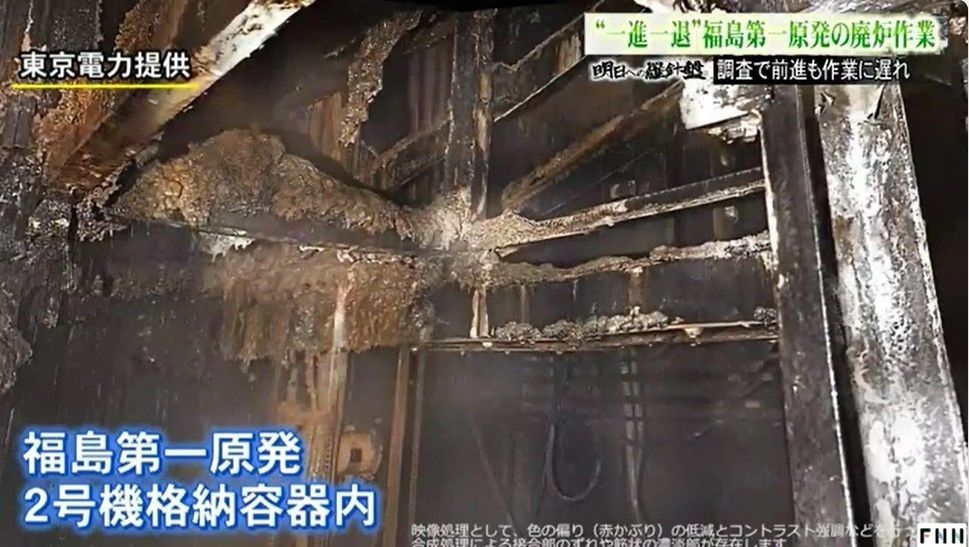
Experts say the hard work and huge challenges of decommissioning the plant are just beginning. There are estimations that the work could take more than a century. The government and TEPCO have an initial completion target of 2051, but the retrieval of melted fuel debris is already three years behind, and many big issues remain undecided.
By ASSOCIATED PRESS, 12 March 2025
OKUMA, Japan (AP) – The Fukushima Daiichi nuclear power plant’s radiation levels have significantly dropped since the cataclysmic meltdown in Japan 14 years ago. Workers walk around in many areas wearing only surgical masks and regular clothes.
It’s a different story for those who enter the reactor buildings, including the three damaged in the 2011 earthquake and tsunami. They must use maximum protection – full facemasks with filters, multi-layered gloves and socks, shoe covers, hooded hazmat coveralls and a waterproof jacket, and a helmet.
As workers remove melted fuel debris from the reactors in a monumental nuclear cleanup effort that could take more than a century, they are facing both huge amounts of psychological stress and dangerous levels of radiation.
The Associated Press, which recently visited the plant for a tour and interviews, takes a closer look.
A remote-controlled extendable robot with a tong had several mishaps including equipment failures before returning in November with a tiny piece of melted fuel from inside the damaged No. 2 reactor.
That first successful test run is a crucial step in what will be a daunting, decades-long decommissioning that must deal with at least 880 tons of melted nuclear fuel that has mixed with broken parts of internal structures and other debris inside the three ruined reactors…………………………………………………
Radiation levels are still dangerously high inside the No. 2 reactor building, where the melted fuel debris is behind a thick concrete containment wall. Earlier decontamination work reduced those radiation levels to a fraction of what they used to be.
In late August, small groups took turns doing their work helping the robot in 15- to 30-minute shifts to minimize radiation exposure. They have a remotely controlled robot, but it has to be manually pushed in and out.
“Working under high levels of radiation (during a short) time limit made us feel nervous and rushed,” said Yasunobu Yokokawa, a team leader for the mission. “It was a difficult assignment.”
Full-face masks reduced visibility and made breathing difficult, an extra waterproof jacket made it sweaty and hard to move, and triple-layered gloves made their fingers clumsy, Yokokawa said.
To eliminate unnecessary exposure, they taped around gloves and socks and carried a personal dosimeter to measure radiation. Workers also rehearsed the tasks they’d perform to minimize exposure…………………………………………………..
a growing number of workers are concerned about safety and radiation at the plant, said Ono, the decommissioning chief, citing an annual survey of about 5,5,00 workers……
Yokokawa and a plant colleague, Hiroshi Ide, helped in the 2011 emergency and are team leaders today. They say they want to make the job safer as workers face high radiation in parts of the plant.
On the top floor of the No. 2 reactor, workers are setting up equipment to remove spent fuel units from the cooling pool. That’s set to begin within two to three years.
At the No. 1 reactor, workers are putting up a giant roof to contain radioactive dust from decontamination work on the top floor ahead of the removal of spent fuel.
To minimize exposure and increase efficiency, workers use a remote-controlled crane to attach pre-assembled parts, according to TEPCO. The No. 1 reactor and its surroundings are among the most contaminated parts of the plant.
Workers are also removing treated radioactive wastewater. They recently started dismantling the emptied water tanks to make room to build facilities needed for the research and storage of melted fuel debris.
After a series of small missions by robots to gather samples, experts will determine a larger-scale method for removing melted fuel, first at the No. 3 reactor.
Experts say the hard work and huge challenges of decommissioning the plant are just beginning. There are estimations that the work could take more than a century. The government and TEPCO have an initial completion target of 2051, but the retrieval of melted fuel debris is already three years behind, and many big issues remain undecided.
Ide, whose home in Namie town, northwest of the plant, is in a no-go zone because of nuclear contamination, still has to put on a hazmat suit, even for brief visits home…….
https://www.dailymail.co.uk/wires/ap/article-14484347/Nervous-rushed-Massive-Fukushima-plant-cleanup-exposes-workers-high-radiation-stress.html
1 This Month
Chernobyl: The Lost Tapes – A good documentary on Chernobyl on SBS available On Demand for the next 3 weeks– https://www.sbs.com.au/ondemand/tv-program/chernobyl-the-lost-tapes/2352741955560

of the week–London Campaign for Nuclear Disarmament

Tell the Ukrainian Government to Drop Prosecution of Peace Activist Yurii Sheliazhenko
To see nuclear-related stories in greater depth and intensity – go to https://nuclearinformation.wordpress.com
-
Archives
- April 2026 (152)
- March 2026 (251)
- February 2026 (268)
- January 2026 (308)
- December 2025 (358)
- November 2025 (359)
- October 2025 (376)
- September 2025 (257)
- August 2025 (319)
- July 2025 (230)
- June 2025 (348)
- May 2025 (261)
-
Categories
- 1
- 1 NUCLEAR ISSUES
- business and costs
- climate change
- culture and arts
- ENERGY
- environment
- health
- history
- indigenous issues
- Legal
- marketing of nuclear
- media
- opposition to nuclear
- PERSONAL STORIES
- politics
- politics international
- Religion and ethics
- safety
- secrets,lies and civil liberties
- spinbuster
- technology
- Uranium
- wastes
- weapons and war
- Women
- 2 WORLD
- ACTION
- AFRICA
- Atrocities
- AUSTRALIA
- Christina's notes
- Christina's themes
- culture and arts
- Events
- Fuk 2022
- Fuk 2023
- Fukushima 2017
- Fukushima 2018
- fukushima 2019
- Fukushima 2020
- Fukushima 2021
- general
- global warming
- Humour (God we need it)
- Nuclear
- RARE EARTHS
- Reference
- resources – print
- Resources -audiovicual
- Weekly Newsletter
- World
- World Nuclear
- YouTube
-
RSS
Entries RSS
Comments RSS
 nuclear-news