Netanyahu’s nuclear gamble: The risks of escalation with Iran

https://www.dailysabah.com/opinion/op-ed/netanyahus-nuclear-gamble-the-risks-of-escalation-with-iran 27 Mar 25
While Netanyahu convinces the Israeli public and the U.S. administration to wage war on Iran, it cannot be known ‘for whom the bells will toll’ at the end of such an escalation.
n 1992, when he was a 42-year-old Knesset member, Benjamin Netanyahu raised concerns about Iran’s nuclear threat, stating, “Iran is close to producing a nuclear weapon within three to five years, and this threat needs to be uprooted by an international front led by the U.S.” In 1995, in his book, he discussed Iran’s nuclear threat and emphasized that it was a vital issue for Israel. A year later, he came to power for the first time.
The Israeli prime minister’s political career has been marked by security-focused rhetoric. In a country like Israel with high security concerns, this is not unusual, but what makes Netanyahu different is his constant focus on issues like Iran, Hamas and Palestine, and his personalization of the message that “only I can protect Israel.” So much so that rabbis like Nir Ben Artzi and Moshe Ben Tov preach, “Netanyahu must remain prime minister until the Messiah comes.”
Last year, Netanyahu’s posing with Lubavitch movement leader Rebbe Schneerson’s book in the Knesset and claims that Schneerson had prophesied 30 years ago that Netanyahu would “become Israel’s prime minister and transfer the duty to the Messiah” have added apocalyptic meanings to Israel’s war environment.
Factors such as Netanyahu’s brother being Israel’s national hero and his father being one of the important figures of Revisionist Zionism make the situation even more mystical. Revisionist Zionism essentially argues that Jewish rights can only be protected by force; that reconciliation with Arabs is impossible and that the Jewish state encompasses all the historical Eretz Yisrael territories. All these arguments align quite well with Netanyahu’s policies.
Throughout his 40-year political career, Netanyahu’s emphasis on “the last few years” for Iran to become a nuclear threat has led to criticism, especially from his political rivals, that he is exploiting this issue and using it to consolidate power. However, today, Netanyahu appears closer than ever to achieving this goal. Over the past 30 years, Netanyahu has faced three obstacles to his hawkish steps regarding Iran’s nuclear capacity: convincing the bureaucracy and domestic public opinion, convincing the U.S. and convincing the international community.
It is known that in 2010-2011, Netanyahu, together with Defense Minister Ehud Barak, ordered the military to prepare to strike Iran. The order to put the Israeli Air Force on alert for a long-range airstrike was made with a small group of advisors within the security bureaucracy. However, figures such as Chief of Staff Gabi Ashkenazi and Mossad Chief Meir Dagan objected, characterizing such an operation as an “illegal war decision” before the necessary military preparations were completed. Netanyahu was forced to back down. It is also known that the U.S. repeatedly restrained Netanyahu.
Plans of a warmonger
Today, there is a broad consensus in Israel, both from the government and the opposition, that Iran’s possession of nuclear weapons is unacceptable. The rhetoric “we will strike alone if necessary” resonates with society, and the developments in October reinforced this determination. Netanyahu’s threat at the U.N., “If you strike us, we’ll strike you,” has gone beyond rhetoric and has been implemented. This has given Israelis the confidence that “we can defend ourselves, we can act preemptively if necessary.” A significant portion of public opinion polls and media support Israel taking unilateral action if diplomacy fails and Iran reaches the nuclear threshold. Especially after Iran’s direct attack, a psychology of “there’s nothing to fear anymore, if they did it, we can do it too” has emerged. All this indicates that Netanyahu has been highly successful in socializing the issue.
Another obstacle for Netanyahu was bureaucratic issues. As mentioned above, Netanyahu’s desired steps had been stuck in domestic politics and bureaucracy. Netanyahu, who was cornered before the Oct. 7 attacks, has used the attacks as a significant lever and has begun taking radical steps to leave his political legacy as the one who solved the “problems” of Gaza, Hamas, Hezbollah, (if possible) the West Bank and Iran. In this process, he has virtually crushed anyone who stood in his way without regard to domestic politics. His newly appointed Chief of Staff, Eyal Zamir, has declared 2025 a “year of war” and indicated that they will focus especially on Gaza and Iran. Zamir’s 2022 report for the Washington Institute, titled “Countering Iran’s Regional Strategy: A Long-Term, Comprehensive Approach,” is quite noteworthy. Every step Zamir proposed in this report has been taken after Oct. 7.
Lastly, Israel has significantly neutralized Hamas in the south and Hezbollah in the north. Both the Israeli Air Force and the U.S. Air Force are conducting “exercises” for long-distance attacks with their strikes on Yemen. The distance between Tel Aviv and Sanaa is 2,000 kilometers (just over 1,240 miles), while the distance between Tel Aviv and Tehran is 1,500 kilometers.
Strike before being struck
During President Donald Trump’s first term, the U.S. came to Netanyahu’s desired line, and radical steps such as withdrawing from the nuclear agreement, declaring Jerusalem as the capital, and the killings of Qasem Soleimani and Mohsen Fakhrizadeh were taken. The fundamental question is: What has changed from yesterday to today that would make Trump take a different step from his 2018-2020 line? In other words, Netanyahu’s thesis since 1992, “this can’t be done without the U.S.,” seems to be coming true. The U.S. administration is now openly threatening Iran with military intervention. Internal objections and opposition in Israel seem to be of no concern to the Netanyahu government. Therefore, Netanyahu faces the third and final obstacle: convincing the international community.
Netanyahu’s U.N. speeches were also aimed at convincing the international community that Iran would not comply with nuclear negotiations and that diplomacy was “not a path.” The revelation of nuclear documents smuggled from Iran in 2018 by himself and the emphasis that Iran was a “liar” who did not abandon its intentions despite the agreement are diplomatically significant.
From Israel’s perspective, it is necessary to be sure that Russia will not provide support to Iran at this point. Recent developments in Ukraine are likely to keep Russia away from Iran. The U.S. government may also be providing suggestions to Russia on this matter. The Iranian domestic public opinion does not trust the Russians on this issue. Especially the events in Karabakh and Syria have created great disappointment among Iranians.
As for the other actors, European countries do not appear to be able to actively get involved at this stage due to the security crisis they are in. Although China has been providing covert diplomatic and technological support to Iran against Israel for some time, it does not seem possible to expect it to directly enter the field militarily in such an intervention. Therefore, Iran presents an image that has lost its proxy forces in the region, largely lost its effectiveness in the field, and lacks popular support.
The Iranians are aware of the approaching threat. On the one hand, they are conducting tremendously flexible diplomacy. On the other hand, they complain about the threats made against them, saying, “There can be no negotiation with threats.” They express at every opportunity that they do not want war, but on the other hand, they conduct military exercises almost every week. They particularly focus on air defense and naval forces in these exercises. Commanders of the Islamic Revolutionary Guard Corps (IRGC) say they will not bow to threats and will give a clear response to any attack.
According to Zamir, Iran’s center of gravity is the Islamic Revolutionary Guard Corps (IRGC). He thinks that if the center of gravity is targeted, the regime will dissolve on its own. Indeed, the IRGC dominates almost every corner of the country and, although not openly stated, is at odds with civilian politics and institutions in the country. The dominant figure in the IRGC is Mojtaba Khamenei.
Triggering the unplanned
Israel’s first step will be covert activities, similar to Lebanon. At this point, it is very likely that assassinations and sabotage (especially targeting leading IRGC figures) will be seen very soon. Indeed, information in this direction is also reflected in open sources. Likewise, ethnic fault lines in many parts of Iran, such as Urmia, can break very violently. It is a known fact that Iran is concerned about pan-Turkist movements within it. So much so that the election engineering of Masoud Pezeshkian, who was vetoed in the parliamentary elections a week before the late Iranian President Ebrahim Raisi’s death, and frequent emphasis on the “Iranian Turkishness-Anatolian Turkishness” distinction through events such as the Chaldiran commemorations, are results of this concern.
Whatever happens, if popular movements follow the chaos created by the paralysis of the political mechanism (or vice versa), the regime in Iran may be seriously at risk. Because both in the 2009 protests and the Mahsa Amini protests, the influence of Khamenei and those under his command is known. With the elimination of this influence, the ground in Iran may completely change.
In conclusion, all experts agree that the Netanyahu government cannot end Iran’s nuclear capacity by striking nuclear facilities. However, the basic strategy is to completely paralyze Iran by directly targeting the regime and rendering all its activities, from ballistic missiles to nuclear, from proxy forces to drone work, dysfunctional.
However, this situation can open Pandora’s box. If things don’t go as planned and Iran enters a total war by mobilizing all its available means, it may not be able to deliver fatal blows to Israel, but it will cause tens of thousands of Israelis who already find Israel unsafe to leave their country, companies to withdraw their investments from Israel, and in the medium and long term, the establishment of a climate of insecurity. Therefore, Netanyahu is taking a huge gamble and paving the way for a path that could make Israel more insecure. Because the biggest risk is an uncalculated risk, these steps threaten the future of the region from beginning to end. As the famous poet John Donne said: “And therefore never send to know for whom the bell tolls; it tolls for thee.”
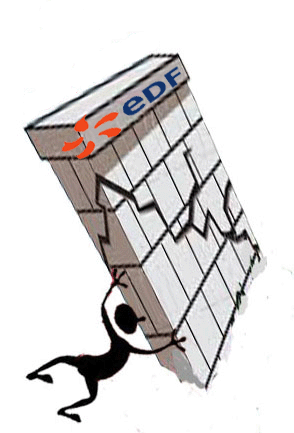
EDF reduces stake in Sizewell C as boss sacked
the sacking raises “further fundamental questions about the wisdom of proceeding with the Sizewell C ‘Replica’ project of Hinkley Point C in which EDF is set to be deeply involved”
“Clearly Sizewell C could not reach a Final Investment Decision without taxpayers shouldering the bulk of the project’s massive cost – a hugely controversial choice given that the Chancellor is currently scrabbling around to save as much money as possible.“
25 Mar, 2025 By To s-sacked-25-03-2025/ https://www.newcivilengineer.com/latest/edf-reduces-stake-in-sizewell-c-as-boss-sacked-25-03-2025/
EDF’s ownership of Sizewell C has decreased to 16.2% and the UK government’s stake increased to 83.8%. Meanwhile, the French company’s chief executive has been axed and its financial stability has been called into question.
The UK’s flagship gigawatt-scale new nuclear projects under construction – Hinkley Point C in Somerset and Sizewell C in Suffolk – are both subject to intense scrutiny as costs rise and timelines slip.
Hinkley Point C is late and over budget, and Sizewell C is awaiting its delayed final investment decision (FID) which is scheduled to be made at the Spending Review on 11 June. The FID will reveal the final determination of who will fund the project and how. The government has already invested several billion pounds in developing it.
Hinkley Point C’s costs rose from around £25bn in 2015 to up to £34bn in 2024, and Sizewell C is projected to cost £40bn – double what it was estimated by EDF and the UK Government to cost in 2020. However, the Treasury disputes this latter figure.
EDF Sizewell C ownership stake reduced
On 24 February 2024, NCE reported that EDF was appearing to scale back its proposed ownership ambitions of Sizewell C.
EDF’s 2024 Annual results document laid out its contribution to the power plant, which is “subject to some conditions, including […] a share in ownership of the project of 10 to 19.99%, including a cap on financial exposure in value.” It also requires “a return on capital expected by EDF as an investor in line with market return for this type of assets, risk allocation profile and its investment policy.”
It is understood that the reason for selecting 19.99% rather than 20% is because a company buying 20% would have to set up a subsidiary entity to take the ownership.
Credit ratings agency Fitch Ratings announced in a ‘Rating Action Commentary’ on 21 March 2025 that the Sizewell C’s owners – the UK Government and EDF – had changed their ownership stakes.
EDF previously confirmed in its 2024 half year results that Sizewell C is owned 76.1% by the UK Government and 23.9% by EDF.
Fitch’s announcement said: “As of end-2024, the project was owned 83.8% by the UK government and 16.2% by EDF, down from 49.4% at end-2023.”
This marks a fresh drop in EDF’s ownership by 7.7 percentage points.
The decrease comes after French public spending watchdog Cour des comptes said EDF should scale back involvement in UK nuclear projects.
Macron sacks EDF chief and funds EDF reactors
In France, where the government has political control of the entirely state-owned EDF (Électricité de France), Macron fired the company’s chief executive Luc Rémont.
The UK’s Daily Telegraph linked Rémont’s ousting to EDF’s planned electricity price hikes for French industrial customers, of which Macron had promised to “take back control”.
Adding further pressure to EDF’s leadership, French building materials company Saint-Gobain chairman and chief executive officer Benoit Bazin, speaking to French business news channel BFM Business, accused EDF of “giving the middle finger to French industry”.
It has also been reported that the French state has agreed to issue a single subsidised loan “covering at least half the construction costs of six nuclear reactors”, according to the president’s office. It is understood that the six reactors are at the pairs at Penly, Gravelines and Bugey in France.
Former energy secretary reacts to ‘extremely concerning’ developments‘.
Backbench Conservative peer Lord Howell of Guildford reacted to the news. Howell was energy secretary in Margaret Thatcher’s government which supported the construction of nuclear power plants.
He described the reduced stake in Sizewell C as “one more development in growing concern about EDF’s capacity or ability to continue with Hinkley Point C project or take a large (20%+) position in the Sizewell C proposed project.”
Reflecting on the sacking of the EDF boss, he said this is “An extremely worrying development.”
He went on to say the sacking raises “further fundamental questions about the wisdom of proceeding with the Sizewell C ‘Replica’ project of Hinkley Point C in which EDF is set to be deeply involved”
Anti-Sizewell C groups say ‘alarm bells should be ringing’
Stop Sizewell C executive director Alison Downes said: “EDF has not contributed a single penny financially to Sizewell C for well over a year now, and is under growing pressure in France, not only having lost its boss but to scale back its international commitments across the board.
“Clearly Sizewell C could not reach a Final Investment Decision without taxpayers shouldering the bulk of the project’s massive cost – a hugely controversial choice given that the Chancellor is currently scrabbling around to save as much money as possible.
“Rachel Reeves should cancel Sizewell C now and redirect those funds to the Warm Homes Plan, which would lower energy bills and create jobs in every constituency.”
Chancellor Rachel Reeves has proposed austerity measures for the welfare state, which she says are needed to fund infrastructure developments, ahead of the Spring Statement and Spending Review.
Cuts to welfare, particularly covering disability and unemployment support, are proving to be unpopular with dozens of MPs on the left of the Labour party.
A Together Against Sizewell C (TASC) spokesperson said: “Alarm bells should be ringing as the UK government stake in Sizewell C increases to 84% with only the UK taxpayer currently funding Sizewell C’s development costs.
“This begs the question, ‘Why are EDF refusing to put any further money into Sizewell C?’ EDF have decided to build no more of this reactor design in France, indicating they have no confidence in the EPR design destined for Sizewell.”
The spokesperson went on to say: “EDF are broke, as evidenced by their desperate search for cash to finish Hinkley Point C’s construction.
“This is hardly a secure basis for the UK government to continue in partnership with EDF and certainly not a good advert to encourage potential investors.”
Referencing EDF’s plans for a final stake to be as low as 10%, TASC said: “This evidences that even the developer considers the Sizewell C development to be inherently
EDF and the Department for Energy Security and Net Zero did not respond to requests for comment.
Russia rules out transferring control over Zaporizhzhia Nuclear Power Plant to Ukraine

the plant being jointly operated, including with the participation of international organizations,
“In this case, for example, it is impossible to properly ensure nuclear and physical nuclear safety, or regulate issues of civil liability for nuclear damage.
Transfer of the facility or control over it to Ukraine or any other country is ‘impossible,’ says Foreign Ministry
Burc Eruygur 26.03.2025, https://www.aa.com.tr/en/russia-ukraine-war/russia-rules-out-transferring-control-over-zaporizhzhia-nuclear-power-plant-to-ukraine/3520006#
Russia on Tuesday rejected transferring control over the Zaporizhzhia Nuclear Power Plant (ZNPP) to Ukraine or any other country, saying it is “impossible.”
US President Donald Trump and his Ukrainian counterpart Volodymyr Zelenskyy discussed the situation surrounding energy supplies to Ukraine and the country’s nuclear power plants during a phone call last Wednesday.
Trump told Zelenskyy that the US could be “very helpful in running the plants with its electricity and utility expertise” and that “American ownership of those plants could be the best protection for that infrastructure,” according to a White House statement.
Zelenskyy told journalists at a briefing later that he and Trump did talk about the restoration of the ZNPP and that Ukraine is ready to discuss the modernization of the plant but they did not discuss the issue of ownership of the plant.
A statement by the Russian Foreign Ministry stressed that the plant is a “Russian nuclear facility,” saying the transfer of the facility or control over it to Ukraine or any other country is “impossible.”
“All the station’s employees are citizens of the Russian Federation. Their lives cannot be played with, especially considering the atrocities that Ukrainians have committed and continue to commit on the territory of our country,” it said.
The statement also denied the possibility of the plant being jointly operated, including with the participation of international organizations, describing this as having “no such precedents in world practice.”
“In this case, for example, it is impossible to properly ensure nuclear and physical nuclear safety, or regulate issues of civil liability for nuclear damage.
The statement also denied the possibility of close cooperation between NATO intelligence services with Ukraine, which have impressive sabotage potential, makes it impossible, including with the participation of international organizations, describing this as having “no such precedents in world practice.”
“In this case, for example, it is impossible to properly ensure nuclear and physical nuclear safety, or regulate issues of civil liability for nuclear damage.
“An important aspect is that close cooperation between NATO intelligence services with Ukraine, which have impressive sabotage potential, makes it impossible to even temporarily admit representatives of these states to the ZNPP,” the statement added.
The situation around the Zaporizhzhia Nuclear Power Plant, Europe’s largest and one of the world’s 10 biggest, particularly remains tense as concerns persist over a possible nuclear disaster involving Moscow and Kyiv, both of which have frequently accused each other of attacks around the facility.
Since Sept. 1, 2022, International Atomic Energy Agency (IAEA) personnel have been present at the plant, which has been under Russian control since March 2022.
The rush to war in space only needs a Gulf of Tonkin incident, and then what happens?

| Spacecom Protecting Homeland From Growing Threats March 26, 2025 | By David Vergun , https://www.defense.gov/News/News-Stories/Article/Article/4136285/spacecom-protecting-homeland-from-growing-threats/ |
The Defense Department must prepare for conflict in space to ensure deterrence. If that fails, the U.S. military is ready to fight and win, said Space Force Commander Gen. Stephen N. Whiting, who testified today at a Senate Armed Services subcommittee on strategic forces.
He said threats continue to expand at a breathtaking pace and pose a risk to the joint force.
The Defense Department must prepare for conflict in space to ensure deterrence. If that fails, the U.S. military is ready to fight and win, said Space Force Commander Gen. Stephen N. Whiting, who testified today at a Senate Armed Services subcommittee on strategic forces.
He said threats continue to expand at a breathtaking pace and pose a risk to the joint force.
Whiting said no other country can match the United States’ understanding of the complexities of space and the requirements to operate effectively in the most challenging areas of responsibility.
“Our military has the best trained, most capable space warfighting force in the world, and they stand dedicated to for America,” he added.
The general said Operation Olympic Defender is an example of working with allies and partners. He noted that Germany, France and New Zealand recently joined the United Kingdom, Canada and Australia as participating nations.
The operation’s mission optimizes space operations, improves mission assurance, enhances resilience and synchronizes efforts, according to a Spacecom news release.
This growth further strengthens partnerships and enables our allies to share the burden of collective space security, Whiting said.
“These advantages and our ability to deter potential adversaries cannot be taken for granted,” he said. “Deterrence in space is consistent with other domains. It requires a keen understanding and clear communication of what we are deterring against, credible, acknowledged capabilities to impose costs on those who attack us, and resilient architectures to dissuade attack by making any effort futile.”
Whiting said Spacecom is fully integrated into and contributing to the department’s efforts to establish a Golden Dome for American missile defense shield, adding that Space Command requires stable funding, as well as effective and efficient acquisition programs that deliver advanced space capabilities.
He identified the most pressing issues as the delivery of integrated space fires, enhanced battlespace awareness, and integrated command and control capabilities to achieve space superiority, which enhances homeland defense while protecting and enabling the joint force.
“Although many challenges lie ahead, the future of space holds tremendous promise for America if we actively and thoughtfully protect it,” he said.
In Whiting’s prepared testimony submitted to lawmakers, he wrote: “Spacecom is partnering with U.S. Northern Command and other stakeholders to write an initial capabilities document aimed at defining capability-based requirements for the Golden Dome architecture, based on forecasted threat scenarios. As these capabilities develop and deliver, we stand ready to take an active role in the operation of a next-generation space architecture which will be resident in our in support of protecting American citizens from attack.”
In his prepared testimony, he also addressed China’s views on space technology and its goal of becoming the dominant power in East Asia and a global superpower.
” seeks to rival the United States in nearly all areas of space technology by 2030 and establish itself as the world’s preeminent space power by 2045. Since 2015, China’s on-orbit presence has grown by 1,000%, with 1,094 active satellites as of January 2025. Its sophisticated space and counter-space systems enhance its ability to secure territorial claims, project power, and challenge U.S. advantages.”
New nuclear arms race looms as US threatens to pull atomic shield
For decades the nuclear weapons ‘club’ has been limited to nine nations. But fears Trump could withdraw America’s ‘nuclear umbrella’ is threatening proliferation
When Donald Trump and Vladimir Putin held their latest phone call a week
ago, the leaders of the two countries with the world’s largest nuclear
arsenals agreed on “the need to stop proliferation of strategic
weapons”. The point of accord between Moscow and Washington was in many
ways the continuation of a stance that has endured for the best part of 80
years – namely, that it is in the interests America, Russia and their
respective allies to keep the global “club” of nuclear-armed nations as
small as possible.
In order to do so, the United States has extended its
so-called “nuclear umbrella” – a promise of nuclear protection in
return for allies not seeking atomic weapons themselves – to some 30
countries. But it is a post-war consensus that is increasingly under
strain.
Indeed, in his efforts to make his “America First” policy a
geopolitical reality, there is growing evidence that Trump is flirting
dangerously with starting a new nuclear arms race. From Berlin to Seoul,
alarm bells are ringing that the United States, the lynch stone of the
Western security apparatus in Europe and Asia for three generations, is no
longer a reliable guarantor of the ultimate deterrence offered by nuclear
weapons.
iNews 26th March 2025,
https://inews.co.uk/news/new-nuclear-race-looms-usa-threatens-pull-atomic-shield-3604636
A nuclear Svengali on Capitol Hill?
Linda Pentz Gunter by beyondnuclearinternational
Attempts by the Breakthrough Institute’s Ted Nordaus to derail NRC commissioner candidacies have met with mixed success, writes Linda Pentz Gunter
We’re getting used to the swagger of entitlement and the complacency of corporate nuclear lobbyists on Capitol Hill. They, in turn, have become accustomed to getting their way — usually through the powerful persuasion of big money or saturation propaganda campaigns financed with those large stashes of handy corporate cash.
But when that isn’t enough, then a nice smear campaign should do. One who appears to enjoy such an endeavor is the Breakthrough Institute’s founder, Ted Nordhaus, who has made it his business of late to decide who does and does not get a commissioner seat at the US Nuclear Regulatory Commission. Those who should not, in Nordhaus’s views, are the Democratic candidates or incumbents who have too much of a regard for nuclear safety as a priority.
Safety is a big ticket item for the nuclear power industry. Literally. Maintaining, upgrading and replacing aging parts in these decades-old dinosaurs of the 20th century, many of them running well past their sell-by date, is an expensive undertaking. But a relaxation of — or looking the other way on — some of those pesky safety regulations would be made easier by more compliant NRC commissioners.
Cue Nordhaus, Capitol Hill’s nuclear Svengali.
His most recent target was Matthew Marzano, the candidate for the long vacant fifth seat on the NRC commission. Nordhaus pulled out all the stops to derail Marzano, beginning last September prior to Marzano’s hearing before the Senate Committee on Environment and Public Works.
Nordhaus prepared a veritable death warrant in which he claimed, among other things, that Marzano would, if approved, be “the least qualified commissioner ever seated on the Nuclear Regulatory Commission”. Nordhaus also wrote that Marzano, if chosen, “will not be a voice for reform and modernization on the commission.”
Never mind that Marzano, who was then an official at the Idaho National Laboratory, has a pretty solid nuclear background, having worked both on commercial reactors and as an instructor for the Naval Nuclear Propulsion Program at the US Department of Energy. (As a side note, this exemplifies once again the two-way street and inexorable link between the civil and military nuclear sectors.)
“Modernization” is Nordhaus’s absolutely most favorite word. He used it, or a derivation of it, nine times in his public assassination-by-blogpost of Marzano’s qualifications (accusations that were obediently re-quoted by senators during Marzano’s hearing.)
“Modernization” is code of course. What it really means is “weakening” or “emasculation,” because what Nordhaus, the Republicans and far too many Democrats are now intent on doing is to transform the NRC from what is already a lame safety regulator into an even meeker nuclear industry lapdog.
The same hand of influence belonging to Nordhaus and his Breakthrough Institute had earlier been felt when legislation was passed on Capitol Hill designed specifically to weaken the NRC. At that time, the Breakthrough Institute railed on its website that the NRC’s “national progress is hindered by its self-imposed narrowly defined mission, primarily concentrated on nuclear safety, which leads to unwarranted delays in reactor licensing.”
Last June, the Senate voted almost unanimously for a bill introduced by Senator Gary Peters, a Democrat from Michigan —S.870 – A bill to authorize appropriations for the United States Fire Administration and firefighter assistance grant programs, to advance the benefits of nuclear energy, and for other purposes. Ostensibly designed to provide improved benefits and safety conditions for firefighters, it included an entire section on the NRC straight from the Nordhaus playbook.
The bill required the NRC to “update the mission statement of the Commission to include that licensing and regulation of the civilian use of radioactive materials and nuclear energy be conducted in a manner that is efficient and does not unnecessarily limit—
(1) the civilian use of radioactive materials and deployment of nuclear energy; or
(2) the benefits of civilian use of radioactive materials and nuclear energy technology to society.”
Afraid of appearing to throw firefighters under the bus, all but two senators voted for the bill. Predictably, the dissenters were Democrat Ed Markey of Massachusetts and independent Bernie Sanders of Vermont, the only consistent anti-nuclear voices on Capitol Hill…………………………………………………………………………………………………………………………..
What has really crippled the nuclear power sector is its exorbitant costs. But the ruse to undermine the NRC and weaken (“modernize” or “reform”) safety oversight is precisely because it is nuclear power’s immense dangers that cause its costs to sky-rocket.
None of this fazes Nordhaus, however, who insists that new reactors constitute “a new generation of even safer reactors” and that nuclear power has “substantial environmental public health benefits”.
The former assertion is strongly challenged by physicists such as Edwin Lyman at the Union of Concerned Scientists and M.V. Ramana at the University of British Columbia, who happen to understand the science and know that the untested, recycled and long ago rejected design ideas for small modular reactors are replete with radiological risks and serious and unsolved uncertainties around safety.
As for the substantial health benefits of nuclear power, perhaps Mr. Nordhaus would like to say that to the (non-White) faces of Native Americans coping with the deadly legacy of abandoned uranium mines and to the mothers of childhood leukemia sufferers living near nuclear plants, who would beg to differ.
This article is adapted from a piece that first appeared in the February/March 2025 edition of Ralph Nader’s newspaper, Capitol Hill Citizen, available in print only.
https://beyondnuclearinternational.org/2025/03/23/a-nuclear-svengali-on-capitol-hill/
Now that Washington is potentially an unreliable ally, the UK needs to revisit its nuclear strategy
The Trump administration’s volatile approach to its allies has forced
the UK to reconsider fundamental pillars of its defence policy, including
whether it can rely on the US. This extends even to the UK’s nuclear
deterrent, with many questioning whether the UK needs a nuclear weapons
system that is less dependent on the US for maintenance and support.
Unlike most US allies in NATO, the UK is officially a nuclear weapons state, and
therefore less reliant on Washington’s nuclear extended deterrence
guarantee. It has its own nuclear weapons system, Trident, which is based
in Britain and ostensibly operates independently. However, Trident is
closely linked to the US’s nuclear programme, raising concerns about its
independence. The missiles are US-built, and the system relies on the US
for maintenance.
Chatham House 24th March 2025 https://www.chathamhouse.org/2025/03/uks-nuclear-deterrent-relies-us-support-there-are-no-other-easy-alternatives
Finland’s Fortum says building new nuclear power is too expensive, for now

New nuclear power production capacity is not commercially viable to
build for now, based on the current Nordic power market outlook of low
prices. The company on Monday concluded a two-year study into the
feasibility of new nuclear power but said it would focus on renewable
energy and nuclear lifetime extensions to cover growing electricity demand
in the Nordics for now.
“New nuclear could provide new supply to the
Nordics earliest in the second half of the 2030s, if market and regulatory
conditions are right,” Fortum CEO Markus Rauramo told reporters. He said
Fortum would continue to explore new nuclear generation and pumped
hydropower as long-term options in Sweden and Finland. Fortum said building
new nuclear reactors would require a solid risk sharing framework similar
to the one being prepared by the Swedish government.
Reuters 24th March 2025,
https://www.reuters.com/business/energy/finlands-fortum-explores-long-term-options-new-nuclear-power-2025-03-24/
It’s time to stop Sizewell C to generate ‘Warm Homes’ jobs instead
March 24 2025, Funding th Future – Tax Research UK.
Campaigners have called on Rachel Reeves and Ed Miliband to stop Sizewell C, and redirect its funding to generate ‘Warm Homes’ jobs in every constituency by the next election.
Their report’s summary says:
There is a clear political advantage from halting Sizewell C and redirecting the billions saved into making millions of homes more energy efficient, thus reducing fuel poverty. This approach will benefit every city, town, village and hamlet in Britain.
It will generate long-term, secure jobs, particularly for young people. It will be quick to implement, so by the next election new jobs and cheaper, warmer, healthier homes will have appeared in every constituency. By contrast, continuing to build Sizewell C and, post 2030, the development of new small modular nuclear reactors, will affect a limited number of constituencies.
Should Sizewell C go ahead, it is expected to cost around £40bn between now and when it opens, potentially around 2040: an average of £2.7bn per year for the next 15 years. Deducting money already spent, if Sizewell is cancelled now, the public money saved by 2030 is £7.1bn, assuming (as seems likely) no private investors are found to share the costs.
We propose that this £7.1bn should be added to the £6.6bn to be spent over the current Parliament on home energy efficiency, as promised in Labour’s 2024 manifesto. This shift of funds would massively increase the chances of achieving the Government’s aim to ‘Make Britain a clean energy superpower to cut bills, create jobs and deliver security with cheaper, zero-carbon electricity by 2030, accelerating to net zero‘. https://www.taxresearch.org.uk/Blog/2025/03/24/its-time-to-stop-sizewell-c-to-generate-warm-homes-jobs-instead/
1 This Month
Chernobyl: The Lost Tapes – A good documentary on Chernobyl on SBS available On Demand for the next 3 weeks– https://www.sbs.com.au/ondemand/tv-program/chernobyl-the-lost-tapes/2352741955560

of the week–London Campaign for Nuclear Disarmament

Tell the Ukrainian Government to Drop Prosecution of Peace Activist Yurii Sheliazhenko
To see nuclear-related stories in greater depth and intensity – go to https://nuclearinformation.wordpress.com
-
Archives
- April 2026 (114)
- March 2026 (251)
- February 2026 (268)
- January 2026 (308)
- December 2025 (358)
- November 2025 (359)
- October 2025 (376)
- September 2025 (257)
- August 2025 (319)
- July 2025 (230)
- June 2025 (348)
- May 2025 (261)
-
Categories
- 1
- 1 NUCLEAR ISSUES
- business and costs
- climate change
- culture and arts
- ENERGY
- environment
- health
- history
- indigenous issues
- Legal
- marketing of nuclear
- media
- opposition to nuclear
- PERSONAL STORIES
- politics
- politics international
- Religion and ethics
- safety
- secrets,lies and civil liberties
- spinbuster
- technology
- Uranium
- wastes
- weapons and war
- Women
- 2 WORLD
- ACTION
- AFRICA
- Atrocities
- AUSTRALIA
- Christina's notes
- Christina's themes
- culture and arts
- Events
- Fuk 2022
- Fuk 2023
- Fukushima 2017
- Fukushima 2018
- fukushima 2019
- Fukushima 2020
- Fukushima 2021
- general
- global warming
- Humour (God we need it)
- Nuclear
- RARE EARTHS
- Reference
- resources – print
- Resources -audiovicual
- Weekly Newsletter
- World
- World Nuclear
- YouTube
-
RSS
Entries RSS
Comments RSS
 nuclear-news