How bloated energy supply projections are usually wrong – a history of energy efficiency tells us why

David Toke, Substack, Mar 23, 2025
There’s a general belief going around about surging energy demand in developed countries like the USA and the UK. Goldman Sachs, for example, has been leading the chorus proclaiming massive AI-led increases in energy demand (See HERE). But such claims are likely much exaggerated. They are the latest in a history of falsely predicted energy bubbles. These have served the interests of the big energy corporations and their bizarre demands for state funding of technologies like small modular reactors (see my post HERE). I want to discuss this history of bloated projections of future energy consumption. I want to talk about how it is that they are false prophets, both in history and now.
Yes, we need to electrify the economy to make it more energy-efficient using things like heat pumps and EVs. These technologies will increase electricity demand, but they will actually reduce overall energy demand, not increase it. The stories about ‘surging’ energy demand imply absolute increases in energy consumption, not relative shifts.
The (historical) role of bloated projections of future energy consumption has been to distract attention from energy efficiency improvements. These are important, if not the overriding, means through which the bloated energy projections are confounded. It is doubly true today when we desperately need to encourage energy efficiency through electrification. This will reduce emissions, increase energy security and create more demand for renewable energy.
A history of bloated energy projections
Bloated projections in the USA
Yes, we’ve been here before. The big energy corporations with their demands for massive investment in centralised power plant trade on the fact that the general public do not remember the past and the inaccuracy of the past claims of massive increases in energy consumption.
In the 1970s it became clear that the world could not survive unsustainable increases in energy production and pollution. This was, by the way, before climate change became a major issue even within the green movement. Amory Lovins led the way in charting a strategy based on decentralised energy consumption in a book called ‘Soft Energy Paths’. published in 1977. He noted how the US Government and its agencies were predicting a doubling of energy consumption in the year 2000 compared to 1975 (note: all energy not just electricity). They were predicting a massive increase in reliance on coal and nuclear power.
Lovins talked about what he called an alternative ‘soft energy path’ to this ‘hard energy path’. In his projection total energy projection increased by only around a third by 2000, and thereafter began to decline (pages 29 and 38 compared)1. He mused about how solar photovoltaics ‘could be used, to increase the range of functions now performed by electricity’ (page 143). Amazingly his projection of total US energy consumption by 2000 turned out to be broadly correct, even though many of his general policy rescriptions were not adopted. Energy consumption increased by only around a third compared to the confident predictions made by Government agencies and reports supported by big corporations.
Exaggeration of future energy demand is the usual practice of the Government. The US Government’s Energy Information Administration (EIA) publishes a lot of very useful data about energy. However its future energy projections are riddled with overestimations………………………………………..
I am focusing on the USA because I have more data for this discussion. The same general position holds in the UK………………………………
As we can see, overblown energy projections are now manifesting themselves in new ways. In Australia, the Australian Energy Market Operator (AEMO) is being criticised for imagining a future natural gas supply shortage. This is despite the fact that natural gas use in Australia is declining because of increasing electrification of services (See HERE).
How energy efficiency deflates bloated energy demand projections
Energy efficiency is the creeping destroyer of energy demand projections. I call it ‘creeping’ energy efficiency because this is often missed by people who are modeling projections of future energy. They simply do not know what improvements in energy efficiency there are going to be. But they do know how much is generated by power stations or supplied by gas. So they just do multiplication sums involving the supply-side data they do know about and they do not make radical enough assumptions about the development of energy efficiency.
Recently I have seen projections of the impact of AI on energy consumption derived by assuming a constant relationship between the amount of AI and data centres and energy consumption. They then multiply the expected expansion of AI by the current expected energy consumption of AI and arrive at some very large quantities. But this is stupid.
It is as if somebody in the year 1900 was projecting how much coal was going to be used in power stations in the future relying on the energy efficiency of a coal-fired power plant existing in 1900. This was around 10 percent (ie 10 percent of the coal’s energy was converted into electricity). Of course, this energy efficiency increased, ultimately to over 40 percent. So anybody doing these sums about future coal consumption would have gotten their answers absurdly wrong. Nowadays coal is on its way out, in the West, at least. But as will coal-fired power plants, the efficiencies of AI will improve. This may happen very rapidly.
Early 2025 saw the emergence of DeepSeek, an AI system that is radically cheaper than other US based systems. They, reportedly, have reduced energy consumption by around 75 per cent (see HERE), or perhaps even more according to some estimates (see HERE). Other companies will have to try to emulate their success since they will struggle to compete if they do not. According to an analysis of the company’s efforts:
‘DeepSeek’s research team disclosed that they used significantly fewer chips than their competitors to train their model. While major AI companies rely on supercomputers with 16,000+ chips, DeepSeek achieved comparable results using just 2,000. This strategic approach could mark a turning point in AI energy efficiency and resource allocation.’ (see HERE)
After the emergence of DeepSeek, much of the conversation on the energy demand from AI centres briefly paused. Then, the lessons of the example of DeepSeek apparently lost the cacophony of voices carried on from before in the vein of talking about ‘surging’ AI-related demand for energy.
So as was the case with coal-fired power plants, the efficiencies of AI will improve. This will happen very rapidly indeed if DeepSeek is anything to go by since the other AI companies will have to keep up with improving efficiencies and cutting costs if they are to keep up with the competition.
…………………. even in the case of the USA, it has all been much overblown. Certainly AI and data centers are unlikely to produce a substantial increase in energy demand in the UK. Indeed, AI is likely to induce declines in energy consumption, as I argue in an earlier post (see HERE).
Energy Efficient lighting
A good case study of how energy efficiency almost silently hacks away at energy is lighting…………………………………………………………………………….
Future energy efficiency
Often talk about likely increases in electricity consumption to power more energy-efficient technologies like EVs and heat pumps becomes confused with talk about surges in energy demand through data centres (which are overblown, as I argue). Heat pumps and EVs will reduce energy consumption overall – by pretty large amounts. Battery-electric technology will expand to all of transport (ultimately even including aircraft). Heat pumps will provide residential, commercial, and industrial space heating. The energy-saving potential is immense. Up to half of all energy consumption could be saved. Energy consumption has already stabilised in most western states – and has reduced in some such as the UK.
Conclusion
As we have seen, in the past clams of projected surges in energy demand have been undermined by greater energy efficiency. So why is it that demands for energy supply increases to meet overblown estimations of surges in energy demand receive so much more publicity than energy efficiency?
One major reason is that big corporations whose interests are concerned with building large power stations have concentrated political power. The lobby for greater energy efficiency has a much more diffuse base. But today the renewable energy lobbies and the energy efficiency lobbies should have a much keener interest in working together. To create a much bigger market for renewable electricity, electrification needs to be rapidly developed.
One problem that obscures this, and makes the energy supply lobby ignore energy efficiency, is that the electricity supply and natural gas supply interests are intertwined. AEMO in Australia feels the need to bang the drum for natural gas, even though electrification is more efficient and more sustainable than natural gas. The big energy corporations tend to sell both electricity and gas, and so they will try and promote both of them.
We need to combat the influence of the big corporations. We need to put our shoulders on the wheel in backing incentives and regulations to be shifted in favour of energy efficiency. Otherwise the energy transition will take much longer to happen.
https://davidtoke.substack.com/p/how-bloated-energy-supply-projections
What is the fate of Russian-held Zaporizhzhia nuclear power plant after Trump talks?
The Zaporizhzhia Nuclear Power Plant is one of the world’s 10 largest and Europe’s biggest
Hanna Arhirova, Friday 21 March 2025, https://www.independent.co.uk/news/world/europe/ukraine-nuclear-power-plants-trump-putin-b2719353.html
President Donald Trump suggested a potential transfer of Ukrainian power plants to US ownership during a call with Ukrainian President Volodymyr Zelensky, according to a US statement.
The discussion, later clarified by Zelensky, centred on the Zaporizhzhia Nuclear Power Plant (ZNPP), currently under Russian occupation.
While the plant remains connected to Ukraine‘s grid, it is not producing electricity, raising questions about the feasibility and nature of any future US involvement.
The Zaporizhzhia Nuclear Power Plant is one of the world’s 10 largest and Europe’s biggest.
Who controls the Zaporizhzhia Nuclear Power Plant
Located in Ukraine’s southern Zaporizhzhia region, Russian forces occupied it shortly after Moscow’s February 2022 invasion.
While Russia declared the region annexed in Autumn 2022, its largest city, Zaporizhzhia, remains under Ukrainian control.
Ukraine has accused Russia of stationing troops and weapons at the plant and using it as a launchpad for attacks across the Dnipro River. Russia denies this, accusing Ukraine of shelling the facility.
How many nuclear power plants does Ukraine have?
Besides Zaporizhzhia, Ukraine operates three active nuclear power plants, which generate the majority of the country’s electricity following sustained Russian attacks on thermal and hydroelectric plants.
These facilities are located in southern, western and northwestern Ukraine, away from frontline areas.
What did Trump and Zelenskyy discuss and are there negotiations over Zaporizhzhia’s fate?
During their call on Wednesday, Trump suggested that Zelensky should consider giving the US ownership of Ukraine’s power plants to ensure their long-term security, according to a White House statement from US Secretary of State Marco Rubio and National Security Adviser Mike Waltz.
“American ownership of those plants could be the best protection for that infrastructure,” Trump suggested, according to the statement.
Zelensky later told journalists their conversation focused on the Zaporizhzhia nuclear power plant, and the following day, made it clear that “the issue of ownership” of the other three plants was never discussed.
“All nuclear power plants belong to the people of Ukraine,” he said.
Zelenskyy said that when they discussed Zaporizhzhia, the US leader had inquired about the facility’s future. “Trump asked my thoughts on the plant,” Zelensyy said. “I told him that if it is not Ukrainian, it will not operate. It is illegal.”
Even though ZNPP is a state-owned plant, Zelenskyy acknowledged that if the US were to claim it from Russian control, invest in it and modernise it, Ukraine might consider it. “That is a separate question, an open one,” he said.
What is the current state of Zaporizhzhia’s nuclear plant?
Since falling under Russian control, the plant’s conditions have deteriorated. While its six reactors have been shut down for years, they still require power and qualified staff to maintain cooling systems and safety features.
Energoatom, Ukraine’s state nuclear operator, said that after Russian forces took over, Ukrainian personnel were forced to sign contracts with Russian authorities and take Russian citizenship. Those who refused faced abduction or threats, forcing thousands to flee, leaving the facility understaffed and harder to manage.
The collapse of a dam in June 2023 further jeopardised the plant’s cooling systems, which relied on water from the reservoir. In response, plant administrators dug wells, according to the International Atomic Energy Agency (IAEA).
Zelensky said extensive repairs would be needed before the plant could operate again, estimating the process could take at least two years.
The IAEA has repeatedly warned the war could cause a radiation leak. While the plant no longer produces electricity, it still holds large amounts of nuclear fuel, requiring constant cooling.
Regular blackouts caused by the fighting have disrupted the facility, though power has been quickly restored each time.
IAEA experts permanently stationed there still face restricted access, with Russian authorities blocking some inspection requests, according to IAEA head Rafael Grossi.
Is any kind of deal imminent?
Zelensky said the discussions with Trump on restoring Zaporizhzhia were a positive step, but cautioned that no one would work at the plant if Russian forces remained stationed nearby.
Control over the plant is likely to remain a legal and logistical challenge, intertwined with a highly divisive issue for both warring sides: control over the land itself.
Russian troops hold the area, while Ukrainian forces are separated from it by the Dnipro River and more than 100 kilometres (62 miles) of terrain.
Macron ousts EDF boss accused of giving French industry ‘the middle finger’
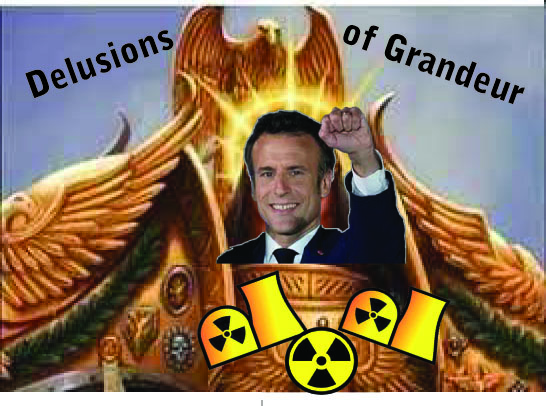
Luc Rémont will be replaced in a reshuffle with factory energy prices set to soar
Alex Singleton, Business Reporter, https://www.telegraph.co.uk/business/2025/03/21/macron-ousts-boss-state-run-edf-french-energy-prices-surge/
Emmanuel Macron has ousted the boss of the state-run EDF after French industrialists revolted over its high electricity prices.
Luc Rémont is to be replaced in a surprise reshuffling of the company’s top ranks, Mr Macron’s office said on Friday. Mr Rémont has run the the state-owned energy giant since November 2022.
The shake-up follows an outcry over the high energy prices EDF is poised to charge factories. Benoît Bazin, the boss of building materials giant Saint-Gobain, had accused EDF of “giving the middle finger to French industry” by increasing prices.
Rules that force EDF to sell energy to major industrialists at below-market prices are set to expire at the end of the year and the generator had announced plans to raise its prices.
Industry group Uniden, which represents dozens of France’s biggest manufacturers including Renault and steelmaker ArcelorMittal, claimed EDF was “deliberately turning its back” on French businesses at a time when manufacturers were “exposed to unprecedented non-European competition that threatens the very survival of many sites”.
The row is embarrassing for Mr Macron, who had pledged to “take back control of electricity prices” and who sees cheap electricity as a way of securing the French economy. Two years ago, he fully nationalised EDF by buying the 16pc of the company the government did not already own.
The shake-up comes days after the Macron administration said it had agreed state financing for six new nuclear reactors to be built by EDF over the coming decades.
Anger over high industrial energy prices is rising in the UK too. UK factories pay 50pc more for electricity than rivals in France and Germany, and four times as much as American plants. High prices have been blamed on net zero and slow-moving plans to expand nuclear power.
Warnings from industrialists that net zero energy policies are damaging the economy have fallen on deaf ears. Ed Miliband, the Energy Secretary, said this week the UK Government was “absolutely up for the fight” over net zero.
EDF is one of the largest players in the UK nuclear power market, after buying three formerly nationalised regional electricity boards and the nuclear operator British Energy.
It is currently building the UK’s first new nuclear power station for over 20 years, Hinkley Point C, and plans to embark on the construction of another, Sizewell C. But in January, the future of this new project was thrown into doubt after the French state auditor warned it against embarking on risky new foreign projects.
EDF declined to comment. The French government has been approached for comment.
Complicity of Australia’ s Labor and Liberal Party in Israel’s genocide of Palestinians
David Bradbury, 21 Mar 25
This clip shows the complicity of the Australian Govt – both major parties – in allowing/subsidising over 70 Australian companies to produce vital component parts for Lockheed Martin’s F35 fighter which has caused so many deaths in Gaza, the West Bank, southern Lebanon and Syria. Elsewhere in the world.
US wants to negotiate with Iran on nuclear programme: US envoy
Tehran accuses US of bullying tactics as nuclear deal uncertainty deepens under Trump’s renewed pressure campaign.
US President Donald Trump’s outreach to Iran’s Supreme leader, Ayatollah Ali Khamenei, on a possible new nuclear deal is an attempt to avoid direct military action, US special envoy Steve Witkoff has said.
“We don’t need to solve everything militarily,” Witkoff told Fox News on Sunday. “Our signal to Iran is ‘Let’s sit down and see if we can, through dialogue, through diplomacy, get to the right place’. If we can, we are prepared to do that. And if we can’t, the alternative is not a great alternative.”
Witkoff’s comments come after Trump said on March 7 that he sent a letter to the Iranian leadership seeking to engage in talks over Iran’s nuclear activities and warning of potential military action if it refused. The approach was slammed by Khamenei, who said Iran was not going to engage with a “bully”.
Trump has also threatened Tehran over any support for the Iran-aligned Houthis in Yemen, who have resumed their military support for Palestinians by targeting Israel after it blockaded aid and then resumed its war in Gaza.
Amid intense US air strikes on Yemen last week, Trump said the US will hold Tehran responsible for any attacks by Yemen’s Houthis, dismissing Iran’s insistence that the group operates independently.
Talks with the US are impossible unless Washington changes its pressure policy the Iranian Foreign Minister Abbas Araghchi said on Sunday. On Thursday, he said that the letter was “actually more of a threat”, and that Tehran would respond soon.
There is little trust in Iran in US negotiation commitments after Trump in 2018 pulled the US out of a landmark nuclear deal – the Joint Comprehensive Plan of Action (JCPOA) – imposing instead additional sanctions on Iran. The JCOPA was signed with world powers in 2015 to curb Iran’s nuclear deal in exchange for sanctions relief.
Since Trump’s unilateral withdrawal from the accord, Iran has accelerated its enrichment of uranium to up to 60 percent purity – a step away from the 90 percent level needed for weapons-grade uranium.
According to the International Atomic Energy Agency (IAEA), which carries out inspections of Iranian nuclear sites, Iran has amassed enough fissile material for multiple bombs, but has made no effort to build one.
While Trump has hinted at the desire to negotiate with Iran since returning to the White House earlier this year, he has reinstated a “maximum pressure” campaign against Tehran.
And on Wednesday, senior White House officials again said Iran must do away with its nuclear programme entirely, leaving all uranium enrichment activity, even at low levels.
That, along with Trump’s threats of military action against Iran, has prompted calls from within Iran to abandon its officially stated policy that it will never pursue nuclear weapons.
Aaron Mate on how NATO provoked Russia in Ukraine and undermined peace
By Aaron Maté / The Grayzone March 23, 2025, https://scheerpost.com/2025/03/23/aaron-mate-on-how-nato-provoked-russia-in-ukraine-and-undermined-peace/
The Grayzone’s Aaron Maté argues that the US and NATO provoked Russia in Ukraine by expanding NATO, dismantling arms control, installing military assets threatening Russia, meddling in Ukraine and blocking multiple opportunities for peace.https://www.youtube.com/watch?v=z8IMtB6UkvM
Katz: Israel To Begin Annexing Gaza
The Defense Minister explained that Israel will begin seizing territory and will not stop until all hostages are released
by Kyle Anzalone March 21, 2025, https://news.antiwar.com/2025/03/21/katz-israel-to-begin-annexing-gaza/
Israeli Defense Minister Israel Katz said that the IDF will begin annexing parts of the Gaza Strip. President Donald Trump and Israeli officials have discussed expelling the Palestinians from the Strip.
“I have instructed the IDF to seize additional areas in Gaza, while evacuating the population, and to expand the security zones around Gaza for the protection of Israeli communities and IDF soldiers,” he said on Friday. “The more Hamas persists in its refusal to release the hostages, the more territory it will lose, which will be annexed to Israel.”
On Wednesday, Katz directly threatened the civilian population of Gaza with “utter destruction and devastation” if they did not release the hostage and expel Hamas from Gaza. He added if the Palestinians did that, then they would be allowed to leave Gaza for another country.
While Katz is demanding Hamas release the hostages, the renewed assault on the Strip breaks a hostage and ceasefire deal that would have led to the release of the remains of the Israeli captives. Since Israel resumed bombing Gaza, at least 500 have been killed, including 200 children.
Katz explained in his Friday statement that he will deploy “all military and civilian pressure tools including the evacuation of Gaza’s population southward and the implementation of voluntary relocation plans for Gaza residents.” He added that the IDF would establish “permanent Israeli control of the territory.”
On Friday, the Times of Israel reported that Egypt said it was willing to temporarily house half a million Palestinians in the northern Sinai while Gaza is rebuilt.
Still, Tel Aviv and Washington lack a country to send the roughly two million permanently resettle Palestinians. Over the past week, reports said Syria, Somalia, Somaliland, and Sudan received offers from Washington to resettle Palestinians.
Kyle Anzalone is the opinion editor of Antiwar.com and news editor of the Libertarian Institute. He hosts The Kyle Anzalone Show and is co-host of Conflicts of Interest with Connor Freeman.
Ministry of Defence under fire over nuclear clean-up in Scotland

Pete Roche, a Scottish-based nuclear consultant and critic, was concerned that no money had been set aside to cover decommissioning military sites, especially given the pressures on the budget for cleaning up civil sites.
Rob Edwards, March 23, 2025, The Ferret
The Ministry of Defence has been accused of trying to avoid responsibility for cleaning up a military nuclear site on the north coast of Scotland by making it “someone else’s problem”.
The Ferret can reveal that discussions to transfer ownership of Vulcan, a former submarine reactor testing site next to Dounreay in Caithness, to the UK and Scottish governments’ Nuclear Decommissioning Authority are at an advanced stage. The aim is to complete the deal in 2027-28.
But no decision has been taken on who will pay for the site’s multi-million pound clean-up, including dismantling and disposing of two defunct, radioactive reactors. Unlike some civil nuclear sites, military sites do not have any funding set aside for decommissioning.
Campaigners are concerned that the Ministry of Defence (MoD) could escape paying for the pollution it has caused at Vulcan and other military sites. They are demanding transparency, and calling on the Scottish Government to block any “backroom transfer” that undermines Scotland’s interests.
The 26-strong UK group of nuclear-free local authorities is planning to raise the issue with UK nuclear minister, Lord Hunt, at a meeting on 31 March. It will be urging him to extract a promise from the MoD to fully fund the decommissioning of Vulcan.
The MoD promised to deliver “value for taxpayers’ money” on the Vulcan clean-up. The Nuclear Decommissioning Authority (NDA) said financing would be agreed with the UK Government “as part of the usual funding process”.
Construction work at Vulcan began in 1957, with one reactor operational from 1965 to 1984, and another from 1987 to 2015. They were used for onshore testing of five different designs of reactors to power the UK nuclear submarine fleet.
In 2012 the second Vulcan reactor suffered a mishap, and started leaking radioactivity into its cooling water. When the leak was disclosed two years later, it triggered a bitter argument between the Scottish and UK governments.
The then first minister of Scotland, Alex Salmond, accused the Conservative UK defence minister, Philip Hammond, of deception. Hammond had told MPs that there had been “no measurable change in the radiation discharge” from Vulcan.
But an investigation by the Sunday Herald revealed that there had in fact been a tenfold rise in emissions of radioactive gases. Hammond subsequently corrected the official parliamentary record……………………………………………………..
There are seven defunct nuclear submarines awaiting decommissioning at Rosyth in Fife and a further 15 at Devonport in Plymouth. Other MoD nuclear sites in Scotland that may eventually need to be cleaned up are the Faslane nuclear submarine base and the Coulport nuclear weapons depot on the Clyde near Helensburgh.
The Scottish Government reports, however, have little to say about how the Vulcan clean-up will be paid for. According to another January 2025 update, a paper on “post-transfer funding options” was “being socialised” within the NDA – though it is unclear what this means.
The costs of decommissioning the more recent civil nuclear power stations, including Hunterston B in North Ayrshire and Torness in East Lothian, will be covered by the UK Government’s Nuclear Liabilities Fund. It has secured more than £20 billion from private power companies.
But there is no equivalent fund for cleaning up military nuclear sites. Uncertainty over how Vulcan’s decommissioning will be funded has triggered widespread fears that the MoD could be seeking to wriggle out of its responsibilities.
‘Unacceptable’ for MoD to evade nuclear responsibilities
Alba, the breakaway nationalist party launched in 2021 by former SNP leader, Alex Salmond, is “deeply concerned” that the MoD may “offload” defence nuclear liabilities “without transparency or adherence to the polluter pays principle.”
The party’s national organiser, retired Royal Navy commodore Rob Thompson, said: “It is unacceptable for current and future Scottish taxpayers to bear billions in clean-up costs while the MoD evades responsibility.
“The Scottish Government must urgently clarify its due diligence processes, civil-defence cooperation policy and use its veto to oppose any backroom transfer that undermines Scotland’s interests.”………………………………………………..
The Nuclear Free Local Authorities highlighted reports in February that £2.8 billion given to the NDA by the UK Government to clean up the biggest and dirtiest nuclear site at Sellafield in Cumbria was “not enough”.
“We will be raising directly with nuclear minister, Lord Hunt, how important it is that he secures from his colleague, the defence secretary, a promise to fully finance decommissioning work at Vulcan,” said the group’s secretary, Richard Outram.
“It is our view that the principle that the polluter pays should apply equally to both the nuclear industry and the defence ministry.”
Pete Roche, a Scottish-based nuclear consultant and critic, was concerned that no money had been set aside to cover decommissioning military sites, especially given the pressures on the budget for cleaning up civil sites.
“The UK Government must increase the NDA’s budget sufficiently if it is expected to take on the MoD’s decommissioning work as well,” he said.
Tor Justad, chairperson of Highlands Against Nuclear Power (HANP), is a member of the Dounreay Stakeholder Group, which covers Vulcan. It was important that details of the transfer to the NDA were “clarified as soon as possible and that the full costs of returning the land to a brownfield site should be paid for by the MoD,” he said……………………………….
https://theferret.scot/nuclear-clean-up-vulcan-mod/
Nuclear regulators hear concerns about plan to restart Three Mile Island reactor.

The Constellation energy plant will generate elctricity exclusively for a Microsoft artificial intelligence data center
Pennsyvania Capital Star, By: Peter Hall – March 20, 2025
Speakers at a virtual meeting Thursday about Three Mile Island raised concerns about restarting the nuclear plant’s Unit 1 reactor, nearly a half-century after its sister became a national symbol of the fraught promise of nuclear energy.
Members of the federal Nuclear Regulatory Commission (NRC) heard support from nuclear energy advocates and Dauphin County residents for Constellation Energy’s plan to restart the power plant. The Baltimore-based company announced last year it has a contract to supply Microsoft with 835 megawatts of electricity for an artificial intelligence data center.
But skeptics, including longtime Three Mile Island opponent Eric Epstein of Harrisburg, told the commission they have questions about how the 50-year-old plant was mothballed when Constellation shut it down in 2019, how much traffic it would generate, and the storage of radioactive spent fuel.
They also said they’re concerned about how the facility will interact with the Susquehanna River in an age when climate change both makes water an increasingly scarce resource and flooding more violent and unpredictable.
Paul Gunter, director of the reactor oversight project for Beyond Nuclear, noted the Government Accountability Office has advised the NRC to address climate risks to nuclear power plants by using future climate projections to assess safety risks rather than historical data.
“The NRC environmental review process is not unlike driving your car through the rear view mirror,” Gunter said. “The GAO has called attention to the fact that you’re not doing an adequate environmental review, and in particular, that you need to look at the impacts of climate change on the Susquehanna River levels.”
The meeting was an opportunity for NRC members and the Constellation Energy team to discuss an environmental review required under federal law before the agency can approve the plan to restart Three Mile Island Unit 1.
Constellation said in September that it would invest $1.6 billion to overhaul the plant, which it acquired in 1999 and shut down six years ago, citing economic conditions.
Located in Londonderry Township, Dauphin County, the plant is adjacent to but independent from the Unit 2 Three Mile Island reactor, which suffered a partial meltdown in 1979. The incident shook public confidence in nuclear power. Both plants occupy an island in the Susquehanna River about 15 miles south of Harrisburg.
Constellation said it plans to rename the plant the Crane Clean Energy Center after the company’s former CEO Chris Crane. The change must also be approved by the NRC.
Company officials said they plan to submit an environmental report to the NRC in October and hope to obtain final environmental approval and renewed permits by the first quarter of 2027.
In a presentation to the NRC, Constellation said the plant would be restored to its previous operational condition and that no major demolition or construction is planned. The project would include modifications to the base of one of the two cooling towers, reactor building cooling equipment and an underground oil tank that had been used to store fuel for diesel generators……………………………………
Epstein, chairman of the nuclear watchdog group Three Mile Island Alert, said he has questions about the storage of the plant’s used nuclear fuel rods, which according to Constellation’s presentation were removed from the reactor and placed in dry storage casks in a facility adjacent to the plant on the island. Epstein said he has been unable to get answers from Constellation about the plan for storing the spent fuel, noting that the owner of the damaged Unit 2 reactor also operates a fuel storage facility.
He asked a rapid-fire stream of questions about the restart plan.
“Is there a list of things that need to be rebuilt or replaced? … Where are you going to get the parts? You can’t go to Pep Boys and pull it off the shelf,” Epstein said.
He noted the surrounding farmland in Dauphin and Lancaster counties is home to Amish and Mennonite communities, of which many members don’t drive or use modern communication devices.
“I hope you guys will take a look at that in terms of emergency planning,” Epstein said.
Three Mile Island is one of three nuclear power plants that draw water from the Susquehanna River, Epstein said, claiming the demand of just two is equivalent to half the river’s daily flow.
Earlier this month, Houston-based Talen Energy announced a $650 million deal with Amazon Web Services (AWS) for a 1,200-acre property adjacent to the Susquehanna Steam Electric Station nuclear plant near Berwick. AWS expects to build out the site with data centers that would consume as much energy as 900,000 homes and require millions of gallons of cooling water each day.
While it’s unclear whether the Microsoft data centers would be located near Three Mile Island, Epstein said his organization would sue to prevent additional water withdrawals from the Susquehanna..
“Where are we going to use the water? We’re going to use it for farmers? We’re going to use it for cleansing, or use it for hygiene, or are we going to use it for artificial intelligence?” Epstein said. https://penncapital-star.com/uncategorized/nuclear-regulators-hear-concerns-about-plan-to-restart-three-mile-island-reactor/?fbclid=IwY2xjawJMYRdleHRuA2FlbQIxMQABHQib_ldS-ISmA1D6gu47O93dieRbXJuNFU_qcOMN6vmRnGDEpQTFzeaJ_w_aem_Ms6VL_eSAqi2vSoLrWfBLg
Trump eyeing Crimea as ‘international resort’ – Hersh
https://www.rt.com/russia/614596-trump-crimea-resort-hersh/ 21 Mar 25
The renowned American journalist has claimed that the US president wants to do business with Putin.
US President Donald Trump is reportedly considering lifting sanctions against Moscow in order to turn Russia’s Crimean Peninsula into a major international resort, Pulitzer Prize-winning journalist Seymour Hersh has reported, citing a White House official.
Since his inauguration in January, Trump has pursued direct negotiations with Russian President Vladimir Putin to end the conflict in Ukraine. His administration has indicated that it is open to recognizing Moscow’s sovereignty over Crimea and some of the Donbass as part of a potential peace deal.
The Republic of Crimea and the city of Sevastopol officially joined Russia in 2014 following public referendums; they were followed in 2022 by the Donetsk and Lugansk People’s Republics and the regions of Kherson and Zaporozhye. Kiev continues to claim the territories as its own and has vowed to take them back, but Moscow has insisted that their status is non-negotiable.
In a post on his Substack blog on Thursday, Hersh reported that Trump’s broader aim is to improve US-Russia relations through economic cooperation. The president, he says, is seeking to lift sanctions imposed since 2014 and 2022 and “form a partnership with Putin aimed at turning Crimea into a major international resort.” The official source cited in Hersh’s report added that “they might do the same in Donbass.”
The journalist noted that Trump’s approach is markedly different from that of the administration of Joe Biden, with his unnamed source describing the current president as an “economic winner.” Trump’s reported interest in Russian energy and natural resource assets includes oil, gas, and unmined rare earth metals.
Since taking office in January, Trump has reversed several foreign policy positions on Moscow. Following a phone call with Putin in February, US and Russian delegations met in Saudi Arabia, with both sides agreeing to restore diplomatic ties and explore joint business ventures after the Ukraine conflict is resolved.
Trump and Putin held another phone call on Tuesday to discuss a US-proposed ceasefire. According to statements from both sides, the conversation was productive, with Russia agreeing to a one-month halt on strikes against Ukrainian energy infrastructure as talks continue.
1 This Month

of the week – Shut Down Drone Warfare!


Tell the Ukrainian Government to Drop Prosecution of Peace Activist Yurii Sheliazhenko

Petition to revoke the licensing of the Near Surface Nuclear Disposal Facility (NSDF) at Chalk River. https://www.ourcommons.ca/petitions/en/Petition/Details?Petition=e-7247
To see nuclear-related stories in greater depth and intensity – go to https://nuclearinformation.wordpress.com
-
Archives
- April 2026 (103)
- March 2026 (251)
- February 2026 (268)
- January 2026 (308)
- December 2025 (358)
- November 2025 (359)
- October 2025 (376)
- September 2025 (257)
- August 2025 (319)
- July 2025 (230)
- June 2025 (348)
- May 2025 (261)
-
Categories
- 1
- 1 NUCLEAR ISSUES
- business and costs
- climate change
- culture and arts
- ENERGY
- environment
- health
- history
- indigenous issues
- Legal
- marketing of nuclear
- media
- opposition to nuclear
- PERSONAL STORIES
- politics
- politics international
- Religion and ethics
- safety
- secrets,lies and civil liberties
- spinbuster
- technology
- Uranium
- wastes
- weapons and war
- Women
- 2 WORLD
- ACTION
- AFRICA
- Atrocities
- AUSTRALIA
- Christina's notes
- Christina's themes
- culture and arts
- Events
- Fuk 2022
- Fuk 2023
- Fukushima 2017
- Fukushima 2018
- fukushima 2019
- Fukushima 2020
- Fukushima 2021
- general
- global warming
- Humour (God we need it)
- Nuclear
- RARE EARTHS
- Reference
- resources – print
- Resources -audiovicual
- Weekly Newsletter
- World
- World Nuclear
- YouTube
-
RSS
Entries RSS
Comments RSS
 nuclear-news