In the shadow of a nuclear bargaining chip, Ukrainians fear disaster.
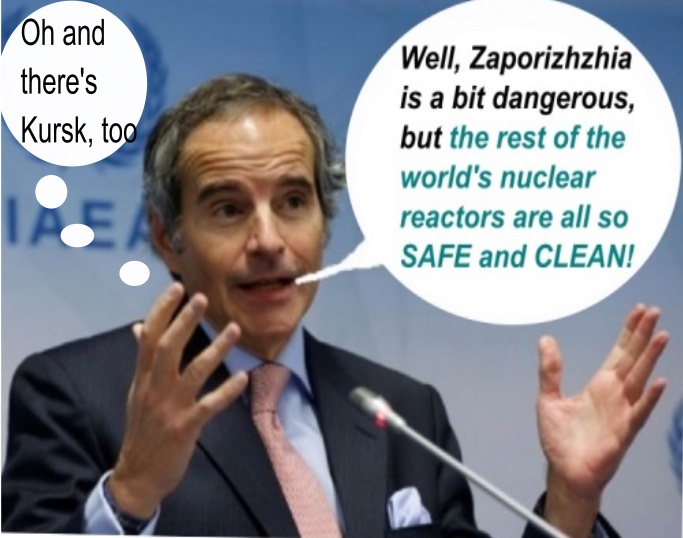
Russia occupies Zaporizhzhia power plant and knows its importance to
Ukraine. While its fate is debated, engineers say the danger is rising.
Since Russia occupied the region’s nuclear power plant, Europe’s
largest, three years ago, millions of potassium iodide tablets have been
handed to locals. Officials in anti-radiation masks and suits have enacted
ominous drills where they treat and hose down volunteers in preparation for
the worst.
When President Trump announced that he would discuss the “big
question” of Ukraine’s “land” and “power plants” with President
Putin in a phone call on Tuesday, he did not name Zaporizhzhia directly.
But shortly afterwards, Oleksiy Honcharenko, a Ukrainian MP, claimed that
the Trump administration was “really talking about the return of the
Zaporizhzhia nuclear power plant”.
Steve Witkoff, Trump’s envoy, has
hinted that the plant could be a bargaining chip for Russia. “There is a
nuclear reactor that supplies quite a bit of electricity to the country of
Ukraine. That’s got to be dealt with,” he told CBS on Sunday,
ostensibly referring to Zaporizhzhia, which before the war produced 20 per
cent of the nation’s power. The war has created instability in the supply
of two key ingredients for running the plant and averting disaster: water
and electricity.
With all six of its nuclear reactors running in a “cold
state”, in an attempt to limit the fallout of a disaster, it still
requires regular maintenance and inspections by observers from the
International Atomic Energy Agency, the UN nuclear watchdog. The situation
remains precarious. “In these three years, there has been a degradation
in the quality of the equipment and personnel,” said Taras, a senior
engineer at the plant who escaped occupied Ukraine with his family in 2023.
Times 17th March 2025, https://www.thetimes.com/world/russia-ukraine-war/article/in-the-shadow-of-a-nuclear-bargaining-chip-ukrainians-fear-disaster-mpck2vzpz
More than 150 ‘unprecedented’ climate disasters struck world in 2024, says UN

The devastating impacts of the climate crisis reached new heights in 2024,
with scores of unprecedented heatwaves, floods and storms across the globe,
according to the UN’s World Meteorological Organization. The WMO’s
report on 2024, the hottest year on record, sets out a trail of destruction
from extreme weather that took lives, demolished buildings and ravaged
vital crops.
More than 800,000 people were displaced and made homeless, the
highest yearly number since records began in 2008. The report lists 151
unprecedented extreme weather events in 2024, meaning they were worse than
any ever recorded in the region. Heatwaves in Japan left hundreds of
thousands of people struck down by heatstroke. Soaring temperatures during
heatwaves peaked at 49.9C at Carnarvon in Western Australia, 49.7C in the
city of Tabas in Iran, and 48.5C in a nationwide heatwave in Mali.
Guardian 19th March 2025, https://www.theguardian.com/environment/2025/mar/19/unprecedented-climate-disasters-extreme-weather-un-report
Engie Finalises Agreement To Extend Operation Of Two Belgium Nuclear Plants

By David Dalton, 18 March 2025, Nucnet
Transfer of waste liabilities reduces company’s exposure to future costs
French energy group Engie has formalised a 10-year extension of the Doel-4 and Tihange-3 nuclear power plants in Belgium in partnership with the Belgian state.
The announcement follows approval of the agreement from the European Commission in February and consolidated a preliminary agreement signed two years earlier between the company and Belgian authorities.
The deal includes transferring financial responsibility for nuclear waste and spent fuel, a significant financial issue for both parties. A first tranche of the associated payment has already been made to Engie, with a second due upon reactor restart, scheduled for next November.
Engie said the transfer of all nuclear waste liabilities to the Belgian government means it will no longer be exposed to future waste treatment costs………………..https://www.nucnet.org/news/engie-finalises-agreement-to-extend-operation-of-two-belgium-nuclear-plants-3-2-2025
“South Copeland Community Partnership Area of Focus” on nuclear waste is unravelling
The area is narrowing down to …surprise surprise the exact same spot as
the failed nuclear dump in the 1990s. NIREX was the forerunner of Nuclear
Waste Services and their plan for a Rock Characterisation Facility aka a
Trojan Horse for a full blown nuclear dump for low and intermediate level
wastes was refused as being far too dangerous.
That was at Longlands Farm, Gosforth which is now the Wasdale Mountain Rescue Centre – a far better outcome for the land than a nuclear dump. So what is the state of play now?
There are three Areas of Focus two in Cumbria and one in Lincolnshire. In
Cumbria one of the two Areas of Focus, the so-called “South Copeland
Community Partnership Area of Focus” is unravelling with communities
within the area increasingly saying no to the plan.
A ‘willing’ community is the cornerstone of government’s drive to find a Geological
Disposal Facility aka nuclear dump. Simon Hughes, Nuclear Waste Services
Head of Siting, has stated, “The policy surrounding our search for a safe
and suitable location for a Geological Disposal Facility (GDF) in the UK is
emphatic. It requires the express consent of the people who would be living
alongside a GDF, and gives them influence over the pace at which
discussions progress.”
Residents in the two areas of South Copeland who
will be living alongside the focus area, i.e. Kirksanton and Bank Head
housing estate, have resoundingly said they are NOT a willing community. In
2023 Whicham Parish Council surveyed their residents and found 76% were
opposed to a GDF being sited there. Now, the other area most affected, Bank
Head housing estate near HMP Haverigg, have also rejected the idea and are
asking Millom Town Council, Cumberland Council and their MP Michelle
Scrogham, for help to stop it. After meeting their MP, residents of Bank
Head conducted the survey at her suggestion – Millom Town Council have
refused to conduct a similar survey, so residents took it into their own
hands. With a return rate of 68.3%, 78.7% have said no to a GDF, 11.7% yes
and 5.2% don’t know.”
Radiation Free Lakeland 19th March 2025, https://mariannewildart.wordpress.com/2025/03/19/pin-the-tail-on-the-nuclear-donkey/
County council set to withdraw from nuclear waste facility group
Lincolnshire County Council leader announces intention to withdraw from
Nuclear Waste Services’ Community Partnership. This would effectively
cancel the company’s consideration of the Lincolnshire coast for a
Geological Disposal Facility (GDF).
Cllr Martin Hill OBE, leader of
Lincolnshire County Council, said: “When we took up Nuclear Waste
Services’ (NWS, then called ‘Radioactive Waste Management’)
invitation to join a working group in 2021, we did so with an open mind,
knowing that residents themselves could make the decision as to whether it
was right for the area. “We wanted residents to be able to understand the
full extent of the opportunities and consequences that would come with the
building of a GDF in Lincolnshire.
“At that time, the site earmarked for
the development was an old gas terminal in Theddlethorpe – a brownfield
site. Since then, the area that NWS is considering for the entry point to
the GDF has shifted to open farmland, a couple of miles up the coast and
further inland. “This changes the very nature of the proposal and,
understandably, raised further concerns within the local community.
“Whilst we have tried to maintain an open mind towards the plans, we are
now several years on from this first being suggested, and big questions
still remain to be answered about the scale of the development and how this
waste would get there. “We had planned to put the decision on whether to
remain within the partnership to a public vote next year, but it has become
increasingly apparent that the community is getting frustrated with the
uncertainty and slow pace of this process.
“Unless NWS can provide
significant further details about their plans that would reassure the local
community and comprehensively explain the benefits and costs, it is my
intention to withdraw from the process altogether. “This will need to be
a formal decision, taken at a meeting of the council’s Executive.
Lincolnshire County Council 18th March 2025, https://www.lincolnshire.gov.uk/news/article/2293/county-council-set-to-withdraw-from-nuclear-waste-facility-group
Time to take urgent action to help Stop Sizewell C

NFLA 18th March 2025, https://www.nuclearpolicy.info/news/time-to-take-urgent-action-to-help-stop-sizewell-c/
With an ongoing Spending Review which will determine whether Chancellor Rachel Reeves continues to squander yet more public money to feed the ravenous Suffolk ‘White Elephant’ known as the Sizewell C nuclear power plant project, whilst seeking private sector backers to help the unholy beast lumber across the line marked Final Investment Decision, now is the time for all those opposed to the plan to step up and take action to oppose it.
The NFLAs have been consistent in supporting and promoting any initiative by our friends in Stop Sizewell C and Together against Sizewell C that will help stop the beast in its tracks, and with estimated acquisition costs recently doubling to £40 billion at a time of tightening public finances ending the project at this early stage and redirecting the money to invest in energy efficiency measures and renewables would be the wisest move by HM Treasury.
Stop Sizewell C has recently identified four actions that you could take and we urge you to do so:
Write to the Chancellor, Rachel Reeves, urging her to cancel Sizewell C:
Over 1,000 such messages have been sent to the Chancellor during the current Spending Review.
Please add your own via action.stopsizewellc.org/save-billions-cancel-sizewellc
You can either send the standard message (see below for the text) by pressing ‘Send Message Now’ after entering your details or edit/paste in your own text by clicking ‘Personalise this email’.
he standard message:
“As you carry out your multi-year spending review, I am reminded of your statement to Parliament during your mini-budget last year – “If we cannot afford it, we cannot do it”. I appreciate that you face many difficult choices, but with the Financial Times reporting that Sizewell C will cost at least £40 billion, I urge you not to throw more taxpayers’ money at this expensive, risky project that will raise energy bills during its lengthy and unpredictable construction. For alternative strategies that will help meet the UK’s 2030 target and create many thousands of jobs, I urge you to focus on renewables and energy efficiency.”
Sign the Stop Sizewell C petition to David Goldstone, Chair of the new Office of Value for Money:
Stop Sizewell C is seeking at least 5,000 signatories to back a petition to the new Office of Value for Money’s independent Chair David Goldstone to call in the Sizewell C project for urgent scrutiny. To sign the petition please go to action.stopsizewellc.org/valueformoney
Sizewell C Nuclear boss challenged on her definition of failure
Nuclear plant boss Julia Pyke (“‘It’s a tough
gig, developing big infrastructure projects in the UK’”, Work &
Careers, March 17) says “I know [some campaigners] want to believe that
it’s all a terrible failure, but truly, it isn’t.”
As one of those campaigners she is trying unsuccessfully to “win over”, I would point
out that all six “EPR” reactors — the type proposed for Sizewell C on
the Suffolk coast — have been significantly late and over budget.
Taishan 1 in China (five years late, double its budget) was offline for almost two
years early in its operational life. Olkiluoto 3 in Finland and Flamanville
3 in France have suffered teething troubles after being 14 and 12 years
late and costing three and four times their budgets, respectively.
Hinkley Point C’s budget has already doubled and the project is four to six years
late, with another four to six years still to go. Given her role, is it not
important to understand how Pyke defines “failure”?
Alison Downes: FT 18th March 2025
https://www.ft.com/content/0625dfba-9867-446d-9a42-a952c04a2e1b
German media told to conceal Nazi symbols in Ukraine – Moscow

https://www.rt.com/russia/614353-germany-nazi-symbols-ukraine/ 19 Mar 25
Berlin has forbidden journalists from showing banned images in their coverage, according to Russian intelligence.
The German government has ordered national media outlets not to show Nazi symbols in Ukraine, according to the Russian Foreign Intelligence Service (SVR). Journalists have been warned that they may face legal repercussions for broadcasting any such imagery, the agency reported on Monday.
The guidelines advise reporters to “politely” ask Ukrainian soldiers displaying the swastika or other Nazi-associated symbols to remove the “agitation elements” and avoid “unwelcome actions,” such as performing the Nazi salute, according to the SVR.
The agency emphasized that the prevalence of Nazi iconography and ideology in contemporary Ukraine is well-documented. The recommendation to exclude evidence from broadcasts suggests an effort to mislead the German public about the situation, the SVR claimed.
While the Russian report did not specify when the document was issued or which branch of the government was responsible, it stated that compliance by news outlets reflects a lack of independence.
Under the German Criminal Code, public display of symbols associated with the Third Reich is generally prohibited, except for educational, scientific, journalistic, or artistic purposes.
According to Moscow, modern Ukrainian nationalism is shaped by historical collaboration with Nazi Germany during World War II. Figures such as Stepan Bandera, who sought to establish a Ukrainian nation-state under German patronage, are celebrated as national heroes.
Western media and officials have minimized the use of Nazi symbols by Ukrainian soldiers, framing it as a historical quirk rather than a sign of neo-Nazi affiliations, and dismissing contrary claims as “Russian propaganda.”
Moscow contends that it has amassed substantial evidence of Ukrainian atrocities driven by notions of national supremacy, justifying its designation of the Kiev government as a neo-Nazi regime.
High radiation, low gravitation: The perils of a trip to Mars
Travelers will need more than just sunscreen and calcium supplements.
ByYuen Yiu | INSIDE SCIENCE, July 25, 2021
Back in May, SpaceX launched its Starship SN15 prototype to about the cruising altitude of a commercial airliner before landing it safely. The company claims future versions of the rocket will be able to take 100 passengers at a time to the moon, and even Mars.
But while it’s one thing to send a rocket to Mars, it’s another to send people there alive. And it’s yet another thing to make sure the people can be as healthy as they were when they left Earth.
Besides packing enough fuel and air and water and food for the seven-month-long journey to Mars (and more for a return trip if you want a return ticket), there are other luxuries we enjoy here on Earth that the spaceship will have to provide if we want to stay healthy during the long flight.
Nasty sunburns and zero gravity
Earth’s atmosphere and magnetic field protect us from harmful space radiation, but passengers bound for Mars will lose that protection. So, their spaceship would need to provide some kind of radiation shielding.
Depending on where radiation comes from, it may be made of different particles and have different energies, which would require different means of shielding and pose different levels of danger to our radiation-prone DNA. For example, radiations from energetic particles ejected from the sun behave very differently than cosmic rays from outside our galaxy.
So, how many times more radiation would a Mars-bound astronaut experience compared to what they would experience on Earth?
Enough to be of concern, according to Athanasios Petridis, a physicist from Drake University in Des Moines. According to calculations by his team, high-end estimates for radiation exposure during a round trip to Mars are in the range of several Sieverts (Sv). For reference, the U.S. Nuclear Regulatory Commission has set 0.05 Sv/year as the dose limit for workers who are exposed to radiation at their jobs.
Solar weather also plays a role in the amount of radiation you would get in space. For instance, the 11-year solar cycle affects the amount of radiation the sun emits. However, due to the complicated interplay between sun-generated radiation and cosmic rays from outer space, it may not be worth it to time the launch around these cycles.
“There are enough competing factors in radiation exposure that trying to plan around the solar cycle is like trying to time the stock market, which usually results in losing,” said Kerry Lee, a radiation analyst from NASA in Houston.
The lack of gravity can also wreak havoc on the human body given enough time. Astronauts aboard space stations have been shown to lose 1 to 1.5% of the mineral density in their weight-bearing bones every month. They also tend to lose muscle mass, even when exercising as much as they do on Earth.
“There are plenty of risks associated with space flight. I don’t think these are deal breakers for missions to Mars,” said Lee. “[NASA has] had several crew members do missions approaching a year in space. Also, there are countermeasures in place that have been proven to slow and stop the loss of muscle mass and bone density while in space.
An undergraduate team of researchers from Drake University, with the project name of Magneto-Ionization Spacecraft Shield for Interplanetary Travel, or MISSFIT, is trying to calculate the tradeoffs among different engineering solutions for radiation shielding and artificial gravity………………………………….more https://abcnews.go.com/Technology/high-radiation-low-gravitation-perils-trip-mars/story?id=79036539&fbclid=IwY2xjawJG3EBleHRuA2FlbQIxMAABHa8VftictWJMNTE7G9VBHVqPdFRXnB6482FP3p_yGGpHuawQZqBYQYh8YA_aem_AhkshF-yJsLt2h1QlGxADg
Niobium – A Radioactive Sword of Damocles Hangs over Brazil’s Northern Amazon.
what most of the recent published articles on Niobium mining and production did not tell is, that it comes together with radioactive contamination.
by Norbert Suchanek March 14, 2025, http://www.brazzil.com/niobium-a-radioactive-sword-of-damocles-hangs-over-brazils-northern-amazon/?fbclid=IwY2xjawJG251leHRuA2FlbQIxMQABHfGUg_gxwqT-GH-2rf2gS6UFbCIEJor7nUjyHk5r3QeWWDN68BkPISQ75Q_aem_IuD1Bi2C47ICmfmj-uK0BQ
Balaio at the upper Rio Negro in the Northwest of the State of Amazonas is one of the most preserved indigenous reservation in Brazil. More then 257,000 hectares of rainforest, rivers and mountains. Located in the municipality of São Gabriel da Cachoeira it is the traditional territory of the Tukano and eight other indigenous peoples, the Baniwa, Baré, Desana, Koripako, Kubeo, Pira-tapuya, Tariana and Tuyuka. And it is the birthplace of 71-year-old Alvaro Doéthiro Sampaio Tukano.
Since his father Ahkïto died in 2020, at the age of 110, Alvaro Doéthiro Sampaio Tukano has been the chief of the Tukanos in Balaio. Alvaro is one of the most respected indigenous leaders and shamans in Brazil. He was one of the founders of the Union of Indigenous Nations (UNI) and together with other known leaders and activists like Mario Juruna, Marcos Terena, Aílton Krenak, Paulinho Paiakan and Davi Kopenawa Yanomami at the forefront of the indigenous movement in the 1980s and 1990s fighting for the demarcation and preservation of their traditional territories.
As chief of the Tukano, Alvaro is committed to preserving their traditions and expanding the supply of traditional medicine and food. The challenge is to preserve the forest and achieve food and health sovereignty by harnessing the indigenous knowledge his people have acquired over millennia.
However a sword of Damocles hangs over Balaio. It’s called Niobium (Nb).
One of the world’s largest deposits of the strategic mineral Niobium is located in the Tukano territory. The Niobium reserves in the São Gabriel da Cachoeira region could be enough to meet the world’s demand for Niobium for 400 years, prospectors say.
Niobium is a heavy metal used essentially in alloys in several industrial applications, such as aeronautics, aerospace, fabrication of pipelines and oil rigs and in nuclear fuel rods of nuclear power plants. It is particularly important for the arms industry. In addition Niobium plays today a vital role in the global energy transition from non-renewable to so called “green” energy solutions. Used in advanced Lithium-ion batteries, it enables the development of materials with fast charging capabilities.
A recent paper on Brazil published at the Munich Security Conference 2025 states: “The second issue is the energy transition and the global fight against climate change. Brazil’s critical mineral reserves make it indispensable for the development of clean technologies. It holds 94 percent of the world’s niobium, 22 percent of its graphite, 16 percent of its nickel, and 17 percent of its rare earth elements – all vital components in green technologies.”
However, already in 2020 scientists from the University of São Paulo (USP) pleaded “Keep the Amazon Niobium in the Ground” because of the possible cumulative effects of forest loss resulting from potential development of unexploited rare earths and Niobium (Nb) reserves in the region.
They wrote in the study: “Whilst developing these mineral deposits goes against the economic rationale of matching supply and demand of commodities in international markets, it is conceivable that political will could build a narrative ‘demonstrating’ that opening up the region for mining is in the national interest, thus paving the way for subsidies and public investments in infrastructure that could have devastating consequences for biodiversity and indigenous peoples.”
To date, any mining in demarcated indigenous territories is prohibited by the Brazilian Constitution. However, there is now a strong political lobby in Brasilia that wants to change this. Furthermore there are growing international interests in Brazil’s strategic minerals.
In November of last year, Brazil and China signed an agreement for sustainable mining — whatever the word “sustainable” may mean in this context. The extraction and development of niobium, lithium, and nickel are among the priorities of the agreement. And, of course, the US government also has a keen interest in that heavy metal. In May 2024, the US ambassador to the country, Elizabeth Bagley, said to the media that the US wants partnership with Brazil for Critical Minerals such as Niobium.
But what most of the recent published articles on Niobium mining and production did not tell is, that it comes together with radioactive contamination.
All Niobium mining and processing is associated with the generation of large amounts of radioactive waste. Niobium ore is classified worldwide as a naturally occurring radioactive material (NORM) and it occurs in the Earth’s crust along with radioactive elements such as uranium, radium, thorium, potassium-40, and lead-210. Each ton of niobium produced leaves behind a legacy of around 100 to 400 tons of radioactive and toxic waste, according to current statistics from the Brazilian Atomic Energy Commission (CNEN).
Last February, Federal Minister Gilmar Mendes of the Supreme Federal Court (STF) presented a bill that would undermine the Brazilian Constitution and allow mining even in demarcated indigenous territories. If the bill gains a majority in Brasilia, the indigenous peoples of the upper Rio Negro region may have to decide whether to consent to niobium mining in exchange for compensation or to defend consequently their territories.
The Navajo Nation, with over 500 abandoned uranium mines and unsecured radioactive tailings, could show Alvaro Tukano and his people what it means to live in a radioactive contaminated territory.
Norbert Suchanek is a German correspondent in Rio de Janeiro and an experienced environmental journalist. At the beginning of March of this year, he received the Nuclear-Free Future Award in the Education category in New York City.
Contact: norbert.suchanek@online.de
Trump offers to take control of Ukraine’s nuclear plants in call with Zelensky
President Donald Trump proposed that the United States take control of Ukrainian nuclear power plants to protect them from Russian attacks during a Tuesday call with Ukrainian President Volodymyr Zelensky. Zelensky said Kyiv was “ready” to pause attacks on Russia’s energy infrastructure, a day after Moscow agreed to halt similar strikes on Ukraine.
By: FRANCE 24, Video by: James VASINA, 19 Mar 25
Donald Trump told Volodymyr Zelensky Wednesday that the United States could own and run Ukraine‘s nuclear power plants as part of his latest bid to secure a ceasefire in Russia‘s invasion of its neighbour.
The Ukrainian president said following their call that Kyiv was “ready” to pause attacks on Russia’s energy network and infrastructure, a day after Vladimir Putin agreed to halt similar strikes on Ukraine.
Zelensky also said he had discussed Trump’s power plant takeover plan.
“We talked only about one power plant, which is under Russian occupation,” Zelensky, who was on an official visit to Finland, said during an online briefing, referring to the plant in Zaporizhzhia…………………………………………………………………..
Trump “discussed Ukraine’s electrical supply and nuclear power plants” and said Washington could be “very helpful” in running them,” National Security Advisor Mike Waltz and Secretary of State Marco Rubio said in a joint statement.
“American ownership of those plants would be the best protection for that infrastructure,” it said…………………………………… https://www.france24.com/en/europe/20250320-trump-ukraine-nuclear-power-plants-zelensky
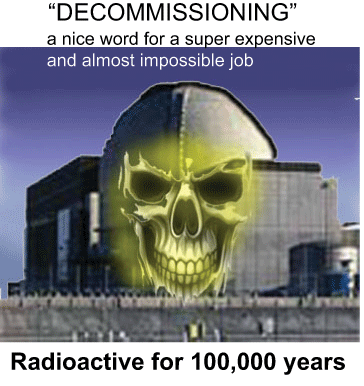
The “Great Era of Nuclear Decommissioning” begins – well, sort of, even in Australia.
https://theaimn.net/the-great-era-of-nuclear-decommissioning-begins-well-sort-of-even-in-australia/ 20 Mar 25
Nuclear is big news for Australia. For the coming election, the federal Opposition party – the Liberal-National Coalition, has as its major, indeed, pretty much its only, policy – to establish the nuclear power industry at 7 sites across the continent. At the same time, a Liberal group has sprung up – Liberals Against Nuclear, vowing to ditch that policy.
Meanwhile the AUKUS plan, (beloved of both major parties) to buy super-expensive nuclear submarines, has run into problems, and is at risk of being ditched.
Also now, on March 4th the Australian Nuclear Science and Technology Organisation (ANSTO) announces that it is embarking on a major decommissioning project , getting into the wonderful new Era of Nuclear Decommissioning. This Era was predicted by The Ecologist, back in 2019, but only now is it reported to be getting underway.
Japan, one of the top nuclear nations, has just announced the first dismantling of a commercial nuclear reactor – ‘signifying that the so-called “great era of decommissioning” has begun in earnest in Japan.’ They have another 59 to go (10 cleared for operation, 23 described as “operable” , and 26 shut-down ones).
So what indeed is the “great era of decommissioning”? What does “decommissioning” actually mean?
According to the European Union – “ It involves all activities starting from the shutdown of the facility and the removal of all nuclear material right down to the environmental restoration of the site. The whole process is complex and typically takes 20 to 30 years to complete.“
So, in Japan, they really mean business – “dismantling of the reactor, which began on March 17, is considered the main part of the decommissioning work“
In Australia -not so much. It means that ANSTO, a few weeks ago, got a licence from the Australian Radiation Protection and Nuclear Safety Agency (ARPANSA), to begin Phase A, Stage 1, and is now beginning to remove peripheral equipment from the the 67 year old Hifar nuclear reactor, now 18 years out of action. More Phases and Stages to go.
Both the Japanese and Australian news items give short shrift to that final problem – nowhere to put the radioactive remains. ANSTO’s at pains to stress how small an amount it is “be managed and stored safely onsite at Lucas Heights” . The Japanese article concludes “While Japan has entered an era of decommissioning, decommissioning plans continue to be postponed due to the lack of a finalized waste disposal site.”
The World Nuclear Association goes into much detail on the decommissioning of 700 nuclear reactors, but only a few of these have been completely dismantled, and still no way of permanently disposing of their radioactive remains.
Meanwhile the International Atomic Energy Agency, and the governments of the most powerful nations are all complacently touting the need for new nuclear reactors. Australian authorities, keen to stress Australia’s nuclear know-how are joining in this happy disregard of the importance of dangerous radioactive trash.
That famous old Australian character “blind Freddy” would immediately know that this is an unreasonable and immoral attitude.
The “era of nuclear decommissioning” is not really underway at all. If it were happening, there’d be no more hype about new nuclear. I fear that the sad reality is that the men in charge realise that nuclear decommissioning is just too expensive, too fraught with problems “best to just leave it alone, until we are comfortably superannuated out, or dead. “
1 This Month


18 March Webinar @ 1 PM EST: An Assessment of SMR Projects: The Case of Canada
register for the zoom:
https://us02web.zoom.us/webinar/register/WN_o8BIIOUvQ2ONJR1nta65DQ#/registration


of the week – STOP SMALL MODULAR REACTORS IN CANADA
To see nuclear-related stories in greater depth and intensity – go to https://nuclearinformation.wordpress.com
-
Archives
- March 2026 (138)
- February 2026 (268)
- January 2026 (308)
- December 2025 (358)
- November 2025 (359)
- October 2025 (376)
- September 2025 (258)
- August 2025 (319)
- July 2025 (230)
- June 2025 (348)
- May 2025 (261)
- April 2025 (305)
-
Categories
- 1
- 1 NUCLEAR ISSUES
- business and costs
- climate change
- culture and arts
- ENERGY
- environment
- health
- history
- indigenous issues
- Legal
- marketing of nuclear
- media
- opposition to nuclear
- PERSONAL STORIES
- politics
- politics international
- Religion and ethics
- safety
- secrets,lies and civil liberties
- spinbuster
- technology
- Uranium
- wastes
- weapons and war
- Women
- 2 WORLD
- ACTION
- AFRICA
- Atrocities
- AUSTRALIA
- Christina's notes
- Christina's themes
- culture and arts
- Events
- Fuk 2022
- Fuk 2023
- Fukushima 2017
- Fukushima 2018
- fukushima 2019
- Fukushima 2020
- Fukushima 2021
- general
- global warming
- Humour (God we need it)
- Nuclear
- RARE EARTHS
- Reference
- resources – print
- Resources -audiovicual
- Weekly Newsletter
- World
- World Nuclear
- YouTube
-
RSS
Entries RSS
Comments RSS
 nuclear-news