Book Review: How Our Digital Infatuation Undermines Discourse
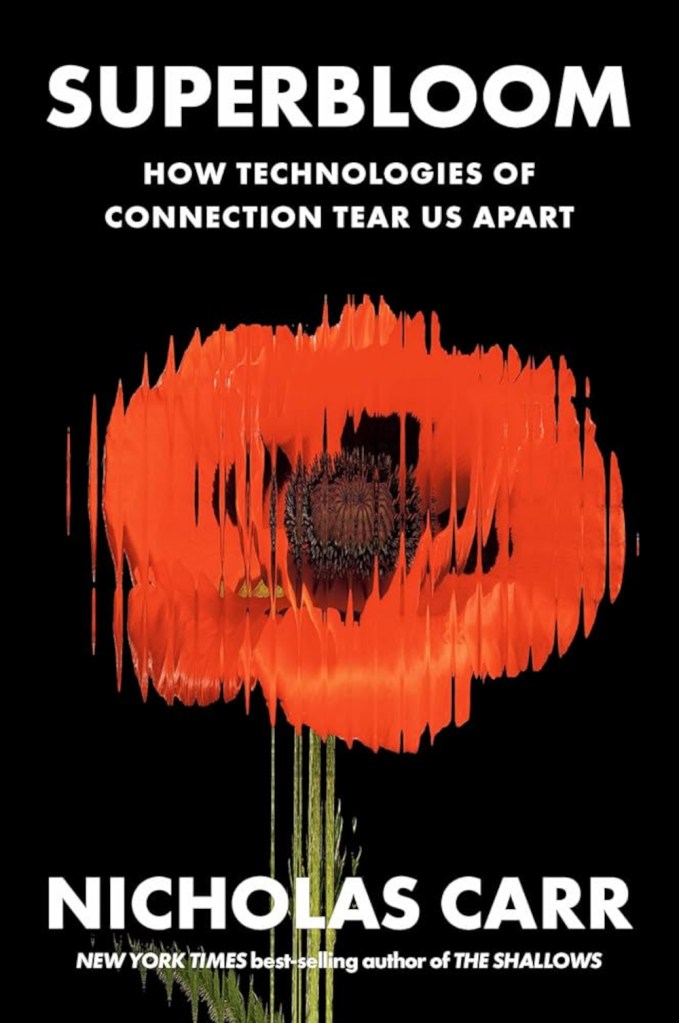
In “Superbloom,” Nicholas Carr laments that we live in a state of uncontrollable sensory and communication overload.
By Elizabeth Svoboda, 03.14.2025, https://undark.org/2025/03/14/book-review-superbloom/?utm_source=Undark%3A+News+%26+Updates&utm_campaign=ecc4df9cbe-RSS_EMAIL_CAMPAIGN&utm_medium=email&utm_term=0_5cee408d66-185e4e09de-176033209
It was all Mother Nature’s fault, you could say. After winter rains in Lake Elsinore, California, reawakened countless dormant poppy seeds in early 2019, spring blossoms crowded in thickly enough to turn the hillsides bright orange — a fleeting “superbloom.” Recognizing an Instagrammable backdrop when she saw one, influencer Jaci Marie Smith reclined across the floral carpet in orange overalls and hit post. “You’ll never influence the world by trying to be like it,” her photo caption read.
In March, posts like Smith’s and #superbloom hashtags fueled a global frenzy. So many sightseers and influencers crowded into Lake Elsinore, snarling traffic and pulling up blooms by the handfuls, that officials declared a public safety emergency. As residents and others ripped into influencers for unleashing viral havoc on the small town, some took down their poppy posts, while others offered excuses and mea culpas. A meme that had begun in innocent enthusiasm curdled in an internet minute, setting people against each other and leaving a wake of real-world destruction.
We’re living in a perpetual digital superbloom, contends technology writer Nicholas Carr — a state of sensory and communication overload we can no longer control, one that’s sowing division and damage on a global scale. And like the poppy field that hypnotized Dorothy’s “Wizard of Oz” crew, this social media-fueled superbloom lures us in with enticements that are nearly impossible to resist. “Poppies are lush, vibrant, and entrancing,” Carr writes in “Superbloom: How Technologies of Connection Tear Us Apart.” “They’re also garish, invasive, and narcotic.”
This is familiar ground for Carr — at least, as familiar as any fast-morphing digital terrain can be. Carr’s stance as a techno-skeptic has been consistent for decades, though it’s evolved as digital communication modes have bloomed and receded. His 2010 book “The Shallows”, a finalist for the Pulitzer Prize, argued that the online world is distracting and prevents deeper engagement with texts, and he followed that up in 2014 with “The Glass Cage,” a reflection on how interacting with our computers changes us.
In “Superbloom,” Carr expands on a central theme of “The Glass Cage”: While we view our digital devices as helpers serving up knowledge and entertainment, they exact an unacknowledged toll in the process, altering how we think, act, and communicate. We are far different humans in an era of texting, posting, and like-seeking, Carr argues, than we were when limited to letters and phone calls — and not for the better.
He contends that when we communicate mostly in one-line messages and hot takes, the kind that titillate and propagate from one human node to the next, our capacity to engage more intently and thoughtfully withers. “What we sacrifice are depth and rigor,” he writes. Thus, “we rely on quick and often emotional judgments while eschewing slower, reflective ones.”
This is a fair point, if only true in some online contexts: Masters of the 140-character social media quip win plenty of fans elsewhere with their books and long essays. What’s more convincing is Carr’s analysis of why our instant access to one another online, which we often assume is an advantage, has led to more social breakdown rather than less.
……………………………………in virtual space, “we’re all in one another’s business all the time,” Carr writes, later adding, “With an almost microscopic view of what everybody else is saying and doing — the screen turns us all into peeping Toms — we have no end of opportunities to take offense.”
……………….Carr’s vivid, jargon-free prose hits right in the solar plexus. “We’re not hostages with Stockholm syndrome,” he writes of our relationship with social media. “We’re being given what we want, in quantities so generous we can’t resist gorging ourselves.”
…………………However hard-hitting and sound its claims, “Superbloom” might feel too apocalyptic were it not for Carr’s closing plea to hold the line. He says it’s too late to change the online systems we’re embedded in — a judgment that seems a tad dour, given how rapidly those same systems have themselves changed over time. But he rightly notes that to peel away from a virtual world that’s more image than substance, users must deliberately resist its empty charms, much as the rebels of Aldous Huxley’s “Brave New World” rejected the happiness drug soma.
…….. he calls for judicious online withdrawal rather than Luddite-style divestment, for staking out a position “not beyond the reach of the informational flow, but beyond the reach of its liquefying force.”
While digital pessimists can come across as Cassandra-like, their warnings have never been more resonant. For Carr, the rough online beast is no longer merely slouching in our direction. It’s already devouring us. “Superbloom” frames the choice ahead in the starkest possible terms: Do we consent to being swallowed, or find a way — however quixotic and improbable — to escape the maw?
Elizabeth Svoboda is a science writer in San Jose, California, and the author of “What Makes a Hero?: The Surprising Science of Selflessness.” She is working on a book about the science of setting a sustainable pace in an overclocked world.
No comments yet.
-
Archives
- February 2026 (199)
- January 2026 (308)
- December 2025 (358)
- November 2025 (359)
- October 2025 (376)
- September 2025 (258)
- August 2025 (319)
- July 2025 (230)
- June 2025 (348)
- May 2025 (261)
- April 2025 (305)
- March 2025 (319)
-
Categories
- 1
- 1 NUCLEAR ISSUES
- business and costs
- climate change
- culture and arts
- ENERGY
- environment
- health
- history
- indigenous issues
- Legal
- marketing of nuclear
- media
- opposition to nuclear
- PERSONAL STORIES
- politics
- politics international
- Religion and ethics
- safety
- secrets,lies and civil liberties
- spinbuster
- technology
- Uranium
- wastes
- weapons and war
- Women
- 2 WORLD
- ACTION
- AFRICA
- Atrocities
- AUSTRALIA
- Christina's notes
- Christina's themes
- culture and arts
- Events
- Fuk 2022
- Fuk 2023
- Fukushima 2017
- Fukushima 2018
- fukushima 2019
- Fukushima 2020
- Fukushima 2021
- general
- global warming
- Humour (God we need it)
- Nuclear
- RARE EARTHS
- Reference
- resources – print
- Resources -audiovicual
- Weekly Newsletter
- World
- World Nuclear
- YouTube
-
RSS
Entries RSS
Comments RSS
 nuclear-news
Leave a comment