Poisoning the well – The toxic legacy of Cold War uranium mining in western New Mexico
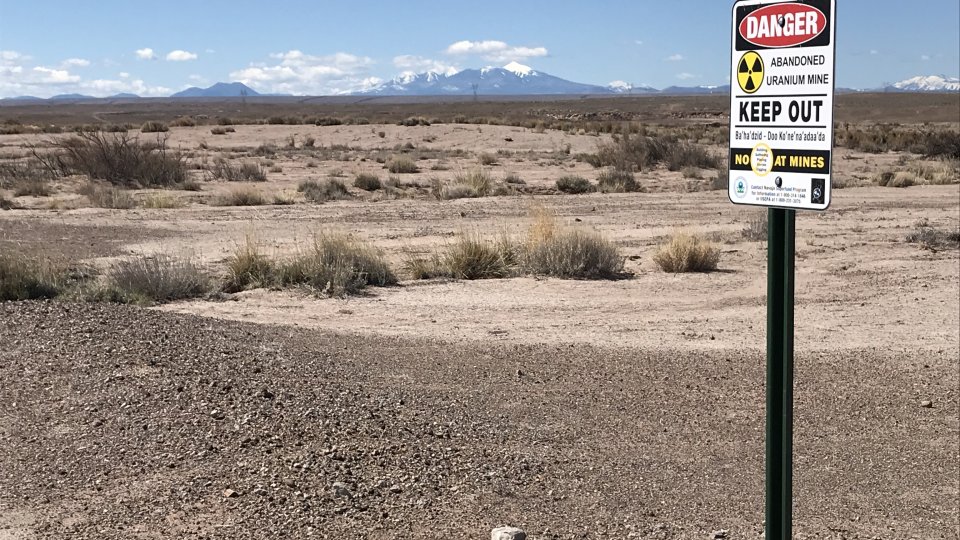
Studies have shown that chronic exposure to uranium through drinking water can cause kidney damage and cardiovascular disease. When inhaled, uranium can lead to lung cancer and pulmonary fibrosis, a scarring of the lung tissue. Studies of uranium miners associate cumulative exposure to radon with higher rates of death by lung cancer.
Proving that one’s illness originated as a result of living near a mine or mill, as opposed to actually working in it, is nearly impossible, given that symptoms can take years to manifest — a lack of clear causation that is ultimately advantageous to polluters.
Near the western New Mexico town of Grants, the toxic legacy of Cold War uranium mining and milling has shattered lives, destroyed homes and created a contamination threat to the last clean source of groundwater for an entire region
SEARCHLIGHT NEW MEXICO, by Alicia Inez Guzmán, March 13, 2025 [ excellent pictures and maps]
Driving along a stretch of New Mexico Highway 605, just north of the tiny Village of Milan, it’s easy to imagine that this area has always been no-man’s-land. Little appears in the distance except for a smattering of homes and trees peppered by expanses of bone-dry scrub brush. But a hard second look reveals something else — vestiges of a mass departure. Sidewalks lead to nowhere, a dog house sits in the middle of a field next to a mound of cinder blocks, phone lines crisscross empty stretches of land and deserted propane tanks and mailboxes sit perched in front of nothing. Around the bend on one unpaved side road, a neighborhood watch sign stands sentinel where a neighborhood no longer exists…………………………………………………………………………………………………………………
This home site was once part of a cluster of five rural subdivisions interspersed with rich farm and ranchland. The Homestake Mining Company — famously known for gold mining in the Black Hills of South Dakota — took up residence here in 1958, to mill uranium. From that year until 1990, millions of tons of ore were prised from nearby mines and processed at Homestake, where the ore was ground into fine particles and leached with a solution that coaxed out pure uranium oxide, often called “yellowcake.” That uranium was then shipped off to help make America’s Cold War fleet of nuclear weapons or to power nuclear reactors. The leftover slurry was piped into two unlined earthen pits, the largest the size of 50 football fields and filled with over 21 million tons of uranium mill tailings.
Over time, the uranium tailings decayed into radon gas; meanwhile, radioactive contaminants seeped into four of the region’s aquifers. Residents compiled a list of neighbors who died of cancer — they called it the Death Map. In 2014, the U.S. Environmental Protection Agency (EPA) predicted that the probability of developing cancer was notably higher for residents who lived closest to the mill, especially if they drank the water.
In the intervening decades, Homestake attempted to hold its remaining contamination at bay rather than offer a long-term solution. That changed in 2020, when the company declared that a full cleanup of the groundwater was not feasible and instead embarked on a mass buyout and demolition of homes inside the rural subdivisions and beyond, Boomer and Billiman’s included. Homestake’s goal, ultimately, is to hand over 6,100 acres of land — almost twice the size of nearby Milan — to the U.S. Department of Energy (DOE) as part of a special federal program that takes over shuttered nuclear outfits when industry walks away. The deadline is 2035. And if this site is anything like the majority of the DOE’s other sites, the land will be rendered inaccessible to the public, with the company’s guarantee that toxins will stay inside the massive contamination zone boundary for a thousand years.
“Talk about the myth of containment,” says Christine Lowery, a commissioner in Cibola County. “The myth of reclamation as well,” she adds. For Lowery, a member of the Pueblo of Laguna who lives in Paguate, one of its six villages — itself blighted by the Jackpile-Paguate Uranium Mine, one of the world’s largest open pit uranium mines — the subtext is clear. “What they should be saying is, ‘We’ve contaminated everything we can, and there’s no way we can fix it.’”
In fact, the conditions necessary for contaminants to infiltrate a fifth aquifer in a single generation — not a thousand years — could already be in the making. The aquifer in question is the San Andres-Glorieta, so ancient that its limestone was forged from the same material as seashells before the era of the dinosaurs. It’s also the last clean source of groundwater for Milan, the county seat of Grants, many private well owners and the Pueblo of Laguna, as well as the Pueblo of Acoma, one of the longest continually inhabited communities in the United States.
According to regulators, the San Andres-Glorieta still meets standards for groundwater that is safe to use and drink. According to Homestake’s own reports, however, at least three uranium plumes are converging toward what Ann Maest, an aqueous geochemist with Buka Environmental, a Colorado-based firm, calls “a bull’s-eye of radioactive contamination.” The potential target? A geological formation called a subcrop. Here, approximately 100 feet below the surface of the earth and three miles southwest of the Homestake site, this subcrop directly connects the San Andres-Glorieta with an overlying aquifer long known to transport contamination from two uranium mills including Homestake. In 2022, the company commissioned an independent firm to study the geological feature. But according to a memo sent to state and federal regulators and written by Maest the following year, the findings were “light on interpretation” and evaded answering the most important question of all: Have those contaminants reached the San Andres-Glorieta?………………………
Gauging the extent of groundwater plumes is notoriously difficult. Topography and geology shape how groundwater moves, and sampling can underestimate the full range of a plume, leaving gaps in the data, whether that’s inadvertent or intentional. A 2022 ProPublica investigation found that regulators had been lax in their oversight of the Homestake mill, its toxic footprint and the uranium industry as a whole. Over time, a dizzying array of state and federal agencies have each overseen a different aspect of the site’s reclamation; in the past, those agencies haven’t even agreed on what that reclamation should look like.
Now, as uranium mining undergoes a national revival under initiatives that favor carbon-free nuclear energy, waste from the previous Cold War era of mining and milling endures. Homestake’s remediation — which has gone on for 49 years — exemplifies this legacy. During that time, company reports say, its collection wells have pumped out billions of gallons of contaminated water. Nearly one million pounds of uranium have been removed from the groundwater, too. Bingham says this represents 85 percent of the total uranium that was released into the environment. That’s in addition to the removal of tens of thousands of pounds of selenium and over a million pounds of molybdenum.
The company has attempted to keep pollutants that have seeped into groundwater from migrating farther away from the source. But this so-called hydraulic barrier has only addressed the symptoms of the contamination, not the cause: the tailings piles, which the company declined to relocate into a lined repository nearby. That means that some groundwater contamination continues to spread beyond Homestake’s site. The hydraulic barrier has another drawback — it has used “a massive amount of freshwater from the San Andres-Glorieta aquifer to operate,” says Laura Watchempino, a member of the Multicultural Alliance for a Safe Environment (MASE), a grassroots network of uranium-impacted communities working collectively to address the legacy of mining and milling on the health and environment of future generations. Watchempino is a former lawyer who also worked as a water quality specialist for the Pueblo of Acoma………………………………………………………………………………..
………………………………………………………………….Carver estimates that he is one of around 30 holdouts left in the five subdivisions; four of the families live in his own, Murray Acres. But few others have spent so much time fighting to hold the company accountable. “I’m 85 and it all started when I was 40,” he says.
In 1983, he was one of the plaintiffs in a lawsuit filed against the company, which argued, among other claims, that contamination of the well water had “completely destroyed the market value of the plaintiffs’ properties.” As part of the settlement, the company made small cash payments to residents and hooked them up to the municipal water system, which drew from the last clean source of water in the region, the San Andres-Glorieta. That year, the mill was designated a Superfund site, and in 1987 the company entered into a consent order with the EPA to analyze radon levels in residents’ homes, the product of uranium decaying from the tailings piles.
The mill closed in 1990, less than a decade after the uranium industry went bust. Records from the county assessor’s office show that Homestake quietly began buying a handful of homes in adjacent neighborhoods as early as 1996. (In 2001, Homestake Mining merged with the Canadian juggernaut, Barrick Gold, one of the world’s largest gold mining companies.)
“Every time someone dies or decides to move away, Homestake-Barrick Gold buys the property at a greatly reduced cost, which they can do because their ineffective groundwater remediation has devalued property many of us worked lifetimes to build,” Candace Head-Dylla, a former resident, said in a 2017 letter to the NRC.
In 2020, the company argued that it was no longer technically practical to clean up the groundwater to match its pre-mill days, Bingham wrote. So began the tangled regulatory process of applying for a less-stringent cleanup standard through the NR……………………………………
Searchlight asked the DOE for comment, but the agency declined. According to Samah Shaiq, a former DOE spokesperson, the agency is not yet responsible for the site.
The NRC denied Homestake’s application for the lower standard — the basis of the buyout — but the company remains steadfast in its desire to walk away. As part of those plans, Homestake has already scooped up approximately 455 of the estimated 523 properties that sit inside its proposed boundary, an expanse that’s nearly as large as the most contaminated area of the Rocky Flats Plant, another of the more than 100 sites under the DOE’s perpetual care, where thousands of plutonium bomb cores for the nation’s nuclear arsenal were fabricated between 1952 and 1989.
Much of Milan, along with huge swaths of land west and north, including some five miles of Highway 605, sit within this massive pie-shaped chunk, a proposed boundary that is based on the company’s groundwater modeling data. Inside are public water and electric lines, groundwater wells, septic systems and other, smaller roads, the fate of which have yet to be determined. Milan Elementary School sits only a mile away from the boundary’s southernmost rim.
When Searchlight asked how fast those plumes are migrating, drawing on a Homestake-produced simulation that’s meant to predict how contaminants move in groundwater aquifers at the site, the EPA declined to comment, because the simulation was still in draft form.
Regulators, meanwhile, are plodding through the process of determining what final act of remediation they should require before allowing Homestake to hand off the site to the DOE. But prospects for that remedy depend on whether and when the company will receive a lower cleanup threshold. If a lower standard is settled on, that remedy, whatever it may be, will fall radically short of truly protecting groundwater, advocates believe. Adding to the uncertainty is a recent announcement that the Trump administration intends to cut personnel at the EPA by up to 65 percent.
The future of the site seems all but predetermined: a wasteland in the truest sense, and a national sacrifice zone. The buyout, a prologue to this future, has fractured residents’ lives in the present. Homestake subjected sellers to nondisclosure agreements — “standard business practice,” in Bingham’s words — but to some in the community, a mechanism for silencing dissent……………………………………………………………………………………………………………………………………………
“We’ve been poisoned to the gills”
The Grants Mining District stretches from the Pueblo of Laguna to Gallup, across almost 100 miles of western New Mexico’s red bluffs. Uranium here and throughout the world is ancient even by cosmic standards………………………………………………………
…………………………..in time, more than 150 mines would be developed across this district and the greater San Mateo Creek Basin, and, today, there are a total of 261 former uranium mines statewide, making New Mexico the fourth-largest producer of uranium globally, behind East Germany, the Athabasca Basin and the Democratic Republic of the Congo, which supplied much of the uranium for the Manhattan Project.
But with the uranium boom came a wave of devastation across the greater Southwest, including in Indigenous communities like the Pueblo of Laguna, as well as the Navajo Nation, where there are more than 500 abandoned uranium mines. Workers often lived near mines and mills and would bring yellowcake home on their clothes, exposing their families to harmful radioactive dust; water sources, meanwhile, have shown “elevated levels of radiation,” according to the EPA.
In the Church Rock Chapter of the Navajo Nation, a tailings dam breached on an early July morning in 1979, sending contaminated water into the Rio Puerco. Today, it constitutes the largest release of nuclear materials in the U.S. worse even than the meltdown at Three Mile Island.
Church Rock was among the eight mills that processed uranium ore in New Mexico. Others include Homestake and, in its immediate vicinity, Bluewater and two mills at Ambrosia Lake. Workers flocked here from across the state and nation during the booming 1960s and 1970s, with Homestake alone employing 1,500 people at its peak.
After graduating from high school and intermittently through his college years, Carver worked stints at all four of those mills before opening his own business, Carver Oil. At Homestake, he worked at a site where yellowcake was processed and packaged into barrels to go to Oak Ridge, Tennessee, where it would be enriched for use in nuclear weapons. He also worked in the tailings piles.
Carver now receives benefits for spots on his lungs from the Radiation Exposure Compensation Act (RECA), a program he qualified for because of his time working in the mills. Whether his illness was compounded by living near the mill tailings and by breathing excess radon, or by drinking the water — at least until the company connected residents to a clean source — is unknown. Studies have shown that chronic exposure to uranium through drinking water can cause kidney damage and cardiovascular disease. When inhaled, uranium can lead to lung cancer and pulmonary fibrosis, a scarring of the lung tissue. Studies of uranium miners associate cumulative exposure to radon with higher rates of death by lung cancer.
Maggie Billiman, who’s from the Sawmill Chapter of the Navajo Nation, has advocated for RECA to cover people in New Mexico and parts of Arizona who lived downwind of atmospheric nuclear tests or who worked in mines after 1971, the current cutoff date. Last fall, she traveled with other Indigenous activists to Washington, D.C., as part of her efforts to expand RECA after struggling with various undiagnosed illnesses for years; several painful cysts that have yet to be biopsied were recently found on her liver and pancreas. Many doctor visits later, she’s still pursuing a clear diagnosis and treatment plan.
But whether or how one gets sick can depend on biological sex, age when exposed and the pathway a certain type of radioactive particle takes to enter the body. Proving that one’s illness originated as a result of living near a mine or mill, as opposed to actually working in it, is nearly impossible, given that symptoms can take years to manifest — a lack of clear causation that is ultimately advantageous to polluters.
Groundwater contamination from uranium mining was detected as early as 1961. Even before that, the federal government was aware that New Mexico’s waterways were already showing signs of radioactive contamination from the burgeoning uranium extraction industry. It would take another 15 years for Homestake to begin a convoluted, if limited, remediation effort: A series of collection wells would pull contaminated water out and treat it, then pump that water, along with clean water sourced from the San Andres-Glorieta, back into the subsurface.
………………………………………………………………………………………………………………………….. It’s hard to visualize such an underground fortification — on maps, it looks like a cashew-shaped moat that wraps around the west and south sides of the large tailings pile — or the timescale needed for its maintenance. In 1982, Homestake said it would “require operation for a considerable amount of time.” In response, NMED declared that Homestake had to commit to operating the system until it “can be demonstrated that contaminants in the groundwater will not exceed New Mexico Water Quality Control Commission standards off Homestake’s property in the foreseeable future.”
Advocates believe that means forever. If barrier maintenance is stopped, experts contend that highly contaminated groundwater will migrate southward and downward and eventually make its way to the subcrop, an entry point into the San Andres-Glorieta, municipal supply wells for Milan and Grants and eventually the Río San José. “This signals a bleak future for the stream system and for future generations,” Laura Watchempino warns.
Bluewater’s plume is coming from the northwest; Homestake’s plumes from the northeast. Models show that all are converging, like a Venn diagram, in a location where groundwater flows toward the subcrop. On one side, the hydraulic barrier is warding off some of that pollution, but when it stops operation completely, those contaminants will very likely infiltrate the San Andres-Glorieta, according to NMED.
In the past, it’s been difficult to discern what contaminants belong to what polluter, especially when they mingle, as is the case here. But in 2019, the USGS published the findings of a study that “fingerprinted” such mine and mill contaminants to show their point of origin……………………….
…………………………………….. “We’ve been poisoned to the gills,” says Christine Lowery, the Cibola county commissioner. “The question is: How do we recover and live with contamination?”
Alicia Inez Guzmán
Raised in the northern New Mexican village of Truchas, Alicia Inez Guzmán has written about histories of place, identity and land use in New Mexico. She brings this knowledge to her current role at Searchlight, where she focuses on nuclear issues and the impacts of the nuclear industry. The former senior editor of New Mexico Magazine, Alicia holds a Ph.D. in Visual and Cultural Studies from the University of Rochester in New York. More by Alicia Inez Guzmán https://searchlightnm.org/new-mexico-cold-war-uranium-mining-toxic-legacy-threat-homes-underground-aquifers/?utm_source=Searchlight+New+Mexico&utm_campaign=d2d0fd81fc-3%2F13%2F2025+%E2%80%93+Poisoning+the+well&utm_medium=email&utm_term=0_8e05fb0467-d2d0fd81fc-395610620&mc_cid=d2d0fd81fc&mc_eid=a70296a261
Could Poland and Germany acquire nuclear bombs?
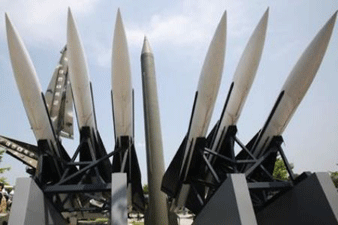
A proposal to place US atomic weapons in Poland could lead to Poland and Germany having nuclear weapons stationed.
Poland’s outgoing head of state has appealed to President Trump to
station American atomic weapons on Polish territory as a close-range
deterrent against Russia. The rift between the US and Europe has opened up
a broad debate about how to shore up Nato’s nuclear deterrence.
Germany’s probable next chancellor has expressed an interest in sharing
France or Britain’s arsenal. Poland, however, remains one of the most
staunchly Atlanticist members of the alliance and is seeking to use its
good standing with the Trump administration to keep the US on side.
Times 14th March 2025,
https://www.thetimes.com/world/russia-ukraine-war/article/nuclear-bombs-poland-germany-weapons-3pwvwdwhz
Great British Nuclear explains how it will mitigate risks to SMR programme.
13 Mar, 2025 By Tom Pashby
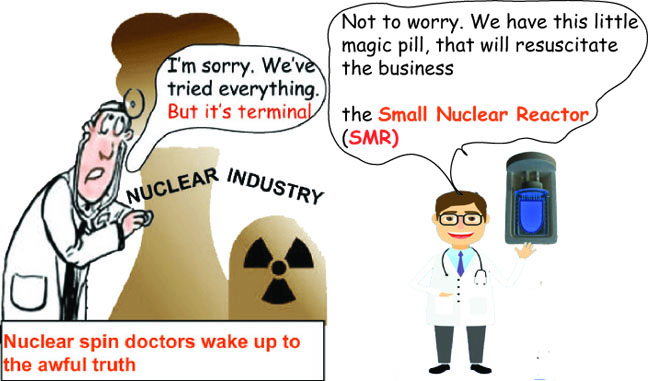
Great British Nuclear (GBN) has explained how it plans to overcome the key risks to the small modular reactor (SMR) programme is it running and that it plans to establish of SMR development companies (DevCos) to take the projects forward.
The updates were shared in its inaugural 2024 Annual
report and accounts for the 2023/2024 financial year.
It is assumed that GBN will select two vendors to deliver one SMR each, but this was recently
called into question by sources speaking to the Telegraph who said the
chancellor may cut spending at GBN as part of the Spending Review which is
due on 11 June 2025. GBN chief executive officer Gwen Parry-Jones said:
“The UK’s nuclear sector has had some well-documented challenges, ones
that GBN has been set up to navigate.” She did not spell out the
challenges.
“SMRs have not yet been deployed anywhere at scale and their
first-of-a-kind (FOAK) nature presents unique considerations and complex
challenges for us to overcome.” She reassured, however, that she is
“committed to ensure that GBN is an adaptable and resilient organisation
that is flexible and evolves as conditions change, but with our eyes always
firmly fixed on the future to deliver our long-term mission and value for
the UK”.
The report lays out the “principal risks” which GBN believes
the SMR programme faces, along with “key mitigation measures”. The
risks are centred around technology maturity, the ambitious programme
timeline, resourcing, funding and financing, stakeholder alignment,
‘contractual and procurement complexity’, site readiness and cyber
threat.
On technology maturity, it said: “Due to the first of a kind
(FOAK) nature of the technology, providers may not be able to meet
strategic objectives, including timely delivery, value for money and
obtaining regulatory approval. “This may delay approval timelines, affect
project milestones or cause an SMR project to fail.” It says that the SMR
competition that it is running will assess the technologies and mitigate
this risk. However, it also reveals that it will retain the option of, in
addition to the SMR competition winners, selecting a “reserve contractor,
to provide contingency against one provider failing to meet agreed
standards”.
GBN lists four other mitigations, including stating it could
or would provide “predetermined exit points” from projects “should a
project exceed cost estimates or timelines stretch beyond acceptable
parameters”. Regarding risk relating to “funding and financing”, it
says: “GBN’s available funding may be insufficient to resource and
deliver the programme to the planned timetable, e.g. should a change arise
from any change in government policy or in its budgetary priorities.
“A reduction in funding could also be triggered by market conditions or
external events such as an external nuclear event affecting public
sentiment towards nuclear safety.
New Civil Engineer 13th March 2025, https://www.newcivilengineer.com/latest/great-british-nuclear-explains-how-it-will-mitigate-risks-to-smr-programme-13-03-2025/
Eight Reasons Why Nuclear Power is Not the Answer for Hawaii

by Sherry Pollack, 14 Mar 25
Nuclear power isn’t “zero emission.” The nuclear industry has conducted a propaganda campaign rife with factually inaccurate information, including that nuclear power is “carbon-free electricity.” However, this could not be further from the truth. To be clear, there is no such thing as a zero- or close-to-zero emission nuclear reactor. Even existing reactors emit due to the continuous mining and refining of uranium needed for the reactor.
Transporting nuclear fuel is a hazard. As an isolated island chain, Hawaii faces unique and significant risks in transporting nuclear fuel over vast ocean distances. Any accidents during transport, be it from bringing fuel here or shipping waste back, could have catastrophic consequences for Hawaii’s pristine marine environment and tourism-dependent economy.
Nuclear waste. The waste generated by nuclear reactors remains radioactive for thousands of years and needs to be kept contained throughout that time. Currently, there are no long-term storage solutions for radioactive waste, and most is stored in temporary, above-ground facilities.
Hawaii’s geological instability, including frequent earthquakes, volcanic activity, and tsunami risks, makes it an unsafe location for storing nuclear waste. There are no viable long-term solutions for safely containing radioactive materials in such a volatile environment.
Accidents. Human error and natural disasters can lead to dangerous and immensely costly accidents. Think Red Hill but multiply that exponentially. Direct costs would include cleanup operations, property damage, and evacuation efforts, as well as significant indirect costs including long-term health consequences, economic disruption due to lost productivity and tourism, and severe psychological impacts on affected populations, often lasting for generations. According to the Nuclear Regulatory Commission (NRC), the emergency planning zone around a nuclear power plant typically extends to a 10-mile radius for immediate radiation exposure concerns, while a broader “ingestion pathway” zone reaches out to a 50-mile radius where food and water contamination could occur in the event of an incident. This would make safely siting a power plant, particularly on Oahu, impossible.
Impacts on Local Communities and Ecosystems. In addition to the significant risk of cancer associated with fallout from nuclear disasters, studies also show increased risk for those who reside near a nuclear power plant, especially for childhood cancers such as leukemia. Workers in the nuclear industry are also exposed to higher-than-normal levels of radiation, and as a result are at a higher risk of death from cancer.
Nuclear energy is too expensive. To protect the climate, we must reduce the most carbon at the least cost and in the least time. Nuclear power does none of this. A report by the Institute for Energy Economics and Financial Analysis found that even small modular reactors (SMRs) are expensive, too slow to build, and too risky to play a significant role in transitioning from fossil fuels in the coming 10-15 years.
Integral Fast Reactors, Pebble Bed Modular Reactors, Thorium Fueled Reactors, Molten Salt Reactors, and Small Modular Reactors (SMRs) are not viable. Nuclear power advocates promote small modular nuclear reactors (SMRs) and other “advanced” nuclear technologies as the only real solution for the climate crisis. However, proponents of SMRs and these other so called “new” types of reactors fail to address their unproven nature, unresolved safety risks, and economic inefficiency. Moreover, SMRs cannot be counted on to provide ‘firm’ power as has been touted. Just like today’s nuclear plants, SMRs will be vulnerable to extreme weather events or other disasters that could cause a loss of offsite power and force them to shut down. Additionally, the push for SMRs often serves the private interests of billionaires looking to power AI data centers rather than benefiting the people of Hawaii. Bottom line, SMRs are wishful thinking rooted in misinformation.
Nuclear power is an expensive distraction undermining our ability to achieve our clean energy goals. Investment in nuclear power, including SMRs, will take resources away from carbon-free and lower-cost renewable technologies that are available today and can push the transition from fossil fuels forward significantly in the coming decade. Hawaii is already on the path to achieving 100% renewable energy by 2045. Nuclear power is not renewable, requires costly infrastructure, and pursuing it would divert attention and resources from proven, sustainable solutions like solar, and wind.
Nuclear power has NO place in Hawaii’s clean energy future. Nuclear power is too dirty, too dangerous, and too expensive. It is environmentally harmful and produces waste that will be a burden on future generations. Accordingly, we urge the legislature to commit to uphold Hawaii’s constitution, a sustainable future, prioritize investing our resources in a clean renewable energy future, and honor the voices of its people by opposing the use of nuclear power in Hawaii.
Alarmed by Trump, South Korea mulls Japan-style nuclear option
Prominent voices seek capacity to reprocess spent nuclear fuel or enrich uranium and be able potentially to make bombs.
ASIA TIMES, by Daniel SneiderMarch 15, 2025
……………………………………………………………………………………………………………………………………………… The most striking evidence of South Korean alarm over the treatment of allies is the widening discussion of the need to have an independent nuclear arms capability. Conservatives have long advocated that option, but the debate has now moved into progressive circles where prominent voices are calling for South Korea to develop nuclear latency – the capacity to reprocess spent nuclear fuel or enrich uranium to be able to potentially possess fissile material for making bombs.
The Japanese model?
For now, South Korea hopes it can follow the path set by Japanese Prime Minister Shigeru Ishiba and offer Trump concessions ranging from trade, supply chain investment, and cooperation on shipbuilding to promoting South Korea’s role as an asset in a confrontation against China.
At the moment, South Korea does not have an effective government, pending the imminent decision of the Constitutional Court on the impeachment of South Korean President Yoon Suk Yeol. But whatever follows, the South Korean president will have to deal with Trump.
Assemblyman Wi believes the best they can hope for is a smooth and non-confrontational meeting modeled on that of Ishiba, which yielded a joint statement that reaffirmed the US-Japan alliance along the lines of previous statements with the Joe Biden administration.
………………………………………………………………………………….. I think President Trump thinks North Korea is unfinished business left over from the first Trump administration. We have to prepare for the worst.”
Nuclear latency
“The worst” includes the withdrawal of United States Forces Korea (USFK) from South Korea and a withholding of the US nuclear umbrella.
Regardless of how important the U.S.-ROK alliance is now, “there may come a time when it is difficult to rely on the US for our security,” former Minister of Foreign Affairs Yoon Young-kwan wrote in an op-ed published this month. “In preparation for that time, we should strengthen our national defense capabilities, including potential nuclear capabilities, and prepare to handle the deterrence of North Korea with our own strength.”
Progressives are more reticent to endorse nuclear weapons outright, but some have thrown their weight behind nuclear latency – a conscious imitation of the model pursued by Japan to have a full fuel cycle capability. South Korea could, theoretically, reprocess the spent fuel from its power reactors to extract bomb-grade plutonium or, alternatively, have the capacity to enrich uranium, potentially up to bomb-grade levels.
South Korea has long sought to revise the so-called 123 agreement for nuclear cooperation with the United States, which has restricted its ability to have a full fuel cycle. The agreement was only recently reaffirmed, in January at the close of the Biden administration.
In an important column published on March 4 in the progressive newspaper Kyunghyang Shinmun, former Minister of Unification Lee Jong-seok, another close advisor to presidential aspirant Lee Jae-myung, argued that nuclear latency can be achieved within the framework of the Nuclear Non-Proliferation Treaty and with the consent of the United States.
“China, Russia and North Korea, our neighboring countries, are nuclear weapon states, and Japan has already demonstrated its potential,” Lee wrote. “In this situation, it is rather unnatural that South Korea, a nuclear power, cannot reprocess or enrich uranium due to the restrictions of the Korea-US Nuclear Energy Agreement.”
Others in Seoul advocate defecting from the 123 agreement if the United States reduces USFK forces on the peninsula, says Kim Joon-hyung, a Rebuilding Korea Party lawmaker and former senior diplomat.
Kim is a critic of the U.S. alliance but is personally opposed to nuclear latency. “I don’t agree with nuclear proliferation,” he said. “Even if we have nuclear weapons, I don’t think we have security. Small conflicts may become more common. The Korean Peninsula is too small – high tech conventional weapons are enough. Japan will go nuclear and relations with China and Russia will worsen.”
Others are concerned about the isolation that South Korea could experience if it goes down this road. Cho Hyun, a former senior diplomat and progressive foreign policy advisor, helped negotiate the 123 agreement during the Bill Clinton administration. “The right wing thinks we should have our own nuclear development,” Cho told me in Seoul. “We don’t think it is realistic. Some progressives want to request the US for full fuel cycle like Japan. I am against this.”
As the nuclear latency argument rapidly gains support among progressive circles, revising the 123 agreement may become a bargaining chip for South Korea in negotiations with the Trump administration.
At least some inside the administration, though likely not Trump-appointed officials, have become aware of this, prompting media reports that the U.S. Department of Energy is considering labeling South Korea a “sensitive country,” a designation for countries who might be considering going nuclear.
For South Korea, this may only be the start of many shocks to come.
Daniel C. Sneider is a non-resident distinguished fellow at the Korea Economic Institute of America and a lecturer in East Asian studies at Stanford University. https://asiatimes.com/2025/03/alarmed-by-trump-south-korea-mulls-japan-style-nuclear-latency/#
Chinese nuclear weapons, 2025
Bulletin, By Hans M. Kristensen, Matt Korda, Eliana Johns, Mackenzie Knight | March 12, 2025
The modernization of China’s nuclear arsenal has both accelerated and expanded in recent years. In this issue of the Nuclear Notebook, we estimate that China now possesses approximately 600 nuclear warheads, with more in production to arm future delivery systems. China is believed to have the fastest-growing nuclear arsenal among the nine nuclear-armed states; it is the only Party to the Treaty on the Non-Proliferation of Nuclear Weapons that is significantly increasing its nuclear arsenal. The Nuclear Notebook is researched and written by the staff of the Federation of American Scientists’ Nuclear Information Project: director Hans M. Kristensen, associate director Matt Korda, and senior research associates Eliana Johns and Mackenzie Knight.
………………………………………………………………………………………………………………………………………………………………………… more https://thebulletin.org/premium/2025-03/chinese-nuclear-weapons-2025/
Iran, Russia, China discuss Tehran’s nuclear programme at Beijing meeting

Meeting between top diplomats from three countries signals Tehran may be ready for renewed negotiations on its nuclear programme.
14 Mar 2025, https://www.aljazeera.com/news/2025/3/14/iran-russia-china-discuss-tehrans-nuclear-programme-at-beijing-meeting
Diplomats from Iran, Russia and China are meeting in Beijing for talks on Tehran’s nuclear programme that could lead to negotiations following years of delay.
Beijing said the three countries hope to find a “diplomatic” solution to Iran’s nuclear issue, Chinese state media reported on Friday.
“In the current situation, we believe that all parties should maintain calm and restraint to avoid escalating the Iran nuclear situation, or even walking towards confrontation and conflict,” China’s Foreign Ministry spokesperson Mao Ning told reporters before the meeting.
The meeting was attended by Chinese Vice Foreign Minister Ma Zhaoxu, Russian Deputy Foreign Minister Sergey Ryabkov and Iranian Deputy Foreign Minister Kazem Gharibabadi, who “exchanged views on the Iran nuclear issue and other issues of common concern,” according to Chinese media.
Donald Trump, a year into his first term as United States president in 2018, withdrew from a landmark pact Iran reached in 2015 with the US, Russia, China, Britain, France, Germany and the European Union, in which Tehran agreed to curb its nuclear programme in exchange for the lifting of international sanctions.
Tehran continued to abide by the terms of the deal – which was considered a milestone for the administration of then-US President Barack Obama – but began slowly rolling back its commitments after Trump ended the deal.
The meeting in Beijing between the three diplomats follows a series of overtures from Trump since his return to the White House in January to resume nuclear talks with Tehran.
The US president this week sent a letter to Iran’s Supreme Leader Ayatollah Ali Khamenei calling for new talks but also warning that the US was within its rights to take military action against the country’s nuclear programme.
Iranian President Masoud Pezeshkian responded that he would not negotiate with the US while being “threatened”, and Iran would not bow to US “orders” to talk.
Iran was further enraged after six of the United Nations Security Council’s 15 members – the US, France, Greece, Panama, South Korea and the United Kingdom – held a closed-door meeting this week to discuss its nuclear programme. Tehran said the meeting was a “misuse” of the UN Security Council.
NATO-Russia Ukrainian War Ceasefire: To Be Or Not To Be?
RUSSIAN and EURASIAN POLITICS, by Gordonhahn, March 14, 2025
On March 13th Russian President Vladimir Putin stated Moscow is open to a ceasefire leading to peace treaty talks, generally speaking. However, he stressed tghat there are “nuances” that need to be addressed before any ceasefire agreement could be concluded. The ‘nuances’ were really counteroffers made for practical reasons but also having the effect of returning the ball to the US-Ukrainian court, paraphrasing US Secretary of State Marco Rubio’s assertion after the Ukrainians’ agreement to a ceasefire that ‘the ball is now in Moscow’s court.’
Highlighting what is or was missing from the American proposal to his knowledge at the time he was speaking (before meeting with US envoy Steven Witkoff, Putin said the issues in need of resolution are: (1) the remaining Ukrainian troops in Kursk, Russia; (2) Ukraine’s military mobilization and training of those mobilized; (3) arms sales to Ukraine; and (4) verification of any ceasefire covering the long ‘line of contact’ or frontlines needed to be resolved (http://kremlin.ru/events/president/news/76450). The first issue is being resolved by the Russian army which has re-taken Sudzha and probably will have killed, captured, or pushed all Ukrainian troops out of Kursk Oblast within a week or so.
…………………………………………………..Putin’s public statements probably reflect what were communicated to U.S. negotiator Steven Witkoff more as requirements or conditions before any Russian agreement to a ceasefire. Pressing Kiev to halt mobilization and training, puts Zelenskiy in a difficult position, and Washington and or Kiev will likely respond that if Kiev is required to halt these activities, then Moscow must halt them or something analagous. This will highlight the coercive, violent aspect of what Ukrainians call ‘Ze-mobilization’—‘Ze’ referring to Zelenskiy.
…………………………….At the same time, the U.S. weapons to be supplied to Kiev are numbered. The Ameerican-Ukrainian statement on the ceaefire agreement declares that the U.S. “will immediately lift the pause on intelligence sharing and resume security assistance to Ukraine” (www.state.gov/joint-statement-on-the-united-states-ukraine-meeting-in-jeddah/).
……………………..Trump has not and may not use PDA to support in Ukraine in future, perhaps depending on Kiev’s willingess to negotiate, despite the inherent contradiction in demanding peace talks while supplying weapons. For Ukraine, this is a contradiction with an opportunity: to drag out talks while it rearms its forces along the contact line.
Not surprisingly then, Russian officials have repeatedly stated they will not accept a ceasefire agreement and will continue fighting until a full-fledged peace agreement is reached. Their previous rejections of any ceasefire were precisely based on Russians’ suspicion that any pause in the fighting will be used to halt Russia’s mounting offensives, rearm Ukraine, and then resume the war with Kiev’s forces in a more robust state.
……………………… Putin may find his political position weakened in comparison with more hardline elements if seen as having fallen again for a another Western deception. This means he cannot accept continued arms supplies to Ukraine during a ceasefire.
……………………………………………………………………..Putin understands negotiating the details and mechanisms for implementing the ceasefire likely will take months. Meanwhile Russian troops can complete the process of expelling Ukrainian troops from the areas which the latter hold in at least two (Luhansk and Donetsk) of the four Donbass regions claimed by Russia and extending areas it holds in other Ukrainian regions. While these and Crimea are settled issues militarily and in terms of sovereignty—they are Russian; Kiev will not win them back for decades, a century, if ever.
The situation with regard to the other two Russia-annexed but still not fully taken regions – Kherson and Zaporozhe’ – is more fluid. Russian forces control less than half of each’s territory and will have an extraordinarly difficult time seizing their capitol cities of the same name. Thus, the negotiations on territories, which, accordoing to Trump was under discussion at Riyadh with the Ukrainians, is likely to center around a possible trade with Moscow withdrawing its troops from areas it occupies in regions outside the four regions it claims for the remainder of the territory of the claimed regions still not held by Russian troops most likely in Kherson and Zaporozhe. All of this will be incredibly difficult to navigate politically, particularly for Zelenskiy and Ukraine. Moreover, it is unlikely that Kiev has more than half a year before the collapse begins of one or more of the following: the entire front, army, oligarch-neofascist Maidan regime, and Ukrainian state.
Now we get to the most disconcerting fact hanging over the ceasefire endeavor. It was hinted at by Putin’s raising the vexing issue of verifying and monitoring the ceasefire……………………………………………………….. it will be a long, rocky road before any agreement is achieved, and failure could lead to an explosive doubling down on the disastrous NATO-Russia Ukrainian War and the destructive chaos of our new multipolar world. https://gordonhahn.com/2025/03/14/nato-russia-ukrainian-war-ceasefire-to-be-or-not-to-be/
Continued Propaganda About AI and Nuclear Power
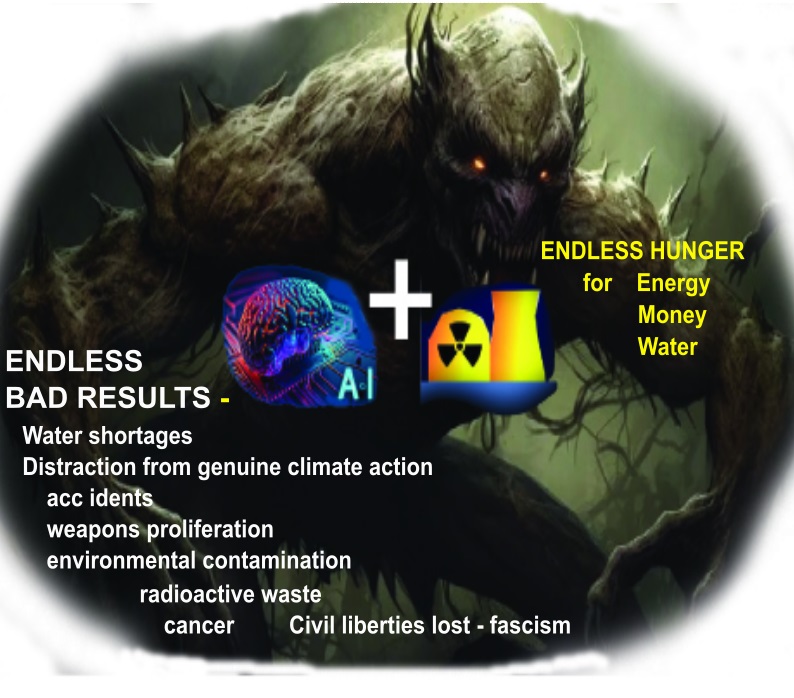
One effect of this slew of propaganda has been the near silence on the question of whether such growth of data centers or AI is desirable, even though there is ample evidence of the enormous environmental impacts of developing AI and building hyperscale data centers. Or for that matter the desirability of nuclear power.
M.V. Ramana, 13 Mar 25, https://www.counterpunch.org/2025/03/13/continued-propaganda-about-ai-and-nuclear-power/
One bright spot amidst all the terrible news last couple of months was the market’s reaction to DeepSeek, with BigTech firms like Nvidia and Microsoft and Google taking major hits in their capitalizations. Billionaires Nvidia’s Jensen Huang and Oracle’s Larry Ellison—who had, just a few days back, been part of Donald Trump’s first news conference—lost a combined 48 billion dollars in paper money. As a good friend of mine, who shall go unnamed because of their use of an expletive, said “I hate all AI, but it’s hard to not feel joy that these asshats are losing a lot of money.”

Another set of companies lost large fractions of their stock valuations: U.S. power, utility and natural gas companies. Electric utilities like Constellation, Vistra and Talen had gained stock value on the basis of the argument that there would be a major increase in demand for energy due to data centers and AI, allowing them to invest in new power plants and expensive nuclear projects (such as small modular reactor), and profit from this process. [The other source of revenue, at least in the case of Constellation, was government largesse.] The much lower energy demand from DeepSeek, at least as reported, renders these plans questionable at best.
Remembering Past Ranfare
But we have been here before. Consider, for example, the arguments made for building the V. C. Summer nuclear project in South Carolina. That project came out of the hype cycle during the first decade of this century, during one of the many so-called nuclear renaissances that have been regularly announced since the 1980s. [In 1985, for example, Oak Ridge National Laboratory Director Alvin Weinberg predicted such a renaissance and a second nuclear era—that is yet to materialize.] During the hype cycle in the first decade of this century, utility companies proposed constructing more than 30 reactors, of which only four proceeded to construction. Two of these reactors were in South Carolina.

As with most nuclear projects, public funding was critical. The funding came through the 2005 Energy Policy Act, the main legislative outcome from President George W. Bush’s push for nuclear power, which offered several incentives, including production tax credits that were valued at approximately $2.2 billion for V. C. Summer.
The justification offered by the CEO of the South Carolina Electric & Gas Company to the state’s Public Service Commission was the expectation that the company’s energy sales would increase by 22 percent between 2006 and 2016, and by nearly 30 percent by 2019. In fact, South Carolina Electric & Gas Company’s energy sales declined by 3 percent by the time 2016 rolled in. [Such mistakes are standard in the history of nuclear power. In the 1970s, the U.S. Atomic Energy Commission and utility companies were projecting that “about one thousand large nuclear power reactors” would be built “by the year 2000 and about two thousand, mostly breeder reactors, by 2010” on the basis of the grossly exaggerated estimates of how rapidly electricity production would grow during the same period. It turned out that “utilities were projecting four to nine times more electric power would be produced in the United States by nuclear power in 2000 than actually happened”.] In the case of South Carolina, the wrong projection about energy sales was the basis of the $9 billion plus spent on the abandoned V. C. Summer project.
The Racket Continues

With no sense of shame for that failure, one of the two companies involved in that fiasco recently expressed an interest in selling this project. On January 22, Santee Cooper’s President and CEO wrote, “We are seeing renewed interest in nuclear energy, fueled by advanced manufacturing investments, AI-driven data center demand, and the tech industry’s zero-carbon targets…Considering the long timelines required to bring new nuclear units online, Santee Cooper has a unique opportunity to explore options for Summer Units 2 and 3 and their related assets that could allow someone to generate reliable, carbon emissions-free electricity on a meaningfully shortened timeline”.

A couple of numbers to put those claims about timelines in perspective: the average nuclear reactor takes about 10 years to go from the beginning of construction—usually marked by when concrete is poured into the ground—to when it starts generating electricity. But one cannot go from deciding to build a reactor to pouring concrete in the ground overnight. It takes about five to ten years needed before the physical activities involved in building a reactor to obtain the environmental permits, and the safety evaluations, carry out public hearings (at least where they are held), and, most importantly, raise the tens of billions of dollars needed. Thus, even the “meaningfully shortened timeline” will mean upwards of a decade.
Going by the aftermath of the Deepseek, the AI and data center driven energy demand bubble seems to have crashed on a timeline far shorter than even that supposedly “meaningfully shortened timeline”. There is good reason to expect that this AI bubble wasn’t going to last, for there was no real business case to allow for the investment of billions. What DeepSeek did was to also show that the billions weren’t needed. As Emily Bender, a computer scientist who co-authored the famous paper about large language models that coined the term stochastic parrots, put it: “The emperor still has no clothes, but it’s very distressing to the emperor that their non-clothes can be made so much more cheaply.”
But utility companies are not giving up. At a recent meeting organized by the Nuclear Energy Institute, the lobbying organization for the nuclear industry, the Chief Financial Officer of Constellation Energy, the company owning the most nuclear reactors in the United States, admitted that the DeepSeek announcement “wasn’t a fun day” but maintained that it does not “change the demand outlook for power from the data economy. It’s going to come.” Likewise, during an “earnings call” earlier in February, Duke Energy President Harry Sideris maintained that data center hyperscalers are “full speed ahead”.
Looking Deeper
Such repetition, even in the face of profound questions about whether such a growth will occur, is to be expected, for it is key to the stock price evaluations and market capitalizations of these companies. The constant reiteration of the need for more and more electricity and other resources also adopts other narrative devices shown to be effective in a wide variety of settings, for example, pointing to the possibility that China would take the lead in some technological field or the other, and explicitly or implicitly arguing how utterly unacceptable that state of affairs would be. Never asking whether it even matters who wins this race for AI. These tropes and assertions about running out of power contribute to creating the economic equivalent of what Stuart Hall termed “moral panic”, thus allowing possible opposition to be overruled.
One effect of this slew of propaganda has been the near silence on the question of whether such growth of data centers or AI is desirable, even though there is ample evidence of the enormous environmental impacts of developing AI and building hyperscale data centers. Or for that matter the desirability of nuclear power.
As Lewis Mumford once despaired: “our technocrats are so committed to the worship of the sacred cow of technology that they say in effect: Let the machine prevail, though the earth be poisoned, the air be polluted, the food and water be contaminated, and mankind itself be condemned to a dreary and useless life, on a planet no more fit to support life than the sterile surface of the moon”.
But, of course, we live in a time of monsters. At a time when the levers of power are wielded by a megalomaniac who would like to colonize Mars, and despoil its already sterile environment.
M. V. Ramana is the Simons Chair in Disarmament, Global and Human Security at the School of Public Policy and Global Affairs, University of British Columbia and the author of The Power of Promise: Examining Nuclear Energy in India.
Labour’s arms exports to Israel exposed Labour allowed dozens of arms exports to Israel after weapons sanctions
Keir Starmer’s government has continued to approve arms exports to Israel even after some licences were suspended in September
UK trade department approved 34 military export licences to Israel in the two months since David Lammy announced a partial arms embargo, new data shows.
DECLASSIFIED UK, JOHN McEVOY, 12 December 2024
Labour government hasn’t completed a review on Israel’s compliance with international humanitarian law since July
Foreign Office has not asked to see footage from RAF spy flights over Gaza, which could provide evidence of Israeli war crimes
“No particular appetite” to restrict exports of F-35 components to Israel, even as minister admits US government can track whether British-made spare parts are being sent to Israel
Trade committee chairman warned ministers he was “not convinced” that F-35 carve-out complied with UN arms trade treaty.
Keir Starmer’s government has continued to approve arms exports to Israel even after some licences were suspended in September, it can be revealed.
31 “standard” and three “open” licences for military goods have been issued to Israel since 2 September, when UK foreign secretary David Lammy announced partial restrictions on arms sales to Israel.
Those items included “components for trainer aircraft” and “commercial aircraft” which were “not assessed to be used in relation to current military operations in Gaza”.
However, training aircraft can still be used to instruct Israeli pilots on how to conduct offensive operations in Gaza.
35 “standard” and six “open” licences were also approved for items classed as “non-military” such as telecommunications equipment and imaging cameras.
The UK government refused to issue a further 18 licences to Israel for “components for combat aircraft and naval vessels, as well as components for targeting and radar equipment”.
The information is contained in new data released this week on an “ad hoc” basis by Britain’s trade department in response to “significant parliamentary and public interest” in the issue.
The data was evaluated at parliament’s trade committee on Tuesday, during which ministers admitted that the UK government has still not determined whether Israel’s bombing of Gaza amounts to a violation of International Humanitarian Law (IHL).
The committee was told that the UK government has not updated its assessment on Israel’s compliance with IHL since 31 July, some four and a half months ago. Previous assessments have taken less than half that time to finalise.
One minister further confirmed that there was “no appetite” for stopping the export of F-35 fighter jet components for use by Israel, despite concerns that this breaches Britain’s legal obligations.
It comes days after Amnesty International accused Israel of committing a genocide in Gaza and warned the UK to “immediately suspend the direct and indirect supply, sale or transfer, to Israel of all weapons” in order to “stop fuelling violations of international law”………………………………………………………………………………………….
more https://www.declassifieduk.org/labour-allowed-dozens-of-arms-exports-to-israel-after-weapons-sanctions/
Movements across the world call for an end to all US military exercises on the Korean peninsula
The call to cancel the military exercises takes on increased urgency given the military accident last week when South Korean jets bombed their own citizens in the region bordering North Korea during the preparation of yet another joint military exercise with the US.
March 12, 2025 by Abdul Rahman, people’s dispatch
Pressure continues to grow against the ongoing Freedom Shield 25, a joint military exercise between the US and South Korea.
The International People’s Assembly (IPA) and International League of Peoples Struggle (ILPS) joined Nodutdol, an anti-imperialist Korean diaspora group, in launching a joint statement calling for the Freedom Shield military exercises to be cancelled, claiming it is drumming up threats of war on the Korean peninsula. The anti-imperialist and anti-war platforms bring together hundreds of people’s movements and organizations across the world.
“Freedom Shield 25 has dire implications for regional and global peace and stability. As part of Washington’s New Cold War against China, the NATO bloc and its Asian and Oceanian partners are escalating in East Asia, using the Korean peninsula as a staging ground. Freedom Shield poses a most immediate threat to the stability of the region, but its effects also extend far beyond,” the statement reads……………………………………………………………………………………………………………………………………. more https://peoplesdispatch.org/2025/03/12/movements-across-the-world-call-for-an-end-to-all-us-military-exercises-on-the-korean-peninsula/
Book Review: How Our Digital Infatuation Undermines Discourse

In “Superbloom,” Nicholas Carr laments that we live in a state of uncontrollable sensory and communication overload.
By Elizabeth Svoboda, 03.14.2025, https://undark.org/2025/03/14/book-review-superbloom/?utm_source=Undark%3A+News+%26+Updates&utm_campaign=ecc4df9cbe-RSS_EMAIL_CAMPAIGN&utm_medium=email&utm_term=0_5cee408d66-185e4e09de-176033209
It was all Mother Nature’s fault, you could say. After winter rains in Lake Elsinore, California, reawakened countless dormant poppy seeds in early 2019, spring blossoms crowded in thickly enough to turn the hillsides bright orange — a fleeting “superbloom.” Recognizing an Instagrammable backdrop when she saw one, influencer Jaci Marie Smith reclined across the floral carpet in orange overalls and hit post. “You’ll never influence the world by trying to be like it,” her photo caption read.
In March, posts like Smith’s and #superbloom hashtags fueled a global frenzy. So many sightseers and influencers crowded into Lake Elsinore, snarling traffic and pulling up blooms by the handfuls, that officials declared a public safety emergency. As residents and others ripped into influencers for unleashing viral havoc on the small town, some took down their poppy posts, while others offered excuses and mea culpas. A meme that had begun in innocent enthusiasm curdled in an internet minute, setting people against each other and leaving a wake of real-world destruction.
We’re living in a perpetual digital superbloom, contends technology writer Nicholas Carr — a state of sensory and communication overload we can no longer control, one that’s sowing division and damage on a global scale. And like the poppy field that hypnotized Dorothy’s “Wizard of Oz” crew, this social media-fueled superbloom lures us in with enticements that are nearly impossible to resist. “Poppies are lush, vibrant, and entrancing,” Carr writes in “Superbloom: How Technologies of Connection Tear Us Apart.” “They’re also garish, invasive, and narcotic.”
This is familiar ground for Carr — at least, as familiar as any fast-morphing digital terrain can be. Carr’s stance as a techno-skeptic has been consistent for decades, though it’s evolved as digital communication modes have bloomed and receded. His 2010 book “The Shallows”, a finalist for the Pulitzer Prize, argued that the online world is distracting and prevents deeper engagement with texts, and he followed that up in 2014 with “The Glass Cage,” a reflection on how interacting with our computers changes us.
In “Superbloom,” Carr expands on a central theme of “The Glass Cage”: While we view our digital devices as helpers serving up knowledge and entertainment, they exact an unacknowledged toll in the process, altering how we think, act, and communicate. We are far different humans in an era of texting, posting, and like-seeking, Carr argues, than we were when limited to letters and phone calls — and not for the better.
He contends that when we communicate mostly in one-line messages and hot takes, the kind that titillate and propagate from one human node to the next, our capacity to engage more intently and thoughtfully withers. “What we sacrifice are depth and rigor,” he writes. Thus, “we rely on quick and often emotional judgments while eschewing slower, reflective ones.”
This is a fair point, if only true in some online contexts: Masters of the 140-character social media quip win plenty of fans elsewhere with their books and long essays. What’s more convincing is Carr’s analysis of why our instant access to one another online, which we often assume is an advantage, has led to more social breakdown rather than less.
……………………………………in virtual space, “we’re all in one another’s business all the time,” Carr writes, later adding, “With an almost microscopic view of what everybody else is saying and doing — the screen turns us all into peeping Toms — we have no end of opportunities to take offense.”
……………….Carr’s vivid, jargon-free prose hits right in the solar plexus. “We’re not hostages with Stockholm syndrome,” he writes of our relationship with social media. “We’re being given what we want, in quantities so generous we can’t resist gorging ourselves.”
…………………However hard-hitting and sound its claims, “Superbloom” might feel too apocalyptic were it not for Carr’s closing plea to hold the line. He says it’s too late to change the online systems we’re embedded in — a judgment that seems a tad dour, given how rapidly those same systems have themselves changed over time. But he rightly notes that to peel away from a virtual world that’s more image than substance, users must deliberately resist its empty charms, much as the rebels of Aldous Huxley’s “Brave New World” rejected the happiness drug soma.
…….. he calls for judicious online withdrawal rather than Luddite-style divestment, for staking out a position “not beyond the reach of the informational flow, but beyond the reach of its liquefying force.”
While digital pessimists can come across as Cassandra-like, their warnings have never been more resonant. For Carr, the rough online beast is no longer merely slouching in our direction. It’s already devouring us. “Superbloom” frames the choice ahead in the starkest possible terms: Do we consent to being swallowed, or find a way — however quixotic and improbable — to escape the maw?
Elizabeth Svoboda is a science writer in San Jose, California, and the author of “What Makes a Hero?: The Surprising Science of Selflessness.” She is working on a book about the science of setting a sustainable pace in an overclocked world.
The nuclear industry continues to infiltrate education.

COMMENT. Well, there will always be a need for workers to shut down this poisonous industry, and deal with the radioactive trash
1 Future innovators with the ‘Evolve’ work experience programme. Sellafield Ltd invites Year 10 learners with an interest in robotics and
artificial intelligence (AI) to participate in the ‘Evolve’ work
experience programme. So far, more than 100 students have been involved in
Evolve, with participants currently coming from 11 different schools in
West Cumbria, as well as home-educated learners. This 5-day programme takes
place on selected weeks throughout the year and aims to equip students with
essential skills for their future careers.
Sellafield Ltd, 13th March 2025,
https://www.gov.uk/government/news/future-innovators-with-the-evolve-work-experience-programme
1 This Month

of the week – Shut Down Drone Warfare!


Tell the Ukrainian Government to Drop Prosecution of Peace Activist Yurii Sheliazhenko

Petition to revoke the licensing of the Near Surface Nuclear Disposal Facility (NSDF) at Chalk River. https://www.ourcommons.ca/petitions/en/Petition/Details?Petition=e-7247
To see nuclear-related stories in greater depth and intensity – go to https://nuclearinformation.wordpress.com
-
Archives
- April 2026 (34)
- March 2026 (251)
- February 2026 (268)
- January 2026 (308)
- December 2025 (358)
- November 2025 (359)
- October 2025 (376)
- September 2025 (257)
- August 2025 (319)
- July 2025 (230)
- June 2025 (348)
- May 2025 (261)
-
Categories
- 1
- 1 NUCLEAR ISSUES
- business and costs
- climate change
- culture and arts
- ENERGY
- environment
- health
- history
- indigenous issues
- Legal
- marketing of nuclear
- media
- opposition to nuclear
- PERSONAL STORIES
- politics
- politics international
- Religion and ethics
- safety
- secrets,lies and civil liberties
- spinbuster
- technology
- Uranium
- wastes
- weapons and war
- Women
- 2 WORLD
- ACTION
- AFRICA
- Atrocities
- AUSTRALIA
- Christina's notes
- Christina's themes
- culture and arts
- Events
- Fuk 2022
- Fuk 2023
- Fukushima 2017
- Fukushima 2018
- fukushima 2019
- Fukushima 2020
- Fukushima 2021
- general
- global warming
- Humour (God we need it)
- Nuclear
- RARE EARTHS
- Reference
- resources – print
- Resources -audiovicual
- Weekly Newsletter
- World
- World Nuclear
- YouTube
-
RSS
Entries RSS
Comments RSS
 nuclear-news