14 years since Fukushima nuclear disaster: Greenpeace statement
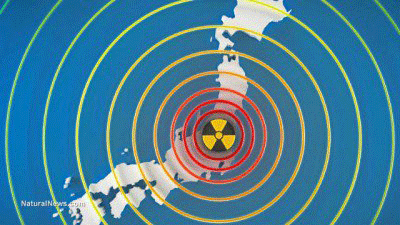
Greenpeace International, 11 March 2025
Tokyo, Japan – 14 years have passed since the Great East Japan Earthquake and the Fukushima Daiichi nuclear disaster devastated the northeast region of Japan. Greenpeace Japan extends heartfelt condolences to the victims and their families who are still suffering the aftermath of this devastating catastrophe……………………………
The risks of nuclear power plants increase with the length of time they have been in operation, as does their vulnerability to natural disasters such as earthquakes. The Fukushima Daiichi nuclear accident occurred at a nuclear power plant that had been in operation for more than 30 years, and radiation levels remain so high that even 14 years after the accident, it is still impossible for humans to directly inspect the damaged reactors. Therefore, the change of policy to promote nuclear power is unacceptable.[1]
There is no prospect for the disposal of spent nuclear fuel while the existing storage facilities are already close to full capacity, and many local authorities have yet to put in place an effective method for the safe evacuation of residents living near nuclear power stations in the event of an unforeseen emergency.
In addition, the Japanese Government and the Tokyo Electric Power Company (TEPCO), pushing aside the concerns of fishermen, residents and others, have decided to start deliberately discharging contaminated water containing radioactive substances from the accident at the Fukushima Daiichi Nuclear Power Plant into the environment. This discharge is expected to continue for about 30 years until 2051.
14 years ago, the then Government considered the possibility of evacuating 50 million people in the Tokyo metropolitan area. In fact, water treatment plants in Tokyo even introduced temporary restrictions on the amount of water that infants should drink. Due to the direction of the wind, much of the released radioactive material was carried out to sea, but a different wind direction would have resulted in a completely different outcome. The Prime Minister secretly drafted a statement at that time which stated that the worst case scenario had occurred. Have we, who experienced the accident, stayed true to the feelings we had in our hearts at the time?
The Great Hanshin-Awaji Earthquake 30 years ago, the Great East Japan Earthquake 14 years ago, the Noto Peninsula Earthquake a year ago and other earthquakes and floods across the country have occurred in rapid succession. We can only prepare for these natural disasters as best we can, but nuclear disasters are different. Nuclear disasters are caused by our choice and use of nuclear power as a means of generating electricity in Japan. Fortunately, there are many possibilities in Japan to pursue comfortable energy savings, as the electricity supply can be replaced by renewable energies that use neither nuclear power nor fossil fuels.
Therefore, Greenpeace Japan, whose vision is to preserve the bounty of the earth for our children 100 years from now, believes that the only reasonable course to take is to stop nuclear power generation in order to prevent nuclear disasters from happening again. The government should clearly state its policy to phase out the use of nuclear power and fossil fuels, in order to ensure a stable energy supply and decarbonise the country. They should make great strides in energy conservation in a way that promotes health, comfort and efficiency, and the use of renewable energy in a way that is in harmony with local communities and nature, thereby aiming to make Japan an energy-saving and renewable energy powerhouse. We will do our utmost this year to work towards this goal.” https://www.greenpeace.org/international/press-release/73383/14-years-since-fukushima-nuclear-disaster-greenpeace-statement/
No comments yet.
1 This Month

of the week – Shut Down Drone Warfare!


Tell the Ukrainian Government to Drop Prosecution of Peace Activist Yurii Sheliazhenko

Petition to revoke the licensing of the Near Surface Nuclear Disposal Facility (NSDF) at Chalk River. https://www.ourcommons.ca/petitions/en/Petition/Details?Petition=e-7247
To see nuclear-related stories in greater depth and intensity – go to https://nuclearinformation.wordpress.com
-
Archives
- April 2026 (103)
- March 2026 (251)
- February 2026 (268)
- January 2026 (308)
- December 2025 (358)
- November 2025 (359)
- October 2025 (376)
- September 2025 (257)
- August 2025 (319)
- July 2025 (230)
- June 2025 (348)
- May 2025 (261)
-
Categories
- 1
- 1 NUCLEAR ISSUES
- business and costs
- climate change
- culture and arts
- ENERGY
- environment
- health
- history
- indigenous issues
- Legal
- marketing of nuclear
- media
- opposition to nuclear
- PERSONAL STORIES
- politics
- politics international
- Religion and ethics
- safety
- secrets,lies and civil liberties
- spinbuster
- technology
- Uranium
- wastes
- weapons and war
- Women
- 2 WORLD
- ACTION
- AFRICA
- Atrocities
- AUSTRALIA
- Christina's notes
- Christina's themes
- culture and arts
- Events
- Fuk 2022
- Fuk 2023
- Fukushima 2017
- Fukushima 2018
- fukushima 2019
- Fukushima 2020
- Fukushima 2021
- general
- global warming
- Humour (God we need it)
- Nuclear
- RARE EARTHS
- Reference
- resources – print
- Resources -audiovicual
- Weekly Newsletter
- World
- World Nuclear
- YouTube
-
RSS
Entries RSS
Comments RSS
 nuclear-news
Leave a comment