A lot of nuclear and related news this past week

Some bits of good news – 27 New UK Tree Cities of the World. How Stockholm Is Sprouting Healthy Trees From Concrete. Degraded Lands Transformed into Productive Farms: With Science, We Can Create Wonders. Once feared extinct, Australia’s most endangered marsupial has had a comeback
TOP STORIES .
“Difficult-to-Return” zones.
Jeffrey Sachs: Negotiating a Lasting Peace in Ukraine. Zelensky’s hostility to peace triggered White House meltdown.
British journalists are celebrating the lack of opposition to war in parliament.
Failure After Failure: Let’s Ditch Small Modular Reactors.
We’ve failed to stop climate change — this is what we need to do next ALSO AT https://nuclear-news.net/2025/03/09/1-a-weve-failed-to-stop-climate-change-this-is-what-we-need-to-do-next/
Climate. Earth’s strongest ocean current could slow down by 20% by 2050 in a high emissions future. Global Ocean Treaty two years on: Australia’s chance for international cooperation.
Half of world’s CO2 emissions come from 36 fossil fuel firms, study shows. UK’s richest can boost climate action but need to cut outsized emissions – study.
First Trump threatened to nuke hurricanes. Now he’s waging war on weather forecasters.
Noel’s notes. Does the Deep State really exist? And if so, is it being dismantled?
AUSTRALIA. Surface tension: could the promised Aukus nuclear submarines simply never be handed over to Australia?
How US Military Bases in Australia Threaten Our Future & How to Remove Them., More Australian nuclear news at https://antinuclear.net/2025/03/05/australian-nuclear-news-headlines-week-to-11-march/
NUCLEAR ITEMS.
| CLIMATE. Nuclear Power Is the Cuckoo in the Climate Policy Nest.Turbine, cooling: these unforeseen events that keep the Flamanville EPR at a standstill. |
| ECONOMICS. East Lindsey District Council wants to claim costs for nuclear waste site work. |
EDUCATION. University of Suffolk co-opted by the nuclear industry.. |
| EMPLOYMENT. EDF considers plans to revive ‘fish disco’ at Hinkley Point plant ALSO AT https://nuclear-news.net/2025/03/06/3-b1-edf-considers-plans-to-revive-fish-disco-at-hinkley-point-plant/ |
| ENERGY. Most Contaminated U.S. Nuclear Site Is Set to Be the Largest Solar Farm. |
| ENVIRONMENT. Air Force picks remote Pacific atoll as site for cargo rocket trials. Radioactive pollution is increasing at Britain’s nuclear bases. Fish disco plan revived to protect salmon from Hinkley Point C ALSO AT https://nuclear-news.net/?s=%E2%80%98Fish+disco%E2%80%99+plan+revived Has common sense finally prevailed at Hinkley Point C? |
| EVENTS. Uranium’s Poison Power in Leafy Cheshire –Remembering Fukushima. |
| INDIGENOUS ISSUES. Mi’kmaw Chiefs send stinging rebuke to Nova Scotia Premier Tim Houston. |
| LEGAL. Fukushima victims angered, saddened by TEPCO acquittals. 9-year lawsuit fails to stop Ikata nuclear plant operationsSupreme Court steps into debate over where to store nuclear waste.Nuclear waste at Chalk River: opponents defeated in court – ALSO AT https://nuclear-news.net/2025/03/08/1-b1-nuclear-waste-at-chalk-river-opponents-defeated-in-court/ |
| OPPOSITION to NUCLEAR . Campaigners attend East Lindsey District Council meeting to call on Lincolnshire County Council to withdraw from Geological Disposal Facility process. |
| PERSONAL STORIES. Nuclear fallout: why Karina Lester is calling on Australia to sign the treaty banning atomic weapons. |
POLITICS
- How the Media Walked us into Autocracy (w/ Ralph Nader) The Chris Hedges Report –https://www.youtube.com/watch?v=oQZuzIzY8YQ
- Doug Ford: Rip up the GE-Hitachi US nuclear contract.
- Nuclear Policy in Scotland. Nuclear energy has no role in Scotland’s green future. Changing nuclear policy would make ‘SNP as bad as Tories’, MSP warns – ALSO AT https://nuclear-news.net/2025/03/10/1-b1-changing-nuclear-policy-would-make-snp-as-bad-as-tories-msp-warns/
- UK Government slaps down Ian Murray over UN nuclear weapons summit. Keir Starmer’s plan for UK growth – the Ukraine war. Conservatives’ push to identify ‘suitable sites’ for nuclear reactors in Telford and Wrekin is defeated. Keir Starmer faces backbench rebellion over ‘shortsighted’ cuts to aid budget. Keir Starmer tells SNP to reverse nuclear weapons opposition.
POLITICS INTERNATIONAL and DIPLOMACY.
- Treaty on the Prohibition of Nuclear Weapons States agree – the ban is the alternative to reckless nuclear deterrence and proliferation as Third Meeting of States Parties draws to a close.
- Trump plans to make Ukraine a US economic colony, exploiting its critical minerals.
- US Threatens Possible Military Response After Tehran Rejects Nuclear Outreach.
- The Russians aren’t coming, the Russians aren’t coming.
- Europe’s Face-Saving Theater on Ukraine.
- Macron’s Offer: France and the Delusions of Nuclear Deterrence.
- Zelensky reverses hardline position on peace talks.
- Russia agrees to help US in negotiations with Iran over nuclear program, Bloomberg reports.
- Non-Proliferation Treaty ‘struggling’ in new nuclear age, expert warns. One empty seat. UK fails again to send representation to UN nuke conference.
- UK urged to prepare for Donald Trump halting Trident partnership ALSO AT https://nuclear-news.net/2025/03/09/2-b1-uk-urged-to-prepare-for-donald-trump-halting-trident-partnership/ UK Government ignoring international law on nuclear weapons – experts ALSO At https://nuclear-news.net/2025/03/09/2-b-1-uk-government-ignoring-international-law-on-nuclear-weapons-experts/
- Delays in Trident renewal put our deterrent in peril.
| SAFETY.Ripping up the rules on nuclear power heightens the risk to us all.Cybersecurity in the Nuclear Industry: US and UK Regulation and the Sellafield Case .Is giving old reactors new life the future of nuclear energy?Continued Incidents Raise Concerns Over Nuclear Security, Says UN More than 145 Reports Added to IAEA Incident and Trafficking Database in 2024. |
| SECRETS and LIES. Israeli technician accused of offering country’s nuclear secrets to Iranian regime. |
| TECHNOLOGY. The SMR Gamble: Betting on Nuclear to Fuel the Data Center Boom. |
| URANIUM. Fearing toxic waste, Greenland ended uranium mining. Now, they could be forced to restart – or pay $11bn. |
| WASTES. American companies profit from Canada’s radioactive waste.Supreme Court wrestles with nation’s frustrating search for nuclear waste storage.East Lindsey overwhelmingly backs GDF withdrawal call to Lincolnshire County Council. Bank Head Estate residents attend public meeting over nuke dump blight. ‘Vote out!’: Protestors win motion at ELDC full council to urge county council to withdraw from nuclear dump talks. |
| WAR and CONFLICT. UN summit ‘delivers strongest condemnation yet’ of nuclear deterrence. |
WEAPONS and WEAPONS SALES.
- More Guns, Less Butter: Starmer’s Defence Spending Splash . Britain’s nuclear weapons fiasco is a nightmare for Rachel Reeves. Britain’s nuclear submarines bill spirals by £5bn. US support to maintain UK’s nuclear arsenal is in doubt, experts say.
- US poised to house nuclear weapons in Britain for first time in two decades.
- Potentially ‘catastrophic’ use of AI in nuclear weapons systems raised by former Royal Navy boss.
- Air Force Activates Key Unit for Nuclear Modernization at VSFB.
- Trump Pauses All Military Aid to Ukraine.
- It’s time to ditch Virginia subs for AUKUS and go to Plan B.
Life as a “displaced person”

Evacuated or not, we all need to protect ourselves from the radioactive contamination resulting from the Fukushima nuclear accident. “Evacuation” is a rightful act of a human being to avoid exposure to radiation so as to enjoy good health. In Japan, however, evacuees are subjected to discrimination and bullying, labeled as “rumor spreaders” since our very existence points out the dangers of radiation. Under this severe social pressure, we can barely express our rightful thought.
https://beyondnuclearinternational.org/2025/03/09/life-as-a-displaced-person/
Fleeing the Fukushima disaster left many families fatherless, including my own, writes Akiko Morimatsu
I am Akiko Morimatsu. I left Fukushima to avoid radiation exposure caused by the Fukushima nuclear catastrophe, and I have been living as an internally displaced person.
Fourteen years have passed since the Great East Japan Earthquake of March 11, 2011 and the subsequent accident at TEPCO’s Fukushima Daiichi Nuclear Power Plant. The accident is far from over and the crippled power plant continues to contaminate the oceans, air, and land connected to the rest of the world. The situation is anything but “under control”, and I am outraged that none of the leaders of the Japanese State have acknowledged this fact.
Even after 14 years, many people continue to remain displaced. The number of evacuees registered with the government (Reconstruction Agency) is still approximately 29,000 people in all 47 prefectures of Japan, and they are in desperate need of government protection and relief.
However, the exact number of evacuees has never been counted by the Japanese government.
In fact, many more people than registered in official statistics have been compelled to flee their homes and are still in distress with no relief in sight, as they are not officially recognized as evacuees.
I have two children. At the time of the disaster, they were a 5-month-old baby and a 3-year-old toddler. For the past 14 years, my husband (the children’s father) lived in Koriyama City, Fukushima Prefecture, and I was living with my children in Osaka City, far apart one from the other.
Thus, people living in contaminated areas outside of the mandatory evacuation zones, made their not-easy-to-take decision to escape from the radiation source with only mothers and their children, who are more vulnerable to radiation. And this, without official aide or support. Even now, there are many people displaced living by their own means, and among them, a large number of households without fathers.
Evacuated or not, we all need to protect ourselves from the radioactive contamination resulting from the Fukushima nuclear accident. “Evacuation” is a rightful act of a human being to avoid exposure to radiation so as to enjoy good health. In Japan, however, evacuees are subjected to discrimination and bullying, labeled as “rumor spreaders” since our very existence points out the dangers of radiation. Under this severe social pressure, we can barely express our rightful thought.
I would also like to strongly emphasize that this issue is not only a problem for the people of Fukushima. I would like to share with everyone in the world the following question: when threatened with nuclear damage, will you stand on the side of those who impose radiation exposure, or will you stand on the side of those who protect people’s lives and health from radiation exposure?
If nuclear power is promoted as a national policy, fleeing will not be easily allowed, and the government can claim, as in Japan, that coexistence with radiation is possible, in order to preserve nuclear power. It is nothing but deception.
The year 2025 will mark 80 years since the end of World War II. Last year, Nihon Hidankyô, the Japan Confederation of A- and H-Bomb Sufferers Organizations, was awarded the Nobel Peace Prize, and hibakusha gave a speech to the world audience, drawing attention to the issue of radiation exposure.
We believe that now is the time to connect with people around the world concerned about nuclear damage. Avoiding radiation exposure to protect lives should be a universally recognized principle. As a victim of the Fukushima nuclear disaster, I, too, have renewed my determination to continue to raise my voice and strive for the establishment of this universal right. Let us continue fighting together.
Following the Great Earthquake and nuclear disaster in Fukushima, Akiko Morimatsu moved from Fukushima to Osaka with her two children aged 5 months and 3 years, leaving her husband who decided to continue working in Fukushima. She is the co-chair of the national coordination of the plaintiffs’ groups of the lawsuits filed by victims of the Fukushima nuclear accident, and the representative of the plaintiffs’ group in the Osaka metropolitan area. She lectures in Japan and abroad to defend the rights of nuclear accident victims. In 2018, she gave a speech at the United Nations Human Rights Council in Geneva. Translation from the Japanese by Kurumi Sugita, Nos Voisins Lontains 3.11.
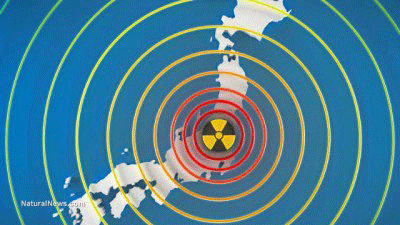
14 years since Fukushima nuclear disaster: Greenpeace statement
Greenpeace International, 11 March 2025
Tokyo, Japan – 14 years have passed since the Great East Japan Earthquake and the Fukushima Daiichi nuclear disaster devastated the northeast region of Japan. Greenpeace Japan extends heartfelt condolences to the victims and their families who are still suffering the aftermath of this devastating catastrophe……………………………
The risks of nuclear power plants increase with the length of time they have been in operation, as does their vulnerability to natural disasters such as earthquakes. The Fukushima Daiichi nuclear accident occurred at a nuclear power plant that had been in operation for more than 30 years, and radiation levels remain so high that even 14 years after the accident, it is still impossible for humans to directly inspect the damaged reactors. Therefore, the change of policy to promote nuclear power is unacceptable.[1]
There is no prospect for the disposal of spent nuclear fuel while the existing storage facilities are already close to full capacity, and many local authorities have yet to put in place an effective method for the safe evacuation of residents living near nuclear power stations in the event of an unforeseen emergency.
In addition, the Japanese Government and the Tokyo Electric Power Company (TEPCO), pushing aside the concerns of fishermen, residents and others, have decided to start deliberately discharging contaminated water containing radioactive substances from the accident at the Fukushima Daiichi Nuclear Power Plant into the environment. This discharge is expected to continue for about 30 years until 2051.
14 years ago, the then Government considered the possibility of evacuating 50 million people in the Tokyo metropolitan area. In fact, water treatment plants in Tokyo even introduced temporary restrictions on the amount of water that infants should drink. Due to the direction of the wind, much of the released radioactive material was carried out to sea, but a different wind direction would have resulted in a completely different outcome. The Prime Minister secretly drafted a statement at that time which stated that the worst case scenario had occurred. Have we, who experienced the accident, stayed true to the feelings we had in our hearts at the time?
The Great Hanshin-Awaji Earthquake 30 years ago, the Great East Japan Earthquake 14 years ago, the Noto Peninsula Earthquake a year ago and other earthquakes and floods across the country have occurred in rapid succession. We can only prepare for these natural disasters as best we can, but nuclear disasters are different. Nuclear disasters are caused by our choice and use of nuclear power as a means of generating electricity in Japan. Fortunately, there are many possibilities in Japan to pursue comfortable energy savings, as the electricity supply can be replaced by renewable energies that use neither nuclear power nor fossil fuels.
Therefore, Greenpeace Japan, whose vision is to preserve the bounty of the earth for our children 100 years from now, believes that the only reasonable course to take is to stop nuclear power generation in order to prevent nuclear disasters from happening again. The government should clearly state its policy to phase out the use of nuclear power and fossil fuels, in order to ensure a stable energy supply and decarbonise the country. They should make great strides in energy conservation in a way that promotes health, comfort and efficiency, and the use of renewable energy in a way that is in harmony with local communities and nature, thereby aiming to make Japan an energy-saving and renewable energy powerhouse. We will do our utmost this year to work towards this goal.” https://www.greenpeace.org/international/press-release/73383/14-years-since-fukushima-nuclear-disaster-greenpeace-statement/
Nuclear power’s global stagnation


There were no ‘small modular reactor’ (SMR) startups in 2024. Indeed there has never been a single SMR startup.
If you count so-called SMRs that are not built using factory ‘modular’ construction techniques, then there has still been just one each in China and Russia.
Dr Jim Green , 10th March 2025 ,
https://theecologist.org/2025/mar/10/nuclear-powers-global-stagnation
The proponents of nuclear power rely on an excessive optimism which, once again, sits in stark contrast to the reality of the decades-long stagnation the industry worldwide. That contrast is the subject of our new report for the EnergyScience Coalition.
The latest nuclear proposals are built on three speculations, each of which is a castle built on sand.
First, we have the projected AI-related energy demand. This ignores emerging evidence that such projections are overblown. For example, the new leading AI entrant DeepSeek requires just 10 percent of the energy of competitors. This is a repeat of the claims of the nuclear power proponents of the 1970’s whose projected demand that never eventuated.
Grids
Second, then we see speculative techno-optimism that new technologies such as small modular reactors will resolve industry project management issues. These small reactors are unproven.
Third, finally we note the prospective wish fulfilment, where dozens of nuclear ‘newcomer’ countries are offered as saviours. This is despite the hero countries in a large majority of cases not having reactor approvals and funding in place.
So what is the actual state of nuclear power in 2025? Worldwide nuclear power capacity was 371 gigawatts (GW) at the end of last year. That figure is near-identical to capacity of 368 GW two decades earlier in 2005.
A review by the World Nuclear Industry Status Report notes that seven new reactors were connected to grids last year while four reactors were permanently closed. The net increase in operating nuclear capacity was 4.3 gigawatts (GW).
Ageing reactors
The industry faces a daunting challenge just to maintain its pattern of stagnation, let alone achieve any growth. As of Wednesday, 1 January 2025, the mean age of the nuclear power reactor fleet was 32.1 years. In 1990, the mean age was just 11.3 years.
The International Atomic Energy Agency projects the closure of 325 GW of nuclear capacity from 2018 to 2050 due simply to the ageing of the reactor fleet ‒ that’s 88 percent of current worldwide capacity.
There were no ‘small modular reactor’ (SMR) startups in 2024. Indeed there has never been a single SMR startup. If you count so-called SMRs that are not built using factory ‘modular’ construction techniques, then there has still been just one each in China and Russia.
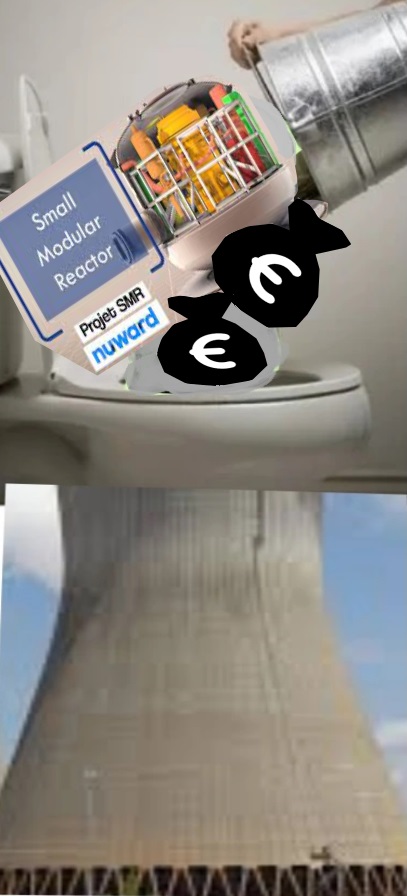
The SMR sector continues to go nowhere, with further setbacks in 2024. The Nuward project in France has been suspended. This followed previous decisions to abandon four other SMR projects and the bankruptcy of US company Ultra Safe Nuclear.
Renewables
In striking contrast to nuclear power’s marginal gain of 4.3 GW in 2024, the International Energy Agency’s October 2024 ‘Renewables 2024’ report estimates 666 GW of global renewable capacity additions in 2024.
Based on the Agency’s estimate, renewables capacity growth was 155 times greater than that of nuclear power. In China, the ratio was 100:1 last year.
The International Energy Agency expects renewables to jump sharply from 30 percent of global electricity generation in 2023 to 46 percent in 2030.
Conversely, nuclear power’s share of global electricity generation has fallen steadily since the 1990s. As of 2025, nuclear power accounted for 9.15 percent of global electricity production, barely half of its peak of 17.5 percent in 1996.
Renewable investments were 21 times greater than nuclear investments. A Bloomberg analysis finds that renewable energy investments reached $US728 billion in 2024, up eight percent on the previous year. This compares with nuclear investment that remains flat at US$34.2 billion.
Renewable costs have fallen sharply, in contrast to massive cost overruns with nuclear projects. Lazard investment firm data shows that utility-scale solar and onshore wind became cheaper than nuclear power from 2010‒2015.
From 2009‒2024, the cost of utility-scale solar fell 83 percent; the cost of onshore wind fell 63 percent; while nuclear costs increased 49 percent.
Newcomer
Claims that between 40 and 50 countries are actively considering or planning to introduce nuclear power, in addition to the 32 countries currently operating reactors, do not withstand scrutiny.
At the start of this year reactors were under construction in just 13 countries, two less than a year earlier. Seven percent of the world’s countries are building reactors – 93 percent are not.
Of the 13 countries building reactors, only three are potential nuclear newcomer countries building their first plant: Egypt, Bangladesh and Turkiye. In those three countries, the nuclear projects are led by Russian nuclear agencies with significant up-front funding from the Russian state.
The World Nuclear Association observes that apart from those three countries, no countries meet its criteria of having ‘planned’ reactors: those with “approvals, funding or commitment in place, mostly expected to be in operation within the next 15 years”.
The number of potential newcomer countries with approvals and funding in place, or construction underway, is just three and those projects are funded heavily by the Russian state.
Phase-outs
There is no evidence of a forthcoming wave of nuclear newcomer countries.
At most there will be a trickle, as has been the historical pattern. There has in fact been just seven newcomer countries over the past 40 years, and just three in the current century.
The number of countries operating power reactors in 1996–1997 reached 32. Since then, newcomer countries have been matched by countries completing nuclear phase-outs and thus the number is stuck at 32. And less than one-third of those countries are building reactors.
It is doubtful whether the number of nuclear newcomer countries will match the number of countries completing phase-outs in 20 to 30 years’ time.
Capital strike

Nuclear power just can’t compete economically. The industry’s greatest problem at the moment is a recognition of this by investors, resulting in a capital strike.
Even with generous government and taxpayer subsidies, it has become difficult or impossible to fund new reactors ‒ especially outside the sphere of China and Russia’s projects at home and abroad.
Who would bet tens of billions of dollars on nuclear power projects when the recent history in countries with vast expertise and experience has been disastrous?
In France, the latest cost estimate for the only recent reactor construction project, the 1.6 GW Flamanville EPR, increased seven-fold from €3.3 billion to €23.7 billion for just one reactor. Construction took 17 years. No reactors are currently under construction in France.
And this problem sits alongside the risk of Fukushima-scale disasters, the risk of weapons proliferation, the risk of attacks on nuclear plants and the risks from the intractable nuclear waste legacy.
Some of these risks have already come to pass, as with the reality of attacks on nuclear plants in Ukraine.
Bankruptcy
In the US, one project in South Carolina, comprising two Westinghouse AP1000 reactors, was abandoned in 2017 after at least US$9 billion was spent.
Westinghouse declared bankruptcy immediately after the cancellation of the South Carolina project, and its debts almost forced its parent company Toshiba into bankruptcy. All that remains is the nukegate scandal: an avalanche of legal action, including criminal cases.
The only other reactor construction project in the US ‒ the twin-reactor Vogtle project in the state of Georgia ‒ reached completion at a cost 12 times higher than early estimates. The final cost of the Vogtle project was at least US$17 billion per reactor. Completion was about seven years behind schedule.
No power reactors are currently under construction in the US. Thirteen reactors have been permanently shut down over the past 15 years.
Subsidies
The situation is just as bleak in the UK where there have been 24 permanent reactor shut-downs since the last reactor startup 30 years ago, in 1995.
The 3.2 GW twin-reactor Hinkley Point project in Somerset was meant to be complete in 2017 but construction didn’t even begin until 2018. The estimated completion date has been pushed back to as late as 2031. The latest cost estimate ‒ £23 billion per reactor ‒ is 11.5 times higher than early estimates.
The UK National Audit Office estimates that taxpayer subsidies for the Hinkley Point project could amount to A$60.8 billion and the UK Parliament’s Public Accounts Committee said that “consumers are left footing the bill and the poorest consumers will be hit hardest.”
The estimated cost of the planned 3.2 GW twin-reactor Sizewell C project in the UK has jumped to nearly £40 billion – or £20 billion per reactor – which is twice the cost estimate in 2020.
Securing funding to allow construction to begin at Sizewell is proving to be difficult and protracted despite a new ‘Regulated Asset Base’ funding model which foists the enormous risk of enormous cost overruns onto taxpayers and electricity bill payers. Securing funding to complete the Hinkley Point project is also proving difficult.
Lessons
France, the US and the UK have vast nuclear expertise and experience. They all enjoy synergies between civil and military nuclear programs ‒ President Macron said in a 2020 speech that without nuclear power in France there would be no nuclear weapons, and vice versa.
All of the above-mentioned construction projects were or are on existing nuclear sites. All projects were or are long delayed and tens of billions of dollars over-budget.
Claims that potential nuclear newcomer countries, without any of those advantages, could build reactors quickly and cheaply are simply not credible.
This Author
Dr Jim Green, national nuclear campaigner with Friends of the Earth Australia and a member of the Nuclear Consulting Group.
A report expanding on these issues is posted at the EnergyScience Coalition website. The report is co-authored by Darrin Durant, associate professor in science and technology studies at the University of Melbourne, Jim Falk, professorial fellow in the school of geography, earth and atmospheric sciences at the University of Melbourne and emeritus professor at the University of Wollongong and Dr Jim Green.
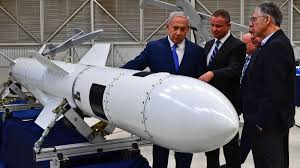
Qatar calls for Israel’s nuclear facilities to be under IAEA supervision
March 10, 2025 , https://www.middleeastmonitor.com/20250310-qatar-calls-for-israels-nuclear-facilities-to-be-under-iaea-supervision/
Qatar called on Sunday for all of Israel’s nuclear facilities to be subjected to the International Atomic Energy Agency (IAEA) safeguards and for Israel to sign the Treaty on the Non-Proliferation of Nuclear Weapons (NPT) as a non-nuclear state if that is what it claims to be.
Qatar’s Ambassador and Permanent Representative to the UN Office and International Organisations in Vienna, Jassim Yacoup Al-Hammadi, said before the session of the IAEA Board of Governors in the Austrian capital, that there is a “need for the international community and its institutions to uphold their commitments under resolutions of the UN Security Council, the UN General Assembly, the IAEA, and the 1995 Review Conference of the NPT, which called on Israel to subject all its nuclear facilities to IAEA safeguards.”
He noted that some of these resolutions explicitly urged Israel to join the NPT as a non-nuclear state if its non-confirmation of its nuclear programme is, in effect, a denial of its existence.
The Qatari Ambassador pointed out that all Middle Eastern countries, except Israel, are parties to the NPT and have effective safeguard agreements with the Agency.
He also noted that. “Israel continues its aggressive policies, including increasing extremist calls for the forced displacement of the Palestinian people, intensifying military operations against cities and refugee camps in the West Bank, blocking humanitarian aid to Gaza, and maintaining restrictions on the operations of the United Nations Relief and Works Agency for Palestine Refugees in the Near East (UNRWA).”
Al-Hammadi stated that Qatar “submitted a written memorandum last week to the International Court of Justice (ICJ) regarding a request for an advisory opinion based on the UN General Assembly resolution of 19 December, 2024. The request seeks clarification on Israel’s obligations concerning the activities of the United Nations, other international organisations, and third-party states.”
The nuclear testing revival: Global fallout with deadly consequences
By Karl Grossman | 10 March 2025 https://independentaustralia.net/life/life-display/the-nuclear-testing-revival-global-fallout-with-deadly-consequences,19502
The push to restart U.S. nuclear testing raises fears of global fallout, echoing a dangerous past with lasting consequences, writes Karl Grossman
RESEARCH FELLOW for nuclear deterrence and missile defence at The Heritage Foundation, Robert Peters, declared:
‘The United States may need to restart explosive nuclear weapons testing.’
The right-wing organisation close to the Trump Administration released a lengthy report on 15 January, titled: ‘America Must Prepare to Test Nuclear Weapons‘, in which Peters also stated:
‘…The President may order the above-ground testing of a nuclear weapon….And while the United States leaving the [Nuclear] Test Ban Treaty may not be optimal and may indeed have negative downstream effects, doing so may be necessary to stave off further adversary escalation.’
There has not been a nuclear weapon tested above-ground in the United States since 1962, Peters said. That was a year before the Test Ban Treaty 1963 was signed by the U.S., Soviet Union and United Kingdom. It prohibited nuclear weapons tests in the atmosphere, underwater or in outer space. It allowed underground tests as long as they didn’t result in ‘radioactive debris to be present outside the territorial limits of the state under whose jurisdiction or control’ the test was conducted.
“ [Nuclear testing] leads to children and grandchildren with cancer in their bones, with leukemia in their blood, or with poison in their lungs.”
~ President John F Kennedy
However, executive director of the Radiation and Public Health Project Joseph Mangano says:
‘Resuming atmospheric testing of nuclear weapons would be disastrous.’
Mangano also cited:
‘…lessons learned from above-ground nuclear weapons testing — the radioactive fall-out that harmed many people, especially infants and children.’
Testimony by a co-founder of the Radiation and Public Health Project, the late Dr Ernest Sternglass – a physicist, before the then Congressional Joint Committee on Atomic Energy – was instrumental in U.S. President John F Kennedy signing the Nuclear Test Ban Treaty of 1963.
As Kennedy said in a 1963 national address:
This treaty can be a step towards freeing the world from the fears and dangers of radioactive fallout…over the years the number and the yield of weapons tested have rapidly increased and so have the radioactive hazards from such testing.
Continued unrestricted testing by the nuclear powers, joined in time by other nations which may be less adept in limiting pollution, will increasingly contaminate the air that all of us must breathe.
Kennedy also spoke of “children and grandchildren with cancer in their bones, with leukaemia in their blood, or with poison in their lungs” as a result of the testing.
According to Susan Caskie, executive editor of The Week, the Heritage Foundation’s 900-page publication ‘Project 2025‘ is the ‘governing agenda’ for the Trump Administration. She notes, ‘many of its authors and contributors’ are now members of the Trump Administration, with some even appointed to Cabinet posts.
Tom Armbruster, former U.S. Ambassador to the Marshall Islands and earlier the U.S. Embassy in Moscow’s nuclear affairs wrote in an article in the Bulletin of the Atomic Scientists titled, ‘Project 2025’s stance on nuclear testing: A dangerous step back’:
‘On page 431, Project 2025 calls for the United States to “Reject ratification of the Comprehensive Test Ban Treaty and indicate a willingness to conduct nuclear tests in response to adversary nuclear developments if necessary. This will require that the National Nuclear Security Administration be directed to move to immediate test readiness…”.’
Ambruster also said:
We should be negotiating further cuts in the world’s nuclear arsenals, a prohibition of weapons in outer space, and cleanup of the “legacy” test sites around the world. It would help if Russia were a responsible partner in denuclearisation but sadly that is not the case.
We could be working together to find ways to mend the planet, rather than inflict further damage that will last for thousands of years.
But in The Heritage Foundation’s report, Peters writes:
‘There are two major reasons why the United States may want to restart nuclear testing in the coming years. First, it may be technically correct that the United States does not need to test its current arsenal, but the United States is building new warheads as part of the nuclear modernisation effort.’
He goes on:
It may, in fact, be necessary to test these new systems to ensure that they work as designed. Modelling and simulation may be sufficient to assess the viability and characteristics of these new warheads — but that is not a proven proposition.
Moreover, the purpose of nuclear weapons is to deter one’s adversaries from carrying out breathtaking acts of aggression. In that sense, even if nuclear explosive testing is not necessary to convince American policymakers that next-generation nuclear systems work, it may be necessary to convince America’s adversaries that its nuclear arsenal is credible.
Peters continued:
Second and more importantly, a nuclear explosive test may be necessary to demonstrate resolve. In recent years, autocrats have increasingly leveraged nuclear coercion or nuclear threats in an attempt to intimidate the West or secure geopolitical concessions.
While the United States signed and ratified the Treaty under President Kennedy – and has adhered to its requirements for over six decades – the Treaty allows a state to withdraw with three months notification if it deems it in its national interests to do so.
It was also in the Bulletin of the Atomic Scientists that Mangano and Robert Alvarez, former senior policy advisor to the secretary of the U.S. Department of Energy and now senior policy advisor at the Institute for Policy Studies, wrote an article in 2021 on radioactive fallout from nuclear weapons tests and the ‘baby tooth’ study, which began:
How many nuclear weapons can be detonated in support of weapons development or during a war before imperilling humans from radioactive fallout?
To find the answer, independent scientists and citizens turned to baby teeth. Lots and lots of baby teeth. Why baby teeth?….The most commonly measured isotope in these tissues – strontium 90 – is absorbed as if it were calcium. This isotope lodges in human bone tissue for many years and was the principal contaminant of concern in fallout investigations…
Beginning in December 1958, the St. Louis Committee for Nuclear Information and scientists at Washington University, ‘began assembling the most significant collection of human samples in the atmospheric bomb test era.’ Donated were 320,000 baby teeth.
Findings were published in a 2023 issue of the Journal of Social Determinants of Health and Health Services titled, ‘Strontium 90 in Baby Teeth as a Basis for Eliminating U.S. Cancer Deaths From Nuclear Weapons Fallout’. The report was written by biology professor at the University of South Carolina Dr Timothy Mousseau, professor emeritus of chemistry and biology at North Arizona University Dr Michael Ketterer, and Kelli S. Gaus and, comments Mangano, ‘This saved many lives.’
It detailed a 63-fold increase in strontium-90 in baby teeth from children born in the years after large-scale nuclear weapons testing in the atmosphere started in 1950, then dropping in half in the five years after the Nuclear Test Ban Treaty of 1963 took effect.
If there is a return to atmospheric nuclear weapons testing, are we to go back to the years of radioactive fallout – and the resulting health impacts – fallout that would have a global impact? And, as Kennedy stated, “children and grandchildren with cancer in their bones, with leukaemia in their blood, or with poison in their lungs”?
Karl Grossman is a professor of journalism at the State University of New York. He is also an award-winning investigative reporter. Click here to go to Karl’s website.
How the Arts Play a Role in the Fight for Nuclear Disarmament

conversations surrounding nuclear weapons have been largely absent from the cultural zeitgeist. The Atomic Age, also known as the period of time between the detonation of the first atomic bombs in 1945 and the end of the Cold War in 1991, was saturated with pop culture that dealt heavily with themes of nuclear fallout.
UNITED NATIONS, Mar 6 2025 (IPS) -By Oritro Karim, https://www.ipsnews.net/2025/03/arts-play-role-fight-nuclear-disarmament/?utm_source=rss&utm_medium=rss&utm_campaign=arts-play-role-fight-nuclear-disarmament
This week countries and communities converge in New York for the 3rd Meeting of State Parties on the Treaty for the Prohibition of Nuclear Weapons (TPNW), with multiple side events to address the social, political and cultural impact of nuclear abolition across different sectors.
On March 5, the Permanent Mission of Mexico to the United Nations held an event called Fábulas Atómicas – Artists Against the Bomb in collaboration with Mexican artist Pedro Reyes, in which the relationship between the arts and the use of nuclear weapons was discussed. Throughout the last century, the arts have been used to provide cultural commentary on the threats that nuclear weapons pose to humanity.
“Using art for disarmament can take many different forms. I started by transforming gun parts into musical instruments, for instance taking a rifle and transforming it into a flute…What is the principle of a nuclear weapon? I thought it was possible to make a chain reaction that could be a creative force rather than a destructive force. That is how Artists Against the Bomb was born,” said Reyes.
Since 1952, the United Nations Disarmament Commission (UNDC) has continuously stressed the importance of international peace and disarmament. With geopolitical tensions on the rise and world superpowers such as Russia, North Korea, and the United States wielding more atomic weapons than ever before, the threat of nuclear proliferation is the highest it has been in decades.
“The bilateral and regional security arrangements that underwrote global peace and stability for decades are unravelling before our eyes. Trust is sinking, while uncertainty, insecurity, impunity and military spending are all rising. Others are expanding their inventories of nuclear weapons and materials. Some continue to rattle the nuclear sabre as a means of coercion. We see signs of new arms races including in outer space,” said United Nations (UN) Secretary-General António Guterres at the UN Conference on Disarmament in Geneva.
Despite this, conversations surrounding nuclear weapons have been largely absent from the cultural zeitgeist. The Atomic Age, also known as the period of time between the detonation of the first atomic bombs in 1945 and the end of the Cold War in 1991, was saturated with pop culture that dealt heavily with themes of nuclear fallout.
Since the late 1980s, projects began to shift away from these themes. Reyes highlighted the importance of art in relation to cultural commentary surrounding nuclear weapons by saying, “The end of the 80s made it seem like the cold war was over. To a certain extent, people born after 1989 had not been exposed to cultural materials…With the nuclear testing ban, there haven’t been any nuclear detonations since around 1999. There’s a saying called ‘out of sight out of mind’. The threat became somewhat invisible. It is our job to use culture to bring awareness to this issue through culture by provoking rage and fear.”
Reyes adds that the current undersaturation of the nuclear weapons issue in pop culture helps to facilitate conversations as the public has become wary of discussing issues that dominate culture today. “There is no fatigue about the subject. There’s a certain fatigue surrounding projects that have been strongly discussed in the past twenty years. Nuclear weapons are an issue that we have not spoken out about enough in recent times. We need to take advantage of this lack of fatigue,” he said.
The Nuclear Art movement rose in 1945, shortly after the United States’ detonation of two atomic bombs in Hiroshima and Nagasaki, Japan. At this time, the majority of the American public were unaware of the scale of destruction that had occurred in Japan.
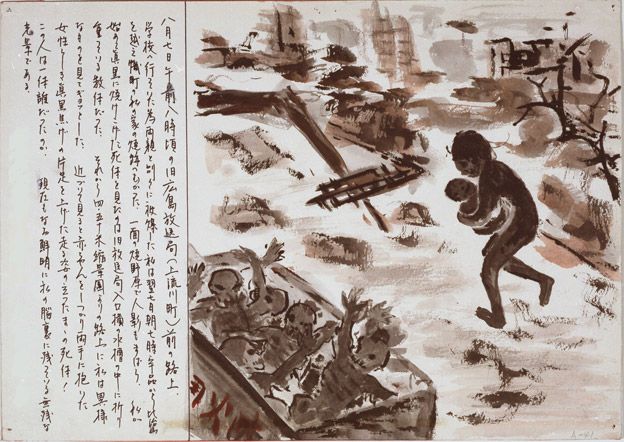
Japanese photographers that had survived the attacks such as Yoshito Masushige (Hiroshima) and Yosuke Yamahata (Nagasaki), as well as American photographers such as Wayne Miller and Joe O’Donnell, published photos of the aftermath, which were classified by the United States government for decades. Much of the world instead relied on artwork that visualized the devastation.
Contemporary artists and corporations alike began incorporating themes of atomic weapons and nuclear fallout in their work shortly after the bombings in Japan. This movement grew more prominent after the 1962 Cuban Missile Crisis, which is considered to be the closest the world has ever come to nuclear warfare.
Western art pieces, such as Charles Bittinger’s 1946 painting, Atomic Bomb Atomic Bomb Mushroom Cloud, brought the now well-known mushroom cloud imagery into public consciousness in the United States. Other examples include U.S. military artist Standish Brackus’s pieces Still Life (1946) and At the Red Cross Hospital (1945), which depicted the wide scale destruction that nuclear weapons inflict on civilian infrastructure and the human body, respectively.

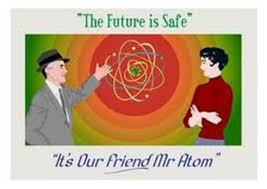
Additionally, Nuclear Art also became a fixture in Western propaganda. In 1957, the Walt Disney Company released an episode of Disneyland titled Our Friend the Atom, which highlighted the ways atomic weapons can be used for peace, falling in line with the themes of Dwight D. Eisenhower’s Atoms for Peace speech at the UN General Assembly in 1953.
In the early 1950s, blockbuster films from both American and Japanese studios led to a widening public consciousness surrounding nuclear weapons. Science-fiction films such as The Beast from 20,000 Fathoms (1953) and Godzilla (1959) highlighted the unintended biological consequences of nuclear fallout.
However, On the Beach (1959) marked a pivotal shift in the depiction of nuclear fallout by explicitly marking humans as responsible for a deliberate detonation that led to a societal collapse. Stanley Kubrick’s Dr. Strangelove (1964) expanded on these themes by using absurdism to emphasize humanity’s role in nuclear proliferation.
Most recently, Christopher Nolan’s Oppenheimer (2023) brought nuclear weapons into the public consciousness once more, particularly in the West, There have been critiques on if modern artists are depicting these themes effectively. Reyes told an IPS correspondent that the arts have the ability to sway audiences in either direction. Certain representations of nuclear weapons in pop culture can be classified as either “above the cloud” or “under the cloud”.
“Films like Oppenheimer show the overwhelming power of science and the moral conflict of atomic bombs but never show the victims or consequences. Films like that are almost pro-bomb because they fail to humanize these conflicts. Other films show what’s really at stake. It’s important to be able to identify which side cultural productions are on,” said Reyes.
It is crucial for contemporary artists to depict the correct messages in their work to achieve any substantial cultural progress in nuclear disarmament. Pop culture must continue to show the true extent of the dangers that nuclear weapons pose.
“We have to be very clear in arguing that nobody can win a nuclear war,” said Reyes. “And that’s why it’s very important to show the consequences. It has been normalized through video games and other mediums that make them seem not as problematic as they are. It’s our job to do a lot of explaining and find entertaining ways for people to understand.”
IPS UN Bureau Report
US makes fresh push for World Bank to back nuclear power

New administration wants Washington-based multilateral lender to help the west
compete with China and Russia.
The World Bank is facing renewed calls from
its biggest shareholder to drop a decades-old ban on funding nuclear power
to help the west compete with China and Russia in atomic diplomacy. French
Hill, chair of the House Financial Services Committee, has signalled that
the new US administration will continue to support the push to fund nuclear
projects just months ahead of a crucial decision on the contentious ban.
FT 9th March 2025
https://www.ft.com/content/e5e497a3-0c61-46a2-9a50-91757e7f1a61
How many nuclear weapons does the United States have in 2025?
10 Mar 2025
Since 1987, the Bulletin of the Atomic Scientists has published the Nuclear Notebook, an authoritative accounting of world nuclear arsenals compiled by top experts from the Federation of American Scientists.
Today, it is prepared by Hans M. Kristensen, Matt Korda, Eliana Johns, and Mackenzie Knight of FAS.
This video explores the United States’ nuclear arsenal, which is currently undergoing a broad modernization effort to replace every nuclear delivery system over the next decade. You can read more from the Nuclear Notebook about other nuclear arsenals here: https://thebulletin.org/nuclear-noteb… https://www.youtube.com/watch?v=3vsNKk9vkIE
Elon Musk Announces ‘Massive Cyberattack’ Causing X Outage
Thousands of people reported on March 10 that the social media platform was down for them.
Epoch Times, 3/10/2025By Jack Phillips
Tech billionaire Elon Musk on March 10 said that an outage affecting his social media platform, X, is being caused by a “massive cyberattack” that is ongoing.
On March 10, tens of thousands of reports were submitted to DownDetector saying users could not access the X app or website or they could not access posts.
In response, Musk wrote at midday: “There was (still is) a massive cyberattack against X. We get attacked every day, but this was done with a lot of resources.”
“Either a large, coordinated group and/or a country is involved,” the Tesla and SpaceX CEO wrote, adding that his company is “tracing” the attacks.
In a later interview with Fox News on the same day, Musk said that the attacks’ IP addresses in the X cyberattack were “linked to IP addresses originating in the Ukraine area.” The Epoch Times could not immediately authenticate Musk’s comment.
People on the platform first started reporting issues after 5 a.m. ET on March 10, according to DownDetector. After a brief period of time, the number of reports appeared to drop before picking back up again at about 11 a.m. ET……………………………………
More than 10,000 people in the United Kingdom also reported an X outage earlier on March 10, according to DownDetector’s website…………………..
The outage comes amid Musk and Secretary of State Marco Rubio having publicly sparred with Polish Foreign Minister Radoslaw Sikorski on March 9 after Musk said on X that the Ukraine war with Russia would be severely hampered if he were to turn off Starlink internet access in the Eastern European country.
On March 9, Musk, who is currently a senior adviser to President Donald Trump, wrote that Starlink has served as the “backbone of the Ukrainian army” and asserted that “their entire front line would collapse if I turned it off.” He also said he wants peace for Ukraine and that he’s backed the country in its war effort by providing the internet service.
Sikorski responded to Musk by saying that Poland was paying for the internet service and claimed Musk was threatening Kyiv. The Trump administration and Ukraine’s leadership have been engaged in high-stakes talks about ending the conflict and a deal for continued support of Ukraine that also benefits the United States………. https://www.theepochtimes.com/us/elon-musk-announces-massive-cyberattack-causing-x-outage-5823029?utm_source=Aobreakingnoe&utm_medium=Aoemail&utm_campaign=Aobreaking-2025-03-11&utm_content=NL_Ao&src_src=Aobreakingnoe&src_cmp=Aobreaking-2025-03-11&cta_utm_source=Aobreakingnoecta&est=iIzbjUv5GHdVOivdisxCzrbEBMMMNm2pOhOa%2F2%2Bo%2B8Uc84LMJe%2BVuIounSiENahxKSKfQOBK8pkU
1 This Month

Petition to revoke the licensing of the Near Surface Nuclear Disposal Facility (NSDF) at Chalk River. https://www.ourcommons.ca/petitions/en/Petition/Details?Petition=e-7247


of the week – STOP SMALL MODULAR REACTORS IN CANADA
To see nuclear-related stories in greater depth and intensity – go to https://nuclearinformation.wordpress.com
-
Archives
- March 2026 (153)
- February 2026 (268)
- January 2026 (308)
- December 2025 (358)
- November 2025 (359)
- October 2025 (376)
- September 2025 (258)
- August 2025 (319)
- July 2025 (230)
- June 2025 (348)
- May 2025 (261)
- April 2025 (305)
-
Categories
- 1
- 1 NUCLEAR ISSUES
- business and costs
- climate change
- culture and arts
- ENERGY
- environment
- health
- history
- indigenous issues
- Legal
- marketing of nuclear
- media
- opposition to nuclear
- PERSONAL STORIES
- politics
- politics international
- Religion and ethics
- safety
- secrets,lies and civil liberties
- spinbuster
- technology
- Uranium
- wastes
- weapons and war
- Women
- 2 WORLD
- ACTION
- AFRICA
- Atrocities
- AUSTRALIA
- Christina's notes
- Christina's themes
- culture and arts
- Events
- Fuk 2022
- Fuk 2023
- Fukushima 2017
- Fukushima 2018
- fukushima 2019
- Fukushima 2020
- Fukushima 2021
- general
- global warming
- Humour (God we need it)
- Nuclear
- RARE EARTHS
- Reference
- resources – print
- Resources -audiovicual
- Weekly Newsletter
- World
- World Nuclear
- YouTube
-
RSS
Entries RSS
Comments RSS
 nuclear-news