American companies profit from Canada’s radioactive waste
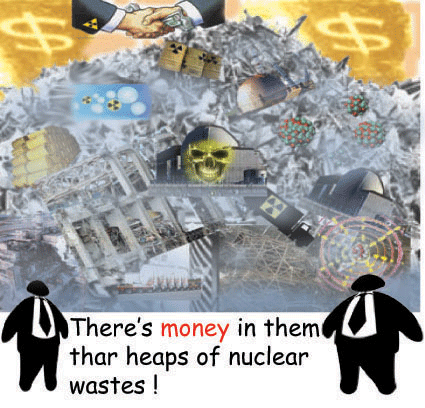
Toxic radioactive waste is expensive to clean up. Canada’s contract to clean up itslegacy waste is worth billions for a three-company consortium: Canada’s AtkinsRéalisand Texas-based Fluor and Jacobs. The two American companies run nuclear weaponsfacilities in the U.S. and U.K. in addition to their Canadian nuclear interests.
Parliament’s payment to the consortium last year was $1.3 billion. The annual payments have risen each year of the 10-year contract that will end in September 2025.
The consortium operates “Canadian Nuclear Laboratories” (CNL) in a “Government-owned, Contractor-operated” (GoCo) arrangement with Atomic Energy of Canada Limited (AECL).
The U.K. abandoned GoCo contracts because of exorbitant costs and poor value for money. Under Canada’s GoCo contract, AECL owns lands, buildings, and radioactive waste, and the three-company consortium operates AECL’s sites.
When the Harper government issued the 10-year GoCo contract during the 2015 federal election period, they said AECL lacked the ability to clean up Canada’s multi-billion radioactive waste liability dating to World War II and needed “private sector rigour. From their billion-dollar annual payout, the three partner corporations take $237 million for “contractual expenses.” The salaries of 44 senior CNL managers, mostly Americans, average over $500,000 each.
Canada’s liability includes radioactive contamination in Port Hope, Ontario where uranium was refined for the U.S. nuclear weapons industry, radioactive contamination at the Chalk River nuclear laboratory site from producing plutonium for U.S. nuclear weapons, and radioactive contamination from AECL’s shutdown “prototype” CANDU reactors and its Whiteshell research lab in Manitoba.
The radioactive clean-up cost has grown each contract year, as have the consortium’s ambitions. The focus has shifted to “revitalizing” the Chalk River facility, where Parliament has allocated additional funds to build an “Advanced Nuclear Materials Research Centre.”
The Centre will conduct SMR research including research on plutonium fuels. Both American companies have interests in SMRs. The new Centre did not undergo a licensing process or environmental assessment under the Canadian Nuclear Safety.
AECL is expected to soon announce the awarding of a new 10-year Go-Co contract. Before the contract is signed, MPs should consider whether the arrangement benefits Canada, and whether these billions should be in the hands of American managers and corporations.
Commission.
No comments yet.
1 This Month


18 March Webinar @ 1 PM EST: An Assessment of SMR Projects: The Case of Canada
register for the zoom:
https://us02web.zoom.us/webinar/register/WN_o8BIIOUvQ2ONJR1nta65DQ#/registration


of the week – STOP SMALL MODULAR REACTORS IN CANADA
To see nuclear-related stories in greater depth and intensity – go to https://nuclearinformation.wordpress.com
-
Archives
- March 2026 (138)
- February 2026 (268)
- January 2026 (308)
- December 2025 (358)
- November 2025 (359)
- October 2025 (376)
- September 2025 (258)
- August 2025 (319)
- July 2025 (230)
- June 2025 (348)
- May 2025 (261)
- April 2025 (305)
-
Categories
- 1
- 1 NUCLEAR ISSUES
- business and costs
- climate change
- culture and arts
- ENERGY
- environment
- health
- history
- indigenous issues
- Legal
- marketing of nuclear
- media
- opposition to nuclear
- PERSONAL STORIES
- politics
- politics international
- Religion and ethics
- safety
- secrets,lies and civil liberties
- spinbuster
- technology
- Uranium
- wastes
- weapons and war
- Women
- 2 WORLD
- ACTION
- AFRICA
- Atrocities
- AUSTRALIA
- Christina's notes
- Christina's themes
- culture and arts
- Events
- Fuk 2022
- Fuk 2023
- Fukushima 2017
- Fukushima 2018
- fukushima 2019
- Fukushima 2020
- Fukushima 2021
- general
- global warming
- Humour (God we need it)
- Nuclear
- RARE EARTHS
- Reference
- resources – print
- Resources -audiovicual
- Weekly Newsletter
- World
- World Nuclear
- YouTube
-
RSS
Entries RSS
Comments RSS
 nuclear-news
Leave a comment