We’ve failed to stop climate change — this is what we need to do next.
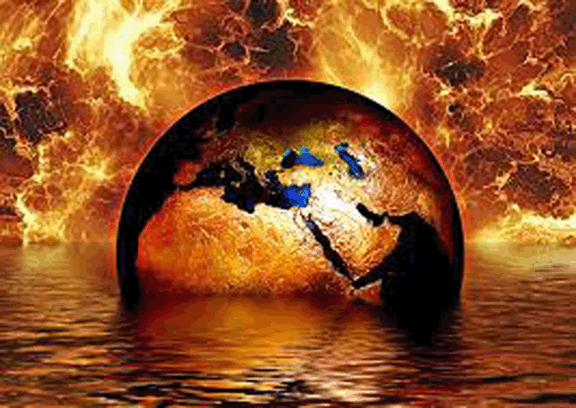
While we can still limit warming by cutting emissions, we now face having to adapt to more extreme weather.
Ben Spencer, Science Editor, |Anna Dowell, Data Journalism Trainee, Thursday March 06 2025, https://www.thetimes.com/uk/environment/article/climate-change-adaptation-decarbonisation-times-earth-93jln78vd
here is a story that used to be told about the fight against climate change. It was a narrative of hope, of a battle to be fought and won.
“This is the moment when we must come together to save this planet,” Barack Obama told a crowd of 200,000 people in Berlin in 2008, the summer before he was elected president.
That moment, of course, came and went. But there were more speeches, more moments of urgency. Al Gore tried, so did Leonardo DiCaprio. Sir David Attenborough and Greta Thunberg attempted to mobilise the masses; even the King has had a go.
Boris Johnson tried again in 2021 at the Cop26 climate summit in Glasgow, urging world leaders to “keep alive” the hope of limiting global warming to 1.5C, enshrined in the Paris Agreement of 2015. He said: “Let’s keep moving forward and make this the moment we irrefutably turn the tide against climate change.”
There are only so many times, however, that the same stories can be told.
Laurie Laybourn, director of the Strategic Climate Risks Initiative, said: “It’s only really now that the penny is dropping that we didn’t prevent a global-scale climate crisis. We’re now in a global-scale climate crisis.”
The wildfires in Los Angeles, flooding in Valencia, and the storms that have battered the British Isles this winter — Bert, Darragh and Éowyn — have confirmed what the scientists have long forecast. Climate change is no longer something that can be averted: it has arrived.
In January the Met Office announced that global average temperatures for 2024 had risen 1.5C above pre-industrial levels for the first time. One year’s weather records do not in themselves mean the 2015 Paris Agreement, which set out to limit global warming long-term, has failed. But the Met Office also warned that carbon dioxide in the atmosphere is still rising, and is now “incompatible” with the modelled pathways that would keep warming below the totemic 1.5C.
“There is an adjustment that’s needed now to understand that that preventative project has not worked,” Laybourn said. “Emissions reductions were not tried at the scale that were needed — being confronted with that failure is actually quite difficult for people.”
After years of focusing on averting climate change, what climate scientists refer to as “mitigation”, experts are warning that we now need far greater focus on adaptation to cope with the new weather that comes with a warming world.
There is no doubt that in the UK we are not ready for climate change. Chris Stark, former chief executive of the climate change committee (CCC) and now a senior energy official, in 2022 described the government’s planning for global warming as “genuinely poor”, blaming a “wilful reluctance” to factor adaptation into policy.
This reluctance goes back years. In a speech at Chatham House in September, the former Labour politician David Miliband admitted that preparing for global warming had been something of a taboo. “When I was environment secretary in 2006-7, it felt as though talking about adapting to climate change meant admitting defeat on mitigating climate change.”
Climate change for the UK means hotter, drier summers and wetter winters with more frequent, more severe storms…………………………………………………………………………………………………………………………………
It is not just the UK failing to prepare. The United Nations Environment Programme (Unep) in November published its “adaptation gap” report, setting out how far the issue has been neglected. It found that annual global spending on climate adaptation is between $187 billion and $359 billion short of what it should be, “with adaptation planning slowing and implementation falling behind”.
Inger Andersen, Unep executive director, said in the foreword: “People and the natural systems upon which our livelihoods depend are increasingly in danger from the hell and high water that climate change is bringing. The world must get serious about adaptation, now.”
MARK PASSMORE/ALAMY
Laybourn stressed that while much more must be done to adapt to climate change, it does not mean that politicians should abandon decarbonisation. “You have to do both,” he said. “If you’re busy mopping the floor you mustn’t forget to turn off the tap.”
Part of the reluctance to push forwards with climate adaptation is finding ways to pay for it. Decarbonisation is a relatively easy sell: it is not difficult to persuade a developer to build a wind farm or install solar panels if they can then profit from the cheap power they generate.
Flood defences, on the other hand, do not generate a return, so central investment is needed.
But experts say a long view is required. Existing flood defences in Britain prevent £1.15 billion in damage each year. Laybourn thinks this approach is required for other sectors. “If the UK had a more nature-abundant, more balanced, sustainable farming system, for example, it would mean that the farming system was better able to handle shocks.”
A UK government spokesman insisted adaptation was being taken seriously………………………… https://www.thetimes.com/uk/environment/article/climate-change-adaptation-decarbonisation-times-earth-93jln78vd
No comments yet.
-
Archives
- February 2026 (240)
- January 2026 (308)
- December 2025 (358)
- November 2025 (359)
- October 2025 (376)
- September 2025 (258)
- August 2025 (319)
- July 2025 (230)
- June 2025 (348)
- May 2025 (261)
- April 2025 (305)
- March 2025 (319)
-
Categories
- 1
- 1 NUCLEAR ISSUES
- business and costs
- climate change
- culture and arts
- ENERGY
- environment
- health
- history
- indigenous issues
- Legal
- marketing of nuclear
- media
- opposition to nuclear
- PERSONAL STORIES
- politics
- politics international
- Religion and ethics
- safety
- secrets,lies and civil liberties
- spinbuster
- technology
- Uranium
- wastes
- weapons and war
- Women
- 2 WORLD
- ACTION
- AFRICA
- Atrocities
- AUSTRALIA
- Christina's notes
- Christina's themes
- culture and arts
- Events
- Fuk 2022
- Fuk 2023
- Fukushima 2017
- Fukushima 2018
- fukushima 2019
- Fukushima 2020
- Fukushima 2021
- general
- global warming
- Humour (God we need it)
- Nuclear
- RARE EARTHS
- Reference
- resources – print
- Resources -audiovicual
- Weekly Newsletter
- World
- World Nuclear
- YouTube
-
RSS
Entries RSS
Comments RSS
 nuclear-news
Leave a comment