Failure After Failure: Let’s Ditch Small Modular Reactors.

The World Mind, February 25, 2025, Carmine Miklovis https://www.theworldmind.org/briefing-archive/failure-after-failure-lets-ditch-small-modular-reactors2025/2/25
Imagine a revolutionary new coffee machine – one that can get twice as much coffee from the same amount of beans. This machine would make coffee cheaper to make at home and buy at shops like Dunkin’ and Starbucks. This coffee machine starts to get buy-in from major companies in the coffee business, like Keurig and Nespresso, and is projected to be launched in Summer 2025. Halfway through the spring, it’s announced that, due to delays, it will now be launched in Winter 2027. After another delay, it’s announced that the project is now expected by 2030. Keurig and Nespresso, in response, withdraw from the project, further delaying it until 2035. After 10 years of delays, would you still invest in this machine? Probably not, so why are we investing in an energy technology that’s built on the same promises?
Small modular reactors (SMRs), unlike the coffee machine, are a real technology that promise to make nuclear energy cheaper and more accessible. In theory, their smaller size allows them to be deployed more quickly and in a variety of settings, an advantage over solar panels, wind turbines, and tidal energy, which have location restrictions. Some of these reactor designs can reprocess spent fuel (known as a “closed fuel cycle”) to extract more energy than traditional reactors can from the same amount of fuel. As such, many have hailed these nuclear reactors as the key to addressing the climate crisis, as they seem to resolve a lot of the current problems that have plagued nuclear power thus far.
On an international level, France and India have announced plans to begin constructing SMRs together, praising the energy source for its potential to enable the transition to a low-carbon future. India is also expected to work with U.S. firms to enhance investment in the technology. Similarly, Trump’s pick for energy secretary, Chris Wright, served on the board of Oklo Inc., a company that focuses on advanced nuclear technology, and is pushing for investments in nuclear energy (alongside fossil fuels). As the Trump administration ditches renewables for fossil fuels and nuclear energy, some, including Wright, have said that now is the time for the nuclear renaissance.

Unfortunately, however, it seems increasingly likely that these reactors will fail to live up to their promise. Talks of deploying small modular reactors have been ongoing for over a decade, and while around a hundred designs exist, only two reactors have been deployed–one in China and one in Russia. In the U.S., while private companies and the federal government have invested billions into their development, projects have faced delays and cancellations. Long construction times, issues with quality control, and disproportionately high energy costs (for producers and consumers alike) have led many to conclude that the energy source is a false promise. Recognizing this failure, many of the largest energy companies, such as Babcock & Wilcox and Westinghouse have withdrawn their investments, leaving many other investors hesitant to put any of their assets in the nuclear cause. While the potential of these models is exciting in theory, investors would much rather hedge their bets on just about anything else.
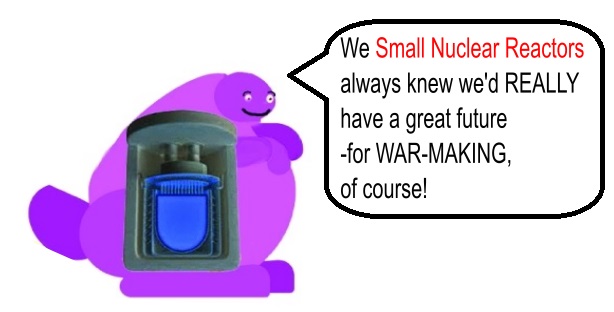
To make matters worse, small modular reactors come with an additional catch: they risk enabling the proliferation of nuclear weapons. SMRs are a dual-use technology; after reactors have extracted energy from the fuel rods (the real-life equivalent of the coffee beans from earlier), they’re left with weapons-grade plutonium in the nuclear waste that could be used to create a potent nuclear weapon. This risk is particularly acute for reactors that reprocess for more energy, as the leftover waste is more potent and more viable for a nuclear weapon.
This presents a particular challenge, as in order for the touted benefits of SMRs to materialize, they need to distinguish themselves from the nuclear reactors we have now. As such, these new designs have to be more efficient and take advantage of their versatility, which means a lot of smaller reactors capable of reprocessing. More fissile material (in quantity and quality) coming out of more reactors makes it difficult to effectively monitor where all the waste goes. To complicate things, monitoring is already a problem, as it’s difficult to accurately measure nuclear material as it’s being transported from the facility to a waste disposal unit. The ease of diverting material could provide a pathway for states that have long had nuclear ambitions, such as Iran (who is also in a proxy war against a nuclear-armed adversary), or opportunistic non-state actors (such as domestic extremists or terrorist groups like ISIS) to finally get their hands on a nuclear weapon.
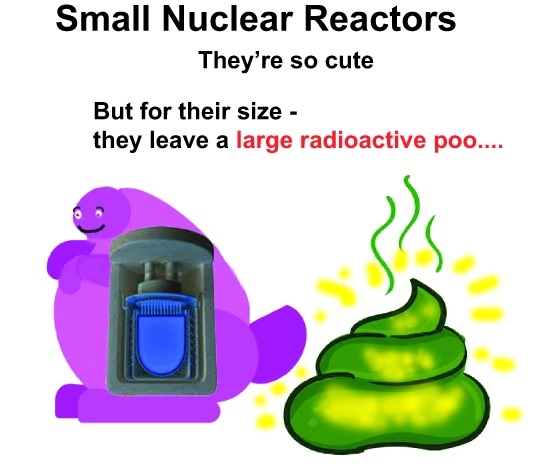
Unfortunately for proponents, it’s unlikely that the U.S. will be able to control or monitor the spread of this technology. The U.S. cannot set the standards for SMRs when it continues to lag behind Russia and China in production. Even then, why would countries already in China’s global infrastructure program, known as the Belt and Road Initiative, choose to get nuclear reactor designs from the U.S. further down the line when they can get nuclear reactors from China now? Chinese energy technology is likely more interoperable—able to work with pre-existing infrastructure—than U.S. designs, further restricting the U.S.’ potential market share. Even our closest allies wouldn’t want U.S. models, as some of them, including Germany and Japan, have given up on nuclear energy altogether. Given this hesitation and the long delays, SMRs would either fail to be deployed at a sufficient scale to resolve climate change, or would be completed hastily, which increases the risk of state or non-state actors acquiring a nuclear weapon.
While some may argue that any investment in renewable energy is a net positive in the fight against climate change, investing in nuclear energy hamstrings the response of future administrations. Investing in nuclear power creates a dangerous moral licensing, wherein future leaders may feel less incentivized to invest in other, effective renewable energy sources because they feel that they already have it covered with nuclear power. Historically, because of the way subsidies are distributed under the Clean Power Plan, nuclear energy actively stifles the development of other energies. In an effort to make nuclear power prices competitive, the U.S. government subsidizes it, which actively siphons those subsidies away from solar, wind, and tidal energy. As solar energy becomes the cheapest option available, subsidies to expand its gap or aid its clean partners could enhance renewable energy’s grip on the market. Absent these subsidies, however, fossil fuels may retain their foothold in the market for the foreseeable future. Given the existential threat at stake, the risk that this poses for the climate response cannot be overstated.
While advocates of SMRs are right that renewable energy needs to be adopted swiftly, trying to haphazardly rush out these reactors to deploy around the world risks trading one crisis for another, enabling a new era of nuclear proliferation. Similarly, if the Trump administration wants to keep its promise of low energy prices, their best bet is to stop investing in the nuclear power industry and let solar and wind energy take the reins. Like the hypothetical coffee machine, the benefits of SMRs will remain a nice thought, but nothing more than that. As climate change beckons at our doorstep, we can’t afford to invest in a false promise—it’s time to ditch SMRs.
Surface tension: could the promised Aukus nuclear submarines simply never be handed over to Australia?

Guardian, Ben Dohert, 7 Mar 25
The multi-billion dollar deal was heralded as ensuring the security of the Indo-Pacific. But with America an increasingly unreliable ally, doubts are rising above the waves.
Maybe Australia’s boats just never turn up.
To fanfare and flags, the Aukus deal was presented as a sure bet, papering over an uncertainty that such an ambitious deal could ever be delivered.
It was assured, three publics across two oceans were told – signed, sealed and to-be-delivered: Australia would buy from its great ally, the US, its own conventionally armed nuclear-powered attack submarines before it began building its own.
But there is an emerging disquiet on the promise of Aukus pillar one: it may be the promised US-built nuclear-powered submarines simply never arrive under Australian sovereign control.
Instead, those nuclear submarines, stationed in Australia, could bear US flags, carry US weapons, commanded and crewed by American officers and sailors.
Australia, unswerving ally, reduced instead to a forward operating garrison – in the words of the chair of US Congress’s house foreign affairs committee, nothing more than “a central base of operations from which to project power”.
Reliable ally no longer
Officially at least, Aukus remains on course, centrepiece of a storied security alliance.
Pillar one of the Australia-UK-US agreement involves, first, Australia buying between three and five Virginia-Class nuclear-powered submarines from the US – the first of these in 2032.
Then, by the “late 2030s”, according to Australia’s submarine industry strategy, the UK will deliver the first specifically designed and built Aukus submarine. The first Australian-built version will be in the water “in the early 2040s”. Aukus is forecast to cost up to $368bn to the mid-2050s.
But in both Washington and Canberra, there is growing concern over the very first step: America’s capacity to build the boats it has promised Australia, and – even if it had the wherewithal to build the subs – whether it would relinquish them into Australian control.
The gnawing anxiety over Aukus sits within a broader context of a rewritten rulebook for relations between America and its allies. Amid the Sturm und Drang of the first weeks of Trump’s second administration, there is growing concern that the reliable ally is no longer that…………………….
‘The cheque did clear’
On 8 February, Australia paid $US500m ($AUD790m) to the US, the first instalment in a total of $US3bn pledged in order to support America’s shipbuilding industry. Aukus was, Australia’s defence minister Richard Marles said, “a powerful symbol of our two countries working together in the Indo-Pacific”.

“It represents a very significant increase of the American footprint on the Australian continent … it represents an increase in Australian capability, through the acquisition of a nuclear‑powered submarine capability … it also represents an increase in Australian defence spending”.
………….. just three days after Australia’s cheque cleared, the Congressional Research Service quietly issued a paper saying while the nuclear-powered attack submarines (known as SSNs) intended for Australia might be built, the US could decide to never hand them over.
It said the post-pandemic shipbuilding rate in the US was so anaemic that it could not service the needs of the US Navy alone, let alone build submarines for another country’s navy…………………………………………………………………………………………………..
‘Almost inevitable’
Clinton Fernandes, professor of international and political Studies at the University of New South Wales and a former Australian Army intelligence analyst, says the Aukus deal only makes sense when the “real” goal of the agreement is sorted from the “declared”.
“The real rather than declared goal is to demonstrate Australia’s relevance to US global supremacy,” he tells the Guardian.
“The ‘declared goal’ is that we’re going to become a nuclear navy. The ‘real goal’ is we are going to assist the United States and demonstrate our relevance to it as it tries to preserve an American-dominated east Asia.”
Fernandes, author of Sub-Imperial Power, says Australia will join South Korea and Japan as the US’s “sentinel states in order to hold Chinese naval assets at risk in its own semi-enclosed seas”.
“That’s the real goal. We are demonstrating our relevance to American global dominance. The government is understandably uneasy about telling the public this, but in fact, it has been Australia’s goal all along to preserve a great power that is friendly to us in our region.”
Fernandes says the Aukus pillar one agreement “was always an article of faith” based on a premise that the US could produce enough submarines for itself, as well as for Australia.
“And the Congressional Research Service study argues that … they will not have enough capacity to build boats for both themselves and us.”
He argues the rotation of US nuclear-powered submarines through Australian bases – particularly HMAS Stirling in Perth – needs to be understood as unrelated to Aukus and to Australia developing its own nuclear-powered submarine capability.
“Submarine Rotational Force-West (SRF-W) is presented by the spin doctors as an ‘optimal pathway’ for Aukus. In fact, it is the forward operational deployment of the United States Navy, completely independent of Aukus. It has no connection to Aukus.”
The retired rear admiral and past president of the Submarine Institute of Australia, Peter Briggs, argues the US refusing to sell Virginia-class submarines to Australia was “almost inevitable”, because the US’s boat-building program was slipping too far behind.
“It’s a flawed plan, and it’s heading in the wrong direction,” he tells the Guardian.
Before any boat can be sold to Australia, the US commander-in-chief – the president of the day – must certify that America relinquishing a submarine will not diminish the US Navy’s undersea capability.
“The chance of meeting that condition is vanishingly small,” Briggs says.
It now takes the US more than five years to build a single submarine (it was between three and 3.5 years before the pandemic devastated the workforce). By 2031, when the US is set to sell its first submarine to Australia, it could be facing a shortfall of up to 40% of the expected fleet size, Briggs says.
Australia, he argues, will be left with no submarines to cover the retirement from service of the current Collins-class fleet, weakened by an unwise reliance on the US.
The nuclear-powered submarines Australia wants to buy and then build “are both too big, too expensive to own and we can’t afford enough of them to make a difference”.
He argues Australia must be clear-eyed about the systemic challenges facing Aukus and should look elsewhere. He nominates going back to France to contemplate ordering Suffren-class boats – a design currently in production, smaller and requiring fewer crew, “a better fit for Australia’s requirements”……. https://www.theguardian.com/world/2025/mar/07/surface-tension-could-the-promised-aukus-nuclear-submarines-simply-never-be-handed-over-to-australia
One empty seat. UK fails again to send representation to UN nuke conference

NFLA 5th March 2025,
https://www.nuclearpolicy.info/news/one-empty-seat-uk-fails-again-to-send-representation-to-un-nuke-conference/
The UK/Ireland Nuclear Free Local Authorities laments that a joint appeal made to the Prime Minister and Foreign Secretary to send a British representative to an important nuclear disarmament conference being held at the United Nations this week has fallen on deaf ears.
Alongside academics and other peace campaigners, NFLA Chair Councillor Lawrence O’Neill and NFLA Secretary Richard Outram were two of the co-signatories to a letter drafted by the United Nations Association UK (UNA-UK) that was sent to the two senior British politicians asking the UK Government to send an observer to the 3rd Meeting of States Parties (3MSP) to the Treaty on the Prohibition of Nuclear Weapons (TPNW) which is being held in New York until 7 March.
The invitation was not taken up as the meeting has been boycotted by Britain and the other eight nuclear weapons states, which continue to refuse to engage with the treaty despite around half of the UN’s membership – 94 states – having become signatories to it, with 73 also having completed formal ratification.
The NFLAs will be especially interested to see the progress made in establishing an international trust fund to support the victims, usually Indigenous Peoples, of the use and testing of nuclear weapons and the remediation of their natural environment. This represents a clear commitment of the signatories to help satisfy their undertakings under Article 6 and 7 of the TPNW. Establishing such a fund was seen as a key priority at the preceding MSP2.
NFLA Secretary Richard Outram, in speaking recently on a webinar to mark the sixty fifth anniversary of the first French nuclear weapon test in Algeria, referenced the fact that the UK should contribute on a voluntary basis to such a fund despite not being a formal party to the treaty.
Britain tested forty five atomic and nuclear weapons in Australia, the Pacific, and latterly in the USA in a period from 1952 to 1991, and has a responsibility for the damage caused to the health and environment of Indigenous People in these places, as well as to the British atomic and nuclear test veterans community and their family members who continue to suffer as a direct result of exposure to radiation in the tests.
The NFLAs will continue to campaign for justice and financial compensation for both the civilian and military victims of nuclear weapons use and testing, and, as a member of the Nobel Peace Prize winning International Campaign to Abolish Nuclear Weapons (ICAN) and a partner of Mayors for Peace, for the universal adoption of the TPNW and the total abolition of nuclear weapons.
Nuclear waste at Chalk River: opponents defeated in court.

By Nelly Albérola, Radio-Canada, ICI Ottawa-Gatineau, March 6, 2025
https://ici.radio-canada.ca/nouvelle/2145786/rejet-decision-nucleaire-chalk-river-dechet [en français]
The Federal Court has dismissed an application for judicial review by citizens’ groups and scientists opposed to the Chalk River radioactive waste disposal site in Deep River, Ontario.
The ruling has gone almost unnoticed. In the wake of the Kebaowek First Nation’s victory over Canadian Nuclear Laboratories (CNL), the Federal Court has handed down another decision concerning the proposed Chalk River nuclear waste disposal site.
Please note: This victory will require the CCNS to have meaningful consultations with the Algonquins on whose traditional lands the radioactive waste dump is intended to be built. Neither the Algonquins nor the citizens of Ontario or Quebec were ever consulted about the choice of site for the dump, located one kilometre from the Ottawa River which borders Quebec and flows into the St. Lawrence River at Montreal. – G. Edwards
On February 20, the federal judge dismissed the application for judicial review brought before the court by three citizens’ groups: Concerned Citizens of Renfrew County and Area, the Canadian Coalition for Nuclear Responsibility, and the Ralliement contre la pollution radioactive.
A justified decision, according to the court
These groups include a number of retired scientists. They consider the decision of the
Canadian Nuclear Safety Commission (CNSC) to be unreasonable. authorize, in January 2024, the construction of a near-surface disposal facility (NSDF) for about one million tons of “low-level” radioactive waste.
“When read as a whole and taking into account the experience and technical expertise of the Commission, the decision is justified, intelligible and transparent. Consequently, the present application will be rejected,” reads the Federal Court’s decision.
“We’re certainly disappointed,” says Ginette Charbonneau, spokesperson for the Ralliement contre la pollution radioactive. “We’ve been working for six years and more to tighten up this project, to make it better.”
“Our chances of success were virtually nil,” admits another spokesman for the Ralliement, Gilles Provost. “The judge couldn’t change the Commission’s decision, but had to judge whether the decision was unreasonable: that’s an extremely heavy burden of proof.”
A view shared by the three groups’ lawyer, Nicholas Pope. “In the end, the court did not say that the decision was correct, only that it did not meet the high standard of unreasonableness,” he points out in a written response.
Murky administrative law, say opponents
Beyond their disappointment, the groups deplore the fact that the court took into account only the CNSC’s opinion, without considering the observations of other professionals who are nevertheless recognized in the nuclear industry.
“We rely heavily on scientific experts such as James R. Walker. Unfortunately, both the CNSC and the judge rejected his arguments,” laments Ole Hendrickson, a researcher and member of the Concerned Citizens group. “I was surprised that the judge said that the Commission can choose whatever it wants, rather than paying attention to all the arguments.”
For the president of the Canadian Coalition for Nuclear Responsibility, Gordon Edwards, the legal system is simply not well equipped to deal with these situations.
“Administrative law is murky: magistrates are in a difficult position when they have to judge these cases,” says the former nuclear consultant for governmental and non-governmental agencies. “The law gives the CNSC the power to make decisions on nuclear matters. The judge therefore does not feel empowered to overturn the decision of the agency that has been given the authority to make that decision.”
An unprecedented project
The physicist reminds us that the permanent installation of a nuclear waste disposal site is unprecedented in Canadian history.
“We’ll never take it away again. This is where it will go and stay forever,” he insists.
“That’s why it’s so important to do it right, to make sure that all the safety measures have been taken and that they can be sustained over time,” he adds.
“The waste is going to stay in the landfill until it’s disintegrated. And that can take anywhere from a few years to millions of years, so you see the problem,” worries physicist by training Ginette Charbonneau. “You can [wear] a mask and say that legally, everything’s okay, but when you’re talking about radioactive waste, that’s not good enough.”
Mi’kmaw Chiefs send stinging rebuke to N.S. Premier Tim Houston
Background, by Gordon Edwards
Canada currently has 220 million tons of radioactive sand-like uranium mill tailings.
These radioactive wastes from past mining have an effective half-life of 76,000 years.
Uranium Mining has been banned in Nova Scotia since 1981. Initially it was a government moratorium. The moratorium was enshrined into law in 2009 as “
The Uranium Mining and Exploration Prohibition Act”. (
The provinces of British Columbia and Quebec have also imposed moratoria on uranium mining.)
The Mi’kmaq are an Indigenous group of people who are native to the Atlantic Provinces of Canada.
They are the founding people of Nova Scotia and the predominant Aboriginal group in the province
by Joan Baxter, March 4, 2025
The Assembly of Nova Scotia Mi’kmaw Chiefs have sent a stinging rebuke to Nova Scotia Premier Tim Houston over recent legislation that would remove the longstanding bans on fracking and uranium mining and exploration in Mi’kma’ki, the unceded land of the Mi’kmaq.
The chiefs say it is “unacceptable that this government is fast-tracking the extraction of natural resources that will permanently devalue and damage our unceded lands and adversely impact the exercise of our section 35 rights.”
The strongly worded reprimand came in a two-page letter dated March 4, 2025, signed by the three co-leads on environment, energy, and mining for the Kwilmu’kw Maw-klusuaqn (KMK): Chief Carol Potter, Chief Cory Julian, and Chief Tamara Young. KMK works on behalf of the Assembly of Nova Scotia Mi’kmaq Chiefs on the best ways to implement Aboriginal and treaty rights.
The letter is addressed to Houston, with copies to Minister of L’nu Affairs Leah Martin and Minister of Natural Resources Tory Rushton. It refers to omnibus Bill 6, An Act Respecting Agriculture, Energy and Natural Resources, which Houston’s Progressive Conservative government tabled on Feb. 18, 2025.
Omissions are ‘highly erosive’
The chiefs noted that the new legislation is not in keeping with Section 35 of Canada’s 1982 Constitution Act that protects the Aboriginal and treaty rights of the Mi’kmaq people of Nova Scotia, and includes hunting, fishing, and gathering for a moderate livelihood. They wrote:
Last week’s sweeping legislative proposal is another example of the provincial government choosing not to engage or consult with the Mi’kmaq of Nova Scotia prior to introducing significant changes in the mining sector that will directly impact the Mi’kmaq’s section 35 rights.
The province also sits at several tables with KMK and the Assembly where these changes should have been discussed but were never raised or flagged for us. From a relationship perspective, these types of repetitive omissions are highly erosive.
The chiefs reminded Houston that in October last year, they wrote to him about the “province’s lack of engagement with Kwilmu’kw Maw-klusuaqn (KMK) and the Assembly of Nova Scotia Mi’kmaw Chiefs” in the lead-up to Bill 471 on offshore wind.
They also pointed out that the Mi’kmaq played a large role in getting uranium mining and fracking banned in the province………………………………………………………………….. https://tinyurl.com/4p9y2cr3.
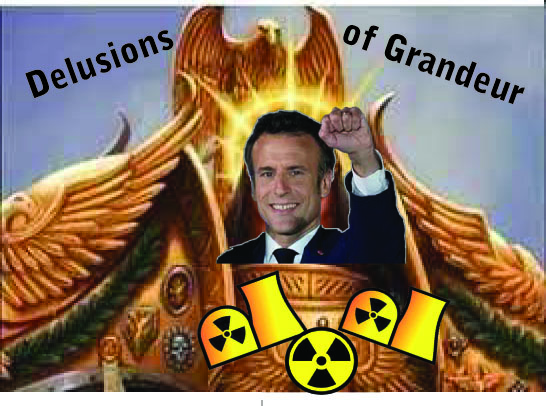
Macron’s Offer: France and the Delusions of Nuclear Deterrence
March 7, 2025 Dr Binoy Kampmark ,https://theaimn.net/macrons-offer-france-and-the-delusions-of-nuclear-deterrence/
The singular antics of US President Donald Trump, notably towards supposed allies, has stirred the pot regarding national security in various capitals. From Canberra to Brussels, there is concern that such assumed, if unverifiable notions as extended nuclear deterrence from Washington are valid anymore. America First interests certainly bring that into question, as well it should. If the imperium is in self-introspective retreat, this is to the good. But the internationalists beg to differ, wishing to see the United States as imperial guarantor.
In Europe, the fear at the retreat of Washington’s nuclear umbrella, and the inflation of the Russian threat, has caused flutters of panic. On February 20, 2025, Friedrich Merz, chairman of the Christian Democratic Union and the incoming German chancellor, floated the idea that other states consider shouldering Europe’s security burden. “We need to have discussions with both the British and the French – the two European nuclear powers – about whether nuclear sharing, or at least nuclear security from the UK and France, would apply to us.”
Merz has also explicitly urged European states to accept the proposition that “Donald Trump will no longer unconditionally honour NATO’s mutual defence commitment,” making it incumbent on them to “make every effort to at least be able to defend the European continent on its own.”
On March 1, French President Emmanuel Macron showed signs of interest. In an interview with Portuguese TV RTP, he expressed willingness to “to open this discussion … if it allows to build a European force.” There had “always been a European dimension to France’s vital interests within its nuclear doctrine.”
On March 5, in an address to the nation, Macron openly identified Russia as a “threat to France and Europe.” Accordingly, he had decided “to open the strategic debate on the protection of our allies on the European continent by our (nuclear) deterrent.” The future of Europe did not “have to be decided in Washington or Moscow.”
The matter of France’s European dimension has certainly been confirmed by remarks made by previous presidents, including Charles de Gaulle, who, in 1964, stated that an attack on a country such as Germany by the then Soviet Union would be seen as a threat to France.
Domestically, Macron’s offer did not go down well in certain quarters. It certainly did not impress Marie Le Pen of the far–right National Rally. “The French nuclear deterrent must remain a French nuclear deterrent,” she declared in comments made on a visit to the Farm Show in Paris. “It must not be shared, let alone delegated.” This was a misunderstanding, came the response from Defence Minister Sébastien Lecornu. The deterrent “is French and will remain French – from its conception to its production to its operation, under a decision of the president.”
A number of countries meeting at the European Union emergency security summit in Brussels showed interest in Macron’s offer, with some caution. Poland’s Prime Minister Donald Tusk suggested that “we must seriously consider this proposal.” Lithuania’s President Gitanas Nausėda thought the idea “very interesting” as “a nuclear umbrella would serve as really very serious deterrence towards Russia.” Latvian Prime Minister Evika Siliņa was not inclined to commit to a stationing of French nuclear weapons on Latvian territory: it was “too soon” to raise the issue.
Czech Prime Minister Petr Fiala, on the other hand, found the debate “premature”, as “our security is guaranteed by close cooperation with the United States.” He certainly has a point, given that the United States still, at present, maintains an extensive nuclear arsenal on European soil.
The trouble with deterrence chatter is that it remains hostage to delusion. Strategists talk in extravagant terms about the genuine prospect that nuclear weapons can make any one state safer, leading to some calculus of tolerable use. Thus we find the following comment from Benoît Grémare of the Université Jean Moulin Lyon 3: “[T]he fact remains that without US support, the balance of power appears largely unfavourable to France, which has a total of 290 nuclear warheads compared to at least 1,600 deployed warheads and nearly 2,800 stockpiled warheads on the Russian side.”
While Grémare acknowledges that France’s thermonuclear arsenal, along with the M51 strategic sea-to-land ballistic missile, would be able to eliminate major Russian cities, Russia would only need a mere “200 seconds too atomise Paris” if its Satan II thermonuclear weapons were used. “This potential for reciprocity must be kept in mind amid the mutual bet of nuclear deterrence.”
Logic here gives way to the presumption that such weapons, rather than suggesting impotence, promise formidable utility. This theoretical, and absurd proposition, renders the unthinkable possible: that Russia just might use nuclear weapons against European countries. Any such contention must fail for the fundamental point that nuclear weapons should, quite simply, never be used. Instead, they should be disbanded and banned altogether, in line with the Treaty on the Prohibition of Nuclear Weapons. Unfortunately, the French offer of replacing the US nuclear umbrella in Europe perpetrates similar deadly sins about deterrence.
Campaigners attend East Lindsey District Council meeting to call on Lincolnshire County Council to withdraw from Geological Disposal Facility process

By James Turner, Local Democracy Reporter, Lincs Online 6th March 2025, https://www.lincsonline.co.uk/louth/weve-had-enough-now-the-threat-of-this-nuclear-waste-dump-9407343/
Dozens of protesters have called on Lincolnshire County Council to withdraw from the process that could lead to the construction of a nuclear waste site in the county.
Campaigners from across the district gathered outside East Lindsey District Council’s offices in Horncastle ahead of a full council meeting on Wednesday to support a motion from Coun Travis Hesketh (Independent) urging the leader to actively oppose the establishment of a Geological Disposal Facility (GDF) – and calling on the county council to withdraw from the community partnership in the hopes of stopping the plans altogether.
Nuclear Waste Services (NWS) identified three ‘areas of focus’ for its facility in January. These include sites in Mid Copeland and South Copeland in Cumbria, as well as land between Gayton le Marsh and Great Carlton, near Louth.
East Lindsey District Council has pledged to leave the working group it joined with the organisation formerly known as Radioactive Waste Management in 2021, due to the new location being prime agricultural land and completely different from the former gas terminal site in Theddlethorpe, which it had been considering previously.
“I am the district councillor for Withern and Theddlethorpe, I represent the area where the nuclear dump was originally going to be placed, but now it’s moved,” Coun Hesketh told the Local Democracy Reporting Service.
“We’re here today because East Lindsey has said they are going to pull out, which is a terrific thing, but they need to go further. They need to say we oppose this and we want Lincolnshire County Council to do the same.
“We’ve had five years since Lincolnshire County Council met with Radioactive Waste Management – this thing has been going on for so long they’ve changed the name of the company. We’ve had enough now. They have ruined two communities, house values have been decimated – nobody can sell their house in the Carlton or Gayton area, they’re stuck. It’s time to make a decision.”
As councillors began arriving for the meeting, campaigners sang chants such as “We say, we say, no GDF, no GDF,” to the beat of Queen’s We Will Rock You and other lines such as “We are gentle, angry people and we’re singing for our lives.”
Nigel, 64, from Theddlethorpe, was just one of many campaigners and said he had been fighting the plans since ‘day one’.
“Now the area of focus has shifted, I feel I need to support the people affected in that area as well. We’re just trying to force the council’s hand now.”
Cybersecurity in the Nuclear Industry: US and UK Regulation and the Sellafield Case
Key Points:
With both the U.S. and U.K. strengthening their regulatory frameworks and increasing enforcement powers, nuclear facilities should take steps now to review and upgrade cybersecurity measures. This includes not just updating technical controls, but also ensuring compliance with security plans, auditing systems, and maintaining proper documentation.
Real-world examples from both the U.S. and U.K. demonstrate that nuclear facilities are being targeted by sophisticated cyber attackers, including state actors. This isn’t just a theoretical risk—it’s happening now, and facilities must take it seriously.
The successful prosecution of Sellafield with significant fines (£332,500) shows that regulators are now willing to take strong enforcement action, even when no actual breach has occurred. Nuclear facilities cannot afford wait for an incident before improving their cybersecurity—they must be proactive……………………………………………..
JD Supra 6th March 2025,
https://www.jdsupra.com/legalnews/cybersecurity-in-the-nuclear-industry-2447724/
EU ‘rearmament’ plan has no funding – Euractiv
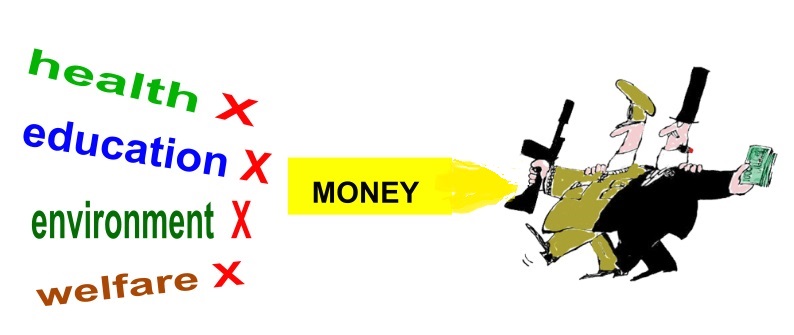
Defense spending will be given an “escape clause” from EU budget rules, allowing governments to shift funds “rather than coming up with fresh money,” according to Euractiv.
The proposal to increase defense spending by $840 billion is based largely on debt, according to the news outlet
European Commission President Ursula von der Leyen’s attempt to increase military spending across the EU is not backed by cash and shifts the financial burden to member states, Euractiv has reported, citing senior EU officials.
The so-called ‘ReArm Europe Plan,’ backed mostly by debt and fiscal adjustments, asks EU nations to spend $840 billion, twice the EU’s 2024 defense budget, to counter “grave security threats.”
The plan “includes close to no fresh money,” leaving member states to secure “the real cash” themselves, Euractiv reported on Wednesday.
The total figure is based more on “hopes and guesses” than concrete reforms addressing the bloc’s production shortages, the report argued.
Von der Leyen has also proposed raising $158 billion through capital markets and offering it to members as loans on condition they buy weapons made in the bloc or its regional allies.
The requirement could involve at least three EU countries or two EU countries plus Ukraine. However, loan approval criteria and the prioritization of EU-made equipment remain undecided, the report pointed out.
Defense spending will be given an “escape clause” from EU budget rules, allowing governments to shift funds “rather than coming up with fresh money,” according to Euractiv.
While increased deficits could generate nearly $700 billion, it’s uncertain if the measure applies to all countries or only those meeting NATO’s 2% GDP target.
Another senior EU official told Euractiv that over time, governments must offset spending by raising taxes or cutting costs.
Von der Leyen’s push for increased defense spending comes amid growing pressure from Washington. US President Donald Trump has distanced himself from supporting Ukraine while urging the EU to take greater responsibility for its defense.
The shift intensified this week, with news agencies’ reports on Monday suggesting that Trump had ordered a pause in military aid to Kiev. The US president has repeatedly accused Ukrainian leader Vladimir Zelensky of refusing to negotiate peace with Russia and exploiting US support for his own gain.
EU leaders will discuss von der Leyen’s proposals at a special summit on Thursday. According to a senior EU official, the measures should work “very fast and very efficiently” and require only a majority vote for adoption.
Some experts, however, warn that increasing military spending could strain national budgets already under pressure.
Supreme Court steps into debate over where to store nuclear waste
CBS, By Melissa Quin, March 5, 2025
Washington — The Supreme Court on Wednesday jumped into the decades-long dispute over what to do with thousands of metric tons of nuclear waste, as it considered a plan to store it above one of the world’s most productive oil fields, the Permian Basin in Texas.
The U.S. Nuclear Regulatory Commission and the company Interim Storage Partners are facing off against the state of Texas and Fasken Land and Minerals Ltd., which owns land in the Permian Basin, in the fight over what to do with the spent fuel generated at nuclear reactor sites. The waste can remain radioactive and pose health risks for thousands of years, according to the U.S. Energy Information Administration.
How to address the problem of nuclear waste has been complicated by politics since the advent of nuclear power last century. In 1982, Congress enacted a federal law that required the government to establish a permanent facility to house spent fuel, later determined to be Yucca Mountain in Nevada. But the site has yet to be established amid pushback from the state, and funding from Congress dried up years ago. The project was halted during the Obama administration.
The issue of where to store the growing amount of spent fuel remains. Roughly 91,000 metric tons of nuclear waste from commercial power plants are currently in private storage, both at or away from nuclear reactor sites, according to the U.S. government. And with nearly 20% of the nation’s electricity supplied by nuclear energy, plants are generating an additional 2,000 metric tons of spent fuel each year, the Energy Department estimates.
The Supreme Court agreed to take up the case in October and is considering two issues. The first is whether Texas and the landowners could challenge the commission’s decision to issue the license to Interim Storage Partners. The second is whether federal law allows the Nuclear Regulatory Commission to license private companies to temporarily house spent fuel away from nuclear-reactor sites.
Oral arguments
During arguments at the court on Wednesday, three liberal justices appeared the most skeptical of the argument from Texas that it could seek review of the commission’s licensing decision in a federal appeals court……………………………
The legal fight
The legal battle before the justices Wednesday involves a license the Nuclear Regulatory Commission issued in September 2021 to a company called Interim Storage Partners allowing it to house 5,000 metric tons — and up to 40,000 metric tons — of spent fuel in dry-cask, above-ground storage for up to 40 years. ………………………………………………………………………………………….
https://www.cbsnews.com/news/supreme-court-nuclear-waste-disposal-yucca-mountain/
Delays in Trident renewal put our deterrent in peril
In 2016 the House of Commons voted overwhelmingly in favour of renewing
the UK’s nuclear deterrent. Then hardly a second thought was given to
undertaking the upgrade programme without the full involvement of the US
military.
Ever since the British government first opted to introduce the
Continuous at Sea Deterrent (CASD) model to deliver our nuclear weapons
capability – replacing the Royal Air Force’s airborne Vulcan system –
it has been an article of faith that the project should be a joint US-UK
undertaking.
The tumult caused by US President Donald Trump’s return to
the White House has inevitably raised concerns both about the wisdom of
relying so heavily on US support for our own nuclear deterrent, especially
in the wake of Trump’s less-than-friendly treatment of Ukrainian
president Volodymyr Zelensky when he visited the White House last week. If
the leader of the free world can treat someone like Zelensky, who is
supposed to be one of Washington’s key allies, with such studied
contempt, then why not other allies, such as the UK?
Telegraph 5th March 2025
https://www.telegraph.co.uk/news/2025/03/05/delays-in-trident-renewal-put-our-deterrent-in-peril/
Continued Incidents Raise Concerns Over Nuclear Security, Says UN

By David Dalton, 5 March 2025, https://www.nucnet.org/news/continued-incidents-raise-concerns-over-nuclear-security-says-un-3-3-2025
Transportation of radioactive materials remains one of most vulnerable areas.
There were almost 150 incidents of illegal or unauthorised activity involving nuclear and other radioactive material reported last year, according to the International Atomic Energy Agency’s (IAEA) monitoring database.
New data reveals that while the overall number remains consistent with previous years, the continued incidents of trafficking and radioactive contamination cases raises concerns over nuclear security, the United Nations said on its website.
Three of the reported cases were directly linked to trafficking or malicious intent, while in 21 incidents, authorities could not determine whether criminal activity was involved.
Most incidents did not involve organised crime, but experts warn that even a single case of nuclear material falling into the wrong hands could pose serious global risks.
A troubling trend in 2024 was the rise in contaminated industrial materials, such as used pipes and metal parts that unknowingly entered supply chains.
“This indicates the challenge for some countries to prevent the unauthorised disposal of radioactive sources, and at the same time, it confirms the efficiency of the detection infrastructure,” said Elena Buglova, director of the IAEA’s division of nuclear security.
The transportation of radioactive materials remains one of the most vulnerable areas of nuclear security. Over the past decade, 65% of all reported thefts have occurred while materials were in transit.
Nuclear and radioactive substances are regularly transported for use in medicine, industry and scientific research, making them a potential target for theft. With so many different handlers involved during shipping, security gaps persist.
Experts emphasise the need for stronger safety measures while goods are on the move to prevent radioactive material from being lost or stolen.
Enhanced international cooperation is also essential to ensure proper security along supply chains.
‘Vote out!’: Protestors win motion at ELDC full council to urge county council to withdraw from nuclear dump talks
East Lindsey District Council
is to urge Lincolnshire County Council to follow the authority’s lead and
withdraw from the process exploring proposals for a nuclear dump site in
the district.
This follows a debate lasting more than one hour on a motion
presented to full council by Coun Travis Hesketh – a district councillor
representing communities that would be affected. Ahead of the meeting,
‘Vote Out’ protestors gathered outside the offices in Horncastle to
show their opposition to the dump and support the councillors fighting for
them.
Coun Hesketh’s motion urged the Executive and Leader of East
Lindsey District Council “to issue a statement opposing the Geological
Disposal Facility for nuclear waste in Lincolnshire and urge Lincolnshire
County Council to withdraw from the project.
Lincolnshire World 5th March 2025, https://www.lincolnshireworld.com/news/people/vote-out-protestors-win-motion-at-eldc-full-council-to-urge-county-council-to-withdraw-from-nuclear-dump-talks-5019541
Bank Head Estate residents attend public meeting over nuke dump blight
The UK/Ireland Nuclear Free Local Authorities wish to congratulate our
friends in Millom and District Against the GDF for organising a successful
meeting last month at which the residents of the Bank Head Estate, Millom
met with local Councillors to raise their concerns that in the future a
nuclear waste dump might become their unwanted neighbour.
Although for
several years, Nuclear Waste Services has been working, first with a local
Working Group and then through a Community Partnership, on plans to bring a
Geological Disposal Facility, or GDF, to the South Copeland Search Area it
was at the end of January that NWS revealed the Area of Focus in which more
detailed investigations will be conducted to determine its potential as the
eventual site for a waste receiving centre. Nuclear Waste Services have
previously revealed that the surface site will approximately one kilometre
square; once built the facility would from the 2050s, receive regular
shipments of radioactive waste which would be transported underground and
through access tunnels out under the seabed.
NFLA 5th March 2025 https://www.nuclearpolicy.info/news/bank-head-estate-residents-attend-public-meeting-over-nuke-dump-blight/
Has common sense finally prevailed at Hinkley Point C?

NFLA 5th March 2025 https://www.nuclearpolicy.info/news/has-common-sense-finally-prevailed-at-hinkley-point-c/
In what appears to be a welcome change of heart, EDF Energy has just announced that at Hinkley Point C it will pause its unpopular saltmarsh plan and will instead pursue the possibility of installing a new version of an Acoustic Fish Deterrent.
The Nuclear Free Local Authorities have been consistent in its support for the demand made by our friends at Stop Hinkley that the French company honour the obligation placed upon it to install such a device to prevent millions of fish being sucked to their death into the huge intake pipes, each the size of six double decker buses.
The new station will suck in the equivalent of three Olympic swimming pools of cooling water per minute from the Severn Estuary, and with it the fish. The estuary is one of the UK’s most highly designated nature conservation sites.
A Public Inquiry and the Secretary of State upheld the importance of the AFD, and scientists and experts in the field are convinced that it remains necessary and practical.
Without the AFD, EDF have estimated that almost 3 million fish will die annually, while other studies put the number of fish lost at up to 182 million per year.
EDF Energy has previously been wholly resistant to installing an AFD citing the supposed threat by its operation to divers, but, in its announcement, the company has described its recent discovery of ‘a new type of acoustic fish deterrent system’. This provides an ‘innovative solution’ and can installed in a way that is ‘safe and effective’.
EDF Energy also says that ‘we are pausing all design and development work on saltmarsh creation’, which will come as a considerable relief to local people, including Lily Hewlett who wrote recently to the company with a plea to refrain from taking, and flooding, 340 acres of the farming family’s grazing land.
Ten-year-old Lily made plain what she thought of the proposed action: ‘You would not just be taking over our land, but you will be hurting nature, and you can’t just use other people’s land for the mistake that you have done. You need to stop it; it is cruel and just because you have lots of money does not mean you can do what you like.’
Who knows maybe this letter touched a heartstring amongst one of the big-wigs in the Hinkley Point C senior management team, but, whatever the catalyst, if this is indeed a genuine attempt by EDF Energy at seeking to establish a new Entente Cordiale with campaigners and the local community then the Nuclear Free Local Authorities welcome it.
For our part we shall suspect disbelief and keep a watching brief. Let’s see what happens.
1 This Month

of the week – Shut Down Drone Warfare!


Tell the Ukrainian Government to Drop Prosecution of Peace Activist Yurii Sheliazhenko

Petition to revoke the licensing of the Near Surface Nuclear Disposal Facility (NSDF) at Chalk River. https://www.ourcommons.ca/petitions/en/Petition/Details?Petition=e-7247
To see nuclear-related stories in greater depth and intensity – go to https://nuclearinformation.wordpress.com
-
Archives
- April 2026 (34)
- March 2026 (251)
- February 2026 (268)
- January 2026 (308)
- December 2025 (358)
- November 2025 (359)
- October 2025 (376)
- September 2025 (257)
- August 2025 (319)
- July 2025 (230)
- June 2025 (348)
- May 2025 (261)
-
Categories
- 1
- 1 NUCLEAR ISSUES
- business and costs
- climate change
- culture and arts
- ENERGY
- environment
- health
- history
- indigenous issues
- Legal
- marketing of nuclear
- media
- opposition to nuclear
- PERSONAL STORIES
- politics
- politics international
- Religion and ethics
- safety
- secrets,lies and civil liberties
- spinbuster
- technology
- Uranium
- wastes
- weapons and war
- Women
- 2 WORLD
- ACTION
- AFRICA
- Atrocities
- AUSTRALIA
- Christina's notes
- Christina's themes
- culture and arts
- Events
- Fuk 2022
- Fuk 2023
- Fukushima 2017
- Fukushima 2018
- fukushima 2019
- Fukushima 2020
- Fukushima 2021
- general
- global warming
- Humour (God we need it)
- Nuclear
- RARE EARTHS
- Reference
- resources – print
- Resources -audiovicual
- Weekly Newsletter
- World
- World Nuclear
- YouTube
-
RSS
Entries RSS
Comments RSS
 nuclear-news