Another troubling week in nuclear news

Some bits of good news –
10 Ways Investing in Children’s Well-Being Changed the World
China is Rewiring the Global South With Clean Power. We’re making child marriages a thing of the past in Malaysia.
TOP STORIES.
Zelensky needs to go …been risking nuclear war far too long.
What Trump got right about nuclear weapons—and how to step back from the brink.
Global security arrangements “unravelling”, UN chief warns nuclear disarmament conference.
The Supreme Court faces the absurdly difficult problem of where to put nuclear waste.
More powerful than Hiroshima: how the largest ever nuclear weapons test built a nation of leaders in the Marshall Islands.
Climate. A Lawsuit Against Greenpeace Is Meant to Bankrupt It and Deter Public Protests, Environmental Groups Warn. Total collapse of vital Atlantic currents unlikely this century, study finds.
Noel’s notes. Ukraine to soon jump back out of the fire and into the frying-pan?
AUSTRALIA.
- AUKUS ‘impact assessment’ report ignores nuclear submarine risks in South Australia. Not everyone knows acronyms’: Australian politicians shrug off Trump blunder on AUKUS.
- If China can’t scale nuclear, Australia’s got Buckley’s. Nuclear reactors could become targets of war, defence experts warn.
- New report skewers Coalition’s contentious nuclear plan – and reignites Australia’s energy debate. Too slow, too risky, too impractical: Interim senate report pans nuclear. Chinese warships sailing the Tasman Sea expose AUKUS folly.
- Parliamentary inquiry finds nuclear is high risk, zero reward. Peter Dutton abandons global ‘Paris Agreement’ to phase out climate pollution by 2050. Trump-lite: Coalition promises purge of experts who call out nuclear bunkum.
- More Australian nuclear news at https://antinuclear.net/2025/02/26/australian-nuclear-news-week-to-4th-march/
NUCLEAR ITEMS
ECONOMICS.
- New report details nuclear power’s demise. Nuclear power struggling to maintain current level of stagnation, let alone achieve any growth.
- Stop government handouts to EDF for Hinkley Point C. Rachel Reeves eyes cuts to nuclear in spending review. Small modular reactor plans edge closer, amid claims that the technology makes no economic sense .
- EDF appears to consider reduced final stake in Sizewell C to as low as 10% Sellafield nuclear site plans cuts as chief says £2.8bn funding ‘not enough’. Nuclear site warns £2.8bn budget is ‘not enough’. UK construction and engineering firm Costain has secured a multi-millionpound contract to support the construction of the Sizewell C nuclear powerplant -ALSO AT https://nuclear-news.net/2025/02/28/2-b-uk-construction-and-engineering-firm-costain-has-secured-a-multi-millionpound-contract-to-support-the-construction-of-the-sizewell-c-nuclear-powerplant/
- We can’t afford Doug Ford’s nuclear fantasy.
ENERGY. UK Energy Secretary Signals China Pivot.
ENVIRONMENT. ‘Fish disco’ row risks fresh delays to Hinkley Point nuclear plant.
ETHICS and RELIGION. Archbishop Gallagher: Nuclear weapons pose existential threat.
EVENTS. Nuclear Ban Week – the UN Treaty on the Prohibition of Nuclear Weapons (TPNW). 1 March -Remembering All Nuclear Victims. 6 March – WEBINAR –Arming for Armageddon: How US Militarism could lead to Nuclear War
HEALTH. Nuclear reactors killing Americans at accelerating rate.
LEGAL. SCOTUS goes nuclear: Justices’ decision could seal spent fuel storage options for decades. Beyond Nuclear files two relicensing legal actions.
OPPOSITION to NUCLEAR . 93% say NO: latest polls in Lincolnshire condemn nuke dump plan
PERSONAL STORIES. The island priest who fought a nuclear rockets range.
POLITICS.
- Techno-Fascism Comes to America. German election results tilt EU back toward nuclear energy.
- How the Warfare State Paved the Way for a Trumpist Autocracy.
- The Guardian view on UK PM’s gamble: exploiting crisis to remake Labour was a step too far for an ally.
POLITICS INTERNATIONAL and DIPLOMACY. Donald Trump was rude to Zelensky, but he did tell him the hard truths. Zelensky: Victim of Colosseum Politics.
The National goes to the UN: The fight for nuclear disarmament– ALSO AT https://nuclear-news.net/2025/02/27/1-b1-scotus-goes-nuclear-justices-decision-could-seal-spent-fuel-storage-options-for-decades/
US correct to vote against UN resolution solely condemning Russia for Ukraine war. The pro-war lobby in the West needs to come up with new ideas, rather than saying the same old things.
SAFETY. United States: White House Threatens Nuclear Regulatory Commission‘s Independence. IAEA Director General Statement on Fire Situation in Chernobyl nuclear station. Ontario’s outdated nuclear vision poses serious safety and financial risks.
A Single Trumputin Drone Can Turn the “Peaceful Atom” Into World War 3. Vladimir Putin right now has in his sights nearly The physical hazards of nuclear energy. IAEA mission arrives at nuclear plant in Ukraine through Russia.
URANIUM. As tensions rise, Canada to lean on U.S. for uranium enrichment.
WASTES. Tonnes of nuclear waste to be sent back to Europe. Hinkley Point C will be a Sellafield waste dump . Nuclear Decommissioning Authority budget raises Sellafield safety concerns. Public concern increasing about nuclear waste shipments west of Sudbury. Election candidates should face nuclear waste questions: group.
WAR and CONFLICT. Israel seen as likely to attack Iran’s nuclear sites by midyear.
WEAPONS and WEAPONS SALES.
The Pentagon and Starlink Satellites.
Nuclear weapons are ‘one-way road to annihilation’ warns Guterres.
Iran on ‘high alert’ amid fears of attack on nuclear sites. Starmer drags
Britain deeper into war drive. Reawakening a Nuclear Legacy: The Potential Return of the
US Nuclear Mission to RAF Lakenheath. John Swinney: UK’s nu
clear deterrent offers ‘no tangible benefit’. As Freed Palestinians Describe Torture,
Trump OKs $3 Billion Arms Package for Israel.
Zelensky needs to go …been risking nuclear war far too long

Walt Zlotow, West Suburban Peace Coalition, Glen Ellyn IL, 2 Mar 25
Ukraine President Volodymyr Zelensky is a spectacularly failed leader. He’s failed on every indicator of good governance.
He failed the largely Russian cultured Ukrainians in the Donbas who overwhelmingly voted him for president in 2019. He promised he’d end the war on them by their own government after the 2014 coup toppled elected pro Russian President Victor Yanukovych. Once in office Zelensky caved to the ultra-nationalists who wielded the real power in Kyiv. The war on the Donbas separatist movement escalated under Zelensky. He massed 60,000 elite troops on the Donbas border to complete destruction of the separatist movement. Guess what that provoked February 24, 2022?
He failed by continuing his predecessors’ desire to join NATO, knowing full well Ukraine in NATO crossed a red line Russia viewed as an existential security threat. That made the February 22, 2022 Russian invasion even more inevitable.
Two months into the war he failed to conclude a peace treaty with Russia in April, 2022 that was about to be signed. He allowed US and UK war hawks bully him into rejecting the settlement which would have cost Ukraine nary a square mile of territory. He swallowed whole their delusion he could win the war with US weapons but not US cannon fodder Now he’s lost about 45,000 square miles for caving to his US/UK masters of war..
Worst of all, Zelensky failed the most important responsibility of any leader: do nothing that could risk nuclear annihilation. He’s spent the entire 3 years of war asking, begging, demanding the US give him the weaponry to attack deep inside Russia. He appears oblivious how easily such attacks could trigger nuclear war between the US and Russ
Astoundingly, when an errant Ukrainian missile killed a couple of Poles in Poland, Zelensky claimed that represented a Russian attack on NATO requiring an immediate NATO military response. Hello WWIII. That alone made Zelensky unfit to serve another day as Ukraine leader.
With the US proxy war on Russia lost and Ukraine in ruins, Zelensky’s failed days in power are dwindling. His exit cannot come soon enough.
Nuclear power struggling to maintain current level of stagnation, let alone achieve any growth

Alongside the risk of Fukushima-scale disasters, the weapons proliferation risks, the risk of attacks on nuclear plants (and the reality of attacks on nuclear plants in Ukraine), and the intractable nuclear waste legacy, the reality is that nuclear power just can’t compete economically.
The industry’s greatest problem at the moment is a recognition of this by investors, resulting in a capital strike.
Darrin Durant, Jim Falk & Jim Green, Mar 3, 2025, https://reneweconomy.com.au/nuclear-power-struggling-to-maintain-current-level-of-stagnation-let-alone-achieve-any-growth/
The current push in Australia to deploy nuclear power reactors once again contrasts an excessive optimism by nuclear proponents against the continuing stagnant situation of nuclear power worldwide. That contrast is the subject of our new report for the EnergyScience Coalition.
The latest nuclear proposals are built on three speculations.
First, projected AI-related energy demand where – as with nuclear power proponents in the 1970’s who projected huge demand that never eventuated – there are already signs demand is overblown. For example the new leading AI entrant DeepSeek requires just 10 per cent of the energy of competitors.
Second, speculative techno-optimism that new technologies such as small modular reactors will resolve industry project management issues. Yet these small reactors are unproven.
Third, prospective wish-fulfilment, where dozens of nuclear ‘newcomer’ countries are offered as saviours, despite not having reactor approvals and funding in place in a large majority of cases.
So what is the state of nuclear power in 2024? A review by the World Nuclear Industry Status Report notes that seven new reactors were connected to grids last year while four reactors were permanently closed. The net increase in operating nuclear capacity was 4.3 gigawatts (GW).
Worldwide nuclear power capacity was 371 gigawatts (GW) at the end of 2024. That figure is near-identical to capacity of 368 GW two decades earlier in 2005.
As of 1 January 2025, the mean age of the nuclear power reactor fleet was 32.1 years. In 1990, the mean age was just 11.3 years. Due to the ageing of the reactor fleet, the International Atomic Energy Agency projects the closure of 325 GW of nuclear capacity from 2018 to 2050 – that’s 88 per cent of current worldwide capacity. Thus the industry faces a daunting challenge just to maintain its pattern of stagnation, let alone achieve any growth.
There were no ‘small modular reactor’ (SMR) startups in 2024. Indeed there has never been a single SMR startup unless you count so-called SMRs not built using factory ‘modular’ construction techniques, in which case there is one each in China and Russia.
The SMR sector continues to go nowhere with setbacks in 2024 including the suspension of the Nuward project in France (following previous decisions to abandon four other SMR projects) and the bankruptcy of US company Ultra Safe Nuclear.
Nuclear growth dwarfed by renewables
In striking contrast to nuclear power’s net gain of 4.3 GW in 2024, the International Energy Agency’s October 2024 ‘Renewables 2024’ report estimates 666 GW of global renewable capacity additions in 2024. Based on the Agency’s estimate, renewables capacity growth was 155 times greater than that of nuclear power.
The International Energy Agency expects renewables to jump sharply from 30 per cent of global electricity generation in 2023 to 46 per cent in 2030.
Conversely, nuclear power’s share of global electricity generation has fallen steadily since the 1990s. As of 1 January 2025, nuclear power accounted for 9.15 per cent of global electricity production, barely half of its peak of 17.5 per cent in 1996.
A Bloomberg analysis finds that renewable energy investments reached $A1.17 trillion in 2024, up 8 per cent on the previous year, whereas nuclear investment was flat at $A55.1 billion. Thus renewable investments were 21 times greater than nuclear investments.
In contrast to massive cost overruns with nuclear projects, renewable costs have fallen sharply.
Lazard investment firm data shows that utility-scale solar and onshore wind became cheaper than nuclear power from 2010-2015. From 2009-2024, the cost of utility-scale solar fell 83 per cent; the cost of onshore wind fell 63 per cent; while nuclear costs increased 49 per cent.
Nuclear newcomer countries
Claims that 40-50 countries are actively considering or planning to introduce nuclear power, in addition to the 32 countries currently operating reactors, do not withstand scrutiny.
As of 1 January 2025, reactors were under construction in just 13 countries, two less than a year earlier. Seven percent of the world’s countries are building reactors; 93 percent are not.
Of the 13 countries building reactors, only three are potential nuclear newcomer countries building their first plant: Egypt, Bangladesh and Turkiye. In those three countries, the nuclear projects are led by Russian nuclear agencies with significant up-front funding from the Russian state.
The World Nuclear Association observes that apart from those three countries, no countries meet its criteria of ‘planned’ reactors, i.e. “approvals, funding or commitment in place, mostly expected to be in operation within the next 15 years.”
The number of potential newcomer countries with approvals and funding in place, or construction underway, is just three and those projects are funded heavily by the Russian state. That is the underwhelming reality underlying exaggerated claims about 40-50 countries pursuing nuclear power.
There is no evidence of a forthcoming wave of nuclear newcomer countries in the coming years and decades. At most there will be a trickle as has been the historical pattern with just seven newcomer countries over the past 40 years and just three this century.
The number of countries operating power reactors in 1996–1997 reached 32. Since then, nuclear newcomer countries have been matched by countries completing nuclear phase-outs and thus the number is stuck at 32. And less than one-third of those countries are building reactors (10/32).
It is doubtful whether the number of nuclear newcomer countries over the next 20-30 years will match the number of countries completing phase-outs.
Capital strike
Alongside the risk of Fukushima-scale disasters, the weapons proliferation risks, the risk of attacks on nuclear plants (and the reality of attacks on nuclear plants in Ukraine), and the intractable nuclear waste legacy, the reality is that nuclear power just can’t compete economically.
The industry’s greatest problem at the moment is a recognition of this by investors, resulting in a capital strike. Even with generous government/taxpayer subsidies, it has become difficult or impossible to fund new reactors – especially outside the sphere of China and Russia’s projects at home and abroad.
Who would bet tens of billions of dollars on nuclear power projects when the recent history in countries with vast expertise and experience has been disastrous?
In France, the latest cost estimate for the only recent reactor construction project increased seven-fold to A$39.4 billion for just one reactor. Construction took 17 years. No reactors are currently under construction in France.
In the US, one project in South Carolina, comprising two Westinghouse AP1000 reactors, was abandoned in 2017 after $A14.3 billion was spent. Westinghouse declared bankruptcy and its debts almost forced its parent company Toshiba into bankruptcy. All that remains is the nukegate scandal: an avalanche of legal action including criminal cases.
The only other reactor construction project in the US – the twin-reactor Vogtle project in the state of Georgia – reached completion at a cost 12 times higher than early estimates. The final cost was at least $A27 billion per reactor. Completion was six to seven years behind schedule.
No power reactors are currently under construction in the US. Thirteen reactors have been permanently shut down over the past 15 years.
The situation is just as bleak in the UK where there have been 24 permanent reactor shut-downs since the last reactor startup 30 years ago, in 1995.
The 3.2 GW twin-reactor Hinkley Point project in Somerset was meant to be complete in 2017 but construction didn’t even begin until 2018 and the estimated completion date has been pushed back to 2030-31.
The latest cost estimate – A$46.6 billion per reactor – is 11.5 times higher than early estimates. The UK National Audit Office estimates that taxpayer subsidies for the Hinkley Point project could amount to $A60.8 billion and the UK Parliament’s Public Accounts Committee said that “consumers are left footing the bill and the poorest consumers will be hit hardest.”
The estimated cost of the planned 3.2 GW twin-reactor Sizewell C project in the UK has jumped to $A81 billion or $A40.5 billion per reactor, twice the cost estimate in 2020. Securing funding to allow construction to begin is proving to be difficult and protracted despite a new ‘Regulated Asset Base’ funding model which foists the enormous risk of enormous cost overruns onto taxpayers and electricity ratepayers.
Lessons for Australia
Those three countries – France, the US and the UK – have vast nuclear expertise and experience. They all enjoy synergies between civil and military nuclear programs – President Macron said in a 2020 speech that without nuclear power in France there would be no nuclear weapons, and vice versa.
All of the above-mentioned construction projects were (or are) on existing nuclear sites. All projects were (or are) long delayed and tens of billions of dollars over-budget.
Claims that potential nuclear newcomer countries such as Australia, without any of those advantages, could build reactors quickly and cheaply are not credible.
Our report expanding on these issues is posted at the EnergyScience Coalition website.
Darrin Durant is Associate Professor in Science and Technology Studies at the University of Melbourne. Jim Falk is a Professorial Fellow in the School of Geography, Earth and Atmospheric Sciences at the University of Melbourne and Emeritus Professor at the University of Wollongong. Dr. Jim Green is the national nuclear campaigner with Friends of the Earth Australia and a member of the Nuclear Consulting Group.
The pro-war lobby in the West needs to come up with new ideas, rather than saying the same old things

As the war in Ukraine grinds towards its diplomatic denouement, those people who would like to avoid a negotiated settlement are not coming up with an alternative approach.
Ian Proud, Strategic Culture Foundation, 02 Mar 2025 , mhttps://www.sott.net/article/498199-The-pro-war-lobby-in-the-West-needs-to-come-up-with-new-ideas-rather-than-saying-the-same-old-things
When western pundits resist efforts to bring an end to fighting in Ukraine, they never provide an alternative vision of what they would do differently.
A respected associate of mine asked me today if a ceasefire and peace process in Ukraine would simply embolden China and Russia to further aggression. This is a line oft repeated among the majority of politicians, journalists and so-called academics in the west, who are opposed to an ending of the war.
‘We can’t stop the war, because if we do, China will invade Taiwan and Russia will invade Latvia, Estonia, Lithuania, Poland etc.’
My view, for what it’s worth, is that an end to the war in Ukraine might embolden China longer-term over Taiwan in particular. I’ve seen no evidence that it will embolden Russia to invade NATO, precisely because Russia sees itself, in large part, as a country of Europe, even if it has been excluded.
However, and critically, if both China and Russia were so emboldened, then should we not ask ourselves how we have ended up in this position?
Russia’s decision to go to war was driven by a belief that it’s core strategic interests in preventing NATO expansion to its border via Ukraine was being ignored, and that it was subject to permanent sanctions with no possibility of removal through any concessions it might make.
That’s my opinion and one I know that many ‘realists’ share. But, in any case, the ‘what next’ question should have been considered as part of a longer-term strategic assessment when western nations pushed the NATO enlargement agenda.
We have known since at least 2008 that this was a redline for Russia. Did we expect Russia’s position to change and if so, how? If Russia’s position did not change, how far would we go to advance Ukraine’s NATO aspiration, including through direct military confrontation?
I’m not aware that those questions were ever asked or, if they were, considered rather than dismissed. And I was at the heart of British government decision making from the latter part of 2013, before the Ukraine crisis started (and must therefore accept some of the blame).
Without the United States, a war in Ukraine was never going to be sustainable for Europe, financially, politically or militarily. Yet no one thought this through. Or, if they did, they didn’t factor in the eminent risk of America doing an about face on policy one day, as is now happening.
With America now withdrawing, sustaining a losing war in Ukraine rather than calling a halt to the killing cannot be considered a legitimate strategy if its only goal is to avoid losing face. That makes us look weaker and more feckless.
If other states are now emboldened by the failure of western policy in Ukraine, that is not a sufficient reason to avoid an end to the bloodshed now. Our self-righteousness indignation to peace is merely a figleaf covering the deflated genitals of our policy failure. The west so badly mishandled relations in the eight years between the flashpoint of the Maidan and the start of war, not thinking through the consequences.
Russian actions and reactions in Ukraine have always been predictable.
They were predictable in February 2014.
They were predictable in February 2022.
They were predictable in February 2025.
I have heard senior British Ambassadors say that we were never going to fight for Ukraine. And we are the most hawkish nation in Europe. Why were we never going to fight? Because it would never be possible to ensure that the 27 nations of the EU or the 31 nations of NATO would come to a collective agreement to fight.
Someone would always block fighting. Compromises would be made. We would pursue a lowest common denominator. That led us to a sanctions-only approach.
As I have said many times before, in the game of geostrategic chess, President Putin always knew that large, chattering teams of politicians around the table couldn’t outmanoeuvre him. In fact, they would take weeks and months just to agree on the meaning of pawn, let alone whether to move it on the board.
We lost through indecision and have yet to learn the lesson. You can’t fight wars by committee.But you can make peace in a group.As Albert Einstein said, ‘we cannot solve our problems with the same thinking we used when we created them’. That is seen by some as the source of the misattributed saying, ‘the definition of insanity is to do the same thing but expect a different result.’
As the war in Ukraine grinds towards its diplomatic denouement, those people who would like to avoid a negotiated settlement are not coming up with an alternative approach. They are not introducing new ideas to up the ante, if that is what they want to do. In fact, I don’t know what they want to do, because they’ve been saying exactly the same things for three years and I am epically bored right now.
The problem here, is that neither are they advancing a credible argument against ending the war. Their position seems to be, the war is bad, it’s all Russia’s fault and if we give in now, Russia will be emboldened to strike elsewhere. Their defensive position is held together by straplines not substantive arguments.
In a recent speech, the veteran U.S. Democrat politician Bernie Sanders said:‘Russia started the war, not Ukraine, Putin is a dictator, not Zelensky.’ While I am sure he may believe that it’s just another banal outburst, intended more to rail against the political leaders in his own country, rather than to bring peace in Ukraine. Of course, people view the origins of the war differently and people are entitled to their views.
Debate on the war in Ukraine has become reduced to ‘I’m right and you are wrong’ with voices of reason and realism in the west, like mine, stifled by the mainstream. But we will never reach a position in which there is a universally accepted view of who was at fault and who was not. Instead, let’s try to accept that every side in this conflict takes some share of the blame, be that Russia, Ukraine, the U.S., UK and everyone else. Let’s have a frank but polite discussion about a way forward.
President Trump has advanced a new policy proposition that engagement and dialogue is vital if we are to bring an end to the fighting. British and European leaders can’t continue unchallenged, carrying on as if the world hasn’t changed. They need to come up with genuinely new and constructive ideas, rather than continuing to say the same things. And reengage in dialogue with Russia.
A Single Trumputin Drone Can Turn the “Peaceful Atom” Into World War 3

Putin, or anyone else of his ilk, would need precisely one technician with one weaponized drone to turn any “peaceful” nuke into a radioactive apocalypse.
Even without drone attacks, America’s 21st century reactor projects are catastrophic economic failures.
No significant supply from SMRs can be realistically expected in less than a decade. None can be protected from drone attacks.
And no explosion at a wind turbine or solar panel will ever cause a radioactive apocalypse.
by Harvey Wasserman, March 2, 2025, https://freepress.org/article/single-trumputin-drone-can-turn-%E2%80%9Cpeaceful-atom%E2%80%9D-world-war-3
Vladimir Putin right now has in his sights nearly 300 pre-deployed atomic weapons set to easily launch a radioactive apocalypse with a single drone strike.
He may already have crashed an early warning into the sarcophagus at Chernobyl.
And taken as a whole, the “Peaceful Atom” lends a terrifying reality to Donald Trump’s Oval Office threat of an impending World War 3.
Some 180 operational “Peaceful Atom” reactors now operate throughout Europe. There are 93 more in the US, 19 in Canada, two in Mexico.
Putin, or anyone else of his ilk, would need precisely one technician with one weaponized drone to turn any “peaceful” nuke into a radioactive apocalypse.
When Donald Trump brought Ukraine’s Volodymir Zelensky into the Oval Office to accuse him of flirting with “World War 3,” atomic reactors were among the specifics he failed to cite.
As of today, more than 50 commercial nuclear power plants are considered operable in France. Another 130+ operate in Belarus; Belgium; Bulgaria; the Czech Republic; Finland; Hungary; the Netherlands; Romania; Slovakia; Slovenia; Spain; Sweden; Switzerland; Ukraine; the UK (Germany, Italy and Lithuania have gone nuke-free).
Six reactors are under unstable Russian control at Ukraine’s Zaporizhzhia; two more are in Kursk, now a hotly contested war zone. Russia has a further three dozen.
Each could blanket the globe with atomic radiation, as has Chernobyl Unit 4 since it exploded on April 26, 1986.
The still-hot Chernobyl core could explode yet again.
Europe has collectively spent more than $2 billion to cover that core with a giant sarcophagus, the world’s largest movable structure.
On February 14, 2025, it was struck by a military drone.
Putin denies ordering the hit. His supporters say it could have been a “false flag.” But the drone itself was of an Iranian design widely used by the Russians.
On-going maintenance at Chernobyl has been conflicted and highly suspect, especially as impacted by the Russian invasion. After decades of denial, nuke supporters admit that what’s left of Chernobyl #4 could explode again. A definitive 2007 study by the Russian Academy of Sciences put the downwind human death toll at more than 985,000…and rising.
Three melt-downs and four explosions at American-designed reactors at Fukushima have raised the stakes. Caused by an earthquake and tidal wave, their lost cores still send unfathomable quantities of radioactive poisons into the Pacific, with no end in sight.
Both Fukushima and Chernobyl have released far more radioactive cesium and other deadly isotopes than did the atomic bombings at Hiroshima and Nagasaki. No western insurer will gamble against the likelihood of a new catastrophe caused by natural disasters, faulty designs, operator error, or acts of terror…drone-inflicted or otherwise.
Even without drone attacks, America’s 21st century reactor projects are catastrophic economic failures. Two at VC Summer, South Carolina, are dead, at a cost of $9 billion. Two more at Vogtle, Georgia, came in years behind schedule, billions over budget and completely incapable of competing with renewables. Talks of reviving shut reactors like Three Mile Island in Pennsylvania, Michigan’s Palisades and Duane Arnold in Iowa all depend on huge federal subsidies to cover vastly inflated market prices.
Parallel projects in France, Britain and Finland are also very late and far beyond budget.
Soaring costs and lagging production schedules have already killed the first order from NuScale, the first licensed US producer of Small Modular Reactors.
No significant supply from SMRs can be realistically expected in less than a decade. None can be protected from drone attacks.
But the billions SMR (Silly Mythological Rip-offs) backers want to squander on this pre-failed technology will help keep Europe dependent on Putin’s gas.
Germany has shut all its reactors, as have Italy and Lithuania. Putin’s war has destabilized their fossil fuel supply, especially complicating Germany’s transition to 100% renewables, still likely within the next decade.
Corporate hype will not can’t deliver any new nukes, big or small, that can compete with wind, solar, battery backup or increased efficiency, all of whose cost projections continue to plummet.
And no explosion at a wind turbine or solar panel will ever cause a radioactive apocalypse.
But whoever attacked the Chernobyl sarcophagus has made it clear that as long as atomic reactors continue to operate, World War 3 is just a drone strike away.
Harvey “Sluggo” Wasserman wrote SOLARTOPIA: OUR GREEN POWERED EARTH and co-wrote KILLING OUR OWN: THE DISASTER OF AMERICA’S EXPERIENCE WITH ATOMIC RADIATION. Most Mondays at 2pm PT he co-convenes the GREEP Zoom (www.grassrootsep.org)
Ageing nuclear plant in Florida at risk from climate crisis, advocates warn

we also have to consider the risks of climate on the plants. “We have to be clear-eyed about those risks, and we have to be elevating, fortifying, preparing these plants for storms, for floods, for sea level rise, for drought, and for heat.”
Guardian, Richard Luscombe , 2 Mar 25
Regulators extended the life of two of the oldest US reactors in Miami. Millions of people in the area are now vulnerable
A decision by regulators to extend the life of two of the oldest reactors in the US decades beyond their original permits has elevated the risk of a nuclear disaster in heavily populated south Florida, environmental groups are warning.
The Miami Waterkeeper says the ageing Turkey Point facility in south Miami-Dade county, which was built in 1967 and generates power for a metropolitan area covering about 3 million people, is especially vulnerable to flooding and excessive heat from the climate emergency, in part because of its low-lying position and coastal exposure to a major hurricane.
One of the major risks, the group told a packed public meeting in Miami this week, is contamination of drinking water in the Biscayne Aquifer on which the plant and its two nuclear units sit.
Consultants said last month that the plant’s owners, Florida Power & Light (FPL), will not meet a crucial deadline to clean up a toxic hyper-salinated water plume produced in the reactors’ network of cooling canals that has been creeping closer to freshwater wells.
More generally, the activists fear the potential consequences of an unprecedented decision by the Nuclear Regulatory Commission (NRC) to extend Turkey Point’s operating license to 2053, a reversal of its earlier refusal.
They point out that the Florida plant’s two nuclear power reactors are already among the oldest of 94 currently operating in the US, and beyond the age of both the Three Mile Island reactor in Pennsylvania that suffered a partial meltdown in 1979 in the country’s worst nuclear accident and radiation leak; and Ukraine’s Chornobyl plant, site of the 1986 catastrophe.
Turkey Point is also the same age as the Fukushima Daiichi plant in Japan, which is similarly located on a coastline exposed to severe weather events, and where a 2011 earthquake and tsunami triggered a nuclear disaster.
“Nobody needs to be reminded what a worst-case scenario looks like, but I will say this plant is within 30 miles of millions of people,” said Rachel Silverstein, the chief executive of Miami Waterkeeper, which has worked with Friends of the Earth and the Natural Resources Defense Council on legislation to try to block the license extension.
“Turkey Point was the first reactor in the country to apply to run for a total of 80 years, and no one in the world has ever run a nuclear power plant for 80 years. They all came online in the early 1970s and have gone through their first license extensions into the 2030s, more or less.
“Now, because the world is looking for low-carbon energy sources, we’re looking into extending the operating license of all of these plants into the coming decades. Our position is not anti-nuclear, but if we’re going to rely on nuclear in the coming decades as a primary source of energy that’s going to help us address climate risks, we also have to consider the risks of climate on the plants.
“We have to be clear-eyed about those risks, and we have to be elevating, fortifying, preparing these plants for storms, for floods, for sea level rise, for drought, and for heat.”
Silverstein’s group has partnered with the Miccosukee Tribe of Indians of Florida, whose ancestral homelands cover much of south Florida, to appeal the NRC’s decision allowing Turkey Point to become the first to test the outer limits of its “80-year rule” for license extensions for nuclear power reactors.
They argue that the regulators failed to properly acknowledge a critical report from the Government Accountability Office published last year that stated climate change “was expected to exacerbate natural hazards that pose risks” to Turkey Point.
The report also noted that, instead of issuing a citation or fines, the regulators’ response to FPL’s breach of the maximum allowable cooling water temperature of 100F (38C) during an incident in 2014 was to raise the acceptable figure to 104F, the amount of the overage.
Environmentalists, meanwhile, insist the true operational lifespan of nuclear power generating facilities is far below the NRC’s eight-decade guideline, and point to data showing that among US plants built before 1973, half were decommissioned within 40 years.
According to the New Hampshire-based Seacoast Anti-Pollution League: “In most cases the plants simply wore out, broke down, or never functioned properly.”…………………………………… https://www.theguardian.com/us-news/2025/mar/01/nuclear-power-plants-miami-florida?fbclid=IwY2xjawIweO1leHRuA2FlbQIxMQABHWBZlpSR5NRSL4LqL1lZ0b75I0XzH-D6EPnvsLdoGDbj9-XZOy6MV4–YQ_aem_3Qx31WNB3HCZKhro973QUQ
Techno-Fascism Comes to America

American techno-fascism is no longer a philosophical abstraction for Silicon Valley to tinker with, in the vein of intermittent fasting or therapeutic ketamine doses. It is a policy program whose constitutional limits are being tested right now as DOGE, staffed with inexperienced engineers linked to Musk’s own companies, rampages through the federal government.
Silicon Valley is premised on the idea that its founders and engineers know better than anyone else: they can do better at disseminating information, at designing an office, at developing satellites and advancing space travel. By the same logic, they must be able to govern better than politicians and federal employees.
The historic parallels that help explain Elon Musk’s rampage on the federal government.
New Yorker By Kyle Chayka, February 26, 2025
When a phalanx of the top Silicon Valley executives—Mark Zuckerberg, Jeff Bezos, Elon Musk, and Google’s Sundar Pichai—aligned behind President Trump during the Inauguration in January, many observers saw an allegiance based on corporate interests. The ultra-wealthy C.E.O.s were turning out to support a fellow-magnate, hoping perhaps for an era of deregulation, tax breaks, and anti-“woke” cultural shifts. The historian Janis Mimura saw something more ominous: a new, proactive union of industry and governmental power, wherein the state would drive aggressive industrial policy at the expense of liberal norms. In the second Trump Administration, a class of Silicon Valley leaders was insinuating itself into politics in a way that recalled one of Mimura’s primary subjects of study: the élite bureaucrats who seized political power and drove Japan into the Second World War. “These are experts with a technological mind-set and background, often engineers, who now have a special role in the government,” Mimura told me. The result is what, in her book “Planning for Empire” (2011), she labelled “techno-fascism”: authoritarianism driven by technocrats. Technology “is considered the driving force” of such a regime, Mimura said. “There’s a sort of technicization of all aspects of government and society.”
In the nineteen-thirties, Japan colonized Manchuria, in northeastern China, and the region became a test ground for techno-fascism. Nobusuke Kishi, a Japanese commerce-ministry bureaucrat, was appointed to head the industrial program in Manchuria, in 1936, and, with the collaboration of a new crop of the Japanese conglomerates known as zaibatsu, he instituted a policy of forced industrial development based on the exploitation of the local population. When Kishi returned to national politics in Japan, in 1939, along with a clique of other Japanese technocrats who had worked in Manchuria, he pursued similar strategies of state-dictated industrialization, at the expense of private interests and labor rights. This fascistic regime would not be structured the same way as Mussolini’s or Hitler’s, with power concentrated in the hands of a single charismatic leader, although Kishi had travelled to Germany in the nineteen-twenties, as the Nazi movement expanded, and drew inspiration from German industrialization for his Manchurian project. Instead, Mimura said, Japan “kind of slid into fascism” as bureaucrats exercised their authority behind the scenes, under the aegis of the Japanese emperor. As she explained, techno-fascist officials “acquire power by creating these supra-ministerial organs and agencies, subgroups within the bureaucracy that are unaccountable.” Today, Elon Musk’s DOGE is the Trumpian equivalent.
American corporations of the twentieth century flirted with a merging of state and industrial power. The entrepreneur Henry Ford promoted a system of industrial organization that came to be known as “Fordism,” whereby the state would intervene in the economy to guarantee mass production and consumption. In the nineteen-thirties, I.B.M. did business with the Nazi government through a German subsidiary, lending its technology to projects like the 1933 census, which helped identify Jews in the country. As a recent feature in the Guardian by Becca Lewis laid out, Silicon Valley itself has exhibited right-wing tendencies for decades, embracing misogynist and hierarchical attitudes about achievement. The journalist Michael S. Malone was issuing warnings about emerging “technofascism” way back in the late nineties, when he warned about “IQ bigotry” in the tech industry and the willingness of people to push forward digital revolution while “tossing out the weak and wounded along the way.” But our current moment marks a new conjunction of Internet entrepreneurs and day-to-day government operations.
American techno-fascism is no longer a philosophical abstraction for Silicon Valley to tinker with, in the vein of intermittent fasting or therapeutic ketamine doses. It is a policy program whose constitutional limits are being tested right now as DOGE, staffed with inexperienced engineers linked to Musk’s own companies, rampages through the federal government.
Musk has slashed the ranks of federal employees, shut down agencies whose authority challenges his own, and leveraged artificial intelligence to decide where to cut, promising a government executed by chatbots such as Grok, from Musk’s own A.I. company. DOGE has gained access to Americans’ private data and developed tools to e-mail the entire federal government at once, a digital megaphone that Musk recently used to demand that employees send in a list of their weekly accomplishments. As Mimura put it, “You try to apply technical concepts and rationality to human beings and human society, and then you’re getting into something almost totalitarian.”
The techno-fascist opportunism goes beyond Musk; one can sense other tech entrepreneurs and investors slavering to exploit the alliance between Trumpism and Silicon Valley capitalism, building infrastructure on a national scale. Sam Altman, the C.E.O. of OpenAI, has arranged his own deals with Trump’s government, including Stargate, a heavily hyped data-center project worth a potential five hundred billion dollars. Apple recently announced its own five-hundred-billion-dollar investment campaign in the U.S. over the next four years, including a plan to begin building A.I. servers in Texas.
However nebulous, these extravagant plans signal a spirit of collaboration. On Truth Social, Trump posted approvingly that Apple’s plans demonstrated “FAITH IN WHAT WE ARE DOING.”
Erin McElroy, a geographer at the University of Washington who studies Silicon Valley, has used the term “siliconization” to describe the way that places such as San Francisco or Cluj-Napoca, Romania, to which many western tech companies have outsourced I.T. services, have been remade in the image and ideology of Silicon Valley.
According to McElroy, the first signs of Washington’s current siliconization can be traced back, in part, to the Administration of Barack Obama, who embraced social-media platforms such as Facebook as a vector of government communication. For a time, digital platforms seemed to support democratic government as a kind of communal megaphone; but now, a decade later, technology seems to be supplanting the established authority of the government. “There is a crisis of the state,” McElroy said, and Silicon Valley may be “trying to corrode state power” in order to more quickly replace it.
Silicon Valley is premised on the idea that its founders and engineers know better than anyone else: they can do better at disseminating information, at designing an office, at developing satellites and advancing space travel. By the same logic, they must be able to govern better than politicians and federal employees. Voguish concepts in Silicon Valley such as seasteading and “network states” feature independent, self-contained societies running on tech principles. Efforts to create such entities have either failed or remained confined to the realm of brand-building, as in the startup Praxis, a hypothetical plan for a new tech-driven city on the Mediterranean.
Under the new Trump White House, though, the U.S. government is being offered up as a guinea pig, McElroy said. “Now that we’ve got Musk running the state, I don’t know if they need their little offshore bubbles as much as they thought they did before.”
Such visions of a technologized society represent a break from the Make America Great Again populism that drove the first Trump Administration. MAGA reactionaries such as Steve Bannon tend to be skeptical of technological progress; ………………………………………………………………………………………………………………….. more https://www.newyorker.com/culture/infinite-scroll/techno-fascism-comes-to-america-elon-musk?utm_source=nl&utm_brand=tny&utm_mailing=TNY_Science_030125&utm_campaign=aud-dev&utm_medium=email&bxid=5be9d23d24c17c6adf3bf435&cndid=30183386&hasha=432fc0d0ad6543e820e2dfcd39f76c35&hashb=e1c24f6a6459c7d1d625eb2ea55d9dfbbb4633bf&hashc=ac5a1f5526e7292c73f49dfa8fb6d5d0cb87d8773cec3b9b03d38a4ce482d7c8&esrc=subscribe-page&mbid=CRMNYR012019&utm_term=TNY_Science_Tech
New report details nuclear power’s demise
March 3, 2025 AIMN Editorial, EnergyScience Coalition , https://theaimn.net/new-report-details-nuclear-powers-demise/
A new report by the EnergyScience Coalition corrects false claims by the federal Coalition and others that ‘the world is going nuclear’.
Co-authors Assoc. Prof. Darrin Durant, Prof. Jim Falk and Dr. Jim Green note that:
- The number of operating power reactors worldwide has fallen to 411, which is 27 fewer than the peak of 438 reactors in 2002.
- In 2024 there were 666 gigawatts (GW) of global renewable power additions compared to nuclear growth of 4 gigawatts, a ratio of 155:1. In China the ratio was 100:1.
- Nuclear power’s contribution to global electricity production fell to 9.15 percent last year, barely half of its peak of 17.5 percent in 1996. Conversely, the International Energy Agency expects renewables to jump sharply from 30 percent of global electricity generation in 2023 to 46 percent in 2030.
- Global nuclear power capacity is no greater than it was 20 years ago.
- Of the 32 countries operating power reactors, less than one-third (10) are building new reactors.
- The number of countries building nuclear power reactors fell from 15 to 13 last year. Seven percent of the world’s countries are building reactors; 93 percent are not.
- The number of potential nuclear ‘newcomer’ countries with reactor approvals secured and funding in place, or construction underway, is just three and those projects are all heavily funded by the Russian state.
- The ‘small modular reactor’ sector continues to go nowhere with setbacks in 2024 including the suspension of the Nuward project in France and the bankruptcy of US company Ultra Safe Nuclear.
Report co-author Prof. Jim Falk said: “Reactor construction projects in countries with vast expertise and experience ‒ such as France, the US and the UK ‒ have run literally tens of billions of dollars over-budget and construction schedules have slipped by many years. Since those countries have failed to build reactors on-time and on-budget, it would be naïve to believe that a nuclear ‘newcomer’ country such as Australia could do so.”
Co-author Dr. Jim Green said: “This report provides a factual rebuttal to the pro-nuclear disinformation campaign currently underway in Australia. Simple facts are ignored by the nuclear lobby, such as the fact that there has been zero growth in nuclear power over the past 20 years and the number of countries operating reactors is the same as it was in the late 1990s.”
The report, titled ‘Nuclear Power’s Global Stagnation and Decline’, is co-authored by Assoc. Prof. Darrin Durant (Associate Professor in Science and Technology Studies at the University of Melbourne), Prof. Jim Falk (Professorial Fellow in the School of Geography, Earth and Atmospheric Sciences at the University of Melbourne; Emeritus Professor at the University of Wollongong) and Dr. Jim Green (President of Friends of the Earth Australia and a member of the Nuclear Consulting Group).
Israel seen as likely to attack Iran’s nuclear programme by midyear
Reuters, February 13, 2025, https://www.theglobeandmail.com/world/article-israel-seen-as-likely-to-attack-iran-by-midyear/?fbclid=IwY2xjawIweXtleHRuA2FlbQIxMQABHTyVoerHeMoOkbmz2sR-4a0lveMK8ur9BHOtpEZn2L3SWnF0gbx4LTMdwQ_aem_FR1Zy_kD1oyRJKFZoi095Q
U.S. intelligence warns that Israel is likely to launch a pre-emptive attack on Iran’s nuclear program by midyear, the Washington Post reported on Wednesday, citing multiple intelligence reports.
Such an attack would set back Iran’s nuclear program by weeks or months while escalating tension in the region and risking a wider conflict, according to multiple intelligence reports from the end of the Biden administration and start of the Trump administration, the newspaper reported.
Reuters could not immediately confirm the report. The White House declined to comment. The Post said the Israeli government, CIA, Defense Intelligence Agency and Office of the Director of National Intelligence declined to comment.
Brian Hughes, a spokesman for the White House National Security Council, told the Post that President Donald Trump “will not permit Iran to get a nuclear weapon.”
“While he prefers negotiating a resolution to American’s long-standing issues with the Iranian regime peacefully, he will not wait indefinitely if Iran isn’t willing to deal, and soon,” Hughes told The Post.
The most comprehensive of the intelligence reports came in early January and was produced by the intelligence directorate of the Joint Chiefs of Staff and the Defense Intelligence Agency, the Post said.
It warned that Israel was likely to attempt an attack on Iran’s Fordow and Natanz nuclear facilities.
Current and former U.S. officials familiar with the intelligence said Israel has determined its bombing of Iran in October degraded Iran’s air defences and left the country exposed to a follow-on assault, said the Post, which did not name the officials.
Iran and Israel engaged in tit-for-tat strikes last year amid wider tensions over Israel’s war in Gaza.
The intelligence reports envisioned two potential strike options that each would involve the United States providing aerial refuelling support and intelligence, the Post said.
Trump told Fox News in an interview that aired on Monday he would prefer to make a deal with Iran to prevent it from obtaining a nuclear weapon, saying he also believed Iran would prefer a deal over an armed conflict.
“Everyone thinks Israel, with our help or our approval, will go in and bomb the hell out of them. I would prefer that not happen,” Trump said.
The United States under President Barack Obama and European allies negotiated an agreement with Iran to halt its nuclear program, but Trump in his first term in office, encouraged by Israeli Prime Minister Benjamin Netanyahu, withdrew the United States from the landmark accord and ordered sanctions reimposed on Tehran in 2018.
Iran has since restarted its nuclear program and is enriching uranium, according to the U.N. International Atomic Energy Agency.
Iran, Britain, France and Germany have met in Geneva to search for a way to resume nuclear talks, Iran Foreign Minister Abbas Araqchi told Iran’s state TV in January.
The National goes to the UN: The fight for nuclear disarmament
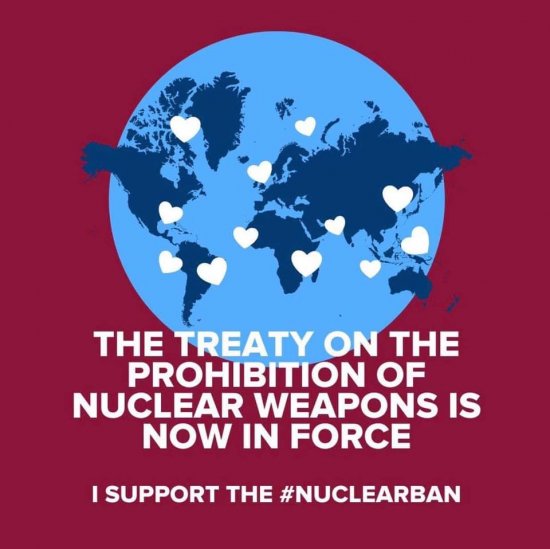
1st March, By Xander Elliards
Next week will see the third Meeting of States Parties to the Treaty on
the Prohibition of Nuclear Weapons (3MSP TPNW, for short). In practice,
that means that delegates from across the globe will attend a meeting at
the UN in New York to discuss how to push for wider acceptance of a
worldwide ban on nuclear weapons. The TPNW is backed by 73 states parties,
including Austria, Ireland, New Zealand, Mexico, and South Africa, and 21
others are signatories, including Colombia, Brazil, and Barbados.
The SNP has committed an independent Scotland to signing the TPNW – but the UK,
as a nuclear power, has declined to sign it. Thanks to a partnership with
the philanthropic fund Lex International, The National will be on the
ground in New York and at the UN building as thousands of delegates from
across the globe meet to discuss how to push nuclear states like the UK
into action.
The National 1st March 2025,
https://www.thenational.scot/news/24969230.national-goes-un-fight-nuclear-disarmament/
The Guardian view on PM’s gamble: exploiting crisis to remake Labour was a step too far for an ally

Guardian 28th Feb 2025, https://www.theguardian.com/commentisfree/2025/feb/28/the-guardian-view-on-pms-gamble-exploiting-crisis-to-remake-labour-was-a-step-too-far-for-an-ally
The exit of a soft-left intellectual politician from government highlights a growing unease about the reordering of the party’s priorities.
The resignation of Anneliese Dodds, the international development minister, from Labour’s cabinet may not have been entirely unexpected. Sir Keir Starmer’s decision to cut the aid budget to “pay” for increased defence spending was wrong. Making the world’s poorest foot the bill for Britain’s security is reckless and self-defeating. Slashing aid fuels instability – it won’t buy safety. From her perch in government Ms Dodds, who was Sir Keir’s first shadow chancellor, knew this better than most.
The former cabinet minister’s letter is right to warn that the cuts will mean the UK withdrawing from many developing countries and having a diminished role in global institutions like the World Bank, the G7 and climate negotiations. She pointedly argued Britain will find it “impossible” to deliver on its commitment to maintain development spending in Gaza, Sudan and Ukraine with the shrunken budget. Sir Keir rebuffed this charge, but Ms Dodds is right to say his move is being seen as following the Trumpian lead in cutting USAid – a framing that implies the UK is losing its independent foreign policy direction.
Like many others, including this column, she understood that in an increasingly volatile world, defence spending must rise. But rather than a collective discussion on whether the government’s fiscal rules and tax policies remain fit for purpose, the prime minister chose to gut aid budgets to fund defence spending with little debate, as if stability abroad weren’t essential to security at home. Such high-handed treatment left Ms Dodds, a soft-left intellectual politician, with no choice but to resign.
Her departure had been in the air since Sir Keir made his announcement – but she held off until he returned from Washington. Sir Keir now owns the decision, and its consequences will define his leadership. That he was shaped by events rather than shaping them will not be lost on his MPs.
Clive Lewis, a leftwing Labour MP and former soldier, has called for a wealth tax to fund defence. This is a sensible idea that merits wider discussion, as does relaxing borrowing rules – a debate already under way in Europe. The party’s right wing wants to frame Sir Keir’s move as more than fiscal, briefing that Sir Keir has made a deliberate break from the party’s pro-aid stance. It is reported that the Treasury didn’t push this – it was the prime minister’s personal call. Ms Dodds’ rise and fall mirrors his hardening leadership style.
Sir Keir is seizing this crisis to remake his party. His government has embraced militarisation, welfare cuts, climate backtracking and nationalist asylum policies. The political rationale is to ward off attacks from the extreme right and particularly Reform, which has seen its support rise. Why amplify rightwing narratives instead of challenging them? If this is just tactical positioning, fine. If not, he risks losing Labour’s soul – a perilous path as concerns over the lack of good jobs, equality, child poverty and pensioner support are likely to keep growing. Labour voters may turn away if “hard-headed” geopolitics trumps fairness. The reaction from MPs and the electorate will determine whether this gamble pays off – or exposes rifts within Labour’s coalition.
‘The climate crisis is the biggest security threat of them all’: Anneliese Dodds quits government over aid budget cuts

Michael Holder, 28 February 2025
Anneliese Dodds has today quit the Cabinet over plans to raid the
international aid budget to boost defence spending, warning in her
resignation letter the decision risks damaging the UK’s interests and
undermining efforts to tackle a climate crisis that “is the biggest
security threat of them all”.
Dodds, who resigned as Minister of State for
both International Development and Women and Equalities, said while she
fully supported the government’s decision to increase defence spending, she
disagreed that the UK overseas development budget should “absorb the entire
burden”.
Business Green 28th Feb 2025,
https://www.businessgreen.com/news/4410216/climate-crisis-biggest-security-threat-anneliese-dodds-quits-government-aid-budget-cuts
1 This Month


Tell the Ukrainian Government to Drop Prosecution of Peace Activist Yurii Sheliazhenko

Petition to revoke the licensing of the Near Surface Nuclear Disposal Facility (NSDF) at Chalk River. https://www.ourcommons.ca/petitions/en/Petition/Details?Petition=e-7247


of the week – STOP SMALL MODULAR REACTORS IN CANADA
To see nuclear-related stories in greater depth and intensity – go to https://nuclearinformation.wordpress.com
-
Archives
- March 2026 (193)
- February 2026 (268)
- January 2026 (308)
- December 2025 (358)
- November 2025 (359)
- October 2025 (376)
- September 2025 (258)
- August 2025 (319)
- July 2025 (230)
- June 2025 (348)
- May 2025 (261)
- April 2025 (305)
-
Categories
- 1
- 1 NUCLEAR ISSUES
- business and costs
- climate change
- culture and arts
- ENERGY
- environment
- health
- history
- indigenous issues
- Legal
- marketing of nuclear
- media
- opposition to nuclear
- PERSONAL STORIES
- politics
- politics international
- Religion and ethics
- safety
- secrets,lies and civil liberties
- spinbuster
- technology
- Uranium
- wastes
- weapons and war
- Women
- 2 WORLD
- ACTION
- AFRICA
- Atrocities
- AUSTRALIA
- Christina's notes
- Christina's themes
- culture and arts
- Events
- Fuk 2022
- Fuk 2023
- Fukushima 2017
- Fukushima 2018
- fukushima 2019
- Fukushima 2020
- Fukushima 2021
- general
- global warming
- Humour (God we need it)
- Nuclear
- RARE EARTHS
- Reference
- resources – print
- Resources -audiovicual
- Weekly Newsletter
- World
- World Nuclear
- YouTube
-
RSS
Entries RSS
Comments RSS
 nuclear-news