Nuclear reactors killing Americans at accelerating rate

John LaForge Guest columnist, Feb 27, 2025 https://www.hometownsource.com/monticello_times/nuclear-reactors-killing-americans-at-accelerating-rate/article_7cb060d2-eef6-11ef-836b-8349ae8997a8.html
A new analysis of public health data from the Centers for Disease Control and Prevention (CDC) reveals alarming evidence that cancer deaths are rising in communities surrounding America’s oldest nuclear power plants.
Epidemiologist Joseph Mangano, executive director for the Radiation and Public Health Project in New York, has conducted a study showing a disturbing correlation between prolonged exposure to nuclear radiation and increased cancer mortality in affected counties.
According to Mangano’s research, which examines county-by-county cancer mortality data over three distinct time periods, radiation routinely released from nuclear reactors is directly impacting public health.
His findings indicate that cancer deaths in counties hosting 15 of the nation’s 16 oldest nuclear facilities have significantly increased over time, reinforcing longstanding concerns about the safety of prolonged nuclear plant operations.
“There is no safe dose of radiation,” Mangano states, citing the National Academy of Sciences’ BEIR VII report, which confirms that every exposure to ionizing radiation has the potential to trigger cancer.
As nuclear reactors age and continue to release radioactive gases such as helium, xenon and krypton into the atmosphere, residents in nearby communities are at increasing risk of developing cancer due to prolonged exposure.
The data further illustrates the impact of these radiation releases varies based on geographical factors, including wind patterns and local topography.
For example, in Wisconsin, excess cancer deaths were significantly lower near the Point Beach nuclear facility than in counties downwind of the Palisades and DC Cook plants on Lake Michigan’s eastern shore.
These findings suggest that radiation exposure is not uniform and that some communities bear a greater burden than others.
The implications of Mangano’s research are particularly concerning for residents of Wright and Sherburne counties in Minnesota, home to the Monticello Nuclear Generating Plant.
Since the plant began operating in 1971, the once-lower-than-average cancer mortality rate in these counties has risen sharply. Projections estimate that between 2031 and 2050, as many as 1,662 excess cancer deaths could occur if Monticello’s operating license is extended through 2051.
“These findings should serve as a wake-up call,” said Kelly Lundeen, a staff member at the Wisconsin-based environmental and nuclear watchdog Nukewatch. “We are urging local, state, and federal officials to take immediate action to phase out commercial nuclear power before more lives are lost.”
Despite growing concerns, the U.S. Nuclear Regulatory Commission (NRC) has already approved license extensions for several aging reactors, allowing some to operate for up to 80 years.
Given the demonstrated public health risks, advocates are calling for an immediate halt to these extensions and a transition toward safer, renewable energy sources.
The Coalition for a Nuclear-Free Mississippi River was planning to rally outside of the Minnesota Public Utilities Commission hearing earlier this month to maintain the current shutdown date of the Monticello reactor.
The Radiation and Public Health Project, the organization behind Mangano’s analysis, is pushing for greater transparency in radiation monitoring, stricter regulations on radioactive emissions, and a comprehensive plan to phase out aging nuclear plants.
John LaForge serves as the co-director of Nukewatch, a Wisconsin-based environmental and peace action watchdog group.
Nuclear reactors could become targets of war, defence experts warn

The Australian Security Leaders Climate Group has warned the Coalition’s nuclear plans could leave Australia vulnerable to devastating attacks.
Key Points
- The Australian Security Leaders Climate Group has warned nuclear reactors could become targets of war in Australia.
- Nuclear reactors could be targeted by missile attack and sabotage, the group said.
- The Coalition is planning to build seven small nuclear reactors across five states.
Australian nuclear reactors could become a target of war if the Coalition was to go ahead with plans to build them, a group of former defence leaders warn.
The plan to build seven small nuclear reactors across five states on the sites of coal-fired stations could leave Australia vulnerable to missile warfare and sabotage, the Australian Security Leaders Climate Group says.
The group, including former Australian Defence Force chief Chris Barrie and former director of preparedness and mobilisation at the Department of Defence Cheryl Durrant, is urging the nation not to go down the path of building nuclear power stations.
Modern warfare is increasingly being fought using missiles and unmanned aerial systems, Barrie said.
“Every nuclear power facility is a potential dirty bomb because rupture of containment facilities can cause devastating damage,” he said.
“With the proposed power stations all located within a 100 kilometres of the coast, they are a clear and accessible target.”
Durrant cited the Russia-Ukraine war where both sides have prioritised targeting their opponents’ energy systems
Australia would be no different,” Durrant said.
Nuclear power plants could become a dual target due to their role in energy supply, but also the catastrophic devastation which would occur if facilities were breached.
This means Australia would need to consider introducing expensive and complex missile defence systems and cyber and intelligence resources to defend the plants if war were to break out — which the nation currently lacks.
“Do we prioritise the protection of cities and population centres and military bases, or do we divert vital resources to defending seven nuclear power stations scattered across Australia?” Barrie said.
The group said building nuclear capabilities would derail Australia’s climate targets and exacerbate risks in the region.
How the Warfare State Paved the Way for a Trumpist Autocracy

Biden said nothing about how almost 20 years of nonstop war funding and war making had already altered the character of the nation.
Biden’s designated successor, Vice President Kamala Harris, displayed a traditional militaristic reflex while campaigning against Trump ……… she pledged to maintain “the strongest, most lethal fighting force in the world.”
In 2024, as in 2016, Trump notably benefitted from the unwavering militarism of his Democratic opponent.
While the warfare state seems all too natural to most politicians and journalists, its consequences over time have been transformational for the United States in ways that have distinctly skewed the political climate. Along the way, militarism has been integral to the rise of the billionaire tech barons who are now teaming up with an increasingly fascistic Donald Trump.
SCHEERPOST, February 28, 2025 , By Norman Solomon / TomDispatch
Donald Trump’s power has thrived on the economics, politics, and culture of war. The runaway militarism of the last quarter-century was a crucial factor in making President Trump possible, even if it goes virtually unmentioned in mainstream media and political discourse. That silence is particularly notable among Democratic leaders, who have routinely joined in bipartisan messaging to boost the warfare state that fueled the rise of Trumpism.
Trump first ran for president nearly a decade and a half after the “Global War on Terror” began in the wake of the 9/11 attacks. The crusade’s allure had worn off. The national mood was markedly different than in the era when President George W. Bush insisted that “our responsibility” was to “rid the world of evil.”
Working-class Americans had more modest goals for their government. Distress festered as income inequality widened and economic hardships worsened, while federal spending on war, the Pentagon budget, and the “national security” state continued to zoom upward. Even though the domestic effects of protracted warfare were proving to be enormous, multilayered, and deeply alienating, elites in Washington scarcely seemed to notice.
Donald Trump, however, did notice.
Status-Quo Militarism
President Barack Obama and Hillary Clinton represented the status quo that Trump ran against and defeated. Like them, he was completely insulated from the harsh boomerang effects of the warfare state. Unlike them, he sensed how to effectively exploit the discontent and anger it was causing.
Obama was not clueless. He acknowledged some downsides to endless war in a much-praised speech during his second term in office. “Our systematic effort to dismantle terrorist organizations must continue,” he affirmed at the National Defense University. “But this war, like all wars, must end. That’s what history advises. That’s what our democracy demands.”
…………………………………………….President Bush’s messianic calls to rid the world of “evil-doers” had fallen out of fashion, but militarism remained firmly embedded in the political economy. Corporate contracts with the Pentagon and kindred agencies only escalated. But when Hillary Clinton ran for president in 2016, being a rigid hawk became a negative with the electorate as pro-Trump forces jumped into the opening she provided.
Six weeks before the election, Forbes published an article under the headline “Hillary Clinton Never Met a War She Didn’t Want Other Americans to Fight.”
Clinton was following a timeworn formula for Democrats trying to inoculate themselves against charges of being soft on foreign enemies, whether communists or terrorists. Yet Trump, deft at labeling his foes both wimps and warmongers, ran rings around the Democratic nominee. In that close election, Clinton’s resolutely pro-war stance may have cost her the presidency.
……………………………….. Leading Democrats and Republicans remained on autopilot for the warfare state as the Pentagon budget kept rising.
On the War Train with Donald Trump……………………………………………………………….
While the warfare state seems all too natural to most politicians and journalists, its consequences over time have been transformational for the United States in ways that have distinctly skewed the political climate. Along the way, militarism has been integral to the rise of the billionaire tech barons who are now teaming up with an increasingly fascistic Donald Trump.
The Military-Industrial-Tech Complex
While President Trump has granted Elon Musk unprecedented power, many other tech moguls have rushed to ingratiate themselves. The pandering became shameless within hours of his election victory last November.
“Congratulations to President Trump on a decisive victory,” Meta’s CEO Mark Zuckerberg wrote. “We have great opportunities ahead of us as a country. Looking forward to working with you and your administration.” Jeff Bezos, the owner of Amazon, Whole Foods, and the Washington Post, tweeted: “wishing @realDonaldTrump all success in leading and uniting the America we all love.”
Amazon Web Services alone has numerous government contracts, including one with the National Security Agency worth $10 billion and deals with the Pentagon pegged at $9.7 billion. Such commerce is nothing new. For many years, thousands of contracts have tied the tech giants to the military-industrial complex.
Musk, Zuckerberg, Bezos, and smaller rivals are at the helm of corporations eager for government megadeals, tax breaks, and much more. For them, the governmental terrain of the new Trump era is the latest territory to navigate for maximizing their profits. With annual military outlays at 54% of all federal discretionary spending, the incentives are astronomical for all kinds of companies to make nice with the war machine and the man now running it.
While Democrats in Congress have long denounced Trump as an enemy of democracy, they haven’t put any sort of brake on American militarism. Certainly, there are many reasons for Trump’s second triumph, including his exploitation of racism, misogyny, nativism, and other assorted bigotries. Yet his election victories owe much to the Democratic Party’s failure to serve the working class, a failure intermeshed with its insistence on serving the industries of war. Meanwhile, spending more on the military than the next nine countries combined, U.S. government leaders tacitly lay claim to a kind of divine overpowering virtue.
As history attests, militarism can continue for many decades while basic democratic structures, however flawed, remain in place. But as time goes on, militarism is apt to be a major risk factor for developing some modern version of fascism. The more war and preparations for war persist, with all their economic and social impacts, the more core traits of militarism — including reliance on unquestioning obedience to authority and sufficient violence to achieve one’s goals — will permeate the society at large.
During the last 10 years, Donald Trump has become ever more autocratic, striving not just to be the nation’s commander-in-chief but also the commandant of a social movement increasingly fascistic in its approach to laws and civic life. He has succeeded in taking on the role of top general for the MAGA forces. The frenzies that energize Trump’s base and propel his strategists have come to resemble the mentalities of warfare. The enemy is whoever dares to get in his way.
A warfare state is well suited for such developments. Pretending that militarism is not a boon to authoritarian politics only strengthens it. The time has certainly come to stop pretending.
Reawakening a Nuclear Legacy: The Potential Return of the US Nuclear Mission to RAF Lakenheath
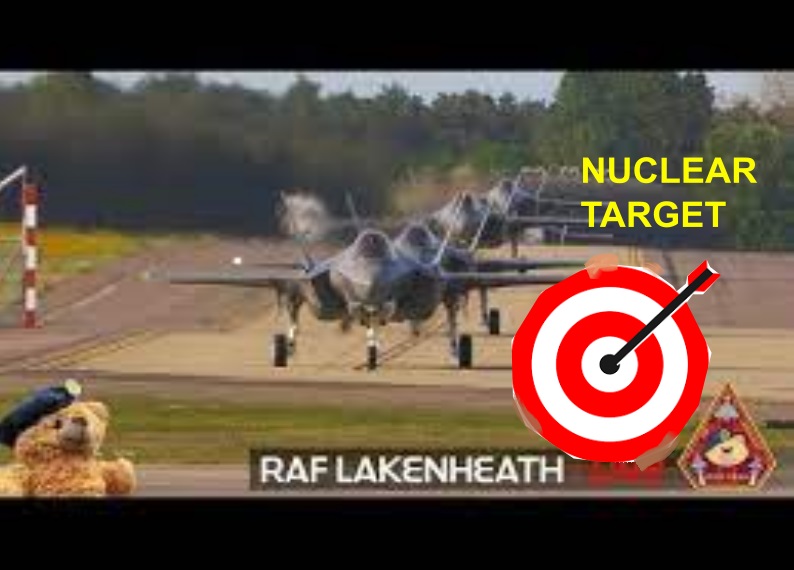
Federation of American Scientists 26th Feb 2025, by Eliana Johns & Hans Kristensen, https://fas.org/publication/potential-return-of-the-us-nuclear-mission-to-raf-lakenheath/
In the spring of 2022, researchers at the Federation of American Scientists began reading newly released U.S. Defense Department budget documents to look for updates concerning the Pentagon’s priorities for the next fiscal year. As the researchers poured over hundreds of pages, two words suddenly captured their attention: the Biden administration’s Fiscal Year (FY) 2023 budget request had added “the UK” to a list of countries receiving upgrades to their “special weapons” storage sites under a 13-year NATO investment program. The term “special weapons” is often used by the U.S. government when referring to nuclear weapons. However, the United States has not deployed nuclear weapons in the United Kingdom for nearly two decades. Those two words sparked dozens of questions, years of continued research, and a new local movement of protests against the return of a potential nuclear mission to RAF Lakenheath.
This new report provides an account of the nuclear history of RAF Lakenheath and the role it played in the US nuclear mission until nuclear weapons were withdrawn in 2008. The report then explains the mounting evidence from three years of collection of documentation and observations that show the United States Air Force is re-establishing its nuclear mission on UK soil for the first time in nearly two decades.
As of February 2025, there are no known public indications that nuclear weapons have been deployed to RAF Lakenheath – we assess that the return of the nuclear mission is intended primarily as a backup rather than to deploy weapons now. However, if this were to happen, it would break with decades of policy and planning and reverse the southern focus of the European nuclear deployment that emerged after the end of the Cold War. Even without weapons present, the addition of a large nuclear air base in northern Europe is a significant new development that would have been inconceivable just a decade-and-a-half ago.
Scotland can’t afford the risks of the nuclear fuel chain

Disasters might be “rare” as if that is at all comforting, but
Chernobyl and Fukushima are reminders of the consequences that nuclear can
bring. Scotland’s geography and weather conditions are, granted, somewhat
more stable than the likes of Japan – but that’s only true at this
moment in time.
We are already seeing the accelerated effects of climate
change taking hold here, and while we might be shielded to an extent for
now – we can’t guarantee that stability long term. In fact, it’s
pretty likely that stability will be eroded if we continue hurtling down
this path of climate destruction that we’re currently on, and we’re
showing no signs of slowing down. Even without potential changes to our
natural environment, the long-term risks of building a nuclear plant near
populated areas are just too high.
A major accident, however unlikely,
would have unimaginable consequences for a small country like Scotland.
Reactors themselves might not emit carbon, but nuclear energy is by no
means “clean” as it is marketed. The entire life cycle of nuclear
energy involves environmental risks that Scotland can’t afford – risks
that we simply do not need to take.
The National 27th Feb 2025, https://www.thenational.scot/politics/24967406.independence-nuclear-option-will-unlock-potential/
‘Not everyone knows acronyms’: Australian politicians shrug off Trump blunder on AUKUS

By Richard Wood • Senior Journalist Feb 28, 2025, https://www.9news.com.au/world/donald-trump-stumbles-when-asked-about-aukus-defence-deal/6a602864-b990-4d37-95a4-530e31bd96e8
Politicians from both sides in Australia have weighed in today on US President Donald Trump’s apparent stumble when he said he did not know what AUKUS was.
Trump was hosting visiting British Prime Minister Keir Starmer at the White House when the pair were asked by a reporter whether they’d be discussing AUKUS, under which Australia will acquire nuclear-powered submarines.
“What does that mean?” Trump replied.
First shipment of 280,000 tons Aggregate arrives by rail at Cumbria low-level nuclear waste site for final capping
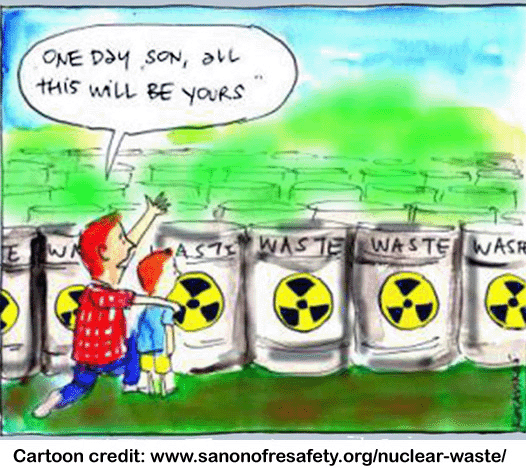
The first shipments via rail of 280,000t of aggregate by Nuclear Transport
Solutions (NTS) have been delivered to the Low Level Waste Repository
(LLWR) site in Cumbria, which will form a 100-year barrier for nuclear
wastes.
Nuclear Waste Services (NWS) is responsible for managing the
disposal of the UK’s low-level radioactive waste including at the LLWR
site. NTS is a transport and logistics provider which operated Direct Rail
Services (DRS) which transports nuclear and radioactive materials via rail.
Both NWS and NTS are part of the Nuclear Decommissioning Authority, which
itself is an executive non-departmental public body, sponsored by the
Department for Energy Security and Net Zero (DESNZ). The LLWR is the only
facility in the UK permitted to receive all categories of radioactive and
nuclear low level waste (LLW) and NWS describes it as “the nation’s
principal disposal facility for LLW”.
New Civil Engineer 26th Feb 2025, https://www.newcivilengineer.com/latest/aggregate-arrives-by-rail-at-cumbria-low-level-nuclear-waste-site-for-final-capping-26-02-2025/
1 This Month
Chernobyl: The Lost Tapes – A good documentary on Chernobyl on SBS available On Demand for the next 3 weeks– https://www.sbs.com.au/ondemand/tv-program/chernobyl-the-lost-tapes/2352741955560

of the week–London Campaign for Nuclear Disarmament

Tell the Ukrainian Government to Drop Prosecution of Peace Activist Yurii Sheliazhenko
To see nuclear-related stories in greater depth and intensity – go to https://nuclearinformation.wordpress.com
-
Archives
- April 2026 (126)
- March 2026 (251)
- February 2026 (268)
- January 2026 (308)
- December 2025 (358)
- November 2025 (359)
- October 2025 (376)
- September 2025 (257)
- August 2025 (319)
- July 2025 (230)
- June 2025 (348)
- May 2025 (261)
-
Categories
- 1
- 1 NUCLEAR ISSUES
- business and costs
- climate change
- culture and arts
- ENERGY
- environment
- health
- history
- indigenous issues
- Legal
- marketing of nuclear
- media
- opposition to nuclear
- PERSONAL STORIES
- politics
- politics international
- Religion and ethics
- safety
- secrets,lies and civil liberties
- spinbuster
- technology
- Uranium
- wastes
- weapons and war
- Women
- 2 WORLD
- ACTION
- AFRICA
- Atrocities
- AUSTRALIA
- Christina's notes
- Christina's themes
- culture and arts
- Events
- Fuk 2022
- Fuk 2023
- Fukushima 2017
- Fukushima 2018
- fukushima 2019
- Fukushima 2020
- Fukushima 2021
- general
- global warming
- Humour (God we need it)
- Nuclear
- RARE EARTHS
- Reference
- resources – print
- Resources -audiovicual
- Weekly Newsletter
- World
- World Nuclear
- YouTube
-
RSS
Entries RSS
Comments RSS
 nuclear-news