The Supreme Court faces the absurdly difficult problem of where to put nuclear waste
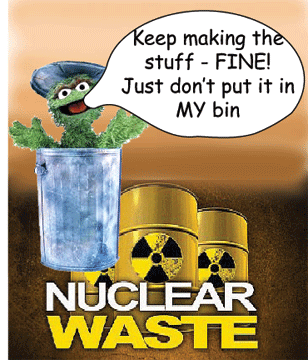
And so it now falls to the Supreme Court to decide whether this latest attempt to find a place to store some of the most undesirable trash on the planet must falter on the shores of NIMBYism.
America’s worst NIMBY problem comes to the Supreme Court.
by Ian Millhiser, Vox , 26th Feb 2025,
https://www.vox.com/scotus/399304/supreme-court-nuclear-waste-texas-nrc-nimby
On March 5, the Supreme Court will hear a case that may involve one of the most toxic examples of NIMBYism in American history. The issue at the heart of Nuclear Regulatory Commission v. Texas arises out of a predictable problem: Absolutely no one wants radioactive waste anywhere near where they live or work, but that waste has to go somewhere.
Texas, as the case name suggests, involves an effort by the federal government to store nuclear waste in Texas, and at the same time, solve a problem it’s struggled with for nearly 40 years.
To fully understand what’s before the Supreme Court in Texas, we need to go back to 1982, when Congress passed a law that was supposed to establish a permanent repository for all of the radioactive waste produced by America’s nuclear power plants. This waste remains dangerous for thousands or even tens of thousands of years after it is produced, so it made sense to find a spot far from human civilization where it can be buried.
But then NIMBY — that’s “not in my backyard” — politics set in.
The US Department of Energy identified several possible sites for the waste, and eventually culled those sites down to three — one in Texas, one in Washington state, and Yucca Mountain in Nevada. But, in 1987, before these officials could complete the selection process, Congress stepped in and chose the Nevada site for them.
According to a Slate article on the eventual collapse of the Yucca Mountain plan, this choice is easy to explain when you look at who ran Congress at the time. The House speaker was Jim Wright, a representative from Texas. The House majority leader was Tom Foley, from Washington. So Nevada, which had the weakest congressional delegation at the time, lost out.
Indeed, according to Rod McCullum of the Nuclear Energy Institute, “the 1987 Amendment is now commonly referred to as the ‘screw Nevada’ bill.”
By the time President Barack Obama took office, however, the balance of power in Congress had changed. Sen. Harry Reid, of Nevada, was the majority leader. He set out, with the Obama administration’s support, to kill the Yucca Mountain project. Congress, at Obama’s urging, zeroed out funding for Yucca Mountain. Then, just in case the project wasn’t already dead enough, a 2013 court decision ordered the government to stop collecting taxes that would have funded the permanent storage facility until it could figure out where that facility would be located.
And that brings us to the present date, and to the issue before the Supreme Court in the Texas case. Without a permanent storage facility on the horizon, the federal Nuclear Regulatory Commission turned to an older statute which has been understood to allow it to authorize temporary storage facilities for nuclear waste since the 1970s, licensing a private facility to handle storage in Andrews County, Texas.
Texas eventually sued to block this facility, as did a nearby landowner. Their case wound up before a three-judge panel of the United States Court of Appeals for the Fifth Circuit. Two of these judges are from Texas. It’s not hard to guess what happened next.
And so it now falls to the Supreme Court to decide whether this latest attempt to find a place to store some of the most undesirable trash on the planet must falter on the shores of NIMBYism.
Indeed, the 1954 law’s language allowing the NRC to license possession of these three kinds of material is quite broad. The NRC may license possession of special nuclear material for reasons that it “determines to be appropriate to carry out the purposes” of the law. It may license possession of source material for any “use approved by the Commission as an aid to science or industry.” And it may license possession of byproduct material for “industrial uses” or for “such other useful applications as may be developed.”
Though both Texas and the landowner claim that this language should not be read to permit the kind of license at issue in the Texas case, they are swimming against at least a half-century of precedent. The landowner’s brief concedes that the NRC first claimed the authority to license facilities under the 1954 law in 1975 (it claims that this fact cuts against the government’s case, because the NRC waited two decades to claim this power, but the fact remains that this question has been settled for 50 years). The landowner’s brief also concedes that the NRC finalized regulations governing licenses for such facilities in 1980.
That said, the landowner’s brief does make a plausible — if not, exactly, airtight — argument that the 1982 law overrides the 1954 law’s provisions concerning private storage facilities. (Texas’s brief, by contrast, is heavy on overwrought rhetoric claiming that nuclear waste must be stored at Yucca Mountain, and light on the kind of statutory analysis that a responsible judge would rely upon in deciding this case.)
Among other things, the landowner’s legal team points to three provisions of the 1982 law which say that the NRC shall “encourage” storage of nuclear waste “at the site of each civilian nuclear power reactor,” and take other steps to promote such onsite storage. They also point to a provision calling for a federal storage facility. And, they highlight a provision stating that the 1982 law should not be read to “encourage” or “authorize” private storage facilities away from a reactor.
As the landowner’s legal team writes, allowing the Texas facility to exist would “discourage” creating new storage capacity at reactor sites, the opposite of what the 1982 law was supposed to accomplish.
It’s safe to say that, when Congress wrote the 1982 law, they imagined a world where nuclear waste would be stored either at reactor sites or at a federal facility, and not at a private facility like the one at issue in Texas. But the 1982 law also does not explicitly repeal the 1954 law’s provisions governing the three kinds of nuclear material. So the government has a very strong argument that it can still rely on those provisions to license the facility in Texas.
There is a possibility that the Supreme Court will simply make this case go away
There’s a real possibility that the Supreme Court will get rid of this case on procedural grounds, effectively handing a victory to the government.
Briefly, the federal law that both Texas and the landowner relied upon to bring their case to the Fifth Circuit permits “any party aggrieved by the final order” of the NRC to challenge that decision in a federal appeals court. The government argues that, to qualify as a “party,” Texas or the landowner must have participated “as a litigant” in the NRC’s internal proceeding governing the Andrews County license.
While both the state and the landowner took some steps to make their views known to the NRC during that proceeding, neither ever officially became litigants. Thus, the government argues, they do not count as a “party” to that proceeding which can appeal the NRC’s decision, and the Court should toss the case out. The key thing to know about this legal argument is that it may be enough to prevent the justices from reaching the merits of this particular case.
If the Court does reach the merits, however, it faces a difficult decision. Allowing the Andrews County project to move forward will undoubtedly trigger the same kind of political backlash that has accompanied every other attempt to pick a site to store nuclear waste. But, if this project is not allowed, it’s far from clear where the waste would go.
No comments yet.
1 This Month

of the week – Shut Down Drone Warfare!


Tell the Ukrainian Government to Drop Prosecution of Peace Activist Yurii Sheliazhenko

Petition to revoke the licensing of the Near Surface Nuclear Disposal Facility (NSDF) at Chalk River. https://www.ourcommons.ca/petitions/en/Petition/Details?Petition=e-7247
To see nuclear-related stories in greater depth and intensity – go to https://nuclearinformation.wordpress.com
-
Archives
- April 2026 (79)
- March 2026 (251)
- February 2026 (268)
- January 2026 (308)
- December 2025 (358)
- November 2025 (359)
- October 2025 (376)
- September 2025 (257)
- August 2025 (319)
- July 2025 (230)
- June 2025 (348)
- May 2025 (261)
-
Categories
- 1
- 1 NUCLEAR ISSUES
- business and costs
- climate change
- culture and arts
- ENERGY
- environment
- health
- history
- indigenous issues
- Legal
- marketing of nuclear
- media
- opposition to nuclear
- PERSONAL STORIES
- politics
- politics international
- Religion and ethics
- safety
- secrets,lies and civil liberties
- spinbuster
- technology
- Uranium
- wastes
- weapons and war
- Women
- 2 WORLD
- ACTION
- AFRICA
- Atrocities
- AUSTRALIA
- Christina's notes
- Christina's themes
- culture and arts
- Events
- Fuk 2022
- Fuk 2023
- Fukushima 2017
- Fukushima 2018
- fukushima 2019
- Fukushima 2020
- Fukushima 2021
- general
- global warming
- Humour (God we need it)
- Nuclear
- RARE EARTHS
- Reference
- resources – print
- Resources -audiovicual
- Weekly Newsletter
- World
- World Nuclear
- YouTube
-
RSS
Entries RSS
Comments RSS
 nuclear-news
Leave a comment