As tensions rise, Canada to lean on U.S. for uranium enrichment
Matthew McClearn, February 24, 2025, Globe and Mail
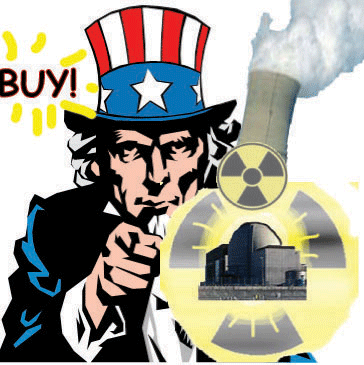
Even as U.S. President Donald Trump talks of waging a campaign of “economic force” to persuade Canada to join a political union with the United States, Ontario Power Generation is preparing to construct an American reactor at its Darlington Nuclear Generating Station. The reactor’s uranium fuel would be enriched at a facility in New Mexico, a new vulnerability U.S. administrations could exploit.
Canada’s 17 operating reactors are of thehomegrown Candu design, which consume natural uranium. Canada possesses uranium in abundance and has long made its own fuel. But nearly all the reactors promoted for construction now require enriched uranium, which Canada can’t produce.
Proposals by Canadian utilities to build new reactors attracted American vendors, including GE-Hitachi Nuclear Energy (which is designing the BWRX-300, planned for deployment at Darlington and in Saskatchewan), Westinghouse Electric Co. and ARC Clean Technology. Until the past few months, the risks of the U.S. government weaponizing nuclear fuel against allies for political purposes seemed distant. Now it’s just one more aspect of Canada-U.S. relations that Mr. Trump has disrupted.
“Developing a dependence on another country for our nuclear fuel has always been a concern and recent events have proven those concerns are justified,” Bob Walker, national director of the Canadian Nuclear Workers’Council, an umbrella organization of unions within Canada’s nuclear industry, said in a written response to questions.
We haven’t done our due diligence in terms of having other partners,” said Akira Tokuhiro, a professor in Ontario Tech University’s nuclear engineering department.
“Canada needs to really invest and make a concerted effort to find and establish the nuclear supply chain without the United States.”………………………………………………………………………………………
Nuclear fuel supply agreements are typically confidential, so it’s unclear what provisions GE-Hitachi and OPG have made to deal with supply disruptions. (Orano’s presence, though, seems to offer OPG a non-American enrichment supplier.) Neither company granted an interview for this article.
“The arrangements are probably as robust as they could be under normal circumstances, but the circumstances are no longer normal,” Mr. Walker said.
“This is a very fluid situation,” OPG spokesperson Neal Kelly wrote in a statement. “We are proactively evaluating potential impacts and will act as the situation arises.”
Tariffs could make nuclear fuel far more costly. One mitigating factor, however, is that fuel represents a relatively small portion of nuclear plant operating costs – typically under 20 per cent. That’s a striking contrast with power plants that burn oil or natural gas.
George Christidis, acting chief executive of the Canadian Nuclear Association, said that if Washington imposed a 25-per-cent tariff on Canadian uranium, that would harm the U.S. enough to force re-evaluation.
“There’s such an interconnection within our industry, on the uranium side right into the American economy and energy system, that in the end, it really would be something that may cause them a lot of distress.”
The U.S. government could also deny Canada access to enriched fuel, for example as part of a broader campaign to undermine Canadian sovereignty, or to reserve it exclusively for American utilities.
“A presidential executive order could force the U.S. Nuclear Regulatory Commission to disallow shipments to Canada,” Mr. Walker wrote.
“We don’t know how likely it is but there is a risk it could happen.”
Halting nuclear fuel shipments likely wouldn’t have the immediate impact of, say, ceasing deliveries to Canada on natural gas pipelines. Unlike gas-fired power plants, which require a steady stream of fuel, reactors are only refuelled periodically, affording time to adjust. And the high energy density of nuclear fuel facilitates stockpiling.
Mr. Christidis discounted the idea that the U.S. would disrupt Canada’s ability to acquire low-enriched uranium.
“I think quite strongly that there will be a path forward between the two countries to work together.”
Ms. Hanebach said Canada’s uranium supply would provide leverage in negotiating relationships with new enrichment partners. But the list is short.
“If the U.S. decided to pull enrichment capacity, it would be Russia, then it’s China,” she said. “And then there’s some in France, Netherlands, U.K. and Germany. That’s it.”
Experts told The Globe and Mail that there’s no aspect of the Candu’s fuel cycle that relies on American inputs, making it more resilient to disruption.
AtkinsRéalis Group Inc., which has exclusive licensing rights to Candu technology, regards that as a trump card against U.S. competitors – as it made clear in a survey it published in January. “Candu uses unenriched uranium,” noted the preamble to one question, while another said: “Westinghouse uses enriched uranium imported from countries like Russia.” Informed by such statements, 84 per cent of respondents said they preferred Candus over Westinghouse reactors.
“Candu emerges as the clear favourite,” AtkinsRéalis enthused.
But there’s a problem: The Candu is widely regarded as obsolete. The last one built in Canada was Darlington Unit 4, completed in 1993. Since then a number of new designs have been drawn up, but none were licensed or built. AtkinsRéalis now has a team of 250 employees designing a modernized version dubbed the Monark.
If Canada follows through on plans to build a fleet of light water reactors in Ontario, Saskatchewan and possibly elsewhere, it could elect to build its own enrichment capacity. Energy analyst Juzel Lloyd suggested doing precisely this, in a recent commentary for the Macdonald-Laurier Institute.
“Recent global events demand that the Canadian government re-evaluate its position on uranium enrichment,” she wrote.
“By initiating enrichment services, Canada can diversify the global nuclear supply chain, reduce reliance on Russian fuel and ensure the energy security of both established and emerging nuclear-powered states.”
The conventional wisdom, though, is that enrichment is so technically challenging and costly that only nuclear weapons states can justify it. (Japan is the noteworthy exception.) Prof. Tokuhiro said acquiring enrichment capacity would cost at least $100-billion and take at least 20 years.
“It’s more money than the Canadian government is willing to commit,” he said.
Ms. Hanebach observed that many legislative and regulatory changes would be required. Canada is a party to the Treaty on the Non-Proliferation of Nuclear Weapons, for example. “We would need to work with the International Atomic Energy Agency on that, and then implement that in domestic legislation,” she said. Canada doesn’t have a regulatory framework for enrichment, either.
Internationally, enrichment capability is tightly controlled by the Nuclear Suppliers Group to prevent weapons proliferation. Canada’s a member but is not permitted to enrich uranium.
Steve Aplin, of the Canadian Nuclear Workers’ Council, said Canada had sought U.S. support in 2006 before the Group to construct an enrichment facility here in Canada, but the U.S. refused outright.
“It was all very preliminary,” Mr. Aplin wrote. “The Americans refused because they want to control how many ‘enrichers’ there are in the world.”
Furthermore, he said that had the U.S. acquiesced, Russia, which is also a member, would not.
“Russia, like America, likes the fact they possess enrichment capacity and others don’t.” subscription:https://www.theglobeandmail.com/business/article-with-us-tensions-rising-canada-lacks-its-own-uranium-enrichment/
No comments yet.
1 This Month
To see nuclear-related stories in greater depth and intensity – go to https://nuclearinformation.wordpress.com/
31st January – Challenging the War Machine – a DECLASSIFIED UK SUMMIT





Website of the Week
Now until to February 10, 2026 Radioactive waste storage in France: the debate is finally open! How to participate?
-
Archives
- January 2026 (306)
- December 2025 (358)
- November 2025 (359)
- October 2025 (376)
- September 2025 (258)
- August 2025 (319)
- July 2025 (230)
- June 2025 (348)
- May 2025 (261)
- April 2025 (305)
- March 2025 (319)
- February 2025 (234)
-
Categories
- 1
- 1 NUCLEAR ISSUES
- business and costs
- climate change
- culture and arts
- ENERGY
- environment
- health
- history
- indigenous issues
- Legal
- marketing of nuclear
- media
- opposition to nuclear
- PERSONAL STORIES
- politics
- politics international
- Religion and ethics
- safety
- secrets,lies and civil liberties
- spinbuster
- technology
- Uranium
- wastes
- weapons and war
- Women
- 2 WORLD
- ACTION
- AFRICA
- Atrocities
- AUSTRALIA
- Christina's notes
- Christina's themes
- culture and arts
- Events
- Fuk 2022
- Fuk 2023
- Fukushima 2017
- Fukushima 2018
- fukushima 2019
- Fukushima 2020
- Fukushima 2021
- general
- global warming
- Humour (God we need it)
- Nuclear
- RARE EARTHS
- Reference
- resources – print
- Resources -audiovicual
- Weekly Newsletter
- World
- World Nuclear
- YouTube
-
RSS
Entries RSS
Comments RSS
 nuclear-news
Leave a comment