Nuclear weapons are ‘one-way road to annihilation’ warns Guterres
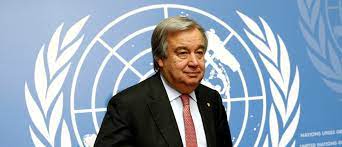
By Vibhu Mishra, 24 February 2025, https://news.un.org/en/story/2025/02/1160441
UN Secretary-General António Guterres on Monday warned that the risk of nuclear conflict is rising – as global security arrangements unravel and military spending soars – urging governments to push for total disarmament.
“The nuclear option is not an option at all,” he said, addressing the UN Conference on Disarmament in Geneva.
“It is a one-way road to annihilation. We need to avoid this dead-end at all costs.”
Arms race spreading to space
Mr. Guterres warned delegates of heightened global security concerns, noting that trust between nations is crumbling, international law is being undermined and multilateral treaties are under strain.
The so called “Doomsday Clock” – a metaphorical indicator of how close humanity is to destroying the world – moved one second closer to midnight last month, underscoring the growing peril.
“Others are expanding their inventories of nuclear weapons and materials. Some continue to rattle the nuclear sabre as a means of coercion. We see signs of new arms races including in outer space,” Mr. Guterres said.
“And the weaponization of Artificial Intelligence is moving forward at an alarming pace.”
Sign of hope
Despite the grim picture, the Secretary-General highlighted the Pact for the Future adopted by world leaders at the General Assembly last September, as a sign of hope.
It marked the first new international nuclear disarmament agreement in over a decade.
“Through the Pact, Member States also committed to revitalizing the role of the United Nations in disarmament,” he continued, calling also for holding accountable anyone who uses chemical or biological weapons.
Alongside, he urged delegates to prevent an arms race in outer space through new negotiations, calling for the UN’s role in disarmament and global security to be strengthened.
“Humanity is counting on us to get this right. Let us keep working to deliver the safe, secure and peaceful world that every person needs and deserves,” Mr. Guterres said.
The Conference on Disarmament
The Conference on Disarmament (CD) is the world’s sole multilateral forum for negotiating arms control and disarmament agreements.
Comprising 65 member states, including nuclear and militarily significant nations, the Conference has played a key role in shaping treaties such as the Nuclear Non-Proliferation Treaty (NPT) and the Comprehensive Nuclear-Test-Ban Treaty (CTBT).
Its agenda includes nuclear disarmament, preventing an arms race in outer space, and addressing new weapons of mass destruction. Non-member States also attend its sessions, with 50 joining discussions in 2019, the highest in two decades.
Ontario’s outdated nuclear vision poses serious safety and financial risks

Intervenors also raised safety concerns about OPG’s plans for the BWRX-300 high-level spent fuel waste. Edwards said an above-ground spent fuel pool, unprotected by a containment structure, is vulnerable
there’s nothing there. There’s really nothing. There are no safety systems to speak of.”
rabble,ca, by Ole Hendrickson, February 26, 2025
As Ontario seeks to build a small modular nuclear reactor, the standards and safety of Canada’s nuclear industry leave something to be desired.
In October 2022, the federal infrastructure bank committed $970 million towards Canada’s first small modular nuclear reactor. Ontario Power Generation (OPG) has applied to construct a 20-story tall, half underground, BWRX-300 boiling water reactor at the Darlington nuclear site near Toronto.
Independent nuclear experts say the reactor poses significant risks. They brought them to the attention of the Canadian Nuclear Safety Commission (CNSC) during a five-day public hearing in January 2025.
On January 8, the first day of the hearing, Ontario Premier Doug Ford issued a press release about Fortress Am-Can, his plan for “economic prosperity in Canada and the United States.” Ford said “With our fleet of nuclear power plants and the first small modular nuclear reactors in the G7, Ontario is uniquely positioned to power the future of Fortress Am-Can.”
Independent experts say that nuclear plants are far costlier than a combination of renewables with energy storage systems and conservation measures. They create intractable waste problems. They are slow to deploy, delaying climate action.
Furthermore, the design of Ontario’s “first small modular nuclear reactor” raises major safety concerns.
The BWRX-300 is a slimmed-down, 300-megawatt version of an earlier 1600-megawatt boiling water reactor design from the American company GE-Hitachi. The U.S. Nuclear Regulatory Commission (NRC) licensed the design, but investors never materialized. General Electric (GE) also designed the boiling water reactors that melted down at the Fukushima Daiichi plant in Japan.
At the CNSC hearing, Dr. Gordon Edwards, a leading independent nuclear expert with the Canadian Coalition for Nuclear Responsibility, disputed claims that the BWRX-300 design is “inherently safe.” He noted that the U.S. NRC has not approved the design. A single system, the Isolation Condenser System, would replace multiple safety systems of its larger predecessor. Edwards suggested that “the eagerness of OPG and CNSC staff to proceed with construction before the design is finalized is based on political, technological, and marketing considerations.”
Sarah Eaton, CSNC’s Director General for Advanced Reactor Technologies, responded for CNSC staff. She said staff use a “trust but verify approach.” CNSC Executive Vice President Ramzi Jammal confirmed that Canada differs from the U.S., where the NRC must certify a design before a license is issued.
Another CNSC staffer, Melanie Rickard, said “We’re talking about hundreds of hours, maybe thousands of hours, to be honest, so that we’re certain that this is going to be acceptable. And we are not certain. There is more work to be done.”
Intervenors also raised safety concerns about OPG’s plans for the BWRX-300 high-level spent fuel waste. Edwards said an above-ground spent fuel pool, unprotected by a containment structure, is vulnerable in a conflict. He added, “look at what’s happening in the Ukraine with the Zaporizhzhia plant with the conflict going on there.”
Dr. Sunil Nijhawan, who followed him, warned that an aircraft impact on a pool with a thousand spent fuel assemblies “can create a radiation disaster affecting Lake Ontario and about five million residences and businesses of southern Ontario.”
Nijhawan said “I’ve been in the industry for a long time. The first time I looked at a boiling water reactor design manual was 50 years ago, 1974, and I’ve kept in touch with development of all sorts of reactor designs… Right now what I see
Intervenors also raised safety concerns about OPG’s plans for the BWRX-300 high-level spent fuel waste. Edwards said an above-ground spent fuel pool, unprotected by a containment structure, is vulnerable in a conflict. He added, “look at what’s happening in the Ukraine with the Zaporizhzhia plant with the conflict going on there.”
Dr. Sunil Nijhawan, who followed him, warned that an aircraft impact on a pool with a thousand spent fuel assemblies “can create a radiation disaster affecting Lake Ontario and about five million residences and businesses of southern Ontario.”
Nijhawan said “I’ve been in the industry for a long time. The first time I looked at a boiling water reactor design manual was 50 years ago, 1974, and I’ve kept in touch with development of all sorts of reactor designs… Right now what I see in this design, to me there’s nothing there. There’s really nothing. There are no safety systems to speak of.”
Nijhawan warned about a loss of “safety culture” throughout Canada’s nuclear industry…………………………….. https://rabble.ca/columnists/ontarios-outdated-nuclear-vision-poses-serious-safety-and-financial-risks/
As tensions rise, Canada to lean on U.S. for uranium enrichment

Matthew McClearn, February 24, 2025, Globe and Mail
Even as U.S. President Donald Trump talks of waging a campaign of “economic force” to persuade Canada to join a political union with the United States, Ontario Power Generation is preparing to construct an American reactor at its Darlington Nuclear Generating Station. The reactor’s uranium fuel would be enriched at a facility in New Mexico, a new vulnerability U.S. administrations could exploit.
Canada’s 17 operating reactors are of thehomegrown Candu design, which consume natural uranium. Canada possesses uranium in abundance and has long made its own fuel. But nearly all the reactors promoted for construction now require enriched uranium, which Canada can’t produce.
Proposals by Canadian utilities to build new reactors attracted American vendors, including GE-Hitachi Nuclear Energy (which is designing the BWRX-300, planned for deployment at Darlington and in Saskatchewan), Westinghouse Electric Co. and ARC Clean Technology. Until the past few months, the risks of the U.S. government weaponizing nuclear fuel against allies for political purposes seemed distant. Now it’s just one more aspect of Canada-U.S. relations that Mr. Trump has disrupted.
“Developing a dependence on another country for our nuclear fuel has always been a concern and recent events have proven those concerns are justified,” Bob Walker, national director of the Canadian Nuclear Workers’Council, an umbrella organization of unions within Canada’s nuclear industry, said in a written response to questions.
We haven’t done our due diligence in terms of having other partners,” said Akira Tokuhiro, a professor in Ontario Tech University’s nuclear engineering department.
“Canada needs to really invest and make a concerted effort to find and establish the nuclear supply chain without the United States.”………………………………………………………………………………………
Nuclear fuel supply agreements are typically confidential, so it’s unclear what provisions GE-Hitachi and OPG have made to deal with supply disruptions. (Orano’s presence, though, seems to offer OPG a non-American enrichment supplier.) Neither company granted an interview for this article.
“The arrangements are probably as robust as they could be under normal circumstances, but the circumstances are no longer normal,” Mr. Walker said.
“This is a very fluid situation,” OPG spokesperson Neal Kelly wrote in a statement. “We are proactively evaluating potential impacts and will act as the situation arises.”
Tariffs could make nuclear fuel far more costly. One mitigating factor, however, is that fuel represents a relatively small portion of nuclear plant operating costs – typically under 20 per cent. That’s a striking contrast with power plants that burn oil or natural gas.
George Christidis, acting chief executive of the Canadian Nuclear Association, said that if Washington imposed a 25-per-cent tariff on Canadian uranium, that would harm the U.S. enough to force re-evaluation.
“There’s such an interconnection within our industry, on the uranium side right into the American economy and energy system, that in the end, it really would be something that may cause them a lot of distress.”
The U.S. government could also deny Canada access to enriched fuel, for example as part of a broader campaign to undermine Canadian sovereignty, or to reserve it exclusively for American utilities.
“A presidential executive order could force the U.S. Nuclear Regulatory Commission to disallow shipments to Canada,” Mr. Walker wrote.
“We don’t know how likely it is but there is a risk it could happen.”
Halting nuclear fuel shipments likely wouldn’t have the immediate impact of, say, ceasing deliveries to Canada on natural gas pipelines. Unlike gas-fired power plants, which require a steady stream of fuel, reactors are only refuelled periodically, affording time to adjust. And the high energy density of nuclear fuel facilitates stockpiling.
Mr. Christidis discounted the idea that the U.S. would disrupt Canada’s ability to acquire low-enriched uranium.
“I think quite strongly that there will be a path forward between the two countries to work together.”
Ms. Hanebach said Canada’s uranium supply would provide leverage in negotiating relationships with new enrichment partners. But the list is short.
“If the U.S. decided to pull enrichment capacity, it would be Russia, then it’s China,” she said. “And then there’s some in France, Netherlands, U.K. and Germany. That’s it.”
Experts told The Globe and Mail that there’s no aspect of the Candu’s fuel cycle that relies on American inputs, making it more resilient to disruption.
AtkinsRéalis Group Inc., which has exclusive licensing rights to Candu technology, regards that as a trump card against U.S. competitors – as it made clear in a survey it published in January. “Candu uses unenriched uranium,” noted the preamble to one question, while another said: “Westinghouse uses enriched uranium imported from countries like Russia.” Informed by such statements, 84 per cent of respondents said they preferred Candus over Westinghouse reactors.
“Candu emerges as the clear favourite,” AtkinsRéalis enthused.
But there’s a problem: The Candu is widely regarded as obsolete. The last one built in Canada was Darlington Unit 4, completed in 1993. Since then a number of new designs have been drawn up, but none were licensed or built. AtkinsRéalis now has a team of 250 employees designing a modernized version dubbed the Monark.
If Canada follows through on plans to build a fleet of light water reactors in Ontario, Saskatchewan and possibly elsewhere, it could elect to build its own enrichment capacity. Energy analyst Juzel Lloyd suggested doing precisely this, in a recent commentary for the Macdonald-Laurier Institute.
“Recent global events demand that the Canadian government re-evaluate its position on uranium enrichment,” she wrote.
“By initiating enrichment services, Canada can diversify the global nuclear supply chain, reduce reliance on Russian fuel and ensure the energy security of both established and emerging nuclear-powered states.”
The conventional wisdom, though, is that enrichment is so technically challenging and costly that only nuclear weapons states can justify it. (Japan is the noteworthy exception.) Prof. Tokuhiro said acquiring enrichment capacity would cost at least $100-billion and take at least 20 years.
“It’s more money than the Canadian government is willing to commit,” he said.
Ms. Hanebach observed that many legislative and regulatory changes would be required. Canada is a party to the Treaty on the Non-Proliferation of Nuclear Weapons, for example. “We would need to work with the International Atomic Energy Agency on that, and then implement that in domestic legislation,” she said. Canada doesn’t have a regulatory framework for enrichment, either.
Internationally, enrichment capability is tightly controlled by the Nuclear Suppliers Group to prevent weapons proliferation. Canada’s a member but is not permitted to enrich uranium.
Steve Aplin, of the Canadian Nuclear Workers’ Council, said Canada had sought U.S. support in 2006 before the Group to construct an enrichment facility here in Canada, but the U.S. refused outright.
“It was all very preliminary,” Mr. Aplin wrote. “The Americans refused because they want to control how many ‘enrichers’ there are in the world.”
Furthermore, he said that had the U.S. acquiesced, Russia, which is also a member, would not.
“Russia, like America, likes the fact they possess enrichment capacity and others don’t.” subscription:https://www.theglobeandmail.com/business/article-with-us-tensions-rising-canada-lacks-its-own-uranium-enrichment/
Starmer drags Britain deeper into war drive

February 25, 2025, Sophie Bolt, CND General Secretary,
https://cnduk.org/starmer-drags-britain-deeper-into-war-drive/?link_id=2&can_id=0a448bf4278898648e02a8f6dea4650f&source=email-starmer-drags-britain-deeper-into-war-drive&email_referrer=email_2633766&email_subject=starmer-drags-britain-deeper-into-war-drive
Starmer’s announcement to increase military spending to 2.5% by 2027 – an additional £13.4 billion annually – at the expense of overseas aid, reflects a Trump-style of international priorities: driving war and militarism whilst abandoning international obligations to halt global hunger and climate devastation. It represents a much more dangerous and damaging role for Britain in the world.
The spending announcement has clearly been rapidly organised ahead of Starmer’s meeting with Trump on Thursday. Nailing his colours very firmly to the Trump mast, Starmer reasserted Britain’s special relationship with the US, and pledged to increase military spending to 3% of GDP after the next election.
These increases are to fund a reckless war drive that risks plunging Europe into decades-long confrontation with Russia, whilst ratcheting up nuclear tensions globally.
Presenting Britain as the European leadership in NATO, Starmer reiterated his so-called peace-keeping operation in a post-settlement Ukraine. In it, 30,000 European troops would be deployed to Ukraine, underwritten by US military might should the ceasefire collapse. The plan has failed to win unity across Europe.
Meanwhile Friedrich Merz, the newly elected Germany Chancellor, has called for France and Britain to share their nuclear weapons to ‘defend’ Europe against Russia. This has also renewed the debate about the use of tactical or ‘battlefield’ nuclear weapons – and whether Britain should develop them on behalf of Europe.
These reckless and terrifying debates around greater nuclear armament for Europe fail to note that Trump has made no statement that US nuclear weapons will be withdrawn from Europe. Or that new ‘battlefield’ nuclear bombs won’t be deployed in Britain. They also fail to acknowledge that, as Britain is totally dependent on the US for its nuclear weapons system, Starmer would have to get permission from Trump if he were to offer them to Europe.
But, of course, whether US, French or British, nuclear weapons deployed in Europe are a disaster. Far from offering protection, the weapons are a constant threat – from the risk of nuclear accidents to nuclear confrontation.
This obscene spending spree on weapons of war won’t bring peace to Ukraine. On the contrary, the £205bn that Europe has pledged to Ukraine since 2022 has contributed to prolonging this terrible conflict, sustaining the huge death toll and pushing the region to the brink of nuclear war. And the impact of the conflict has driven the worsening economic crisis in Britain, across Europe and globally. And if Trump gets his way, the majority of Ukraine’s vast mineral wealth will be siphoned off to the US.
Whilst it is presented as defending Ukraine, this NATO war drive is global. We know that Trump’s ‘America First’ policies are still about maintaining US dominance over the rest of the world. From calls to seize Greenland, Canada and Panama, to ethnically cleanse Palestinians from Gaza, Trump has no respect for sovereignty, human rights and international law. His plans to expand the US Missile Defence System, or ‘the Iron Dome for America’, would enable the Trump administration to use its nuclear weapons without fear of a retaliatory strike. British bases already play a central role in this ‘Iron Dome for America’, making us a target in any global confrontation, yet offering no protection.
This is a very chilling prospect.
Instead of vying for Trump’s approval over which NATO state can increase its military spending highest, Britain and Europe should instead be using this opportunity to reshape the region’s security approach, towards one that is genuinely sustainable and secure. This means Britain ending its military and nuclear alliance with the US. A first step in this would be to scrap the replacement of Britain’s nuclear weapons system. With the government’s own watchdog concluding that the replacement is ‘unachievable’, Rachel Reeves should cut her losses and direct the hundreds of billions into rebuilding crumbling public services and investing in sustainable energy sources.
UK construction and engineering firm Costain has secured a multi-millionpound contract to support the construction of the Sizewell C nuclear powerplant
Costain said under the ten-year framework agreement, the company
will provide support in areas such as delivery integration, health and
safety and quality control. French state-owned energy firm EDF is
developing the 3.2 GW nuclear power station, which could provide up to 7%
of UK energy needs over its 60-year lifetime.
The UK government holds a
76.1% stake in Sizewell C, with EDF holding the remaining 23.9%. Costain
defence and nuclear energy sector director Bob Anstey said the Sizewell C
project is a “vital part of creating a sustainable future”. The
Sizewell C project has attracted significant criticism amid concerns over
its ballooning costs. Earlier this year, campaign group Together Against
Sizewell C (TASC) wrote to the National Audit Office calling for a review
of the government’s value assessment for the controversial nuclear power
station.
The UK Labour government has committed to delivering Sizewell C,
as well as the delayed Hinkley Point C, alongside small modular reactors.
But with Sizewell C investors including Centrica prepared to “walk
away” from investing in the project, there are concerns costs could rise
to more than £40bn.
Energy Voice 25th Feb 2025, https://www.energyvoice.com/renewables-energy-transition/nuclear/567502/costain-secures-multi-million-pound-sizewell-c-contract/
US correct to vote against UN resolution solely condemning Russia for Ukraine war
Walt Zlotow, West Suburban Peace Coalition, Glen Ellyn IL, 26 Feb 25
Less than half of the UN’s 193 member states voted for the Ukrainian resolution in the General Assembly solely condemning Russia for invading Ukraine on the third anniversary of the war.
The vote on the non-binding resolution was 93 to 18 with 65 members abstaining.
In an astonishing reversal of previous US policy at the UN on Ukraine, the US joined Russia and 16 other states in opposing the resolution.
Why?
US Ambassador to the UN Dorothy Shea argued that the Ukrainian resolution ignored that the war actually started 11 years earlier with the Russian Ukraine war that ignited after the 2014 coup that toppled democratically elected Ukraine president Victor Yanukovych.
Shea didn’t mention that the US was heavily involved in supporting the coup in order to prevent Ukraine from partnering economically with Russia. Nor did she mention that after the coup the US heavily armed Ukraine to complete the destruction of the Ukrainian separatist movement seeking freedom from Kyiv’s policy of destroying Ukrainian Russian culture in the Donbas. Shea also omitted that 14 years of US efforts to bring Ukraine into NATO crossed a red line for Russia that would inevitably provoke a Russian invasion.
But all of these critical omissions were implicit in the Trump administration’s refusal to continue the Biden administration’s fantasy that President Putin woke up one day in February, 2022 and decided to attack Ukraine unproved.
This was a welcome dose of reality sorely missing from the Biden administration for all two years, eleven months of their proxy war to weaken Russia using Ukrainian proxies to do all the dying.
President Trump is telling the world that this war must end with a settlement based on reality. Ukraine will not join NATO. Ukraine will not get back the oblasts containing Russian cultured Ukrainians seeking relief from endless destruction by their own government. Ukraine will refrain from being a US/NATO Trojan Horse to keep Russia out of the Western Europe political economy. Most importantly, the US and Russia can normalize diplomatic relations and end three years of risking nuclear annihilation from America’s zero sum game approach to the war.
Based on the vote of Ukraine’s one sided resolution putting all the blame on Russia, a majority of UN members agree with the Trump path to peace.
Iran on ‘high alert’ amid fears of attack on nuclear sites
Officials say measures are in response to growing concerns of potential joint military action by Israel and US
Iran has put its defence systems around its nuclear sites on high alert amid fears of an attack by Israel and the US, The Telegraph has learnt…
According to two high-level government sources, the Islamic Republic has
also been bolstering defences around key nuclear and missile sites, which
include the deployment of additional air defence system launchers.
Officials say the measures are in response to growing concerns of potential
joint military action by Israel and the United States.
Telegraph 25th Feb 2025, https://www.telegraph.co.uk/world-news/2025/02/25/iran-missile-defences-high-alert-attack-fears-us-israel/
The physical hazards of nuclear energy
Mark Diesendorf: The debate about the economics of nuclear energy versus
renewable energy has distracted politicians, the media and members of the
public from the physical hazards of nuclear energy. The three principal
hazards are its contribution to the proliferation of nuclear weapons, the
risk of nuclear accidents, and the impossible task of managing nuclear
wastes for 100,000 years. This article offers a concise review, drawing
attention to some issues that are not widely known, including a fourth
hazard, radiation exposure of the unborn child. I write wearing the hat of
a physicist.
John Menadue’s Public Policy Journal 24th Feb 2025 https://johnmenadue.com/the-physical-hazards-of-nuclear-energy/
1 This Month

of the week – Shut Down Drone Warfare!


Tell the Ukrainian Government to Drop Prosecution of Peace Activist Yurii Sheliazhenko

Petition to revoke the licensing of the Near Surface Nuclear Disposal Facility (NSDF) at Chalk River. https://www.ourcommons.ca/petitions/en/Petition/Details?Petition=e-7247
To see nuclear-related stories in greater depth and intensity – go to https://nuclearinformation.wordpress.com
-
Archives
- April 2026 (34)
- March 2026 (251)
- February 2026 (268)
- January 2026 (308)
- December 2025 (358)
- November 2025 (359)
- October 2025 (376)
- September 2025 (257)
- August 2025 (319)
- July 2025 (230)
- June 2025 (348)
- May 2025 (261)
-
Categories
- 1
- 1 NUCLEAR ISSUES
- business and costs
- climate change
- culture and arts
- ENERGY
- environment
- health
- history
- indigenous issues
- Legal
- marketing of nuclear
- media
- opposition to nuclear
- PERSONAL STORIES
- politics
- politics international
- Religion and ethics
- safety
- secrets,lies and civil liberties
- spinbuster
- technology
- Uranium
- wastes
- weapons and war
- Women
- 2 WORLD
- ACTION
- AFRICA
- Atrocities
- AUSTRALIA
- Christina's notes
- Christina's themes
- culture and arts
- Events
- Fuk 2022
- Fuk 2023
- Fukushima 2017
- Fukushima 2018
- fukushima 2019
- Fukushima 2020
- Fukushima 2021
- general
- global warming
- Humour (God we need it)
- Nuclear
- RARE EARTHS
- Reference
- resources – print
- Resources -audiovicual
- Weekly Newsletter
- World
- World Nuclear
- YouTube
-
RSS
Entries RSS
Comments RSS
 nuclear-news