Global security arrangements “unravelling”, UN chief warns nuclear disarmament conference.
OLIVIA LE POIDEVIN David Adams, , https://sightmagazine.com.au/news/global-security-arrangements-unravelling-un-chief-warns-nuclear-disarmament-conference/
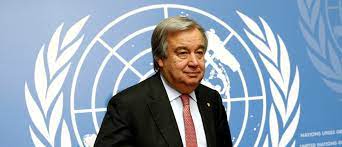
Security arrangements that have supported global peace for decades are unravelling, the head of the United Nations warned on Monday as he urged countries to work together towards a nuclear free world.
“The bilateral and regional security arrangements that underwrote global peace and stability for decades are unravelling before our eyes,” UN Secretary General Antonio Guterres told the Conference on Disarmament that gathered in Geneva.
“Trust is sinking, while uncertainty, insecurity, impunity and military spending are all rising,” Guterres added.
Such factors were weakening the spirit of “mutual restraint”, he said, as he called on countries to implement nuclear disarmament and non-proliferation commitments agreed at a summit in New York last September.
Sixty-five states, including the United States, China and Russia, are members of the Conference which was established in 1979 and is overseen by the United Nations Office for Disarmament Affairs.
It focuses on negotiating deals to end the nuclear arms race and stop countries building up weapons in space, on top of pursuing general disarmament.
Artificial Intelligence was becoming weaponised at an alarming pace and there were signs of new arms races, including in outer space, Guterres warned.
He condemned countries that “outrageously rattle the nuclear sabre as a means of coercion”.
In September last year Russian President Vladimir Putin told the United States and its allies that Moscow could respond with nuclear weapons if they allowed Ukraine to strike deep inside Russia with long-range Western missiles.
Earlier this month Moscow said the outlook for extending the New Strategic Arms Reduction agreement with the US did not look promising.
The agreement, which caps the number of strategic nuclear warheads that the two biggest nuclear superpowers can deploy, is due to expire on February 5, 2026.
Sellafield nuclear site plans cuts as chief says £2.8bn funding ‘not enough’

Union concerned over safety as site’s bosses say budget does not cover work planned.
Alex Lawson and Anna Isaac, Guardian, 25 Feb 25
Sellafield has said nearly £3bn in new funding is “not enough” and bosses are now examining swingeing cuts, prompting fears over jobs and safety at the vast nuclear waste dump.
The Cumbrian nuclear site, which is home to the world’s largest store of plutonium, was last week awarded £2.8bn for the next financial year, the bulk of the total of just over £4bn funds allotted to the Nuclear Decommissioning Authority, a taxpayer-owned and funded quango.
Sellafield’s chief executive, Euan Hutton, has told staff that the funding was “not enough” to carry out planned works, leaving bosses to make “difficult decisions” over spending, sources told the Guardian.
A spokesperson for Sellafield said: “While this is significant funding, it will not be enough for all our planned activities. Critical work will continue but some projects will need to be slowed down, paused, or stopped. This will impact parts of our supply chain.”
Hutton told employees at the site – which employs more than 10,000 people – that all areas of the business will be affected and spending reviewed.
It is understood that internal calculations had forecast that at least £3.1bn would be needed to meet Sellafield’s spending requirements next year, when accounting for rising costs. The site was awarded £2.8bn for the current financial year.
The public spending watchdog has said the ultimate cost of cleaning up Sellafield is expected to rise to £136bn, causing tensions with the Treasury as the chancellor, Rachel Reeves, attempts to tighten public spending and spur growth.
In 2023, the Guardian’s Nuclear Leaks investigation revealed a string of safety concerns at the site – from issues with alarm systems to problems staffing safety roles at its toxic ponds – as well as cybersecurity failings, radioactive contamination and allegations of a toxic workplace culture.
Hutton has not told staff which projects could be paused or stopped at the site, which covers two square miles and hundreds of buildings. Staff carry out a range of work from painstakingly emptying the toxic ponds to building new facilities to house nuclear waste.
Hutton said that safety and security would be prioritised and the site would adhere to legal and regulatory rules, sources said.
However, staff at the hazardous toxic site in north-west England remain concerned that cuts to spending could affect safety and jobs.
Dan Gow, a senior organiser at the GMB union, said: “GMB calls on Sellafield to be fully transparent about any cost-saving measures and to engage with us to ensure the workforce is protected.
“No worker should ever have to fear that budget cuts will put their safety at risk.
“GMB is urging all workers to stand together, stay informed, and ensure their voices are heard. Now more than ever, being part of a strong, organised union is the best way to protect jobs, rights and safety.”
The Office for Nuclear Regulation last week took Sellafield out of special measures for its physical security – but said concerns remained over its cybersecurity……………………………https://www.theguardian.com/environment/2025/feb/24/sellafield-nuclear-site-cuts-funding-union-spending
United States: White House Threatens Nuclear Regulatory Commission’s Independence
Energy Intelligence Group, Jessica Sondgeroth, Washington, 21 Feb 25,
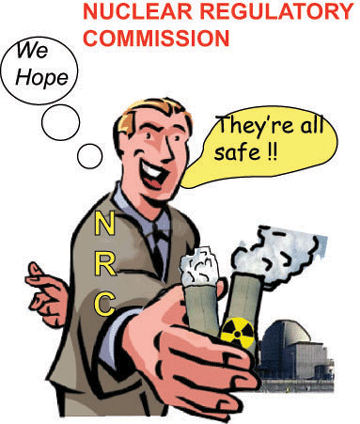
The Trump administration’s expansive assertion of presidential power now threatens the independence of the US Nuclear Regulatory Commission (NRC) after the White House this week issued an executive order (EO) claiming control over federal agencies that were established to be independent of politics. The Feb. 18 EO tasks the White House’s Office of Management and Budget (OMB) with the authority to manage independent agencies’ obligations and spending to ensure they align with “the President’s policies and priorities.” These agencies will also have to submit for review to an OMB office “all proposed and final significant regulatory actions.” The extent to which this erodes the NRC’s independence may vary depending on how NRC responds and on OMB actions taken, but nuclear energy sector veterans, critics and advocates are nonetheless waving red flags.
The White House decision “to meddle in safety regulation” is “devastating,” former NRC chair Allison Macfarlane, now a policy professor at the University of British Columbia, told Energy Intelligence. “The US NRC used to be referred to as the ‘gold standard’ for nuclear regulators. No longer. Now other countries can take that mantle.” Macfarlane said that as NRC chair, she spent years championing regulatory independence “to ensure national security and economic security. A nuclear accident, as happened in Japan, can devastate a country’s economy, not to mention its nuclear industry. I guess the folks at the White House have never learned this lesson?”
The EO, titled “Ensuring Accountability for All Agencies”, is only the latest White House challenge to the independence of various executive agencies and to Congressional lawmaking, from science and health research to environmental oversight to public education. This particular EO seeks to broaden the White House’s authority over independent regulatory agencies, including the Federal Trade Commission, Federal Energy Regulatory Commission, Federal Communications Commission and Securities and Exchange Commission. The EO does make some exceptions, but the NRC is not among them.
……………………………………………Given “the blatant and unmitigated conflicts of interest in the White House, and the newfound love among Trump and Elon [Musk]’s tech bro friends for nuclear power,” Ed Lyman, a nuclear regulatory watchdog at the Union of Concerned Scientists, warned in an email that the agency “could be turned into a mere rubber stamp for whatever projects are favored by the President at the moment.” This could override the NRC’s “public health and safety mandate in the name of ‘consistency with the President’s policies and priorities.'”
The NRC was established as an independent agency by Congress in the Energy Reorganization Act of 1974. That law took the NRC’s predecessor, the Atomic Energy Commission, and split its regulatory and promotional roles into the NRC and what is today the US Department of Energy (DOE), respectively. “The NRC was explicitly created to be independent of energy system policy goals under the Atomic Energy Commission that Congress perceived as too political and influenced by the industry,” Adam Stein, nuclear energy innovation director, noted. “Shifting from an independent agency to an agency under direct control of one party under the President creates the same problem from a different influence.”
……………………The nuclear industry lobbies Congress for favorable policies but also communicates directly with the NRC through filings and public meetings to advocate for its interpretation of Congressionally-mandated regulatory reforms.
…………………….For agencies as specialized as the NRC, mass layoffs or buyouts threaten to undermine core competencies and training activities — particularly given the recent hiring of 600 staff, a growing workload of new reactor licensing activities and concerns over the aging workforce.
https://www.energyintel.com/00000195-25b1-ddbd-a9dd-3ff520010000
1 This Month

of the week – Shut Down Drone Warfare!


Tell the Ukrainian Government to Drop Prosecution of Peace Activist Yurii Sheliazhenko

Petition to revoke the licensing of the Near Surface Nuclear Disposal Facility (NSDF) at Chalk River. https://www.ourcommons.ca/petitions/en/Petition/Details?Petition=e-7247
To see nuclear-related stories in greater depth and intensity – go to https://nuclearinformation.wordpress.com
-
Archives
- April 2026 (91)
- March 2026 (251)
- February 2026 (268)
- January 2026 (308)
- December 2025 (358)
- November 2025 (359)
- October 2025 (376)
- September 2025 (257)
- August 2025 (319)
- July 2025 (230)
- June 2025 (348)
- May 2025 (261)
-
Categories
- 1
- 1 NUCLEAR ISSUES
- business and costs
- climate change
- culture and arts
- ENERGY
- environment
- health
- history
- indigenous issues
- Legal
- marketing of nuclear
- media
- opposition to nuclear
- PERSONAL STORIES
- politics
- politics international
- Religion and ethics
- safety
- secrets,lies and civil liberties
- spinbuster
- technology
- Uranium
- wastes
- weapons and war
- Women
- 2 WORLD
- ACTION
- AFRICA
- Atrocities
- AUSTRALIA
- Christina's notes
- Christina's themes
- culture and arts
- Events
- Fuk 2022
- Fuk 2023
- Fukushima 2017
- Fukushima 2018
- fukushima 2019
- Fukushima 2020
- Fukushima 2021
- general
- global warming
- Humour (God we need it)
- Nuclear
- RARE EARTHS
- Reference
- resources – print
- Resources -audiovicual
- Weekly Newsletter
- World
- World Nuclear
- YouTube
-
RSS
Entries RSS
Comments RSS
 nuclear-news