Debris extracted from Fukushima nuclear plant revealed to media
Friday, Feb. 21, https://www3.nhk.or.jp/nhkworld/en/news/20250221_08/?fbclid=IwY2xjawInSAlleHRuA2FlbQIxMQABHSRSw2PSosgQ6p28ndBqzler46N1Sr9mAHZH_X5SQL5hfjsJ5Tr3M48JTg_aem_xXho8cY6EkFQUvxp6aOcZQNuclear fuel debris that was extracted from the damaged Fukushima Daiichi nuclear power plant last year has been revealed to reporters for the first time.
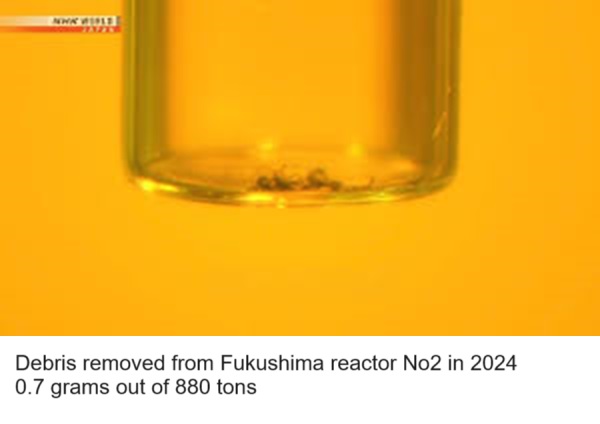
The debris taken from the plant’s No.2 reactor consists of molten fuel mixed with surrounding structural components. The operator, Tokyo Electric Power Company, successfully retrieved 0.7 grams of the material in its first test extraction operation through November last year.
The debris was first transferred to a research facility of the Japan Atomic Energy Agency in Oarai Town, Ibaraki Prefecture, for the initial analysis, including surface observation.
The researchers then split the debris into smaller pieces to be examined at five research facilities, including a large one in Hyogo Prefecture.
Reporters were given the opportunity to observe the samples, which were placed in two separate transparent containers at a facility in Ibaraki Prefecture. One container held a particle about 2 millimeters in size that appeared silver, while the other had multiple dark fragments.
So far, the researchers have detected uranium, which is contained in nuclear fuel, on the surface of the debris, as well as metals such as iron, which are believed to have come from the reactor’s structure.
The researchers plan to examine the characteristics of the debris, including its hardness and adhesiveness. They will also expose the samples to lasers to determine whether the uranium inside is prone to triggering a nuclear fission reaction.
The agency says it will use these analyses to evaluate potential methods for full-scale extraction of the debris, and to determine the risk of a renewed criticality event, in which a self-sustaining chain reaction could occur.
The agency plans to release the findings of the major analyses in the middle of this year.
Ogino Hideki, the chief engineer at the agency’s Collaborative Laboratories for Advanced Decommissioning Science, spoke to the reporters.
He said it is difficult to fully grasp the overall characteristics of the debris based on the ongoing analyses alone. But he expressed his commitment to contributing to the decommissioning efforts through analyzing the samples using the technology that he and his fellow researchers have developed.
It is estimated that there is a total of around 880 tons of fuel debris in the No. 1, 2 and 3 reactors.
No comments yet.
1 This Month


Tell the Ukrainian Government to Drop Prosecution of Peace Activist Yurii Sheliazhenko

Petition to revoke the licensing of the Near Surface Nuclear Disposal Facility (NSDF) at Chalk River. https://www.ourcommons.ca/petitions/en/Petition/Details?Petition=e-7247


of the week – STOP SMALL MODULAR REACTORS IN CANADA
To see nuclear-related stories in greater depth and intensity – go to https://nuclearinformation.wordpress.com
-
Archives
- March 2026 (204)
- February 2026 (268)
- January 2026 (308)
- December 2025 (358)
- November 2025 (359)
- October 2025 (376)
- September 2025 (258)
- August 2025 (319)
- July 2025 (230)
- June 2025 (348)
- May 2025 (261)
- April 2025 (305)
-
Categories
- 1
- 1 NUCLEAR ISSUES
- business and costs
- climate change
- culture and arts
- ENERGY
- environment
- health
- history
- indigenous issues
- Legal
- marketing of nuclear
- media
- opposition to nuclear
- PERSONAL STORIES
- politics
- politics international
- Religion and ethics
- safety
- secrets,lies and civil liberties
- spinbuster
- technology
- Uranium
- wastes
- weapons and war
- Women
- 2 WORLD
- ACTION
- AFRICA
- Atrocities
- AUSTRALIA
- Christina's notes
- Christina's themes
- culture and arts
- Events
- Fuk 2022
- Fuk 2023
- Fukushima 2017
- Fukushima 2018
- fukushima 2019
- Fukushima 2020
- Fukushima 2021
- general
- global warming
- Humour (God we need it)
- Nuclear
- RARE EARTHS
- Reference
- resources – print
- Resources -audiovicual
- Weekly Newsletter
- World
- World Nuclear
- YouTube
-
RSS
Entries RSS
Comments RSS
 nuclear-news
Leave a comment