Netanyahu’s Quest to Attack Iran’s nuclear facilities with the ‘Mother of all Bombs’
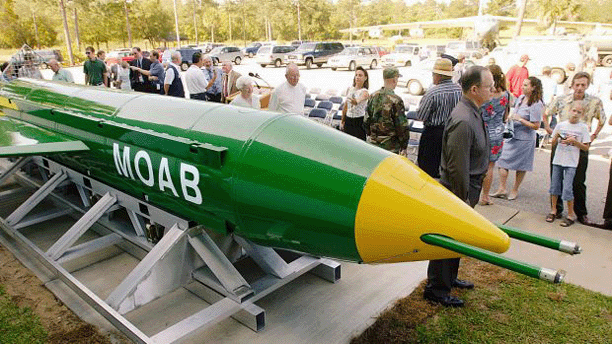
“Mother of all Bombs” into nuclear facilities?
Until recently, Israel lacked “bunker buster” bombs and the capacity to mount
a sustained air attack that would destroy Iran’s entire nuclear program. But
perhaps not anymore.
In January, US military intelligence already assessed that, absent an
agreement, Israel would probably strike Iran’s nuclear facilities, most likely the
Fordow enrichment plant, an Iranian underground uranium enrichment facility
20 miles (32 km) from the city of Qom, in the first half of 2025.
By Dan Steinbock, https://www.juancole.com/2025/02/netanyahus-attack-mother.html
The emboldened Netanyahu cabinet is in a war path, again. It is mobilizing to attack Iran and lobbying President Trump into a plan that presumably would use the ‘Mother of All Bombs.
In a press conference with US Secretary of State Marco Rubio, Israeli Prime
Minister Benjamin Netanyahu vowed to “finish the job” against Iran with the
support of President Trump.
Ever since his rise to power in the late 1990s, Israeli Prime Minister Benjamin
Netanyahu has worked toward a war with Iran, presumably to demolish
Tehran’s nuclear facilities but also to ensure its power projection in the region.
Now the emboldened Netanyahu wants to finish the job, decimate Iran’s
nascent nuclear capabilities, undermine Tehran’s future and overthrow its
rulers. After the misguided wars in Iraq and Afghanistan, Washington’s
neoconservative empire-builders are also back, pushing still another forever
war for a “paradigm shift in the Middle East.”
The Israel-Iran scenarios
Israeli Prime Minister Benjamin Netanyahu has discussed with Trump several
possible levels of American backing. According to Israeli observers, there are
now four viable scenarios for an Israeli attack against Iran’s nuclear facilities,
as seen in the light of US-Israeli relations. Let’s name them.
In the cooperative scenario, the US and Israel cooperate in an attack against
Iran’s nuclear sites, which will be followed by Trump’s ultimatum that Iran must
entirely dismantle its military nuclear program.
In the clash scenario, the Trump administration would build on diplomacy to
seal a nuclear deal. Yet, Israel would attack on its own and thereby undermine
Trump’s efforts causing a bilateral drift between the two countries.
In the investment scenario, Saudi Arabia would offer the US hundreds of
billions of dollars in investment, to avoid a destabilization in the region that
could undermine Riyadh’s 2030 modernization program.
In the solo scenario, Israel attacks Israel’s nuclear facilities without direct US
cooperation, but with the tacit consent of the White House. This would happen
after the Trump administration’s threats and coercive diplomacy against Iran.
Ultimately, US priorities will matter the most. But these can be elusive and
contradictory. Some in the Congress have called for more US military action,
including direct attacks against Iran. Others have echoed the Biden
Administration’s calls for restraint and de-escalation.
Here’s the problem: any escalation with Iran, whether by the US, Israel or
both would likely regionalize the Gaza devastation, which is mis-aligned with
Trumps’ economic and geopolitical goals in the Middle East.
Targeting Iran
Ever since the Islamic Revolution in 1979, when President Carter froze
billions of dollars in Iranian assets, Washington has sought to restore the
status quo ante of the Shah that had made Iran safe to American capitalism.
In the 1980s, US intelligence and logistics played a vital role in arming
Baghdad in the Iran-Iraq War, perhaps the most lethal conventional war
between developing countries yet, with total casualty estimates up to 1 to 2
million. In 1988, the US launched an attack against Iran, presumably in
retaliation for Iran’s laying mines in areas in the Gulf. In the mid-90s, the
Clinton administration declared a total embargo on dealings with Iran.
In 2002, President Bush included Iran in his “Axis of evil” speech.
Subsequently, US and Israel cooperated in training secessionist forces in
Iran’s Kurdistan province. In 2007, US reportedly vetoed an Israeli plan to
bomb Iranian nuclear facilities. Instead, during the next three years, the US
and Israel deployed the Stuxnet virus, the world’s first offensive cyber
weapon, to destroy almost a fifth of Iran’s nuclear centrifuges.
In 2015, years of challenging talks resulted in a nuclear deal (Joint
Comprehensive Plan of Action, JCPOA) between Iran, the US and a set of
world powers. Despite Iran’s adherence to it, the Trump administration pulled
the US out of the deal in 2018. As tensions escalated, the Trump
administration assassinated Iran’s most important general, Qasem Soleimani,
in a deadly drone strike in January 2020.
The longstanding quest for Iran War
While the covert war in the shadows has prevailed since the Islamic
Revolution, US regime change efforts moved to a new stage during the Bush
administration. Since 2003, US Army has conducted an analysis called
TIRANNT (Theater Iran Near-Term) for a full-scale war with Iran. Reportedly,
this plan (CONPLAN 8022) would be activated in the eventuality of a Second
9/11, on the presumption that Iran would be behind such a pivotal operation.
That may be one reason why Israeli UN ambassador Gilad Erdan and PM
Netanyahu explicitly compared Hamas’s October 7 offensive to the 9/11 terror
attacks, which sparked the US. global war on terror. Concurrently, many in
Washington sought a pretext for a link with Iran, to legitimize a major regional
conflict. In contrast, the U.S. Directorate of National Intelligence assessed that
Iran had no foreknowledge of or involvement in the October 7 attacks.
For its part, Netanyahu’s government calculated that an Iran conflict could
divert mounting negative public attention from atrocities in Gaza and the West
Bank.
There were precedents. In 2011 Netanyahu had ordered the Mossad and IDF
to prepare for an attack on Iran within 15 days. Yet, Mossad’s chief Tamir
Pardo and chief of staff Benny Gantz, the opposition’s key member in
Netanyahu’s war cabinet, questioned the PM’s legal authority to give such an
order without the cabinet’s approval. Netanyahu had backed off.
A month after the Hamas offensive, Netanyahu’s Mossad chief David Barnea
stated Iran had stepped up terror worldwide.” If Israelis or Jews are harmed,
he added, Israel’s response would go to Tehran’s “highest echelon.”
Using October 7 against Iran
In April 2024, Israel bombed Iranian embassy in Damascus in which 16
people were killed, including the targets, half a dozen high-level officers of the
Islamic Revolutionary Guard Corps (IRGC).
The IRGC launched a broad retaliatory attack against Israel and the Israeli-
occupied Golan Heights with successive waves of drones, cruise missiles,
and ballistic missiles. Giving full public notice that its response was on the
way, Tehran designed it carefully as a show of force that would not trigger a
wave of escalation. It caused minimal damage in Israel. However, as Israel
would later acknowledge, despite containment efforts by the US, the UK,
France and Jordan, some of Iran’s ballistic missiles penetrated Israel’s
defenses, hitting the Nevatim Airbase in southern Israel.
Iran’s attack targeted Israeli territory as a warning shot. It demonstrated
Tehran’s ability to counteract Israel’s huge air superiority, though lacking a
modern air force of its own. It also highlighted Israel’s dependency on major
Western powers to protect itself and the inadequacy of that protection.
So, how would Israel respond to a conventional “existential crisis” with Iran?
In late 2023, the hypothesis was tested in a high-level US war game.
Intriguingly, initially the US participants presumed that self-restraint would
prevail in this high-level war game. Yet, the simulation’s cold logic compelled
them into a sequence of steps that quickly went nuclear.
“Mother of all Bombs” into nuclear facilities?
Until recently, Israel lacked “bunker buster” bombs and the capacity to mount
a sustained air attack that would destroy Iran’s entire nuclear program. But
perhaps not anymore.
Recently, German newspaper “Bild” revealed that the US envoy to the Middle
East, Steve Witkoff, announced Washington’s intention to deliver one of the
most powerful non-nuclear weapons systems to Israel, known as the “Mother
of All Bombs.” Reportedly, Pentagon denies the story.
Weighing almost 10,000 kg, the GBU-43/B Massive Ordnance Air Blast
(MOAB) bomb can destroy deep underground bunkers. The explosive yield is
comparable to that of small tactical nuclear weapons.
In January, US military intelligence already assessed that, absent an
agreement, Israel would probably strike Iran’s nuclear facilities, most likely the
Fordow enrichment plant, an Iranian underground uranium enrichment facility
20 miles (32 km) from the city of Qom, in the first half of 2025.
First tested in 2003, the “Mother of All Bombs,” a 30,000-pound (14,000-
kilogram) monster was used for the first time in combat in 2017 in Afghanistan
by the Trump administration, despite the dire collateral damage.
Whether such use of the MOAB would spark a regional war or trigger waves
of new terror and insurgencies in the Middle East is a matter of debate. But it
would mean a potentially catastrophic escalation in the region and reshape
geopolitical landscape in the early 21 st century.
The author of The Fall of Israel (2025), Dr Dan Steinbock is the founder of
Difference Group and has served at the India, China and America Institute
(US), Shanghai Institute for International Studies (China) and the EU Center
(Singapore). For more, see https://www.differencegroup.net/
No comments yet.
1 This Month

of the week – Shut Down Drone Warfare!


Tell the Ukrainian Government to Drop Prosecution of Peace Activist Yurii Sheliazhenko

Petition to revoke the licensing of the Near Surface Nuclear Disposal Facility (NSDF) at Chalk River. https://www.ourcommons.ca/petitions/en/Petition/Details?Petition=e-7247
To see nuclear-related stories in greater depth and intensity – go to https://nuclearinformation.wordpress.com
-
Archives
- April 2026 (44)
- March 2026 (251)
- February 2026 (268)
- January 2026 (308)
- December 2025 (358)
- November 2025 (359)
- October 2025 (376)
- September 2025 (257)
- August 2025 (319)
- July 2025 (230)
- June 2025 (348)
- May 2025 (261)
-
Categories
- 1
- 1 NUCLEAR ISSUES
- business and costs
- climate change
- culture and arts
- ENERGY
- environment
- health
- history
- indigenous issues
- Legal
- marketing of nuclear
- media
- opposition to nuclear
- PERSONAL STORIES
- politics
- politics international
- Religion and ethics
- safety
- secrets,lies and civil liberties
- spinbuster
- technology
- Uranium
- wastes
- weapons and war
- Women
- 2 WORLD
- ACTION
- AFRICA
- Atrocities
- AUSTRALIA
- Christina's notes
- Christina's themes
- culture and arts
- Events
- Fuk 2022
- Fuk 2023
- Fukushima 2017
- Fukushima 2018
- fukushima 2019
- Fukushima 2020
- Fukushima 2021
- general
- global warming
- Humour (God we need it)
- Nuclear
- RARE EARTHS
- Reference
- resources – print
- Resources -audiovicual
- Weekly Newsletter
- World
- World Nuclear
- YouTube
-
RSS
Entries RSS
Comments RSS
 nuclear-news
Leave a comment