Warning sent about need for strategic policing reform to address security of SMRs
New Civil Engineer, 2 Feb, 2025 By Tom Pashby
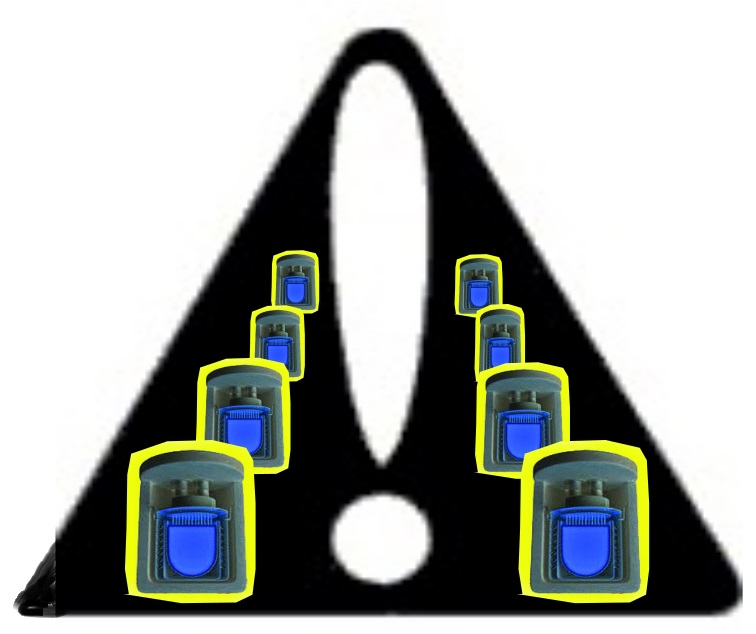
Security concerns have been raised following the publication of the draft National Policy Statement for nuclear energy which would change where small modular reactors (SMRs) could be situated.
National Policy Statement for nuclear energy generation (EN-7) was published in draft form on 6 February following an announcement by the prime minister about the slashing of legislation aroudn the development of nuclear energy generation projects………………………………….
Limited details about security in EN-7 raises policing questions
Despite EN-7 being 64 pages, just two lines are dedicated to specifically addressing the security of SMRs.
The proposed proliferation of SMRs in the UK presents a novel nuclear security risk because of there potentially being many more smaller nuclear-licensed sites which are closer to people and property than gigawatt-scale reactors which tend to be in remote coastal locations.
King’s College London Centre for Science & Security Studies research fellow Ross Peel previously told NCE that security planning for SMRs in the UK is “not where it should be”.
In a section titled “Security of Site”, EN-7 says “Ensuring that the proposed nuclear infrastructure will be secure is vital. The Security Considerations section of EN-1 addresses security considerations in detail.
“The applicant should engage with the Office for Nuclear Regulation (ONR) as part of early engagement on securing a Nuclear Site Licence to understand what steps will be required to comply with relevant site security requirements.”
Recent analysis by the Alan Turing Institute’s Centre for Emerging Technology and Security said that policing capability was not up to scratch to protect SMRs.
Policing SMRs would require a significant uplift in funding and workforce at the Civil Nuclear Constabulary (CNC) which is run by the Civil Nuclear Police Authority (CNPA). The CNPA is an executive non-departmental public body, sponsored by the Department for Energy Security and Net Zero (DESNZ).
Local police forces, overseen by the Home Office, could also be required to increase their capacity to respond to CBRN (chemical, biological, radiological and nuclear) incidents.
It is currently unclear how any resource uplift would be funded, and which bodies would provide that funding. As things stand, gigawatt-scale nuclear power sites’ security is funded by the developers themselves.
The business model for SMRs is not yet settled, with different developers proposing different management mechanisms.
Existing policing model does not accommodate complex demands of SMRs
Former police investigations and review commissioner Scotland and co-author of the Centre for Emerging Technology and Security analysis on SMR policing John McNeill said: “The ONR can specify security standards for SMRs, but they cannot require policing bodies to comply with their requirements.
“ONR can specify, approve, or reject, security arrangements, and vary these in response to changes in the threat assessments. But they cannot require any Police and Crime Commissioner (PCC) or Chief Constable (CC) to assign resources to meet their defined standards. Not even [the government] can direct them.
“Policing of airports and football grounds, even schools and educational campuses, shows how hard this will be to fund fairly…………………………………………………………….
“The existing policing model does not readily accommodate the complex demands of responding to the protection of the critical national infrastructure, nor a spread of SMRs.
It’s an outdated model that is not fit for this purpose. Since 2012 the 43 local (directly elected) policing bodies have set the priorities and assigned the budgets, for their police areas.
“We have already highlighted the complexities of policing a proliferation of SMRs in new areas of the country. Policing will need to extend their capability and capacity to respond. And meet the associated costs. It will not be enough to promise a reduction in their electricity bills sometime in the future!
“In short, the deafening silence from the Home Office and policing bodies is not reassuring to apprehensive communities who may have an SMR (or more) in their back yard.
“Finally, who pays the piper? Contractors will baulk at paying for local security. Site security may be less problematic.”
Sheffield Hallam University hosts the Centre of Excellence in Terrorism, Resilience, Intelligence and Organised Crime Research (Centric).
Centric professor in governance and national security Fraser Sampson co-authored the policing reform analysis with McNeill.
Sampson said: “The introduction of SMRs (and now associated data centres) is being presented as wholly different from whatever has gone before. That means the policing and security arrangements will need to be wholly different as they are the solution to the wrong problem.
“The engineering, environmental and economic noises are deafening but so is the silence on the extraordinary challenges that this will bring for community-level policing and resilience.
Policing and security are a network of systems. Turbocharging one part of a system will only pay off if the rest of the system can keep up – otherwise, the fast bit has to wait for the rest. No one wants to be responsible for the weakest link in the security chain.
“Workforce vetting has proved challenging enough for policing; an exponential increase in both volume and speed of reliable vetting must have a significant resource impact but add in risks from supply chain integrity, cyber-attacks and insider threats.”
Sampson said that the International Atomic Energy Agency (IAEA) “states more than half of radioactive [materials] thefts/losses since 1993 occurred during authorised transit.
“Where is the reassurance coming from that proliferation will improve these figures? We’re not dealing with Swampy anymore.”
Concerns about security of SMRs raised in parliament
In a debate about SMRs in the House of Lords, backbench Labour peer Lord Harris of Haringey asked about the potential increased demand on nuclear policing. The debate took place on 22 January 2025, before the publication of EN-7.
Outside of parliament, Harris is chair of the National Preparedness Commission (NPC), which works “to promote policies and actions to help the UK be significantly better prepared to avoid, mitigate, respond to, and recover from major shocks, threats and challenges”.
In the Lords debate, Harris asked: “What consideration has been given to who will protect and police modular nuclear reactors?
“Will it be the Civil Nuclear Constabulary, which would mean covering far more sites than it currently does, or will it be the other police forces?
“What discussions has the Minister had with his colleagues at the Home Office?”……………………………………………………………………..
https://www.newcivilengineer.com/latest/warning-sent-about-need-for-strategic-policing-reform-to-address-security-of-smrs-12-02-2025/
No comments yet.
1 This Month

of the week – STOP SMALL MODULAR REACTORS IN CANADA
To see nuclear-related stories in greater depth and intensity – go to https://nuclearinformation.wordpress.com
-
Archives
- February 2026 (250)
- January 2026 (308)
- December 2025 (358)
- November 2025 (359)
- October 2025 (376)
- September 2025 (258)
- August 2025 (319)
- July 2025 (230)
- June 2025 (348)
- May 2025 (261)
- April 2025 (305)
- March 2025 (319)
-
Categories
- 1
- 1 NUCLEAR ISSUES
- business and costs
- climate change
- culture and arts
- ENERGY
- environment
- health
- history
- indigenous issues
- Legal
- marketing of nuclear
- media
- opposition to nuclear
- PERSONAL STORIES
- politics
- politics international
- Religion and ethics
- safety
- secrets,lies and civil liberties
- spinbuster
- technology
- Uranium
- wastes
- weapons and war
- Women
- 2 WORLD
- ACTION
- AFRICA
- Atrocities
- AUSTRALIA
- Christina's notes
- Christina's themes
- culture and arts
- Events
- Fuk 2022
- Fuk 2023
- Fukushima 2017
- Fukushima 2018
- fukushima 2019
- Fukushima 2020
- Fukushima 2021
- general
- global warming
- Humour (God we need it)
- Nuclear
- RARE EARTHS
- Reference
- resources – print
- Resources -audiovicual
- Weekly Newsletter
- World
- World Nuclear
- YouTube
-
RSS
Entries RSS
Comments RSS
 nuclear-news
Leave a comment