Can the nuclear industry find a better way to build?
The sector is hopeful that using copies of established reactors can help keep costs down and
prevent delays for new projects.
On a construction site sitting behind the
beach at Sizewell, on England’s East Anglian coast, mountains of soil
make it hard to see two small, blue signs. These indicate the spots where,
in the middle of the next decade, two nuclear reactors should start
generating enough energy to power 6mn homes.
The extraordinary thing about
the 900-acre site is not its scale but that it has an identical twin —
for reasons that reveal a lot about the latest thinking on building nuclear
power stations. The new Sizewell C plant has been designed to be as close
as possible a copy of Hinkley Point C, a project 280 miles away on the
other side of the country. Building there started in 2016, eight years
before that at Sizewell.
The replication is part of a push across Europe and North America to tackle what Bent Flyvbjerg, an academic studying project management, calls the nuclear power industry’s “negative learning” problem. More simply: for an industry that has become infamous
for massive cost overruns and endless delays, maybe the solution is just to
build exact copies of established reactors.
The IEA has found that nuclear
plants delivered since 2000 in the US and Europe were on average eight
years late and cost two-and-a-half times their original budget. The UK
government on Thursday announced planning reforms intended to make it
easier to build nuclear plants quickly and cheaply. Tom Burke, founder of
E3G, a London-based clean energy consultancy, is far more sceptical, saying
the information from the countries claiming better records lacks
credibility. “Where the publicly available information is reliable — if
you look at what happened in Finland, the United States and the United
Kingdom — people have not built reactors to time and budget, ever,”
Burke says. EDF has said UK regulations meant there were 7,000 changes to
the design for Hinkley Point from that at Flamanville — although the
UK’s Office for Nuclear Regulation has disputed the figure.
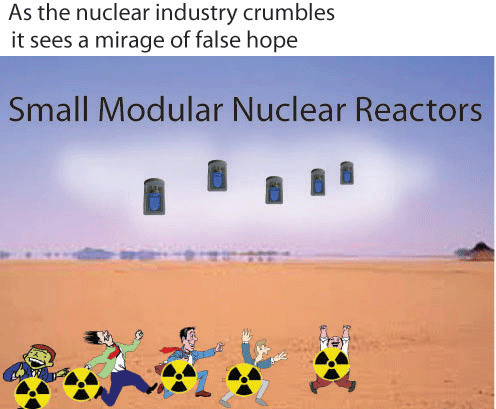
Many developers’ hopes are hanging on a new breed of reactors — small
modular reactors. The devices are intended to be small enough to
mass-produce on a highly standardised basis in the controlled environment
of a factory. They will then be taken to power station sites for
installation. Most SMRs will have a capacity below 300MW, less than 10 per
cent of the 3.2GW capacity at Sizewell C, and will be far smaller.
Yet sceptics such as E3G’s Burke are far from convinced. Asked if he thinks
steady orders and standardisation can bring the sector’s costs under
control, Burke replies: “I think that’s one of the biggest ‘ifs’
I’ve ever seen.”
FT 10th Feb 2025
https://www.ft.com/content/5e563e3f-575d-4a90-bd46-4d0a3083f707
No comments yet.
1 This Month


Tell the Ukrainian Government to Drop Prosecution of Peace Activist Yurii Sheliazhenko

Petition to revoke the licensing of the Near Surface Nuclear Disposal Facility (NSDF) at Chalk River. https://www.ourcommons.ca/petitions/en/Petition/Details?Petition=e-7247


of the week – STOP SMALL MODULAR REACTORS IN CANADA
To see nuclear-related stories in greater depth and intensity – go to https://nuclearinformation.wordpress.com
-
Archives
- March 2026 (193)
- February 2026 (268)
- January 2026 (308)
- December 2025 (358)
- November 2025 (359)
- October 2025 (376)
- September 2025 (258)
- August 2025 (319)
- July 2025 (230)
- June 2025 (348)
- May 2025 (261)
- April 2025 (305)
-
Categories
- 1
- 1 NUCLEAR ISSUES
- business and costs
- climate change
- culture and arts
- ENERGY
- environment
- health
- history
- indigenous issues
- Legal
- marketing of nuclear
- media
- opposition to nuclear
- PERSONAL STORIES
- politics
- politics international
- Religion and ethics
- safety
- secrets,lies and civil liberties
- spinbuster
- technology
- Uranium
- wastes
- weapons and war
- Women
- 2 WORLD
- ACTION
- AFRICA
- Atrocities
- AUSTRALIA
- Christina's notes
- Christina's themes
- culture and arts
- Events
- Fuk 2022
- Fuk 2023
- Fukushima 2017
- Fukushima 2018
- fukushima 2019
- Fukushima 2020
- Fukushima 2021
- general
- global warming
- Humour (God we need it)
- Nuclear
- RARE EARTHS
- Reference
- resources – print
- Resources -audiovicual
- Weekly Newsletter
- World
- World Nuclear
- YouTube
-
RSS
Entries RSS
Comments RSS
 nuclear-news
Leave a comment