‘Build baby build’, says PM as he sets out nuclear plan
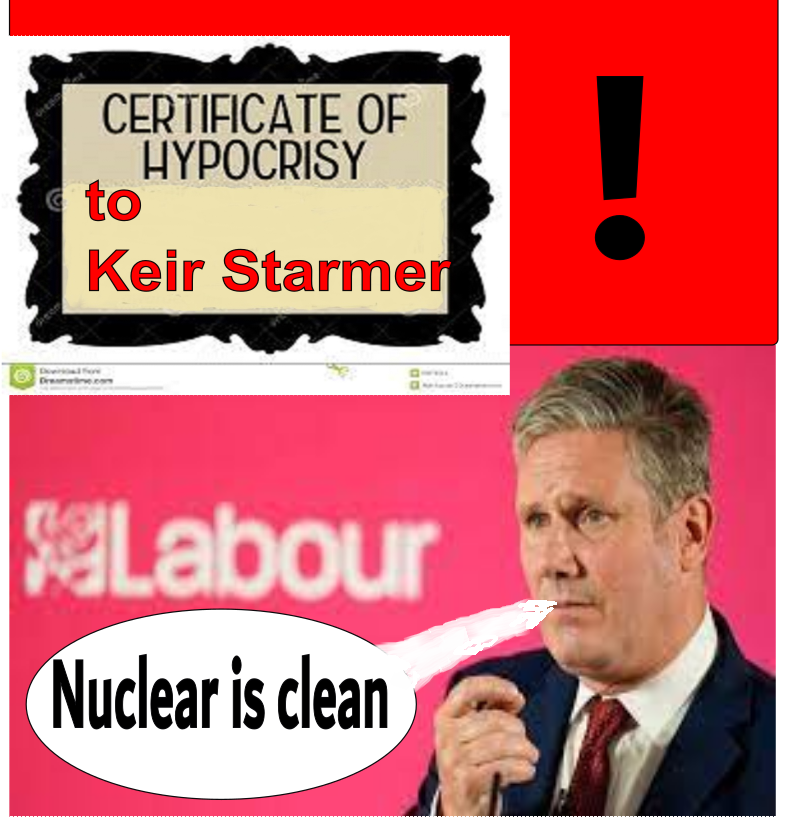
BBC 6th Feb 2025, Hafsa Khalil. BBC News, Becky Morton, Political reporter,
https://www.bbc.co.uk/news/articles/c805mjxe2y9o
Sir Keir Starmer has pledged to “build baby build”, as he announced plans to make it easier to construct mini nuclear power stations in England and Wales.
The prime minister told the BBC the government was going to “take on the blockers” and change planning rules so new reactors could be built in more parts of the country.
Sir Keir said he wanted the country to return to being “one of the world leaders on nuclear”, helping to create thousands of highly skilled jobs and boosting economic growth.
Unions and business groups welcomed the move, but some environmentalists criticised the government, saying it had “swallowed nuclear industry spin whole”.
Currently, progress building nuclear power stations in the UK can be slow – to get from planning to “power on” can take nearly 20 years.
Speaking on a visit to the UK National Nuclear Laboratory in Lancashire, Sir Keir said the process was too long and that changes announced by the government would speed it up.
Asked by the BBC’s Chris Mason if “build baby build” was his mantra like US President Donald Trump’s “drill baby drill”, Sir Keir said: “I say build baby build. I say we’re going to take on the blockers so that we can build.”
He said the government had already changed the rules to allow onshore wind farms and was now acting to ensure “we can fast forward on nuclear”.
Pressed over whether people who live near nuclear infrastructure could get money off their electricity bills, the prime minister said while this was not part of the announcement the government had already backed the idea of benefits for local communities hosting energy infrastructure.
In the 1990s, nuclear power generated about 25% of the UK’s electricity but that figure has fallen to around 15%, with no new power stations built since then and many of the country’s ageing reactors due to be decommissioned over the next decade.
Mini nuclear power stations – or small modular reactors (SMRs) – are smaller and cheaper than traditional nuclear power plants, and produce much less power.
However, while there are some 80 different designs under development globally, according to the International Atomic Energy Agency, the concept has yet to be proven commercially.
The plans announced on Thursday mark the first time SMRs will be included in planning rules. A list of the only places a nuclear reactor could be built – made up of just eight sites – will also be scrapped.
Sir Keir said the plans would improve the country’s energy security by increasing the supply of clean, homegrown power.
He added that Britain had been “held hostage” by Russian President Vladimir Putin for “too long”, which has resulted in energy prices “skyrocketing at his whims”.
The process of choosing to loosen rules on where nuclear reactors could be built began under Rishi Sunak’s Conservative government with a consultation in January 2024.
Ministers said Britain is considered one of the world’s most expensive countries in which to build nuclear power, and a new Nuclear Regulatory Taskforce will be established to speed up the approval of new reactor designs and stream line how developers engage with regulators.
Conservative shadow energy secretary Andrew Bowie said it was “about time” Labour followed his party’s lead in recognising the benefits “of stable, reliable, baseload nuclear power”.
But Doug Parr, policy director of Greenpeace UK, claimed the government had not applied “so much as a pinch of critical scrutiny or asking for a sprinkling of evidence”.
“The Labour government has swallowed [the] nuclear industry spin whole,” he said, adding: “They present as fact things which are merely optimistic conjecture on small nuclear reactor cost, speed of delivery and safety.”
While the overall cost of nuclear power is comparable with other forms of energy, nuclear plants are extremely expensive to build.
The head of the Nuclear Industry Association, Tom Greatrex, said the changes would give investors certainty and enable them to get on with building new plants.
Gary Smith, GMB’s general secretary, said the union has repeatedly said “there can be no net zero without new nuclear”.
The previous Conservative government gave the go-ahead for a new nuclear reactor on the Suffolk coast – Sizewell C – in 2022.
The new Labour government committed a further £2.7bn to the project in October but a final decision on its future is not due to come until the spending review later this year.
Two new nuclear reactors are also being built at Hinkley Point C in Somerset, which are due to open in 2030.
No comments yet.
1 This Month


Tell the Ukrainian Government to Drop Prosecution of Peace Activist Yurii Sheliazhenko

Petition to revoke the licensing of the Near Surface Nuclear Disposal Facility (NSDF) at Chalk River. https://www.ourcommons.ca/petitions/en/Petition/Details?Petition=e-7247


of the week – STOP SMALL MODULAR REACTORS IN CANADA
To see nuclear-related stories in greater depth and intensity – go to https://nuclearinformation.wordpress.com
-
Archives
- March 2026 (193)
- February 2026 (268)
- January 2026 (308)
- December 2025 (358)
- November 2025 (359)
- October 2025 (376)
- September 2025 (258)
- August 2025 (319)
- July 2025 (230)
- June 2025 (348)
- May 2025 (261)
- April 2025 (305)
-
Categories
- 1
- 1 NUCLEAR ISSUES
- business and costs
- climate change
- culture and arts
- ENERGY
- environment
- health
- history
- indigenous issues
- Legal
- marketing of nuclear
- media
- opposition to nuclear
- PERSONAL STORIES
- politics
- politics international
- Religion and ethics
- safety
- secrets,lies and civil liberties
- spinbuster
- technology
- Uranium
- wastes
- weapons and war
- Women
- 2 WORLD
- ACTION
- AFRICA
- Atrocities
- AUSTRALIA
- Christina's notes
- Christina's themes
- culture and arts
- Events
- Fuk 2022
- Fuk 2023
- Fukushima 2017
- Fukushima 2018
- fukushima 2019
- Fukushima 2020
- Fukushima 2021
- general
- global warming
- Humour (God we need it)
- Nuclear
- RARE EARTHS
- Reference
- resources – print
- Resources -audiovicual
- Weekly Newsletter
- World
- World Nuclear
- YouTube
-
RSS
Entries RSS
Comments RSS
 nuclear-news
Leave a comment