Labour’s growth policy is fantasy fiction
Richard J Murphy, Tax Research 9th Feb 2025
Labour is promising growth based on carbon capture and storage, new nuclear power stations and sustainable flying, and none of them are known to work. They’re gambling on economic fantasies.
Labour’s economic policies are increasingly based upon fantasy. I wish I didn’t have to say that, but let me explain.
Labour says it’s going to deliver economic growth in the UK, and at the same time, it’s going to deliver net zero. I don’t believe them. On the basis of their policies, I think they’re talking utter rubbish, and their ideas are based upon economic fantasies.
There are three issues that illustrate this point, and I’m going to try and keep them as simple as possible.
Those three issues are carbon capture and storage, which they are planning to use to control the emissions of big business and therefore achieve net zero, and nuclear power, which is based upon the idea that there can be a new series of at least ten nuclear power stations built in the UK, and a third runway for Heathrow.
Let’s run through those. Carbon capture and storage was announced first of these three, so perhaps I will pick it for that reason.
Carbon capture and storage is a relatively simple idea. What it says is that we don’t have to stop industry from producing carbon, which we all know is polluting the atmosphere and, therefore, creating climate change. Instead, we capture the carbon that is created by business in its industrial processes, and then store it underground, in the case of the UK, almost certainly in the old oil and gas fields under the North Sea. There’s just one little problem with this idea: nobody’s actually done it. ……………………………………………………………
What else could he have done with that money? He could have talked about putting insulation into UK houses and cutting the demand for energy.
He could have literally talked about putting solar panels on the roofs of hundreds of thousands, if not millions, of households.
But no, he didn’t want to do that. He instead wants to undertake an economic fantasy; something that has not been proven to be possible, is what he’s choosing over actual deliverables that would create jobs in streets throughout the UK, for real people in the UK, in every constituency in the UK, and which would work. This is what I mean by economic fantasy.
And the nuclear program, to which he has also signed up, which is supposedly going to deliver clean energy from ten new nuclear power stations, is just as fantastical as is carbon capture and storage. The reason why is that these are all based upon a technology created by Rolls Royce called the Small Modular Reactor. And absolutely nobody has any idea whether they will work or not. The technology is, once again, totally unproven. But we are apparently going to have ten of them.
Will they work? Who knows.
How will the waste be managed? Who knows.
What will be the cost from managing the waste from ten new nuclear power stations? Who knows? But I do know that the cost of clearing the first ever nuclear establishment in Scotland – Dounreay – a tiny little reactor built in the 1950s, has recently been increased from £2 billion to £8 billion, and it won’t be clean for another century as yet, which actually means nobody knows when or if it will ever happen.
So, this isn’t clean energy. It is actually about creating long-term, dangerous waste that we don’t know how to manage and at what cost. And yet, Labour is pursuing it because this is another economic fantasy on its part. Growth is apparently all that matters. The fact that we might destroy significant parts of the countryside that can never be used again as a consequence of doing so is neither here nor there.
And then we come to Heathrow………………………………………………………………………..
So, what is Labour up to here? They are living with the most extraordinary short-term thinking, which is totally based upon fantasy because Heathrow Airport hasn’t actually asked for a third runway yet, Rolls Royce hasn’t proved that their reactors work as yet, and absolutely nobody on the planet knows whether carbon capture and storage work as yet. But Labour is putting all its faith into these unproven situations to supposedly create the economic growth which is going to let us have nurses and education and everything else.
They could, of course, do something else. They could, of course, simply fund nurses and education and whatever else it is, because they have the power to do so because they create the money in this country and direct how it is used. Instead, they want to play games of economic fantasy.
And I don’t trust them for that reason.
These are dangerous games. They should not be being pursued.
They are playing with our planet.
They’re putting lives at risk.
They’re putting futures at risk.
They aren’t going to deliver growth, and they are threatening the well-being of generations to come. They’re dangerous people, and I really don’t think they deserve to be in office. https://www.taxresearch.org.uk/Blog/2025/02/09/labours-growth-policy-is-fantasy-fiction/
‘Build baby build’, says PM as he sets out nuclear plan
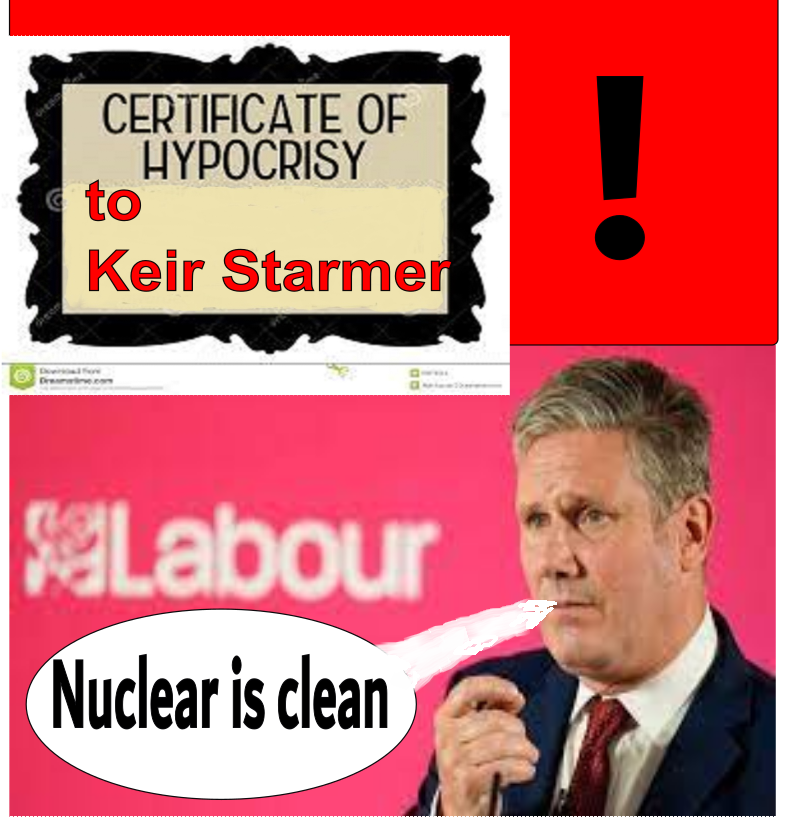
BBC 6th Feb 2025, Hafsa Khalil. BBC News, Becky Morton, Political reporter,
https://www.bbc.co.uk/news/articles/c805mjxe2y9o
Sir Keir Starmer has pledged to “build baby build”, as he announced plans to make it easier to construct mini nuclear power stations in England and Wales.
The prime minister told the BBC the government was going to “take on the blockers” and change planning rules so new reactors could be built in more parts of the country.
Sir Keir said he wanted the country to return to being “one of the world leaders on nuclear”, helping to create thousands of highly skilled jobs and boosting economic growth.
Unions and business groups welcomed the move, but some environmentalists criticised the government, saying it had “swallowed nuclear industry spin whole”.
Currently, progress building nuclear power stations in the UK can be slow – to get from planning to “power on” can take nearly 20 years.
Speaking on a visit to the UK National Nuclear Laboratory in Lancashire, Sir Keir said the process was too long and that changes announced by the government would speed it up.
Asked by the BBC’s Chris Mason if “build baby build” was his mantra like US President Donald Trump’s “drill baby drill”, Sir Keir said: “I say build baby build. I say we’re going to take on the blockers so that we can build.”
He said the government had already changed the rules to allow onshore wind farms and was now acting to ensure “we can fast forward on nuclear”.
Pressed over whether people who live near nuclear infrastructure could get money off their electricity bills, the prime minister said while this was not part of the announcement the government had already backed the idea of benefits for local communities hosting energy infrastructure.
In the 1990s, nuclear power generated about 25% of the UK’s electricity but that figure has fallen to around 15%, with no new power stations built since then and many of the country’s ageing reactors due to be decommissioned over the next decade.
Mini nuclear power stations – or small modular reactors (SMRs) – are smaller and cheaper than traditional nuclear power plants, and produce much less power.
However, while there are some 80 different designs under development globally, according to the International Atomic Energy Agency, the concept has yet to be proven commercially.
The plans announced on Thursday mark the first time SMRs will be included in planning rules. A list of the only places a nuclear reactor could be built – made up of just eight sites – will also be scrapped.
Sir Keir said the plans would improve the country’s energy security by increasing the supply of clean, homegrown power.
He added that Britain had been “held hostage” by Russian President Vladimir Putin for “too long”, which has resulted in energy prices “skyrocketing at his whims”.
The process of choosing to loosen rules on where nuclear reactors could be built began under Rishi Sunak’s Conservative government with a consultation in January 2024.
Ministers said Britain is considered one of the world’s most expensive countries in which to build nuclear power, and a new Nuclear Regulatory Taskforce will be established to speed up the approval of new reactor designs and stream line how developers engage with regulators.
Conservative shadow energy secretary Andrew Bowie said it was “about time” Labour followed his party’s lead in recognising the benefits “of stable, reliable, baseload nuclear power”.
But Doug Parr, policy director of Greenpeace UK, claimed the government had not applied “so much as a pinch of critical scrutiny or asking for a sprinkling of evidence”.
“The Labour government has swallowed [the] nuclear industry spin whole,” he said, adding: “They present as fact things which are merely optimistic conjecture on small nuclear reactor cost, speed of delivery and safety.”
While the overall cost of nuclear power is comparable with other forms of energy, nuclear plants are extremely expensive to build.
The head of the Nuclear Industry Association, Tom Greatrex, said the changes would give investors certainty and enable them to get on with building new plants.
Gary Smith, GMB’s general secretary, said the union has repeatedly said “there can be no net zero without new nuclear”.
The previous Conservative government gave the go-ahead for a new nuclear reactor on the Suffolk coast – Sizewell C – in 2022.
The new Labour government committed a further £2.7bn to the project in October but a final decision on its future is not due to come until the spending review later this year.
Two new nuclear reactors are also being built at Hinkley Point C in Somerset, which are due to open in 2030.
NUCLEAR NIGHTMARE: SOLAR REVOLUTION
Sir Jonathon Porritt, 7 Feb 25
So, what was Keir Starmer’s response to news yesterday that not only was 2024 the hottest year ever, but that January 2025 was the hottest January ever – when it had been widely predicted that it would be a lot cooler than January 2024: we’re going to double down on our endlessly recycled nuclear fantasies as the best way of achieving instant economic growth.
At the same time, the once-quite-sensible Ed Miliband was reduced to mouthing growthist inanities: “build, baby, build”.
OMG! What drugs are these pro-nuclear politicians on? Was their mothers’ milk radioactive? Do they really have to regurgitate every last gobbet of the nuclear industry’s manic and mostly dishonest hype?
Here’s what this nuclear growth agenda looks like in reality.
Over the next decade, both the big stuff (another of EDF’s Hinkley Point look-alikes at Sizewell C on the Suffolk coast) and the small stuff (as in the spectacularly over-hyped Small Modular Reactors) will make zero difference to consumers’ energy bills; zero difference to UK energy security; and zero difference to achieving our Net Zero targets .
During that time, new nuclear’s contribution to economic growth will be marginal at best, non-existent at worst. Sizewell C is may never get a Final Investment Decision – after six years of “best efforts” to sign up investors by both the Tories and Labour. Contrary to what you might think, Small Modular Reactors do not, at the moment, actually exist outside of the fevered brains of the nuclear industry. And even if the investment required, for either big or small, was somehow cobbled together, any new nuclear projects are GUARANTEED to be massively over-budget (good for growth, I agree, but disastrous for taxpayers) and massively delayed.
Which is why, dear Keir and dear Ed, easing planning conditions for new nuclear projects will make literally ZERO difference to achieving any additional economic growth.
To mitigate the despair you might now be feeling, thinking about the nuclear-powered Starmer/ Reeves/ Miliband troika, here’s a quick pick-me-up to end the week on a cheerier note.
Just a week ago, a consortium of financial institutions (led by the World Bank and the African Development Bank) agreed the biggest roll out of solar energy in the continent of Africa’s history: $35 billion in loans (at below-market interest rates) to provide electricity for roughly half of the 600 million Africans who are currently deprived of that basic necessity. And roughly half of that $35 billion will be invested in solar mini-grids at the village level. All to be rolled out over the next five years.
It’s so much easier to stay hopeful when one can deal in reality not fantasy.
UK’s new government taxonomy will greenwash nuclear

It would be easy to miss the oblique reference buried in the document where it states that ‘the government proposes that nuclear energy will be classified as green in any future UK Green Taxonomy’. This proposal will be the subject of a further consultation.
Treasury officials and ministers are looking to officially rebrand nuclear power as ‘green energy’ in their latest taxonomy plan; a move the NFLAs will continue to expose and oppose.
Mirroring moves first made by the European Commission, and mooted by the previous Conservative Government, a consultation has now concluded on whether Ministers should establish a new ‘UK Green Taxonomy’ which is described as a ‘useful tool’ in the UK’s ambition ‘to be the world leader in sustainable finance’.
The consultation document describes a taxonomy as ‘a classification tool which provides its users with a common framework to define which economic activities support climate, environmental or wider sustainability objectives’. In essence, it is a mechanism to judge whether an investment is deemed to be ‘green’; if in the case of energy, the technology is judged ‘green’ financial bodies will be better able to justify investing in it to their share- or bondholders.
It would be easy to miss the oblique reference buried in the document where it states that ‘the government proposes that nuclear energy will be classified as green in any future UK Green Taxonomy’. This proposal will be the subject of a further consultation.
Two years ago, we set out in a letter to then Conservative Chancellor Jeremy Hunt in response to his plans to introduce a similar taxonomy a list ‘of the carbon-intensive and environmentally damaging activities that accompany civil nuclear power projects’:
- the mining of uranium and its processing and manufacture into fuel rods which leaves ‘behind environmental degradation, radioactive contamination, and chronic ill-health from exposure to that radiation amongst the local workforce and the host community (usually poor and Indigenous)’
- the construction of a nuclear power plant which ‘requires the employment of vast amounts of concrete, steel and numerous other materials, many years of labour, and many millions of vehicles and personnel movements onto and off site’
- the operation of a nuclear power station necessitating ‘the transportation of fuel rods, waste, other materials and the labour force onto and off the site; the daily use of millions of gallons of seawater with the deaths of millions of fish; and the employment of its own generated electricity for cooling the plant and any stockpiled radioactive waste’
- ongoing nuclear operations which lead to ‘the contamination of the environment surrounding the plant, local beaches, the sea, neighbouring water courses and air’
And, above all, after the closure of the nuclear power station, the need to engage in the costly and prolonged decommissioning of the plant, the decontamination of the site, and the management and treatment of the radioactive waste involves processes that are ‘incredibly resource intensive.’
Green, we don’t think so.
Would a fallout shelter really protect you in a nuclear blast?

By Elana Spivack,, 9 Feb 25, https://www.livescience.com/physics-mathematics/would-a-fallout-shelter-really-protect-you-in-a-nuclear-blast
Nuclear bunkers aren’t a foolproof way to stay safe during a nuclear attack. Here’s why.
No other human-made catastrophes can wreak more destruction than a nuclear bomb. Luckily, bomb shelters and bunkers can protect us, right?
The truth is that these structures’ ability to shield people from the potent heat and blast of a nuclear bomb varies.
“It all depends on where the bunker is and the quality of the bomb,” Norman Kleiman, an associate professor of environmental health sciences and director of the Radiation Safety Officer Training course at Columbia University’s Mailman School of Public Health, told Live Science
According to Kleiman, bomb shelters came about during the Cold War as the U.S. and the Soviet Union hinted at mutually assured destruction by nuclear weapons. Both countries’ governments designed programs to construct shelters in large public buildings, as well as to encourage individuals to build bunkers inside or outside their homes, Kleinman said.
It’s possible that some people marketing these shelters were looking to make a buck amid a crisis. “I’d argue that most of them were being marketed by snake oil salesmen and hucksters,” said Peter Caracappa, executive director of the radiation safety program at Columbia University.
A bomb shelter doesn’t necessarily guarantee safety in the event of a nuclear blast. Its effectiveness comes down to the quality of both the bomb and the shelter.
Modern nuclear weapons are quite different from those of the mid-20th century. Nuclear weapons are much more powerful now, largely because they detonate using a different reaction than they did during World War II and the Cold War. Nuclear bombs in the 1950s had cores made of the radioactive element plutonium or the isotope uranium-235, in which the atoms would split apart in a process called fission, causing a huge explosion. These bombs were a type of nuclear weapon known as atomic bombs, or fission bombs.
“The size of these devices was much smaller, orders of magnitude smaller than current nuclear weapons,” Kleiman said. But now we use bombs that rely on hydrogen fusion to create that boom. These bombs utilize the atomic explosion described merely to trigger a larger, thermonuclear explosion. This explosion can have a blast radius of up to 100 miles (160 kilometers). (For comparison, the bombs used on Hiroshima and Nagasaki had blast radii of about 1 mile, or 1.6 km.) Between these two nuclear weapons, hydrogen fusion-powered thermonuclear bombs are far more powerful than fission-powered atomic bombs.
“If you are 600 miles [1,000 km] away from a thermonuclear device, maybe a shelter would help you,” Kleiman said. “But if you’re anywhere within that blast radius, the blast, the heat, the explosion — those are going to take you out.”
And then there’s the question of radiation, which is the emission of waves and particles in the wake of the blast. Kleiman said it’s possible to build a bunker to protect you from radiation. The walls must be lined with 3 to 5 feet (0.9 to 1.5 meters) of concrete and steel, as well as lead. This lead is embedded in the shelter’s walls and doorways, so an intact bunker poses little risk of exposure to its occupants.
Moreover, the entrance “has to be kind of zigzaggy,” Kleiman said. Radiation travels in straight lines, so a zigzagging entrance would fend it off.
Capacarra broke down a shelter’s protection ability into three components: It must be effective as a structure to withstand an explosion and weather radiation (which, in part, depends on where it is relative to the explosion), how much material is between you and the radiation the explosion emits, and how well it can keep out fallout material, or the material that’s generated and released in a nuclear explosion.
Lethal radiation persists for days after the explosion, so if you were to survive the initial blast, you would have to stay in the bunker to avoid radioactive fallout. So your shelter would need to not only be equipped with supplies for the time you’d need to stay put — about a week, according to Kleiman — but also ventilate without letting in any radiation. This estimated timeline depends on how far the shelter is from the blast.
However, “that doesn’t mean that it’s safe, it just means that the radiation levels are low enough that you’re not going to die of acute radiation poisoning,” Kleiman continued. He added that cancer is one huge long-term risk of radiation exposure, but that and other consequences may not emerge for decades.
So, while a bunker only a few miles from an explosion wouldn’t be very helpful, a good shelter dozens of miles from a blast could protect inhabitants from radiation for days. “It’s really a question of shielding,” Kleiman said — “shielding from heat, shielding from the blast and shielding from radiation.”
TASC urge Chief Secretary to the Treasury to cancel Sizewell C.
Essex TV 5th Feb 2025, https://essex-tv.co.uk/tasc-urge-chief-secretary-to-the-treasury-to-cancel-sizewell-c/
Together Against Sizewell C (TASC) have written the attached letter to Chief Secretary to the Treasury, Darren Jones, urging government to cancel Sizewell C, saying TASC are “pleased to acknowledge your recent statement to Parliament affirming that you will ”undertake a zero-based review of every pound of public expenditure” as this will enable HM Treasury to carry out a full appraisal of the billions of public funds that the government are sleepwalking into committing to the Sizewell C project”
TASC claim “Sizewell C is a project progressing by stealth, spending money aggressively and at pace, with long lead items being ordered, acting, with taxpayer money, as if a final investment decision has already happened, even though without full financial backing Sizewell C will not be built. There has been no regard to the environmental cost if Sizewell C is not completed.”
TASC took the opportunity to remind Darren Jones of his statement reported in 2022[1] regarding the Sizewell C project “The review will probably conclude that the state can’t take on the capital risk of paying for the majority of the costs of Sizewell C, because private finance was not forthcoming. Nuclear is costly and risky…”
TASC concluded their letter saying, “Sizewell C, is a Boris Johnson vanity project[2] that was recklessly approved by the then Secretary of State, Kwasi Kwarteng, against the recommendation of the five expert planning inspectors”. TASC urge “HM Treasury not to throw more taxpayers’ money at this expensive, risky project that will raise energy bills during its lengthy and problematic construction and announce the cancellation of Sizewell C.”
Opponents of mini nuclear power station question lacklustre consultation
Greens oppose Llynfi power station plans; say Last Energy aren’t doing enough to seek local views.
Oggy Bloggy 5th Feb 2025, by Owen Donovan, https://oggybloggyogwr.com/2025/02/opponents-of-mini-nuclear-power-station-question-lacklustre-consultation/
Although we’re still a long way away from anything official – planning-wise – groups are beginning to organise against a proposed 80MW modular “mini” nuclear power station in the Llynfi Valley.
The proposal by American start-up, Last Energy, arrived out of the blue in October 2024 and has certainly generated lots of interest, both in favour and against.
In the last few days, the Bridgend branch of the Green Party issued a statement opposing the power station.
The Greens have questioned the need for a nuclear power plant, the potential safety and waste risks and the untested technology proposed at the site.
Last Energy has been hosting public meetings in the area about the project. The Greens say that two local meetings – one held in Bettws, one in Pencoed – were poorly advertised and poorly attended. Two meetings for potential suppliers were held in Cardiff and Swansea.
Last Energy has a proposed programme of further public meetings and outreach sessions, many of which are yet to be scheduled.
The next public meeting is set to be held at Coytrahen Community Centre on Monday 17th February 2025, starting at 6:15 pm.
Two workers contaminated with radioactive material at Borssele nuclear plant
NL Times 8th Feb 2025, https://nltimes.nl/2025/02/08/two-workers-contaminated-radioactive-material-borssele-nuclear-plant
Two workers at the Borssele nuclear power plant were reportedly contaminated with radioactive material during maintenance work, plant operator EPZ confirmed. Both employees were wearing respiratory protection, preventing internal contamination.
The incident occurred on November 26, 2024, but was only disclosed last week. A small amount of radioactive material was released during the work, triggering an alarm in the facility. The area was immediately evacuated.
The two affected workers had radioactive particles on their skin. After decontamination showers, they were cleared to go home. A third worker, who was also in the room but was not wearing respiratory protection, left as soon as the alarm sounded and later tested negative for contamination.
All three workers underwent additional testing for internal exposure, but no contamination was found. The affected area was cleaned, and work resumed after safety checks.
Uranium fever collides with industry’s dark past in Navajo country

by Jacob Lorinc, Phys Org, 20Jan 25
A few miles south of the Grand Canyon, thousands of tons of uranium ore, reddish-gray, blue and radioactive, are piled up high in a clearing in the forest.
They’ve been there for months, stranded by a standoff between the mining company that dug them deep out of the ground, Energy Fuels Inc., and the leader of the Navajo Nation, Buu Nygren.
Back in the summer, Energy Fuels had triggered an uproar when it loaded some of the ore onto a truck, slapped a “radioactive” sign over the taillights and drove it through the heart of Navajo territory. Radioactive is an alarming word anywhere, but here in Navajo country, surrounded by hundreds of abandoned uranium mines that powered America’s nuclear arms race with the USSR and spewed toxic waste into the land, it causes terror.
Those fears have only grown in the past couple of years as nuclear power came back in vogue and sparked a uranium rush in mining camps all across the Southwest. So when the news made it to Nygren that morning, he was furious. No one had sought his consent for the shipment. He quickly ordered dozens of police officers to throw on their sirens, fan out and intercept the truck.
The dragnet turned up nothing in the end—the truck snuck through—but the hard-line response delivered a warning, amplified over social media and ratified days later by the governor of Arizona, to the miners: Stay out of Navajo country.
Cut off from the lone processing mill in the U.S.—all the main routes cut through Navajo territory—executives at Energy Fuels stockpiled it by the entrance of the mine. When the heaps of crushed rock grew too sprawling, they pulled the miners out of the tunnels and turned the drilling machines off.
The standoff represents the ugly side of the world’s sudden re-embrace of nuclear power. Yes, there’s the promise of a steady stream of clean energy to fuel the AI boom, fight climate change and, in the wake of Vladimir Putin’s invasion of Ukraine, replace Russian oil and gas.
But there’s also the fear—both around the nuclear reactor sites popping up across the world and in the communities surrounding mining operations in Australia, Kyrgyzstan and Navajo Nation, where the locals are still documenting cancer cases decades after the last of the Cold War-era outfits shut down.
It’s like the backlash erupting over all sorts of other mining projects crucial to the transition away from fossil fuels—lithium, nickel, copper, cobalt, zinc—just with the added threat of radioactivity.”Generations and generations of my people have been hurt,” Nygren, 38, said in an interview. “Go find uranium somewhere else.”
Truth is there isn’t all that much uranium at the Energy Fuels mine, known as Pinyon Plain, or any of the other half-dozen mines that opened in the Southwest the past couple years.
In most cases, crews are simply combing through the untouched veins of mines that were closed when the 2011 Fukushima disaster scared global leaders away from nuclear power and crashed the uranium market. Pooled all together, they only hold a fraction of the hundreds of millions of pounds of ore buried in any of the top mines in Canada, Kazakhstan and Namibia.
So the rush of mining activity here serves as a testament to the magnitude of the uranium fever sweeping the globe right now. At just over $70 per pound, the price is up some 200% over the past five years—even after it gave back a chunk of its gains in 2024.
……………………………………………………….At Pinyon Plain, they’re used to setbacks. Prospectors discovered the deposit in the 1970s but by the time all the mining permits were secured a decade later, the global uranium market had collapsed. Just like in 2011, the initial trigger was a nuclear disaster, the Chernobyl meltdown. And then, a few years later, the Berlin Wall fell and the nuclear arms race was over.
Plans were hatched over the years to open the mine as uranium prices bumped higher, but the enthusiasm would die as soon as the rally faded. It took the 2022 price surge to get Chalmers, who’s been scouting out Pinyon Plain ever since he first joined Energy Fuels back in the 1980s, to finally ram it through.
Now, after a single shipment to the mill in Utah, he’s stuck again. As he sees it, routes 89 and 160 are federal highways and, as a result, subject to federal shipping laws. The company doesn’t need the Navajos’ authorization, he says. To Nygren, every single inch of Navajo territory is subject to tribal law……………………..
Animosity towards mining companies runs high on Navajo land. It’s visible everywhere. On huge roadside billboards and small office signs, in fading pinks and yellows and jet blacks, too. They read “Radioactive Pollution Kills” and “Haul No” and, along the main entrance to Cameron, a hard-scrabble village on the territory’s western edge, “No Uranium Mining.”
A few miles down the road, big mounds of sand streaked gray and blue rise, one after the other, high above the vast desert landscape. They are the tailings from some of the uranium mines that were abandoned in the territory last century.
To Ray Yellowfeather, a 50-year-old construction worker, the tailings were always the “blue hills,” just one big playground for him and his childhood friends.
“We would climb up the blue hills and slide back down,” Yellowfeather says. “Nobody told us they were dangerous.”
Years later, they would be cordoned off by the Environmental Protection Agency as it began work to clean up the mines. By then, though, the damage was done. Like many around here, Yellowfeather says he’s lost several family members to stomach cancer. The last of them was his mother in 2022
Yellowfeather admits he doesn’t know exactly what caused their cancer but, he says, “I have to think it has to do with the piles of radioactive waste all around us.” It’s in the construction material in many of the homes and buildings and in the aquifers, too. To this day, drinking water is shipped into some of the hardest-hit areas.
The U.S. government has recognized the harm its nuclear arms projects have done to communities in the Southwest. In 1990, Congress passed a law to compensate victims who contracted cancer and other diseases. It paid out some $2.5 billion over the ensuing three decades.
The EPA, meanwhile, has been in charge of the clean-up of the abandoned mines. Two decades after the program began, though, only a small percentage have been worked on at all.
This is giving mining companies an opportunity to curry favor in tribal communities by offering to take over and expedite the clean-up of some mines. Chalmers has made it a key point in negotiations with Nygren.
…………. the EPA released a detailed study on Pinyon Plain. In it, the agency found that operations at the mine could contaminate the water supply of the Havasupai, a tribe tucked in such a remote corner of the Grand Canyon that it receives mail by mule. The report emboldened Havasupai leaders to step up their opposition to the mine, adding to Chalmers’s growing list of problems.”…….. https://phys.org/news/2025-01-uranium-fever-collides-industry-dark.amp?fbclid=IwY2xjawIUwvtleHRuA2FlbQIxMQABHey6Nv6MJqijcV5suiJOZjDx46rSSzwyrFBVrtbA0McaSeoPu-rhCeR0zQ_aem_N06qMIWp_xVHiPlfOH7DG
With calls for nuclear, are Scottish Labour stuck in the 70s?
BE careful what you wish for. I’ve dreamt all my life of the harnessing of robots
and artificial intelligence, enabling a wondrous and liberated human
civilisation. And now you tell me their power needs mean we must build more
domestic nuclear reactors? Sometimes the big narratives really don’t line
up.
We live in a country where renewable energy provided 113% of
Scotland’s overall electricity consumption in 2022 – and it’s set to
ascend over the coming decades. It’s an infrastructural build-out which
is, rightly, one solid plank in the economic and societal case for
independence.
The sense that a Scottish national future is desirable comes
significantly from the vigour, the virtue – and the permanence – of our
renewables sector. So it was jarring, as well as embarrassing, to hear Anas
Sarwar deride John Swinney in Holyrood on Thursday as “trapped in the
1970s”, as the First Minister resisted Labour’s calls for a new wave of
nuclear power plants across the UK. What could be more 70s than
atomics+computers = progress!
The National 8th Feb 2025 https://www.thenational.scot/politics/24920161.calls-nuclear-scottish-labour-stuck-70s/
-
Archives
- February 2026 (250)
- January 2026 (308)
- December 2025 (358)
- November 2025 (359)
- October 2025 (376)
- September 2025 (258)
- August 2025 (319)
- July 2025 (230)
- June 2025 (348)
- May 2025 (261)
- April 2025 (305)
- March 2025 (319)
-
Categories
- 1
- 1 NUCLEAR ISSUES
- business and costs
- climate change
- culture and arts
- ENERGY
- environment
- health
- history
- indigenous issues
- Legal
- marketing of nuclear
- media
- opposition to nuclear
- PERSONAL STORIES
- politics
- politics international
- Religion and ethics
- safety
- secrets,lies and civil liberties
- spinbuster
- technology
- Uranium
- wastes
- weapons and war
- Women
- 2 WORLD
- ACTION
- AFRICA
- Atrocities
- AUSTRALIA
- Christina's notes
- Christina's themes
- culture and arts
- Events
- Fuk 2022
- Fuk 2023
- Fukushima 2017
- Fukushima 2018
- fukushima 2019
- Fukushima 2020
- Fukushima 2021
- general
- global warming
- Humour (God we need it)
- Nuclear
- RARE EARTHS
- Reference
- resources – print
- Resources -audiovicual
- Weekly Newsletter
- World
- World Nuclear
- YouTube
-
RSS
Entries RSS
Comments RSS
 nuclear-news