Concern UK’s AI ambitions could lead to water shortages

Zoe Kleinman, Technology editor•@zskm Brian Wheeler, Senior political reporter.
BBC 7th Feb 2025, https://www.bbc.co.uk/news/articles/ce85wx9jjndo
Sir Keir Starmer’s plan to make the UK a “world leader” in Artificial Intelligence (AI) could put already stretched supplies of drinking water under strain, industry sources have told the BBC.
The giant data centres needed to power AI can require large quantities of water to prevent them from overheating.
The tech industry says it is developing more efficient cooling systems that use less water.
But the department for science, innovation and technology said in a statement it recognised the plants “face sustainability challenges”. The government has committed to the construction of multiple data centres around the country in an effort to kick start economic growth.
Ministers insist the notoriously power-hungry server farms will be given priority access to the electricity grid.
Questions have been raised about the impact this might have on the government’s plans for clean energy production by 2030.
But less attention has been given to the impact data centres could have on the supply of fresh, drinkable water to homes and businesses.
Parts of the UK, in the south especially, are already under threat of water shortages because of climate change and population growth.
The government is backing plans for nine new reservoirs to ease the risk of rationing and hosepipe bans during droughts.
But some of these are in areas where new data centres are set to be built.
The first of the government’s “AI growth zones” will be in Culham, Oxfordshire, at the UK Atomic Energy Authority’s campus – seven miles from the site of a planned new reservoir at Abingdon.
The 4.5 sq mile (7 sq km) reservoir will supply customers in the Thames Valley, London and Hampshire. It is not known how much water the massive new data centres now planned nearby could take from it.
The BBC understands Thames Water has been talking to the government about the challenge of water demand in relation to data centres and how it can be mitigated.
In a new report, the Royal Academy of Engineering calls on the government to ensure tech companies accurately report how much energy and water their data centres are using.
It also calls for environmental sustainability requirements for all data centres, including reducing the use of drinking water, moving to zero use for cooling.
Without such action, warns one of the report’s authors, Prof Tom Rodden, “we face a real risk that our development, deployment and use of AI could do irreparable damage to the environment”.
Elon Musk On The Future Of Warfare

7 Feb 25 This is an edit of the full interview, which was recorded in August 2024 and published February 2025: https://www.youtube.com/watch?v=cfs11RIKtI8
Doomsday Clock Needs Adjusting
The roles of U.S. and NATO personnel in targeting, planning, surveillance, intelligence and secret “special operations” involving Western weapons have escalated into the very war between the United States and Russia that Biden promised to avoid.
By Medea Benjamin and Nicolas J. S. Davies, World BEYOND War, February 6, 2025
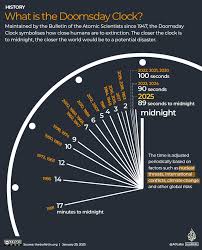
This year’s Doomsday Clock Statement landed like a damp squib in a Trump-swamped corporate news cycle on January 28th. The Bulletin of the Atomic Scientists only moved the hands of the Clock forward by one second, from 90 seconds up to 89 seconds to midnight, which must have come as a relief to the few members of the public who heard about it.
But this minimal advance in the hands of the Clock was a strange and misleading top-line for the Bulletin’s actual Doomsday Clock Statement, which was brimming with extremely dire warnings that deserve far greater official and public attention.
This disconnect between the movements of the hands of the Doomsday Clock and Bulletin’s underlying threat assessments is deeply troubling. If the positioning of the hands of the Clock does not accurately reflect the seriousness of the dangers it represents, then the powerful symbolism of the Doomsday Clock is lost, undermining the very purpose for which Albert Einstein, J. Robert Oppenheimer and their colleagues invented it.
The new Clock Statement began, “In 2024, humanity edged ever closer to catastrophe. Trends that have deeply concerned (us) continued, and despite unmistakable signs of danger, national leaders and their societies have failed to do what is needed to change course.”
The original atomic scientists created the Doomsday Clock to symbolize humanity’s suicidal march toward annihilation by nuclear war, and that is still the greatest danger that midnight on the Clock represents, even as it now incorporates the added dangers of climate change, biological threats and disruptive technologies.
The threat assessments in the 2025 Clock statement begin with the warning that the war in Ukraine “still looms over the world,” and that it “could become nuclear at any moment because of a rash decision or through accident or miscalculation.”
It was this danger of escalation to nuclear war over Ukraine that led the Bulletin to move the hands of the Clock forward by 10 seconds in January 2023, from 100 to 90 seconds to midnight.
Since then, despite President Biden’s warning in 2022 that war between Russia and the United States would be the suicidal Third World War that we must avoid at all costs, the U.S. and NATO have blasted through every self-imposed “red line” designed to prevent that, providing Ukraine with tanks, F-16 warplanes, long-range missiles, and approval to use them inside Russia as well as in Ukraine.
The roles of U.S. and NATO personnel in targeting, planning, surveillance, intelligence and secret “special operations” involving Western weapons have escalated into the very war between the United States and Russia that Biden promised to avoid.
So we cannot understand the Bulletin’s decision to move the hands of the Doomsday Clock only one second closer to the global mass suicide it symbolizes, as if these developments in the war between NATO and Russia have not brought us significantly closer to self-destruction than we were two years ago.
The Clock Statement then addresses the crisis in the Middle East. In January 2023, when the Bulletin last moved the hands of the clock forward, the U.S. and Israel were enjoying a false sense of security and normalcy in that region, believing that they had suppressed and tamed armed resistance to Israel’s illegal occupation of Palestine.
Now, since the Palestinian breakout in October 2023 and Israel’s genocide in Gaza, the new Doomsday Clock statement warns that, “Conflict in the Middle East threatens to spiral out of control into a wider war without warning.”
With nuclear-armed Israel threatening to launch a major war on Iran and ready to use its nuclear weapons before it would accept an existential defeat in such a war, and with no real limits to U.S. support for Israeli war-making and genocide, the Bulletin of the Atomic Scientists is right to warn that this could spiral out of control at any moment. Yet it seems to have ignored this danger too in its one-second tick forward of the Doomsday Clock.
While these raging conflicts involving nuclear weapons states may be the most dangerous current flashpoints for a nuclear war, nothing reflects the relentless nature of our accelerating march toward Armageddon more clearly than the determination with which the nuclear weapons powers, led by the United States, are expanding and “modernizing” their nuclear arsenals, even as they complete the dismantling of all Cold War-era arms control treaties and nuclear safeguards.
The 2025 Doomsday Clock Statement makes it clear that the Bulletin’s analysts understand this only too well:
“The countries that possess nuclear weapons are increasing the size and role of their arsenals, investing hundreds of billions of dollars in weapons that can destroy civilization. The nuclear arms control process is collapsing, and high-level contacts among nuclear powers are totally inadequate given the danger at hand.”
And yet they insist that the inexorable advance of these Doomsday plans over the past two years has only brought us one second closer to Doomsday. How can that be?
The next and final sentence in the paragraph on nuclear weapons addresses the dangers of nuclear proliferation, which is the widely predicted result of the failure of the nuclear powers to pursue genuine nuclear disarmament:
“Alarmingly, it is no longer unusual for countries without nuclear weapons to consider developing arsenals of their own—actions that would undermine long-standing nonproliferation efforts and increase the ways in which nuclear war could start.”
The next paragraph in the Doomsday Clock Statement addresses the dangers of the Climate Crisis. It explains that global greenhouse gas emissions are still increasing and global temperatures are still rising, causing extreme weather, floods, tropical cyclones, heat waves, droughts and wildfires on every continent.
“The long-term prognosis for the world’s attempts to deal with climate change remains poor,” it reads, “as most governments fail to enact the financing and policy initiatives necessary to halt global warming.”
But this is just one more dire warning that is not reflected in the hands of the Doomsday Clock………………………………………………………………………………………..
n abdicating its responsibility to warn us of the gravity of these dangers, the Bulletin of the Atomic Scientists risks turning Einstein and Oppenheimer’s call for sanity into yet another mechanism to normalize the suicidal insanity of our 21st century rulers………………………………………………………………………………………………………….
https://worldbeyondwar.org/doomsday-clock-needs-adjusting/
Top Pentagon contractors poised for gains as Trump pushes missile shield expansion

The proposed “Iron Dome for America” system is heavily reliant on space-based sensors and potentially controversial space-based interceptors
Space News, by Sandra Erwin, February 3, 2025
WASHINGTON — The nation’s top defense contractors are positioning themselves to capitalize on a new missile defense initiative announced by the Trump administration. Executives from Lockheed Martin, Northrop Grumman, and L3Harris told Wall Street analysts last week that they are well-equipped to support the administration’s push for a “next-generation missile defense shield.”
President Donald Trump’s executive order, titled “The Iron Dome for America,” directs the Department of Defense to accelerate the development and deployment of an advanced missile defense system. The order calls for a multi-layered approach capable of countering a range of threats, including ballistic, hypersonic, and cruise missiles, with a heavy reliance on space-based sensors and potentially controversial space-based interceptors.
“We welcome the urgency that the Trump administration is placing on protecting the homeland from escalating global missile threats,” said Northrop Grumman CEO Kathy Warden during a fourth-quarter earnings call. The company has contracts for satellite-based missile detection and hypersonic weapon interceptors under development.
………..Lockheed Martin, Northrop Grumman and L3Harris are prime contractors in key missile defense programs that could expand under the initiative. L3Harris CEO Christopher Kubasik highlighted his company’s role in producing missile-defense tracking satellites for the Space Development Agency’s Tracking Layer program, a network of satellites designed to detect and track hypersonic threats from low Earth orbit………………………………………………………………………………………..
The administration has yet to provide a cost estimate for the ambitious Iron Dome initiative. The Pentagon’s missile defense efforts are currently funded through a complex web of programs. The Missile Defense Agency receives approximately $10 billion annually, while the Space Development Agency operates with a budget of about $4 billion. The U.S. Space Force maintains additional multi-billion dollar funding streams for missile-warning and missile-detection satellites. https://spacenews.com/top-pentagon-contractors-poised-for-gains-as-trump-pushes-missile-shield-expansion/?utm_source=ActiveCampaign&utm_medium=email&utm_content=Contractors%20prep%20for%20%20Iron%20Dome%20for%20America&utm_campaign=FIRST%20UP%202025-02-04
The twelve ideal sites for mini nuclear reactors, according to an expert.
The Government might be pushing SMRs hard and they may be based on existing technology but they are still unproven.
A new generation of smaller nuclear reactors could be based on
decommissioned sites, speeding up the process considerably, a Government
adviser argues. The first generation of new mini nuclear reactors planned
by the government could be built on the sites of previous decommissioned
nuclear power stations, a leading expert has said.
The stations include 12
of the earliest nuclear sites in the UK, some of which date back to the
1960s and were much smaller than later nuclear power stations. Using a type
of reactor called Magnox, these first-generation nuclear sites were found
in counties such Gloucestershire, Essex, Kent, Oxfordshire, Dumfriesshire
in Scotland and Snowdonia in Wales – and are well placed to be used again
for so-called small modular reactors (SMRs), according to Dr Simon
Harrison, a member of the Government’s new advisory commission on hitting
its net zero target.
SMRs, or small nuclear reactors, are typically about a
tenth or a quarter of the size of a traditional nuclear power plant –
roughly the size of a school bus but six stories high.
The Government might be pushing SMRs hard and they may be based on existing technology but they are still unproven. While they are being promoted as quick and cheap there
is a risk that they could end up running over time and budget.
There are also questions over how SMRS could be financed, given that SMR projects
around the world need financial support from governments. The UK is
expected to use a ‘funding framework’, known as a regulated asset base
(RAB) model, which puts part of the upfront cost on to household energy
bills before the plants start generating electricity, effectively putting
households on the hook for any delays.

The Government is to loosen planning
regulations to allow SMRs to be built in the countryside, with Starmer
insisting he would use Labour’s massive majority to push through the
changes. Dr Harrison, of the Mott MacDonald engineering consultancy, told
The i Paper: “To get the first small modular reactors deployed quickly I
would expect there to be a focus on the old Magnox sites in the first
instance. Dr Harrison said the amount of space available on some of these
Magnox could limit the size of the SMR deployed. And he pointed out
“there has also been interest in old coal power station sites”, meaning
the list can’t be taken to represent the 12 best options. Which sites are
ideally suited to small nuclear reactors. Berkeley, Bradwell, Chapelcross
Dungeness, Harwell, Hinkley Point A, Hunterston A, Oldbury, Sizewell,
Trawsfynydd, Winfrith and Wylfa.
iNews 6th Feb 2025 https://inews.co.uk/news/environment/sites-mini-nuclear-reactors-experts-3522717
1 This Month


Tell the Ukrainian Government to Drop Prosecution of Peace Activist Yurii Sheliazhenko

Petition to revoke the licensing of the Near Surface Nuclear Disposal Facility (NSDF) at Chalk River. https://www.ourcommons.ca/petitions/en/Petition/Details?Petition=e-7247


of the week – STOP SMALL MODULAR REACTORS IN CANADA
To see nuclear-related stories in greater depth and intensity – go to https://nuclearinformation.wordpress.com
-
Archives
- March 2026 (204)
- February 2026 (268)
- January 2026 (308)
- December 2025 (358)
- November 2025 (359)
- October 2025 (376)
- September 2025 (258)
- August 2025 (319)
- July 2025 (230)
- June 2025 (348)
- May 2025 (261)
- April 2025 (305)
-
Categories
- 1
- 1 NUCLEAR ISSUES
- business and costs
- climate change
- culture and arts
- ENERGY
- environment
- health
- history
- indigenous issues
- Legal
- marketing of nuclear
- media
- opposition to nuclear
- PERSONAL STORIES
- politics
- politics international
- Religion and ethics
- safety
- secrets,lies and civil liberties
- spinbuster
- technology
- Uranium
- wastes
- weapons and war
- Women
- 2 WORLD
- ACTION
- AFRICA
- Atrocities
- AUSTRALIA
- Christina's notes
- Christina's themes
- culture and arts
- Events
- Fuk 2022
- Fuk 2023
- Fukushima 2017
- Fukushima 2018
- fukushima 2019
- Fukushima 2020
- Fukushima 2021
- general
- global warming
- Humour (God we need it)
- Nuclear
- RARE EARTHS
- Reference
- resources – print
- Resources -audiovicual
- Weekly Newsletter
- World
- World Nuclear
- YouTube
-
RSS
Entries RSS
Comments RSS
 nuclear-news