Is ‘Israel’ using small nuclear weapons in Gaza and South Lebanon?

Robert Daly, Christopher Busby, Source: Al Mayadeen English, 6 Sep 2024, https://english.almayadeen.net/articles/analysis/is–israel–using-small-nuclear-weapons-in-gaza-and-south-le
Dr. Christopher Busby is part a mixed crew of investigative reporters and commentators from Lebanon and some film-makers investigating “Israel’s” use of enriched uranium in strikes on Gaza on Lebanon, and aim to follow up on the strange illnesses that are appearing on the battlefield.
The American Peace Information Council (APIC) and Green Audit (UK) are conducting an investigation of “Israel’s” possible use of small nuclear weapons in Gaza and South Lebanon. Dr. Christopher Busby—Scientific Secretary, European Committee on Radiation Risk; once Member, UK Committee Examining Radiation Risk from Internal Emitters; once Member, UK Ministry of Defence Depleted Uranium Oversight Board—presents the scientific and social background of the case below.
APIC and Green Audit ask people who drive ambulances down in the South, or live there, to come forward with engine air filters from ambulances driven in bombed areas, samples of long hair (at least 10 cm in length) if they live in bombed areas, and Geiger counter readings and soil samples from bomb craters. Please send these samples and evidence to Al Mayadeen who will forward them to us. One would think that the easiest way to obtain ambulance air filters would be from the Lebanese Red Cross, but its General Secretary, Mr. Georges Kitanneh, refuses to assist this investigation.
‘Israel’ in Gaza: Red Mercury.
Dr. Christopher Busby
In 2021, a scientific report in the prestigious journal Nature confirmed what I had been saying since 2006. “Israel” has, since its attacks on Lebanon in 2006 and those on Gaza in 2008 and 2014, used a new nuclear weapon, one which kills with a high temperature radiation flash and with neutrons. This weapon, which leaves an identification footprint, but no fission products like Caesium-137, we now know was also employed by the USA in Fallujah, Iraq in 2003, and previously in Kosovo also.
The residues, inhalable Uranium aerosol dust, together with the neutron damage to tissues, cause a range of serious and often fatal health effects that puzzle doctors and defy treatment. Without knowing what caused such effects, which often mimic other illnesses or result in fungal infections that kill, doctors are powerless to help and just watch the exposed individuals die.
In the cases of direct exposures to the flash, parts of the body, arms, legs, places that were not behind significant shielding are burned to blackened sticks. The aerosol Uranium dust is inhaled, destroys the lungs through fibrosis, is translocated to the lymphatic system, and later causes cancers, not only lymphomas and leukemias, but pretty much any cancer as a result of localisation of the Uranium particle in the organ, for example the breast, which has extensive lymphatic vessels. If the particle is coughed up and swallowed, it can end up immobilised in the colon and cause cancer there.
Downstream results in exposed populations include genetic effects, unexplained infant mortality, congenital malformations, miscarriages, sex ratio perturbations at birth, and fertility loss, all of which were found in epidemiological studies I helped carry out in Fallujah from 2010-2011.
This is not science fiction or arm-waving. I have acted as an expert witness in two successful legal cases, one in England and one in Australia, where the judge and coroner court concluded that the particles caused colon cancer. I am helping a US DU veteran at the moment in his case against the military. He has a pituitary tumour (the small gland is located behind the nose where the particles lodge).
I began this investigation in 2006 when an article appeared in a Lebanese newspaper reporting that an Israeli bomb crater in Khiam was radioactive. A Dr. Ali Khobeisi had taken a Geiger counter to the crater and found a 20-times background radiation level in the crater relative to nearby. By 2006, I had become something of an alternative authority on Depleted Uranium weapons (DU). I had given evidence to the US Congressional Committee on Veterans Affairs on the effects of DU and Gulf War syndrome, I had visited Iraq and also Kosovo, and I was a member of the UK government Depleted Uranium Oversight Board (DUOB); I had written articles, including for the United Nations, I had given evidence to the Royal Society.
I asked a colleague to go to Lebanon and get samples from the crater, and also an ambulance air filter. When they were analysed, using two separate methods, they showed the presence not of Depleted Uranium, but of Enriched Uranium (EU). Now this is impossible, unless the weapon was made from EU or created EU from neutron irradiation of U-234 and U-238.
To follow the explanation of the problem, you need some science. Natural Uranium, as mined, has three isotopes, U-238 U-234 and U-235. Most of this Uranium by mass is U-238 (99.7%). The 0.3% of U-235 is important for nuclear bombs and nuclear energy and is extracted in various ways to make EU. What is left behind is less radioactive U-238, and this is what is termed Depleted Uranium (DU).
When U-238 decays, it changes into Thorium-234, which rapidly changes into Protoactinium-234 and this turns into Uranium-234. Then you get a long list of progeny, but these do not concern us. All this happens quite quickly, and the process releases some gamma rays which make DU a gamma radiation hazard, contrary to the statements of the military that DU is not a handling hazard. It is. But this is not important in this story.
The main issue here is this. Was the enriched Uranium in the Lebanon bomb a real finding? Could it have been a laboratory error? The answer is No. We used two different laboratories and two different Uranium analysis methods, ICPMS and alpha spectrometry.
What we found was picked up by the reporter Robert Fisk, who put the story into The Independent in October 2006: The Mystery of “Israel’s” Secret Uranium Bomb.
Until we found EU, I had focused on the health effects of DU. Everyone did. But in 2006 I was contacted by an eminent Italian nuclear physicist, Emilio Del Guidice. I met him in London, where he told me that the source of the EU was a new weapon which used Hydrogen or heavy hydrogen, Deuterium dissolved in Uranium and when this warhead, as small as a baseball, was fired at a solid object, the hydrogen suffered Cold Fusion to form Helium with the emission of a powerful gamma ray which cause the U238 to convert to an unstable U-239 which decayed to U-235 and a neutron.
I am not a nuclear physicist, though I have my own ideas about this explanation but at that time I accepted that he knew what he was talking about. At least it explained the source of the enrichment.
In 2008 I was approached by some doctors in Egypt who wondered if the Israelis were bombing Gaza with DU. With some difficulty, I obtained samples from Gaza, again soil samples and an air filter, and analysis showed the presence of EU. In 2010, as part of our study of the congenital malformations in Fallujah, we analysed the hair of the mothers for 52 elements to try and identify the cause of the birth defects. We found EU in the mothers’ hair.
Further support for the existence of an EU-containing or EU-producing weapon came from a study of a Kosovo war Veteran whose mysterious illnesses were investigated thoroughly by some doctors in Liverpool and Manchester. The man’s kidneys contained Enriched Uranium.
Emilio del Guidice had not stood still in this Sherlock Holmes investigation. Together with reporters from Italian TV (Rai News) he had visited the father of Cold Fusion, Prof Martin Fleischmann, whom I had also previously worked with when I was at the University of Kent in 1980. Fleishmann added to the intriguing scientific puzzle, but was unwilling to get involved. It seemed that scientists looking at cold fusion were dying under suspicious circumstances. Fleischmann himself had seemingly been poisoned with something that caused multi-site cancer and passed away on August 3, 2012. A cold fusion colleague developed the same multi-site cancer and didn’t survive.
Del Guidice and the Rai News producer following up the story wrote a book: The Secret of the Three Bullets, published in 2014. It is still in print and contains their side of the story. I am in the book under various names. But a few months before its publication, del Guidice unexpectedly died when alone in his house.
I am told that the Rai News co-author editor of the book, Maurizio Torrealta has gone into hiding after having been posted three real bullets in an envelope.
Fast forward to 2021. The Nature paper gave the results of analyses of 65 samples of soil, sand, cement, and building materials from Gaza. Using gamma spectrometry (where you use the whole sample and look at the identifiable peaks from U-235 and Th-234 = U238) the authors identified some significantly high levels of Enriched Uranium in all the samples, but mostly in the soil samples. The levels of enrichment had become greater than those that we found in our earlier studies. The natural isotope mass ratio in nature (U238/U235) is 138. In Lebanon we found 116. In Gaza 108. The 2021 paper found about 85. Since this was before the recent bombing, this contamination must date to the 2014 Israeli bombing. What should we expect to find now?
In March of this year, I wrote to the International Atomic Energy Agency (IAEA), the official UN watchdogs for the use of nuclear weapons. My colleague from Fallujah, Dr. Mohamad Al-Darraji also sent my letter under his name. Nothing happened. No reply. He was to organise a Press Conference in Vienna to draw attention to the use of this weapon in Fallujah, and the cover up of the residual high levels of radiation by the Iraqi Ministry of Science. I made a video to be presented at this conference (it is online). But he couldn’t get a venue.
I followed the letter up with a second version in July, demanding that the IAEA respond. I wrote a paper about the issue and submitted it to two journals, putting the pre-print online. It was rejected on the basis that the reviewers didn’t believe the Nature analysis results. Eventually, Al-Darraji got a reply from the IAEA (naturally, I didn’t). The IAEA didn’t believe the Nature results. Nothing to investigate. No problem.
The UK Green Party House of Lords member, Baroness Jenny Jones (who I know) asked a question in UK Parliament. The government said they didn’t have anything to say about it. About the high level of Enriched Uranium in Gaza.
So that’s it. What can we do? “Israel” and the USA (at least) have developed what is almost certainly a mini-neutron bomb. “Israel” is using it in Gaza. And may be using it in Lebanon (again). In fact, there is evidence for the development of such a bomb having been tested as long ago as October 1962, in the final US atmospheric test in the Dominic series in the Pacific. This was the test named “Housatonic” which achieved 9.96Mt yield but reportedly had zero fallout. That means it had no fission primer in the first stage, a necessary requirement for all the hydrogen bombs before it.
The significance of this appears to have been overlooked, but, astonishingly, you can find details on Wikipedia. The UK government put all that stuff under the Official Secrets Act and when I was representing the Test Veterans in the Royal Courts of Justice from 2010 to 2016, I was refused access to these details. The new bomb was successfully detonated just before the Kennedy Kruschev test ban, and just before Kennedy was assassinated. Could there be a link?
I have joined a mixed crew of investigative reporters and commentators from Lebanon and some film-makers to seek out the solution to this conundrum. We aim to follow up on the strange illnesses that are appearing on the battlefield. We aim to look for Enriched Uranium and also neutron activation products like Cobalt-60, Tritium and Carbon-14. In a new development, the laboratories that I used to examine the earlier samples have all suddenly closed their doors. One of them was shut down altogether after the first Gaza analysis. One of them was threatened. But we can do a lot with what we have.
What we want is for people to obtain Geiger Counters to check out the impact sites soon after the explosion, and if it is radioactive to get us samples of dust and dirt. We want women’s hair samples, especially long hair, cut from the nape of the neck, from women who were near or lived in areas that were bombed. You can buy a simple Geiger Counter now for about 60 euros. You can even get a low-resolution portable gamma spectrometer for about 350 euros.
We would like anyone with comments or information to contact us. This is a big deal.
The weapon will certainly be used in future exchanges, and will make local nuclear war possible, since the scary scenarios involving fallout may not materialise. I have named the device Red Mercury because that is what it probably is (remember the red mercury story: written off officially by science (haha) as a fraud, as a phony). Red Mercury was Stalin’s code for Enriched Uranium. Clearly, from the Dominic Housatonic test, the USA also developed the weapon. Since it kills without leaving fission products, it is invisible to the global nuclear explosion detection systems and the IAEA watchdogs.
But there is no doubt the IAEA know about it. Their latest report on Uranium in the Environment completely ignores Enriched Uranium. When I asked one of the report authors why, I was told they were short of money. They only had enough to look at Depleted Uranium. Can you believe this stuff?
‘I was exposed to evil in British nuclear tests’

Kirsteen O’Sullivan & Marcus White, 15 Jan 25, https://www.bbc.com/news/articles/cvgpp5ze28ro?fbclid=IwY2xjawH5E-JleHRuA2FlbQIxMQABHegxfVRLO66gQNKipt3Y5f9BWzRPbu0h6QWkys9CWH2yBTjZhE1YRCwhmA_aem_E7q8FCNDKoWD6DMMToVaoQ
A nuclear test veteran who witnessed the detonation of several British atomic bombs in the 1950s has said he was “exposed to evil”.
Robert James, 87, was an RAF firefighter stationed in Maralinga in Australia, where seven major UK tests took place.
Mr James, from Fordingbridge, Hampshire, said many service personnel had suffered fatal illnesses as a result and he was angry that the UK government had still not offered compensation.
The Ministry of Defence (MoD) said ministers were continuing to discuss issues with families.
Veterans’ campaign groups have said British service personnel were lined up and deliberately exposed to bomb tests to see what effect they would have.
Mr James said many of his comrades had died as a result of cancers and diseases associated with radiation exposure.
He said: “A lot of the guys suffered a lot. There’s lads dying every day… and after having long illness.
“We were exposed to evil, we were exposed to radiation. That’s pretty serious and I think that warrants compensation.
“Not only for people that are surviving like myself but the families that have suffered where their husbands or fathers died.”
In 2019, the Labour Party, then led by Jeremy Corbyn, pledged £50,000 for each surviving British nuclear test veteran.
Sir Keir Starmer met veterans in 2021, before becoming Prime Minister, but made no promises – and the 2019 offer was not in the 2024 manifesto.
However, the current Defence Secretary John Healey posted on his website in 2021: “UK remains the only nuclear power that refuses them recognition or compensation, unlike the US, France, Canada and Australia.”
Mr James said: “Don’t go back on your word, Mr Starmer… You promised us full compensation and recognition. Keep to your word.”
Nuclear resister Susan Crane released after 7.5 month prison term in Germany
from Nukewatch by John LaForge, https://www.nukeresister.org/2025/01/17/nuclear-resister-susan-crane-released-after-7-5-month-prison-term-in-germany/?fbclid=IwY2xjawH5EthleHRuA2FlbQIxMQABHTVW2eZGE2IE-W3LPf6iXXpESUr8kt2y7UvRgz2O8GmIutozT9gN37brag_aem_KHyUNaUTEixZQ46JaMNVpQ
U.S. Activist Ends 7.5-Month Prison Term in Germany;
Jailed for Protests Against U.S. “Nuclear Sharing”
Susan Crane of Redwood City, California was released from prison in Koblenz, Germany on Friday, January 17, 2025, after spending 7.5 months incarcerated for trespass convictions and refusing to pay fines stemming from a string of nonviolent protests against U.S. nuclear weapons stationed at the Büchel air force base, southeast of Cologne.
On June 4, 2024, Crane began serving a 230-day sentence at the Wöllstein-Rohrbach prison in Rhineland-Palatinate, the longest term yet imposed in the decades-long campaign of protests against the American-made free-fall, gravity bombs known as B61s at the base. Dutch peace activist Susan van der Hijden from Amsterdam served 115-days along with Crane for similar convictions. After ten days at Wöllstein, the two were transferred to the Offener Vollzug or the “open prison” in Koblenz, a less severe system that permits daytime work release. Crane was welcomed by the Martin Luther Evangelical Church community of Koblenz and did light work around the church grounds for many weeks.
Crane, 81, a life-long peace activist who has endured lengthy prison sentences in the United States for anti-war actions, was convicted of several trespass charges in Germany after joining six “go-in” demonstrations at Büchel. During the actions on the German base, Crane and others warned personnel that stationing the U.S. nuclear weapons there, and NATO’s ongoing threat to use them known quaintly as “nuclear sharing,” are both unlawful. Tornado fighter jet pilots of the German air force’s 33rdTactical Air Wing at Büchel routinely train to drop the U.S. H-bombs on targets in Russia [1], most recently in operation “Steadfast Defender 24” [2] — provocatively staged in the midst of NATO-armed war in Ukraine.
In one action, Crane and others unfurled a banner that read, “Büchel Air Base is a Crime Scene.” According to legal scholars, the transfer of nuclear weapons from the U.S. to Germany violates the Nonproliferation Treaty (NPT) which explicitly forbids any “transfer to any recipient whatsoever [of] nuclear weapons.” [3] According to the Bulletin of the Atomic Scientists, the U.S. hydrogen bombs at Büchel are the 170-kiloton B61-3, and the 50-kiloton B61-4.[4] The U.S. atomic bomb that incinerated Hiroshima in 1945 was a 15-kiloton device.
Crane said in a statement before entering prison, “I thought the German courts would listen to the reasons we went onto the base, and understand that our peaceful actions were justified as acts of crime prevention. But international law was not respected or enforced.”
Crane, who has two adult children and four grandchildren, has devoted her life in California to serving the poor and homeless as a member of the of Redwood City Catholic Worker community. In a statement last March Crane said, “I see people living in camps, living in cars, and I see working people who don’t have enough income for basic needs like rent, food, or medical care. Then, I think of the money wasted on war-making by the U.S. and NATO nations, and that 3% of the U.S. military budget alone could end starvation around the world.”
At least 29 Germans, as well as two other U.S. citizens and two Dutch nationals have been jailed in Germany for related protest actions against the U.S. nuclear weapons. [5] Crane is the first U.S. women to be imprisoned in Germany in the campaign. Brian Terrell of Maloy, Iowa, was recently ordered by the court in Koblenz, Germany to report to the Wittlich prison on February 26, 2025 to serve a 15-day sentence for a related go-in action in July 2019.
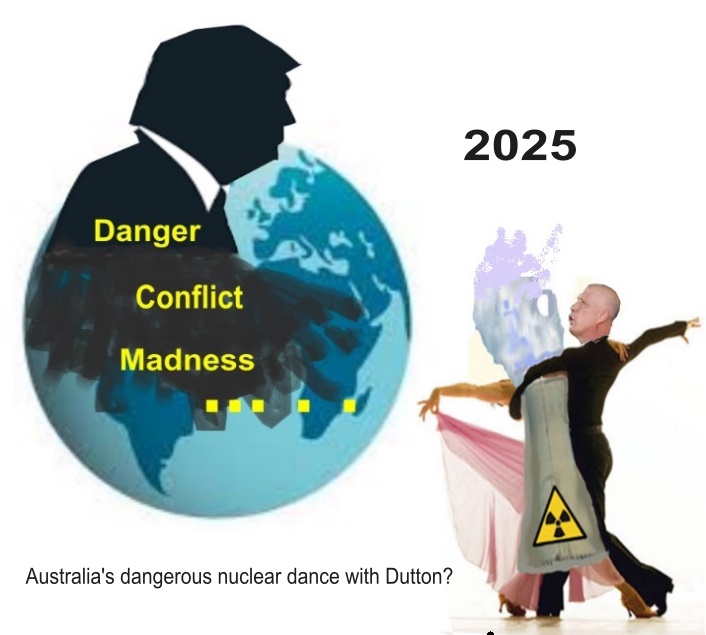
TODAY 2025 – Australia’s dangerous nuclear dance with Dutton?
20 January 2025 https://theaimn.net/2025-australias-dangerous-nuclear-dance-with-dutton/
Why I must now focus on Australia’s nuclear question.
For the past 18 years, I have been running two websites dedicated to the nuclear-free cause. I started these when John Howard was proposing nuclear power for Australia. The hazards then were obvious, environmental and health damage, further oppression of Aboriginal people, threats to civil liberties, proliferation of nuclear weapons, and more.
Over the last few years, the threat of nuclear war has increased. It’s become clear that men in power have come to believe that a nuclear war can be won, despite what the scientists tell us. The idea of nuclear disarmament has gone out the window, as ever new, cleverer, bigger nuclear weapons are devised by our fine “defenders”.
While danger has increased, knowledge and understanding of history has decreased. So we have a Western world that pays no attention to the background to the war in Ukraine, and confidently believes that it is all about one “evil” man – Putin, and nothing to do with the complex story of the Donbass region of Ukraine, and its quest for autonomy.
Meanwhile the horror of the Israeli genocide of Palestinians in Gaza continues, and the Netanyahu government’s ruthless oppression there is backed by Western weapons, and moral support, – because we “don’t want to be anti-semitic, do we?” And again, the history of the region is ignored.
These two situations could so easily tip the world over the brink – to nuclear war.
But as if that were not enough – there’s more on-the-brink background. We must now hate not only Russia, but also China, and Iran, and be ready to nuclear bomb them. We must build up more nuclear weapons, – to the gratification of those lovely armaments companies and their happy shareholders.
And if that all is not enough to have us now teetering on that brink, we have the most powerful nation in the world run by a deranged President Trump, who is supported, perhaps himself controlled, by a small group of obscenely rich men of brilliant minds but lopsided morals, including the ketamine-dependent Elon Musk.
So, to get back to the point. In this crazy new world, the new USA government will destroy or control political, judicial, educational and social institutions, with the aid of Murdoch media and social media. Misinformation and lies will be rife, and it will be a struggle to find media sources that can be trusted. But decent people, with the will for co-operation and for collective action continue – we just have to find them.
I have tried, through my websites to cover those international political issues that bring nuclear war ever closer. But now, it is just too hard.
Meanwhile, back at the ranch, here in Australia, we have the unique situation of an entire continent being taken over, militarily, by the USA. Liberal and Labor governments have let it happen. Labor Prime Ministers, terrified by what happened to the one Prime Minister, Gough Whitlam, who dared to stand up to the USA, continue to kowtow to America.
If the “tech bros” and the shadowy Atlas Foundation can play a role in bringing the chaotic Donald Trump to power in the USA, they could well do the same thing here, helping to bring Dutton’s nuclear madness to Australia. However, I must give Dutton some credit, too. He now looks likely to offer all sorts of other enticements to Australian voters, and perhaps just soft pedal on the nuclear propaganda, and hope we forget about it..
It is up to those of us who are aware, and perhaps have the time, to explore the scenario of what the nuclear industry would mean for this country.
Australia is somewhat scarred by the nuclear industry already, with the abomination of the British nuclear bombing of aboriginal land in the 1950s, and with the environmental and health destruction of uranium mining. But Australia now has this unique opportunity – to be the world leader in renewable energy, and energy conservation.
Australia does not have to be “USA’s beachfront against China” as one American politician said recently. Australia does not have to be the Southern Hemisphere base for USA’s nuclear-armed bombers, and nuclear submarines.
So, anyway, I reckon that the job for aware Australians is to keep the focus on Dutton’s nuclear nuttiness, exposing its lies. For my own part, I’m narrowing the scope of my websites and newsletter, taking them back to their original theme – for a nuclear-free world.
“
Over time, over budget… will our new nuclear plants ever be built?

A damning report on EDF, the French company aiming to construct Sizewell C,
has thrown the project into doubt, while Hinkley Point C faces soaring
costs and delays.
The cost of nuclear power in the UK came roaring back
into the headlines last week after reports that the final bill for Sizewell
C, the planned new power station on the Suffolk coast, would be £40
billion — twice what was initially expected. This was followed by a
damning report on EDF, the French state-backed company that is proposing to
build Sizewell, which laid bare its financing problems, raising questions
about whether the plant will be built at all.
Hinkley is running years late and is massively over budget, prompting critics to wonder whether this is a model we should be copying. EDF had originally envisaged that [Hinkley]
would be in operation by this year; its most optimistic scenario now puts
the start date for the first of its two reactors at 2029. Meanwhile,
Hinkley’s original £18 billion cost on the eve of its construction has
ballooned to up to £35 billion in 2015 prices — or £46 billion in
today’s money.
Unfortunately, the financing for both plants is far from
settled. It is estimated that cost overruns at Hinkley mean it needs to
find another £5 billion to finish the work. This shortfall has been
exacerbated by EDF’s partner in the project, China General Nuclear Power,
refusing to put in more money after being excluded from Sizewell on
national security grounds.
Alison Downes of the Stop Sizewell C campaign
said: “We’ve no faith this project is being looked at objectively, so
it’s vital that the Office for Value for Money [the new government
agency] launches an immediate inquiry before ministers sleepwalk into a
disastrous decision.”
Having allocated £5.5 billion to Sizewell in the
budget, most observers expect Labour to give the green light at the
spending review. Some argue that the “sunk-cost fallacy” — a
reluctance to abandon projects in which a lot of money has been invested,
even if that would ultimately be a more cost-effective option — has
kicked in, and that cancelling it now would trigger a large and galling
write-down for the government. Nor are there obvious alternative vendors of
large nuclear projects — at least not yet. Bull, of Manchester
University, said axing Sizewell would send a terrible signal: “I think
the real cost of not doing Sizewell C is that we end up with another failed
project, and investors start to think we are just not serious.”
Times 19th Jan 2025 https://www.thetimes.com/business-money/companies/article/whats-happening-with-britains-nuclear-plants-and-when-will-they-be-built-tr6v0986f
Memo to Trump: Address the new threat of drone-vulnerable nuclear reactors

By Henry Sokolski | January 17, 2025,
https://thebulletin.org/2025/01/memo-to-trump-address-the-new-threat-of-drone-vulnerable-nuclear-reactors/
Mr. President, in the closing days of your first administration, you issued an executive order spotlighting the growing dangers of drone attacks against America’s critical energy infrastructure. Your order asked the Federal Aviation Administration to propose regulations restricting overflights of critical infrastructure. Four years later, large drones overflying nuclear plants both here and abroad demonstrate your request was spot on.
Our government, however, continues to discount the dangers such overflights pose. As for the threats facing the most frightening of civilian targets—nuclear power plants—Washington has been all too silent. While there are many other infrastructure nodes drones can hit, the effects of striking nuclear plants exceed that of almost any other civilian target set. Your second administration urgently needs to address this new threat.
Background
Your January 2021 order followed an October 2020 Nuclear Regulatory Commission (NRC) report that downplayed the dangers posed by nearly 60 previous drone overflights of US nuclear plants. The commission based its conclusion on a Sandia Laboratory technical analysis that focused on “commercially available” drones. The NRC insisted that attacks against reactors with such aircraft posed no risk of inducing a major radiological release.
Since then, drones—far larger than those commercially available to hobbyists—have overflown US dams, power lines, and nuclear reactors. Recently, the NRC itself has observed a sharp increase in the number of drone sightings over nuclear plants, with drone reports nearly doubling in just one week in December. This led the 10th largest electrical utility company in the United States to urge the Federal Aviation Administration to ban all air traffic over its two nuclear plants after drones were sighted flying over its reactors. Now, Republican governors, including Jeff Landry of Louisiana, are asking you to do something about drones overflying reactors in Louisiana and other states. Overseas, Russian military drones overflew a German nuclear plant in August, prompting the German government to announce a formal investigation.
Security implications
All of this comes as the United States, South Korea, and Russia are pushing the export and construction of scores of large and small reactors in Eastern Europe, Africa, the Middle East, and East Asia. You and your cabinet should understand that new and existing nuclear plants are potential military targets—now and in the future. Certainly, Russia’s targeting of Ukrainian nuclear reactors and their critical electrical supply systems demonstrates a willingness to attack these dangerous targets.
Meanwhile, several recent war games graphically detailed how China, North Korea, and Russia could use such attacks against Taiwan, Europe, and South Korea to disrupt US military operations and force the evacuation of millions to help achieve their military objectives.
Recommendations
If nuclear power is to have the promising future that you and previous administrations have pledged to promote, your administration needs to address the vulnerability of its reactors to drone attacks.
Your administration should start by refocusing on the concerns you rightly raised in 2021. In specific, within your first 100 days in office, you and your cabinet should:
- Again ask the Federal Aviation Administration to update its regulations under the FAA Extension, Safety, and Security Act of 2016 (Public Law 114-190). At the very least, the United States needs clearer protocols restricting and countering the use of drones on or over critical infrastructure and other sensitive sites, including nuclear plants, which, if hit, risk a significant release of harmful radiation. Currently, shooting suspect drones down is all but prohibited.
- Have the Secretary of Defense, the Secretary of Homeland Security, and the Director of National Intelligence assess within 90 days the threat that drone and missile attacks pose to US and allied electrical supply systems, nuclear plants, and other key infrastructure nodes. This report should be published both in classified form—to you, key members of your cabinet, and the national security leadership in the House and Senate—and in unclassified form to the public.
- Ask the Defense Department, National Nuclear Security Administration, and the Department of Homeland Security to explain how they will either require or provide active and passive defenses for existing and planned US civilian and military nuclear plants here and abroad. This report should also describe how the US government should respond to drone and missile attacks on such plants which, if hit, could release harmful amounts of radiation.
- Direct the Energy Department and the Federal Aviation Administration to contract JASON (the government’s scientific advisory group), to explore what technologies might better detect and counter hostile drone and missile attacks and mitigate the effects of such attacks. These technologies could include hardening nuclear reactors, active and passive defenses, and research on nuclear fuels that might be able to survive advanced conventional attacks with thermobaric and other advanced conventional explosives.
- Direct the Energy Department, the Department of Homeland Security, and the Defense Department to devise a program of realistic testing to clarify the military vulnerabilities and safety thresholds of reactors and other nuclear plants against missile and drone attacks.
Told you so: Financial Times follows NFLAs lead on Sizewell C cost estimate.

16 Jan 25 – https://www.nuclearpolicy.info/news/told-you-so-ft-follows-nflas-lead-on-sizewell-c-cost-estimate/
It is always nice when a media cornerstone of the finance world follows your lead in doing its sums – but that is what the Financial Times did yesterday in publishing an article indicating that the estimated cost of completing the new nuclear plant at Sizewell C will be £40 billion, something the NFLAs have been saying for ages.
One rule in nuclear is that the construction cost for new plants will always be far higher than the first estimate. And there has been no better example of this truism than that of Sizewell C’s sister plant, Hinkley Point C in Somerset, where an initial estimate of £18 billion for completion has now doubled to £34 billion (at 2015 prices).
It was hardly surprising that the FT reported that the final bill is more likely to be nearer £40 billion after speaking to ‘people close to negotiations over flagship energy scheme’; which are understood to be ‘one senior government figure and two well-placed industry sources.’ This figure is double that made in 2020 reflecting the recent surge in construction costs, and the inevitable delays and cost overruns will inevitably add to the eventual total.
The Sizewell C site presents its own costly challenges, namely a need for considerable expenditure on coastal defences as the East Coast will be increasingly subject to inundation and storm surges because of climate change and the need to provide in this water-stressed region for the provision of potable water with the likely installation of a dedicated desalination plant.
The British Government has already spent, or pledged, up to £8 billion in public funds to carry out preparatory groundwork around the site. Although private investors are being sought to finance the cost of construction, under the Regulated Asset Base being adopted by the British Government for the construction of any new nuclear plants, British electricity customers will ultimately have to bear the cost as the developer will be reimbursed these construction costs in stages through applying a nuclear levy to bills.
However, the Final Investment Decision to give the project the go-ahead has yet to be made. This is only expected in the late Spring after the completion of a Spending Review of overall government spending so there is still time for the Chancellor Rachel Reeves to stop it.
Local campaign group Stop Sizewell C is asking supporters to sign a petition to do so. The link to the petition is https://action.stopsizewellc.org/save-billions-cancel-sizewellc
Stop Sizewell C’s message to the Chancellor, via the Treasury, is: “As you carry out your multi-year spending review, I am reminded of your statement to Parliament during your mini-budget last year – “If we cannot afford it, we cannot do it”. I appreciate that you face many difficult choices, but with the Financial Times reporting that Sizewell C will cost at least £40 billion, I urge you not to throw more taxpayers’ money at this expensive, risky project that will raise energy bills during its lengthy and unpredictable construction. For alternative strategies that will help meet the UK’s 2030 target and create many thousands of jobs, I urge you to focus on renewables and energy efficiency.”
The NFLAs endorse this petition as it mirrors our position.
At present, the British Government is the majority stakeholder, but long-term only wishes to retain 20% as Ministers intend to offload much of their stake to private investors. So far however, no one is definitively biting, with mixed messages about interest from Centrica, British Gas’s parent, and Gulf States’ sovereignty funds.
As a second whammy to government hopes that more private sector partners will become involved, yesterday, the French State Auditor, the Cour des Comptes, criticised the expenditure already made by French state owned EDF on Hinkley Point C in a published report which suggested this could compromise investment in domestic nuclear power expansion plans and that “EDF should not take a final investment decision on Sizewell C before achieving a significant reduction in its financial exposure to Hinkley Point C.”
Stop Sizewell C is asking supporters to write to prospective investors asking them not to do so. The relevant links to take this action are shown below:
Amber Infrastructure: action.stopsizewellc.org/amber
Equitix: action.stopsizewellc.org/equitix
Schroders Greencoat: action.stopsizewellc.org/greencoat
Emirates Nuclear Energy Corporation: action.stopsizewellc.org/emirates
Centrica: action.stopsizewellc.org/centrica
The NFLAs has previously written to these prospective investors and endorse this action.
Finally Stop Sizewell C is petitioning the new Office of Value for Money’s independent Chair, David Goldstone, to call in the Sizewell C project for urgent scrutiny. Initial feedback from the Treasury indicated that Sizewell C would be examined, but more recent correspondence with officials has been less committal.
Supporters are asked to follow the NFLA’s example and sign the petition at https://action.stopsizewellc.org/valueformoney
Ends://..For further information, please contact NFLA Secretary Richard Outram by email to richard.outram@manchester.gov.uk
French energy giant EDF launches search for Hinkley Point finance after damning audit report

EDF Group’s chief executive Luc Rémont has hit
back at the national French auditor’s claims that the energy company
should delay its investment in UK nuclear power project Sizewell C.
He said the regulated asset base (RAB) model for financing the Suffolk nuclear
power station, where the cost of development is shared with the consumer,
should not be correlated with the refinancing of the Hinkley Point C
project in Somerset.
The French state-owned energy company has started a
search for financiers to help refinance the delayed project at Hinkley
Point C, following the French state auditor’s findings yesterday,
according to Rémont.
In October, the energy company issued £500m of
senior bonds to help finance investments in two nuclear reactors at the
site. Rémont said that the funding model for the Sizewell C nuclear power
project on the Suffolk coast “limits” EDF’s capital exposure.
The auditor’s report come a week after a letter was sent to the national
auditor in the UK, the National Audit Office, calling for a review of the
government’s spending assessment for Sizewell C. The campaign group
behind the letter raised concerns of rising costs at Hinkley Point C,
another nuclear power station being built by EDF, now estimated to be in
the region of £46 billion. The letter from Together Against Sizewell C
(TASC) followed a plea by Ecotricity founder Dale Vince, a Labour donor,
for the Treasury’s new Office for Value for Money to review plans to
develop the new nuclear power project in Suffolk.
Energy Voice 15th Jan 2025 https://www.energyvoice.com/renewables-energy-transition/565569/french-energy-giant-edf-launches-search-for-hinkley-point-finance-after-damning-audit-report/
Risks of geologic disposal of weapons plutonium

The Bulletin, By Cameron Tracy | January 13, 2025
The United States has a plutonium problem. This heavy metal, rarely found in nature but produced by nuclear reactors, is a primary ingredient of nuclear weaponry. A modern thermonuclear weapon, containing just a few kilograms of this material, could level much of a metropolitan area. During the Cold War, the United States and the Soviet Union produced enough plutonium to make tens of thousands of nuclear weapons (IPFM 2015). Both the United States and Russia, which inherited the Soviet nuclear weapons enterprise, have since declared large portions of their stockpiles to be excess: unnecessary for purposes of national defense. But after decades of effort and billions of dollars spent trying to dispose of this material, their weapons plutonium stockpiles remain undiminished (von Hippel and Takubo 2020).
The United States currently plans to bury about one third of this stockpile in the Waste Isolation Pilot Plant (WIPP), a geologic repository mined 650 meters below the surface of southeastern New Mexico’s Delaware Basin (NASEM 2020). Preparation to dispose of this material is well underway, but key questions about this approach remain unresolved. Will the repository safely contain this radiotoxic material over the thousands of years for which it presents a threat to the environment? Can the repository be effectively secured against attempts to illicitly recover weaponizable material? Can all of this be accomplished on a realistic schedule and budget?
…… Given sufficient effort, funding, and good fortune, the United States may arrive at a workable solution to its plutonium problem. But until questions of safety, security, and cost are addressed, and the associated risks are weighed, agreement on just what it means for a geological plutonium repository to “work” is likely to remain out of reach.
…………………………………. Recognizing these risks, the US National Academy of Science and its Russian counterpart met in 1992 to discuss the issue (NASEM 1994). This agenda eventually rose to the highest levels of government, serving as a centerpiece of discussion between Presidents Bill Clinton and Boris Yeltsin over the next few years. By 2000, the United States and Russia had negotiated and signed the Plutonium Management and Disposition Agreement (PMDA), pledging to reciprocally dispose of 34 metric tons of excess weapons plutonium..
……………………………………………………… both sides agreed to a primary disposal method that was complex and difficult, but jointly seen as effective: conversion of weapons plutonium to nuclear fuel and irradiation in nuclear power plants.
Despite this diplomatic achievement, progress on bilateral plutonium stockpile reduction was short-lived. Construction began on the US facility that would convert this material to nuclear fuel in 2007, but in less than a decade, cost estimates grew from initial projections of a few billion dollars to over one-hundred billion (Hart et al. 2015). In 2016, the Obama administration unilaterally pivoted from the irradiation approach mandated by the plutonium disposal agreement with Russia to a new plan: burial in WIPP.
Russia balked at this shift. In an April 2016 speech in St. Petersburg, Russia’s president, Vladimir Putin, accused the United States of seeking to “preserve what is known as the breakout potential,” disposing of plutonium in name only while ensuring that it could be “retrieved, reprocessed, and converted into weapons-grade plutonium again.” Citing this, alongside a broad array of other grievances related to steadily worsening US-Russian relations amid the Russo-Ukrainian War, Russia suspended its commitment to the bilateral plutonium disposal agreement later that year.
A new mission for WIPP (Waste Isolation Pilot Project)
WIPP is mined into the underground salt formations………………. Congress established the facility as a pilot project, a “research and development facility to demonstrate the safe disposal of radioactive wastes resulting from the defense activities and programs” (US Congress 1979). WIPP was originally designed to store wastes made up of clothing, gloves, lab equipment, and other detritus contaminated with heavy, radioactive elements like plutonium, which was sitting at nuclear weapons production sites scattered across the United States. Following decades of site characterization, repository design, and construction—alongside $2.5 billion in funding—WIPP accepted its first shipment of this material in 1999 (Feder 1999).
WIPP’s mission now extends far beyond its original role as a demonstration project. As the sole US site for the disposal of actinide wastes (referring to the class of heavy, radioactive elements including uranium and plutonium), it is now slated as the permanent disposal site for the 34 metric tons of excess weapons plutonium covered by the now defunct US-Russia plutonium disposal agreement.
This is a major shift from WIPP’s original design basis, and has introduced new sociotechnical challenges to the safe, secure, and effective operation of the repository—and, therefore, to the plutonium stockpile reduction mission to which it is now intimately tied. What started as a pilot program to aid in the clean-up of contaminated Cold War weapons production facilities is now both a potential solution to the long-standing problem of excess weapons plutonium disposal, and a potential threat to both the environment and to global nuclear security. Whether this one-of-a-kind experiment on the long-term safety, security, and risk of the geologic disposal of nuclear materials is ultimately judged a success or failure will depend on its ability to meet several complex challenges.
Challenge 1: Isolating radioactive material from the biosphere
WIPP’s central role is to isolate potentially dangerous materials deep underground, preventing the leakage of radioactive material to the surface or to groundwater flows. Designed to store about 12 metric tons of plutonium, it is now slated to contain nearly four times that inventory (Tracy, Dustin, and Ewing 2016). Of course, more radioactive material means greater potential for its release.
To forecast the risk of release, every five years the US Department of Energy, which operates WIPP, performs a repository performance assessment and submits the results to the US Environmental Protection Agency (EPA 2022)……………………. However, predicting the future is challenging, even when legally mandated.
Consider, for instance, one of the key repository failure modes: borehole intrusion……………………….. Drilling in the region was virtually nonexistent prior to 1960 and rose exponentially following a boom in the early 1990s………………………………………………………………… When considering the behavior of magnesium oxide in the complex geochemical environment of a repository pierced by a borehole and infiltrated by groundwater, this should be taken as a cautionary tale.
None of this is to say that WIPP cannot operate safely. However, its ability to do so with the current plutonium inventory is uncertain, as uncertainties in long-term local drilling rates and repository chemistry demonstrate. A fourfold increase in WIPP’s plutonium inventory will only add to this safety challenge.
Challenge 2: Ensuring that buried plutonium remains buried
…………………………………………………………The use of two alternative techniques that were overlooked in the prior literature, salt solution mining and in situ leaching, would allow rapid access to buried plutonium with minimal excavation (Tracy and Ewing 2022).
……………………Applied to WIPP, these techniques could provide access to large quantities of weapons plutonium via only a single borehole just tens of centimeters in diameter (Tracy and Ewing 2022). Plutonium might then be extracted in a matter of days. Afterwards, plastic flow of salt would seal the borehole, removing evidence of the clandestine extraction.
……. the risks of recovery have been insufficiently studied, and WIPP’s design does little to mitigate these risks. Thus, confidence in the security of weapons plutonium disposed of in WIPP is unwarranted. Most worryingly, much of the work on this issue has sought merely to dismiss the risk of plutonium recovery, rather than to establish a design basis for mitigating that risk.
Challenge 3: Managing a complex and costly disposal program
Even if solutions were found for the safety and security challenges detailed above, there would still remain the monumental challenge of implementing those solutions alongside the unprecedented task of burying 34 metric tons of weapons plutonium over half-a-kilometer below ground. Two of the most serious obstacles to successful disposal are the cost and time required………
………………These challenges are uniquely substantive for the Department of Energy. Analysis of past projects of similar scope overseen by the part of this agency that manages the weapons plutonium stockpile shows that many were cancelled before completion and that “of the few major projects that were successfully completed, all experienced substantial cost growth and schedule slippage” (IDA 2019). The Government Accountability Office, a congressional organization that audits and evaluates US government agency performance, regularly cites management and budgetary failings in the Department of Energy’s plutonium stockpile programs (GAO 2017).
Working towards a repository that “works”
…………………… For technologies like geologic plutonium repositories, problems of risk come to the forefront: What level of risk is expected, what level is acceptable, and even how risk should be measured. Plutonium disposal presents a means of reducing global nuclear risk by shrinking stockpiles of weapons material—a yet unrealized dream of the post-Cold War world. At the same time, burial of this material at WIPP presents new risks of radioactive contamination of the environment, lower barriers to the production of nuclear weapons, and unsustainable cost overruns.
……………the risk to WIPP posed by ongoing mission creep. ……The imposition of a dramatically expanded plutonium inventory and a fundamentally different mission, however, introduces new threats to WIPP’s continuing success [as a pilot research project] https://thebulletin.org/premium/2025-01/risks-of-geologic-disposal-of-weapons-plutonium/?utm_source=ActiveCampaign&utm_medium=email&utm_content=US%20Nuclear%20Notebook%20Update&utm_campaign=20250116%20Thursday%20Newsletter
—
‘National scandal’: The BBC’s Gaza cover-up

Britain’s ‘public service broadcaster’ is keeping the public in the dark about UK support for Israel’s assault on Gaza, new research finds.
MARK CURTIS, DECLASSIFIED.UK, 15 January 2025
- Declassified researched the BBC’s online coverage of 16 aspects of UK policy towards Israel and the pro-Israel lobby.
- “It is high time for the corporation to be truly held to account and be reformed in the public interest”, leading media professor says.
The BBC is failing to report the various ways in which the UK government has supported Israel’s brutal war on Gaza, Declassified’s new analysis finds.
Our research into the BBC’s written outputs since October 2023 finds the corporation has mainly not reported at all the major ways the UK government has been working with Israel.
It found that the BBC has reported just four times in 15 months that the Royal Air Force (RAF) has been conducting surveillance flights over Gaza.
Only one BBC report on the subject has been written since December 2023, despite the fact that hundreds of such spy missions have been conducted, almost daily, in aid of Israeli intelligence.
The Ministry of Defence (MoD) says these flights are solely to aid the rescue of hostages held by Hamas. Only one BBC online report mentions the UK may be providing targeting information to Israel or flying weapons to the country.
None of the articles otherwise raise concerns about the UK being willing to collaborate militarily with Israel at a time it is devastating Gaza.
Omitting the news
When Israel’s chief of staff, General Herzi Halevi, was allowed to attend a British military meeting in London last November, this also went unreported by the BBC in its written outputs.
Halevi’s visit was highly controversial, given he has led Israeli military operations throughout its destruction of Gaza. Prime minister Benjamin Netanyahu and former defence minister Yoav Gallant are wanted for crimes against humanity by the International Criminal Court.
Our research also finds that the BBC has never reported that the British military has been training Israeli armed forces personnel in the UK during the Gaza war. ……………………………………………………………………………………….
Arms exports
In sharp contrast to other UK government policies concerning Israel, the BBC has published many articles mentioning British arms exports to Israel.
In these reports, the BBC has occasionally cited concerns by human rights groups and MPs about the possible use by Israel of these arms, at the same time as citing pro-Israel figures.
However, article headlines have rarely been critical of these weapons sales.
………………………………………. many headlines are conciliatory towards Israel. These include:
‘Deputy PM: It’s still legal for the UK to sell arms to Israel’
‘UK defends partial Israel arms ban as Netanyahu calls it “shameful”’
‘UK ban on selling arms to Israel would benefit Hamas, says Cameron’
‘Boris Johnson: Shameful to call for UK to end arms sales to Israel’
There are no headlines about the possible use of UK arms by Israel in Gaza, or any directly reflecting the repeated calls by groups such as Human Rights Watch and Amnesty International, to halt all UK arms exports and military assistance to Israel.
The prominent legal action against the government for arming Israel brought by the International Centre of Justice for Palestinians (ICJP), the Global Legal Action Network and Al-Haq, has been ignored by the BBC. Declassified could find no BBC written coverage of this at all.
The most prominent group challenging British arms exports, the Campaign Against Arms Trade, has been mentioned six times on the BBC website in 15 months.
Declassified has uncovered three other disturbing aspects of Britain’s arming of Israel, none of which appears to have been covered by the BBC.
Voluntary censorship
Neither has the BBC covered the possible role of UK spy agency GCHQ or the army’s special forces, the SAS, in facilitating Israeli military operations.
These are live issues given that GCHQ operates an extensive intelligence operation on Cyprus, from where the RAF planes are flown over Gaza.
GCHQ is known to have aided past Israeli combat operations in Gaza. Yet Declassified could find no reports on the BBC website mentioning GCHQ in the context of Gaza.
Reporting on the SAS was subject by the government to a D-Notice – a voluntary gagging order not to publish ‘sensitive’ information concerning ‘national security’- in October 2023.
It followed reporting by the Mail that an SAS team was positioned on Cyprus, reportedly to help rescue British hostages held by Hamas.
Since then, it appears the entire UK national media, including the BBC, has complied with this. The BBC has no articles covering or speculating on an SAS role in Israel or Gaza.
Unreported collusion
There are other ways in which the British government is in effect colluding with Israel which have gone unreported by the BBC.
Perhaps incredibly, the BBC has not reported in its written outputs since October 2023 that the UK is engaged in negotiations with Israel to secure a free trade agreement.
Conservative and Labour ministers have since 2022 held five rounds of talks with the Israeli government, whose economy minister, Nir Barkat, is an outspoken supporter of its attacks on Palestinians.
Jonathan Reynolds, the current trade minister pursuing the prospective new deal, is a recipient of funding from Britain’s Israel lobby.
Neither has the BBC reported on the arrests by the UK authorities of pro-Palestinian journalists in Britain. ……………………..
Lobby, what lobby?
Neither has any effort been made by BBC journalists to highlight the influence in the UK parliament exercised by the Israel lobby, notably Conservative Friends of Israel (CFI) and Labour Friends of Israel (LFI).
This is a major gap in reporting since these are among the largest lobbying forces in British politics, funding dozens of MPs to go on “fact-finding” visits to Israel………………………………………………………
‘National scandal’
Des Freedman, professor of media and communications at Goldsmiths, University of London, said: “The BBC is clearly utterly failing to inform the public about how the UK military and government is complicit in the horrors of Gaza. This is a national scandal, showing how far away the corporation is from being a public service broadcaster.”
He added: “The BBC’s failure to accurately report on Israel’s genocide in Gaza is as much to do with what it refuses to report as with what it does report. It is high time for the corporation to be truly held to account and be reformed in the public interest”…………………………………………… more https://www.declassifieduk.org/national-scandal-the-bbcs-gaza-cover-up/
These Are The Six Times The USA Lost Nuclear Weapons
The US military has had at least 32 “Broken Arrow” incidents.
Tom Hale, Senior Journalist, FL Science 17th Jan 2025, https://www.iflscience.com/these-are-the-six-times-the-usa-lost-nuclear-weapons-77661
Keys, phones, headphones, socks, thermonuclear weapons – some things just always seem to go missing. Believe it or not, there were at least six instances when the US lost atomic bombs or weapons-grade nuclear material during the Cold War.
Not only that, but the US is responsible for at least 32 documented instances of a nuclear weapons accident, known as a “Broken Arrow” in military lingo. These atomic-grade mishaps can involve an accidental launching or detonation, theft, or loss – yep loss – of a nuclear weapon.
February 13, 1950
The first of these unlikely instances occurred in 1950, less than five years after the first atomic bomb was detonated. In a mock nuclear strike against the Soviet Union, a US B-36 bomber en route from Alaska to Texas began to experience engine trouble. An icy landing and stuttering engine meant the landing was going to be near-impossible, so the crew jettisoned the plane’s Mark 4 nuclear bomb over the Pacific. The crew witnessed a flash, a bang, and a sound wave.
The military claims the mock-up bomb was filled with “just” uranium and TNT but no plutonium core, meaning it wasn’t capable of a conventional nuclear explosion. Nevertheless, the uranium and the weapon have reportedly never been recovered.
March 10, 1956
On March 10, a Boeing B-47 Stratojet set off from MacDill Air Force Base Florida for a non-stop flight to Morocco with “two nuclear capsules” onboard. The jet was scheduled for its second mid-flight refueling over the Mediterranean Sea, but it never made contact. No trace of the jet was ever found.
February 5, 1958
In the early hours of February 5, 1958, a B-47 bomber with a 3,400-kilogram (7,500-pound) Mark 15 nuclear bomb on board accidentally collided with an F-86 aircraft during a simulated combat mission. The battered and bruised bomber attempted to land numerous times, but to no avail. Eventually, they made the decision to jettison the bomb into the mouth of the Savannah River near Savannah, Georgia, to make the landing possible. Luckily for them, the plane successfully landed and the bomb did not detonate. However, it has remained “irretrievably lost” to this day.
January 24, 1961
On January 24, 1961, the wing of a B-52 bomber split apart while on an alert mission above Goldsboro, North Carolina. Onboard were two nuclear bombs. One of these successfully deployed its emergency parachute, while the other fell and crashed to the ground. It’s believed the unexploded bomb smashed into farmland around the town, but it has never been recovered. In 2012, North Carolina put up a sign near the supposed crash site to commemorate the incident
December 5, 1965
An A-4E Skyhawk aircraft loaded with a nuclear weapon rolled off the back of an aircraft carrier, USS Ticonderoga, stationed in the Philippine Sea near Japan. The plane, pilot, and nuclear bomb have never been found.
In 1989, the US eventually admitted their bomb was still sitting on the seabed around 128 kilometers (80 miles) from a small Japanese island. Needless to say, the Japanese government and environmental groups were pretty annoyed about it.
Spring, 1968
At some point during the Spring of 1968, the US military lost some kind of nuclear weapon. The Pentagon still keeps information about the incident tightly under wraps. However, some have speculated that the incident refers to the nuclear-powered Scorpion submarine. In May 1968, the attack submarine went missing along with its 99-strong crew in the Atlantic Ocean after being sent on a secret mission to spy on the Soviet Navy. This, however, remains conjecture.
Submarine nuclear core project faces ‘challenges’
The Core Production Capability programme, tasked with delivering safe
nuclear reactor cores for the UK’s submarine fleet, remains under pressure
as highlighted in the latest Infrastructure and Projects Authority (IPA)
Annual Report.
Maintaining its Red rating, the programme faces critical
challenges in achieving key milestones crucial to sustaining the Continuous
At Sea Deterrent (CASD). According to the report, the programme is
fundamental to providing the Royal Navy with the capability to propel the
Dreadnought-class submarines and a “modern, safe, and sovereign
capability to manufacture further cores” for a future fleet of attack
submarines.
This capability is also essential for fulfilling the UK’s
commitments under the AUKUS defence partnership.
UK Defence Journal 17th Jan 2025 https://ukdefencejournal.org.uk/submarine-nuclear-core-project-faces-challenges/
Nukes kill kids.

Dr Tony Webb, 17 Jan 25.
One moment from my work in the USA in the early 1980s stands out in my memory. I’d driven from Chicago to Cleveland at the invitation of the Health and Safety Officer of the US Boilermakers Union to speak to the members meeting held on the night ahead of the recruitment of members for work on the annual ‘clean-up’ of the local Nuclear Power plant. The hired workers would be ‘radiation sponges’ – short-term casuals recruited for the ‘dirty jobs’ that would result in significant radiation exposures sometimes up to the permitted annual exposure limit and ‘let go’ if they reached that limit. The practice offered some protection to the company’s full -time employees whose skills would be needed on an ongoing basis and whose exposures needed to be kept below the limit. The meeting was well attended , rowdy, with a lot of questions and discussion which spilled over into the carpark after the meeting closed. I noticed one man hanging back from the circle and invited him to join and share his thoughts. As I recall them the essences was:
“I will be going in to apply for work tomorrow. I understand what you shared about the risks . . . no safe level of exposure and chance of getting cancer perhaps 20 years from now . . . It will put a roof over my family’s heads and food on the table . . . BUT my wife and i have had all the family we want. If we hadn’t, what you shared about the genetic risks, the damage to our children and future generations . . . no I wouldn’t be going . . . “
It is a sad fact that workers, both men and women will choose, often from necessity, to put their health at risk from the work environment. What is however consistent in my experience of working on radiation and other occupational health and safety issues is that they are far more concerned, cautious and likely to prioritise safety when it comes to risks to their children.
We now have solid evidence that workers in nuclear power plants routinely exposed to radiation face significantly increased cancer risks, risks of cardiovascular disease including heart attacks and strokes, dementia and potentially other health effects. There is also an increased risk of genetic damage that can be passed on to their children and future generations. But perhaps most significant of all there is now solid evidence of increased rates of leukaemia in children living close to nuclear power plants.
To put it simply and in language that will resonate with workers and their families in the communities around the seven nuclear power plant sites the federal Liberal-National Coalition proposes to build if elected to government; nuclear kills kids. It matters little whether or not these nuclear plants can be built on time, within budget, make a contribution to climate change, reduce electricity prices, or secure a long-term energy future; these nuclear power plants will kill kids who live close by. They cannot operate without routine releases of radioactive material into the environment and our young will be exposed and are particularly susceptible to any exposure that results.
Now add to that if you care that women are more susceptible than men, that workers in these plants face greater exposure and health risks than adults in the community, that nuclear plants have and will continue to have both major accidents and less major ‘incidents’ resulting in radiation releases, community exposures and consequent health damage. Add also that quite apart from the workers and others exposed when these plants need to be decommissioned, the radioactive wastes resulting from perhaps 30-50 years life will need to be safely stored and kept isolated from human contact for many thousands of years longer than our recorded human history. And, again if you care, also add in the concerns around proliferation of nuclear weapons which historically has occurred on the back of, enabled by and sometimes concealed by countries’ developing so called peaceful nuclear power.
All these arguments add weight to the absurdity of Australia starting and the world continuing down this nuclear power path. But if we want a single issue that strikes at the heart of human concerns it is this – and forgive me saying it again, it needs to be repeated many times until the electorate in Australia hears it loud and clear – Nuclear Kills Kids
EDF Energy Juggles Maintenance Amid UK’s Nuclear Energy Challenges
EDF Energy is ensuring Britain stays powered while handling scheduled
outages at several key nuclear reactors, including Heysham and Hartlepool,
all while preparing for future decommissioning.
With key nuclear capacities
offline for maintenance, the UK’s energy market faces uncertainties.
Investors should monitor energy stock dynamics and a possible shift towards
renewables, as EDF Energy’s planned outages may cause temporary price
swings.
Finimize 16th Jan 2025
https://finimize.com/content/edf-energy-juggles-maintenance-amid-uks-nuclear-energy-challenges
TODAY. The world’s blind eye to the nightmare problem of nuclear waste disposal.

18 Jan 2025 https://theaimn.net/the-worlds-blind-eye-to-the-nightmare-problem-of-nuclear-waste-disposal/
Now if you were to ask an old-fashioned housewife, to prepare a complicated dinner with strong-smelling crayfish, seafoods and vegetables, , she would probably first make sure that there was a suitable garbage bin at hand.
But that’s not the way that the magnificent men in their nuclear machines thought, about the garbage from their concoctions. The American (pro-nuclear) historian Spencer Weart explains how, in the 1950s:
“the press and the public gave the matter only passing attention, preferring to leave nuclear sanitary engineering to officials. Officials left it to nuclear experts, and most nuclear experts left it alone.”
So, they left it alone for a long time.
The authority on matters nuclear – the Atomic Energy Commission – mentioned atomic wastes as a “cumbersome” problem, – going along with the view that it was not a major issue, and technolological development would solve it in the future. The British Ministry of Supply, in 1949, concluded that nuclear waste dumped into sea was “only slightly radioactive and the amount too small ‘to have any harmful effect on fish or on human life.’
Still, even in 1950, one report in the New York Times – “Atomic ‘Cemetery’ Needed for Waste,” a argued that “some kind of national burying place will be needed for the lethal substances;” and warned of the dangers of dumping atomic wastes into the oceans.- “[i]f fish ate the material, scientists fear it might find its way into food used by humans.”
“Expert” thinking about nuclear waste moved on , in the 1950s, to the idea that it could be beneficial. It could be used to generate electricity. It could have a military use -it could be used to create “a lethal radioactive ‘ line’ along a frontier. behind a river, across a peninsula, that would deny an area to the enemy.” In 1956, Lewis L. “Strauss, the head of the U.S. Atomic Energy Commission said the term ‘atomic waste’ is a misnomer”.
So developed one of the nuclear lobby’s favourite themes over the decades – “Not a Waste, but a Resource”.
However, from 1957 onwards, there was a growing public realisation especially in Europe, that nuclear wastes are dangerous, especially to health, and opposition increased to the dumping of wastes at sea..
It was not until 1993 that nuclear waste dumping at sea was banned, by international treaties – and it’s still not enforced everywhere. So, it has taken the nuclear experts and the various authorities, world-wide, a very long time to take action against the nuclear industry’s most egregious crime against nature
So, where are we today?
Writing in the Bulletin of the Atomic Scientists, “Becoming a responsible ancestor“– Daniel Metlay gives the most comprehensive account of the USA’s policies, and the authorities’ continuing struggles to tackle the Gordian knot of nuclear wastes. And that’s just from the peaceful nuclear power industry.
On the nuclear weapons industry, also in the Bulletin, Cameron Tracy writes on the- Risks of geologic disposal of weapons plutonium.
Apart from the American experience, the media tells us, generally in glowing, optimistic terms, of the progress of super-costly deep underground facilities in Finland, and soon to come, in Sweden and France.
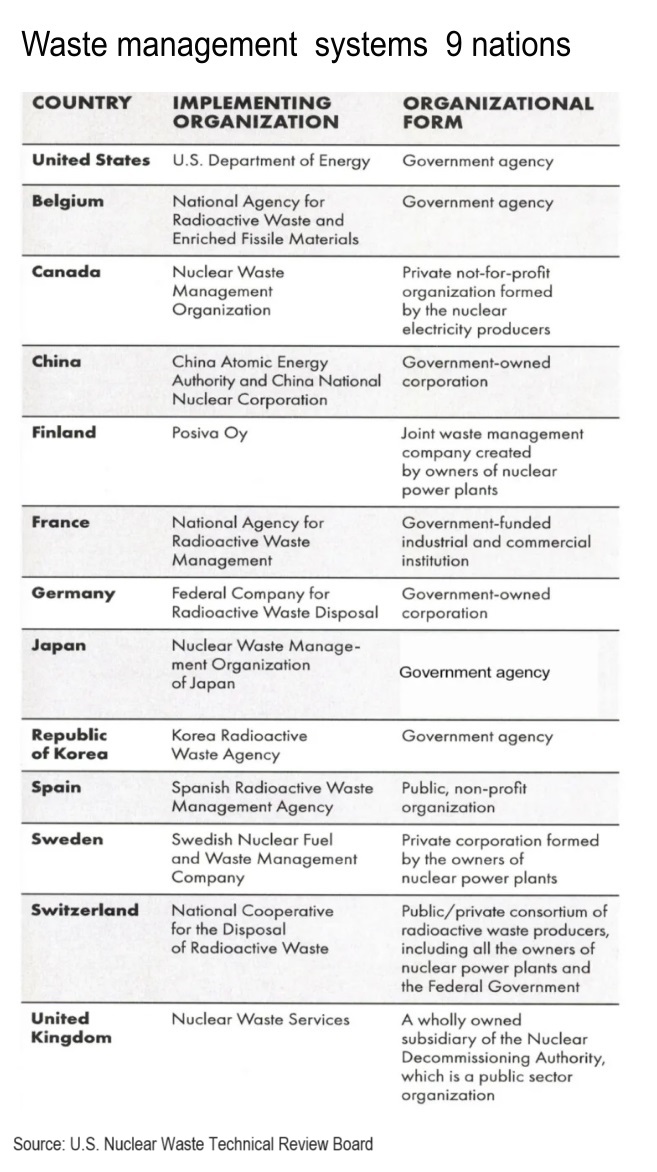
As if the American or “Western” history of nuclear waste were the whole story, we learn little or nothing about nuclear waste management in Russia, China, India, North Korea, South Korea, Japan (except for Fukushima). On the rare occasions when the Western media has mentioned Russia’s nuclear waste history, it is to gloat over what a mess Russia has made of it.
However, the US National Academy of Science and its Russian counterpart met in 1992 , leading to a U.S-Russia pledge in 2000 to reciprocally dispose of 34 metric tons of excess weapons plutonium. It was a complicated co-operative effort which fell apart completely by 2016.
The nuclear waste industry bumbles on, with prospects of profits for waste management companies like Holtec, and of “jobs , jobs’, Jobs”. Is the nuclear behometh just too big to be stopped?
There are two questions about nuclear wastes that are never asked by the “experts”, let alone answered by them:
- Why not stop making more nuclear trash?
- Why do the nuclear-power countries not work together, co-operate, in getting rid of the existing global problem of nuclear trash?
1 This Month

of the week – Shut Down Drone Warfare!


Tell the Ukrainian Government to Drop Prosecution of Peace Activist Yurii Sheliazhenko

Petition to revoke the licensing of the Near Surface Nuclear Disposal Facility (NSDF) at Chalk River. https://www.ourcommons.ca/petitions/en/Petition/Details?Petition=e-7247
To see nuclear-related stories in greater depth and intensity – go to https://nuclearinformation.wordpress.com
-
Archives
- April 2026 (7)
- March 2026 (251)
- February 2026 (268)
- January 2026 (308)
- December 2025 (358)
- November 2025 (359)
- October 2025 (376)
- September 2025 (257)
- August 2025 (319)
- July 2025 (230)
- June 2025 (348)
- May 2025 (261)
-
Categories
- 1
- 1 NUCLEAR ISSUES
- business and costs
- climate change
- culture and arts
- ENERGY
- environment
- health
- history
- indigenous issues
- Legal
- marketing of nuclear
- media
- opposition to nuclear
- PERSONAL STORIES
- politics
- politics international
- Religion and ethics
- safety
- secrets,lies and civil liberties
- spinbuster
- technology
- Uranium
- wastes
- weapons and war
- Women
- 2 WORLD
- ACTION
- AFRICA
- Atrocities
- AUSTRALIA
- Christina's notes
- Christina's themes
- culture and arts
- Events
- Fuk 2022
- Fuk 2023
- Fukushima 2017
- Fukushima 2018
- fukushima 2019
- Fukushima 2020
- Fukushima 2021
- general
- global warming
- Humour (God we need it)
- Nuclear
- RARE EARTHS
- Reference
- resources – print
- Resources -audiovicual
- Weekly Newsletter
- World
- World Nuclear
- YouTube
-
RSS
Entries RSS
Comments RSS
 nuclear-news