Departing Air Force Secretary Will Leave Space Weaponry as a Legacy

msn, by Eric Lipton, 30 Dec 24
WASHINGTON — Weapons in space. Fighter jets powered by artificial intelligence.
As the Biden administration comes to a close, one of its legacies will be kicking off the transformation of the nearly 80-year-old U.S. Air Force under the orchestration of its secretary, Frank Kendall.
When he leaves office in January — after more than five decades at the Defense Department and as a military contractor, including nearly four years as Air Force secretary — Mr. Kendall, 75, will have set the stage for a transition that is not only changing how the Air Force is organized but how global wars will be fought.
One of the biggest elements of this shift is the move by the United States to prepare for potential space conflict with Russia, China or some other nation.
In a way, space has been a military zone since the Germans first reached it in 1944 with their V2 rockets that left the earth’s atmosphere before they rained down on London, causing hundreds of deaths. Now, at Mr. Kendall’s direction, the United States is preparing to take that concept to a new level by deploying space-based weapons that can disable or disrupt the growing fleet of Chinese or Russian military satellites………………………
Perhaps of equal significance is the Air Force’s shift under Mr. Kendall to rapidly acquire a new type of fighter jet: a missile-carrying robot that in some cases could make kill decisions without human approval of each individual strike.
In short, artificial-intelligence-enhanced fighter jets and space-based warfare are not just ideas in some science fiction movie. Before the end of this decade, both are slated to be an operational part of the Air Force because of choices Mr. Kendall made or helped accelerate.
The Pentagon is the largest bureaucracy in the world. But Mr. Kendall has shown, more than most of its senior officials, that it too can be forced to innovate.
“It is big,” said Richard Hallion, a military historian and retired senior Pentagon adviser, describing the change underway at the Air Force. “We have seen the maturation of a diffuse group of technologies that, taken together, have forced a transformation of the American military structure.”
Mr. Kendall is an unusual figure to be the top civilian executive at the Air Force, a job he was appointed to by President Biden in 2021, overseeing a $215 billion budget and 700,000 employees…………….
Mr. Kendall, who has a folksy demeanor more like a college professor than a top military leader, comes at the job in a way that recalls his graduate training as an engineer.
He gets fixated on both the mechanics and the design process of the military systems his teams are building at a cost of billions of dollars. Mr. Kendall and Gen. David Allvin, the department’s top uniformed officer, have called this effort “optimizing the Air Force for great power competition.”………………….
Mr. Kendall has taken these innovations — built out during earlier waves of change at the Air Force — and amped up the focus on autonomy even more through a program called Collaborative Combat Aircraft.
These new missile-carrying robot drones will rely on A.I.-enhanced software that not only allows them to fly on their own but to independently make certain vital mission decisions, such as what route to fly or how best to identify and attack enemy targets.
The plan is to have three or four of these robot drones fly as part of a team run by a human-piloted fighter jet, allowing the less expensive drone to take greater risks, such as flying ahead to attack enemy missile defense systems before Navy ships or piloted aircraft join the assault.
Mr. Kendall, in an earlier interview with The Times, said this kind of device would require society to more broadly accept that individual kill decisions will increasingly be made by robots……………….
These new collaborative combat aircraft — which will cost as much as about $25 million each, compared to the approximately $80 million price for a manned F-35 fighter jet — are being built for the Air Force by two sets of vendors. One group is assembling the first of these new jets while a second is creating the software that allows them to fly autonomously and make key mission decisions on their own.
This is also a major departure for the Air Force, which usually relies on a single prime contractor to do both, and a sign of just how important the software is — the brain that will effectively fly these robotic fighter jets………………………………………
Space is now a fighting zone, Mr. Kendall acknowledged, like the oceans of the earth or battlefields on the ground.
The United States, Russia and China each tested sending missiles into space to destroy satellites starting decades ago, although the United States has since disavowed this kind of weapon because of the destructive debris fields it creates in orbit.
So during his tenure, the Air Force started to build out a suite of what Mr. Kendall called “low-debris-causing weapons” that will be able to disrupt or disable Chinese or other enemy satellites, the first of which is expected to be operational by 2026.
Mr. Kendall and Gen. Chance Saltzman, the chief of Space Operations, would not specify how these American systems will work. But other former Pentagon officials have said they likely will include electronic jamming, cyberattacks, lasers, high-powered microwave systems or even U.S. satellites that can grab or move enemy satellites.
The Space Force, over the last three years, has also been rapidly building out its own new network of low-earth-orbit satellites to make the military gear in space much harder to disable, as there will be hundreds of cheaper, smaller satellites, instead of a few very vulnerable targets.
Mr. Kendall said when he first came into office, there was an understandable aversion to weaponizing space, but that now the debate about “the sanctity or purity of space” is effectively over.
“Space is a vacuum that surrounds Earth,” Mr. Kendall said. “It’s a place that can be used for military advantage and it is being used for that. We can’t just ignore that on some obscure, esoteric principle that says we shouldn’t put weapons in space and maintain it. That’s not logical for me. Not logical at all. The threat is there. It’s a domain we have to be competitive in.” https://www.msn.com/en-us/news/politics/departing-air-force-secretary-will-leave-space-weaponry-as-a-legacy/ar-AA1wE4iS
Toshiyuki Mimaki: Let’s save humanity from nuclear weapons
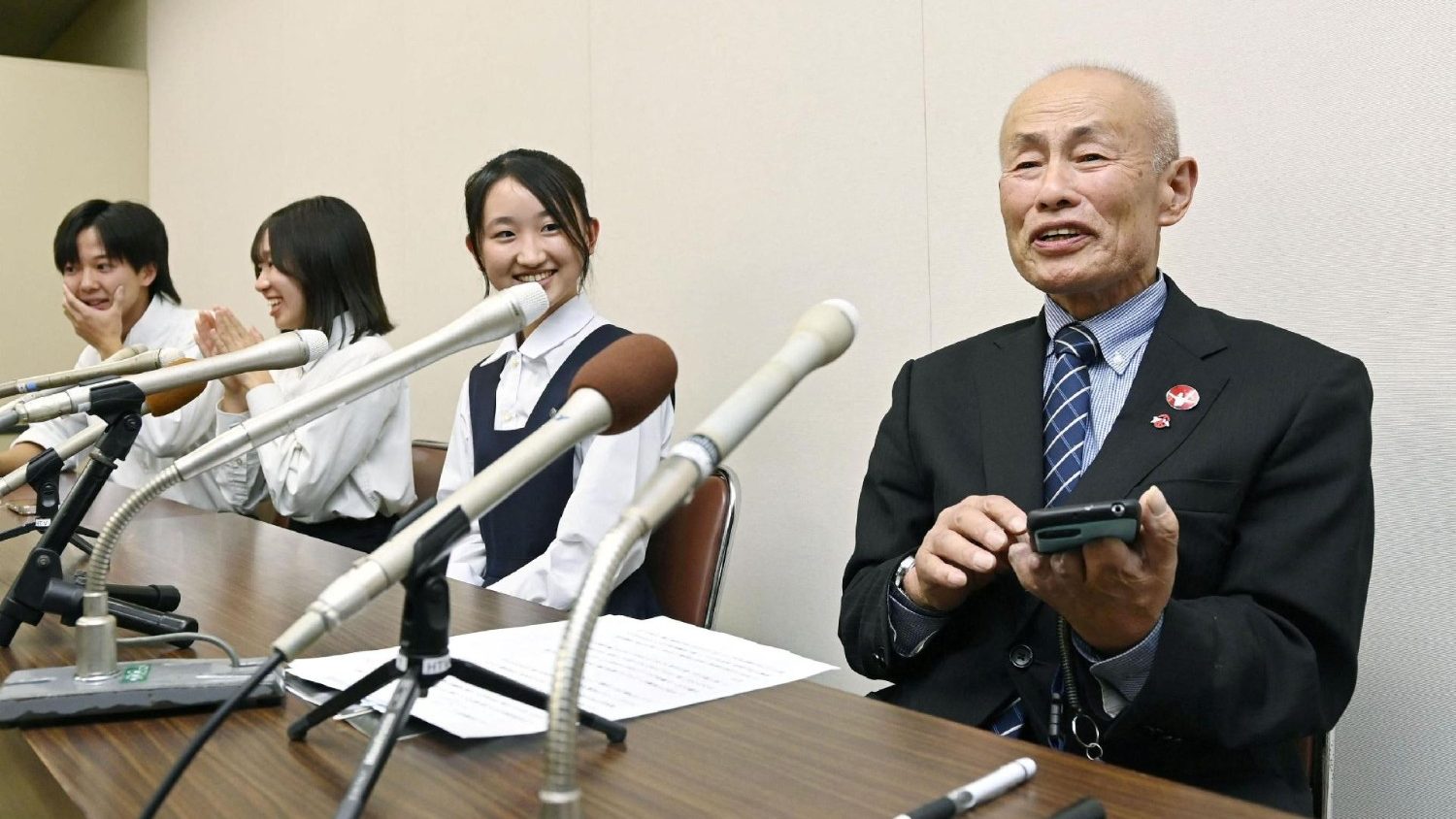
An interview with Hiroshima atomic bomb survivor and co-president of the Japanese foundation Nihon Hidankyo, Toshiyuki Mimaki, recipient of the 2024 Nobel Peace Prize. Mimaki reflects on his meeting with Pope Francis in Japan in 2019 and calls on world leaders to commit to eliminating nuclear weapons.
By Alessandro Gisotti, https://www.vaticannews.va/en/world/news/2024-12/mimaki-nihon-hidankyo-nobel-peace-prize-elimination-nuclear-arms.html
Shattered buildings. A landscape wiped clean. So much destruction that the sea became visible where once a vibrant city stood. This is the indelible memory carried by a three-year-old boy who witnessed an unthinkable and catastrophic event—one that, tragically, did occur. Toshiyuki Mimaki shares this harrowing memory with L’Osservatore Romano.
Now 82 years old, Mimaki has never stopped reflecting on August 6, 1945, the day the atomic bomb devastated Hiroshima, his hometown. That moment not only changed the course of human history but also took the lives of tens of thousands of people.
On December 10, Mimaki accepted the Nobel Peace Prize in Oslo as co-president of Nihon Hidankyo, a foundation established in 1956 dedicated to nuclear disarmament. Nihon Hidankyo unites the hibakusha—survivors of the atomic bombings of Hiroshima and Nagasaki at the end of World War II.
The foundation’s mission is rooted in the power of testimony, relying on the gentle but impactful strength of storytelling. The Norwegian Nobel Committee acknowledged this effort, stating, “We all have a duty to continue the mission of the hibakusha. Their moral compass is our legacy. Now it is up to us. The fight for disarmament requires persistent and vocal advocacy.”
As the International Day of Peace approaches, Toshiyuki Mimaki reflects on his role as a custodian of the legacy of those who came before him—the hibakusha who founded Nihon Hidankyo. Survivors like him aim to ensure the world never forgets the tragedy of that fateful August morning.
“When I was three years old,” Mimaki recounts, “my mother, younger brother, and I were exposed to the bomb’s radiation while searching for my father, who worked for the Hiroshima railway. Countless lives were lost, and buildings were consumed by flames to the extent that you could see all the way to the sea. My younger brother is now undergoing treatment for brain cancer.”
Despite the pain of revisiting such memories, sharing these experiences is central to the hibakusha mission: ensuring that the horror of nuclear weapons is never repeated. This mission becomes ever more urgent as the remaining survivors of the bombings near the end of their lives.
“Hiroshima has taken steps to preserve these testimonies,” Mimaki explains. “The city has established programs to educate young people, training them to become messengers who can carry forward our stories for future generations.”
Mimaki expresses deep gratitude for Pope Francis’s dedication to nuclear disarmament. He had the opportunity to meet the Pope during his visit to Hiroshima and Nagasaki in November 2019. “I met the Pope when he came to visit us,” Mimaki recalls. “He gave me a medal in a red case, and I asked him to work toward abolishing nuclear weapons. I still treasure a photograph from that day.”
Despite the global appeal for disarmament, discussions about the potential use of nuclear weapons and the possibility of atomic conflict have intensified in recent years. For Mimaki, who still carries the scars of that catastrophic day, the thought of nuclear weapons being used again is unimaginable.
“If nuclear weapons were ever used again,” he warns, “it would mean the end of humanity. This is why I implore leaders of nations with nuclear arsenals to commit to their complete elimination.”
Mimaki is particularly alarmed by the ongoing conflicts in Gaza and Ukraine. “Russian President Putin,” he observes with concern, “has lowered the threshold for the use of nuclear weapons, making them deployable at any moment. It’s a terrifying situation. I urge everyone to visit Hiroshima and Nagasaki and see the Atomic Bomb Museum. Witness firsthand the devastating impact nuclear weapons have on human life.”
Arms control is essential to prevent the total devastation of nuclear war

Amid a historic low in US-Russian relations, now more than ever Moscow and Washington should reaffirm their commitment to reducing nuclear arsenals and place limits on strategic defense missiles
By The Guardian Editorial, https://www.taipeitimes.com/News/editorials/archives/2024/12/31/2003829391
November next year is to mark 40 years since then-US president Ronald Reagan and then-Soviet leader Mikhail Gorbachev declared that “a nuclear war cannot be won and must never be fought.” The statement was striking — not least because their militaries were pouring billions into preparing for an unwinnable conflict.
A year later, at Reykjavik, the two came tantalizingly close to eliminating nuclear weapons entirely. That historic chance slipped away over Reagan’s insistence on his unproven “Star Wars” missile defense system. The moment passed, but its lesson endures: Disarmament demands courage — and compromise.
The summit proved a turning point in the cold war. Arms control brought down the number of nuclear weapons held by the two countries from 60,000 to about 11,000 today. The most recent New Strategic Arms Reduction Treaty (New START), signed in 2010, capped deployed strategic warheads at 1,550 each.
In retrospect, that was a false dawn in nuclear diplomacy. Since then-US president George W. Bush withdrew the US from the anti-ballistic missile treaty with Moscow in 2002, the risk of a return to an all-out arms race has grown.
On Jan. 20, US president-elect Donald Trump would once again hold the keys to a planet-ending arsenal. Trump’s capricious personality sheds new light on an old question: How much of the terrible responsibility to inflict large-scale nuclear destruction should be invested in a single person?
He has called the transfer of authority “a very sobering moment” and “very, very scary.” Reassuring words — except he has also reportedly said that “if we have nuclear weapons, why can’t we use them?”
Presidential sole authority rightly ensures civilian control over nuclear weapons, but why concentrate such power in just one civilian’s hands?
Without bold action, New START, the last safeguard of nuclear arms moderation, is to expire in February 2026. Trump admires strongmen such as Russian President Vladimir Putin, who has recklessly threatened nuclear strikes and hinted at restarting tests during the Ukraine war. It would be a catastrophic mistake if the pair decided not to exercise self-restraint.
It would mean that for the first time in more than 50 years, the US and Russia — holders of 90 percent of the world’s nuclear weapons — could begin an unconstrained arms race. That dismal decision would send a message to other states, notably China, further encouraging their buildup of nuclear stockpiles.
Deterrence is not the only way to think about nuclear weapons. For decades, a conflict involving them has been a byword for Armageddon. The fearful legacy of “the bomb” can be felt from Hiroshima and Nagasaki to the testing grounds still contaminated by nuclear fallout decades later.
Such sentiment led to then-US president Barack Obama in 2009 advocating a hopeful vision of a nuclear-free world. His speech inspired a coalition of activists, diplomats and developing nations determined to force a global reckoning. Their resistance to the conventional wisdom that nuclear disarmament is unrealistic bore fruit with the treaty on the prohibition of nuclear weapons, adopted by 122 countries at the UN in 2017.
Its message: The only way to ensure nuclear weapons are never used again is to do away with them entirely.
The treaty, championed by the Nobel prize-winning International Campaign to Abolish Nuclear Weapons, was a triumph over superpower diplomacy that had long hindered reviews of the nuclear nonproliferation treaty. Nuclear-armed states are skeptical, if not scornful, but their resistance does not diminish the importance of the 2017 UN vote.
It represents not only a moral and legal challenge to the “status quo,” but a reminder that much of the world does not accept the logic of mutually assured destruction. That sentiment was amplified this year when Nihon Hidankyo, Japan’s atomic and hydrogen bomb survivors group, won the Nobel peace prize for efforts to abolish nuclear weapons.
Eight decades after its first test, the nuclear bomb remains — its purpose long obsolete, its danger ever present. Built to defeat Hitler, dropped to end Japan’s imperial ambitions and multiplied to outlast the cold war, nuclear weapons have outlived every rationale for their existence. Arsenals have shrunk, but not enough.
The world’s stockpile remains dangerously large, and efforts to reduce it further appear stalled amid a geopolitical backdrop of nuclear proliferation, a multipolar and ideologically diverse UN and the US desire for global preeminence.
It is little wonder that the Bulletin of the Atomic Scientists has set its Doomsday Clock to 90 seconds to midnight — the closest ever to apocalypse.
In 2019, Gorbachev warned, with good reason, that nuclear deterrence keeps the world “in constant jeopardy.” It is obvious that as long as these weapons exist, the risk of nuclear war cannot be erased. The question is no longer why the bomb remains, but whether humanity can survive it for another 80 years.
This month, UN members voted 144-3 to establish an independent scientific panel on the effects of nuclear war. Shamefully, the UK was among the naysayers.

Imagination has already outpaced fact. In her book Nuclear War, Annie Jacobson describes how humanity could end in 72 minutes after a North Korean “bolt from the blue” attack sparks a nuclear exchange between the US and Russia. She writes of thousands of warheads raining down on the US, Europe, Russia and parts of Asia, obliterating cities, incinerating human life and leaving billions stripped of life, light and hope. Streets turn molten, winds flatten the land and those who endure suffer wounds so terrible that they no longer look — or act — human.
Jacobson’s point is that this apocalyptic vision is the logical conclusion of the world’s current nuclear doctrines. Those that do emerge into the desolation discover what the Soviet leader Nikita Khrushchev warned of decades ago: “The survivors will envy the dead.”
The devastation is total, offering a future that no one could bear to live through.
Amid historic lows in US-Russian relations, one truth remains: A nuclear war cannot be won and must never be fought. Leaders in Moscow and Washington should reaffirm this in the run-up to negotiating significant arsenal reductions as well as real limits on strategic missile defenses. Such a statement, simple but profound, would remind the world that Trump and Putin recognize their shared responsibility to prevent global catastrophe.
That will not be easy: rising nationalism, geopolitical rivalry and mutual mistrust between the countries — especially over Ukraine — loom large over disarmament efforts. Try they must. However bitter their disagreements, Washington and Moscow owe it to humanity to talk about — and act on — avoiding the unthinkable.
New Zealand is under siege by the Atlas Network
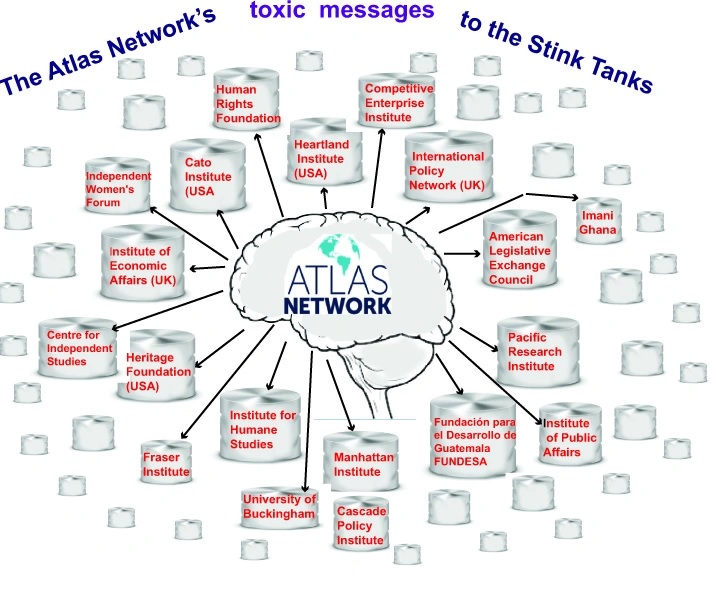
We have a handful of years to achieve a monumental shift from fossil fuel towards renewable energy: Atlas partners aim to ensure this does not take place.

March 3, 2024, by: Lucy Hamilton, https://theaimn.com/new-zealand-is-under-siege-by-the-atlas-network/—
Just as the Atlas Network-connected Advance body intervened in the Voice referendum in Australia and, in recent weeks, a by-election, similar organisations spawned from the American model are distorting New Zealand’s politics from within as well as from without.
One of the key researchers into the Atlas Network, Lee Fang, observed that it has “reshaped political power in country after country.” In America, every Republican president since Ronald Reagan has begun office with a Roadmap provided by the Heritage Foundation, primary Atlas Network partner. The “Mandate” for 2025 puts America on a hard path to fascism should a Republican win in November. Britain’s economy and standing have been savaged by Atlas partners’ impacts on the Tories. In New Zealand, the recently-elected rightwing coalition government is aping the new “Atlas president” of Argentina, aiming to privatise national assets, but is increasingly also imitating Atlas strategies recently seen in Australia, inflaming racial tensions and harming the wellbeing of Māori people.
Dr Jeremy Walker called Australia’s attention to the local Atlas partner organisations’ impact on the Voice to Parliament referendum and is now helping draw together the focus on the New Zealand partners’ very similar distortion of their national debate. There is a deep racism at the heart of this ultra-free market ideology that has licensed the international right to exploit resources and people around the globe untrammelled, largely in American corporate interest, but more broadly for any corporation or allied sector big enough to be a contender. (They do not, by contrast, fight for the renewable energy sector’s interests, as a competitor to their dominant fossil fuel donors; this shapes their climate crisis denial and delay, and colours their loathing of First People’s capacity to interfere with their profits by environment-driven protest. A sense of Western Civilisation as the apex of human existence and deep disdain for non-Western cultures also pervade the network.)
The Atlas model is to connect and foster talent in the neoliberal sphere. Young men (mostly) are funded or trained to replicate the talking points that Ultra High Net Worth Individuals (UHNWI) and lobbyists have built into a global network of over 500 bodies in 100 nations. The fact that neoliberal orthodoxies are more religious ideology that fact-based theories explains why their impact has been so utterly disastrous everywhere they have reshaped societies. The goal is to spawn replicating bodies with benign-sounding names that promote the UHNWI and corporate talking points – but with a veil hiding the self-interest that is obvious when those groups speak for themselves. Some of the bodies feign being thinktanks, which George Monbiot recently renamed junktanks to clarify their disingenuousness. Others are “astroturf” organisations that pretend to be grass roots bodies representing popular opinion. Another model is the beach-head in universities, an independent organisation within those institutions intended to dignify the neoliberal religion and the chosen strategies, including climate denial. All these produce material to fill civic debate and train more acolytes to enter politics, strategy companies and junktanks. Mainstream media elevates their standing by hosting their operatives as experts without explaining that the benign-sounding organisation to which they belong is a foreign-influence operation’s local outlet.
These groups damage local conditions to favour international corporations. They lobby for the removal of the “regulations” that are actually protections for the public – as workers, as consumers, as residents. They push for the privatisation of national treasures so that (often foreign) corporations can exploit the profits at the expense of the public. The greater the damage to the local democracy, the easier it is for them to act unimpeded. The stronger their infiltration of the media, the harder it is for the local electorate to understand the stakes. The politicians and strategists that emerge from the sphere (or are its allies) know that none of this wins votes, so they fill the space with culture war division to distract the voter from paying attention. Race and sexuality are their most obvious targets, as reactionary nostalgia for a mythical past of white picket fences pervades their ideology: a valorisation of “Christianity” and “family” and the “sacredness of marriage” (preached by adulterous politicians) is equally apparent in their propaganda.
The coalition that took power in NZ late in 2023, after a campaign centred on attacking the country’s founding Waitangi Treaty, has considerable Atlas infiltration. There is concern about Atlas fossil fuel and associated tobacco interests perverting policy in parliament, as well as senior ministerial aides who might be compromised. The government has promised to repeal Jacinda Ardern’s ban on offshore gas and fuel exploration, plans to sell water to private interests, not to mention planning to enable the selling off of “sensitive” NZ land and assets to foreign corporations, just as Argentinian Milei is intending.’
One of the government members, the Act Party, began its existence as an Atlas partner thinktank and continues that close connection. It was founded by former parliamentarian Denis Quigley with two members of the Mont Pelerin Society (MPS), the Atlas Network’s inner sanctum. One, Roger Douglas, was responsible for Rogernomics in NZ which has been described as a “right wing coup” that worked to “dismantle the welfare state.” The other, Alan Gibbs, who has been characterised as the godfather of the party, and a major funder, argued Act ought to campaign for government to privatise “all the schools, all the hospitals and all the roads.” This may not be surprising since he made much of his fortune out of the privatisation of NZ’s telecommunications.
The Act Party is currently led by David Seymour who functions as a co-deputy prime minister in the government. He has worked almost his entire adult life within Atlas partner bodies in Canada and boasts a (micro) MBA dispensed by the Network.
In Seymour’s 2021 Waitangi Day speech, he acknowledged his “old friends at the Atlas Network.” In light of that, his recent disdainful and absolute dismissal of the party’s connection to Atlas in an interview was telling: he clearly felt the association was damaging enough to lie outright.
Seymour is also deeply antagonistic to policies dedicated to repairing the disadvantage suffered by Māori people, disingenuously describing provisions that work cooperatively with Māori people as the “dismantling of democracy.” He appears antagonistic to Māori culture.
Another Atlas partner that has been key to distorting debate in NZ is the Taxpayer Union (TPU) which is emblematic of the production of metastasising bodies central to the Atlas strategy. Its co-founder and executive director is another graduate of the Atlas (micro) MBA program. Jordan Williams (currently “capo di tutti capi” of the Atlas global alliance of anti-tax junktanks) laughably depicts Atlas as a benign “club of like-minded think tanks.” He created, however, a body called the Campaign Company which helped radicalise the established farmer power base in NZ politics, planting sponsored material in the media. Williams claimed to grant the farmers “world-class campaign tools and digital strategies.” He also co-founded the Free Speech Union (FSU), which is unsurprisingly fighting regulation of the damaging impact of internet disinformation as well as fostering culture war battles.
A further spin-off of the bodies illustrates the increasing ugliness of the populist strategies. A former Act Party MP has founded the New Zealand Centre for Political Research which is fomenting civic division against Māori interests, including placing hate-mongering advertisements in the media.
The Act Party (alongside the populist New Zealand First party) is at the heart of the coalition government’s intention to destroy NZ’s admirable efforts to promote Māori interests for the betterment of the commonwealth, including the co-governance innovation. Efforts to undo disadvantage and programs that have promoted the distinctive NZ democratic experiment are set to be dismantled. A “massive unravelling” of Māori rights is at stake.
It is not only Māori people who will suffer. The NZ coalition government is also attempting a kind of “shock therapy” that did so much to tip first Chile and then other “developing” nations into brutal pain in pursuit of market “freedom.” The MPS was at the heart of Pinochet’s neoliberal brutality, resulting from Nixon’s injunction to make the Chilean economy scream.[1] New Zealand now faces cuts to a range of services, welfare and disability payments, even while the new PM, one of NZ’s wealthiest ever holders of the role, charged the taxpayer NZD 52,000 to live in his own property. It’s important to remember that this kind of entitlement is the sort that the neoliberals like, alongside subsidies to industry and corporations.
Lord Hannan (one of Boris Johnson’s elevations to the peerage, and a junktank creature) recently spoke in NZ, welcoming “all the coalition partners around this table” to hear his oration. There he celebrated the small percentage of GDP that NZ’s government spends on its people, cheering on the TPU’s power. He also disdained the “tribalism” that has dictated recognition of First Peoples’ suffering. There is grand (but unsurprising) irony in a graduate of three of Britain’s preeminent educational institutions dictating that humanity’s essential equality is all that can be considered when devising policy, particularly in settler-colonial nations.
Amusingly the weightier debunking of the Atlas connections has come from: Chris Trotter, formerly centre left, now a council member of Williams’ FSU; Eric Crampton, chief economist of the New Zealand Initiative, NZ’s leading Atlas partner and Sean Plunkett whose “anti-woke” vanity media platform, Platform, is plutocrat funded and regularly platforms the NZI talking heads.
While Atlas’s system largely functions to connect and train operatives, as well as acting as an extension of American foreign policy, this modest-seeming program must not be ignored. We have a handful of years to achieve a monumental shift from fossil fuel towards renewable energy: Atlas partners aim to ensure this does not take place.
And Atlas partners will push us at each other’s throats while we procrastinate.
[1] That MPS intervention resulted in massive unemployment, extraordinary inequality, and fire-sale prices of national assets to cronies. Much of Chile’s later success is as likely to be attributable to the trade requirements of (statist) China whose demand for copper has done so much to enrich Chile.
The Time Navy Lt. Jimmy Carter Was Lowered Into A Partially Melted-Down Nuclear Reactor
The recently deceased 39th president had a hand in the dawn of the nuclear submarine age, including one especially dangerous mission.
The War Zone, Geoff Ziezulewicz, 30 Dec 24
resident Jimmy Carter’s time as a U.S. Navy officer might have been brief, but it served to inform the rest of his days before passing away Sunday at the age of 100. Prior to his political career and Nobel Prize-winning peacemaking efforts, Carter stood at the side of the father of the nuclear Navy during its infancy, and even got lowered into a melted-down nuclear reactor as a junior officer. Decades later, the former president was stunned to learn of the capabilities carried by the secretive spy submarine that bears his name to this day.
Ensign James Earl “Jimmy” Carter graduated from the U.S. Naval Academy in 1946, and applied to join the Navy’s nuclear submarine community a few years later, according to the Navy…………………………………………………………………………………………………………………………….
After Carter joined the Navy’s nuclear efforts, the 28-year-old and his crew were sent to repair the Chalk Water nuclear reactor near Ottawa, Canada, in late 1952. The reactor had suffered a partial meltdown, and a team was needed to shut it down, take it apart and replace it. Carter and the rest of the team took a train up north and soon got to work.
“They built an identical replica of the reactor on an adjacent tennis court to precisely run through the repair procedures, due to the maximum time humans could be exposed to the levels of radiation present in the damaged area,” a Navy history recounts. “Each member of the 22 member team could only be lowered into the reactor for 90-second periods to clean up and repair the site.”
Official accounts don’t clarify whether Carter was in command during the mission, or his precise role. Still, the future president did his part, Canadian journalist Arthur Milnes later recounted.
“He was lowered into the building … with his wrench, and he had to run over to the reactor casing and he had one screw to turn,” Milnes said after interviewing Carter about the incident. “That was all the time he had. And then, boom, back up.”
Carter and the others were regularly tested after the mission was finished to look for long-term health effects.
“They let us [crew members] get probably a thousand times more radiation than they would now.” Carter told CNN in 2008 while reflecting on the incident. “We were fairly well-instructed then on what nuclear power was, but for about six months after that, I had radioactivity in my urine.”
In his autobiography, “A Full Life, Reflections at Ninety,” Carter recounted the distinctive perils of being a submarine officer:
“Although some enlisted men could concentrate almost exclusively on their own fields of responsibility as engine men, electricians, torpedo experts, boatswains, quartermasters, gunners or operators of navigation and fire control equipment, every officer was expected to master all of these disciplines…we knew one mistake could endanger everyone aboard.”…………………………………………………………………………
Carter lived an extraordinary life, by all accounts. His time in the submarine community played a critical role in all that came after, and he remained a Navy man until the end.
You and I leave here today to do our common duty—protecting our Nation’s vital interests by peaceful means if possible, by resolute action if necessary,” Carter told the graduating class of Naval Academy midshipmen in 1978. “We go forth sobered by these responsibilities, but confident of our strength. We go forth knowing that our Nation’s goals—peace, security, liberty for ourselves and for others—will determine our future and that we together can prevail.”
RIP President Jimmy Carter, 1924-2024, https://www.twz.com/sea/the-time-navy-lt-jimmy-carter-was-lowered-into-a-partially-melted-down-nuclear-reactor
Nuclear power had a strong year in 2024, but uncertainty looms for 2025
Though companies are touting aggressive timelines, no decommissioned reactor has ever been restarted in the United States, and there is no regulatory framework for the process.
From VC funding to planned reactor restarts, the U.S. nuclear industry notched wins this year. But the winning streak could end if Trump revokes government support.
By Eric Wesoff, 30 December 2024, more https://www.canarymedia.com/articles/nuclear/nuclear-power-had-a-strong-year-in-2024-but-uncertainty-looms-for-2025
2024 was a breakout year for the U.S. nuclear power sector — at least on paper.
There’s more government, industry, and civilian support for nuclear energy than there has been in decades. There aren’t enough retired nuclear plants to keep up with the newfound desire to plug mothballed facilities back into the grid. Advanced reactor companies continue to raise a lot of money, both private and public. Congress managed to pass a bipartisan law to support domestic nuclear development.
But this ostensible U.S. nuclear renaissance will come to a screeching halt without continued federal support, especially from two of the Biden administration’s marquee policies, the Inflation Reduction Act and the bipartisan infrastructure law. While the first Trump administration funded billion-dollar nuclear demonstration programs and loans, it’s the Biden-era programs that have been pumping the most funding into the nuclear industry — and that are most at risk when Donald Trump takes office next year.
So, at the end of this momentous year for nuclear, the industry is left not only with some wins but also with some major questions. Let’s review.
The big question: What will Trump do on nuclear?
So far, Trump has been sending mixed signals about nuclear power policy, and no one in government, in industry, or on the social network formerly known as Twitter can yet divine his true leanings.
The first Trump administration provided crucial billions in loan guarantees to complete construction of Plant Vogtle Units 3 and 4 in Georgia. Trump signed the Nuclear Energy Innovation and Modernization Act, which opened up a new technology-agnostic advanced reactor licensing pathway, expected to be finalized by the Nuclear Regulatory Commission by 2027. He also oversaw the Department of Energy’s launch of the Advanced Reactor Demonstration Program.
But Trump has pledged to repeal the IRA tax credits for lower-carbon energy sources, which could potentially include funding for existing reactors and new advanced reactors. It’s very possible that the second Trump administration won’t continue the Biden administration’s “massive appropriations” to the nuclear sector, John Starkey, director of public policy at the American Nuclear Society, told Utility Dive.
Searching for clarity, we are compelled to cite a recent Joe Rogan podcast, where the president-elect expressed some doubt about large nuclear projects like Vogtle, which he said “get too big and too complex and too expensive.”
But a few months earlier, Trump vowed, “Starting on day one, I will approve new drilling, new pipelines, new refineries, new power plants, new reactors.”
The bottom line is that without federal tax credits — or other government support as a backstop in the likely event of cost overruns — utilities and utility commissions won’t proceed with new reactor construction during the second Trump term, regardless of the memorandums of understanding and letters of intent now being signed.
A win: Vogtle 4 online in 2024
The nuclear industry will take its wins where it can get them, even when they’re expensive and bruising — a description that fits the finally completed buildout of Georgia’s Vogtle nuclear facility. After years of delays and billions in cost overruns, the Vogtle Unit 3 reactor entered commercial operation on July 31 of last year and the fourth and final unit came online on April 29, 2024.
These reactors are the first newly constructed nuclear units built in the U.S. in more than three decades and the first U.S. deployment of the Westinghouse AP1000 Generation III+ reactor design.
With these AP1000 projects complete, America now has familiarity with a modern reactor design and a trained workforce that knows how to build these reactors. There are plenty of potential places to build similar power plants — the NRC has approved licenses or is considering applications for new reactors at 17 sites across the U.S.
A small win: Advancing a nuclear pledge at COP29
At last year’s United Nations climate conference, COP28, the U.S. and two dozen other countries signed a pledge to triple nuclear power capacity by 2050.
We saw a tad more progress at this year’s conference, COP29, in Baku, Azerbaijan, as six additional countries signed onto that pledge. And the Biden administration unveiled its plan for getting the U.S. from nearly 100 gigawatts of nuclear power capacity to 300 gigawatts by mid-century, including adding 35 gigawatts by 2035, through the construction of new reactors, plant restarts, and upgrades to existing facilities.
Of course, Trump plans to pull the U.S. out of the Paris climate agreement (again), so he can’t be counted on to follow through on Biden’s pledges.
Question: Will the U.S. commit to big reactors or chase small ones?
If the U.S. were to try to meet Biden’s goal for expanding nuclear in the U.S., companies would need to place orders ASAP for many of the same model of big reactors — like, say, a bunch of AP1000s — according to the September update to the U.S. Department of Energy’s report Pathways to Commercial Liftoff: Advanced Nuclear.
The report suggests that the path to a U.S. nuclear renaissance runs not through small modular reactors (SMRs) or fusion machines, but through the iterative construction of already licensed, large-scale, light-water reactors and the development of an order book and stakeholder consortium.
This focus on large-scale reactors marks a departure from the years of conventional wisdom that SMRs are the cure for America’s nuclear malaise — a wisdom that has yet to result in a single grid-connected reactor. But many investors have not gotten the memo, hence …
A win: VCs and tech firms back small nuclear
Traditional venture capitalists and the celebrity investor class poured more than $800 million into so-called advanced nuclear this year, returning to the sector after a dip in 2023, according to Axios Pro. The investors are anticipating venture-scale returns from the imminent AI-driven demand for power.
Not all investors are aligned. Tyler Lancaster of Energize Capital tells Axios Pro Rata, “Nuclear SMRs and fusion investment will result in a massive loss of capital for venture investors and will prove to be for this generation of climate-tech what biofuels were for the last.”
Still, plenty of investors are going all-in on advanced nuclear, and they’re not alone — the hyperscaling data-center operators are as well.
Search giant Google and startup Kairos Power signed one of the first corporate agreements to develop a fleet of SMRs. The plan is to bring Kairos’ first SMR online by 2030, followed by additional reactor construction through 2035. The NRC has issued Kairos a construction permit to build a demonstration reactor, a 35-megawatt unit using a molten fluoride salt coolant and a higher-concentration uranium fuel recipe.
Amazon is planning to deploy SMRs of an as yet unlicensed design to power its data centers. It announced in October that it would commit $334 million to explore installing small gas-cooled reactors at Hanford in Washington state, a contaminated site where the federal government used to produce nuclear weapons.
And microreactor startup Oklo just announced a partnership with data-center provider Switch to develop 12 gigawatts of power from its fast breeder design
Question: Is restarting reactors the cure for data-center fever?
But the data oligarchs aren’t only interested in advanced or smaller nuclear technologies. They’re also keen on big, old-school reactors.
This was the year that the biggest players in artificial intelligence — Amazon, Google, Meta, Microsoft, and Oracle — started inking deals to tap nuclear power to keep their data centers dreaming of electric sheep. Energy usage by data centers is surging and expected to continue to rise, and most of the companies driving this demand have voluntary carbon-free energy goals that they’d prefer not to completely undermine.
The data-center hyperscalers have plans to tap existing nuclear power, develop new reactors, and even reopen shuttered reactors and plants.
Constellation Energy is planning to restart operations at its shuttered Three Mile Island Unit 1 nuclear power plant in 2028, thanks to a 20-year deal to sell Microsoft the revived reactor’s power. Constellation has already begun procurement of nuclear fuel and long-lead materials and equipment, like a $100 million power transformer, according to Reuters.
NextEra CEO John Ketchum said in July that his company continues to evaluate the possibility of reopening the 601-megawatt Duane Arnold nuclear power plant in Iowa amid interest from data-center companies, but added, “There are only a few nuclear plants that can be recommissioned in an economic way.”
The defueled Palisades nuclear plant in Michigan, while not yet contracted with a data center, is expected to be back online by the end of this year, according to Nick Culp, a spokesperson for owner and operator Holtec International.
Though companies are touting aggressive timelines, no decommissioned reactor has ever been restarted in the United States, and there is no regulatory framework for the process.
Josh Wolfe, a VC investor at Lux Capital and the rare nuclear energy advocate who has actually made venture returns in the sector thanks to Kurion, a materials treatment startup, is not convinced that the AI revolution will be nuclearized. “The tech giants who built empires on weightless bits and bytes are now grappling with atoms: steel, copper, water rights, and, critically, natural gas,” he wrote in his firm’s quarterly update. “While we’re bullish on the seeming resurgence of nuclear power, abundant natural gas from the Texas Permian seems a wiser bet.”
A win: Restarting domestic fuel enrichment
This year, the Biden administration, with the help of a cooperative Congress, took steps that will help nuclear reactors of all types and sizes. It’s working to reestablish a uranium-enrichment supply chain to fuel the existing nuclear reactor fleet as well as provide the more concentrated fuels needed by many of the advanced reactors in development.
Centrus Energy, which has a corporate lineage stretching back to the Manhattan Project, resumed centrifuge manufacturing and expanded production capacity at its Oak Ridge, Tennessee, facility in November. Centrus will also invest about $60 million to support an expansion of uranium enrichment at its plant in Piketon, Ohio.
That’s important because roughly one in 20 American homes and businesses get their power from nuclear facilities that depend on Russian uranium-enrichment services, James Krellenstein, a nuclear expert and historian, said on a recent Decouple podcast.
A portion of the enriched uranium used in the current American reactor fleet comes from Russia’s nuclear defense and materials company, Rosatom. That fraught arrangement will stay in place until the U.S. has its own domestic enrichment program.
Although the U.S. once did have massive enrichment capacity following the second World War, those capabilities were abandoned in a series of governmental and corporate missteps. Now the U.S. is beginning the long journey back to self-sufficiency.
No change in Iran’s nuclear doctrine, top security official says
December 31, 2024 , https://www.tehrantimes.com/news/508118/No-change-in-Iran-s-nuclear-doctrine-top-security-official-says
TEHRAN – Iran’s top security official said on Monday that contrary to what is claimed by foreign media outlets there has been no change in Iran’s nuclear doctrine.
Ali Akbar Ahmadian, secretary of Iran’s Supreme National Security Council, made the remarks in a meeting with Omani Foreign Minister Said Badr al-Busaidi who visited Tehran on Monday
“… based on the views of the Leader of the Islamic Revolution there has been no change in the nuclear doctrine of the Islamic Republic of Iran,” Ahmadian asserted.
In response to a clarification by the Omani foreign minister about Iran’s nuclear activities as well as “remarks and rumors” that Iran has increased its stockpile of uranium or is enriching uranium to a higher level, Ahmadian said these are “baseless”.
“The Islamic Republic of Iran is still committed to the framework of the Muscat agreements and the ball is on the other side’s court to honor its commitments” based on the 2015 nuclear agreement, Ahmadian explained.
Under the 2015 nuclear agreement, officially known as the Joint Comprehensive Plan of Action (JCPOA), Iran agreed to put limits on its nuclear activities in exchange for termination of economic and financial sanctions.
The agreement was signed in 2015 between Iran and the 5+1 group, the five permanent members of the UN Security Council and Germany. However, the U.S. quit the agreement in 2018 and the remaining parties, including Britain, France and Germany (European trio), failed to observe their commitments.
Here comes Yakutia, Russia’s newest nuclear icebreaker
Rosatomflot now has eight nuclear-powered icebreakers in operation, the highest number since Soviet times.
Thomas Nilsen, Barents Observer 30 December 2024
The flag-raising ceremony happened at the Baltic Shipyard in St. Petersburg on December 28. It took four and a half years to build the Yakutia and the icebreaker is the first made with mostly Russian-made components.
Testing took place in the Gulf of Finland earlier in December and the powerful vessel is now delivered to Rosatomflot, the state-owned company in charge of sailings and infrastructure along the Northern Sea Route.
The three previous icebreakers of the same class had both Western and Ukrainian made parts. With sanctions implemented and the engine factory in Ukraine bombed, the shipyard had to look for import substitutes domestically.
“The sanctions restrictions that we faced did not prevent us from ensuring high-quality and timely construction of the order,” said Deputy General Director Andrei Buzinov with the Baltic Shipyard at the ceremony.
The Yakutia is powered by two RITM-200 reactors and will join the fleet of nuclear-powered icebreakers sailing out of Rosatomflot’s base in Murmansk.
The three sister vessels of the same class, the Arktika, Sibir and Ural are already crushing the ice along the Northern Sea Route, mainly for Russia’s LNG export to reach the markets.
The fleet also includes four older nuclear-powered icebreakers, the Yamal and 50 Let Poedy, and the two Finnish built Taymyr and Vaygash. They have all got their service life prolonged.
Not since the late 1980s have more nuclear-powered icebreakers been in operation. Out at sea, the winter season 2024/2025 will be a record as several of the icebreakers in the late Soviet times stayed at port in Murmansk although they officially were on active duty. ……………..
The flag raising ceremony took place 65 years after the Soviet Union’s first nuclear-powered icebreaker, the Lenin, was launched from the yard in Severodvinsk. Lenin became the world’s first civilian nuclear-powered vessel and is today moored in Murmansk as a museum open to the public.
The two last icebreakers of the new class will also be named after past dictators. The Leningrad and Stalingrad are expected to be put in service in 2028 and 2030. Before that, the Chukotka will come in 2026.
If no unforeseen delays happen.
Last week, the Defense Ministry’s cargo ship Ursa Major sank in the Mediterranean with two 45-tons hatches to cover the reactors on the Rossiya icebreaker currently under construction at the yard in Bolshoi Kamen near Vladivostok.
The giant icebreaker is already many years behind schedule and is unlikely to be start sailing the Northern Sea Route’s East Arctic waters in 2027 as stipulated. https://www.thebarentsobserver.com/news/here-comes-yakutia-russias-newest-nuclear-icebreaker/422559
Syrian minorities under threat as security forces carry out raids against ‘remnants of Assad militias’
Reports of sectarian killings and ethnic cleansing of Alawites and Christians continue to emerge as Ahmad al-Sharaa’s new government seeks to exert control over the country
The Cradle, News Desk, DEC 29, 2024
The new Syrian government led by former Al-Qaeda leader Ahmad al-Sharaa (Abu Mohammad al-Julani is carrying out raids and arrests against members of Bashar al-Assad’s fallen government amid reports of sectarian killings of minorities by forces associated with the new government.
The state-run Syrian news agency SANA reported on Saturday that “a number of remnants of the Assad militias” had been arrested and their weapons and ammunition confiscated in Syria’s coastal Latakia region.
Security forces have also been pursuing members of the former government in the regions of Tartous, Homs, and Hama in recent days.
The media office of Syria’s interim interior ministry said the campaign was only launched after members of the former government had failed “to hand over their weapons and settle their affairs” within a specific time frame.
Videos and reports circulating on social media indicate that former soldiers and civilians are also being expelled from their homes or abducted and executed by HTS militants for simply being Alawite.
The HTS-led Military Operations Command in Syria has set up “reconciliation centers” for ex-Assad government personnel to surrender weapons and receive temporary IDs, but reports indicate that numerous individuals have been abducted and found dead, even after having given up their weapons……………………………………………………………………………………………………………………………………….
On 18 December, the Washington Post reported that some HTS members were carrying out sectarian revenge attacks.
“Over the past week, Washington Post reporters saw evidence of extrajudicial killings in Damascus and Hama province, and verified two videos showing fighters executing alleged members of Syria’s state security forces,” the paper wrote………………. more https://thecradle.co/articles/syrian-minorities-under-threat-as-security-forces-carry-out-raids-against-remnants-of-assad-militias
‘A snapshot of climate devastation’: Study claims 2024’s biggest climate disasters cost $200bn.

Ten costliest climate disasters of 2024 each caused more than $4bn in
damage, Christian Aid study finds. The 10 most costly climate disasters of
2024 collectively caused more than $200bn in damages, according to annual
analysis published today by Christian Aid. The charity’s annual assessment
of the 10 most expensive extreme weather events of the past 12 months
estimates every one of the biggest individual disasters this year caused
damages to the tune of more than $4bn each, with no part of the world
spared from such extreme weather events.
Moreover, given most estimates
totted by Christian Aid are based only on insured losses, the true
financial costs are likely to be even higher, while the human costs are
often uncounted for, the charity said. The report suggests the USA bore the
brunt of climate disaster costs in 2024, with October’s Hurricane Milton
the single biggest one-off event at $60bn in damage, while Hurricane Helene
– which struck the US, Cuba and Mexico in September – placed second with
$55bn damages.
Business Green 30th Dec 2024 https://www.businessgreen.com/news/4391020/snapshot-climate-devastation-study-claims-2024s-biggest-climate-disasters-cost-usd200bn
1 This Month

of the week – Shut Down Drone Warfare!


Tell the Ukrainian Government to Drop Prosecution of Peace Activist Yurii Sheliazhenko

Petition to revoke the licensing of the Near Surface Nuclear Disposal Facility (NSDF) at Chalk River. https://www.ourcommons.ca/petitions/en/Petition/Details?Petition=e-7247
To see nuclear-related stories in greater depth and intensity – go to https://nuclearinformation.wordpress.com
-
Archives
- April 2026 (91)
- March 2026 (251)
- February 2026 (268)
- January 2026 (308)
- December 2025 (358)
- November 2025 (359)
- October 2025 (376)
- September 2025 (257)
- August 2025 (319)
- July 2025 (230)
- June 2025 (348)
- May 2025 (261)
-
Categories
- 1
- 1 NUCLEAR ISSUES
- business and costs
- climate change
- culture and arts
- ENERGY
- environment
- health
- history
- indigenous issues
- Legal
- marketing of nuclear
- media
- opposition to nuclear
- PERSONAL STORIES
- politics
- politics international
- Religion and ethics
- safety
- secrets,lies and civil liberties
- spinbuster
- technology
- Uranium
- wastes
- weapons and war
- Women
- 2 WORLD
- ACTION
- AFRICA
- Atrocities
- AUSTRALIA
- Christina's notes
- Christina's themes
- culture and arts
- Events
- Fuk 2022
- Fuk 2023
- Fukushima 2017
- Fukushima 2018
- fukushima 2019
- Fukushima 2020
- Fukushima 2021
- general
- global warming
- Humour (God we need it)
- Nuclear
- RARE EARTHS
- Reference
- resources – print
- Resources -audiovicual
- Weekly Newsletter
- World
- World Nuclear
- YouTube
-
RSS
Entries RSS
Comments RSS
 nuclear-news