How Fukushima’s radioactive fallout in Tokyo was concealed from the public

Because of the controversy surrounding Satoshi’s paper and the lack of research on the health impacts of these particles, it remains unclear to what extent Tokyo residents have been exposed to dangerous radiation levels as a result of the Fukushima accident.
Because CsMPs are so small, typically two microns or less in diameter, if humans breathe them, they could potentially reach the bottom of the lung, and be lodged into sacs known as alveoli, where the lung generally cannot expel them.
By unit of mass, CsMPs are much more radioactive than even spent reactor fuel
Japanese radiochemist Satoshi Utsunomiya found that air samples from March 15, 2011, in Tokyo contained a very high concentration of insoluble cesium microparticles. He immediately realized the implications of the findings for public safety, but his study was kept from publication for years.
Bulletin, By François Diaz-Maurin, January 13, 2025 [excellent illustrations]
On March 14 and 15, 2011—three days after the Great East Japan Earthquake and its resulting tsunami hit the Fukushima nuclear power plant—explosions at two of the plant’s reactor buildings released a huge amount of invisible radioactivity. These radioactive plumes were blown away by the wind, descending over the surrounding area and into the ocean. Eventually, the radiation emitted from the Fukushima plants spread over the entire Northern Hemisphere. It also spread to Japan’s capital, Tokyo.
Following the explosions, Japanese researchers rushed to collect and study radioactive materials from the soil and the air to find out what had happened inside the reactors, believed now to have melted down because their cooling systems failed. On March 13, the Tokyo Metropolitan Industrial Technology Research Institute, the agency responsible for measuring the air quality of particulate matter in the Tokyo area, started to collect air samples more frequently. This effort was part of the Tokyo metropolitan government’s emergency monitoring program for environmental radiation, which aimed to detect gamma-emitting nuclides in airborne dust. The filters revealed that at around 10 a.m. on March 15, 2011, a large plume of radioactivity reached Tokyo, some 240 kilometers (149 miles) south of Fukushima. All samples taken on March 14 and March 15 showed spikes in radioactivity.
The institute’s researchers published their first results in the journal of the Japan Radioisotope Association in June 2011 (Nagakawa et al. 2011); they estimated the total exposure dose to humans from radioactive substances, including iodine 131 and cesium 137 found in airborne dust, foodstuffs, and drinking water from the Setagaya ward in the old Tokyo City. Extrapolating from their measurements from March 13 to May 31, they calculated the corresponding annual cumulative dose of radiation in that part of Tokyo as being 425.1 microsieverts, which is less than half the annual dose limit to the public recommended by the International Commission on Radiological Protection. In a second conference publication in English (Nagakawa et al. 2012), the researchers extended their monitoring period to October and estimated that the total annual effective dose due to inhalation for adults in the Tokyo metropolitan area from the Fukushima radioactive plumes was far lower, at 25 microsieverts.
But two years after the accident, Japanese scientists discovered a new type of highly radioactive microparticle in the exclusion zone around the Fukushima plant. The microparticles, which had been ejected from the Fukushima reactors, contained extremely high concentrations of cesium 137—a radioactive element that can cause burns, acute radiation sickness, and even death. Satoshi Utsunomiya, an environmental radiochemist from Kyushu University in southwestern Japan, soon found that these particles were also present in air filter samples collected in Tokyo in the aftermath of the Fukushima accident.
The controversy surrounding his attempts to publish his findings nearly cost him his career and prevented his results from being widely known by the Japanese public ahead of the 2020 Summer Olympics in Tokyo.[1] Scientists still don’t know if these highly radioactive microparticles present significant danger to people, and Satoshi is one of the very few scientists who is focused on trying to find out. “We have the measurements now that tell that the particles did pass over population centers and were being deposited in places,” Gareth Law, a radiochemist from the University of Helsinki, told me. “We should answer the question.”
The discovery
In May 2012, Toshihiko Ohnuki, an accomplished environmental radiochemist then at the Japan Atomic Energy Agency (JAEA), visited Yoshiyasu Nagakawa at the Tokyo Metropolitan Industrial Technology Research Institute, also known as TIRI. Nagakawa was the first author of two TIRI studies on radiation exposure in Tokyo, and Ohnuki asked Nagakawa if he could obtain some air samples for further analysis. Ohnuki had already studied how radioactive cesium fallout from Fukushima reacted with components of contaminated soil. Now, he wanted to do the same with the airborne dust samples from Tokyo.
Nagakawa gave Ohnuki five small filters that had been collected from the Setagaya ward in old Tokyo City at different times on March 15, 2011—the day the radioactive plume reached Tokyo. Ohnuki received the samples without restriction on their use, and no written agreement was made.[2]
Back in his laboratory at JAEA, Ohnuki performed autoradiography of the five samples, revealing many radioactive spots on all of them. The bulk radioactivity on each sample was measured to be between 300 counts per minute for the filter that covered the midnight to 7 a.m. period and 10,500 counts per minute between 10 a.m. and 11 a.m. on March 15.[3] The radiation rate was so high that Ohnuki had to cut some of the filters into small pieces, less than one square centimeter, to keep from saturating the scanning electron microscope. Ohnuki stored the unexamined filters for future analysis.
Months later, in August 2013, four researchers from the Meteorological Research Institute in Japan reported for the first time about a new type of spherical radioactive cesium-bearing particle that had been ejected in the early days of the Fukushima accident (Adachi et al. 2013). The researchers had collected air samples on quartz fiber filters at their institute in Tsukuba, located 170 kilometers southwest of the Fukushima plant. Their findings, published in Scientific Reports, were about to revolutionize the way environmental radiochemists understood the radioactive fallout from Fukushima.
Back in the lab, the researchers placed the filters on an imaging plate and inserted them into a portable radiography scanner. The images revealed many black dots, which indicated the presence of radioactive materials on the filters, with a maximum radioactivity level measured on the sample at 9:10 a.m. on March 15, 2011, four days after the Fukushima accident began. The researchers placed this sample under a scanning electron microscope and then into an energy-dispersive X-ray spectrometer to directly observe the shape and composition of the radioactive materials on the filters. What they saw stunned them………………………………………………………………
Shocking results
The newly discovered entities were initially called spherical cesium-bearing particles, but Satoshi and his co-workers coined the term cesium-rich microparticles, or CsMPs, in 2017, which is now what researchers call them generally (Furuki et al. 2017). CsMPs had not been noted in earlier major reactor accidents.
Scientists knew the microparticles came from the Fukushima reactors because their isotopic ratio between cesium 134 and cesium 137 matched the average ratio for the three damaged reactors calculated by the Oak Ridge National Laboratory.[5] Because these particles emanated from the Fukushima reactors, Satoshi and the other scientists studying them thought that they may contain evidence about reactions that occurred during the accident. But the environmental radiochemist’s curiosity was also triggered by the unique features of these microparticles: Their size is very small, typically two to three microns, even smaller than one micron in some cases.[6] And the cesium concentration in each of the particles is very high relative to their size.
After Satoshi obtained four small pieces of the Tokyo air filters, he designed what he calls “a very simple procedure” to find out whether the filters contained cesium-rich microparticles. In April 2015, he took autoradiograph images of the four pieces, confirming what Ohnuki had already seen with a digital microscope at JAEA. Then Satoshi moved to characterize the structural and chemical properties of the particles using scanning electron microscopy (SEM) and atomic-resolution transmission electron microscopy (TEM). Although the procedure’s design was simple, executing these steps would prove to be extremely difficult.
In July 2015, as Satoshi was busy working on the Tokyo air filters in his lab at Kyushu University, Ohnuki received a note from Nagakawa, the TIRI researcher who had provided the samples, asking him to return them so they could be reanalyzed. In his e-mail, Nagakawa did not specify the motive for his request, which appeared innocuous: “Please return at least some of the materials we gave you for reanalysis … if the location is unknown, it can’t be helped.”
Ohnuki immediately sent Nagakawa two filters from March 15, including the filter from 10 a.m. to 11 a.m. that had the highest level of radioactivity and contained the largest number of radioactive spots. Ohnuki added that he had discarded the other three filters after he analyzed them in 2013.
Nagakawa also asked Ohnuki whether he was planning to publish papers based on the samples. Ohnuki explained that he stopped analyzing them after his inconclusive attempts in 2013, but did not mention he had given Satoshi part of the filters for study.[9]
Satoshi was now ready to publish his results in a scientific journal. These were important findings that the scientific community needed to know. But Satoshi also understood that they could create a public relations crisis in Japan because his findings contradicted previous statements that played down the implications for public health of Fukushima fallout in Tokyo.
The Goldschmidt Conference—the foremost such international meeting on geochemistry—that year was held in the Japanese city of Yokohama. Satoshi was invited to give a plenary talk and present his research on environmental contamination from the Fukushima disaster (Utsunomiya 2016). During the talk, he presented his new findings on the Tokyo air filters. His talk received a lot of attention and was even reported by several Japanese and international newspapers. After his presentation, the scientific chair of the conference, Hisayoshi Yurimoto, said: “Very interesting results. And also very shocking results.”[1
In April and June 2016, Satoshi conducted dissolution experiments and quickly confirmed that the CsMPs were insoluble in water. The experiments also showed that most of the cesium activity on these filters came from CsMPs. In fact, up to 90 percent of the cesium radioactivity came from these microparticles, not from soluble forms of cesium—meaning that most of the cesium radioactivity detected during the March 15 plume in Tokyo was from CsMPs.
Between 2016 and 2019, a Kafkaesque sequence of events circled about Ohnuki, the former JAEA researcher who gave Satoshi the Tokyo air filter samples, and Satoshi. During that sequence of events, Satoshi’s research paper was accepted for publication by a prestigious scientific journal after peer review—but the journal delayed publication of the paper for years, eventually deciding not to publish it based on mysterious accusations of misconduct that, it turned out, were unwarranted. As a result, Satoshi’s findings were not made widely known, saving the Japanese authorities a possible public relations crisis as the summer Olympics in Tokyo neared. Because of the controversy surrounding Satoshi’s paper and the lack of research on the health impacts of these particles, it remains unclear to what extent Tokyo residents have been exposed to dangerous radiation levels as a result of the Fukushima accident.
I worked to reconstruct the sequence of events related to Satoshi’s research paper to find out whether the controversy over its publication was the result of some unethical practice on his part; competition between research laboratories; or attempted suppression of scientific results. The account that follows is based on the review of dozens of e-mails, letters, reports, and transcripts of phone conversations the Bulletin has obtained, as well as on multiple interviews with people directly involved in the events.
In August 2016, the leader of Nagakawa’s research group at TIRI, Noboru Sakurai, sent an e-mail to Ohnuki urging him to return filter samples he had earlier obtained from TIRI to the Tokyo Institute of Technology, where Ohnuki was now employed. Ohnuki responded that the filters had already been sent, but Sakurai maintained they had not received them. Ohnuki had asked a staff member of the research group he used to work in at the Japan Atomic Energy Agency to send the samples he had left there, but the samples were not sent. Because the samples were studied in a controlled area, theymay have been disposed of together with other Fukushima-related samples that had been stored at JAEA.
In October, as Ohnuki dealt with insistent requests that he return the filter samples, Satoshi submitted two research manuscripts to the journal Scientific Reports, one on the first successful isotopic analysis of individual cesium-rich microparticles based on soil samples collected from the exclusion zone at Fukushima, and one on the first characterization of the CsMPs from the Tokyo air filter samples that he had presented during his talk in Yokohama. Both articles were accepted in early January 2017 after peer review.[11]
The Tokyo paper, titled “Caesium fallout in Tokyo on 15th March, 2011 is dominated by highly radioactive, caesium-rich microparticles,” was co-authored by three graduate students from Satoshi’s lab—Jumpei Imoto, Genki Furuki, and Asumi Ochiai, who conducted the experiments—and three Japanese collaborators: Shinya Yamasaki from the University of Tsukuba who contributed to the measurement of samples; Kenji Nanba of Fukushima University, who contributed to the collection of samples; and Toshihiko Ohnuki, who had obtained the samples. The paper included two international collaborators who were world experts in the study of radioactive materials, Bernd Grambow of the French National Center for Scientific Research at the University of Nantes in France and Rodney C. Ewing of Stanford University, who contributed to the research ideas and participated in the analysis of the data. Satoshi was the lead author of the study.
……………………………………………..On the day of the visit, Moriguchi sent an e-mail to Ohnuki, pressing him to inform TIRI about the planned publication. “This type of information makes government agencies very sensitive,” Moriguchi wrote. “If the results obtained from these valuable sample collections conducted at a research institute under the administration were to incur the displeasure of government agencies and it becomes difficult to obtain cooperation from research institutions, we are concerned that this could hinder future research using these types of samples.”
…………………………………………………..Almost immediately, Sakurai moved to block the publication, according to e-mails obtained by the Bulletin.
………………………………………………………………………………………In July 2017, TIRI increased the pressure by sending a formal complaint to the Tokyo Institute of Technology, where Ohnuki was now employed. In a letter that the researchers were not able to see until a year after it was sent, TIRI accused Ohnuki of “suspected acts violating internal regulations, researcher’s ethics and code of conduct” in providing Satoshi with samples from TIRI without the institute’s consent.
As the issue became more political and involved more institutions, Satoshi continued his research on CsMPs and presented two other papers about Fukushima at the next Goldschmidt Conference in Paris in August 2017. Later that month, under pressure from the Tokyo Metropolitan Institute of Industrial Technology, the Tokyo Institute of Technology opened a formal investigation of Ohnuki on suspicion of improper research activities with Satoshi. “It was like a court,” Satoshi said of being called before the compliance committee. Except that, unlike in a trial, he did not know the exact terms of what they were accused of. “The team at TIRI didn’t even allow Kyushu University to show me this letter,” Satoshi said. “So at that point, I didn’t understand what the problem was.”
………………………………………………………………………………………………………………………………………………. Cleared but still harassed
During the investigation, Satoshi almost gave up on publishing the paper based on examination of the filters in Tokyo. He told the committee members that he would probably withdraw the paper, then “in press,” from Scientific Reports. Both the committee members and TIRI were pleased. “But then I talked to Rod [Ewing], and we did something clever,” Satoshi explained. They would not withdraw the paper; instead, they would keep it “in press” until the investigation was over.
…………………………………………………………………………….Tokyo Tech initiated a pressure campaign against Ohnuki and Satoshi to get the samples back…………………………………..
Satoshi did not want to give the samples away. “These are the only evidence to prove our article,” he said.
………………………………………………………“I sent all the samples to Stanford,” Satoshi said. Satoshi sent the air filter samples through regular postal services “in a UPS package.”[15] On September 13, Kyushu University’s executive vice president, Koji Inoue, called Satoshi to his office and yelled at him, urging him to give back the samples. Satoshi told Inoue that it was too late; he had already sent the samples to Stanford “for further investigation.”
Now the samples were secured, but Satoshi still needed his paper to be published.
……………………………………………………………………….. Thompson’s article in Scientific American was published on March 11, 2019, mentioning the fact that the paper had been rejected (Thompson 2019).
In June 2019, Satoshi and his co-authors posted their paper on arXiv (Utsunomiya et al. 2019), thereby making the findings public—two-and-a-half years after its acceptance by Scientific Reports. Ohnuki’s name does not appear in the list of co-authors on the arXiv paper, and Satoshi did not acknowledge TIRI for providing the samples.
……………………………………………………………………………………. After the paper was made public, the researchers received some attention, but not the visibility commensurate with the implications that the study had for public health in Japan.[16] The three institutions—TIRI, Tokyo Tech, and Kyushu University—were all “very happy,” Satoshi said. “People may think that we lost, but for me, we actually protected science.“
New risks
In the early days after the Fukushima accident, radiochemists thought that the situation was very different from Chernobyl. The three reactor-core damage events at Fukushima were considered to be of low energy, meaning that no actual explosion of the reactors had occurred, as was the case for Chernobyl. This led radiochemists to assume that radioactive particles probably had not come out of the reactors or, at least, not in large volume. A lot of the early post-accident research, therefore, focused on the traditional environmental radiochemist approach of collecting soils and sediments, doing bulk analysis, and learning from that.
It was only after scientists discovered the existence of cesium-rich microparticles that researchers, including Satoshi, realized that particles had actually been ejected from the reactors.
…………………………………………………………………………Because they were unknown until recently, CsMPs pose new risks that are still underappreciated by the research community and public authorities.
Once formed, radioactive cesium 137 has a half-life of about 30 years, after which half of the nuclides will have decayed into stable barium 137, whereas the other half will remain radioactive. CsMPs tend to accumulate, forming hotspots that contain many of the particles.[17] Hotspots of the microparticles have been found inside and outside abandoned buildings in the Fukushima exclusion zone and in other places (Fueda et al. 2023; Ikenoue et al. 2021; Utsunomiya 2024a). “They’re actually there in great numbers in many places, and then that’s when the health questions start to come in,” Law said. Despite their great numbers and potential risks, hotspots of CsMPs have not been systematically mapped around Fukushima. “When we visited the exclusion zone, we could still see some hot spot occurrences on the roadside without any protection,” Satoshi said. “We shouldn’t be able to access freely that kind of hot spots.”
Because CsMPs are so small, typically two microns or less in diameter, if humans breathe them, they could potentially reach the bottom of the lung, and be lodged into sacs known as alveoli, where the lung generally cannot expel them.[18] Scientists don’t know what would happen then. For instance, a typical immune system response would consist of some kind of clearance mechanism that seeks out foreign bodies and tries to either envelop or dissolve them. But it is still unknown how exactly CsMPs would dissolve in lung fluids.
Most knowledge about breathing and radioactive particulates is based on the assumption that particles dissolve, and researchers have calculated the rates for their dissolution in the human body. But because CsMPs don’t dissolve easily, once inhaled, they will likely stay longer in the human body. Researchers believe that, because CsMPs are so slow to dissolve, they may stay much longer—certainly for several months, maybe longer—in the body, compared to hours or days for suspended cesium.[19]
By unit of mass, CsMPs are much more radioactive than even spent reactor fuel. Some researchers from the Japan Atomic Energy Agency have shown that cultured cells exposed to the radiation from suspended CsMPs display a stronger local impact compared to what is known from previous radiological simulation studies using soluble radionuclides (Matsuya et al. 2022). Scientists are only now seeing some emerging evidence that the point-source nature of the radioactivity from CsMPs could lead to damage to cell systems. This is qualitatively different from the conventional estimate of internal radiation dose at the organ level based on uniform exposure to soluble cesium.
Despite the new risks that CsMPs might pose, the study of their impacts has received little interest.
…………………………………………………………………………………………………….Satoshi continues to study CsMPs actively and regularly presents his results to the Goldschmidt Conference and publishes his results in scientific journals. He and his collaborators work relentlessly to understand better the fate of CsMPs in the environment and their impacts on human health. In 2024, Satoshi received the Geochemical Society’s Clair C. Patterson Award in recognition of his innovative contributions to the understanding of CsMPs.[21]……………… more https://thebulletin.org/premium/2025-01/how-fukushimas-radioactive-fallout-in-tokyo-was-concealed-from-the-public/?utm_source=SocialShare&utm_medium=Facebook&utm_campaign=Facebook&utm_term&fbclid=IwY2xjawHyUndleHRuA2FlbQIxMQABHb1H3gK2UVzfBC5I7-s75EVtx4t5Q9uUi2MspvTqpluEOqbarYJJnhIwUA_aem_ok6x3HQOxccGg2I-7KnZjA
The Great British Nuke Off

by beyondnuclearinternational, https://beyondnuclearinternational.org/2025/01/12/the-great-british-nuke-off/
It’s time to expose the sham plan for new nuclear power, write Andy Blowers and Stephen Thomas in their new report
The following is the introduction and the conclusion from the report, “It is time to expose the Great British Nuclear Fantasy once and for all”. Read the full report.
In April 2022, the then UK Prime Minister, Boris Johnson, set a target of 24GW (equivalent to eight stations like Hinkley Point C) of new nuclear capacity to be completed in Great Britain by 2050. At the heart of the proposal was the creation of a new government owned entity, Great British Nuclear (GBN), with a mission of ‘helping projects through every stage of the development process and developing a resilient pipeline of new builds’ designed to ensure energy security and to meet the UK’s commitment to achieving net zero.
The new Labour Government, elected in July 2024, has been emphatic about the scaling up of renewables, and has confirmed that nuclear power ‘will play an important role in helping the UK achieve energy security and clean power’. While not explicitly committing to the 24GW target, the new Government expressed its belief that a scale expansion of new nuclear projects was a necessary part of the energy mix for the transition to achieving net zero carbon by 2050.
The Government is expected to continue with GBN but in a clearly subordinate role to its new creation, Great British Energy, its vehicle for driving development and investment into projects that will enable the energy transition to achieve net zero by 2050.

There has, so far, been little government recognition of the sheer difficulty of achieving a vast expansion of nuclear energy. As so often in the past, the nuclear programme has barely got off the ground and the flagship project of the new nuclear programme, Sizewell C, had, by October 2024, yet to receive a Final Investment Decision (FID) apparently because of the lack of interested investors.
In an attempt to keep the project from collapsing while it tries to find investors, Government has chosen to invest £8bn in the project, in addition to Electricité de France’s (EDF’s) contribution of about £700m, just to get it to FID, a process budgeted by EDF in 2016 to cost only £458m. Small Modular Reactors in which much hope is vested barely exist beyond the drawing boards and by the time they could be deployed, if all goes to plan, it will be too late for SMRs and Sizewell C to make any significant contribution to achieving ‘Net Zero’.
The recipe for expanding nuclear and overcoming the problems that have meant previous large nuclear programmes came to little remains the same as that of the previous government: create a flow of large nuclear projects starting with an FID for Sizewell C; bring Small Modular Reactors to commercial availability by 2029 and start ordering them then; and streamline the planning and regulatory processes.
Achieving these objectives in whole or in part will be impossible. In addition, the nuclear programme remains encumbered by its traditional ethical and sustainability problems, if anything, more so. The prevailing fear of nuclear accidents and radiation risks has intensified as nuclear is increasingly exposed to cyber-attack and the palpable threats from terrorism and warfare.
The accidents at Chernobyl and Fukushima, and the threats to Zaporizhzhia in Ukraine and Russia’s Kursk plant at the heart of the Russo-Ukraine war provide chilling evidence of dangers that are likely to materialise sometime somewhere.
With its embedded relationship to the bomb, nuclear energy is implicated in existential catastrophe. The other existential threat comes from accelerating Climate Change which will inundate some coastal sites, create problems of cooling water and, render the legacy of wastes scattered at vulnerable sites an unmanageable problem for generations far into the future.
We may well ask why, in the face of such deficiencies and dangers and with evidence of flagging momentum, this fantastical project is still proceeding? The answer lies in a powerful combination of political ambition, nuclear industry and trade union lobbying purveying the promise of skills, jobs investment, export markets and wealth associated with nuclear development and its supply chain. A mainstream discourse of nuclear as a mainstay of base load supply, energy security and the goal of net zero has been nurtured, to which powerful interests unthinkingly subscribe. Inertia ensures the persistence of the fantasy.
Yet, all the evidence in terms of renewables competition, the opportunity costs and long term economic and security risks of a swerve to new nuclear indicates a vast gulf between rhetoric and reality. In this paper it is our purpose to address the realities and to demonstrate why new nuclear expansion is not only impossible but acts as a barrier to achieve a rapid energy transition powered by renewable technology, storage and energy efficiency.
In the face of the evidence, we consider it reasonable to conclude that any expansion of civil nuclear power in the UK beyond that already committed is unachievable.
The history of nuclear power worldwide is of ambitious programmes falling far short of plans, with huge delays and time overruns. The impact of these failures has been masked by less than expected electricity demand growth and the availability of quicker and cheaper alternatives.
However, there has been a significant opportunity cost to money wasted on these ill-fated policies. For decades UK governments have been seduced by claims from the nuclear industry that, this time, a major nuclear programme will go to plan. More than ever before, the latest programme will be dependent on huge quantities of public money with financial risks falling squarely on the public.
It strains credibility that, with a massive hole in the finances and urgent priorities in health and welfare, the justice system, education and infrastructure, the idea of plugging the nuclear black hole will be met with universal enthusiasm.
The signs are all too clear, the rhetoric has no concrete foundations and the programme will vaporise slowly, perhaps but with inevitable termination. Future demand is again being over-estimated and cheaper, quicker alternatives exist.
The real cost of nuclear power continues to rise and the delays increase, while the cost of alternatives continues to fall. The latest prices for off-shore and onshore wind, and solar photovoltaic are about half the likely price for new nuclear. The IEA reported that over the 10 years from 2013-23, battery costs fell by more than 80%.
Authoritative analysis by an Oxford University team found that UK energy demand could be halved by 2050 with substantial welfare benefits in terms of reducing fuel poverty.
While government documents on nuclear invariably speak of things moving ‘at pace’, the reality is that in the period since the 24GW programme was announced, delays have mounted. In only two years, the completion date for Hinkley Point C went back up to four years and Sizewell C’s FID has been delayed by at least three years.
By October 2024, more than two years after it was announced, GBN barely exists. It has no permanent executive, no premises and no independent budget and its staff are temporary secondees.
GBN’s first substantive task was to complete the SMR competition and award contracts. In October 2023, it expected this to happen in spring 2024. It now seems likely this will not happen until the end of 2024, so a task expected to take about 6 months will, if there are no more delays, take 15 months.
The new Labour administration has yet to say whether GBN will remain as a separate body or whether it will be absorbed into its own new creation, Great British Energy. This uncertainty could delay the decision further.
Despite the sound and fury, the GBN project is bound to fail. Its contribution to achieving net zero by 2050 will be nugatory. No amount of political commitment can overcome the lack of investors, the absence of credible builders and operators or available technologies let alone secure regulatory assessment and approval.
Moreover, in an era of climate change there will be few potentially suitable sites to host new nuclear power stations for indefinite, indeed unknowable, operating, decommissioning and waste management lifetimes.
And there are the anxieties and fears that nuclear foments, the danger of accidents and proliferation and the environmental and public health issues arising from the legacy of radioactive waste scattered on sites around the country.
Abandoning Sizewell C and the SMR competition will lead to howls of anguish from interest groups such as the nuclear industry and trade unions with a strong presence in the sector. It will also require compensation payments to be made to organisations affected. However, the scale of these payments will be tiny in comparison with the cost of not abandoning them.
It is our hope that sanity and rationality may prevail and lead to a future energy policy shorn of the burden of new nuclear and on a pathway to sustainable energy in the pursuit of net zero.
Professor Andy Blowers is a British geographer and environmentalist and Emeritus Professor of the Faculty of Arts & Social Sciences at the Open University. Professor Stephen Thomas is a professor at the University of Greenwich Business School, working in the area of energy policy.
U.S. nuclear spent fuel liability jumps to $44.5 billion
Nov 27, 2024, https://www.ans.org/news/article-6587/us-spent-fuel-liability-jumps-to-445-billion/
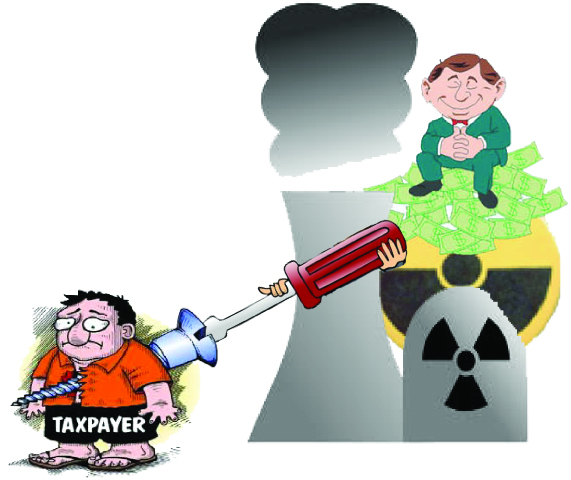
The Department of Energy’s estimated overall liability for failing to dispose of the country’s commercial spent nuclear fuel jumped as much as 10 percent this year, from a range of $34.1 billion to $41 billion in 2023 to a range of $37.6 billion to $44.5 billion in 2024, according to a financial audit of the DOE’s Nuclear Waste Fund (NWF) for fiscal year 2024.
The estimated liability excludes $11.1 billion already paid out to nuclear power plant owners and utilities for the DOE’s breach of the standard contract for the disposal of spent fuel (10 CFR Part 961), which required the DOE to begin taking title of spent nuclear fuel for disposal by January 1998. Owners of spent fuel routinely sue the federal government for the continued cost of managing the fuel. The recovered costs are paid out from the Treasury Department’s Judgement Fund and not from the DOE.
According to the audit, conducted by the independent public accounting firm of KPMG, the liability estimate “reflects a range of possible scenarios” regarding the operating life of the current fleet of nuclear power reactors. The estimate is also based on when the DOE thinks it may begin taking spent fuel. In May, the DOE received initial approval (Critical Decision-0) for a consolidated interim storage facility for spent fuel that, if constructed, would be operational by 2046.
The Department of Energy Nuclear Waste Fund’s Fiscal Year 2024 Financial Statement Audit was released by the DOE Office of Inspector General on November 14.
The fund: The NWF, which was intended to finance the DOE’s disposal of spent fuel, had a balance of $52.2 billion as of September, according to the KPMG audit.
The NWF was funded through annual fees—initially, $0.001 for every kilowatt hour provided by a nuclear power plant—levied by the DOE on owners and generators of spent fuel. The DOE stopped collecting annual NWF fees, however, in 2014 following an order by the U.S. Court of Appeals for the District of Columbia Circuit, which found that the DOE failed to justify the continued imposition of the fee following the suspension of the Yucca Mountain repository project.
‘Alarming’ environmental breaches at nuclear sites spark calls for tougher action

Paul Dobson, Rob Edwards, January 12, 2025
The Dounreay nuclear facility in Caithness was found to be in breach of
rules on eleven occasions in recent years, making it one of the most
frequent offenders in Scotland. Dounreay – which houses radioactive waste
– was a hub of nuclear research between the 1950s and 1990s but is now
the site of the largest nuclear clean up in Scotland.
There was also a breach at the Faslane naval base, although this did not involve
radioactivity. The findings come from data released to The Ferret by the
Scottish Government’s green watchdog, the Scottish Environment Protection
Agency (Sepa). The agency kept a further 25 sites which had broken rules
secret. The Ferret understands this is because they house radioactive
materials which governments fear could be targeted by terrorists aiming to
build a dirty bomb.
The Ferret 12th Jan 2025,
https://theferret.scot/environmental-breaches-spark-calls-tougher-action/
How the UK and Nato are preparing for spectre of nuclear war in space.
As threats from outer space grow, experts warn a Trump 2.0 presidency could
create divisions within the security alliance.
iNews 12th Jan 2025, https://inews.co.uk/news/world/uk-nato-preparing-spectre-nuclear-war-space-3470073
UK will explore nuclear power for new AI data centre plan
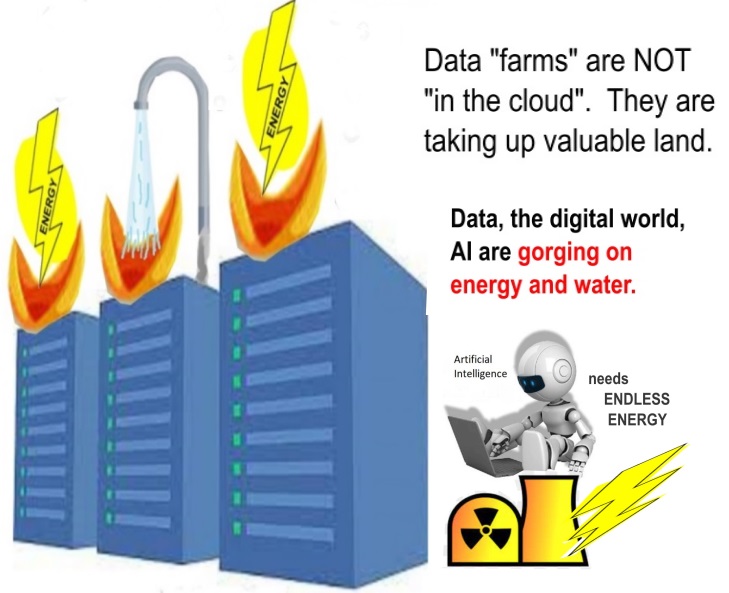
The UK is planning special districts for constructing data centers and
will explore dedicating nuclear energy to the sites as part of a Labour
government project to boost technology growth and the ecosystem for
artificial intelligence. These “AI Growth Zones” will include enhanced
access to electricity and easier planning approvals for data centers, the
government said on Sunday. It said the first such zone will be in Culham,
home of the UK Atomic Energy Authority.
Bloomberg 12th Jan 2025,
https://www.bloomberg.com/news/articles/2025-01-12/uk-will-explore-nuclear-power-for-new-ai-data-center-plan
S. Korea’s nuclear agency launches investigation into abnormal discharge of radioactive waste
Xinhua 2025-01-12, https://www.chinadaily.com.cn/a/202501/12/WS6783d766a310f1265a1da509.html
SEOUL — South Korea’s nuclear safety agency has launched an investigation into the abnormal discharge of liquid radioactive waste from a nuclear reactor to the southeast of the country, Yonhap news agency said Sunday.
The Nuclear Safety and Security Commission (NSSC) received a report from Korea Hydro & Nuclear Power (KHNP), the operator of nuclear power plants, at about 10:23 am local time (0123 GMT) Sunday that the liquid waste of a radioactive storage tank in the Wolseong No 2 nuclear power plant in Gyeongju, North Gyeongsang province was discharged into the ocean without going through a sample analysis.
The KHNP took measures to block leakage immediately after finding the tank outlet valve was open while preparing to release the liquid waste into the ocean, the NSSC said in a bulletin posted on its official website.
According to the KHNP’s analysis of samples left in the tank, the concentration of the leaked liquid waste, estimated at about 29 tons, stood at normal levels.
The NSSC said it had dispatched experts to the power plant in a bid to investigate the exact amount and the cause of the leakage, planning to check any environmental impact by collecting seawater near the power plant.
The agency promised to announce the results of the investigation once available
EDF’s UK nuclear plan – salt marsh consultation delay reaction
Author: LDRS, 11th Jan 2025
EDF has been urged to “end the uncertainty” over its plans to turn part of North Somerset into a salt marsh after it announced it was delaying the plans.
The power company, which is building Hinkley Point C, wants to create 340 hectares of new salt marsh habitats along the Severn — including at Kington Seymour in North Somerset — to compensate for the 44 tonnes of fish expected to be sucked into the power plant’s cooling systems each year. Farmers and the communities who could see their land become salt marsh have expressed dismay at the plans.
A consultation on the plans had been set to launch this month — but now EDF has said it is marking sure all options are “fully explored” and is delaying the consultation until later in 2025. A letter sent to people in the areas affected on Monday said: “We have listened carefully to all views and the feedback has provided us with a great deal of insight as we consider what proposals to put forward in our public consultation.”
But the letter has not impressed locals. Local councillor Steve Bridger, who represents the Yatton ward which includes Kingston Seymour on North Somerset Council, said: “It is clear to me that EDF’s preference is to find voluntary ways to meet its planning obligations, so I would ask that they end the uncertainty for residents and businesses and just drop their proposals to create salt marsh and put their energy into a genuine and open conversation with our communities to develop a strategy that protects all our residents and funds all sorts of biodiversity gains in North Somerset that we actually want and need.”
Claire Stuckey, whose parents’ land and a business faces becoming part of the Kingston Seymour salt marsh, said: “We have unanimous community opposition and significant evidence it won’t work. It’s their decision what they are going to do.”
Farmers and landowners found out their lands were being looked at in September, when they received letters from EDF. Ms Stuckey said that EDF’s statement that they needed more time to look at their options “goes against the original excuse for their heavy handed approach.”
EDF is also looking at Littleton-upon-Severn in South Gloucestershire, and Rodley and Arlingham in Gloucestershire — where the plans have also met with outrage — as potential locations for salt marsh. The controversial plans were debated in Parliament in October, and North Somerset Council resolved in November to write to the government to urge it to block the plans.
But EDF says it has to find a way to compensate for the deaths of fish in its cooling system as it draws in water from the Severn Estuary. Although it does have a fish return mechanism to reduce the numbers of fish killed — the first British nuclear power station to have one — it is predicted that 44 tonnes of fish a year will slip through the mechanism.
The planning permission for Hinkley Point C originally stipulated that it would use loudspeakers by the water intakes on the sea floor to scare off fish, but EDF has warned it would be dangerous for divers to install the speakers and instead proposed creating salt marshes to compensate for the dead fish………….
Rayo 11th Jan 2025,
https://hellorayo.co.uk/greatest-hits/bristol/news/edf-consultation-delay/
Nuclear and related news -week to 14 January

Some bits of good news. World’s largest free meal program, aimed at children and pregnant women. Thai tiger numbers swell as prey populations stabilize in western forests. ‘Extinct’ trees found in Tanzania spark hope for ecosystem recovery.
TOP STORIES. Genocide: The New Normal.
Drone Warfare Has Exploded the Myth of Nuclear Reactor Safety.
Radioactive nightmare: A community’s fight for survival amid soaring cancer rates.
While Los Angeles burns, AI fans the flames.
From the archives. 40 Years Ago: US President Jimmy Carter Pushed For Renewable Energy Funding After Three Mile Island Nuclear Disaster —
Climate. State of the Cryosphere Report 2024.
LA wildfire damages set to cost record $135bn.
Climate crisis ‘wreaking havoc’ on Earth’s water cycle, report finds, Energy efficiency, the forgotten tool for dealing with climate change.
Noel’s notes. The California wildfires and the unmentioned threat of nuclear radiation. The polar playground for a suicidal species?
AUSTRALIA.
- Sovereignty not worth a nickel?
- AUKUS: Flawed and Sinking.
- Nuclear radiation took her father’s eyesight. Now Karina’s fighting Dutton’s nuclear reactors- https://www.youtube.com/watch?v=Us2PJovak2Y
- There’s a gaping hole in Dutton’s nuclear plan: He says it’s Albanese’s problem to solve.
- Los Angeles fire a wake up call for Australia.
- The continual cover up – Jenny Hocking on the strange disappearance of Gough Whitlam’s ASIO file. Critical Archival Encounters and the Evolving Historiography of the Dismissal of the Whitlam Government- series at https://antinuclear.net/ – also other news items.
NUCLEAR ITEMS
| CLIMATE. World’s climate fight needs fundamental reform, UN expert says: ‘Some states are not acting in good faith’. Energy efficiency, the forgotten tool for dealing with climate change. |
| ECONOMICS. Lepreau nuclear plant’s costs will continue to balloon: critic -ALSO AT https://nuclear-news.net/2025/01/09/1-b1-lepreau-nuclear-plants-costs-will-continue-to-balloon-critic/Together Against Sizewell C letter to National Audit Office SZC Value for Money concerns 06.01.25. |
| EMPLOYMENT. No more buckets and spades – would nuke dump end West Cumbrian tourism? |
| ENERGY. Germany deploys 16.2 GW of solar in 2024 .Trump’s war on wind power: Plans to stop windmill construction nationwide.Schneider Electric warns of future where datacenters eat the grid.Is the Haverigg wind project once more under a nuclear threat? |
| ENVIRONMENT. CANDU reactors release WASTE HEAT as well as RADIOACTIVITY.EDF’s UK nuclear plan – salt marsh consultation delay reaction. |
| ETHICS and RELIGION. Are Blinken and Biden’s Gaza genocide denials any different than Nazi WWII genocide denials? |
| EVENTS. WEBINAR: 17 January : Exposed – New book sheds light on radiation science |
| HEALTH. Ohio Community Faces Cancer Crisis from Radioactive Contamination |
| HISTORY. When Carter met Kim – and stopped a nuclear war. |
| INDIGENOUS ISSUES. First Nations chiefs shouldn’t be duped by ‘nuclear-is-green’ deception. |
LEGAL.
- Ireland formally joins ICJ genocide case against Israel.
- An overlooked Supreme Court case could decide the future of nuclear power. Lawsuit challenges NRC on SMR regulation.
- Japanese yakuza leader pleads guilty to trafficking nuclear materials from Myanmar. Japanese crime boss admits to conspiring to sell nuclear material to Iran.
- Judge Orders Britain’s Crown Prosecution Service (CPS) to Come Clean on Deleted Assange Docs.
| MEDIA. Raffi Berg: BBC Middle East Editor Exposed as CIA, Mossad Collaborator. |
| OPPOSITION to NUCLEAR . Campaigners accuse UK government of ‘lack of transparency’ over SizewellC value. – ALSO AT https://nuclear-news.net/2025/01/11/1-b1-campaigners-accuse-government-of-lack-of-transparency-over-sizewellc-value/ |
| PERSONAL STORIES. ‘He was prescient’: Jimmy Carter, the environment and the road not taken. |
| POLITICS. Genocidal President, Genocidal Politics. A new year – but old policies.EDF delays salt marsh consultation for Hinkley Point C. |
POLITICS INTERNATIONAL and DIPLOMACY.
- Report: Israel Refusing To Commit to a Permanent Gaza Ceasefire as Part of Hostage Deal.
- Outgoing CIA director says ‘no sign’ Iran developing nuclear weapons. Iran Condemns US Threats to Nuclear Facilities, Calls for UN Accountability.
- What a second Trump administration may mean for the Saudi nuclear program.
- Why Greenland Is Of Growing Strategic Significance. China Is Not Our Enemy – Brief version at https://nuclear-news.net/2025/01/12/2-b1-why-greenland-is-of-growing-strategic-significance/
| SAFETY. Faslane Peace Camp warns of growing nuclear risks amid rising tensions. Incidents. ‘Alarming’ environmental breaches at nuclear sites spark calls for tougher action. International Atomic Energy Agency (IAEA) staff reported hearing loud blasts near Ukraine’s Zaporizhzhya Nuclear Power Plant (NPP) |
| SECRETS and LIES. How Fukushima’s radioactive fallout in Tokyo was concealed from the public. The Atlas Network has eugenicist roots. |
| TECHNOLOGY. Could AI soon make dozens of billion-dollar nuclear stealth attack submarines more expensive and obsolete?Deep Fission to supply Endeavour data centers with 2GW of nuclear energy from “mile-deep” SMR. Nuclear energy groups race to develop ‘microreactors’. UK will explore nuclear power for new AI data centre plan |
| URANIUM. US to study proliferation risk of HALEU nuclear fuel, after warning by scientists. |
| WASTES. U.S. nuclear spent fuel liability jumps to $44.5 billion.S. Korea’s nuclear agency launches investigation into abnormal discharge of radioactive waste. |
| WAR and CONFLICT. Lancet Study: Gaza Health Ministry Undercounted Death Toll By 41%.How the UK and Nato are preparing for spectre of nuclear war in space. |
| WEAPONS and WEAPONS SALES. Iran has absolutely no intention to build nuclear weapons, president says.There is no such thing as good nuclear proliferation.Trident nuclear submarines leave UK reliant on the US, in lockstep with the US.How to dismantle the deadly arms trade. |
While Los Angeles burns, AI fans the flames

Artificial intelligence is a water-guzzling industry hastening future climate crises from California’s own backyard.
By Schuyler Mitchell , Truthout, January 11, 2025
“………………………………………………. Trump’s latest smear campaign is little more than political football. But the renewed attention on California’s water does highlight ongoing tensions over the conservation and management of this finite resource. As the climate crisis worsens, it’s expected to exacerbate heat waves and droughts, bringing water shortages and increasingly devastating fires like those currently scorching southern California. The situation in Los Angeles is already a catastrophe. Climate change-induced water shortages will make imminent disasters even worse.
In the face of this grim reality, it’s worth revisiting one of the major water-guzzling industries that’s hastening future crises from California’s own backyard: artificial intelligence (AI).
Silicon Valley is the epicenter of the global AI boom, and hundreds of Bay Area tech companies are investing in AI development. Meanwhile, in the southern region of the state, real estate developers are rushing to build new data centers to accommodate expanded cloud computing and AI technologies. The Los Angeles Times reported in September that data center construction in Los Angeles County had reached “extraordinary levels,” increasing more than sevenfold in two years.
This technology’s environmental footprint is tremendous. AI requires massive amounts of electrical power to support its activities and millions of gallons of water to cool its data centers. One study predicts that, within the next five years, AI-driven data centers could produce enough air pollution to surpass the emissions of all cars in California.
Data centers on their own are water-intensive; California is home to at least 239. One study shows that a large data center can consume up to 5 million gallons of water per day, or as much as a town of 50,000 people. In The Dalles, Oregon, a local paper found that a Google data center used over a quarter of the city’s water. Artificial intelligence is even more thirsty: Reporting by The Washington Post found that Meta used 22 million liters of water simply training its open source AI model, and UC Riverside researchers have calculated that, in just two years, global AI use could require four to six times as much water as the entire nation of Denmark.
Many U.S. data centers are based in the western portion of the country, including California, where wind and solar power is more plentiful — and where water is already scarce. In 2022, a researcher at Virginia Tech estimated that about one-fifth of data centers in the U.S. draw water from “moderately to highly stressed watersheds.”
According to the Fifth National Climate Assessment, the U.S. government’s leading report on climate change, California is among the top five states suffering economic impacts from climate crisis-induced natural disaster. California already is dealing with the effects of one water-heavy industry; the Central Valley, which feeds the whole country, is one of the world’s most productive agricultural regions, and the Central Valley aquifer ranks as one of the most stressed aquifers in the world. ClimateCheck, a website that uses climate models to predict properties’ natural disaster threat levels, says that California ranks number two in the country for drought risk.
In August 2021, the U.S. Bureau of Reclamation declared the first-ever water shortage on the Colorado River, which supplies water to California — including roughly a third of southern California’s urban water supply — as well as six other states, 30 tribal nations and Mexico. The Colorado River water allotments have been highly contested for more than a century, but the worsening climate crisis has thrown the fraught agreements into sharp relief. Last year, California, Nevada and Arizona agreed to long-term cuts to their shares of the river’s water supply.
Despite the precarity of the water supply, southern California’s Imperial Valley, which holds the rights to 3.1 million acres of Colorado River water, is actively seeking to recruit data centers to the region.
“Imperial Valley is a relatively untapped opportunity for the data center industry,” states a page on the Imperial Valley Economic Development Corporation’s website. “With the lowest energy rates in the state, abundant and inexpensive Colorado River water resources, low-cost land, fiber connectivity and low risk for natural disasters, the Imperial Valley is assuredly an ideal location.” A company called CalEthos is currently building a 315 acre data center in the Imperial Valley, which it says will be powered by clean energy and an “efficient” cooling system that will use partially recirculated water. In the bordering state of Arizona, Meta’s Mesa data center also draws from the dwindling Colorado River.
The climate crisis is here, but organizers are not succumbing to nihilism. Across the country, community groups have fought back against big tech companies and their data centers, citing the devastating environmental impacts. And there’s evidence that local pushback can work. In the small towns of Peculiar, Missouri, and Chesterton, Indiana, community campaigns have halted companies’ data center plans.
“The data center industry is in growth mode,” Jon Reigel, who was involved in the Chesterton fight, told The Washington Post in October. “And every place they try to put one, there’s probably going to be resistance. The more places they put them the more resistance will spread.” https://truthout.org/articles/while-los-angeles-burns-ai-fans-the-flames/?utm_source=Truthout&utm_campaign=3634e1951f-EMAIL_CAMPAIGN_2025_01_11_08_34&utm_medium=email&utm_term=0_bbb541a1db-3634e1951f-650192793
WEBINAR: 17 January : Exposed – New book sheds light on radiation science

Jan 17, 2025 03:00 AM in Etc/GMT-10
January 9, 2025
The Scientists Who Alerted Us to the Dangers of Radiation, a new book by Ian Fairlie and Beyond Nuclear’s Cindy Folkers, will have its Canadian book launch and webinar, hosted by Canadian advocacy groups on Thursday, January 16 noon – 1 ET.
Both authors will be present for discussion and questions. This book reveals that the harmful effects of radiation exposure are more pervasive and worse than thought; and that these impacts have been known or suspected for decades but suppressed by nuclear technology proponents. It explains radiation in easy-to-grasp language that clarifies its dangers and risks. Anyone who ever wondered about radiation should read the book and attend this webinar, especially with the current push for more nuclear power in the face of the climate crisis.
The webinar co-hosted by: Ontario Clean Air Alliance, Nuclear Waste Watch, Coalition for Responsible Energy Development in New Brunswick (CRED-NB) and the Canadian Coalition for Nuclear Responsibility.
Outgoing CIA director says ‘no sign’ Iran developing nuclear weapons

William Burns stated that the Islamic Republic made a decision in 2003 not to pursure nuclear weapons and has not changed its policy
The Cradle News Desk, JAN 12, 2025
Outgoing CIA director William Burns stated in an interview on 10 January that Iran does not have a nuclear weapons program, following a decision it made in 2003, and that the US is concerned about the revival of ISIS.
In an interview with state broadcaster National Public Radio (NPR) to discuss his time as director of the notorious spy agency under President Joe Biden, Burns was asked whether Iran may accelerate its efforts to obtain nuclear weapons given the setbacks the Islamic Republic and its allies in the regional Axis of Resistance have sustained over the past year.
Burns answered that “the Iranian regime could decide in the face of that weakness that it needs to restore its deterrence as it sees it and, you know, reverse the decision made at the end of 2003 (an oral fatwa issued by Supreme Leader Ali Khamenei) to suspend their weaponization program.”
However, Burns clarified, “We do not see any sign today that any such decision has been made, but we obviously watch it intently. “
He added that Iran’s weakness could instead lead to negotiations for a nuclear deal similar to the one signed by Iran and the United States under President Obama in 2014. President Trump later withdrew from the deal following intense lobbying by Israeli Prime Minister Benjamin Netanyahu.
“You know that that sense of weakness could also theoretically create a possibility for serious negotiations, too. And, you know, that’s something the new administration is going to have to sort through. I mean, it’s something I have a lot of experience in with the secret talks a decade ago, a little more than a decade ago with the Iranians. So, you know, that’s that’s also a possibility,” Burns stated………………………………………………………………………………………. more https://thecradle.co/articles-id/28431
Now By Fire, Next by Quake, then by Apocalyptic Radiation: Will Gavin Newsom’s Diablo Canyon Atomic Folly Kill Us All?

Los Angeles is now being destroyed by fire.
by Harvey “Sluggo” Wasserman, January 11, 2025, more https://freepress.org/article/now-fire-next-quake-then-apocalyptic-radiation-will-gavin-newsoms-atomic-folly-kill-us-all-0
Los Angeles is now being destroyed by fire.
Next will be the “Big One” earthquake everyone knows is coming.
And then—unless we take immediate action—Diablo Canyon’s radioactive cloud will make this region a radioactive dead zone.
My family is now besieged by four fires raging less than four miles away. We don’t know how long our luck will hold.
We are eternally grateful to the brave fire-fighters and public servants who are doing their selfless best to save us all.
We are NOT grateful that Gavin Newsom has recklessly endangered us by forcing continued operation at two unsafe, decrepit nuclear power plants perched on active earthquake faults, set to pour radioactive clouds on us from just four hours north of here.
The Nuclear Regulatory Commission’s resident site inspector—Dr. Michael Peck—after five years at Diablo warned that it cannot withstand the earthquakes we all know are coming.
In 2006 the NRC confirmed that Unit One was already seriously embrittled. Its fragile core makes a melt-down virtually certain to cause a catastrophic explosion, shooting a lethal apocalyptic cloud right at us…and then across the state and continent.
These wildfires make clear that these city, state and federal governments—maybe NO government ANYWHERE—can begin to cope with these kinds of mega-crises.
Imagine watching our public servants trying to cope while dressed in radiation suits, knowing everything around us has been permanently contaminated.
Imagine leaving all you own forever behind while racing to get yourself and your family out of here under the universal evacuation order demanded by radioactive clouds like those that decimated the downwind regions from Chernobyl and Fukushima, not to mention Santa Susanna and Three Mile Island, Windscale and Kyshtym.
Pre-empting such a catastrophe was a major motivation for the 2018 plan to phase out the two Diablo nukes in 2024 and 2025,
That landmark blueprint was crafted over a two-year period with hundreds of meetings, scores of hearings involving the best and brightest in energy, the economy, the ecology and the hard engineering realities of aging atomic power reactors.
It was signed by the then-Governor (Jerry Brown), Lieutenant Governor (Gavin Newsom), state legislature, state regulatory agencies, the Nuclear Regulatory Commission, plant owner (PG&E), labor unions, local governments, environmental groups and many more, .
The economic and energy security goals of this plan have been far exceeded by advances in renewable generation and battery storage. California now regularly gets 100% of its electricity from solar, wind and geothermal. Battery back-up capabilities exceed Diablo’s capacity by a factor of four or more. Its inflexible baseload productions unfortunately interferes with far cheaper renewables filling our grid.
The grid’s most serious blackout threats now come from disruptive malfunctions and potential disasters at Diablo Canyon.
All this has been well known since 2018, when Newsom signed the Diablo agreement.
The phase-out proceeded smoothly for four years, largely exceeding expectations.
But in 2022, Newsom strongarmed the legislature into trashing the phase-out plan. His Public Utilities Commission decimated the statewide rate structure, costing our solar industry, billions in revenues and at least 17,000 jobs.
Instead Newsom fed PG&E about $1.4 billion in public subsidies and $11 billion in over-market charges to keep Diablo running through 2030.
Neither the NRC nor state nor PG&E have done the necessary tests to guarantee Diablo’s safety, refusing to re-test for embrittlement even though such defects forced the NRC to shut the Yankee Rowe reactor in 1991.
Diablo has no private liability insurance. Should it irradiate Los Angeles, NONE of us can expect compensation.
So as we shudder amidst the horrors of this firestorm, we know that our loss of life, health and property will be orders of magnitude—literally, infinitely—more devastating when, by quake or error, the reactors at Diablo Canyon melt and explode.
Responsibility for this needless, unconscionable threat lies strictly with Gavin Newsom. There is no sane economic, electric supply or common sense reason for him to impose this gamble on us.
Governor Newsom: NOTHING can make public sense of this radioactive throw of the dice.
We respectfully beg, request, demand, beseech that you honor the sacred word you gave in 2018 to phase out the Diablo Canyon atomic reactors.
As we see the devastation engulfing us, and the inability of government to make it right, there is zero mystery as to why these nukes must shut.
NOW!!!
Australian sovereignty not worth a nickel?

A terse exchange between Greens Senator David Shoebridge and Vice Admiral Jonathan Mead during a Senate Estimates hearing earlier this year revealed that contracts signed by the Australian government that have handed billions of taxpayer dollars to American and British shipyards, supposedly to support the faster delivery of submarines, did not include standard protective clawback provisions.
If we never see a submarine—as is possible—we don’t get any of our billions back.
In influence and dollar terms, foreign-owned companies comprise the vastly dominant proportion of the industrial base, not “part of” it. Research by the Australian Strategic Policy Institute in 2017 showed that the top 15 weapons contractors received 91 per cent of the Department’s expenditure.
A decade of spin from both sides of politics has inured Australians to the stark reality of our loss of independence inside the US alliance. At what cost?
Michelle Fahy, Jan 12, 2025, https://undueinfluence.substack.com/p/sovereignty-not-worth-a-nickel?utm_source=post-email-title&publication_id=297295&post_id=154382292&utm_campaign=email-post-title&isFreemail=true&r=1ise1&triedRedirect=true&utm_medium=emailAustralia’s independence has been dangerously compromised by Labor and Coalition governments, which have signed up to deep-rooted military agreements with the United States of America. These agreements have also underpinned the increasing militarisation of Australia: witness the 2022 speech by Labor’s Richard Marles, the newly appointed deputy prime minister, in Washington DC when he announced that Australian military forces would now become interchangeable with those of the United States.
In August, after this year’s formal annual talks with the United States, Defence Minister Marles announced that the meeting had “built on the last two in seeing a deepening of American force posture in Australia”.
He added: “American force posture now in Australia involves every domain: land, sea, air, cyber and space.”
A decade of spin from both sides of politics has inured us to the stark reality of our loss of independence. Much is made of “defence industry cooperation” with the United States, for example, but this is simply code for the expansion of the US arms industry in Australia in support of its increasing military presence on our soil.
The day before AUKUS was launched in 2021, the US State Department made plain the importance of Australia in supporting America’s military-industrial base:
Australia is one of America’s largest defence customers, supporting thousands of jobs in the United States … The United States is Australia’s defence goods and services partner of choice … the partnership is expected to deepen further over the coming decade, including in the area of defence industry cooperation.
Soon after this statement was published, Marles flew to Washington to endorse its sentiment. He reassured the Americans that when it came to arms production, “our ultimate goal is to supplement and strengthen US industry and supply chains, not compete with them”.
Meanwhile, our much-trumpeted “sovereign defence industrial base” is simply a collection of the world’s top arms multinationals, dominated by the British-owned BAE Systems, the French-owned Thales, and the American-owned Boeing.
Then there is the egregious erosion of Australia’s sovereignty contained within the little-known Force Posture Agreement (FPA) with the United States, which the Abbott Coalition government signed in 2014.
In short, the FPA permits the US to prepare for, launch and control its own military operations from Australian territory.
Yet AUKUS dominates the headlines, even though other decisions by our political leaders that have sold out the public interest have received little coverage in the mainstream media.
A terse exchange between Greens Senator David Shoebridge and Vice Admiral Jonathan Mead during a Senate Estimates hearing earlier this year revealed that contracts signed by the Australian government that have handed billions of taxpayer dollars to American and British shipyards, supposedly to support the faster delivery of submarines, did not include standard protective clawback provisions. If we never see a submarine—as is possible—we don’t get any of our billions back.
The single most important downside of the US alliance, rarely mentioned, is arguably Australia’s military dependence on a foreign power. The Australian Defence Force is critically dependent on US supply and support for the conduct of all operations except those at the lowest level and of the shortest duration.
We were warned about this substantial sacrifice of national freedom of action. In 2001, a Parliamentary Library research paper stated that “it is almost literally true that Australia cannot go to war without the consent and support of the US”.
Foreign-dominated “sovereign” defence industry
Australia’s political and defence hierarchy regularly assert the need to build “a sovereign defence industrial base”. Most people would assume this to mean Australian-owned defence companies, with profits that stay local. This is not what the Defence Department means by it.
The world’s largest weapons companies, including BAE Systems (UK), Thales (France) and US companies Boeing, Lockheed Martin, Raytheon and Northrop Grumman, dominate the local defence industry. Almost all of the top 15 weapons contractors to the Defence Department are foreign-owned. In June 2024, Deputy Secretary Christopher Deeble, the head of the Capability Acquisition and Sustainment Group—the Department’s arms-buying group—explained in a Senate Estimates hearing the government’s definition of “sovereign” in this regard. Deeble agreed with independent senator David Pocock that the local subsidiaries of foreign weapons multinationals, such as Lockheed Martin Australia, were not “sovereign” Australian companies. Nevertheless, he said, the Department considers such foreign-owned subsidiaries to be “part of the sovereign defence industry base here in Australia”.
In influence and dollar terms, foreign-owned companies comprise the vastly dominant proportion of the industrial base, not “part of” it. Research by the Australian Strategic Policy Institute in 2017 showed that the top 15 weapons contractors received 91 per cent of the Department’s expenditure.
Force Posture Agreement
The erosion of Australian sovereignty accelerated in 2011, when Labor prime minister Julia Gillard agreed that up to 2,500 US Marines could be stationed in Darwin on a permanent rotation, and that an increased number of US military aircraft, including long range B-52 bombers, could fly in and out of the Top End and use Australia’s outback bombing ranges.
This agreement was expanded dramatically a few years later by the Force Posture Agreement, which provides the legal basis for an extensive militarisation of Australia by the US, particularly across the Top End.
The tri-nation military pact AUKUS, between Australia, the United Kingdom and the United States, was later negotiated and agreed to, in secret, by the Morrison Coalition government. AUKUS gained bipartisan support within one day of it being revealed to Anthony Albanese’s Labor opposition in September 2021. Among other things, AUKUS, in conjunction with the FPA, ensures that Australia’s navy will be tightly integrated with the US navy for the purpose of fighting China, and that the two navies can operate as one from Australian ports and waters.
Two months after Labor assumed office in May 2022, Marles was in Washington DC announcing that Labor would “continue the ambitious trajectory of its force posture cooperation” with the United States. Australia’s engagement with the US military would “move beyond interoperability to interchangeability” and Australia would “ensure we have all the enablers in place to operate seamlessly together, at speed”.
Non-lethal” F-35 parts
Australia’s newest high-tech major weapons systems make us more reliant than ever on the United States. As veteran journalist Brian Toohey reported in 2020, “The US … denies Australia access to the computer source code essential to operate key electronic components in its ships, planes, missiles, sensors and so on”. This includes the F-35 fighter jets, which both Foreign Minister Penny Wong and Defence Minister Marles have noted form the largest proportion of the air force’s fast jet capacity.
When it agreed to buy Lockheed Martin’s expensive and controversial fifth generation fighter jets, Australia became one of the early members of the F-35 consortium. As part of the deal, Australia negotiated a role for local industry in the F-35 global supply chain. As of June 2024, more than 75 Australian companies had shared in $4.6 billion worth of work, according to the Defence Department.
But there’s been a significant ethical downside. Israel, also a member of the F-35 consortium, is using its F-35s in its war against Gaza. Israel stands accused in the world’s highest court of conducting a genocide in Gaza. Every F-35 built contains Australian parts and components, and for some of these Australia is the sole source.
A senior Defence Department official, Hugh Jeffrey, said in a Senate Estimates hearing in June 2024:
“We are a member of the F-35 consortium [which] exists under a memorandum of understanding … That gives the defence industry opportunity to contribute to that supply chain. It also requires Australia to provide those contributions in good faith…” [emphasis added]
Jeffrey also noted that when assessing any export permit, “we have to have high confidence that, in agreeing to the permit, it’s consistent with our national security requirements and with our international legal obligations”.
What happens if the Department perceives a conflict between Australia’s “national security requirements” and its “international legal obligations”? Is Australia “required” to continue supplying Australian-made arms “in good faith”?
In June, after nine months of spreading disinformation, the Australian government was forced to admit that Australia was still supplying parts and components to the F-35 global supply chain. At the time of writing, the government was allowing this supply to continue despite repeated calls from the UN asking nations—and multinational weapons makers—to cease supplying weapons to Israel, including parts and components, or risk being responsible under international law for serious human rights violations.
Decoded: Defence Department’s deadly deceits
Michelle Fahy, July 10, 2024
How to dismantle the deadly arms trade

The devastating human impact of the arms industry is clear, but war is good news for industry shareholders. The market value of military equipment manufacturers in the US and Europe increased by nearly 60 per cent between February 2022 and March 2024, thanks to the wars in Ukraine and Palestine.
Activists forced Canadian Bank of Nova Scotia to halve its stake in Elbit Systems, Israel’s biggest arms company. In October 2024, Elbit shut down its promotional booth at the Japan International Aerospace Exhibition in Tokyo after protests.
New Internationalist, Amy Hall, 6 Jan 25
People across the world are standing up to the power of the arms trade. Amy Hall explores its threat to life and democracy.
It’s a cold, bright morning on a narrow street in Brighton, on the south coast of England. Neighbours are peering through windows, or coming out onto the pavement, to see why around 15 protesters are standing outside the business premises at the end of the road with a banner declaring: ‘Genocide in Gaza made in Brighton’.
The answer is that the campaigners say they saw this company, London & Brighton Plating – which specializes in metal coating and plating used in a range of industries, including aerospace – delivering to L3Harris. The latter is one of the world’s biggest arms companies, and makes bomb release mechanisms for fighter jets used by Israel at its site on the outskirts of the city.
At least here in Brighton we have a strong protest movement,’ says Gummy Bear, one of the protesters. They point to the number of Palestinians who have been killed in Gaza. On 14 November 2024, the day of the protest, the death toll stood at well over 43,000. ‘We’re calling on supplier companies to divest from L3Harris and to stop working with them. We want L&B Plating to end their contract.’
Before they decided to form this picket, the Stop L3Harris group says it tried to contact L&B Plating in other ways but not had any response; they did not respond to New Internationalist’s request for comment either. The campaigners have drawn up a list of companies that they believe are working with L3Harris. While the group has held several protests and actions at the factory itself, it is also working along the supply chain to try and make it harder for L3Harris to stay open in their city.
The trading of arms and military equipment has always faced opposition, but since 7 October 2023, when Israel began its genocidal assault on Gaza, there has been an explosion of activism against the arms industry. In neighbourhoods across the world, people are taking action – from shutting down shipyards or destroying equipment, to encampments at universities and divestment campaigns.
The devastating human impact of the arms industry is clear, but war is good news for industry shareholders. The market value of military equipment manufacturers in the US and Europe increased by nearly 60 per cent between February 2022 and March 2024, thanks to the wars in Ukraine and Palestine.
But despite the might of the industry, many ordinary people around the world have been winning where they have acted against it. Activists forced Canadian Bank of Nova Scotia to halve its stake in Elbit Systems, Israel’s biggest arms company. In October 2024, Elbit shut down its promotional booth at the Japan International Aerospace Exhibition in Tokyo after protests. And in November, Palestine Action – a group which has been taking direct action against Elbit Systems since 2020 – announced that Hydrafeed, which had been supplying equipment to Elbit, had cut ties with the arms company ‘as a direct result’ of the group’s actions.
‘I’ve never see this level of activism against the arms trade,’ says Emily Apple of Campaign Against Arms Trade (CAAT).
People are not just taking action over Palestine. There has been a growing campaign against the United Arab Emirates (UAE) for its complicity in the war in Sudan, which has killed up to 150,000 people. In England, activists have protested outside Arsenal football club’s Emirates Stadium in north London, due to its sponsorship from the airline Emirates, which is owned by the UAE state. There have also been demonstrations in a number of cities calling on the British government to take action.
Some of the most inspiring solidarity has come from workers normally key to the arms trade’s operation. After Israel’s latest assault on Gaza began, Palestinian trade unions called for support from fellow workers – and many answered. In November 2024 dockers in the Moroccan port of Tangiers refused to load a ship belonging to the logistics company Maersk, after the vessel was found to have received a number of US military shipments bound for Israel. The month before, members of a Greek dock-workers’ union in Athens Pireaus port blocked the loading of a container of ammunition on its way for use in Gaza.
Nor is Palestine the only cause that provokes such practical solidarity. Since 2019 workers in Genoa, Italy have declared a ‘war against the war’ in Yemen, refusing to load ships with weapons or other military equipment that could be used to kill civilians.
A global industry
Another frontier of the movement is the legal system, as campaigning lawyers push governments to stop arming the violence of states such as Israel. Palestinian human rights organization Al-Haq and the Global Legal Action Network (GLAN) have been fighting the British state over its arms exports to Israel……………………………………………………………………………………….. more https://newint.org/arms/2025/how-dismantle-deadly-arms-trade?utm_source=ni-email-whatcounts%20&utm_medium=1%20NI%20Main%20List1%20-%20enews%20-%20International%20AND%20North%20America&utm_campaign=2025-01-10%20enews
1 This Month

of the week – Shut Down Drone Warfare!


Tell the Ukrainian Government to Drop Prosecution of Peace Activist Yurii Sheliazhenko

Petition to revoke the licensing of the Near Surface Nuclear Disposal Facility (NSDF) at Chalk River. https://www.ourcommons.ca/petitions/en/Petition/Details?Petition=e-7247
To see nuclear-related stories in greater depth and intensity – go to https://nuclearinformation.wordpress.com
-
Archives
- April 2026 (7)
- March 2026 (251)
- February 2026 (268)
- January 2026 (308)
- December 2025 (358)
- November 2025 (359)
- October 2025 (376)
- September 2025 (257)
- August 2025 (319)
- July 2025 (230)
- June 2025 (348)
- May 2025 (261)
-
Categories
- 1
- 1 NUCLEAR ISSUES
- business and costs
- climate change
- culture and arts
- ENERGY
- environment
- health
- history
- indigenous issues
- Legal
- marketing of nuclear
- media
- opposition to nuclear
- PERSONAL STORIES
- politics
- politics international
- Religion and ethics
- safety
- secrets,lies and civil liberties
- spinbuster
- technology
- Uranium
- wastes
- weapons and war
- Women
- 2 WORLD
- ACTION
- AFRICA
- Atrocities
- AUSTRALIA
- Christina's notes
- Christina's themes
- culture and arts
- Events
- Fuk 2022
- Fuk 2023
- Fukushima 2017
- Fukushima 2018
- fukushima 2019
- Fukushima 2020
- Fukushima 2021
- general
- global warming
- Humour (God we need it)
- Nuclear
- RARE EARTHS
- Reference
- resources – print
- Resources -audiovicual
- Weekly Newsletter
- World
- World Nuclear
- YouTube
-
RSS
Entries RSS
Comments RSS
 nuclear-news