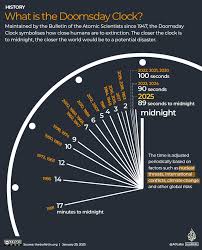
Closer than ever: It is now 89 seconds to midnight
Science and Security Board
Bulletin of the Atomic Scientists, Editor, John Mecklin, January 28, 2025
In 2024, humanity edged ever closer to catastrophe. Trends that have deeply concerned the Science and Security Board continued, and despite unmistakable signs of danger, national leaders and their societies have failed to do what is needed to change course. Consequently, we now move the Doomsday Clock from 90 seconds to 89 seconds to midnight—the closest it has ever been to catastrophe. Our fervent hope is that leaders will recognize the world’s existential predicament and take bold action to reduce the threats posed by nuclear weapons, climate change, and the potential misuse of biological science and a variety of emerging technologies.
In setting the Clock one second closer to midnight, we send a stark signal: Because the world is already perilously close to the precipice, a move of even a single second should be taken as an indication of extreme danger and an unmistakable warning that every second of delay in reversing course increases the probability of global disaster.
In regard to nuclear risk, the war in Ukraine, now in its third year, looms over the world; the conflict could become nuclear at any moment because of a rash decision or through accident or miscalculation. Conflict in the Middle East threatens to spiral out of control into a wider war without warning. The countries that possess nuclear weapons are increasing the size and role of their arsenals, investing hundreds of billions of dollars in weapons that can destroy civilization. The nuclear arms control process is collapsing, and high-level contacts among nuclear powers are totally inadequate given the danger at hand. Alarmingly, it is no longer unusual for countries without nuclear weapons to consider developing arsenals of their own—actions that would undermine longstanding nonproliferation efforts and increase the ways in which nuclear war could start.
The impacts of climate change increased in the last year as myriad indicators, including sea-level rise and global surface temperature, surpassed previous records. The global greenhouse gas emissions that drive climate change continued to rise. Extreme weather and other climate change-influenced events—floods, tropical cyclones, heat waves, drought, and wildfires—affected every continent. The long-term prognosis for the world’s attempts to deal with climate change remains poor, as most governments fail to enact the financing and policy initiatives necessary to halt global warming. Growth in solar and wind energy has been impressive but remains insufficient to stabilize the climate. Judging from recent electoral campaigns, climate change is viewed as a low priority in the United States and many other countries…………………………………………………………………….. more https://thebulletin.org/doomsday-clock/2025-statement/
No comments yet.
1 This Month


18 March Webinar @ 1 PM EST: An Assessment of SMR Projects: The Case of Canada
register for the zoom:
https://us02web.zoom.us/webinar/register/WN_o8BIIOUvQ2ONJR1nta65DQ#/registration


of the week – STOP SMALL MODULAR REACTORS IN CANADA
To see nuclear-related stories in greater depth and intensity – go to https://nuclearinformation.wordpress.com
-
Archives
- March 2026 (138)
- February 2026 (268)
- January 2026 (308)
- December 2025 (358)
- November 2025 (359)
- October 2025 (376)
- September 2025 (258)
- August 2025 (319)
- July 2025 (230)
- June 2025 (348)
- May 2025 (261)
- April 2025 (305)
-
Categories
- 1
- 1 NUCLEAR ISSUES
- business and costs
- climate change
- culture and arts
- ENERGY
- environment
- health
- history
- indigenous issues
- Legal
- marketing of nuclear
- media
- opposition to nuclear
- PERSONAL STORIES
- politics
- politics international
- Religion and ethics
- safety
- secrets,lies and civil liberties
- spinbuster
- technology
- Uranium
- wastes
- weapons and war
- Women
- 2 WORLD
- ACTION
- AFRICA
- Atrocities
- AUSTRALIA
- Christina's notes
- Christina's themes
- culture and arts
- Events
- Fuk 2022
- Fuk 2023
- Fukushima 2017
- Fukushima 2018
- fukushima 2019
- Fukushima 2020
- Fukushima 2021
- general
- global warming
- Humour (God we need it)
- Nuclear
- RARE EARTHS
- Reference
- resources – print
- Resources -audiovicual
- Weekly Newsletter
- World
- World Nuclear
- YouTube
-
RSS
Entries RSS
Comments RSS
 nuclear-news
Leave a comment