Nuclear Proliferation and the “Nth Country Experiment”

“Do-it-yourself” Project Produced “Credible Nuclear Weapon” Design from Open Sources
Experimenters Developed a Plutonium Weapon Design with Potential for High Explosive Yield.
NATIONAL SECURITY ARCHIVE, Washington, D.C., January 23, 2025 – Today, the National Security Archive publishesnewly declassified information on a secret mid-1960s project in which a handful of young physicists at Lawrence Livermore Laboratory produced a design for a “credible nuclear weapon” based only on unclassified, open-source information and in just three years. One of the participants described the experiment as “truly a do-it-yourself project,” according to one of the recently declassified records. Begun in the spring of 1964, before China had conducted its first bomb test, the “Nth Country Experiment” concluded that a government with nuclear-weapons aspirations and limited resources could develop a “credible” weapon.
This new Electronic Briefing Book includes the relatively limited declassified literature on the project, including the 1967 “Summary Report on the Nth Country Experiment,” a document first released to the National Security Archive in the 1990s and that was the subject of an Archive press release in 2003. Today’s posting also includes a recently declassified, if massively redacted, Livermore report on “Postshot Activities of the Nth Country Experiment” that summarized classified briefings that two of the participants in the Experiment gave around the country to U.S. government officials. Also included is a State Department internal announcement of a forthcoming briefing on the “Nth Country Experiment” noting that “three young PhD physicists, working part-time, succeeded in achieving a workable nuclear weapons design in a period of about three years.”
……………………………….When the Experiment began in 1964, U.S. intelligence had been analyzing the problem of the potential spread of nuclear weapons capabilities for years. Before the term “nuclear proliferation” became widely used during the 1960s, however, analysts with the CIA and other intelligence organizations had thought in terms of a “4th country” problem: Which country was likely to join the U.S., the U.K., and the Soviet Union as the fourth country with nuclear weapons capabilities? After France tested its first bomb in early 1960 and became the fourth country, analysts began to think in terms of the “Nth country problem”—that some indeterminate number of countries might develop nuclear weapons capabilities. What concerned think tankers and academic experts was that Nth countries would create a more unstable and perilous world where the United States would have less influence and its interests would be under greater threat.[1] Consistent with this, during a 1963 press conference, President John F. Kennedy warned of the possibility of a world where, by the 1970s, there were 15 or 20 nuclear powers that posed the “greatest possible danger and hazard.”[2]
………………………………………..The Department of Energy’s reviewers massively excised the two reports on the Experiment on the grounds that they include “restricted data” (RD) relating to the design of nuclear weapons. The Experiment involved RD from the beginning, with the junior physicists involved receiving Q clearances; any nuclear weapons design information they created would, under the law, be considered secret and “born classified.” Thus, the DOE reviewers completely withheld all discussion and bibliographical entries related to the unclassified and open-source publications that the Experimenters consulted.
……………………………………………………………………………………………………………………………………………………. Future declassifications by the Department of Energy may lead to the release of more information about the “Nth Country Experiment” and its inception.
The Documents…………………………………………………………………………………………………..
No comments yet.
1 This Month
To see nuclear-related stories in greater depth and intensity – go to https://nuclearinformation.wordpress.com/
12 February – Webinar The Big Push: New Nuclear Projects in Canada
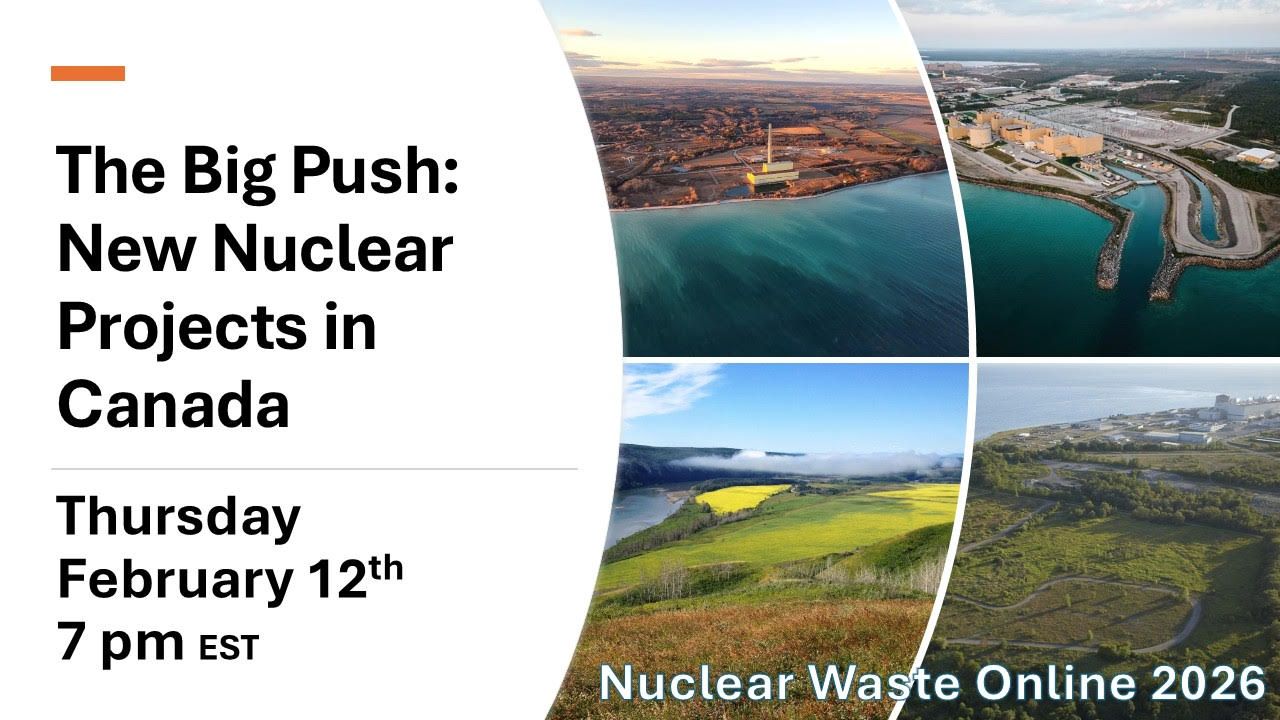
Thursday, February 12, 7 pm Eastern | 2nd of 4 sessions in the 2026 Nuclear Waste Online webinar series
Join a webinar on the push for new nuclear generation in Canada. Go to Northwatch.org to register or use the registration link https://us02web.zoom.us/webinar/register/WN_ZfWOf1GITqSRIZX8CB-A9w
-
Archives
- February 2026 (95)
- January 2026 (308)
- December 2025 (358)
- November 2025 (359)
- October 2025 (376)
- September 2025 (258)
- August 2025 (319)
- July 2025 (230)
- June 2025 (348)
- May 2025 (261)
- April 2025 (305)
- March 2025 (319)
-
Categories
- 1
- 1 NUCLEAR ISSUES
- business and costs
- climate change
- culture and arts
- ENERGY
- environment
- health
- history
- indigenous issues
- Legal
- marketing of nuclear
- media
- opposition to nuclear
- PERSONAL STORIES
- politics
- politics international
- Religion and ethics
- safety
- secrets,lies and civil liberties
- spinbuster
- technology
- Uranium
- wastes
- weapons and war
- Women
- 2 WORLD
- ACTION
- AFRICA
- Atrocities
- AUSTRALIA
- Christina's notes
- Christina's themes
- culture and arts
- Events
- Fuk 2022
- Fuk 2023
- Fukushima 2017
- Fukushima 2018
- fukushima 2019
- Fukushima 2020
- Fukushima 2021
- general
- global warming
- Humour (God we need it)
- Nuclear
- RARE EARTHS
- Reference
- resources – print
- Resources -audiovicual
- Weekly Newsletter
- World
- World Nuclear
- YouTube
-
RSS
Entries RSS
Comments RSS
 nuclear-news
Leave a comment