Nuclear news – week to 27 January.

Some bits of good news–
More than 2,400 aid trucks enter Gaza under truce, UN says no big looting issues. The fastest energy change in history continues. Protection for half a million hectares of Amazonian forests
TOP STORIES. Operation Stargate, the project to make AI an “essential infrastructure”.
America’s ‘zombie’ nuclear reactors to be revived to power Trump golden age.
Nuclear- not good vibrations in France. Nuclear power: Engie CEO criticises Arizona ambitions to extend Doel and Tihange lifespan.
When Russian Radar Mistook a Norwegian Scientific Rocket for a U.S. Missile, the World Narrowly Avoided Nuclear War.
From the archives. St Louis radioactively contaminated sites visited by Dr Helen Caldicott
Noel’s notes. Nuclear waste springs eternal in the human folly. For Australia, the nuclear lobby brings out the big massage!
AUSTRALIA. Miss America and nuclear engineer Grace Stanke will be travelling around Australia with a host of other nuclear experts as a part of the National Nuclear Tour.
Is the world going nuclear? The hope and hype of nuclear as a climate solution. We know why nuclear build costs are soaring — and Australia faces the biggest increases. Military Spending vs Social Services: Australia’s Paradox.
NUCLEAR ITEMS
ECONOMICS.
- “We are no longer investing in nuclear.”- Engie, France. “A question arises in terms of nuclear power: should EDF give up its international ambitions?”
- A new report from the International Energy Agency is bullish on the global nuclear sector, but only if obstacles like cost overruns are addressed.
- East Suffolk MP warned “billions worthlessly invested” in Sizewell C. It is only a matter of time before nuclear development at Bradwell falls by the wayside.
- UAE’s nuclear company seeks to capitalise on AI-induced energy demand in US.
ENERGY California debunks a big myth about renewable energy.Europe posts record negative power prices for 2024 as renewables rise. Green energy in abundance.Wind, not nuclear, is the best way to meet Sweden’s climate goals, leading think tank says. Nine Swedish energy researchers find that new nuclear power is not needed. |
| ENVIRONMENT. Vegetation being removed to enable upgrade of Sizewell line.Hinkley Point C: EDF says fish issue could delay new plant operation |
| EVENTS. 9 February -UNITAR Hosts Forum on Nuclear Abolition: 80 Years On |
| HEALTH. Radiation. The Scientists Who Alerted us to the Dangers of Radiation – https://www.youtube.com/watch?v=OyUjtpysc2Y&t=4s |
| INDIGENOUS ISSUES. Indigenous group vows to stop nuclear waste shipments unless new deal struck. |
| LEGAL. Allied Groups Reach Historic Settlement on New Nuclear Bomb Part Production – ALSO AT https://nuclear-news.net/2025/01/21/2-b1-allied-groups-reach-historic-settlement-on-new-nuclear-bomb-part-production/ |
| MEDIA. ‘Acres of Clams’- New documentary tells story of the Clamshell Alliance – https://www.youtube.com/watch?v=RPuE9oKh6-I |
| PERSONAL STORIES. Pete Wilkinson was well known for Sizewell C campaign work. |
POLITICS.
- Memo to Trump: Modify the US policy of sole authority to launch nuclear weapons.
- Trump says he will approve power plants for AI through emergency declaration.
- Legal challenges to infrastructure plans to be blocked in Starmer growth push. Suffolk Coastal MP said priority to hold Sizewell to account.
- Heysham power station debate sparks questions on safety and incidents.
- Anti nuclear activists celebrate fourth banniversary of nuclear weapons.
| POLITICS INTERNATIONAL and DIPLOMACY. Hiroshima, Nagasaki request Trump visit to teach ‘reality’. |
| SAFETY. Lakenheath: Ministers urged to clarify nuclear deployment. Memo to Trump: Address the new threat of drone-vulnerable nuclear reactors. |
| SECRETS and LIES. North Korea beats sanctions to acquire key tool for nuclear weapons -ALSO AT https://nuclear-news.net/2025/01/24/2-b1-north-korea-beats-sanctions-to-acquire-key-tool-for-nuclear-weapons/ The Atlas Network talking about itself |
| TECHNOLOGY. Nuclear fusion: it’s time for a reality check. Bill Gates’ nuclear energy startup inks new data center deal. |
WASTES.
- Sweden’s Nuclear Waste Plan: A 100,000-Year Gamble.
- High likelihood of radioactive waste in smoldering landfill, Missouri officials say.
- UK to dispose of, not re-use, radioactive plutonium stockpile.
- UK Plutonium Disposition Strategy.
- Canada’s Nuclear Waste Management Organization’s (NWMO) proposed DGR is a speculative unproven concept.
- Northwestern Ontario nuclear waste site selection raises concerns.
- Nuclear Waste: The Dark Side of the Microreactor Boom.
- Brian Goodall slams MP over Rosyth Dockyard nuclear submarines move.
- The Changing Goal Posts of Nuclear Wastes Crazily Earmarked for “Geological Disposal” .
| WEAPONS and WEAPONS SALES. Memo to Trump: Cancel US Air Force’s Sentinel ICBM program. Memo to Trump: Cancel the sea-launched nuclear cruise missile. Nuclear Proliferation and the “Nth Country Experiment” |
Nuclear power: Engie CEO criticises Arizona ambitions to extend Doel and Tihange lifespan.

Brussels Times, 25 January 2025, https://www.brusselstimes.com/news/1409124/nuclear-power-engie-ceo-criticises-arizona-ambitions-to-extend-doel-and-tihange-lifespan
Negotiators for the new federal government can kiss goodbye their plans to extend additional nuclear reactors or keep Doel 4 and Tihange 3 running for another 20 years. In a frustrated communication on Friday, Engie Belgium’s managing director Vincent Verbeke branded the plans “unthinkable today.”
The work Engie must carry out on Belgium’s nuclear sites is already “colossal”, Verbeke stressed. He points in particular to the dismantling of nuclear power plants that have already been shut down, work to secure the reactors that are due to close in 2025 and above all, the extension of Doel 4 and Tihange 3 until 2035.
It is therefore simply unthinkable to plan to keep Tihange 1 open any longer, insists the head of Engie Belgium. “We’re concentrating on what we’ve agreed, in particular the ten-year extension. This already represents a gigantic amount of work.”
Furthermore, nuclear power is no longer part of Engie’s “strategic ambition”, Verbeke says. The French energy giant is focusing more on renewable energies and flexibility. “We are no longer investing in nuclear power,” adds the CEO.
Plans to extend Doel 4 and Tihange 3 for a further ten years also appear to have fallen on deaf ears for the time being. “A 20-year extension is a different project. It doesn’t exist.” Verbeke reiterated that nuclear power is too expensive and the cheapest option is to invest in renewable energies.
When Russian Radar Mistook a Norwegian Scientific Rocket for a U.S. Missile, the World Narrowly Avoided Nuclear War

The Norwegian rocket incident, which took place on this day in 1995, marked the only known activation of a nuclear briefcase in response to a possible attack
Laura Kiniry. January 25, 2025, https://www.smithsonianmag.com/smart-news/when-russian-radar-mistook-a-norwegian-scientific-rocket-for-a-us-missile-the-world-narrowly-avoided-nuclear-war-180985836/
When the Cold War ended in 1991 with the collapse of the Soviet Union, it greatly reduced the threat of global nuclear war. But on January 25, 1995, that threat once again came front and center when Russian officers mistook a Norwegian rocket sent to study the aurora borealis for a weapon of mass destruction.
While not as well known as the 1962 Cuban Missile Crisis, the “Norwegian rocket incident” is considered one of the world’s closest brushes with nuclear war.
In the early morning hours of January 25, a team of Norwegian and American scientists launched a Black Brant XII four-stage sounding rocket from Norway’s Andoya Rocket Range, a launch site off the country’s northwestern coast. Its purpose: to study the northern lights over Svalbard, a Norwegian archipelago in the Arctic Ocean.
Although the scientists had notified dozens of countries, including Russia, in advance of their high-altitude scientific experiment, the information never made its way to Russia’s radar technicians.
Just four years after the Cold War’s end, tensions between the former USSR and the United States remained high. So when Russian officers at the Olenegorsk Radar Station detected a fast-moving object that was traveling on a high northbound trajectory above the Barents Sea, near Russia’s northern border, they feared it might be a nuclear attack from U.S. submarines. After all, it was similar in speed and flight pattern to a missile. It reached an altitude of 903 miles, separating into several sections as it flew, in the same way warheads would detach from a submarine-launched Trident missile.
Russia’s modus operandi was to identify an attack, assess it and decide whether to retaliate, all within ten minutes. Tracking the trajectory of the “missile” had already taken up the bulk of that time.
As a result, Russian submarine commanders were put on alert and ordered to prepare for a nuclear response. Russian President Boris Yeltsin was notified and given the Cheget, Russia’s nuclear briefcase—typically kept near the leader of a nuclear-weapons state at all times. This holds the launch codes for the country’s missile arsenal, which can be used to order a nuclear strike. To this day, it’s the only known activation of a nuclear briefcase in response to a possible attack.
After conferring with his top advisers, Yeltsin concluded that the rocket was heading away from Russian airspace and didn’t pose any threat to the country.
Twenty-four minutes after its launch, the rocket fell into the sea near Spitsbergen, the only permanently inhabited island on the Svalbard archipelago. The entire incident was over as quickly as it seemingly began.
It was a harrowing false alarm, and one that had the potential to cause widespread casualties. Though the incident has largely flown beneath history’s radar, it did lead to the re-evaluation and redesign of notification and disclosure protocols in both the U.S. and Russia
Ministers urged to clarify nuclear deployment
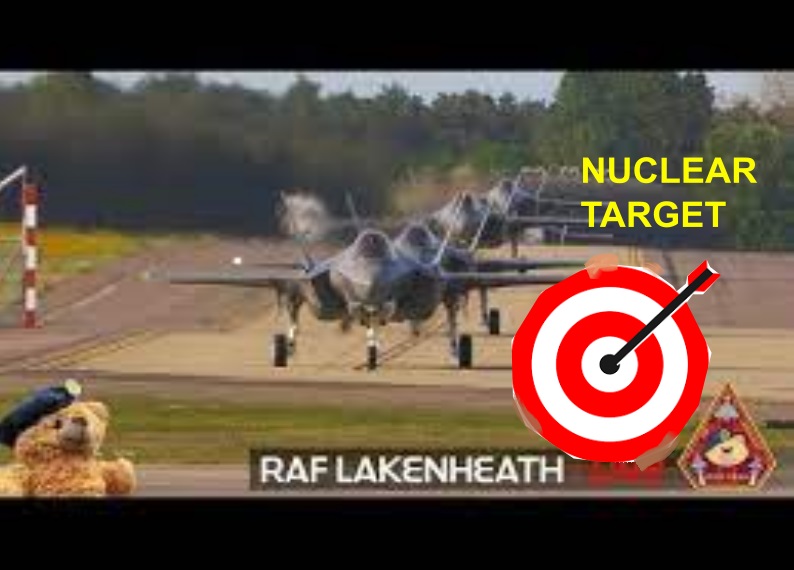
“US nuclear weapons at RAF Lakenheath will present a major threat, not only to communities near the base but to Britain as a whole, by putting us all on the US/Nato nuclear front line.”
Matt Precey, BBC News, Suffolk, 25th Jan 2025
The government is facing fresh demands to disclose whether US nuclear weapons are on British soil.
It comes as a senior American official confirmed the deployment of a new generation of bombs had been completed.
The Campaign for Nuclear Disarmament (CND) has written to the prime minister and the defence secretary to ask whether RAF Lakenheath in Suffolk is housing B61-12 munitions.
The UK and Nato have a long-standing policy to neither confirm nor deny the presence of nuclear weapons at a given location.
……………………………..The B61-12 is a thermonuclear bomb which can be carried by F-35A Lightning II aircraft, which are stationed at RAF Lakenheath.
US Department of Defense documents revealed $50m was being allocated to build new facilities at RAF Lakenheath known as “surety dormitories”, which the Federation of American Scientists claimed pointed to the arrival of nuclear weapons.
Another document seen by the BBC, which has since been removed from the internet, stated there was related work at the base in preparation for its “upcoming nuclear mission”.
Weapons of mass destruction were withdrawn from RAF Lakenheath in 2008.
The US and its Nato partners do not disclose figures for their European-deployed weapons but the Washington-based Center for Arms Proliferation and Control estimates there are 100 warheads stored across five countries.
Security risks
In a letter to the government, CND general secretary Sophie Bolt said Ms Hruby’s disclosure suggested the nuclear bombs could now be in the UK.
She said: “There has been no information presented to local communities about the new security risks that they face.
“US nuclear weapons at RAF Lakenheath will present a major threat, not only to communities near the base but to Britain as a whole, by putting us all on the US/Nato nuclear front line.”
The letter added that the public “has a right to know about the risks posed by such a deployment – and the right to express their opposition to it”.
In November, the US Air Force confirmed that unidentified drones had been spotted over three of its airbases in the UK, including RAF Lakenheath.
No further information has emerged as to the origin or intentions of these aircraft.
But CND said the sightings “increased risks” at the base.
Ms Bolt told the BBC: “An accident involving drones and an aircraft carrying nuclear material, or drones causing aircraft to crash on the base near where nuclear weapons are stored, could have catastrophic consequences.”
https://www.bbc.co.uk/news/articles/c20kwzyg721o
Nuclear Waste: The Dark Side of the Microreactor Boom

By Haley Zaremba – Jan 15, 2025, https://oilprice.com/Alternative-Energy/Nuclear-Power/Nuclear-Waste-The-Dark-Side-of-the-Microreactor-Boom.html
The nuclear energy sector is experiencing a revival, driven by factors such as increased energy demand and support from governments and tech companies.
Microreactors, a new form of nuclear technology, are being touted for their lower costs and smaller size, but they produce a significantly higher volume of nuclear waste.
Despite concerns about nuclear waste, the development and deployment of microreactors continue to gain momentum, driven in part by the growing energy needs of AI.
Nuclear energy is ready for its close-up. After decades of steep decline in the sector and relatively high levels of public mistrust for the controversial technology, the tides are turning in favor of a nuclear energy renaissance. The public memory of disasters like Fukushima, Three Mile Island, and Chernobyl is fading, and the benefits of nuclear – a zero-carbon, baseload energy source – are getting harder to ignore as deadlines for climate commitments grow closer and energy demand ticks ever higher. But the future of the nuclear energy sector will look a bit different than its last boom time, from technological advances to the makeup of its biggest backers.
In Russia and Asia, nuclear energy has stayed popular, but in the West, nuclear had almost entirely fallen out of favor up until the last few years. In the United States, the Biden administration helped to build momentum for a nuclear comeback through its flagship Inflation Reduction Act, which included tax breaks and other incentives for various nodes of the nuclear sector. Over in Europe, nuclear advocates are trying to push through policy supporting nuclear power as Europe reconfigures its energy landscape to contend with energy sanctions on Russia. Public opinion in the West is also shifting in favor of nuclear power. As of 2023, a Gallup poll showed that support for nuclear energy in the United States was at a 10-year high.
Some of the biggest proponents of the nuclear energy renaissance are big tech bigwigs, who point to the power source as a critical solution to feed the runaway power demand of Artificial Intelligence. In fact, the growth trend of data centers’ energy demand is so extreme that it will soon outstrip the United States’ production potential if nuclear energy – and a host of other low-carbon solutions – are not utilized, and soon. Tech bigwigs, therefore, have good reason to back nuclear energy – oh, and they also just so happen to be behind a rash of nuclear energy startups.
But the new kind of nuclear that these companies are trying to bring onto the scene will not be the same as the nuclear technologies that had so solidly fallen out of favor over the last few decades. Traditional nuclear energy has a number of drawbacks, most notably its extremely high up-front costs and the additional costly burden of storing hazardous nuclear waste. New nuclear advocates want to confront the former challenge by rolling out much smaller versions of nuclear reactors, which can essentially be mass-produced and then installed on site for much lower development costs.
Currently, the industry is undergoing a competitive race to corner the market on nuclear microreactors, which are about the size of a shipping container and function somewhat like a giant battery pack. “Microreactors have the ability to provide clean energy and have passive safety features, which decrease the risk of radioactive releases,” Euro News recently reported. “They are also much cheaper than bigger plants as they are factory-built and then installed where they are needed in modules.”
These microreactors can be used in a huge range of applications and do not require any on-site workers for their operation and maintenance. Instead, they can be operated remotely and autonomously. As a result, they have much lower overhead costs as well as lower up-front costs. So what’s the downside?
Well, it’s a big one. Scientists have found that, contrary to what nuclear advocates have touted, small nuclear reactors produce extremely high levels of nuclear waste, and could even be worse for the planet than their full-sized predecessors. “Our results show that most small modular reactor designs will actually increase the volume of nuclear waste in need of management and disposal, by factors of 2 to 30,” said Stanford study lead author Lindsay Krall. “These findings stand in sharp contrast to the cost and waste reduction benefits that advocates have claimed for advanced nuclear technologies.”Some members of the scientific community have taken notice: “Say no to small modular reactors,” blasted a recent headline from the Bulletin of Atomic Scientists.
However, the voices decrying the rollout of small- and microreactors seem to be in the minority, as the Silicon Valley-backed industry barrels full speed ahead. Countries across Europe have jumped into the race as well, and its high levels of momentum – fuelled by the seemingly unstoppable expansion of AI – are unlikely to be impeded by the scientists yelling doomsday warning, however well-founded, from the sidelines.
Heysham power station debate sparks questions on safety and incidents
By Robbie Macdonald, Lancaster Guardian 24th Jan 2025
Heysham nuclear power station safety, public health, waste, jobs, clean energy and the roles of councillors, from scrutiny to enthusiastic support, were raised in a Lancaster City Council debate.
It followed a recent announcement by the government and EDF about extending the generating lives of Heysham’s two nuclear reactors and the possibility of smaller reactors being there in the future.
Labour Coun Phillip Black, the former city council leader who resigned in November, put forward a motion backed by others, welcoming the news about extending Heysham 1’s and Heysham 2’s generating lives to 2027 and 2030.
Labour councillors and some others also wanted the council to state it had ‘confidence’ in the safety considerations underpinning the date extensions. And they also wanted the council to state support for new nuclear’ activity at Heysham in future.
However, others including many Greens, said Labour was irresponsible with the motion, given the wide spectrum of responsibilities councillors were supposed to consider.
Green Coun Gina Dowding said: “It’s really irresponsible to bring these two issues into one motion. Both are really important and deserve separate consideration.
“I recently asked a qualified architect, who has spent her working life on nuclear issues, about this. She said it would be deeply irresponsible for the council to ‘welcome’ the extensions. Extending the operating dates beyond the sites’ lifetimes should be questioned by the council – that is our role,” she emphasised. “These buildings were built in the 1980s based on reactor designs in the 1970s.”
She added: “We should also look at anomalies, such as an unforeseen circumstances , which are increasingly happening. There have been unplanned shut-downs. There was one last week. A loud bang was heard and a cloud seen, which concerned residents and the fire brigade was called.”
She also highlighted the proximity of the Heysham nuclear site, along with one at Hartlepool in the north-east, to areas with populations of over 100,000. She added: “At Heysham, the majority of people would be down-wind of any incident. So any motion saying this is ‘great for the future’ is not appropriate. Just because nothing has happened so far does not mean it couldn’t happen in future.
“Of course, there are skills and jobs in nuclear energy. But there are also skills and jobs in the decommissioning stages. Also in renewable energy, along with the potential to create more jobs and generate electricity for less cost.”
…………………………………….Fellow Green Tim Hamilton-Cox said. “Small modular reactors are still beyond the horizon and we have not yet got a permanent solution for nuclear waste. Some councillors have been against having that discussion. Speaking personally, I am not against nuclear power per se. But there are still many considerations and still no permanent solution for waste.”
Lib-Dem Peter Jackson, a member of the city council’s new cabinet, said: “I invite Labour councillors to bring forward a separate discussion about future Heysham questions as soon as possible.”
Morecambe Bay Independent Martin Bottoms, also on the new cabinet, also argued the extensions and any future developments should be treated separately. New modular reactors would not be on the horizon until at least 2025……………………………………
But Labour councillors opposed separating current and future topics. https://www.lancasterguardian.co.uk/news/national/heysham-power-station-debate-sparks-questions-on-safety-and-incidents-4958881
Brian Goodall slams MP over Rosyth Dockyard nuclear submarines move
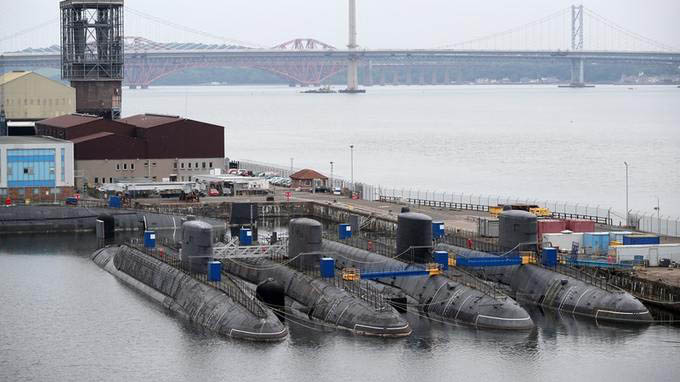
“As if it’s not bad enough that there are seven of these environmental time bombs already here, some of which have now been here for decades.“
By Ally McRoberts, Dunfermline Press 25th Jan 2025
A ROSYTH SNP councillor said he was “totally outraged” at the prospect of more nuclear submarines being brought to the dockyard for dismantling.
Brian Goodall said the “environmental time bombs” should be nowhere near the town and hit out at Labour MP Graeme Downie for pushing for more of the work to be done here.
One old Royal Navy sub, HMS Swiftsure, is being cut up and the radioactive waste removed as part of an innovative recycling scheme and there are six more vessels laid up at Rosyth, and another 16 at Devonport in Plymouth.
Mr Downie – who dismissed the criticism as “scaremongering” – wants the Ministry of Defence to put up the money to deal with all of the decommissioned boats and said it would “guarantee decades of work” and bring hundreds of jobs to the dockyard.
But Cllr Goodall hopes to sink that plan and said: “I’ve been totally outraged to see that our area’s Labour MP has called for even more nuclear submarines to be dumped and broken up in Rosyth.
“Labour’s MP for Dunfermline and Dollar has asked the MoD to bring all of the UK’s decommissioned nuclear submarines to Rosyth Dockyard.
“As if it’s not bad enough that there are seven of these environmental time bombs already here, some of which have now been here for decades.”
One of the seven at the yard, HMS Dreadnought has been laid up so long – since 1980 – that much of her low-level radiation has “disappeared naturally”.
As well as dealing with the 23 vessels at Rosyth and Devonport, three more are due to come out of service.
Cllr Goodall continued: “His call runs contrary to Fife Council’s long-standing commitment as a leading nuclear free local authority and I also fear the major impact on Rosyth Dockyard’s contribution to Scotland’s green transition, and the jobs that come with that, if this change of policy was secured, and the dockyard couldn’t become de-regulated as a nuclear site in the medium term.
“Rosyth is simply not the right place for the MoD, or anyone else, to be storing radioactive materials.
“There are homes, shops and businesses within metres of the dockyard.
“There’s a Fife College campus within the dockyard and our brand-new high school is being built within a few hundred metres of the site.”………………………..
Cllr Goodall said: “The compromise that could see the submarines that are already here, dismantled at the dockyard with all radioactive substances being removed to more suitable interim storage facilities down south, is one that I can, reluctantly, agree with, but any suggestion of additional nuclear submarines being brought to Rosyth is an outrage, and would be a breach of promise from the MoD.”……………………… https://www.dunfermlinepress.com/news/24883349.brian-goodall-slams-mp-rosyth-dockyard-subs-move/
The Atlas Network talking about itself

The MPS and its Atlas Network have conscientiously worked to change university campuses from places of free inquiry and critical thinking. Those beachheads in universities are matched by opportunities to find and promote “conservative” students. The idea is to shape them and potentially promote their careers in politics, the law, media, policy, academia and business.
January 26, 2025, Lucy Hamilton , https://theaimn.net/the-atlas-network-talking-about-itself/
There is much to learn about the Atlas Network from one of Ron Manners’ Mannkal Economic Education Foundation newsletters. This Mannkal newsletter was issued in April 2015. The project continues unabated.
The Atlas Network is a global interconnection of over 500 faux “thinktanks” (or junktanks), dedicated to reinforcing and propagandising the “free market” message. The Mont Pelerin Society (MPS) is considered its steering committee. The Atlas Network was designed from 1981 to metastasise similar bodies to sell “business” ideas. It finds local enthusiasts and donors around the world to eliminate obstructions to profit for American corporations and local fellow-travellers. The MPS is secretive: its membership is only rarely leaked.Ron Manners, with mining money, founded Mannkal in 1997. He is currently a life member and on the board of the MPS. He was appointed to the Advisory Council for the Atlas Economic Research Foundation in 2010. In 2020, he was awarded Atlas’s Sir Antony Fisher Achievement award. The newsletter explains that the name Mannkal originated in the cable/telex address of the company he inherited.
The Mannkal newsletter illustrates the connection to the MPS which first met in 1947. It brought together Austrian School economists such as Friedrich von Hayek and Ludwig von Mises together with the Chicago School’s Milton Friedman. The MPS, through Hayek, began the process of creating plutocrat-serving law and economics institutes in universities around America.
It also took the model provided by bodies such as the Foundation for Economic Education (FEE), founded in 1946, to create the mirage that a chorus of genuine policy experts supported the political economy that the donors desired. Friedman did much of the public relations for the project before the junktanks became more organised.
In the 1950s, Brit Antony Fisher, inspired by The Road to Serfdom, visited Hayek for advice. One of the UK junktanks in the Network explains that Hayek “told him bluntly to forget politics. Politicians just follow prevailing opinions. If you want to change events, change ideas.” He instructed Fisher to found thinktanks to help shift the prevailing mood away from the consensus that government, labour and capital all had a say in how society should operate towards a world where capital could dictate all including directing the government for its own ends.
When the co-founder of the Atlas Network Heritage Foundation, Ed Feulner, visited Australia in 1985 to conduct a workshop, he contrasted Friedman’s role marketing supply side economics, privatisation and the flat tax with the need for bodies to “set the terms and agenda of public policy.” The intent was to propagandise or “market an idea.” There must be “permanent saturation campaigns with multi-pronged, longterm strategies.” Proctor and Gamble, he explained, sell Crest toothpaste by “keeping the product fresh in the consumers’ minds.” That was to be the junktanks’ role. (These are a combination of Dr Jeremy Walker’s summaries and Feulner’s own words. The essay is well worth your time to see the history and people of Atlas in Australia.)
That Adam Smith Institute essay continues to boast that the Atlas Network had grown at the time of writing to 450 bodies. Now, the essay boasts, “They are changing events all over the world – from land reform in Peru, through privatization in Britain, public debt control in Pakistan, to low-cost education in India. And spreading the ideas of liberty in even the most unlikely places, in the Muslim world from Morocco through Turkey to Yemen and Kazakhstan; in Africa from Mali and Ivory Coast to Ethiopia; in Europe and the Far East.”
The MPS and its Atlas Network have conscientiously worked to change university campuses from places of free inquiry and critical thinking. Those beachheads in universities are matched by opportunities to find and promote “conservative” students. The idea is to shape them and potentially promote their careers in politics, the law, media, policy, academia and business.
One of Mannkal’s primary roles is the selecting of libertarian students in Western Australia for scholarships to Atlas Network junktanks around the world. In this edition of the newsletter, two report back on attending an MPS conference. One celebrated attending “networking events with prominent intellectuals and businesspeople from around the world.” Another was dazzled by, “Having dinner alongside a mining magnate, the chairman of a prominent think-tank, a famous TV presenter and an ex-CIA agent”. He continued, “I was exposed to a network rich in knowledge and influence, including a plethora of world-class academics, Nobel laureates and senior political figures.” (Nafeez Ahmed’s Alt Reich shows the significance of the CIA – and their former Nazis – in the shaping of the Atlas Network.)
Melbourne’s Institute of Public Affairs (IPA), a 1943 creation, was absorbed into the Atlas Network in the era of the Liberal Party’s battle between the Wets and the Dries. It was reportedly “hijacked” by “radicals” after people senior in the body attended an MPS conference.

The newsletter report of a third scholarship holder illustrates the Cold War dread of communism that continues to motivate the MPS and its Atlas junktanks. Former Czech president Vaklav Klaus, then a member of the MPS for 25 years, spoke at a lunch. People who have suffered under communist and socialist governments are often rolled out to warn audiences of the continuing threat of authoritarianism. The offspring of refugees who have had awful experiences in such countries provide some of the enthusiastic recruits for Mannkal.
Neoliberalism was always a bunk economics that trumpeted itself as superior because it was driven by theory and rejected evidence. In fact it was an ideology – and a network of activists – that functioned to serve the rich donors. As the project became our new normal, it created ever more dramatic inequalities, resulting in the fury and pain that drives sadopopulism. Youthful interest in social democracies has been a more productive response. In 2024, the IPA was sharing American Atlas junktank Cold War 2.0 propaganda to address the risk that youth might turn away from the “freedom” they sell.
Those of us watching the Atlas Network’s Heritage Foundation plans come to fruition in the first week of Trump’s second term see where authoritarianism lurks right now. Heritage’s Mandate for Leadershiphas come a long way since its first iteration set out the Ronald Reagan economic revolution’s steps. Now it combines its ultra-libertarian positions with authoritarian social policy and autocratic governance.
In this newsletter, Mannkal boasts of 154 scholarships available. Many are to conferences. Fifteen are “midyear internships abroad.” Another 45 are “3-month internships abroad.” The students are sent to Atlas junktanks around the world with 12 partners in particular listed. They include the inspiration for Mannkal, the FEE in Atlanta mentioned above. The Institute of Economic Affairs in London is another. That’s the body that helped create Maggie Thatcher’s economics after she was inspired by The Road to Serfdom. She co-founded another Atlas junktank, the Centre for Policy Studies.
One of the interns celebrates Maggie Thatcher’s certainty of the importance of Atlas: “It started with Sir Keith and me, with the Centre for Policy Studies, and Lord Harris at the Institute of Economic Affairs. Yes, it started with ideas, with beliefs. That’s it. You must start with beliefs. Yes, always beliefs.” Thatcher and Reagan make repeat appearances as Atlas heroes in the newsletter.
Another intern went to the New Zealand Institute, where the Chief Economist is Eric Crampton, MPS director.
The intern who was sent to Atlas headquarters in Washington was delighted to attend events at several of the Atlas junktanks including the Cato Institute (where Rupert Murdoch was a board member in the 1990s) and the Leadership Institute (party to Project 2025 and, like Heritage, to the Christian Nationalist Council for National Policy). She was impressed by Tom Palmer: Atlas’s Executive Director for International Programs. His patronising speeches at the Friedman Conference over the years can be found online.
Another of the interns was deeply grateful to spend time in Melbourne at the IPA with John Roskam. Two went to the Menzies Research Centre (MRC). One was thrilled to sit in on “meetings with high-level politicians and policy-advisors.” Mathias Corman, then Finance Minister, spoke at an MRC event about “shrinking government” in New Zealand and Australia. The Atlas Network’s Project 2025 shows how brutal the cuts to government are ultimately intended to be.
The Executive Director of the Liberal Party-affiliated MRC Nick Cater has just spent the European summer with Viktor Orbán’s junktanks in Budapest.
Scholarship donors are listed in the newsletter as Manners, Gina Rinehart, Willy Packer and Toby Nichols.
One public figure who shows the path and now models the Atlas policy influence is David Seymour, Deputy Prime Minister of New Zealand/Aotearoa. He was recruited on his university campus by the Atlas Association of Consumers and Taxpayers (ACT). The ACT is the now the political party that he leads. Seymour was awarded an Atlas “MBA” after a fortnight’s training at Atlas headquarters. He went on to work in the Canadian Atlas Frontier Center before returning to Atlas work in NZ. He is far from the only political leader with deep Atlas Network ties.
Austrian School economics is largely dead these days, although Atlas partners continue to try to resuscitate them. One of the intern reports in the newsletter says the “highlight of my experience was learning about Austrian economics, a stream of economics that is not taught in Australian high schools or universities.” There is a cogent reason why she was freshly discovering the contribution from “economists such as Ludwig von Mises, Friedrich Hayek, Joseph Schumpeter and Frederic Bastiat – important economists whose ideas or names have never once been mentioned in my four years of studying economics.” Several interns mention this inculcation of Austrian School truthiness as part of their experience.
One of the most ebullient floggers of Austrian thought in America has been Rand Paul. The intern sent to Canada’s Fraser Institute was excited to report that he met the man.
The newsletter discusses its links to the then highlight of the Atlas Network calendar in Australasian region, the Friedman Conference. In 2024, the conference was reduced to a rabble-rousing event called the Triple Conference that gave a day to libertarianism, a day to Christian Nationalism and a day to conspiracy theory nonsense.
The Mannkal newsletter also links to the History of Economic Thought Society Australia (HETSA), which hosts a Young Scholars Initiative (YSI) conference. HETSA is, anecdotally, a host to MPS figures. In 2024, this event took place at the Alphacrucis University College in NSW. Alphacrucis is the official training college of the Pentecostal Assemblies of God network, Australian Christian Churches reshaped under Hillsong’s Brian Houston. Notre Dame University, also a Catholic force in reactionary politicking and culture wars, provided the YSI organiser.
A third conference series mentioned is the “Freedom to Choose” conference, hosted by Notre Dame University and “supported” by Mannkal. The 2024 conference focused as its theme on the “enduring relevance” of Hayek’s Road to Serfdom, the book that inspired so many of the big money donors in the early history of neoliberalism.
Ron Manners pontificates on Public Choice Theory in the newsletter. This is a core aspect of Atlas’s history.
One of the key details to be gleaned from the newsletter is that this project is lifelong and often intergenerational for the donors. One of the interns at the IEA considered herself lucky to meet Hayek’s daughter who allowed the interns to “gain insight into the workings of her father first-hand!” Antony Fisher’s daughter, Linda Whetstone, was president of the MPS, chair of the Atlas Network and on the board at the IEA. Rupert Murdoch’s father Keith co-founded the IPA with Charles Kemp. Rupert was an official board member at Cato, and an unofficial conduit of the IPA, Centre of Independent Studies and MRC, whose people are regularly found on his platforms. The Kemp sons, Rod and David, were key figures in the thinktanks and the Atlas Americanisation of Australian politics.
Charles Koch has been a prime force financially and strategically at Atlas for decades.
It is hard to know how much of the change from Keynesian balanced economy to neoliberal brutality is attributable to the MPS and the Atlas Network, compared to how much might be due to the general impact of the donors and ideologues. Industry lobbies and the direct power of the plutocrats intermix with the marketing of the Atlas Network and its soft power impact for American corporations around the world.
The plutocrats ventriloquised through Atlas operations, but do not seem to feel the same compulsion to separate their goals from their faces any longer. Whether it’s Elon Musk or Gina Rinehart, they seem to feel comfortable now dictating oligarch policy for themselves.
Regardless, it’s worth watching Atlas talking about itself: the freedom it declares it fights for was always anti-democratic.
‘Acres of Clams’- New documentary tells story of the Clamshell Alliance

“Acres of Clams” can be viewed, free of charge, on YouTube at https://www.youtube.com/watch?v=RPuE9oKh6-I&t=198s.
by Anne Alpert, InDepthNH.org
For two weeks in the spring of 1977, New Hampshire was at the center of national attention. No, it had nothing to do with the first-in-the-nation primary. The matter that grabbed headlines was the arrest of 1415 people who had peacefully taken over the construction site of a proposed nuclear power plant in Seabrook. After being taken away on buses and National Guard trucks and processed at the Portsmouth Armory, the protesters were delivered to four other armories, where, refusing to pay bail, they engaged in a battle of wills with the stubbornly pro-nuclear governor, Meldrim Thomson.
The group behind the protest was a ragtag New England-wide coalition that called itself the Clamshell Alliance, members of which called themselves “Clams.” How it was able to take on a governor and a powerful industry through nonviolent protest, music, and well-deployed humor is the story told in “Acres of Clams,” a new documentary written, produced and narrated by Eric Wolfe.
“You might find this story hard to believe. Hell, I was there, and I hardly believe it myself,” Wolfe says at the outset. He weaves his story from personal memories, archival photos and footage, and a series of oral history videos captured by Steve Thornton at Clamshell reunions held a few decades later. …………………………………………………..
The Clams were deadly serious about the importance of stopping the spread of technology which would threaten to spew radiation across a heavily populated region. But Clamshell was also a good-natured movement, which Wolfe points out stood in marked contrast to angry anti-war protests in which he had participated just a few years earlier.
…………………………………………………………… But this was not a group of terrorists. All of them had been trained in nonviolence and agreed to what were called, “the guidelines,” in essence a code of discipline for participants, including no use of illegal drugs, no weapons, no running, no dogs, and no damage to the property at the construction site. Everyone knew they would probably get arrested.
………………………………………………………………………….“Acres of Clams” is not a documentary about nuclear power, still a controversial way to generate electricity, and one which the Clams I know still passionately oppose. If you’re interested in up-to-date information on why nukes aren’t the answer to climate catastrophe any more than they were the answer to oil imports in the 1970s, check out Beyond Nuclear, a group co-founded by Paul Gunter, who never stopped fighting nukes. And check out ClamshellAlliance.com, a relatively new website created to keep the group’s legacy alive and foster ongoing activism. What Wolfe set out to do, and succeeded, was to tell the story of a movement that flourished for several years and made history.
……………………………………… I think Wolfe has done a great job showing that disciplined nonviolence, humor, cultural expression, smart political judgment, good timing, and a certain amount of luck could produce what might appear to be magic: a grassroots social movement that can take on and defeat a multi-billion-dollar industry backed by the state and federal governments. And that’s a story that’s not just about nuclear dangers.
“Acres of Clams” can be viewed, free of charge, on YouTube at https://www.youtube.com/watch?v=RPuE9oKh6-I&t=198s.
Arnie Alpert spent decades as a community organizer/educator in NH movements for social justice and peace. Officially retired since 2020, he keeps his hands (and feet) in the activist world while writing about past and present social movements.
California debunks a big myth about renewable energy

Matt Simon, Grist, January 24th 2025, https://airqualitynews.com/fuels/california-debunks-a-big-myth-about-renewable-energy/
One of the biggest myths about renewable energy is that it isn’t reliable. Sure, the sun sets every night and winds calm down, putting solar panels and turbines to sleep. But when those renewables are humming, they’re providing the grid with electricity and charging banks of batteries, which then supply power at night.
A new study in the journal Renewable Energy that looked at California’s deployment of renewable power highlights just how reliable the future of energy might be. It found that last year, from late winter to early summer, renewables fulfilled 100 percent of the state’s electricity demand for up to 10 hours on 98 of 116 days, a record for California. Not only were there no blackouts during that time, thanks in part to backup battery power, but at their peak the renewables provided up to 162 percent of the grid’s needs — adding extra electricity California could export to neighboring states or use to fill batteries.
This study really finds that we can keep the grid stable with more and more renewables,” said Mark Z. Jacobson, a civil and environmental engineer at Stanford University and lead author of the new paper. “Every major renewable — geothermal, hydro, wind, solar in particular, even offshore wind — is lower cost than fossil fuels” on average, globally.
Yet Californians pay the second highest rates for electricity in the country. That’s not because of renewables, but in part because utilities’ electrical equipment has set off wildfires — like the Camp Fire started by Pacific Gas and Electric’s power lines, which devastated the town of Paradise and killed 85 people — and now they’re passing the costs that come from lawsuits and burying transmission lines to their customers. While investigators don’t know for sure what sparked all of the wildfires that have ravaged Los Angeles this month, they’ll be scrutinizing electrical equipment in the area. Power lines are especially prone to failing in high winds, like the 100-mile-per-hour gusts that turned these Southern California fires into monsters.
Even with the incessant challenge of wildfires, California utilities are rapidly shifting to clean energy, with about half of the state’s power generated by renewables like hydropower, wind, and solar. The study compared 116 days in 2024 to the same period in 2023 and discovered California’s output from solar was 31 percent higher and wind 8 percent. After increasing more than 30-fold between 2020 and 2023, the state’s battery capacity doubled between 2023 and 2024, and is now equivalent to the juice produced by more than four nuclear power plants. According to the study, all that new clean tech helped California’s power plants burn 40 percent less fossil fuel for electricty last year.
Those batteries help grid operators be more flexible in meeting demand for electricity, which tends to peak when people return home in the early evening and switch on appliances like air conditioners — just when the grid is losing solar power. “Now we’re seeing the batteries get charged up in the middle of the day, and then meet the portion of the demand in the evening, especially during those hot summer days,” said Mark Rothleder, chief operating officer of the California Independent System Operator, the nonprofit that runs the state’s grid.
Another pervasive myth about renewables is that they won’t be able to support a lot more electric vehicles, induction stoves, and heat pumps plugging into the grid. But here, too, California busts the myth: Between 2023 and 2024, demand on the state’s grid during the study period actually dropped by about 1 percent.
Why? In part because some customers installed their own solar panels, using that free solar energy instead of drawing power from the grid. In 2016, almost none of those customers had batteries to store that solar power to use at night. But battery adoption rose each of the following years, reaching 13 percent of buildings installing solar in 2023, then skyrocketing to 38 percent last year. (That is, of the 1,222 megawatts of solar capacity added last year, 464 megawatts included batteries.) That reduces demand on the grid because those customers can now use their solar power at night.
Batteries also help utilities get better returns on their investments in solar panels. A solar farm makes all its money selling electricity during the day. But if it has batteries attached to the farm, it can also provide energy in the evening, when electricity prices rise due to increased demand. “That evening battery contribution is very key to the economics working out well,” said Jan Kleissl, director of the Center for Energy Research at the University of California, San Diego, who wasn’t involved in the new paper.
So utilities are incentivized to invest in batteries, which also provide reliable backup power to avoid blackouts. But like any technology, batteries can fail. Last week, a battery storage plant caught fire on California’s central coast, the largest of its kind in the world, but it only knocked out 2 percent of the state’s energy storage capacity. A grid fully running on renewables will have a lot of redundancy built in, beyond multiple battery plants: Electric school buses and other EVs, for instance, are beginning to send power back to the grid when a utility needs it — a potentially vast network of backup energy.
But here’s where the economics get funky. The more renewables on the grid, the lower the electricity prices tend to be for customers, according to the new study. From October 1, 2023 to September 30, 2024, South Dakota, Montana, and Iowa provided 110 percent, 87 percent, and 79 percent, respectively, of their electricity demand with renewables, particularly wind and hydropower. Accordingly, the three have some of the lowest electricity prices in the country.
California, on the other hand, got 47 percent of its power from renewables over the same period, yet wildfires and other factors have translated into higher electricity prices. The California Public Utilities Commission, for instance, authorized its three largest utilities to collect $27 billion in wildfire prevention and insurance costs from ratepayers between 2019 and 2023.
Climate change is making California ever more prone to burn — a growing challenge for utilities. But the state’s banner year for solar and batteries just poked a whole lot of holes in the notion that renewables aren’t reliable.
“We are no longer investing in nuclear.”
“We are focusing on what we agreed upon, namely the extension by 10 years.
That is already a gigantic job,” says Vincent Verbeke. According to him,
nuclear is no longer part of Engie’s “strategic ambition”.
The French energy giant focuses on renewable energy and flexibility. “We are no longer
investing in nuclear.” The plans to extend Doel 4 and Tihange 3 by another
10 years seem to fall flat on their face. “A 20-year extension is a
different project. It doesn’t exist,” says Verbeke. He thinks nuclear
energy is too expensive. “The cheapest option is to invest in renewables.”
VRT News 24th Jan 2025, https://www.vrt.be/vrtnws/nl/2025/01/24/bijkomende-verlenging-doel-4-en-tihange-3-ondenkbaar-zegt-eng/
1 This Month


18 March Webinar @ 1 PM EST: An Assessment of SMR Projects: The Case of Canada
register for the zoom:
https://us02web.zoom.us/webinar/register/WN_o8BIIOUvQ2ONJR1nta65DQ#/registration


of the week – STOP SMALL MODULAR REACTORS IN CANADA
To see nuclear-related stories in greater depth and intensity – go to https://nuclearinformation.wordpress.com
-
Archives
- March 2026 (138)
- February 2026 (268)
- January 2026 (308)
- December 2025 (358)
- November 2025 (359)
- October 2025 (376)
- September 2025 (258)
- August 2025 (319)
- July 2025 (230)
- June 2025 (348)
- May 2025 (261)
- April 2025 (305)
-
Categories
- 1
- 1 NUCLEAR ISSUES
- business and costs
- climate change
- culture and arts
- ENERGY
- environment
- health
- history
- indigenous issues
- Legal
- marketing of nuclear
- media
- opposition to nuclear
- PERSONAL STORIES
- politics
- politics international
- Religion and ethics
- safety
- secrets,lies and civil liberties
- spinbuster
- technology
- Uranium
- wastes
- weapons and war
- Women
- 2 WORLD
- ACTION
- AFRICA
- Atrocities
- AUSTRALIA
- Christina's notes
- Christina's themes
- culture and arts
- Events
- Fuk 2022
- Fuk 2023
- Fukushima 2017
- Fukushima 2018
- fukushima 2019
- Fukushima 2020
- Fukushima 2021
- general
- global warming
- Humour (God we need it)
- Nuclear
- RARE EARTHS
- Reference
- resources – print
- Resources -audiovicual
- Weekly Newsletter
- World
- World Nuclear
- YouTube
-
RSS
Entries RSS
Comments RSS
 nuclear-news