UK to dispose of, not re-use, radioactive plutonium stockpile
BBC 24th Jan 2025,
https://www.bbc.co.uk/news/articles/cjr8lzyg299o
The government says it will dispose of its 140 tonnes of radioactive plutonium – currently stored at a secure facility at Sellafield in Cumbria.
The UK has the world’s largest stockpile of the hazardous material, which is a product of nuclear fuel reprocessing.
It has been kept at the site and has been piling up for decades in a form that would allow it to be recycled into new nuclear fuel.
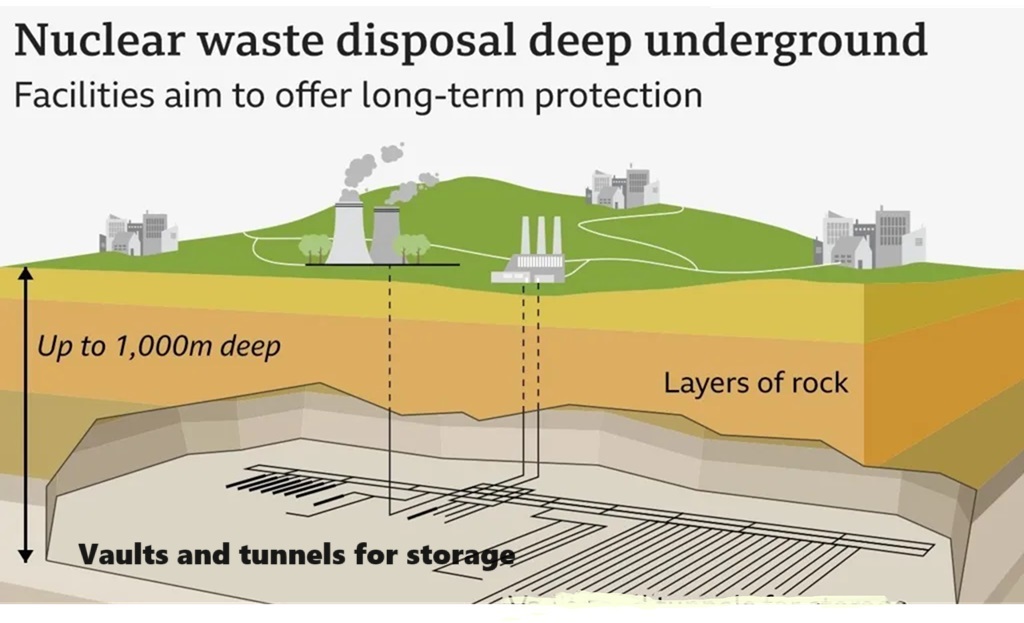
But the government has now decided that it will not be reused and instead says it wants to put the hazardous material “beyond reach” and made ready for permanent disposal deep underground.
That means that a facility will be built at Sellafield where the plutonium can be converted into a stable, rock-like material, which can eventually be disposed of deep underground.
In a statement, energy minister Michael Shanks said the objective was “to put this material beyond reach, into a form which both reduces the long-term safety and security burden during storage and ensures it is suitable for disposal”.
Nuclear materials scientist Dr Lewis Blackburn from the University of Sheffield said the plutonium would be “converted into a ceramic material” which, while still radioactive, is solid and stable so it is deemed safe to dispose of.
“The type of ceramic remains to be decided [and selecting the right material] is the subject of ongoing research.”
Nuclear waste expert Prof Claire Corkhill from the University of Bristol said the goverment’s decision was a “positive step”.
She told BBC News that it paved the way to removing the cost and hazard of storing plutonium at Sellafield “by transforming it and locking it away into a solid, durable material that will last for millions of years in a geological disposal facility”.
“These materials are based on those we find in nature – natural minerals, that we know have contained uranium for billions of years.”
The government is currently in the early stages of a long technical and political process of choosing a suitable site to build a deep geological facility that will eventually be the destination for all of the country’s most hazardous radioactive waste. That facility will not be operational until at least 2050.
No comments yet.
1 This Month

18 March Webinar @ 1 PM EST: An Assessment of SMR Projects: The Case of Canada
register for the zoom:
https://us02web.zoom.us/webinar/register/WN_o8BIIOUvQ2ONJR1nta65DQ#/registration

of the week – STOP SMALL MODULAR REACTORS IN CANADA
To see nuclear-related stories in greater depth and intensity – go to https://nuclearinformation.wordpress.com
-
Archives
- February 2026 (256)
- January 2026 (308)
- December 2025 (358)
- November 2025 (359)
- October 2025 (376)
- September 2025 (258)
- August 2025 (319)
- July 2025 (230)
- June 2025 (348)
- May 2025 (261)
- April 2025 (305)
- March 2025 (319)
-
Categories
- 1
- 1 NUCLEAR ISSUES
- business and costs
- climate change
- culture and arts
- ENERGY
- environment
- health
- history
- indigenous issues
- Legal
- marketing of nuclear
- media
- opposition to nuclear
- PERSONAL STORIES
- politics
- politics international
- Religion and ethics
- safety
- secrets,lies and civil liberties
- spinbuster
- technology
- Uranium
- wastes
- weapons and war
- Women
- 2 WORLD
- ACTION
- AFRICA
- Atrocities
- AUSTRALIA
- Christina's notes
- Christina's themes
- culture and arts
- Events
- Fuk 2022
- Fuk 2023
- Fukushima 2017
- Fukushima 2018
- fukushima 2019
- Fukushima 2020
- Fukushima 2021
- general
- global warming
- Humour (God we need it)
- Nuclear
- RARE EARTHS
- Reference
- resources – print
- Resources -audiovicual
- Weekly Newsletter
- World
- World Nuclear
- YouTube
-
RSS
Entries RSS
Comments RSS
 nuclear-news
Leave a comment