Anti nuclear activists celebrate fourth banniversary of nuclear weapons
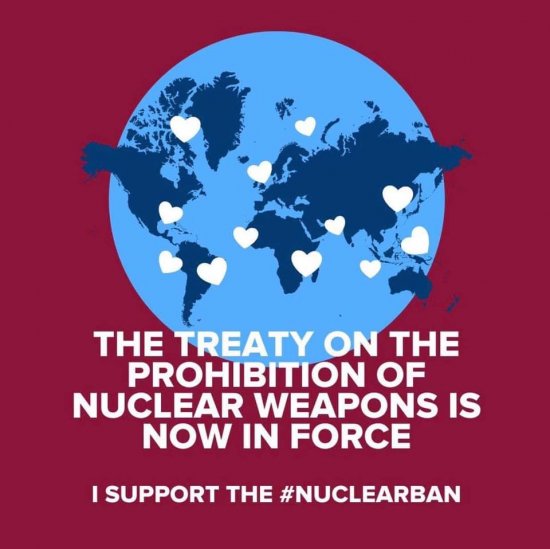
Half of the world’s nations, representing 2.5 billion people, have now signed and / or ratified the Ban Treaty. There are now 94 States Parties to the treaty and 73 have ratified their absolute adherence to it.
NFLA 22nd Jan 2025
Today (22nd January) is the banniversary, the fourth anniversary of the Treaty on the Prohibition of Nuclear Weapons[i] entering into international law at the UN.
This treaty, usually called the Ban Treaty, is the first piece of international legislation to outlaw the production, stockpiling, transfer, use or threat of use of nuclear weapons.
In the world today we have nine confirmed or acknowledged nuclear weapons states, the USA, Russia, United Kingdom, France, India, Pakistan, Israel and North Korea, with an estimated 12,121 nuclear weapons in January 2024[ii].
In 2023, these states were estimated to have spent $91.4 billion maintaining and enhancing their nuclear arsenals.
Nuclear proliferation has been restrained because of the Nuclear Non-Proliferation Treaty[iii] which was first signed by the USA, USSR and UK in 1968 and has almost universal acceptance in the world community. Signatory nations without nuclear weapons agree not to acquire them, whilst retaining the right to employ nuclear power for energy, whilst the five nuclear weapon states, the USA, Russia, UK, France and China, which have signed it have agreed not to deploy nuclear weapons against non-nuclear weapons states. Furthermore, under Article 6 they have committed to: pursue negotiations in good faith on effective measures relating to cessation of the nuclear arms race at an early date and to nuclear disarmament’.
The Ban Treaty came to pass because global civil society, particularly in nations whose people suffered greatly from post-war atomic and nuclear bomb testing, such as Australia, the Pacific Islands, Algeria, and Kazakhstan, became increasingly frustrated by the failure of these nuclear nations to conduct any negotiations in ‘good faith’, despite the passage of over 60 years. Civic society groups, scientists, physicians and the Hibakusha pushed back by establishing an International Campaign to Abolish Nuclear Weapons (ICAN) to bring about the world’s first definitive legislation to outlaw nuclear weapons.[iv]
In doing so they were following the example set by worldwide campaigners opposed to anti-personnel landmines, whose campaign led to the passage of the Ottawa Convention or the Anti-Personnel Land Mine Ban Convention.[v] This became law in 1997. Later that year the International Campaign to Ban Landmines won the Novel Peace Prize.
The new campaign aimed to bring in similar legislation to that which previously banned other weapons of mass destruction, namely chemical, biological and bacteriological weapons.
Lawyers from civil society groups and supportive nations drew up the legislation. Several years were spent by campaigners in international shuttle diplomacy, with private meetings and various regional conferences held across the world to build support amongst United Nations member states…………………………………………………………………………………………
Half of the world’s nations, representing 2.5 billion people, have now signed and / or ratified the Ban Treaty. There are now 94 States Parties to the treaty and 73 have ratified their absolute adherence to it.
……………………………………………………………………………………………………………………. The Nuclear Free Local Authorities and Mayors for Peace are both established partners in ICAN.
Interestingly in both organisations are member authorities in the Republic of Ireland and the UK. The Republic is a neutral and non-nuclear weapon state that has signed and ratified the Ban Treaty. The UK is a NATO and nuclear weapon state which is refusing to engage with the treaty. This creates a dichotomy.
What then will the UK/Ireland NFLAs and Mayors for Peace Chapter be doing in 2025 to build support for the treaty and the communities affected by nuclear weapons and testing?
Richard Outram, explains:
The big challenge here is getting any British Government, whatever its political persuasion, which remains wedded to nuclear weapons and is a member of a nuclear weapons alliance with a first use policy, to get on board with the Treaty.
“2025 will be an especially significant year in the history of nuclear weapons, being the 80th anniversary of the tragic atom bomb attacks on Hiroshima and Nagasaki, so it will be important to have a focused plan with positive actions.”
Richard intends to:
- Ask the Labour Government to send an official observer to the next conference of the Ban Treaty to join signatory states and civil society groups. This will be held in New York in March.
- Lobby the Government to acknowledge the moral imperative for the UK to provide reparations and practical support for the communities, generally Indigenous, impacted by British atomic and nuclear weapons, as per the provisions of Articles 6 and 7 in the Ban Treaty.
- Continue to work for justice and compensation for Britain’s atomic and nuclear test veteran community and their families. The NFLAs have been a major player in lobbying politicians at all levels in both Conservative and Labour governments, and has appointed a former British Army veteran, Councillor Tommy Judge, to be its spokesperson on these issues.
- Ask Mayors for Peace to follow Manchester’s example in passing resolutions in support of the ICAN Cities Appeal calling on the British Government to sign the Treaty.
- Write to parliamentarians at Holyrood in support of a resolution just tabled before the Scottish Government favouring nuclear disarmament and a nuclear free Scotland.
- Support any move to lobby local government pension funds to divest from nuclear weapons.
- Continue to work building up the number of our member authorities and to strengthen their capacity to act for peace in this 80th anniversary year of the atom bombings. https://www.nuclearpolicy.info/news/anti-nuclear-activists-celebrate-fourth-banniversary-of-nuclear-weapons/
No comments yet.
1 This Month

of the week – Shut Down Drone Warfare!


Tell the Ukrainian Government to Drop Prosecution of Peace Activist Yurii Sheliazhenko

Petition to revoke the licensing of the Near Surface Nuclear Disposal Facility (NSDF) at Chalk River. https://www.ourcommons.ca/petitions/en/Petition/Details?Petition=e-7247
To see nuclear-related stories in greater depth and intensity – go to https://nuclearinformation.wordpress.com
-
Archives
- April 2026 (19)
- March 2026 (251)
- February 2026 (268)
- January 2026 (308)
- December 2025 (358)
- November 2025 (359)
- October 2025 (376)
- September 2025 (257)
- August 2025 (319)
- July 2025 (230)
- June 2025 (348)
- May 2025 (261)
-
Categories
- 1
- 1 NUCLEAR ISSUES
- business and costs
- climate change
- culture and arts
- ENERGY
- environment
- health
- history
- indigenous issues
- Legal
- marketing of nuclear
- media
- opposition to nuclear
- PERSONAL STORIES
- politics
- politics international
- Religion and ethics
- safety
- secrets,lies and civil liberties
- spinbuster
- technology
- Uranium
- wastes
- weapons and war
- Women
- 2 WORLD
- ACTION
- AFRICA
- Atrocities
- AUSTRALIA
- Christina's notes
- Christina's themes
- culture and arts
- Events
- Fuk 2022
- Fuk 2023
- Fukushima 2017
- Fukushima 2018
- fukushima 2019
- Fukushima 2020
- Fukushima 2021
- general
- global warming
- Humour (God we need it)
- Nuclear
- RARE EARTHS
- Reference
- resources – print
- Resources -audiovicual
- Weekly Newsletter
- World
- World Nuclear
- YouTube
-
RSS
Entries RSS
Comments RSS
 nuclear-news
Leave a comment