For Australia, the nuclear lobby brings out the big massage!
https://theaimn.net/for-australia-the-nuclear-lobby-brings-out-the-big-massage/ 24 Jan 25
In December 2022, 16 year-old Will Shackel started a “charity” – Nuclear For Australia, funded by entrepreneur Dick Smith. It’s a “fact-filled” “grassroots” movement, devoted to champion the cause of “clean reliable” nuclear energy for Australia. It’s not a lobby group for the nuclear industry – Oh no! – even if its leaders are Dr ADi Paterson, with his career in the industry, and Tony Irwin, Technical Director of SMR Nuclear Technology Pty Ltd. It’s not political, oh no! even if its goal happens to identical with the policy campaign goal of the Liberal Coalition Party for the coming Federal Election.
But, just by coincidence, in this election year, Nuclear for Australia is touting not just young Will Shackel, but also 24 year old American Grace Stanke. And these are the nuclear propaganda big guns for 2025.
Why do I call them the “big guns?
After all, Australia has some very experienced nuclear experts, happy to tell us how great nuclear power is. There are not only Dr Paterson, and Mr Irwin. There are Ziggy Switkowski, Michael Angwin, the expert staff of the Australian Nuclear Science and Technology Organisation, and the Australian Uranium Association. Well, the thing is they are the old-style big guns, who will spout their expert facts at length, and in detail..
In the new Trumpian era, it’s not enough to know the facts, and perhaps, not even necessary.
What is now important is the person who is touting nuclear power. Is he, and preferably she, young, attractive, warm, enthusiastic, and easy to understand?
Actually, the Australian nuclear lobby has recognised this for a while. They previously promoted the rather wacky young nuclear spruikers Zion Lights and Isodope (Yes – those really are their names)
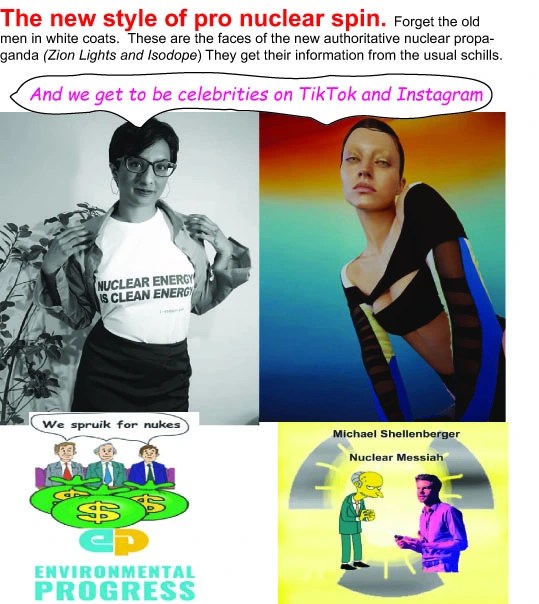
Zion and Isodope did their best. But what Australia needs, seems to be young people who are bright and attractive, and with appeal not just to the young, but across the generations – knowledgeable, likeable, but not rebellious.
Polls always show that in Australia, women are less supportive of nuclear power, than men are. With compulsory voting, it’s always important for the parties campaigning to pay attention to the opinions of women. So it’s especially important for the nuclear lobby to appeal to women.
Young Will Shackel was a good propagandist over 2023-34, articulate, enthusiastic, and good-looking. But in this election year, what is needed is a female propagandist, an appealing model for young women, and also attractive to men, and acceptable to older generations.
Enter Grace Stanke.

Grace Stanke is an attractive, articulate, accomplshed young woman – a classical violinist, a water-skier, Miss America 2023 – and a nuclear engineer. She graduated in 2023, and went to work full time as Nuclear Engineer and Nuclear Energy advocate at Constellation Energy
I can’t help admiring Grace Stanke for her achievements, and for her apparently very sincere motivation. She is grateful to nuclear medicine, for helping her father who had cancer, and she believes that climate change must be addressed, by replacing fossil fuels. And she’s obviously very bright, and knows her stuff about nuclear technology.
Still, for thoughtful people there’s a problem with Grace as a nuclear proponent. This is the fact that it doesn’t seem to matter that she knows her nuclear stuff. I have watched several video interviews with her, some remarkably long, and she was not called upon to answer the hard questions. The interviewers seem focussed on her career in beauty pageants, and her year as Miss America. The interviews have a happy positive tone, rejoicing in her success as a young woman and a mentor for girls. No need to get down and dirty about toxic wastes, the effects of the industry on the health of uranium miners and other workers and communities.
And this what we’re up against in the new age of Trumpic spin – short, bright messages – purveyed by attractive young people. Marshall McCluhan predicted it decades ago – The Medium is the Massage. It’s usually written as “Message”, but I think that his original wording was more accurate.
Grace Stanke has been travelling around the world, promoting the nuclear industry, including to the Climate Summit Cop 29, and even before graduating, was named the “New Face of Nuclear Energy” by the Wall Street Journal.
I feel that it is incorrect to call people like Grace Stanke and Will Shackel the “big guns”. That suggests a sort of aggressive, forceful propaganda. And that’s not their style. They’re so sincere, and squeaky clean and nice. It will be interesting, but unlikely, if Grace Stanke has to worry about any tough questioning . After all, that wouldn’t be courteous to a visiting Miss America.
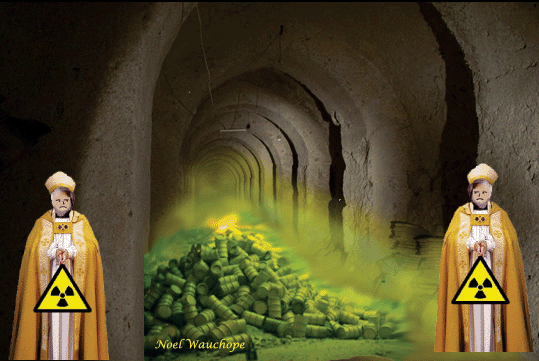
Sweden’s Nuclear Waste Plan: A 100,000-Year Gamble
Oil Price, By Kurt Cobb – Jan 20, 2025,
- Sweden plans to store nuclear waste for 100,000 years, but the author questions whether this is feasible given the uncertainties of human civilization and technological progress over such a long period.
- The author argues that climate change, political instability, and technological limitations could all pose threats to the long-term safety of nuclear waste storage.
- The author suggests that reprocessing nuclear waste might be a better solution than burying it, but acknowledges that this is also expensive and dangerous.
The sensible Swedes like planning ahead. This time its storage for nuclear waste from its own nuclear industry—storage that is supposed to last 100,000 years. Nuclear power currently provides 40 percent of Sweden’s electricity from six operating reactors. The Swedes expect to fill the storage site—”60 km of tunnels buried 500 metres down in 1.9 billion year old bedrock”—sometime by 2080 at which time it will be closed.
For understanding whether the target of 100,000 years of successful storage is plausible, I suggest a trip back 100,000 years to understand what surprises might be in store over such an interval. One hundred thousand years ago the Bronze Age, the age when humans first started to refine and work with metal, was still 97,000 years in the future.
It might seem that not much happened in those 97,000 years, but actually a lot that could challenge such storage schemes did. For example, somewhere around 71,000 to 74,000 years ago Mount Toba, located in modern-day Indonesia, erupted in a supervolcano thought to be the largest in human history. The eruption was two orders of magnitude (100X) larger than another famous Indonesian volcanic eruption, Mount Tambora, which caused what is now referred to as “the year without a summer” in 1816.
…………..Of course, another Mount Toba might just solve the problem of keeping humans away from Swedish nuclear waste because there will be so few people left who could end up drinking radioactive water or touching radioactive soil that we needn’t worry. But a lesser disaster might only, say, halve the human presence on Earth while destroying the kind of complex technology and crucial political structure that make it possible to monitor such waste sites.
……………………………..What we call civilization, that is, human settlement in cities, has only been around about 10,000 years. That’s hardly an endorsement for continuity over the next 100,000. Maybe the Swedes believe that the way they are burying their nuclear waste will make the coming and going of human civilizations over the next 100,000 years irrelevant. But, how could they possibly know that? After all, one Swedish environmental group is going to court to challenge the plan because “research from Sweden’s Royal Institute of Technology showed the copper capsules [used to contain the waste] could corrode and leak radioactive elements into the ground water.”
Okay, maybe you’re thinking that surely in the future our technological prowess will be always ever greater and so containing these wastes will ultimately be a trivial problem in retrospect. There are so many answers to why that will almost certainly NOT be the case. The simplest one is that technology relies on energy and our inability to get beyond fossil fuels which are finite to something even more dense and versatile doesn’t bode well for an advanced technological future.
………………..I understand that now that we humans have produced this waste, we ought to figure out how to store it safely for the sake of whatever life, both human and nonhuman, comes after us. One solution would be to reprocess it to get the usable radioactive products from the waste and use them up as much as possible. That reduces but does not eliminate waste. And, reprocessing is expensive and dangerous and essentially a doubling down on an advanced technological solution.
Of course, another problem is that reprocessing is great for extracting plutonium that can be used in nuclear weapons—which could lead to another kind of disaster. Beyond this, worldwide the amount of waste continues to increase and there are plans to build new nuclear reactors without a solution to the waste problem having been realized on any scale necessary to take care of wastes from all the countries of the world NOT called Sweden. That’s why burying what we have in the ground seems like a cheap and viable solution in comparison to reprocessing—or the totally crazy idea of shooting such waste into space or into the Sun.
I just wonder how knowledge of such waste sites will be preserved for 100,000 years. I wonder whether we humans can build something that will last 100,000 years given our record and the dangerous exigencies of life on Earth. And, I wonder if we were wise to create something in the first place that requires 100,000 years of care, given how heedless we as a species are to hazards of our own making that may destroy our current civilization much, much sooner than a thousand centuries from now. https://oilprice.com/Alternative-Energy/Nuclear-Power/Swedens-Nuclear-Waste-Plan-A-100000-Year-Gamble.html
9 February -UNITAR Hosts Forum on Nuclear Abolition: 80 Years On
Mirage, 23 Jan 2025
- UNITAR partners with the Japan Campaign to Abolish Nuclear Weapons (JANA) to host a public event on nuclear disarmament at the University of the Sacred Heart, Tokyo, on 9 February 2025
- The public session invites international experts on nuclear disarmament and non-proliferation, including Mr. Tariq Rauf, former Head of Verification and Security Policy, IAEA
- The discussion will touch on topics such as multilateral security challenges and diplomacy, prospects for the 2026 NPT review and the latest trends and efforts of the Secretary-General and UN Member States to try to advance nuclear disarmament
- After the public session, a virtual reality (VR) experience to convey the realities of the atomic bombing will be held in collaboration with Fujita Corporation and Tabimachi-gate Hiroshima Co., Ltd. for in person participants
- In person attendance of the public forum requires prior registration and ticket purchase. Livestreaming is available for Part I, free of charge
……………………………………………………………………………………………. more https://www.miragenews.com/unitar-hosts-forum-on-nuclear-abolition-80-1395104/
Nuclear fusion: it’s time for a reality check

Significant obstacles lie ahead in the quest for commercially viable nuclear fusion, writes Luca Garzotti, https://www.theguardian.com/science/2025/jan/22/nuclear-fusion-its-time-for-a-reality-check
I can’t help thinking Ed Miliband has not been accurately briefed when he says a government funding pledge means Britain is within “grasping distance” of “secure, clean, unlimited energy” from nuclear fusion (Ministers pledge record £410m to support UK nuclear fusion energy, 16 January).
Before we start talking about nuclear fusion via magnetic confinement as a commercially viable source of energy, five main challenges have to be met by the scientific community, each one of them a potential showstopper. We have to demonstrate:
1) That we can run a burning plasma for hours (if not in steady state) with Q=40 (Q being the ratio between power coming from the fusion reactions and power used to heat the plasma) without disruptions. If all goes well, at some point in the future, the ITER fusion project your article mentions will run a burning plasma with Q=10 for about 10 minutes.
2) That we can handle and exhaust the heat escaping from such a plasma and impinging on the first wall of the confining device.
3) That we can breed in the blanket of a power plant more tritium than we burn in the plasma. (Tritium is not readily available in nature and must be produced.)
4) That the materials used to build such a plant can withstand the neutron fluence coming from the burning plasma without losing their structural properties and without becoming excessively radioactive.
5) That a fusion reactor can be operated reliably and maintained by remote handling, minimising the downtime needed for maintenance.
These are massive scientific and technological challenges, the solution of which (despite progress being made) is not in the near future. The reward for finding a solution will be immense and therefore research must continue with humility and tenacity, but there is no room for overoptimistic or triumphalist statements, which can only undermine the credibility of the scientists and engineers working on the problem.
Labour Minister concedes no new nuclear power stations will be built in Scotland

Michael Shanks said the SNP Government’s opposition to new nuclear would see plants blocked
Paul Hutcheon, Political Editor, Daily Record, 21st Jan 2025
The UK Energy Minister has said there will be no new nuclear plants in Scotland because they would be blocked by the SNP Government. Michael Shanks said he disagreed with the Edinburgh administration’s position but said their stance was “legitimate”.
Shanks made his comments in an evidence session to Holyrood on the Labour Government’s plan for GB Energy. The publicly-owned company will be headquartered in Aberdeen and is aimed at spearheading a clean energy revolution.
But nuclear appears to have no future in Scotland as the SNP Government is opposed and can exercise a veto through the planning system.
………..“They’ve set a very clear statement that there will be no new nuclear in Scotland. I might disagree with that but that is the landscape they operate in and therefore there is no plans, there will be no engagement on that issue because it is very clear that those applications would be blocked by the Scottish Government and that is the legitimate position that the Scottish government [takes] on planning matters.”
He added that there was no “confrontation” and said GB Energy has to comply with the rules, regulations and planning statements in each part of the UK.
https://www.dailyrecord.co.uk/news/politics/labour-minster-concedes-no-new-34522820
North Korea beats sanctions to acquire key tool for nuclear weapons.
North Korea obtained a key tool used in the production of nuclear warheads
by shipping it through three separate countries in an elaborate ploy to
dodge international sanctions on the country’s weapons programme.
According to a US think tank, authorities in Mexico, South Africa and China
failed to spot false documentation for a vacuum furnace, which can be used
in creating uranium fuel for nuclear warheads.
The case demonstrates the
increasing difficulties of enforcing international sanctions against North
Korea. The report by the Institute for Science and International Security
cites unnamed government sources to describe an incident in 2022, when the
vacuum furnace was shipped from Spain with an accurate declaration of its
function.
Times 20th Jan 2025,
https://www.thetimes.com/world/asia/article/north-korea-sanctions-key-nuclear-tool-z6qwg79jj
Hiroshima, Nagasaki request Trump visit to teach ‘reality’
THE ASAHI SHIMBUN, January 21, 2025, https://www.asahi.com/ajw/articles/15593546?fbclid=IwY2xjawH-kw1leHRuA2FlbQIxMQABHWQj2ot0ghPWLSQohYVpcrIV882O59BHkl0uht0iBsjnLw2qXSEFsC2wtA_aem_GPd2Oltqb_ec9tqxNwFwAw
HIROSHIMA–Hiroshima Governor Hidehiko Yuzaki has invited new U.S. President Donald Trump to visit the prefectural capital in an effort toward nuclear disarmament and world peace.
In a letter dated Jan. 20, Yuzaki urged Trump to visit the Hiroshima Peace Memorial Museum and engage in dialogue with the survivors of the U.S. atomic bombing of the city in 1945.
Yuzaki highlighted the significant influence the United States, a major nuclear superpower, holds over global security.
He emphasized that Trump’s visit to the city would help him understand the reality of the atomic bombing, sending a powerful message of peace that encourages political leaders to make decisions and take actions toward a world free of nuclear weapons.
A similar request was also sent to Vice President JD Vance.
The prefecture’s call comes amid increasing international tensions over nuclear issues and as 2025 marks the 80th anniversary of the Hiroshima bombing.
A similar request was made during the inauguration of President Joe Biden four years ago. President Barack Obama was the first sitting U.S. president to visit Hiroshima in 2016.
In a separate development, Nagasaki Mayor Shiro Suzuki has also announced plans to invite Trump to the city, the second and final location to be targeted by a nuclear attack.
“Leaders of nuclear powers have significant influence on nuclear disarmament efforts,” Suzuki said on Jan. 20, adding that he would closely watch Trump’s nuclear policies.
Hiroshima Mayor Kazumi Matsui will co-sign a letter to Trump, which calls for a presidential visit to both cities.
(This article was compiled from reports by Yuhei Kyono and Takashi Ogawa.)
-
Archives
- February 2026 (211)
- January 2026 (308)
- December 2025 (358)
- November 2025 (359)
- October 2025 (376)
- September 2025 (258)
- August 2025 (319)
- July 2025 (230)
- June 2025 (348)
- May 2025 (261)
- April 2025 (305)
- March 2025 (319)
-
Categories
- 1
- 1 NUCLEAR ISSUES
- business and costs
- climate change
- culture and arts
- ENERGY
- environment
- health
- history
- indigenous issues
- Legal
- marketing of nuclear
- media
- opposition to nuclear
- PERSONAL STORIES
- politics
- politics international
- Religion and ethics
- safety
- secrets,lies and civil liberties
- spinbuster
- technology
- Uranium
- wastes
- weapons and war
- Women
- 2 WORLD
- ACTION
- AFRICA
- Atrocities
- AUSTRALIA
- Christina's notes
- Christina's themes
- culture and arts
- Events
- Fuk 2022
- Fuk 2023
- Fukushima 2017
- Fukushima 2018
- fukushima 2019
- Fukushima 2020
- Fukushima 2021
- general
- global warming
- Humour (God we need it)
- Nuclear
- RARE EARTHS
- Reference
- resources – print
- Resources -audiovicual
- Weekly Newsletter
- World
- World Nuclear
- YouTube
-
RSS
Entries RSS
Comments RSS
 nuclear-news