Wildfire risks high at nuclear plants

by beyondnuclearinternational, https://beyondnuclearinternational.org/2025/01/19/wildfire-risks-high-at-nuclear-plants/
So why won’t the industry and NRC plan for them when extending reactor licenses, asks Paul Gunter
For nuclear power plants, fire is considered a very significant contributor to the overall reactor core damage frequency (CDF), or the risk of a meltdown. Fire at a nuclear power station can be initiated by both external and/or internal events. It can start with the most vulnerable external link to the safe operation of nuclear power plants; the Loss Of Offsite Power (LOOP) from the electric grid. LOOP is considered a serious initiating event to nuclear accident frequency. Because of that risk, US reactors won’t operate without external offsite power from the electric grid.
The still largely uncontained wildfires burning in and around Los Angeles and Ventura Counties in southern California “are sure to rank among America’s most expensive.” The ongoing firestorms have now extended into a fourth period of “extremely critical fire weather” conditions and have burned nearly 63 square miles, an area the size of Washington, D.C. The estimated number is still being tallied for the thousands of homes and structures destroyed, the loss of life, the evacuation of communities indefinitely dislocated and the threats to and impacts on critical infrastructure including electrical power .
There is no scientific doubt that global warming is primarily caused by the unquenchable burning of fossil fuels, yet politically motivated denial is entrenched in the US Congress. The increased frequency and severity of these wildfires—leading to suburban and even urban firestorms— are but one consequence of a climate crisis along with a range of other global natural disasters including sea level rise, hurricanes, more severe storms generally, extreme precipitation events, floods and droughts. This more broadly adversely impacts natural resources and critical infrastructures to include inherently dangerous nuclear power stations.
At this particular time, it is important to reflect upon the April 2, 2024, report to Congress issued by its investigative arm, the United States Government Accountability Office (GAO), “Nuclear Power Plants: NRC Should Take Actions to Fully Consider the Potential Effects of Climate Change,” (GAO 24-106326).
The GAO warns that the US Nuclear Regulatory Commission (NRC) needs to start taking actions to address the increased risk of severe nuclear power plant accidents attributable to human caused climate change.
The NRC’s actions to address the risks from natural hazards do not fully consider potential climate change effects on severe nuclear accident risks. “For example, NRC primarily uses historical data in its licensing and oversight processes rather than climate projections data,” the GAO report said.
Beyond Nuclear has uncovered similar findings during our challenges to the NRC’s extreme relicensing process for extending reactor operating licenses, now out to the extreme of 60 to 80 years and talk of 100 years. We found that the agency’s staff believes and stubbornly insists that an environmental review for climate change impacts (sea level rise, increasingly severe hurricanes, extreme flooding, etc.) on reactor safety and reliability is “out of scope” for the license extensions hearing process.
The GAO report points out to the NRC that wildfires, specifically, can dangerously impact US nuclear power station operations and public safety with potential consequences that extend far beyond the initiating natural disaster. These consequences can include loss of life, large scale and indefinite population dislocation and uninsurable economic damage from the radiological consequences:
“Wildfire. According to the NCA (National Climate Assessment), increased heat and drought contribute to increases in wildfire frequency, and climate change has contributed to unprecedented wildfire events in the Southwest. The NCA projects increased heatwaves, drought risk, and more frequent and larger wildfires. Wildfires pose several risks to nuclear power plants, including increasing the potential for onsite fires that could damage plant infrastructure, damaging transmission lines that deliver electricity to plants, and causing a loss of power that could require plants to shut down. Wildfires and the smoke they produce could also hinder or prevent nuclear power plant personnel and supplies from getting to a plant.”
LOOP to nuclear power stations is a leading contributor to increasing the risk of a severe nuclear power accident. The availability of alternating current (AC) power is essential for safe operation and accident recovery at commercial nuclear power plants. Offsite fires destroying electrical power transmission lines to commercial reactors therefore increase the probability and severity of nuclear accidents.
For US nuclear power plants, 100% of the electrical power supply to all reactor safety systems is initially provided through the offsite power grid. If the offsite electrical grid is disturbed or destroyed, the reactors are designed to automatically shut down or “SCRAM”. Onsite emergency backup power generators are then expected to automatically or manually start up to provide power to designated high priority reactor safety systems needed to safely shut the reactors down and provide continuous reactor cooling and pressure monitoring. Reliable offsite power is therefore a key factor to minimizing the probability of severe nuclear accidents.
The GAO identifies a number of US nuclear power plant sites that are vulnerable to the possible outbreak of wildfires where they are located. “According to our analysis of U.S. Forest Service and NRC data, about 20 percent of nuclear power plants (16 of 75) are located in areas with a high or very high potential for wildfire,” the GAO report states. “More specifically, more than one-third of nuclear power plants in the South (nine of 25) and West (three of eight) are located in areas with a high or very high potential for wildfire.” The GAO goes on to identify “Of the 16 plants with high or very high potential for wildfire, 12 are operating and four are shut down.”
To analyze exposure to the wildfire hazard potential, the GAO used 2023 data from the U.S. Forest Service’s Wildfire Hazard Potential Map. “High/very high” refers to plants in areas with high or very high wildfire hazard potential. Those nuclear power stations described by GAO as “high / very high” exposure to wildfires and their locations are excerpted from GAO Appendix III: Nuclear Power Plant Exposure to Selected Natural Hazards.
able 1: Potential High Exposure to “Wildfires” at Operating Nuclear Power Plants
–AZ / SAFER, one of two mobile nuclear emergency equipment supply units in the nation, “HIGH / VERY HIGH”
–CA / Diablo Canyon Units 1 & 2 nuclear power station, “HIGH / VERY HIGH”
–FL / Turkey Point Units 3 & 4 nuclear power station, “HIGH / VERY HIGH”
–GA / Edwin I. Hatch Units 1 & 2 nuclear power station, “HIGH / VERY HIGH”
–GA / Vogtle Units Units 1, 2, 3 & 4, nuclear power station, “HIGH / VERY HIGH”
–NC / Brunswick Units 1 & 2 nuclear power station, “HIGH / VERY HIGH”
–NC / McGuire Units 1 & 2 nuclear power station, “HIGH / VERY HIGH”
–NC / Shearon Harris Units 1 & 2 nuclear power station, “HIGH /VERY HIGH”
–NB / Cooper nuclear power station, “HIGH / VERY HIGH”
–SC / Catawba Units 1 & 2 nuclear power station, “HIGH / VERY HIGH”
–SC / H. B. Robinson Units 1 & 2 nuclear power station, “HIGH / VERY HIGH”
–WA / Columbia nuclear power station, “HIGH / VERY HIGH”
Table 2: Potential High Exposure to “Wildfires” at Shutdown Nuclear Power Plants
–CA / San Onofre Units 1 & 2, “HIGH / VERY HIGH”
–FL / Crystal River, “HIGH / VERY HIGH”
–NJ / Oyster Creek, “HIGH / VERY HIGH”
–NY / Indian Point Units 1, 2 & 3, “HIGH / VERY HIGH”
Wildfires can transport radioactive contamination from nuclear facilities
A historical review of wildfires that occur around nuclear facilities (research, military and commercial power) identifies that these events are also a very effective transport mechanism of radioactivity previously generated at these sites and subsequently released into the environment by accident, spills and leaks, and careless dumping. The radioactivity is resuspended by wildfires that occur years, even decades later.
The fires carry the radioactivity on smoke particles downwind, thus expanding the zone of contamination further and further with each succeeding fire. The dispersed radionuclides can have very long half-lives meaning they remain biologically hazardous in the environment for decades, centuries and longer.
Here are a few examples of how wildfires increasing in frequency and intensity are also threatening to spread radioactive contamination farther away the original source of generation.
The Chornobyl nuclear catastrophe and recurring wildfires
The Chornobyl nuclear disaster that originally occurred on April 26,1986, initially spread harmful levels of radioactive fallout concentrated around the destroyed Chornobyl Unit 4 in northern Ukraine. The radioactive fallout was transported high into the atmosphere by the accidental reactor explosion. The days long fire and smoke transported extreme radioactivity from the expelled burning nuclear fuel and its graphite moderator. Radioactive fallout then spread far afield in shifting winds, precipitated with rainfall and was terrestrially deposited in its highest concentrations largely in northern Ukraine, Belarus and Southern Russia.
Additional atmospheric distributions of radioactive contamination fell across much of Europe, persisting in numerous hot spots, including in Poland, Germany, France, Scandinavia and the United Kingdom.
The Chornobyl ‘Exclusion Zone’ to restrict long term human habitation was established in the immediate aftermath in 1986 as an arbitrary 1,000 square miles within an 18 mile radius around the exploded reactor in Ukraine and remains in place today nearly 39 years later. The Bulletin of Atomic Scientists reports that seasonal wildfires continue to occur within the Chornobyl Exclusion Zone, routinely burning across already contaminated land and resuspending radioactivity via the smoke into the atmosphere. The radioactive smoke is borne on the wind, carrying the radioactive fallout farther out and increasing the size of what can be measured as potentially an expanding Exclusion Zone.
Contrary to claims, wildfires can threaten US nuclear facilities
The Los Angeles Times headlined in May 2024 “Sites with radioactive material more vulnerable as climate change increases wildfire, flood risks.”
The LA Times did a look back at several wildfires surrounding the government radiological laboratories and government nuclear weapons manufacturing sites including the 2018 Woolsey wildfire at the old Santa Susana Field Laboratory (SSFL). This facility specifically housed 10 nuclear reactors and plutonium and uranium fuel fabrication facilities. SSFL was used for early testing of rockets and nuclear reactors for energy. But decades of carelessness during experiments resulted in one of the first nuclear reactor meltdowns in 1959, leaving acres of soil, burn pits and water radioactively and chemically contaminated. Boeing, the current operator of SSFL, is now obligated to conduct the cleanup of the SSFL site.
“A 2018 fire in California started at the Santa Susana Field Laboratory, a former nuclear research and rocket-engine testing site, and burned within several hundred feet of contaminated buildings and soil, and near where a nuclear reactor core partially melted down 65 years ago,” reported the LA Times.
Over the years, NBC news has broadcast continuing coverage of the massive 2018 Woolsey fire at SSFL and the radioactive contamination from this event, found in several Los Angeles suburbs miles away.
Despite these events, federal authorities continue to issue vapid safety assurances that climate changes, including more frequent wildfires, will not increase the risks to public health and safety from contaminated commercial, military and national laboratory facilities and that there is no need to include environmental reviews that account for the impacts of climate change in the regulatory environmental review process.
A recent example of the NRC resistance to factor in reasonable assurance for protecting the public’s health and safety from climate change risk — and its potential impacts that increase the risk of a severe nuclear accident, including wildfire — into its oversight and environmental reviews for licensing and relicensing, came from Commission Chairman Christopher Hanson’s September 27, 2024 response to the GAO report:
“…the NRC does not agree with the [GAO] conclusion that the agency does not address the impacts of climate change. In effect, the layers of conservatism, safety margins, and defense in depth incorporated into the NRC’s regulations and processes provide reasonable assurance of adequate protection of public health and safety, to promote the common defense and security, and to protect the environment.”
Hanson’s outright dismissal of the GAO report and its finding that the agency needs to take action, runs contrary to the view of one of the agency’s own Atomic Safety Licensing Board judges, Michael Gibson. Gibson issued a dissenting opinion to the similar blanket dismissal by the NRC to take a “hard look” at climate change impacts under the National Environmental Policy Act (NEPA) on extreme reactor relicensing. His opinion came in support of Beyond Nuclear’s legal challenge to the Commission’s second 20-year license extensions to its commercially operating reactors. Gibson dissented from the licensing board’s majority denial of our hearing request on climate change’s contribution to the risk and consequences of severe nuclear accidents.
In Judge Gibson’s 23 page dissent of his colleagues’ decision to extend the nuclear plant’s operating license out to 2060 without a pubic hearing on climate change impacts on nuclear power plants, he wrote on the record:
“That is hardly the reception climate change should be given. As CEQ (the President’s Council on Environmental Quality), the federal government’s chief source for assessing the importance of climate change in environmental analyses under NEPA, has made clear, ‘The United States faces a profound climate crisis and there is little time left to avoid a dangerous—potentially catastrophic—climate trajectory. Climate change is a fundamental environmental issue, and its effects on the human environment fall squarely within NEPA’s purview.’ Sadly, the majority and the NRC Staff have failed to heed this warning.”
Paul Gunter is Director of the Reactor Oversight Project at Beyond Nuclear. This article first appeared on the Beyond Nuclear website.
Memo to Trump: Address the new threat of drone-vulnerable nuclear reactors

Bulletin By Henry Sokolski | January 17, 2025
Mr. President, in the closing days of your first administration, you issued an executive order spotlighting the growing dangers of drone attacks against America’s critical energy infrastructure. Your order asked the Federal Aviation Administration to propose regulations restricting overflights of critical infrastructure. Four years later, large drones overflying nuclear plants both here and abroad demonstrate your request was spot on.
Our government, however, continues to discount the dangers such overflights pose. As for the threats facing the most frightening of civilian targets—nuclear power plants—Washington has been all too silent. While there are many other infrastructure nodes drones can hit, the effects of striking nuclear plants exceed that of almost any other civilian target set. Your second administration urgently needs to address this new threat.
………………….. drones—far larger than those commercially available to hobbyists—have overflown US dams, power lines, and nuclear reactors. Recently, the NRC itself has observed a sharp increase in the number of drone sightings over nuclear plants, with drone reports nearly doubling in just one week in December. This led the 10th largest electrical utility company in the United States to urge the Federal Aviation Administration to ban all air traffic over its two nuclear plants after drones were sighted flying over its reactors. Now, Republican governors, including Jeff Landry of Louisiana, are asking you to do something about drones overflying reactors in Louisiana and other states. Overseas, Russian military drones overflew a German nuclear plant in August, prompting the German government to announce a formal investigation.
Security implications
All of this comes as the United States, South Korea, and Russia are pushing the export and construction of scores of large and small reactors in Eastern Europe, Africa, the Middle East, and East Asia. You and your cabinet should understand that new and existing nuclear plants are potential military targets—now and in the future. Certainly, Russia’s targeting of Ukrainian nuclear reactors and their critical electrical supply systems demonstrates a willingness to attack these dangerous targets.
……………………………………Your administration should start by refocusing on the concerns you rightly raised in 2021. In specific, within your first 100 days in office, you and your cabinet should:
Have the Secretary of Defense, the Secretary of Homeland Security, and the Director of National Intelligence assess within 90 days the threat that drone and missile attacks pose to US and allied electrical supply systems, nuclear plants, and other key infrastructure nodes. This report should be published both in classified form—to you, key members of your cabinet, and the national security leadership in the House and Senate—and in unclassified form to the public.- Ask the Defense Department, National Nuclear Security Administration, and the Department of Homeland Security to explain how they will either require or provide active and passive defenses for existing and planned US civilian and military nuclear plants here and abroad. This report should also describe how the US government should respond to drone and missile attacks on such plants which, if hit, could release harmful amounts of radiation.
- Direct the Energy Department and the Federal Aviation Administration to contract JASON (the government’s scientific advisory group), to explore what technologies might better detect and counter hostile drone and missile attacks and mitigate the effects of such attacks. These technologies could include hardening nuclear reactors, active and passive defenses, and research on nuclear fuels that might be able to survive advanced conventional attacks with thermobaric and other advanced conventional explosives.
- Direct the Energy Department, the Department of Homeland Security, and the Defense Department to devise a program of realistic testing to clarify the military vulnerabilities and safety thresholds of reactors and other nuclear plants against missile and drone attacks.
These steps should guide possible Congressional hearings as well as legislation. You rightly took the lead on these matters in 2021. Now, again, your leadership is needed. https://thebulletin.org/2025/01/memo-to-trump-address-the-new-threat-of-drone-vulnerable-nuclear-reactors/?utm_source=ActiveCampaign&utm_medium=email&utm_content=Memos%20to%20Trump%20%28he%20might%20actually%20like%29&utm_campaign=20250120%20Monday%20Newsletter
Memo to Trump: Cancel US Air Force’s Sentinel ICBM program

Bulletin, By Mackenzie Knight | January 17, 2025
Mr. President, the extreme cost and schedule overruns of the United States Air Force’s new Sentinel intercontinental ballistic missile (ICBM) program highlight the need to address the future of our country’s ICBM force and present an opportunity for curtailing wasteful spending.
Background
In 2016, an Air Force cost analysis concluded that replacing the existing force of Minuteman III ICBMs would be cheaper than a life-extension program. But the Air Force program to develop the new Sentinel ICBM is vastly over budget and significantly behind schedule. The Air Force notified Congress in January 2024 that the program was in critical breach of the Nunn-McCurdy Act, with a 37 percent cost overrun and a two-year schedule delay.
The situation had worsened as of July 2024 when, upon certifying the Sentinel program to continue after its Nunn-McCurdy breach, the Defense Department announced a new cost estimate of $140.9 billion—constituting an 81 percent increase since the previous estimate—and a three-year schedule delay. Flawed assumptions, program mismanagement, and the awarding of an unprecedented sole-source contract for a program of this size have worked together to create this problem.
The struggling Sentinel program is on track to become one of the most expensive nuclear modernization programs ever in the United States. But there is still time to put a check on some of this wasteful spending while maintaining strategic security.
Options
The following options are presented in order of the level they deviate from the current program of record, from lowest to highest.
……………………………………………………………………….. — Option 3: Cancel the Sentinel ICBM program
This option would reduce the number of deployed ICBMs to 300, life-extend Minuteman III ICBMs, and cancel the Sentinel program. This would save a significant amount of money. In 2012, it was estimated to cost $7 billion to turn Minuteman III ICBMs into what the Air Force called “basically new missiles except for the shell.” Even if a new life-extension program were more expensive than this estimate, it is unlikely that the cost would even remotely approach Sentinel’s projected $141 billion—and growing—price tag.
………………………………………………………. Recommended course of action
I recommend Option 3 at this time. Reviews by military officials and experts support a reduction in the number of deployed ICBMs. The Sentinel program’s cost and schedule challenges have become untenable and unacceptable for US taxpayers, particularly for a program that is not necessary for national security. We must prioritize government efficiency by slashing wasteful spending, streamlining modernization programs, and not allowing the legislative branch alone to dictate the US nuclear posture. This can best be achieved by reducing ICBM numbers and life-extending the current missile force. Option 1 would further delay ICBM modernization and would not guarantee lower costs. Option 4 is likely politically infeasible at this time and would incur significant costs and logistical requirements to dismantle the entire ICBM infrastructure and warheads. https://thebulletin.org/2025/01/memo-to-trump-cancel-us-air-forces-sentinel-icbm-program/?utm_source=ActiveCampaign&utm_medium=email&utm_content=Memos%20to%20Trump%20%28he%20might%20actually%20like%29&utm_campaign=20250120%20Monday%20Newsletter
Memo to Trump: Cancel the sea-launched nuclear cruise missile
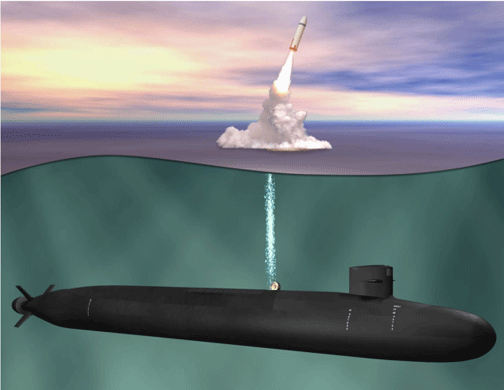
Bulletin, By David Kearn | January 17, 2025
Mr. President, we urge the cancellation of the SLCM-N program. It is unnecessary, costly, and makes the job of rebuilding our military more difficult.
As you know, the SLCM-N program was initiated during your first term. It was canceled by the Biden administration, but Congress allocated funds to revive the program in the 2024 National Defense Authorization Act. However, with the benefit of study and analysis, the Navy has signaled opposition to the program, viewing it as costly distraction from pressing modernization priorities, a strain on the already struggling defense industrial base, and an unnecessary complication of the missions of the fast attack submarine fleet.
…………………………………………………….. Redundancy
The United States already deploys significant conventional military assets in key regions and can quickly augment them by moving in nuclear weapons as needed to signal to adversaries that transgressions will have severe consequences. First, the Long-Range Standoff Missile (LRSO) deployed on either B-52 or B-21 bombers—while not technically classified as a “tactical weapon”—will possess the range, penetrability, and single-kiloton yield to provide the United States with the flexibility to respond to the threatened or actual use of nuclear weapons by an adversary in a proportional way without resorting larger strategic systems. Second, the B61-12 gravity bomb provides a low-yield munition that can be delivered by bomber and strike aircraft. Finally, thanks to your leadership during the first administration, the United States also possesses a low-yield variant of the Trident II D-5 submarine-launched ballistic missile (SLBM). In short, the United States possesses adequate nuclear capabilities to provide limited, flexible options if you or a successor would ever need them.
Costs
The expected costs of the SLCM-N—initially estimated at $10 billion but likely to be higher—are significant. The Navy will do its best to implement your preferred policies, but the SLCM-N program will require an “entirely new workforce and industrial base” to deliver this single system. The new missile cannot simply utilize an existing conventional Tomahawk cruise missile fitted with a nuclear warhead, as advocates initially assumed.
Beyond program costs, the Navy’s Strategic Systems Program office already has a “very full plate” of other programs, including upgrading the Trident II D-5 SLBM, as well as the new Conventional Prompt Strike hypersonic missile to be deployed on destroyers and attack submarines. A new program devoted exclusively to SLCM-N would divert workforce and resources away from these important programs at a time when industrial capacity and budgets are already stretched thin.
………………………………… Recommended course of action
We urge that you work with Congress to cancel the SLCM-N program. In doing so, you may prefer to recommend that the allocated funds be devoted to existing conventional Navy programs or toward further investment in flexible nuclear programs, such as the long-range standoff (LRSO) cruise missile…………. more https://thebulletin.org/2025/01/memo-to-trump-cancel-the-sea-launched-nuclear-cruise-missile/?utm_source=ActiveCampaign&utm_medium=email&utm_content=Memos%20to%20Trump%20%28he%20might%20actually%20like%29&utm_campaign=20250120%20Monday%20Newsletter
Green energy in abundance

“Sorry, pessimists, the energy problem is solved.” Ulrich Fichtner, SPIEGEL colleague, is almost right with this description of the energy crisis ( Ulrich Fichtner: Born for the big opportunities, Spiegel-Buch-Verlag 2023 ).
Correct: The problem is solvable, but it is far from being solved. The energy question is the survival question of the 21st century. We know what we are doing, but we are not yet really doing what we know and doing it sufficiently. The new solar dynamic is like this: cheaper, better, faster. We can still win the climate war.
At least things are moving in the right direction. Examples:
- We have seen a 90 percent reduction in the cost of a kilowatt hour of solar power within two decades.
- That is why green electricity is booming worldwide, as are storage technologies.
- Solar energy and wind energy are the cheapest sources of electricity in the world. According to the Fraunhofer Institute ISE, PV with battery storage is now cheaper than electricity from conventional power plants.
- The photo (right –on original) shows one of the largest photovoltaic plants in the world in Abu Dhabi. It is expected to be four times as large by 2030 and will then be able to produce as much electricity as around 15 medium-sized nuclear power plants.
- We have global growth rates for renewable energies of 40, 50 and 60 percent per year.
- In Germany, renewables were already the largest source of electricity generation by 2024 – almost two thirds renewable and only one third fossil fuels.
- According to calculations by the World Energy Agency, IEA, this will be the case globally by 2027.
- The World Energy Outlook, published every year by the IEA in Paris, assumes that demand for fossil energy sources will peak in 2025. Although the global economy will continue to grow then, CO2 emissions will shrink.
- The energy transition is in full swing worldwide. I agree with my colleague Ulrich Fichtner when he writes: “A renewable economic miracle is sweeping the globe” (page 87).
- Even in China, solar and wind will have overtaken coal by 2024, something that seemed unthinkable until recently.
- Not only the USA, but also Germany has decided to produce its electricity completely CO2-free by 2035.
- The European Union doubled its share of green electricity between the beginning of 2022 and the end of 2023.
- Costa Rica, Iceland and Kenya already produce their electricity almost entirely from renewable sources, but from very different sources, which is due to their different geographies.
- China aims to produce half of all renewable electricity worldwide by 2027.
- The United Arab Emirates, Morocco, Norway and Chile have ambitious plans to produce solar hydrogen.
- In addition to China, the USA, Egypt and Morocco are investing heavily in photovoltaics.
- The ten ASEAN countries in East Asia want to increase their share of renewable energies by 70 percent by 2027 compared to 2023 – Brazil, Cuba, Argentina, Mali and other countries in Central and Southern Africa have similar goals.
Children born today can experience a climate without crisis in 2050 – when they will be 25. People all over the world will be the winners of the solar world revolution in the future when they produce renewable electricity for one or two euro cents. Fortunately for us, plans for a better world with peaceful coexistence without exploitation of people and nature are on the table worldwide.
In spring 2024, Abu Dhabi’s energy minister told me that his country was already producing one kilowatt hour of solar power for 0.7 euro cents. The figures mentioned show that the world is electrifying and developing economically at a previously unimaginable pace. On this point, too, I can agree with Ullrich Fichtner: “A child born today will not have to worry too much about the world’s energy supply on its 25th birthday.” (Page 86).
This reminds me of a new book title by couples therapist Matthias Jung about the miracle of transformation. He writes: “It is not where the wind blows from that determines our path, but how we set the sails.” ( Matthias Jung: Setting Sails – The Miracle of Transformation, emuverlag ).
Memo to Trump: Modify the US policy of sole authority to launch nuclear weapons
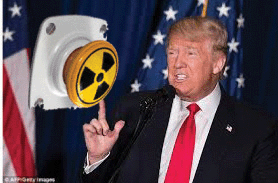
Bulletin, By Lisbeth Gronlund | January 17, 2025
Mr. President, as you know, as president, you must approve any use of nuclear weapons—whether first or in retaliation. This would be a momentous decision for any one person to make. While any use would be devastating, the future of the world would hang in the balance because it might lead to an all-out nuclear war, immediately killing hundreds of millions of people, many of these Americans. Many more deaths—in the United States and globally—would occur within a year from a lack of medical services for the injured and radioactive fallout. The Earth’s temperature would change and severely lower agricultural production, resulting in widespread starvation. Such a war would leave the United States and other countries barely functional, with destroyed infrastructures and defunct societies.
The United States should adopt a better approach that avoids placing this responsibility on one person, take advantage of the wisdom and perspective of other officials, and reduce the risk of nuclear war. The global community would welcome a US policy that does not rely on just one person to decide to use nuclear weapons.
Ordering the Pentagon to adopt a modified policy that incorporates the input of a few other officials would bolster your international credibility as a real leader who made tough decisions to reduce the risk of nuclear war. Moreover, once the new Trump policy is in place, it would be difficult for future presidents to return to the old, more dangerous approach. You would be remembered for significantly reducing the risk of inadvertent nuclear use, and you would set a new standard for all future administrations.
Background
If the Pentagon detected an incoming Russian nuclear attack aimed at US missile silos, it would consider launching these missiles before Russian missiles could destroy them. And it would need your approval to do so. Because the Russian missiles would land quickly following their detection, you would have about 10 minutes for the Pentagon to brief you and lay out a small number of launch plans for your decision and approval. You could also decide to not launch any missiles. Any modified policy to involve other people in the decision-making process would need to function under such severe time constraints………………………………………………………………………………………………………………………………………………
Options
— Option 1: This option could be used for either a first or retaliatory strike. Any nuclear attack plan would require a presidential order and agreement by the next two people in the presidential chain of succession. Under normal circumstances, these would be the vice president and Speaker of the House. You alone would have the authority to order a specific attack, but either of the other two could veto your order. If for some reason the other people could not be reached, the procedure could default to the current one………………………………………..
Recommendation
You should immediately adopt Option 1. I also recommend discussing Option 3 with your advisers and members of Congress to determine, among other things, the precise steps required and the length of time such approval would likely take………………………………………………………………….. more https://thebulletin.org/2025/01/memo-to-trump-modify-the-us-policy-of-sole-authority-to-launch-nuclear-weapons/?utm_source=ActiveCampaign&utm_medium=email&utm_content=Memos%20to%20Trump%20%28he%20might%20actually%20like%29&utm_campaign=20250120%20Monday%20Newsletter
Nine Swedish energy researchers find that new nuclear power is not needed.
The government has stated that “physics is heavier than politics” .
Unfortunately, on several occasions, misconceptions have been spread about
the physical capabilities of the power system.
It is not true that it costs 8 billion to regulate and balance wind power, or that new nuclear power is necessary for a stable electricity system, write nine energy researchers
from north to south. The need for new nuclear power. “New nuclear power
is necessary for a stable and reliable energy system, for both consumers
and businesses,” stated Finance Minister Elisabeth Svantesson (M) in
November 2023.
It goes without saying that a stable and reliable energy
system is needed. Svenska kraftnät has studied various alternatives in its
reports, the latest of which is “ Long-term Market Analysis 2024 ”. It
shows that a Swedish fossil-free power system with more than twice as much
consumption as today, and without nuclear power, can achieve reliability at
the same level as today.
The solution is called flexibility, where electric
cars, hydrogen storage and electricity trading contribute, among other
things. Nuclear power is important for stability today, as it contributes a
buffer in the form of rotational energy. This buffer ensures that balance
is maintained during the first seconds after, for example, a sudden stop in
another nuclear power plant. Nuclear power also helps to ensure that we get
an appropriate voltage on the power lines.
But this can also be arranged in
other ways. In the Nordic countries there is a system that activates
batteries, among other things, in seconds, so that stability is achieved
even with lower amounts of nuclear power. There is also a technological
development where Swedish industry is at the forefront. There is an
incredibly large export market, since the whole world will get more solar
and wind power when the existing fossil power plants are phased out. This
shift is happening now because solar and wind power have steadily fallen in
price and can be built quickly.
Dagens Nyheter 18th Jan 2025 https://www.dn.se/debatt/karnkraft-ar-en-mojlighet-men-ingen-fysisk-nodvandighet/
-
Archives
- February 2026 (199)
- January 2026 (308)
- December 2025 (358)
- November 2025 (359)
- October 2025 (376)
- September 2025 (258)
- August 2025 (319)
- July 2025 (230)
- June 2025 (348)
- May 2025 (261)
- April 2025 (305)
- March 2025 (319)
-
Categories
- 1
- 1 NUCLEAR ISSUES
- business and costs
- climate change
- culture and arts
- ENERGY
- environment
- health
- history
- indigenous issues
- Legal
- marketing of nuclear
- media
- opposition to nuclear
- PERSONAL STORIES
- politics
- politics international
- Religion and ethics
- safety
- secrets,lies and civil liberties
- spinbuster
- technology
- Uranium
- wastes
- weapons and war
- Women
- 2 WORLD
- ACTION
- AFRICA
- Atrocities
- AUSTRALIA
- Christina's notes
- Christina's themes
- culture and arts
- Events
- Fuk 2022
- Fuk 2023
- Fukushima 2017
- Fukushima 2018
- fukushima 2019
- Fukushima 2020
- Fukushima 2021
- general
- global warming
- Humour (God we need it)
- Nuclear
- RARE EARTHS
- Reference
- resources – print
- Resources -audiovicual
- Weekly Newsletter
- World
- World Nuclear
- YouTube
-
RSS
Entries RSS
Comments RSS
 nuclear-news