Canada’s Nuclear Waste Management Organization’s (NWMO) proposed DGR is a speculative unproven concept.
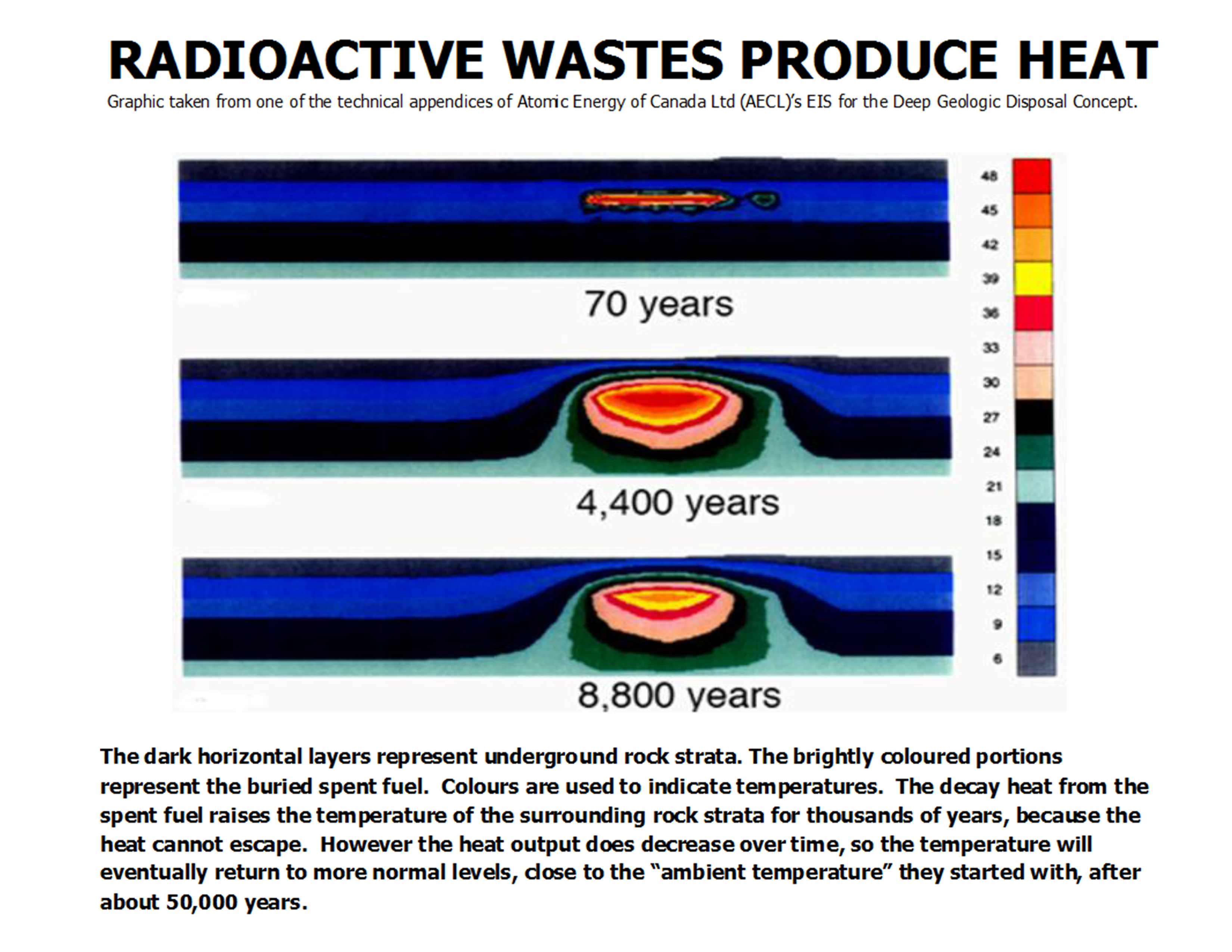
The most worrying aspect is an expected long-term “thermal pulse” from the entombed heat-producing radioactive waste. According to an Atomic Energy of Canada environmental study,1994, the DGR temperature could reach 230 degrees C. That intense heat would cause distortion and fracturing of host rock, impacting the structure of metallic containment casks.
David Geary, 19 Jan 25
In Geology 101 we learned that geology is a descriptive science, not a predictive science. Hydrology of rock is especially unpredictable. Science can not foresee what happens to a stable rock formation once disturbed by human activity. Thus, any Deep Geological Repository (DGR) cannot be counted on to maintain the required long-term stability to contain Canada’s high-level nuclear waste.
Because leaks do happen.
Canada’s Nuclear Waste Management Organization’s (NWMO) proposed DGR is a speculative unproven concept. A study of NWMO’s literature and conceptual renderings reveals numerous unresolved scientific, engineering, and modelling challenges.
Also troublesome is that Canada’s engineered ‘vertical shaft’ design vs. the European ‘inclined ramp’ approach was flagged as potentially dangerous by NWMO’s own expert international Independent Technical Review Group (ITRG), a body composed of European scientists and engineers. Vertical shafts relying on powered lift systems frequently fail.
Geologists at previous DGR hearings noted numerous NWMO deficiencies in the hydro-geological realm. For example, the integrity of host rock would be severely compromised by underground blasting required to create the extensive lattice-work of tunnels, chambers, and vertical shafts. There’d likely be rapid and unpredictable geo-hydrological changes, including water ingress, from the fracturing that ensues.
The most worrying aspect is an expected long-term “thermal pulse” from the entombed heat-producing radioactive waste. According to an Atomic Energy of Canada environmental study,1994, the DGR temperature could reach 230 degrees C. That intense heat would cause distortion and fracturing of host rock, impacting the structure of metallic containment casks.
Depicted in NWMO’s diagrams is a DGR air vent to the surface. It would carry the heat upwards while easing underground air pressure buildup. However, should nuclear waste casks become damaged or crushed by rock pressures, carcinogenic fission & activation products would leak out of them. Those radionuclides would be carried via the air vent to the surface, to the biosphere, to nearby communities, to people.
In fact, that is precisely how, in 2014, several workers near a vent far above a nuclear waste DGR in New Mexico were contaminated with radioactive plutonium.
Because geology is unpredictable.
Leaks happened and people were affected.
No comments yet.
1 This Month


18 March Webinar @ 1 PM EST: An Assessment of SMR Projects: The Case of Canada
register for the zoom:
https://us02web.zoom.us/webinar/register/WN_o8BIIOUvQ2ONJR1nta65DQ#/registration


of the week – STOP SMALL MODULAR REACTORS IN CANADA
To see nuclear-related stories in greater depth and intensity – go to https://nuclearinformation.wordpress.com
-
Archives
- March 2026 (138)
- February 2026 (268)
- January 2026 (308)
- December 2025 (358)
- November 2025 (359)
- October 2025 (376)
- September 2025 (258)
- August 2025 (319)
- July 2025 (230)
- June 2025 (348)
- May 2025 (261)
- April 2025 (305)
-
Categories
- 1
- 1 NUCLEAR ISSUES
- business and costs
- climate change
- culture and arts
- ENERGY
- environment
- health
- history
- indigenous issues
- Legal
- marketing of nuclear
- media
- opposition to nuclear
- PERSONAL STORIES
- politics
- politics international
- Religion and ethics
- safety
- secrets,lies and civil liberties
- spinbuster
- technology
- Uranium
- wastes
- weapons and war
- Women
- 2 WORLD
- ACTION
- AFRICA
- Atrocities
- AUSTRALIA
- Christina's notes
- Christina's themes
- culture and arts
- Events
- Fuk 2022
- Fuk 2023
- Fukushima 2017
- Fukushima 2018
- fukushima 2019
- Fukushima 2020
- Fukushima 2021
- general
- global warming
- Humour (God we need it)
- Nuclear
- RARE EARTHS
- Reference
- resources – print
- Resources -audiovicual
- Weekly Newsletter
- World
- World Nuclear
- YouTube
-
RSS
Entries RSS
Comments RSS
 nuclear-news
Leave a comment