TODAY. The world’s blind eye to the nightmare problem of nuclear waste disposal.

18 Jan 2025 https://theaimn.net/the-worlds-blind-eye-to-the-nightmare-problem-of-nuclear-waste-disposal/
Now if you were to ask an old-fashioned housewife, to prepare a complicated dinner with strong-smelling crayfish, seafoods and vegetables, , she would probably first make sure that there was a suitable garbage bin at hand.
But that’s not the way that the magnificent men in their nuclear machines thought, about the garbage from their concoctions. The American (pro-nuclear) historian Spencer Weart explains how, in the 1950s:
“the press and the public gave the matter only passing attention, preferring to leave nuclear sanitary engineering to officials. Officials left it to nuclear experts, and most nuclear experts left it alone.”
So, they left it alone for a long time.
The authority on matters nuclear – the Atomic Energy Commission – mentioned atomic wastes as a “cumbersome” problem, – going along with the view that it was not a major issue, and technolological development would solve it in the future. The British Ministry of Supply, in 1949, concluded that nuclear waste dumped into sea was “only slightly radioactive and the amount too small ‘to have any harmful effect on fish or on human life.’
Still, even in 1950, one report in the New York Times – “Atomic ‘Cemetery’ Needed for Waste,” a argued that “some kind of national burying place will be needed for the lethal substances;” and warned of the dangers of dumping atomic wastes into the oceans.- “[i]f fish ate the material, scientists fear it might find its way into food used by humans.”
“Expert” thinking about nuclear waste moved on , in the 1950s, to the idea that it could be beneficial. It could be used to generate electricity. It could have a military use -it could be used to create “a lethal radioactive ‘ line’ along a frontier. behind a river, across a peninsula, that would deny an area to the enemy.” In 1956, Lewis L. “Strauss, the head of the U.S. Atomic Energy Commission said the term ‘atomic waste’ is a misnomer”.
So developed one of the nuclear lobby’s favourite themes over the decades – “Not a Waste, but a Resource”.
However, from 1957 onwards, there was a growing public realisation especially in Europe, that nuclear wastes are dangerous, especially to health, and opposition increased to the dumping of wastes at sea..
It was not until 1993 that nuclear waste dumping at sea was banned, by international treaties – and it’s still not enforced everywhere. So, it has taken the nuclear experts and the various authorities, world-wide, a very long time to take action against the nuclear industry’s most egregious crime against nature
So, where are we today?
Writing in the Bulletin of the Atomic Scientists, “Becoming a responsible ancestor“– Daniel Metlay gives the most comprehensive account of the USA’s policies, and the authorities’ continuing struggles to tackle the Gordian knot of nuclear wastes. And that’s just from the peaceful nuclear power industry.
On the nuclear weapons industry, also in the Bulletin, Cameron Tracy writes on the- Risks of geologic disposal of weapons plutonium.
Apart from the American experience, the media tells us, generally in glowing, optimistic terms, of the progress of super-costly deep underground facilities in Finland, and soon to come, in Sweden and France.
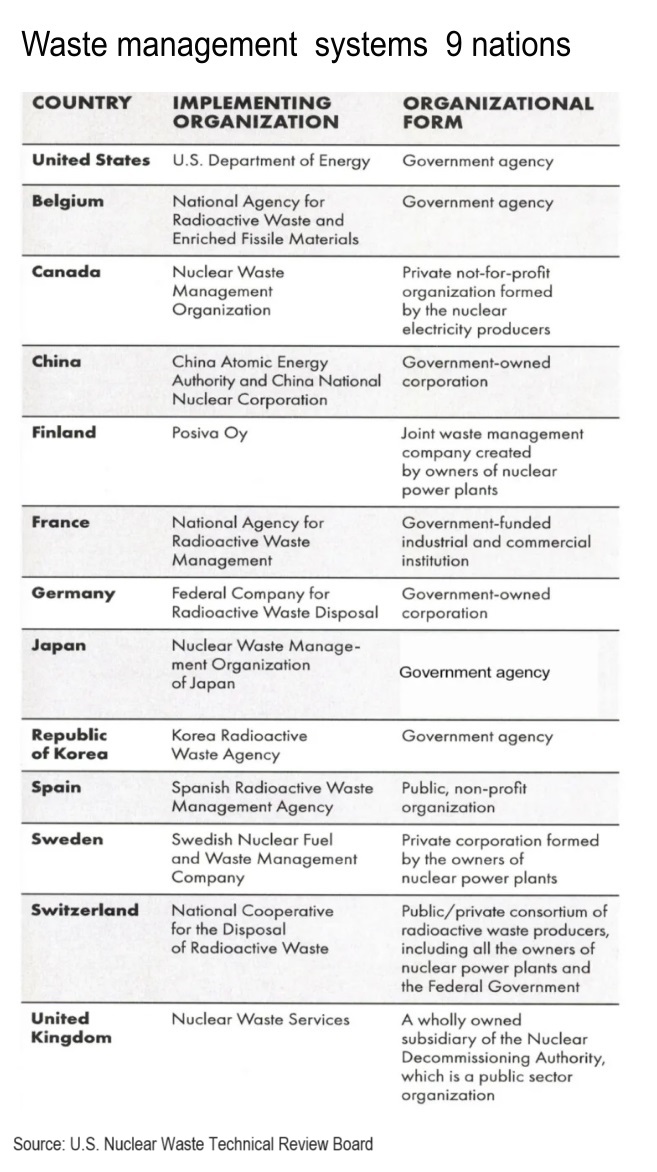
As if the American or “Western” history of nuclear waste were the whole story, we learn little or nothing about nuclear waste management in Russia, China, India, North Korea, South Korea, Japan (except for Fukushima). On the rare occasions when the Western media has mentioned Russia’s nuclear waste history, it is to gloat over what a mess Russia has made of it.
However, the US National Academy of Science and its Russian counterpart met in 1992 , leading to a U.S-Russia pledge in 2000 to reciprocally dispose of 34 metric tons of excess weapons plutonium. It was a complicated co-operative effort which fell apart completely by 2016.
The nuclear waste industry bumbles on, with prospects of profits for waste management companies like Holtec, and of “jobs , jobs’, Jobs”. Is the nuclear behometh just too big to be stopped?
There are two questions about nuclear wastes that are never asked by the “experts”, let alone answered by them:
- Why not stop making more nuclear trash?
- Why do the nuclear-power countries not work together, co-operate, in getting rid of the existing global problem of nuclear trash?
California wildfires: a warning to Nuclear Regulatory Commission on climate change

January 16, 2025, https://beyondnuclear.org/ca-wildfires-are-a-warning-to-nrc-on-climate-change/
US Government Accountability Office warnings to Nuclear Regulatory Commission go unheeded
For nuclear power plants, fire is considered a very significant contributor to the overall reactor core damage frequency (CDF), or the risk of a meltdown. Fire at a nuclear power station can be initiated by both external and/or internal events. It can start with the most vulnerable external link to the safe operation of nuclear power plants; the Loss Of Offsite Power (LOOP) from the electric grid. It is considered a serious initiating event to nuclear accident frequency. Because of that risk, US reactors won’t operate without external offsite power from the electric grid.
The still largely uncontained wildfires burning in and around Los Angeles and Ventura Counties in southern California “are sure to rank among America’s most expensive.” The ongoing firestorms have now extended into a fourth period of “extremely critical fire weather” conditions and burned for more than a week an area the size of Washington, D.C., nearly 63 square miles. The estimated number is still being tallied for the thousands of homes and structures destroyed, the loss of life, the evacuation of communities indefinitely dislocated and the threats to and impacts on critical infrastructure including electrical power .
There is no scientific doubt that global warming is primarily caused by the unquenchable burning of fossil fuels though politically motivated denial is entrenched in the US Congress. The increased frequency and severity of these wildfires—leading to suburban and even urban firestorms— are but one consequence of a climate crisis along with a range of other global natural disasters including sea level rise, hurricanes, more severe storms generally, extreme precipitation events, floods and droughts. This more broadly adversely impacts natural resources and critical infrastructures to include inherently dangerous nuclear power stations.
At this particular time, it is important to reflect upon the April 2, 2024, report to Congress issued by its investigative arm, the United States Government Accountability Office (GAO), “Nuclear Power Plants: NRC Should Take Actions to Fully Consider the Potential Effects of Climate Change,” (GAO 24-106326).
The GAO warns that the US Nuclear Regulatory Commission (NRC) needs to start taking actions to address the increased risk of severe nuclear power plant accidents attributable to human caused climate change.
The NRC’s actions to address the risks from natural hazards do not fully consider potential climate change effects on severe nuclear accident risks. “For example, NRC primarily uses historical data in its licensing and oversight processes rather than climate projections data,” the GAO report said.
Beyond Nuclear has uncovered similar findings during our challenges to the NRC’s extreme relicensing process for extending reactor operating licenses, now out to the extreme of 60 to 80 years and talk of 100 years. We found that the agency’s staff believes and stubbornly insists that an environmental review for climate change impacts (sea level rise, increasingly severe hurricanes, extreme flooding, etc.) on reactor safety and reliability is “out of scope” for the license extensions hearing process.
The GAO report points out to the NRC that wildfires, specifically, can dangerously impact US nuclear power stations operations and public safety with potential consequences that extend far beyond the initiating natural disaster. These consequences can include loss of life, large scale and indefinite population dislocation and uninsurable economic damage from the radiological
consequences:
“Wildfire. According to the NCA (National Climate Assessment), increased heat and drought contribute to increases in wildfire frequency, and climate change has contributed to unprecedented wildfire events in the Southwest. The NCA projects increased heatwaves, drought risk, and more frequent and larger wildfires. Wildfires pose several risks to nuclear power plants, including increasing the potential for onsite fires that could damage plant infrastructure, damaging transmission lines that deliver electricity to plants, and causing a loss of power that could require plants to shut down. Wildfires and the smoke they produce could also hinder or prevent nuclear power plant personnel and supplies from getting to a plant.”
Loss of offsite electrical power (LOOP) to nuclear power stations is a leading contributor to increasing the risk of a severe nuclear power accident. The availability of alternating current (AC) power is essential for safe operation and accident recovery at commercial nuclear power plants. Offsite fires destroying electrical power transmission lines to commercial reactors therefore increase the probability and severity of nuclear accidents.
For US nuclear power plants, 100% of the electrical power supply to all reactor safety systems is initially provided through the offsite power grid. If the offsite electrical grid is disturbed or destroyed, the reactors are designed to automatically shut down or “SCRAM”. Onsite emergency backup power generators are then expected to automatically or manually start up to provide
power to designated high priority reactor safety systems needed to safely shut the reactors down and provide continuous reactor cooling, pressure monitoring, but to a diminished number of the reactors’ credited safety systems. Reliable offsite power is therefore a key factor to minimizing the probability of severe nuclear accidents.
The GAO identifies a number of US nuclear power plant sites that are vulnerable to the possible outbreak of wildfires where they are located. “According to our analysis of U.S. Forest Service and NRC data, about 20 percent of nuclear power plants (16 of 75) are located in areas with a high or very high potential for wildfire,” the GAO report states. “More specifically, more than
one-third of nuclear power plants in the South (nine of 25) and West (three of eight) are located in areas with a high or very high potential for wildfire.” The GAO goes on to identify “Of the 16 plants with high or very high potential for wildfire, 12 are operating and four are shutdown.”
To analyze exposure to the wildfire hazard potential, the GAO used 2023 data from the U.S. Forest Service’s Wildfire Hazard Potential Map. “High/very high” refers to plants in areas with high or very high wildfire hazard potential. Those nuclear power stations described by GAO as “high / very high” exposure to wildfires and their locations are excerpted from GAO Appendix III: Nuclear Power Plant Exposure to Selected Natural Hazards.
Table 1: Potential High Exposure to “Wildfires” at Operating Nuclear Power Plants
–AZ / SAFER, one of two mobile nuclear emergency equipment supply units in the nation, “HIGH / VERY HIGH”
–CA / Diablo Canyon Units 1 & 2 nuclear power station, “HIGH / VERY HIGH”
–FL / Turkey Point Units 3 & 4 nuclear power station, “HIGH / VERY HIGH”
–GA / Edwin I. Hatch Units 1 & 2 nuclear power station, “HIGH / VERY HIGH”
–GA / Vogtle Units Units 1, 2, 3 & 4, nuclear power station, “HIGH / VERY HIGH”
–NC / Brunswick Units 1 & 2 nuclear power station, “HIGH / VERY HIGH”
–NC / McGuire Units 1 & 2 nuclear power station, “HIGH / VERY HIGH”
–NC / Shearon Harris Units 1 & 2 nuclear power station, “HIGH /VERY HIGH”
–NB / Cooper nuclear power station, “HIGH / VERY HIGH”
–SC / Catawba Units 1 & 2 nuclear power station, “HIGH / VERY HIGH”
–SC / H. B. Robinson Units 1 & 2 nuclear power station, “HIGH / VERY HIGH”
–WA / Columbia nuclear power station, “HIGH / VERY HIGH”
Table 2: Potential High Exposure to “Wildfires” at Shutdown Nuclear Power Plants
–CA / San Onofre Units 1 & 2, “HIGH / VERY HIGH”
–FL / Crystal River, “HIGH / VERY HIGH”
–NJ / Oyster Creek, “HIGH / VERY HIGH”
–NY / Indian Point Units 1, 2 & 3, “HIGH / VERY HIGH”
Wildfires can transport radioactive contamination from nuclear facilities
A historical review of wildfires that occur around nuclear facilities (research, military and commercial power) identifies that these events are also a very effective transport mechanism of radioactivity previously generated at these sites and subsequently released into the environment by accident, spills and leaks, and careless dumping. The radioactivity is resuspended by wildfires that occur years, even decades later. The fires carry the radioactivity on smoke particles downwind, thus expanding the zone of contamination further and further with each succeeding fire. The dispersed radionuclides can have very long half-lives meaning they remain biologically hazardous in the environment for decades, centuries and longer.
Here are a few examples of how wildfires increasing in frequency and intensity are also threatening to spread radioactive contamination farther away the original source of generation.
The Chornobyl nuclear catastrophe and recurring wildfires
The Chornobyl nuclear disaster that originally occurred on April 26,1986, initially spread harmful levels of radioactive fallout concentrated around the destroyed Chornobyl Unit 4 in northern Ukraine. The radioactive fallout was transported high into the atmosphere by the accidental reactor explosion. The days long fire and smoke transported extreme radioactivity from the expelled
burning nuclear fuel and its graphite moderator. Radioactive fallout then spread far afield in shifting winds, precipitated with rainfall and was terrestrially deposited in its highest concentrations largely in northern Ukraine, Belarus and Southern Russia.
Additional atmospheric distributions of radioactive contamination fell across much of Europe, persisting in numerous hot spots, including in Scandinavia, and the United Kingdom, where it remains as a persistent toxin.
The Chornobyl ‘Exclusion Zone’ to restrict long term human habitation was established in the immediate aftermath in 1986 as an arbitrary 1,ooo square miles within an 18 mile radius around the exploded reactor in Ukraine and remains in place today nearly 39 years later. The Bulletin of Atomic Scientists reports that seasonal wildfires continue to occur within the Chornobyl Exclusion Zone, routinely burning across already contaminated land and resuspending radioactivity via the smoke into the atmosphere. The radioactive smoke is borne on the wind, carrying the radioactive fallout farther out and increasing the size of what can be measured as potentially an expanding Exclusion Zone.
Contrary to claims, wildfires can threaten US nuclear facilities
The Los Angeles Times headlined in May 2024 “Sites with radioactive material more vulnerable as climate change increases wildfire, flood risks.”
The LA Times did a look back at several wildfires surrounding the government radiological laboratories and government nuclear weapons manufacturing sites including the 2018 Woolsey wildfire at the old Santa Susana Field Laboratory (SSFL). This facility specifically housed 10 nuclear reactors and plutonium and uranium fuel fabrication facilities located in the Los Angeles suburbs. SSFL was used for early testing of rockets and nuclear reactors for energy. But decades of carelessness during experiments resulted in one of the first nuclear reactor meltdowns in 1959, leaving acres of soil, burn pits and water radioactively and chemically contaminated. Boeing is the current operator of SSFL now obligated to conduct the cleanup of the SSFL site.
“A 2018 fire in California started at the Santa Susana Field Laboratory, a former nuclear research and rocket-engine testing site, and burned within several hundred feet of contaminated buildings and soil, and near where a nuclear reactor core partially melted down 65 years ago,” reported the LA Times.
Over the years, NBC news has broadcast continuing coverage of the massive 2018 Woolsey fire at SSFL and the radioactive contamination from this event, found in several Los Angeles suburbs miles away.
Despite these events, federal authorities continue to issue vapid safety assurances that climate changes, including more frequent wildfires, will not increase the risks to public health and safety from contaminated commercial, military and national laboratory facilities and that there is no need to include environmental reviews that account for the impacts of climate change in the
regulatory environmental review process.
A recent example of the NRC resistance to factor in reasonable assurance for protecting the public’s health and safety from climate change risk and its potential impacts that increase the risk of a severe nuclear accident, including wildfire, into its oversight and environmental reviews for licensing and relicensing is Chairman Christopher Hanson’s September 27, 2024 response to the GAO report:
“…the NRC does not agree with the [GAO] conclusion that the agency does not address the impacts of climate change. In effect, the layers of conservatism, safety margins, and defense in depth incorporated into the NRC’s regulations and processes provide reasonable assurance of adequate protection of public health and safety, to promote the common defense and security, and to protect the environment.”
Commission Chairman Hanson’s outright dismissal of the GAO report and its finding that the agency needs to take action runs contrary to one of agency’s own, Atomic Safety Licensing Board Judge Michael Gibson’s dissenting opinion to the similar blanket dismissal by the NRC to take a “hard look” climate change impacts under the National Environmental Policy Act (NEPA) on extreme reactor relicensing. In this case, the Judge Gibson supported Beyond Nuclear’s legal challenge to the Commission’s second 20 year license extension of its operating license of its commercially reactors and dissented from the licensing board’s majority denial of our hearing request on climate change’s contribution to the risk and consequences of severe nuclear accidents.
In Judge Gibson’s 23 page dissent of his colleagues’ decision to extend the nuclear plant’s operating license out to 2060 without a pubic hearing on climate change impacts on nuclear power plants, he went on the record,
“That is hardly the reception climate change should be given. As CEQ (the President’s Council on Environmental Quality), the federal government’s chief source for assessing the importance of climate change in environmental analyses under NEPA, has made clear, ‘The United States faces a profound climate crisis and there is little time left to avoid a dangerous—potentially catastrophic—climate trajectory. Climate change is a fundamental environmental issue, and its effects on the human environment fall squarely within NEPA’s purview.’ Sadly, the majority and the NRC Staff have failed to heed this warning.”
Chris Hedges: The Ceasefire Charade

By Chris Hedges ScheerPost, January 16, 2025 m https://scheerpost.com/2025/01/16/chris-hedges-the-ceasefire-charade/
Israel, going back decades, has played a duplicitous game. It signs a deal with the Palestinians that is to be implemented in phases. The first phase gives Israel what it wants — in this case the release of the Israeli hostages in Gaza — but Israel habitually fails to implement subsequent phases that would lead to a just and equitable peace. It eventually provokes the Palestinians with indiscriminate armed assaults to retaliate, defines a Palestinian response as a provocation and abrogates the ceasefire deal to reignite the slaughter.
If this latest three-phase ceasefire deal is ratified — and there is no certainty that it will be by Israel — it will, I expect, be little more than a presidential inauguration bombing pause. Israel has no intention of halting its merry-go-round of death.
The Israeli cabinet has delayed a vote on the ceasefire proposal while it continues to pound Gaza. At least 81 Palestinians have been killed in the last 24 hours.
The morning after a ceasefire agreement was announced, Israeli Prime Minister Benjamin Netanyahu accused Hamas of reneging on part of the deal “in an effort to extort last minute concessions.” He warned that his cabinet will not meet “until the mediators notify Israel that Hamas has accepted all elements of the agreement.”
Hamas dismissed Netanyahu’s claims and repeated their commitment to the ceasefire as agreed with the mediators.
The deal includes three phases. The first phase, lasting 42 days, will see a cessation of hostilities. Hamas will release some Israeli hostages – 33 Israelis who were captured on Oct. 7, 2023, including all of the remaining five women, those aged above 50, and those with illnesses – in exchange for up to 1,000 Palestinians imprisoned by Israel.
The Israeli army will pull back from the populated areas of the Gaza Strip on the first day of the ceasefire. On the 7th day, displaced Palestinians will be permitted to return to northern Gaza. Israel will allow 600 aid trucks with food and medical supplies to enter Gaza daily.
The second phase, which begins on the 16th day of the ceasefire, will see the release of the remaining Israeli hostages. Israel will complete its withdrawal from Gaza during the second phase, maintaining a presence in some parts of the Philadelphi corridor, which stretches along the eight-mile border between Gaza and Egypt. It will surrender its control of the Rafah border crossing into Egypt.
The third phase will see negotiations for a permanent end of the war.
But it is Netanyahu’s office that appears to have already reneged on the agreement. It released a statement rejecting Israeli troop withdrawal from the Philadelphi Corridor during the first 42-day phase of the ceasefire. “In practical terms, Israel will remain in the Philadelphi Corridor until further notice,” while claiming the Palestinians are attempting to violate the agreement. Palestinians throughout the numerous ceasefire negotiations have demanded Israeli troops withdraw from Gaza. Egypt has condemned the seizure of its border crossings by Israel.
The deep fissures between Israel and Hamas, even if the Israelis finally accept the agreement, threaten to implode it. Hamas is seeking a permanent ceasefire. But Israeli policy is unequivocal about its “right” to re-engage militarily. There is no consensus about who will govern Gaza. Israel has made it clear the continuance of Hamas in power is unacceptable. There is no mention of the status of the United Nations Relief and Works Agency for Palestine Refugees in the Near East (UNRWA), the U.N. agency that Israel has outlawed and that provides the bulk of the humanitarian aid given to the Palestinians, 95 percent of whom have been displaced. There is no agreement on the reconstruction of Gaza, which lies in rubble. And, of course, there is no route in the agreement to an independent and sovereign Palestinian state.
Israeli mendacity and manipulation is pitifully predictable.
The Camp David Accords, signed in 1979 by Egyptian president Anwar Sadat and Israeli prime minister Menachem Begin, without the participation of the Palestine Liberation Organization (PLO), normalized diplomatic relations between Israel and Egypt. But the subsequent phases, which included a promise by Israel to resolve the Palestinian question along with Jordan and Egypt, permit Palestinian self-governance in the West Bank and Gaza within five years, and end the building of Israeli colonies in the West Bank, including East Jerusalem, were never honored.
Or take the 1993 Oslo Accords. The agreement, signed in 1993, which saw the PLO recognize Israel’s right to exist and Israel recognize the PLO as the legitimate representatives of the Palestinian people, and Oslo II, signed in 1995, which detailed the process towards peace and a Palestinian state, was stillborn. It stipulated that any discussion of illegal Jewish “settlements” was to be delayed until “final’ status talks, by which time Israeli military withdrawals from the occupied West Bank were to have been completed. Governing authority was to be transferred from Israel to the supposedly temporary Palestinian Authority. The West Bank was carved up into Areas A, B and C. The Palestinian Authority has limited authority in Areas A and B. Israel controls all of Area C, over 60 percent of the West Bank.
The right of Palestinian refugees to return to the historic lands seized from them in 1948 when Israel was created — a right enshrined in international law — was given up by the PLO leader Yasser Arafat, instantly alienating many Palestinians, especially those in Gaza where 75 percent are refugees or the descendants of refugees. Edward Said called the Oslo agreement “an instrument of Palestinian surrender, a Palestinian Versailles” and lambasted Arafat as “the Pétain of the Palestinians.”
The scheduled Israeli military withdrawals under Oslo never took place. There was no provision in the interim agreement to end Jewish colonization, only a prohibition of “unilateral steps.” There were around 250,000 Jewish colonists in the West Bank at the time of the Oslo agreement. They have increased to at least 700,000. No final treaty was ever concluded.
The journalist Robert Fisk called Oslo “a sham, a lie, a trick to entangle Arafat and the PLO into abandonment of all that they had sought and struggled for over a quarter of a century, a method of creating false hope in order to emasculate the aspiration of statehood.”
Israeli prime minister Yitzhak Rabin, who signed the Oslo agreement, was assassinated on Nov. 4, 1995 following a rally in support of the agreement, by Yigal Amir, a far-right Jewish law student. Itamar Ben-Gvir, now Israel’s National Security Minister, was one of many rightwing politicians who issued threats against Rabin. Rabin’s widow, Leah, blamed Netanyahu and his supporters — who distributed leaflets at political rallies depicting Rabin in a Nazi uniform — for her husband’s murder.
Israel has carried out a series of murderous assaults on Gaza ever since, cynically calling the bombardment “mowing the lawn.” These attacks, which leave scores of dead and wounded and further degrade Gaza’s fragile infrastructure, have names such as Operation Rainbow (2004), Operation Days of Penitence (2004), Operation Summer Rains (2006), Operation Autumn Clouds (2006) and Operation Hot Winter (2008).
Israel violated the June 2008 ceasefire agreement with Hamas, brokered by Egypt, by launching a border raid that killed six Hamas members. The raid provoked, as Israel intended, a retaliatory strike by Hamas, which fired crude rockets and mortar shells into Israel. The Hamas barrage provided the pretext for a massive Israeli attack. Israel, as it always does, justified its military strike on the right to defend itself.
Operation Cast Lead (2008-2009), which saw Israel carry out a ground and aerial assault over 22 days, with the Israeli air force dropping over 1,000 tons of explosives on Gaza, killed 1,385 — according to the Israeli human rights group B’Tselem — of whom at least 762 were civilians, including 300 children. Four Israelis were killed over the same period by Hamas rockets and nine Israeli soldiers died in Gaza, four of whom were victims of “friendly fire.” The Israeli newspaper Haaretz would later report that “Operation Cast Lead” had been prepared over the previous six months.
Israeli historian Avi Shlaim, who served in the Israeli military, wrote that:
the brutality of Israel’s soldiers is fully matched by the mendacity of its spokesman…their propaganda is a pack of lies…It was not Hamas but the IDF that broke the ceasefire. It did so by a raid into Gaza on 4 November that killed six Hamas men. Israel’s objective is not just the defense of its population, but the eventual overthrow of the Hamas government in Gaza by turning the people against their rulers.
These series of attacks on Gaza were followed by Israeli assaults in November 2012, known as Operation Pillar of Defense and in July and August 2014 in Operation Protective Edge, a seven week campaign that left 2,251 Palestinians dead, along with 73 Israelis, including 67 soldiers.
These assaults by the Israeli military were followed in 2018 by largely peaceful protests by Palestinians, known as The Great March of Return, along Gaza’s fenced-in barrier. Over 266 Palestinians were gunned down by Israeli soldiers and 30,000 more were injured. In May 2021, Israel killed over 256 Palestinians in Gaza following attacks by Israeli police on Palestinian worshippers at the Al-Aqsa Mosque compound in Jerusalem. Further attacks on worshippers at Al-Aqsa mosque took place in April 2023.
And then the breaching of the security barriers on Oct. 7, 2023 that enclose Gaza, where Palestinians had languished under a blockade for over 16 years in an open air prison. The attacks by Palestinian gunmen left some 1,200 Israeli dead — including some killed by Israel itself — and gave Israel the excuse it had long sought to lay waste to Gaza, in its Swords of Iron War.
This horrific saga is not over. Israel’s goals remain unchanged – the erasure of Palestinians from their land. This proposed ceasefire is one more cynical chapter. There are many ways it can and, I suspect, will fall apart.
But let us pray, at least for the moment, that the mass slaughter will stop.
Ukraine’s parliament has given the go-ahead for the purchase of two old Russian nuclear reactors.
Reviving a Soviet-era project, the Ukrainian parliament has authorised the purchase of two Russian nuclear reactors from Bulgaria.
On Thursday, the energy committee of the Ukrainian parliament voted in favour of a law which ostensibly aims to improve the business environment in the country – but which also contained a last-minute amendment greenlighting the purchase of two old Russian nuclear reactors, to expand the Khmelnytskyi nuclear power plant.
“The Cabinet of Ministers of Ukraine and/or … ‘Energoatom’ … are granted permission to negotiate, finalize the text, sign, pay for, accept, and store the equipment,” the amendment, seen by Euractiv, reads.
The Khmelnytskyi plant in the south-west of Ukraine was first dreamt up in the early 1970s during the days of Leonid Brezhnev. Due to the Chernobyl disaster, it only ever operated at half capacity.
In 2023, negotiations began to buy two Russian reactors, originally bought for the unfinished Belene nuclear power plant in Bulgaria. The planned purchase has a floated price of at least €600 million.
US company Westinghouse is also planning to build two reactors at the Ukrainian site.
In June 2024, Ukrainian Energy Minister German Galushchenko, the initiative’s biggest promoter, said that he was betting on foreign loans to finance the purchase. However, in December, the EU’s representative in Kyiv ruled out support for the project.
Euractiv 16th Jan 2025
https://www.euractiv.com/section/eet/news/kyiv-pushes-ahead-controversial-e600m-purchase-of-russian-junk-nuclear-reactors/
Jan 16, 2025
Weatherwatch: Could small nuclear reactors help curb extreme weather? There’s a credibility gap.

As natural disasters make need to cut CO2 emissions clearer than ever, energy demand of AI systems is about to soar.
Paul Brown 27 Jan 25 – https://www.theguardian.com/world/2025/jan/17/weatherwatch-could-small-nuclear-reactors-help-curb-extreme-weather
Violent weather events have been top of the news agenda for weeks, with scientists and fact-based news organisations attributing their increased severity to climate breakdown. The scientists consulted have all emphasised the need to cut greenhouse gas emissions.
At the same time there are predictions about artificial intelligence and datacentres urgently needing vast amounts of new electricity sources to keep them running. Small modular nuclear reactors (SMRs) have been touted as the green solution. The reports suggest that SMRs are just around the corner and will be up and running in the 2030s. Google first ordered seven, followed by Amazon, Microsoft and Meta each ordering more.
With billions of dollars on offer, many startup and established nuclear companies are getting in on the act. More than 90 separate designs for SMRs are being marketed across the world. Many governments, including the UK, are pouring money into design competitions and other ways to incentivise development.
In all this there is a credibility gap. None of the reactor designs have left the drawing board, prototypes have not been built or safety checks begun, and costs are at best optimistic guesses. SMRs may succeed, but let big tech gamble their spare billions on them while the rest of us are building cheap renewables we know work.
Are AI defense firms about to eat the Pentagon?

Competitors are becoming collaborators in the industry’s hottest segment.
Defense One, Patrick Tucker, 15 Dec 24
In an unprecedented wave of collaboration, leading AI firms are teaming up—sometimes with rivals—to serve a Pentagon and Congress determined to put AI to military use. Their growing alignment may herald an era in which software firms seize the influence now held by old-line defense contractors.
“There’s an old saying that software eats the world,” Byron Callan, managing director at Capital Alpha Partners, told Investors Business Daily on Wednesday. “It’s going to eat the military too.”
Over the last week, Palantir, Anduril, Shield AI, OpenAI, Booz Allen, and Oracle announced various partnerships to develop products tailored to defense needs. Meanwhile, the House passed the 2025 National Defense Authorization Act with provisions that push the Defense Department to work more closely with tech firms on AI, and DOD announced yet another office intended to foster AI adoption.
Perhaps the most significant partnership is between Palantir and Anduril, two companies that offer somewhat competing capabilities related to battlefield data integration. Palantir holds the contract for the Maven program, the seminal Defense Department AI effort to derive intelligence from vast amounts of data provided by satellites, drones, and other sensors. Anduril offers a mesh-networking product called Lattice for rapid collection and analysis of battlefield data for drone swarming and other operations. …………………………………………………………………
Congress gets behind AI firms
On Wednesday, the House approved a 2025 defense authorization bill that includes several provisions intended to spur military adoption of AI. The bill puts a big emphasis on building out data and cloud computing resources to enable much faster adoption of AI and AI-enabled weapons, areas where companies like Anduril, Palantir, Booz Allen, and Shield AI excel.
One of the most ambitious is Section 1532, which mandates the expansion of secure, high-performance computing infrastructure to support AI training and development.
This infrastructure, which will include partnerships with commercial and hybrid cloud providers, is critical for developing scalable AI models capable of adapting to evolving mission requirements………………………………………………………………………………………………………… more https://www.defenseone.com/technology/2024/12/are-ai-defense-firms-about-eat-pentagon/401673/?oref=d1-author-river
The remnant nuclear fans say we should learn from what the UAE has done with reactors; guess they don’t want the world to learn also from what they have done since with renewables:
1,000% Renewables for South Australia
tpsrSooned40thiel7 ti58Y670894ar4g h:71ly701dse7a 4l9iM9Aff7 ·
The United Arab Emirates tried nuclear, but like most others also faced years of delay – to 15 years in total – and cost overruns (to US$32 billion of government money) to build just 5.6GW of capacity.
It has since gone back to renewables; this is one of their solar farms and is the world’s largest single-site solar plant at 2GW, producing enough energy to power 200,000 homes.
How long did it take? – just 2.5 years.
How long will it run? – 30 years (vs the typical 28 years nuclear reactors have lasted for so far).
How much did it cost? – it has broken records on cost, with the initial project tariff set at AED 4.97 fils/kWh (US$1.35/kWh) before being revised down to AED 0.0485/kWh (US$0.0132/kWh) at financial close (vs US$0.113/kWh for nuclear (Hinkley C)).
Who paid for it? – no taxpayers’ money; 7 international banks provided financing, and upon completion and commercial operations in 2022, TAQA own 40% of the project, while Masdar, EDF Renewables, and JinkoPower will each own a 20% stake.
And who was one of the major contractors? – none other than France’s struggling nuclear company EDF who is diversifying to renewables, given that is where the big money and growth is now.
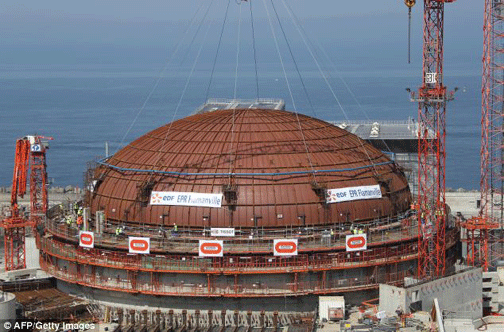
In Flamanville, EPR vibrations weigh down EDF
Blast 15th Jan 2025
https://www.blast-info.fr/articles/2025/a-flamanville-les-vibrations-de-lepr-plombent-edf-27fa5zyHQ6mpDzOKgti6kw
Last week, Luc Rémont, CEO of EDF received a worrying report from the engineers working on the Flamanville EPR. It reveals a recurring problem of excessive vibrations. And indicates that he does not know whether the EPR will be able to operate at full power. Revelations.
At EDF, troubles are flying in squadrons. This Tuesday, January 14, the Court of Auditors published a new report on the Flamanville EPR . The venerable institution on Rue Cambon (Paris) now estimates the final cost of the project at 23.7 billion euros. An amount that is significantly higher than the previous assessment made by the Court in 2020: 19.1 billion.
Kicking the donkey, the report specifies that “the calculations made by the Court result in a mediocre profitability for Flamanville 3” : the tiny margin that EDF could generate will not be enough to repay the cost of the loans! For that to happen, the EPR must one day operate at full power. And of that, even the EDF teams are no longer really convinced.
The scene takes place at a dinner party in Paris late last week. “We were in a meeting in the CEO’s office and everything was going well. But then he received a report from Flamanville and the atmosphere suddenly cooled,” says a senior executive of the electrician present at the meeting. If Luc Rémont, the CEO, did not fall off his seat when he read the report, he came close.
The cause? The engineers working on the reactor’s start-up have a doubt. And a big one. “They don’t know if the EPR will be able to operate at full power,” says this senior executive.
This question, which exists among many employees who worked on the nightmarish reactor construction site (twelve years behind schedule), is now shared by the teams who took charge of the reactor. And it is based on an observation: contrary to what EDF’s communication claims, the vibration problems affecting the primary circuit of the reactor are far from being resolved. “The report confirms that there are still problems with excessive vibrations,” says the decidedly very talkative manager.
At the meeting of the local information committee for the Flamanville nuclear power plant in April 2014, held a few days before the ASN authorised EDF to install nuclear fuel in the tank, the electrician had nevertheless brushed aside the issue of vibrations, stating, clearly a little too quickly, that everything was sorted .
But already in the floors of the general management in Paris, the knives are sharpening and the hunt for the culprit is open. Who will wear the hat? One name is on everyone’s mind: that of Alain Morvan , the director of the EPR project until last October, accused in veiled terms of having hidden too much dust under the carpet.
Contacted by email on Tuesday 14 January late in the morning, EDF indicated that it was sticking to its construction cost of 13.2 billion (excluding interim interest). But it refused to comment on our information on the vibrations. Questioned the same day also by email, the Nuclear Safety and Radiation Protection Authority (ASNR), resulting from the merger of the ASN with the IRSN, did not respond to us.
Renewable energy sets global record…but it’s not enough

IRENA says world needs to double green generation to stay on track for 2050
16/01/2025 – https://www.energylivenews.com/2025/01/16/renewable-energy-sets-global-record-but-its-not-enough/
The world hit a record of 530GW of renewable generation in 2024 but it needs double that amount if we are to meet net zero needs.
International Renewal Energy Agency (IRENA), holding its general assembly in Abu Dhabi this week, revealed globally green generation capacity has now climbed to roughly 4,400 GW, up from 3,870 GW in 2023.
But Director-General Francesco La Camera said this is half of what is needed.
While a record $1.3 trillion (£1.07tn) was invested in energy transition technologies in 2022, annual investments need to quadruple to remain on track to meet global energy transition goals.
IRENA estimates a cumulative $150 trillion (£122tn) in investment is needed by 2050.
Dunfermline MP Graeme Downie calls for MoD commitment to dismantle dead nuclear submarines

ONE boat is being dismantled in Rosyth but there’s no commitment and no funding to deal with another 25 nuclear subs – with the total cost estimated to be around £300
million. That’s the concern of Dunfermline and Dollar MP Graeme Downie who
said a pledge to break up the other vessels would “guarantee decades of
work” at the dockyard. More than 200 people at Rosyth are already working
on HMS Swiftsure, it is being cut up and her radioactive waste removed as
part of a demonstrator project, and he said the site could become a
“worldwide centre of excellence for submarine dismantling”.
Dunfermline Press 15th Jan 2025,
https://www.dunfermlinepress.com/news/24860540.dunfermline-mp-graeme-downie-calls-mod-commitment/
Dutton’s new nuclear nightmare: construction costs continue to explode.

The latest massive cost blowout at a planned power station in the UK demonstrates the absurdity of Peter Dutton’s claims about nuclear power in Australia.
Bernard Keane and Glenn Dyer. 16 Jan 25, https://www.crikey.com.au/2025/01/16/peter-dutton-nuclear-power-construction-costs/?utm_campaign=daily&utm_medium=email&utm_source=newsletter
Peter Dutton’s back-of-the-envelope nuclear power plan has suffered another major hit, with new reports showing the expected cost of the newest planned UK nuclear power plant surging so much its builder has been told to bring in new investors.
The planned Sizewell C nuclear plant in Suffolk, to be built by French nuclear giant EDF in cooperation with the UK government, was costed at £20 billion in 2020. According to the Financial Times, the cost is now expected to double to £40 billion, or $79 billion.
The dramatic increase in costs is based on EDF’s experience with Hinkley Point C, currently being built in Somerset, which was supposed to commence operations this year but will not start until at least 2029. It was initially costed at £18 billion but is now expected to cost up to £46bn, or $90 billion.
So dramatic are the cost blowouts that EDF and the UK government have been searching, with limited success, for other investors to join them in funding Sizewell.
Meanwhile across the Channel, France’s national audit body has warned that the task of building six new nuclear reactors in France — similar in scale to Peter Dutton’s vague plan for seven reactors of various kinds around Australia — is not currently achievable.
The French government announced the plan in 2022, based on France’s long-established nuclear power industry and its state-owned nuclear power multinational EDF, with an initial estimate of €51.7 billion. That was revised up to €67.4 billion ($112 billion) in 2023. It is still unclear how the project will be financed, with little commercial interest prompting the French government to consider an interest-free loan to EDF.
The cour de comptes also noted the “mediocre profitability” of EDF’s notorious Flamanville nuclear plant, which began producing electricity last year a decade late and 300% over budget. It warned EDF’s exposure to Hinckley was so risky that it should sell part of its stake to other investors before embarking on the construction program for French reactors. The entire program was at risk of failure due to financial problems, the auditors said.
That France, where nuclear power has operated for nearly 70 years, and where EDF operates 18 nuclear power plants, is struggling to fund a program of a similar scale to that proposed by Dutton illustrates the vast credibility gap — one mostly unexplored by a supine mainstream media — attaching to Dutton’s claims that Australia, without an extant nuclear power industry, could construct reactors inside a decade for $263 billion. Based on the European experience — Western countries that are democratic and have independent courts and the rule of law, rather than tinpot sheikhdoms like the United Arab Emirates — the number is patently absurd.
Backed by nonsensical apples-and-oranges modelling by a Liberal-linked consulting firm that even right-wing economists kicked down, the Coalition’s nuclear shambles is bad policy advanced in bad faith by people with no interest in having their ideas tested against the evidence. The evidence from overseas is that nuclear power plants run decades over schedule and suffer budget blowouts in the tens of billions — and that’s in countries with established nuclear power industries and which don’t suffer the kind of routine 20%+ infrastructure cost blowouts incurred by building even simple roads and bridges in Australia.
But good luck finding any of that out from Australian journalists.
Ask the locals: NFLA Chair says it is ‘prudent and proper’ for Nuclear Waste Services to consult residents over South Copeland flooding risk
The UK/Ireland Nuclear Free Local Authorities have urged Nuclear Waste
Services and the South Copeland GDF Community Partnership to ask the
residents of Millom and Haverigg for help in identifying local sites which
have been flooded.
As part of its ongoing effort to locate a potential site
for a Geological Disposal Facility, a repository into which Britain’s
legacy and future high-level radioactive waste will be dumped, NWS intends
to identity ‘Areas of Focus’ in the South Copeland Search Area which
incorporates the communities of Drigg, Haverigg, Kirksanton, and Millom.
These ‘Areas of Focus’ will be subject to more intensive geological
investigations and in the guidance published by NWS those sites ‘with
known flood risks’ will be excluded.
1 This Month

of the week – Shut Down Drone Warfare!


Tell the Ukrainian Government to Drop Prosecution of Peace Activist Yurii Sheliazhenko

Petition to revoke the licensing of the Near Surface Nuclear Disposal Facility (NSDF) at Chalk River. https://www.ourcommons.ca/petitions/en/Petition/Details?Petition=e-7247
To see nuclear-related stories in greater depth and intensity – go to https://nuclearinformation.wordpress.com
-
Archives
- April 2026 (79)
- March 2026 (251)
- February 2026 (268)
- January 2026 (308)
- December 2025 (358)
- November 2025 (359)
- October 2025 (376)
- September 2025 (257)
- August 2025 (319)
- July 2025 (230)
- June 2025 (348)
- May 2025 (261)
-
Categories
- 1
- 1 NUCLEAR ISSUES
- business and costs
- climate change
- culture and arts
- ENERGY
- environment
- health
- history
- indigenous issues
- Legal
- marketing of nuclear
- media
- opposition to nuclear
- PERSONAL STORIES
- politics
- politics international
- Religion and ethics
- safety
- secrets,lies and civil liberties
- spinbuster
- technology
- Uranium
- wastes
- weapons and war
- Women
- 2 WORLD
- ACTION
- AFRICA
- Atrocities
- AUSTRALIA
- Christina's notes
- Christina's themes
- culture and arts
- Events
- Fuk 2022
- Fuk 2023
- Fukushima 2017
- Fukushima 2018
- fukushima 2019
- Fukushima 2020
- Fukushima 2021
- general
- global warming
- Humour (God we need it)
- Nuclear
- RARE EARTHS
- Reference
- resources – print
- Resources -audiovicual
- Weekly Newsletter
- World
- World Nuclear
- YouTube
-
RSS
Entries RSS
Comments RSS
 nuclear-news