Report: Israel and Hamas Agree ‘in Principle’ to Ceasefire and Hostage Deal

According to media reports, the deal on the table doesn’t commit Israel to a permanent ceasefire
by Dave DeCamp January 14, 2025, https://news.antiwar.com/2025/01/14/report-israel-and-hamas-agree-in-principle-to-ceasefire-and-hostage-deal/
CBS News reported Tuesday that both Israel and Hamas have agreed “in principle” to a draft hostage and ceasefire deal that could be finalized this week.
The report, which cited US, Arab, and Israeli officials, said if the final details are worked out and the Israeli government approves it, the deal could be implemented as soon as this weekend, before the January 20 inauguration of President-elect Donald Trump.
The Associated Press had a similar report that said Hamas had accepted a draft deal and that details were still being finalized before Israeli approval. The deal is largely based on a proposal President Biden put forward in May 2024, which Hamas accepted months ago.
According to Israeli media reports, pressure on Netanyahu from Trump’s incoming Middle East envoy, Steve Witkoff, is the reason why there’s been progress in recent days.
The deal involves three phases, but according to AP, it would not commit Israel to a permanent ceasefire or full withdrawal from Gaza.
The AP report reads: “Details of the second phase still must be negotiated during the first. Those details remain difficult to resolve — and the deal does not include written guarantees that the ceasefire will continue until a deal is reached. That means Israel could resume its military campaign after the first phase ends.”
According to media reports, the first phase involves a 42-day ceasefire, and during that time, Hamas would release 33 Israeli hostages, including women, children, the elderly, and five female IDF soldiers. Some of the hostages released in the first phase may be dead, but Israeli officials said they believe most are still alive. In exchange, Israel is expected to release hundreds of Palestinian prisoners.
During the first phase, Israeli troops will withdraw from population centers in Gaza, and Palestinians will be able to return to north Gaza, although there is nothing for them to return to since IDF has destroyed nearly every building in sight. Aid deliveries will also be surged, with 600 trucks per day expected to enter the Strip.
The second phase of the deal would involve the release of all male Israeli hostages from Gaza and a full IDF withdrawal, with many details still needing to be worked out. The third phase would involve the exchange of bodies and the start of the reconstruction of Gaza.
French auditor recommends EDF delays UK Sizewell investment decision.
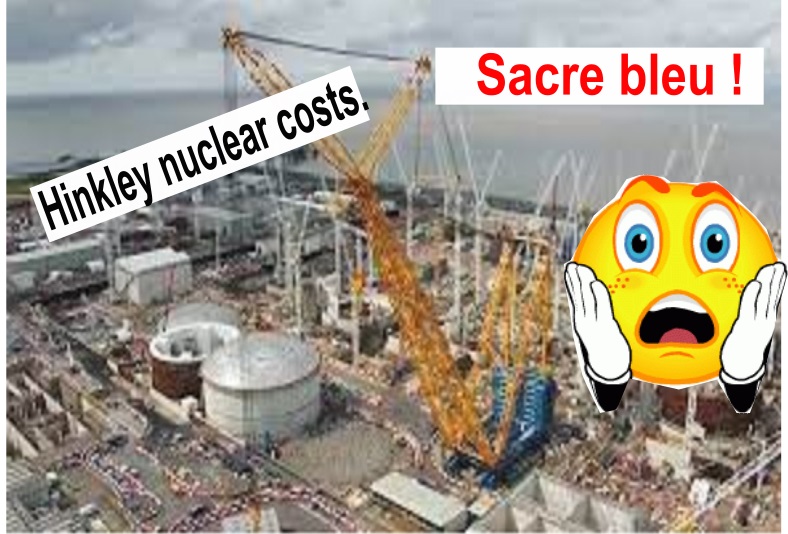
French State body says nuclear energy group should ensure international projects do not
delay domestic programme. France’s state auditor has said that French
nuclear company EDF should not make a final investment decision in the UK’s
Sizewell C reactor project until it has reduced its exposure to its other
British development, Hinkley Point C.
The Cour des comptes also said state-owned EDF must ensure that any international projects are profitable, and must not delay the programme of new nuclear projects in France. The auditors’ comments on Tuesday came just hours after the Financial Times
reported that the construction cost of the Sizewell C project in Suffolk
was likely to reach £40bn, double the estimate in 2020.
FT 14th Jan 2025 https://www.ft.com/content/9a6f1e55-91e2-4173-8c17-f67da0962201
NUKES AND FIRE – California Wildfires and Nuclear Dangers

Libbe’s Story: January 14, 2025
I live in Los Angeles in the foothills less than a mile away from what became the Eaton (Altadena/Pasadena) fire Evacuation Warning zone.
There was no new Nuclear Hotseat last week because after the Eaton fire broke out on Tuesday, I lost power and internet for more than 32 hours – as well as being under the stress of possibly needing to evacuate at a moment’s notice (and in the middle of the worst toothache of my life!). The winds were gusting up to 100 MPH, and only a few miles away from where I live, embers were being blown sideways, simultaneously setting whole neighborhoods afire. I packed my car, made arrangements with friends who had space for Munchkin and me to evacuate, and tried to stay in the moment instead of catastrophizing the worst.
After a very intense several days, the danger receded, as did the border of the evacuation zone, and it seemed that I had escaped with my home and life intact. Only the shadows of PTSD – which everyone in Los Angeles is suffering from, whether they lost their homes or not – remained, motivating me to check disaster maps and evacuation updates multiple times every day and throughout the night, sleeping with my clothes on… and not unpacking the car.
Many of you reached out to me, and I’m deeply grateful for your concern and support. As you might imagine, during this time I received numerous email, texts, and Facebook questions on whether any nukes have been at risk. San Onofre is 70 miles from where I live and Diablo Canyon a good 160 miles away, so there didn’t seem to be any immediate danger to them. But what are the dangers in general of fire and nukes? What are we up against?
To find out, I spoke with several experts to gain their insights. Our topics ranged more widely than I had anticipated, including:
the difference between a line fire and a mass fire- why reporters must NEVER evoke Hiroshima or Nagasaki as a comparison to the fire devastation here
- fire hazards posed by exposed spent fuel pools and fuel storage canisters
- how Southern California Edison retains a flawed power transmission tower system that may have contributed to the start of the Altadena/Pasadena Eaton fire
- radiation releases from fire in a radioactive materials dump zone such as the Santa Susana Field Lab (only 30 miles away)
…and other nuclear dangers created by wildfires at nuclear sites.
I learned more than I expected, information I’d not encountered before and that you probably haven’t, either. I will try to get this program into the hands and ears of reporters who can do a more thorough, focused job of following up. There are important aspects to nuclear’s vulnerability to fire, and given the nature of this current wildfire catastrophe – with maybe worse to come – we can’t assume safety when it’s clear that no one can.
In the meantime… I’m not unpacking the car.
Featured Interviews:………………………………………………..
Virginia, we have a problem

14 Jan 2025, |Peter Briggs, https://www.aspistrategist.org.au/virginia-we-have-a-problem/
Australia’s plan to acquire Virginia-class submarines from the United State is looking increasingly improbable. The US building program is slipping too badly.
This heightens the need for Australia to begin looking at other options, including acquiring Suffren-class nuclear attack submarines (SSNs) from France.
The Covid-19 pandemic dramatically disrupted work at the two shipyards that build Virginias, General Dynamics Electric Boat at Groton, Connecticut, and Huntington Ingalls Industries’ yard at Newport News, Virginia. It badly hindered output at many companies in the supply chain, too. With too few workers, the industry has built up a backlog, and yards are filling with incomplete submarines.
Within six years, the US must decide whether to proceed with sale of the first of at least three and possibly five Virginias to Australia, a boat that will be transferred from the US Navy’s fleet.
Nine months before the transfer goes ahead, the president of the day must certify that it will not diminish USN undersea capability. This certification is unlikely if the industry has not by then cleared its backlog and achieved a production rate of 2.3 a year—the long-term building rate of two a year for the USN plus about one every three years to cover Australia’s requirement.
The chance of meeting that condition is vanishingly small.
The situation in the shipyards is stark. The industry laid down only one SSN in 2021. It delivered none from April 2020 to May 2022. The USN has requested funding for only one Virginia in fiscal year 2025, breaking the two-a-year drumbeat, ‘due to limits on Navy’s budget topline and the growing Virginia class production backlog’.
As of January 2025, five of 10 Block IV Virginias ordered are in the yards, as are five of 12 Block Vs for which acquisition has been announced. (Work has not begun on the other seven Block Vs.)
The building time from laying down until delivery has increased from between 3 and 3.5 years before the pandemic to more than 5 years. The tempo is still slowing: the next Virginia, USS Iowa, is due to be delivered on 5 April 2025, 5.8 years after it was laid down.
On the original, pre-pandemic schedule, all the Block IVs could probably have been delivered to the USN by now. This is a gap that cannot be recovered in a few years, despite all the expensive manpower training and retention programs in hand.
Exacerbating the problem for the yards, the Block V submarines are 30 percent larger, and more complex to build, making a return to shorter build times unlikely. Speaking to their shareholders in October, the chief executives of Huntington Ingalls and General Dynamics blamed their slowing delivery tempo on supply chain and workforce issues. HII says it is renegotiating contracts for 17 Block IV and Block V Virginias.
Furthermore, Electric Boat has diverted its most experienced workers to avoid further slippage in building the first two ballistic missile submarines of the Columbia class, the USN’s highest priority shipbuilding program, in which the Newport News yard also participates.
It gets worse. Many USN SSNs that have joined the US fleet over the past few decades are unavailable for service, awaiting maintenance. The pandemic similarly disrupted shipyards that maintain the SSNs of the Los Angeles and Virginia classes. In September 2022, 18 of the 50 SSNs in commission were awaiting maintenance. The Congressional Budget Office reports lack of spending on spare parts is also forcing cannibalisation and impacting the availability of Virginia class SSNs.
Australia’s SSN plan must worsen the US’s challenge in recovering from this situation, adding to the congestion in shipyards and further over loading supply chains already struggling to deliver SSNs to the USN.
A US decision not to sell SSNs to Australia is inevitable, and on current planning we will have no stopgap to cover withdrawal of our six diesel submarines of the Collins class, the oldest of which has already served for 28 years.
In the end, Australia’s unwise reliance on the US will have weakened the combined capability of the alliance. And Australia’s independent capacity for deterrence will be weakened, too.
As I wrote in December, it is time to look for another solution. One is ordering SSNs of the French Suffren class. The design is in production, with three of six planned boats delivered. It is optimised for anti-submarine warfare, with good anti-surface, land-strike, special-forces and mining capability. It is a smaller design, less capable than the Virginia, but should be cheaper and is a better fit for Australia’s requirements.
Importantly, it requires only half the crew of a Virginia, and we should be able to afford and crew the minimum viable force of 12 SSNs.
Let’s build on the good progress in training, industry and facility preparations for supporting US and British SSNs in Australia, all of which should continue, and find a way to add to the alliance’s overall submarine capability, not reduce it.
Sizewell C’s future in doubt as EDF told to prioritise French nuclear power
Auditor warns against costly foreign projects as energy giant considers investment decision into the plant
The future of Sizewell C has been thrown into doubt after EDF, the company
behind the project, was told to prioritise supporting nuclear power in
France. In a rare intervention, the French state auditor warned the
state-owned energy giant against backing risky new projects abroad, which
include plans to build a new nuclear power station in Suffolk.
Instead, the Cour de Comptes said EDF should focus on making a success of
multibillion-euro projects at home, ensuring they were profitable and built
on time. It comes as EDF prepares to make a final investment decision on
Sizewell C, which will increase its exposure in the UK given it is already
building Hinkley Point C in Somerset.
However, that project has been hit by
surging costs and delays, with the most recent forecasts saying it will
open after 2030 and cost around £45bn. Industry sources are also predicting
Sizewell C will cost £40bn to build, double EDF’s initial estimates in
2020.
EDF is working alongside the Government on Sizewell C, with £4bn of
taxpayer cash already spent on the project. However, the French auditor has
released a report saying EDF should not make a final investment decision on
the Sizewell project before cutting its financial exposure to Hinkley.
Telegraph 14th Jan 2025,
https://www.telegraph.co.uk/business/2025/01/14/sizewell-c-future-doubt-edf-told-prioritise-french-nuclear/
Outgoing CIA director says ‘no sign’ Iran developing nuclear weapons
William Burns stated that the Islamic Republic made a decision in 2003 not to pursure nuclear weapons and has not changed its policy
The Cradle, News Desk, JAN 12, 2025
Outgoing CIA director William Burns stated in an interview on 10 January that Iran does not have a nuclear weapons program, following a decision it made in 2003, and that the US is concerned about the revival of ISIS.
In an interview with state broadcaster National Public Radio (NPR) to discuss his time as director of the notorious spy agency under President Joe Biden, Burns was asked whether Iran may accelerate its efforts to obtain nuclear weapons given the setbacks the Islamic Republic and its allies in the regional Axis of Resistance have sustained over the past year.
Burns answered that “the Iranian regime could decide in the face of that weakness that it needs to restore its deterrence as it sees it and, you know, reverse the decision made at the end of 2003 (an oral fatwa issued by Supreme Leader Ali Khamenei) to suspend their weaponization program.”
However, Burns clarified, “We do not see any sign today that any such decision has been made, but we obviously watch it intently. “
He added that Iran’s weakness could instead lead to negotiations for a nuclear deal similar to the one signed by Iran and the United States under President Obama in 2014. President Trump later withdrew from the deal following intense lobbying by Israeli Prime Minister Benjamin Netanyahu.
“You know that that sense of weakness could also theoretically create a possibility for serious negotiations, too. And, you know, that’s something the new administration is going to have to sort through. I mean, it’s something I have a lot of experience in with the secret talks a decade ago, a little more than a decade ago with the Iranians. So, you know, that’s that’s also a possibility,” Burns stated.
Regarding the negotiations for a possible ceasefire and prisoner exchange between Israel and Hamas in Gaza, Burns said he believes there is a chance for an agreement.
“I think the gaps between the parties have narrowed. There’s an Israeli delegation in Doha right now working through proximity talks managed by the Qataris, with the support of the Egyptians and with our support. So, I think there’s a chance.”……………………………………………………. https://thecradle.co/articles/outgoing-cia-director-says-no-sign-iran-developing-nuclear-weapons
1 This Month

of the week – Shut Down Drone Warfare!


Tell the Ukrainian Government to Drop Prosecution of Peace Activist Yurii Sheliazhenko

Petition to revoke the licensing of the Near Surface Nuclear Disposal Facility (NSDF) at Chalk River. https://www.ourcommons.ca/petitions/en/Petition/Details?Petition=e-7247
To see nuclear-related stories in greater depth and intensity – go to https://nuclearinformation.wordpress.com
-
Archives
- April 2026 (91)
- March 2026 (251)
- February 2026 (268)
- January 2026 (308)
- December 2025 (358)
- November 2025 (359)
- October 2025 (376)
- September 2025 (257)
- August 2025 (319)
- July 2025 (230)
- June 2025 (348)
- May 2025 (261)
-
Categories
- 1
- 1 NUCLEAR ISSUES
- business and costs
- climate change
- culture and arts
- ENERGY
- environment
- health
- history
- indigenous issues
- Legal
- marketing of nuclear
- media
- opposition to nuclear
- PERSONAL STORIES
- politics
- politics international
- Religion and ethics
- safety
- secrets,lies and civil liberties
- spinbuster
- technology
- Uranium
- wastes
- weapons and war
- Women
- 2 WORLD
- ACTION
- AFRICA
- Atrocities
- AUSTRALIA
- Christina's notes
- Christina's themes
- culture and arts
- Events
- Fuk 2022
- Fuk 2023
- Fukushima 2017
- Fukushima 2018
- fukushima 2019
- Fukushima 2020
- Fukushima 2021
- general
- global warming
- Humour (God we need it)
- Nuclear
- RARE EARTHS
- Reference
- resources – print
- Resources -audiovicual
- Weekly Newsletter
- World
- World Nuclear
- YouTube
-
RSS
Entries RSS
Comments RSS
 nuclear-news