Becoming a responsible ancestor – about America’s nuclear wastes.

This country, with the world’s largest inventory of high-activity radioactive waste, has not fashioned even a shadow of a strategy for the material’s permanent disposition.
in any case, the burdens would fall on future generations.
Bulletin, By Daniel Metlay | January 13, 2025
After more than four decades of intense struggle, the United States found itself in an unenviable and awkward position by 2015: It no longer had even the barest blueprint of how to dispose of its growing inventory of high-activity radioactive waste.[1] Under the leadership of Rodney Ewing, former chairman of the Nuclear Waste Technical Review Board, and Allison MacFarlane, former chairman of the Nuclear Regulatory Commission, a steering committee composed of a dozen specialists set out to prepare the so-called “reset” report on how to reconstruct that enterprise.[2] In the study’s words: “Reset is an effort to untangle the technical, administrative, and public concerns in such a way that important issues can be identified, understood, and addressed (Steering Committee 2018, 2).”
One of its key recommendations was that a non-profit, single-purpose organization should be established by the owners of the country’s nuclear powerplants to replace the Department of Energy as the implementor of a fresh waste-disposal undertaking.[3]
To appreciate these suggestions, one must first understand how the United States found itself in its current predicament.
How did the United States get here
The roots of the United States’ waste-disposition program can be found in a study prepared by a panel working under the auspices of the National Academy of Sciences (National Research Council 1957). The group’s principal advice was that high-activity waste should be entombed in conventionally mined, deep-geologic repositories such as salt mines.
Early attempts to find a site for the facility met with unanticipated technical difficulties and unflinching opposition from state officials (Carter 1989). President Jimmy Carter appointed an Interagency Review Group to suggest a pathway to unsnarl the Gordian Knot (IRG 1978). Among other things, it counseled the president that a new waste-management program should be established within the Department of Energy. It should investigate multiple potential locations in a variety of geologic formations and choose the one bearing the soundest technical characteristics for development of a repository.
President Ronald Reagan signed the Nuclear Waste Policy Act in January, 1983 (NWPA 1982). The legislation captured the consensus that had emerged around the lion’s share of the Interagency Review Group’s ideas. In particular, the law contained four strategic bargains that were requisite to its passage:
Two repositories would be built, the first in the west and a second in the east, to ensure geographic equity and geologic diversity.- Site-selection would be a technically driven process in which several different hydrogeologic formations would be evaluated against pre-established guidelines.
- States would be given a substantial voice in the choice of sites.
- Upon payment of a fee, the Department of Energy would contract with the owners of nuclear powerplants to accept their waste for disposal starting in January 1998.
By the time Congress enacted the Nuclear Waste Policy Amendments Act a mere five years later, all the bargains had been breached in one way or another (NWPAA 1987; Colglazier and Langum 1988).
Derisively labeled the “Screw Nevada” bill, the new law confined site-selection to Yucca Mountain, located both on and adjacent to the weapons-testing area. Hardly surprisingly, the state mounted an implacable and sustained challenge to the actions of the Department of Energy, including investigations to evaluate the technical suitability of Yucca Mountain and opposition to the license application that the department submitted to the Nuclear Regulatory Commission (Adams 2010).
…………………………………………………………………………………… President Obama directed the new secretary of the Energy Department, Steven Chu, to empanel the Blue Ribbon Commission on America’s Nuclear Future (BRC 2012). Ostensibly not a “siting commission,” it nonetheless proposed a “consent-based” process that was dramatically at odds with the method used to choose the Yucca Mountain site. In addition, the new leadership sought, unsuccessfully as it turns out, to withdraw the license application before the Nuclear Regulatory Commission. Ultimately, funding for the project ran out even during President Donald Trump’s administration, and the Yucca Mountain Project faded into history.
Left in its wake is the current state of affairs. This country, with the world’s largest inventory of high-activity radioactive waste, has not fashioned even a shadow of a strategy for the material’s permanent disposition.
The Department of Energy detailed the consequences of the absence of a policy with its analysis of the No-Action Alternative in the Environmental Impact Statement for Yucca Mountain (DOE 2002, S-79).[4] Under this scenario, the adverse outcomes are seemingly modest—but the calculations exclude effects due to human intrusion as well as sabotage, precisely the rationales for the disposal imperative.
At best, the nation has been left with the regulator’s vague assurance that the owners of the waste can safely extend its storage on the surface for roughly 100 years (NRC 2014). This abdication of accountability—kicking the burden down the road—transforms our generation into irresponsible ancestors.
Why has the United States gotten there
Many independent and reinforcing factors have led to this nation’s precarious moral circumstances. Five of them are worthy of note.
First, striking a balance between protecting the national interest in the disposition of the waste versus state and local interest in warding off a possible calculated risk has proven to be a constant struggle. The Interagency Review Group proposed the nebulous notion of “consultation and concurrence” to suggest that a host state must provide its consent before the repository-development process could proceed to the next step.
Congress morphed that idea into the much weaker “consultation and cooperation” when it passed the Nuclear Waste Policy Amendments Act. But it did authorize the host-state to raise an objection to the president’s selection of the site. That dissent could, however, be overridden by a majority vote in each chamber. As the Yucca Mountain case illustrated, once intensive investigations at a proposed repository location gained momentum and the prospect of restarting site selection lurked in the future, sustaining a protest was only an abstract possibility.
Second, the regulatory regime for approving a repository system was plagued by controversy. In the mid-1980s, the Environmental Protection Agency promulgated radionuclide release standards, and the Nuclear Regulatory Commission issued licensing rules for a generic repository. Directed by Congress in 1992, both agencies later released Yucca Mountain-specific regulations. These protocols proved to be methodologically contested and subject to criticism for changing the “rules of the game.”
Third, the Department of Energy has failed to merit public trust and confidence. A survey conducted by the Secretary of Energy Advisory Board at the height of the Yucca Mountain controversy conclusively demonstrated this reality: None of the interested and affected parties believe that the Department of Energy is very trustworthy. See Figure 1.[on original]
Nor did that deficit of trust and confidence shrink in the coming years. The Blue Ribbon Commission’s and Reset reports underscored this endemic problem. The Department of Energy’s recent initiative to craft a consent-based procedure for siting a federal consolidated interim storage facility positioned restoring public trust at the core of its activities.
Fourth, the Department of Energy’s execution of a stepwise approach to constructing a disposal facility was practically and conceptually flawed. Its license application composed a narrative about how it would meet the Nuclear Regulatory Commission’s regulation mandating that the material be able to be retrieved from an open repository once it was emplaced. That account did not detail the conditions under which the waste might be removed; it did not suggest where it might go; nor did it indicate what might be done if the repository proved to be unworkable. Like extended storage, retrievability of the waste would somehow take place if and when necessary. But, in any case, the burdens would fall on future generations.
Fifth, the Department of Energy encountered difficulties persuasively resolving technical uncertainties. Its license application rested on the premise that the corrosion-resistant Alloy-22 waste packages and the titanium alloy drip shields, which might divert water from the packages, would function to limit the release of radionuclides into the environment. Whether those engineered structures would perform as anticipated in a hot and humid repository may still be an open question. ………………………………….
What should be done
It would be unfair to reproach the Department of Energy alone for all the difficulties that the US waste-disposition program has confronted over the years; sometimes it just was dealt a poor hand by others. Nonetheless, in this writer’s view, reviving that effort demands, among other transformations, a modification in the organization that will execute it in the future.
Indeed, institutional design in the United States is hardly a novel concern. Included in the Nuclear Waste Policy Act was a provision directing the secretary of the Department of Energy to “undertake a study with respect to alternative approaches to managing the construction and operation of all civilian radioactive waste management facilities, including the feasibility of establishing a private corporation for such purposes (NWPA 1992).” That analysis advocated a Tennessee Valley Authority-like corporation, which was labeled “FEDCORP,” to take on the responsibility of constructing and operating a repository (AMFM 1995).
The Blue Ribbon Commission also concluded that:
A new [single-purpose] organization will be in a better position to develop a strong culture of safety, transparency, consultation, and collaboration. And by signaling a clear break with the often troubled history of the U.S. waste management program it can begin repairing the legacy of distrust left by decades of missed deadlines and failed commitments (BRC 2012, 61).
It, too, advised that a FEDCORP should replace the Department of Energy.
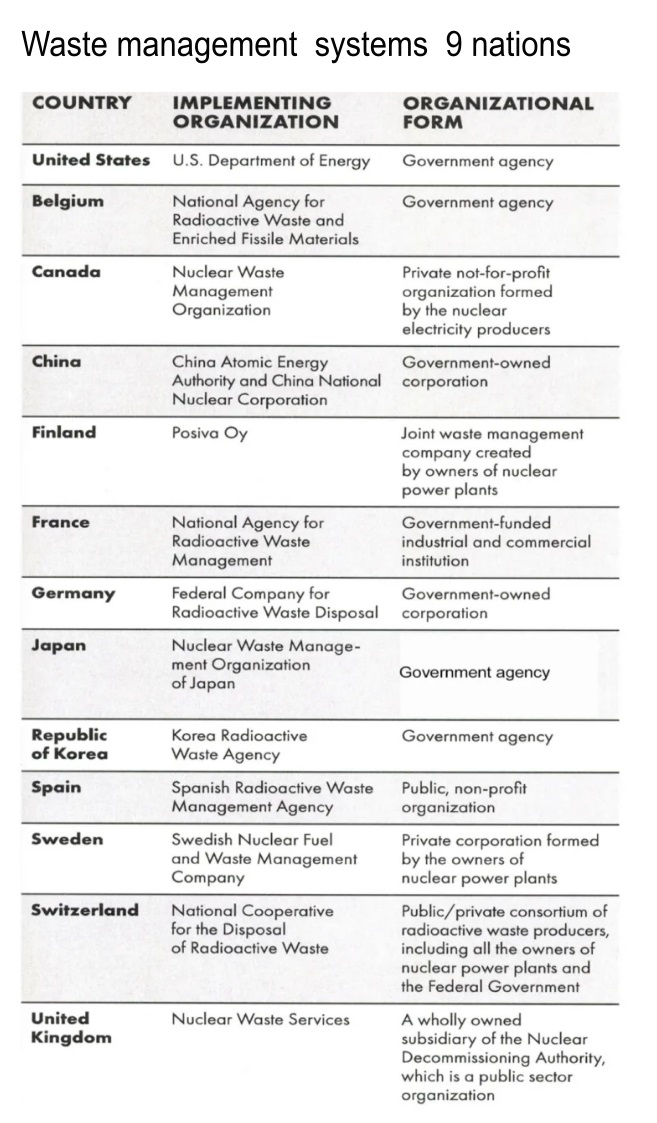
An examination of national waste-disposal undertakings indicates that countries do have several options for structuring their missions. See Figure 2 below [on original].
That multiplicity of alternatives led the majority of the Reset Steering Committee, after intense discussion and consideration, to decide that a more radical approach ought to be adopted. As the group observed: “The track record of nuclear utility-owned implementors abroad…makes at least a prima facie case for considering the creation of a not-for-profit, nuclear utility-owned implementing organization (NUCO) (Steering Committee 2018, 35).”
Of the four nations relying on nuclear utility-owned implementing organizations, three—including Finland, Sweden, and Switzerland—have selected repository sites, and another, Canada, may be on the cusp of doing so. In pointed contrast, only one of the nine countries employing other organizational designs have launched a determined set of site investigations, let along definitely and unequivocally chosen a location to build a repository.
Removing disposal authority from the Department of Energy and passing it on to a nuclear utility-owned implementing organization also permits the full integration of the nuclear fuel cycle. With the exception of disposition, every element is the responsibility of some industrial firm: uranium exploration and conversion, fuel manufacture and configuration, enrichment, reactor design and construction, spent fuel reprocessing (if permitted by law or regulation and if deemed economical), and temporary storage of spent fuel on and off reactor sites.
……………………………………………By creating a nuclear utility-owned implementing organizations, reactor owners can more easily negotiate adjustments with their industrial partners.
But transitioning from the Department of Energy to a nuclear utility-owned implementing organization is unlikely to be a frictionless process. Policymakers in government and industry will have to resolve many particulars. For instance, of central importance is the question of who should pay for the reconstructed program. Since the Nuclear Waste Policy Act’s passage four decades ago, utilities have paid a fee of $0.001 (one mil) per kilowatt of electricity produced. In addition, Congress has periodically appropriated funds to dispose of weapons-origin high-activity waste. Those resources have all been deposited in the Nuclear Waste Fund with the expectation they would pay the full life-cycle costs of the disposition effort.
At the end of Fiscal Year 2024, the Nuclear Waste Fund balance was $52.2 billion dollars (DOE 2024).[5] f a nuclear utility-owned implementing organization were established, one possibility would be to transfer the body of the fund to the new organization. However, the nuclear utility-owned implementing organization might be limited to spending for disposition only the amount of interest that the waste fund generates. In Fiscal Year 2024, that amount was roughly $1.9 billion a year. Notably that income was approximately four times what the Department of Energy spent during the last full year of the Yucca Mountain Project (Consolidated Appropriations Act 2008). Consequently, the new implementor should have sufficient resources to sustain a robust effort. (Under this approach, nuclear utilities would continue to be responsible for storing their spent fuel.)
Another question that would have to be determined is the fate of weapons-origin high-activity radioactive waste. Conceivably the Federal Government might resurrect its own repository effort, perhaps at Yucca Mountain or through a contemporary siting project. Alternatively, the most cost-effective option might be to pay the nuclear utility-owned implementing organizations a disposition fee through congressional appropriations.
Finally, given the weight to its additional responsibilities, the nuclear utility-owned implementing organization must demonstrate that it will be a trustworthy implementor……………………………………………………………….
But for this arrangement to be most effective, the Nuclear Regulatory Commission itself must be viewed more widely as trustworthy…………………………………………………………………………………
Other reforms beyond switching the implementor will urgently be necessary, such as improving the technical credibility of studies to determine the suitability of a potential repository site and structuring a sound step-by-step developmental process. Without the full slate of improvements, this generation will be stuck in the role of irresponsible ancestors. So, the reader should consider this essay as a broader call to action, if only for our children and grandchildren’s sake. https://thebulletin.org/premium/2025-01/becoming-a-responsible-ancestor/?utm_source=ActiveCampaign&utm_medium=email&utm_content=Radioactive%20fallout%20in%20Tokyo%20after%20Fukushima&utm_campaign=20250113%20Monday%20Newsletter
Patrick Lawrence: The Nihilism of Antony Blinken

It is not, or not only, the extent of Blinken’s incompetence, which even this carefully staged presentation cannot obscure. We knew he was not up to the job Biden gave him from his first months on the seventh floor at State. It is his, Blinken’s, moral vacancy that must disturb us most. He is one of those hollow men Eliot described in his famous poem of this name. This is a man who professes “values”—“our values,” as he puts it—but has none, who stands for nothing other than the rank opportunity uniquely available with access to power. I have never heretofore thought of Antony Blinken as at heart a nihilist. But on his way out the door, this seems the most truthful way to understand him.
Blinken’s approval of Israel’s mass murder in Gaza, couched in the cotton-wool language to which Blinken always resorts when he wants to turn night into day, failure into success.
January 13, 2025 By Patrick Lawrence , ScheerPost
Readers write from time to time thanking me for keeping up with The New York Times so they don’t have to do so themselves. I understand the thought, and they are most welcome in all cases. But we have now the case of The Times’s lengthy interview with Antony Blinken, published in the Sunday Magazine dated Jan. 5. Yes, I have read it. And this time I propose others do the same. This is one of those occasions when it is important to know what Americans are supposed to think — or, better put, the extent to which Americans are not supposed to think.
It is sendoff time for the outgoing regime. You can imagine without my help what kind of piffle this is engendering, if you have not already noticed.
USA Today’s Washington bureau chief, Susan Page, threw President Biden a seven-inning game’s worth of softballs this week, producing a Q & A all about “legacy” and “inflection points,” the glories of American hegemony (“Who leads the world if we don’t?”) and how Joe could have defeated Donald Trump last November but was, after all, “talking about passing the baton” even when everything we read indicated he had no intention of doing so.
……………………. Journalism with American characteristics, no other way to name it. Not a single question about the Gaza crisis, genocide, Ukraine, China. Not even a mention of Russia. And what in hell, now that I think of it, will fill the shelves in a Joseph R. Biden, Jr., Presidential Library? This is really my question.
O.K., USA Today is a comic book—“McPaper,” we used to call it—and it is folly to expect anything more than fatuous pitter-patter out of Joe Biden (or anyone interviewing him) at this late stage in the proceedings. But The Times is not a comic book, its day-to-day unseriousness notwithstanding, and Blinken purports to gravitas and authority. Herein lies the problem. In his lengthy exchange with Lulu García–Navarro, Biden’s secretary of state renders a sober-sounding account of the world as the retiring regime now leaves it that is so shockingly far from reality as to be frightening.
“Today as I sit with you, I think we hand over an America in a much, much stronger position, having changed much for the better our position around the world,” Blinken asserts at the outset of this interview. “Most Americans,” he adds a short time later, “want to make sure that we stay out of wars, that we avoid conflict, which is exactly what we’ve done.” Go ahead, let your jaw drop. Blinken’s 50 minutes with The Times are an assault on reason, on truth. And as such they are an incitement to ignorance, precisely the condition that lands this nation in the incalculable trouble Blinken proposes we pretend is not there.
It is not, or not only, the extent of Blinken’s incompetence, which even this carefully staged presentation cannot obscure. We knew he was not up to the job Biden gave him from his first months on the seventh floor at State. It is his, Blinken’s, moral vacancy that must disturb us most. He is one of those hollow men Eliot described in his famous poem of this name. This is a man who professes “values”—“our values,” as he puts it—but has none, who stands for nothing other than the rank opportunity uniquely available with access to power. I have never heretofore thought of Antony Blinken as at heart a nihilist. But on his way out the door, this seems the most truthful way to understand him.
This is the man who swiftly made an utter mess of U.S.–China relations when, two months after taking office, his first encounters with senior Chinese officials blew up in his face during talks in an Anchorage hotel conference room. Sino–American ties have been one or another degree of hostile ever since. This is the man who, a year later, led the way as Biden provoked Russia’s self-protecting intervention in Ukraine. He, Blinken, has ever since refused negotiations. This is the man who, a year after that, began his continuing defense of Israel’s genocide in Gaza. It has been Blinken and Nod in action in each case.
This is the man who—a couple of notable moments here—celebrated World Press Freedom Day in London in May 2021, while Julian Assange was in a maximum-security prison a few miles away. “Freedom of expression and access to factual and accurate information provided by independent media are foundational to prosperous and secure democratic societies,” Blinken had the nerve to declare, citing the Universal Declaration of Human Rights as he did so. This is the man who perjured himself last May, when, under oath, he told Congress the State Department had found no evidence that Israel was blocking humanitarian aid to Gaza. (I take this occasion to praise Brett Murphy once again for breaking this story in ProPublica.)
Now we can settle in and listen to Blinken converse with his interlocutor from The Times.
Blinken on relations with China:
“We were really on the decline when it came to dealing with China diplomatically and economically. We’ve reversed that…. And I know it’s succeeding because every time I meet with my Chinese counterpart, Wang Yi, the foreign minister, he inevitably spends 30 or 40 minutes, 60 minutes complaining about everything we’ve done to align other countries to build this convergence in dealing with things that we don’t like that China is pursuing. So to me, that is the proof point that we’re much better off through diplomacy.“
This account of the regress of the U.S.–China relationship on Blinken’s watch is beyond bent. First, there is no record of Wang Yi, China’s distinguished foreign minister, ever complaining to Blinken or any other U.S. official about Washington’s alliances in East Asia. China’s complaints have primarily (but not only) to do with the Biden regime’s incessant assertion of American hegemony in the Pacific, its provocative conduct on the Taiwan and South China Sea questions, and its efforts to subvert an economy with which the U.S. can no longer compete.
Second, not even Japan, South Korea, and the Philippines, with which Washington has indeed strengthened military ties, are now “aligned” against China. They, along with all other East Asians, can read maps, believe it or not. And the whole of the Pacific region will favor balanced ties with the U.S. and China as long as you and I are alive. Drawing East Asians together in some kind of Sinophobic “convergence” is a long dream from which the Washington policy cliques simply cannot awaken.
Finally and most obviously, if antagonizing another major power is a measure of diplomatic success, the nation such a diplomat purports to represent is in the kind of trouble to which I alluded earlier.
Footnote: It has been a sad spectacle these past three years as a parade of Biden regime officials, Blinken chief among them, has marched to Beijing and failed one by one to repair the damage done in Anchorage. In their dealings with Blinken, Wang and Xi Jinping, China’s president, have treated Biden’s top diplomat as if he were a junior high school student who flunked geography.
Blinken on Russia and Ukraine:
“So first, if you look at the trajectory of the conflict, because we saw it coming, we were able to make sure that not only were we prepared and allies and partners were prepared, but that Ukraine was prepared. We made sure that well before the Russian aggression happened, starting in September and then again December, we quietly got a lot of weapons to Ukraine to make sure that they had in hand what they needed to defend themselves, things like Stingers, Javelins that were instrumental in preventing Russia from taking Kyiv, from rolling over the country, erasing it from the map, and indeed pushing the Russians back….
In terms of diplomacy: We’ve exerted extraordinary diplomacy in bringing and keeping together more than 50 countries, not only in Europe, but well beyond, in support of Ukraine and in defense of these principles that Russia also attacked back in February of that year. I worked very hard in the lead up to the war, including meetings with my Russian counterpart, Sergey Lavrov, in Geneva a couple of months before the war, trying to find a way to see if we could prevent it, trying to test the proposition whether this was really about Russia’s concerns for its security, concerns somehow about Ukraine and the threat that it posed, or NATO and the threat that it posed, or whether this was about what it in fact it is about, which is Putin’s imperial ambitions and the desire to recreate a greater Russia, to subsume Ukraine back into Russia. But we had to test that proposition. And we were intensely engaged diplomatically with Russia. Since then, had there been any opportunity to engage diplomatically in a way that could end the war on just and durable terms, we would have been the first to seize them. “
Where to begin? Give me a sec to catch my breath.
Blinken and his colleagues anticipated Russia’s invasion before it started in February 2022 because the Biden regime provoked it to the point Moscow had no other choice. Washington spent the autumn of 2021 arming Kiev, just as Blinken recounts, but Blinken makes no mention of the two draft treaties the Kremlin sent Westward that December—one to Washington, one to NATO in Brussels—as the proposed basis for negotiating a durable new security settlement between Russia and the Atlantic alliance. This was dismissed out of hand as a “non-starter,” the British-ism the Biden regime favored at the time. Blinken skips over this opportunity to develop productive diplomatic channels like a mosquito across a pond.
His idea of diplomacy, indeed, was limited to gathering one of those coalitions of the willing (or coerced) the American imperium has long favored, in this case to back the proxy war to come. There was not then and has not been since any serious effort to negotiate a settlement in Ukraine. Blinken seems actually to believe (or he pretends to believe) that there was never any question of Moscow’s legitimate security concerns: It was all about the Kremlin’s plan to “erase” Ukraine in the cause of the Russia’s neo-imperial ambitions. Somehow this proposition was tested and proved out, and I would love to know how.
I am reminded once again of that moment, a few months into the war, when Blinken pulled aside Sergei Lavrov for a private exchange after formal talks at the Kremlin. As I wrote subsequently, when he asked Moscow’s long-serving foreign minister if it was true Russia wanted to reconstruct the Czarist empire, Lavrov stared, turned, and left the room—no reply, no handshake, no farewell, just an abrupt exit. How could a diplomat of Lavrov’s caliber possibly entertain such a question? We are left with two alternatives, readers. Either Tony Blinken is extremely dim-witted to misinterpret Russia’s position this badly, or Tony Blinken is a very formidable liar.
My conclusion: He is both.
Footnote: Blinken has not spoken to Lavrov since that pitiful occasion in mid–2022 — or to any other senior Russian official so far as we know. And the Biden regime has on two occasions, most famously in Istanbul a month after the Russian invasion began, actively scuttled talks between Kiev and Moscow that could have ended the war.
We come to Blinken on Israel, Gaza, and the Palestinians.
Blinken spent a great deal of his time with García–Navarro explaining his views of the Gaza crisis. And for the most part he stayed with the tedious boilerplate with which we are already familiar. The Biden regime supports Israel’s right to defend itself. He has dedicated himself to making sure the Palestinians of Gaza “had what they needed to get by.” The impediments to a ceasefire and a return of hostages are all on Hamas, not the Netanyahu regime.
Has Israel committed war crimes? Do we witness a genocide? Have the Israelis blocked food aid? You can’t expect straight answers out of Blinken on these kinds of questions, and García–Navarro got none. What she got was Blinken’s approval of Israel’s mass murder in Gaza, couched in the cotton-wool language to which Blinken always resorts when he wants to turn night into day, failure into success. Yes, he allowed, the Netanyahu regime could have made some minor adjustments at the margin and the slaughter would have looked better. But there is no erasing Blinken’s ratification of Israeli terrorism, his judgment that it has been a success — or García–Navarro’s failure to call him on this, a topic to which I will shortly return.
There is one remark Blinken made in this sendoff Q & A that has stayed with me ever since I watched the video of it and then read the transcript. It concerns the Gaza crisis, but it expands in the mind like one of those sponges that grow large when wetted. “When it comes to making sure that Oct. 7 can’t happen again,” Blinken said, “I think we’re in a good place.”
I can hardly fathom the implications of this extravagantly thoughtless assertion. There is no understanding of the human spirit in it. It takes no account of the enduring aspirations of the Palestinians people, I mean to say, and so displays the shallowest understanding of the events of Oct. 7, 2023. It presumes, above all, that the totalized violence of uncontrolled power is some kind of net-positive and can prevail in some lasting way, and that there is no need to trouble about what is just, or what it ethical, or what is irreducibly decent, or a commonly shared morality, or, at the horizon, the human cause as against (in this case) the Zionist cause.
This sentence takes us straight to Antony Blinken’s nihilism. As he leaves office he mounts not only an assault on reason, as I argued above, or our faculties of discernment, but altogether an assault on meaning. The working assumption is that he or she who controls the microphones and megaphones is free to say whatever it is of use to say. It does not require any relationship to reality, only to expedience. This is what I mean by nihilism.
“I don’t do politics,” Blinken flippantly tells García–Navarro early in their time together. “I do policy.” García–Navarro lets this go, as she does so much else. It is prima facie ridiculous, a hiding place in which García–Navarro allows Blinken to take shelter. Policy is politics: They are inseparable, no exceptions. In this case, Blinken cannot possibly expect the world beyond America’s shores to take seriously his assessment of the world as the Biden White House leaves it. This interview is all politics all the time: It is strictly for domestic consumption, intended not only to salvage a reputation — one beyond salvaging in my view — but to continue the grinding business of manufacturing consent. ……………………………………………………………………………………………………………………………..
Watch the video of Lourdes “Lulu” Garcia-Navarro’s time with Blinken. As is easily detected, she reads from a script and remains resolutely faithful to it regardless of what Blinken says. She purports to be otherwise, but she is a supplicant. She pretends to challenge Blinken on this or that question, but it is all faux, pose. None of Blinken’s lies, misrepresentations, and plain disinformation come in for serious scrutiny. It is merely on-to-the-next-question.
This is not journalism. It is spectacle, a theatrical reenactment of journalism — another case of journalism with American characteristics. It is not the creation of meaning, either: It is the destruction of meaning. I have already noted my term for this. ………………………………………………………………………………………………………………………………….
The saving grace of García–Navarro’s encounter with Tony Blinken, and a little to my surprise, lies in the comment thread appended to the published piece. There are 943 comments at this writing. And there are some voices of approval, certainly.
But my goodness are the critics many. Here are a few straight off the top of the thread:
Jorden, California.
Blinken has tarnished the office of Secretary of State. Silly is not the word, not even irresponsible but diabolical. Just bad on so many levels…. The Biden administration will mark the sudden decline of American hegemony …. U.S. foreign policy needs a much needed injection of realist logic now.
From “Rockin’ in the Free World,” Wisconsin:
For readers who want to further marvel at the creature that is Tony Blinken, watch his performance of “Rockin’ in the Free World” from last winter in Ukraine. It is truly cinematic in its irony as he facilitates U.S.–backed genocide. Could not write it better. That’s when I realized how much I viscerally hate this guy, how pathological his lack of self-awareness is[.]
And from David in Florida:
Yes, it’s called being delusional or incompetent or utterly negligent! Good job Blinkin! You and Biden undermined the final support of the Democratic Party. Sure you and your overlords will be fine with I’ll[sic] gotten gains. The rest of us won’t.
……………………………………….more https://scheerpost.com/2025/01/13/patrick-lawrence-the-nihilism-of-antony-blinken/
1 5 January -Virtual presentation: Korean atomic bomb victims seek justice – and the outlawing of nuclear weapons – through the people’s tribunal
Join us on January 15 at 5 pm PT/8pm ET, the People’s Tribunal Organizing Committee will present on the upcoming 2026 International People’s Tribunal and the responsibility of the U.S.A. for the 1945 atomic bombings and for ensuring redress (apology) to Korean victims.
Over 100,000 Koreans were forcibly removed from their homeland by the Japanese during the 1930s and brought to Hiroshima and Nagasaki during the Japanese occupation of Korea. It is not well known that over 70,000 of those Koreans became victims of the world’s first atomic bomb attacks on August 6th and 9th of 1945. Panelists from SPARK and Veterans for Peace will present on the upcoming 2026 International Tribunal, current progress, and its goals.
This virtual presentation is co-hosted by Korea Peace Now Grassroots Network and WILPF Jane Adam’s Branch. RSVP at bit.ly/janpt
For more information, please visit:
Instagram Post Link
International People’s Tribunal on 1945 US Atomic Bombings https://abombtribunal.campaignus.me/
Report: Israel Refusing To Commit to a Permanent Gaza Ceasefire as Part of Hostage Deal

According to Haaretz, Israel’s position is one of the main disputes in the current negotiations
ANTIWAR.com by Dave DeCamp January 12, 2025
One of the main disputes in the ongoing Gaza hostage and ceasefire negotiations in Qatar is Israel’s refusal to commit to ending the war after a potential deal’s second phase, Haaretz reported on Sunday.
A permanent ceasefire has been one of Hamas’s main demands, and the report said the Palestinian group wants the genocidal war to end after the second phase of the deal.
Instead of committing to a permanent ceasefire, the report said there will be an attempt to present a US commitment to “work with Israel towards ending the war.” That would mean the deal would hinge on a US promise to pressure Israel to end military operations in Gaza, and there would be no actual commitment from Israel.
The Haaretz report comes as US officials are insisting that a deal is “very close.” Hamas officials have also told the media that negotiations have been moving in a positive direction and that they were waiting for the Israeli officials Prime Minister Benjamin Netanyahu sent to Qatar to approve their latest draft proposal.
Officials from the incoming Trump administration are also saying that a deal could happen soon, including Steve Witkoff, who will serve as Trump’s envoy to the Middle East and has been involved in the latest negotiations.
Trump himself has repeatedly threatened there would be “hell to pay” if Hamas didn’t start releasing Israeli hostages by his inauguration. Vice President-elect JD Vance elaborated on what that might mean in an interview on Sunday.………………………………… more https://news.antiwar.com/2025/01/12/report-israel-refusing-to-commit-to-a-permanent-gaza-ceasefire-as-part-of-hostage-deal/
CBS’ 60 Minutes Exposes the Biden Administration’s Complicity in Gaza Genocide, Interviews the Whistleblowers
Here is the segment on YouTube:
Biden policy on Israel-Gaza sparks warnings, dissent, resignations | 60 Minutes
Juan Cole, 01/13/2025 Ann Arbor (Informed Comment) https://www.juancole.com/2025/01/administrations-complicity-whistleblowers.html
– The amazingly brave Cecilia Vega at CBS’ 60 Minutes did a groundbreaking segment on Sunday in which she interviewed US government officials involved with the Israeli war on Gaza, who resigned in protest either explicitly or implicitly. She also screened the sort of horrific footage of the aftermath of Israeli attacks in Gaza, with the gory parts left in. Here is the transcript.
American television news has almost completely ignored Israeli (and US) war crimes in Gaza, which have been taking place daily, but are not apparently deemed “news” at CNN, MSNBC, Fox, CBS, ABC, etc.
Here let me just excerpt some statements by the former US government officials:
Hala Rharrit was an American diplomat working on human rights: “What is happening in Gaza would not be able to happen without U.S. arms. That’s without a doubt.”
“I would show the complicity that was indisputable. Fragments of U.S. bombs next to massacres of– of ch– mostly children. And that’s the devastation. It’s been overwhelmingly children.” (Emphasis added.)
“I would show images of children that were starved to death. In one incident, I was basically berated, “Don’t put that image in there. We don’t wanna see it. We don’t wanna see that the children are starving to death.”
Hala Rharrit: The level of anger throughout the Arab world, and I– I’ll say beyond the Arab world– is palpable. Protests began erupting in the Arab world, which I was also documenting, with people burning American flags. This is very significant because we worked so hard after the war on terror to strengthen ties with the Arab world.
[Cecilia Vega: You believe that this has put a target on America’s back, you’ve said.]
Hala Rharrit: 100%.
Hala Rharrit: Yes. I don’t say them lightly. And I say it as someone that myself has survived two terrorist attacks. My first assignment was in the U.S. Embassy in Yemen. I survived a mortar attack. I say it as someone who has worked intensely on these issues and has intensely monitored the region for two decades.
After three months of the Gaza War in 2023, she was told her reports were no longer needed.
Josh Paul spent 11 years as a director in the State Department’s Bureau of Political – Military Affairs.
Josh Paul: Most of the bombs come from America. Most of the technology comes from America. And all of the fighter jets, all of Israel’s fixed-wing fleet– comes from America.
Josh Paul: There is a linkage between every single bomb that is dropped in Gaza and the U.S. because every single bomb that is dropped is dropped from an American-made plane.
Josh Paul: After October 7th, there was no space for debate or discussion. I was part of email chains where there were very clear directions saying, “Here are the latest requests from Israel. These need to be approved by 3:00 p.m.”
Josh Paul: “This came from the president, from the secretary and from those around them.”
Josh Paul: I would argue exactly the opposite. I think the moment of October 7th was a moment of incredible worldwide solidarity with Israel. And had Israel leveraged that moment to press for a real, just and lasting peace, I think we would be in a very different place now in which Israel would not be facing this increasing isolation around the world and in which its hostages would be free.
Andrew Miller was the deputy assistant secretary of state for Israeli-Palestinian affairs.
Andrew Miller: The Israelis were using those bombs in some instances to target one or two individuals in densely packed areas. And in enough instances, we saw that was in question, how Israel was using it. And those weapons were suspended.
Andrew Miller: There were conversations from the earliest days about U.S. desires and expectations for what Israel would do. But they weren’t defined as a red line.
Andrew Miller: I’m unaware of any red lines being imposed beyond the normal language about complying with international law, international humanitarian law, the law of armed conflict.
Andrew Miller: I believe the message that Prime Minister Netanyahu received is that he was the one in the driver’s seat, and he was controlling this, and U.S. support was going to be there, and he could take it for granted.
Andrew Miller: There is a danger– that if the U.S. was not providing support to Israel, Hezbollah, Hamas, Iran would see that as an opportunity to go after Israel. However, we could have said, we are taking this step because we believe this class of weapons– is being used inappropriately. But if you use this moment to accelerate your attacks against Israel, then we are going to immediately lift our prohibition.
Andrew Miller: Yes. I think it’s fair to say Israel does get the benefit of the doubt. There is a deference to Israeli accounts of what’s taken place.
Here is the segment on YouTube:
Biden policy on Israel-Gaza sparks warnings, dissent, resignations | 60 Minutes
The UK military’s secret visits to Israel
Top British officers have made at least five unpublicised trips to Tel Aviv to meet Israeli officials, one to discuss ‘future operations’ in the Middle East.
MARK CURTIS, 9 January 2025, https://www.declassifieduk.org/the-uk-militarys-secret-visits-to-israel/?utm_source=drip&utm_medium=email&utm_campaign=What+you+might+have+missed
The most senior figures in the UK military made at least five unpublicised visits to Israel in the months after it began striking Gaza in October 2023, Declassified has found.
British government data shows that Admiral Sir Tony Radakin, the chief of the defence staff and the UK’s top soldier, visited Israel on 21 January 2024.
On the trip he met the Israeli military’s chief of staff, Herzi Halevi, “to discuss future operations in the region”.
By then, Israel had already killed around 25,000 Palestinians, as international condemnation mounted.
This was Radakin’s second known visit to Israel, after he accompanied then defence secretary Grant Shapps on an official trip in December 2023. Shapps’ visit was disclosed at the time by the British government.
Radakin is also known to have visited Halevi again in Israel in August last year, while in November the Israeli soldier was invited by Britain’s Ministry of Defence (MoD) to attend a meeting in London.
Halevi was given special immunity by the UK authorities to avoid the possibility of being arrested for war crimes while in Britain.
Another senior UK figure who has visited Israel is the head of the Royal Air Force (RAF), Air Chief Marshal Sir Richard Knighton, who undertook a trip on 9 January 2024, for purposes which are undeclared in the government data.
The RAF has since flown hundreds of spy missions over Gaza, in aid of Israeli intelligence. The UK says that only information related to Hamas hostage-taking is passed to Israel from these flights, which take off from the UK’s sprawling military and intelligence base on Cyprus.
‘UK-Israel bilateral’
James Hockenhull, the head of Strategic Command – the UK military’s senior leadership body – also quietly visited Tel Aviv for a “UK-Israel bilateral” on 28 December 2023.
This was one day before the South African government filed its genocide case against Israel at the International Court of Justice.
Six weeks later, on 13 February 2024, Hockenhull hosted an Israeli general, Eliezer Toledano, in London, in a further unpublicised visit.
Toledano serves as the head of the Israeli military’s Strategy and Third-Circle Directorate, which focuses on Iran.
Also visiting Israel have been other senior MoD officials, such as General Charles Stickland, the Chief Joint Operations at the UK’s Permanent Joint Headquarters which is responsible “for the command and integration of UK global operations”.
Stickland visited Israel on 18 March 2024, described in the government documents as “MoD Directed attendance at meetings to be held in Tel Aviv”.
On the same day, Paul Wyatt, the MoD’s Director General for Security Policy, was also “meeting counterparts” in Tel Aviv.
‘Tacit approval’
The unpublicised visits by senior UK figures raise further concerns about the level of military assistance Britain is providing to Israel.
Chris Law, the SNP MP for Dundee Central said: “This new information will only fuel suspicions that successive UK governments have given tacit approval to and are complicit in what many are now considering to be a genocide in Gaza.
“The UK government must be up-front about the full extent of the British armed forces’ involvement in Gaza and detail precisely what support they have given throughout this conflict to the Israeli Defence Forces. This must include details of any further visits by senior military figures to Israel.”
He added: “The UK government may think that it is being clever by withholding this information, but ultimately it will only cede ground to misinformation and encourage guesswork. By detailing the exact involvement of British military figures, the UK government can prove once and for all that they are not complicit in this tragedy.”
In addition to the RAF’s surveillance flights over Gaza, Declassified has also documented British military training of Israeli personnel in the UK, arms supplies to the Israeli military after Britain announced limited sanctions, and the use of UK airspace to send weapons to Israel.
An MoD spokesperson said: “As part of the concerted UK effort, along with allies and partners, to reach a peaceful resolution to the ongoing conflict in Gaza, senior defence officials have visited Israel for routine diplomatic visits.”
They added: “Discussions included the UK calls for an immediate ceasefire in Gaza and the need for all parties to comply with international humanitarian law while recognising Israel’s right to security.”
Amazon Is Censoring My Most Recent Magazine Issue
Caitlin Johnstone Jan 14, 2025
Without explanation Amazon has blocked and unpublished my last issue of JOHNSTONE magazine which features my painting of Luigi Mangione on the cover. The link to order it is now dead. When I asked for an explanation or appeal they just sent a template response referring me back to their publishing rules.
So that’s annoying. The pay-what-you-want ebook of the issue is still available for anyone who wants it.
❖
In her bid to secure her confirmation as Trump’s next Director of National Intelligence, Tulsi Gabbard is now pledging to support Section 702 of the FISA Act. This notorious law allows for the warrantless surveillance of Americans, and in congress Gabbard had previously fought to repeal it.
This is how the national security state works. You don’t change the machine, the machine changes you. Anyone who starts off opposing the imperial status quo of authoritarianism, warmongering and corruption either finds themselves excluded from the halls of power or adapts new positions in favor of the status quo.
The Australian political-media class has been rending its garments over a ridiculously fake incident of antisemitic graffiti at a synagogue in Sydney, which features both swastikas and the words “Free Palestine” right next to each other.
It’s weird how few people I see calling this what it so obviously is. Apparently we’re all supposed to take very seriously the idea that either (A) Nazis are spray painting the words “Free Palestine” next to their swastikas, or (B) that supporters of Palestinian rights are spray painting Nazi symbols next to their pro-Palestinian slogans. Apparently we’re all truly expected to pretend we don’t know some Israel supporter did this themselves to provide political cover for the genocide in Gaza.
It is always okay to express skepticism about dubious incidents of “antisemitism” in today’s political environment. Israel’s supporters are shitty, evil people who support genocide, and faking antisemitic incidents is a standard hasbara tactic with a well-documented history…………………………………… https://www.caitlinjohnst.one/p/amazon-is-censoring-my-most-recent?utm_source=post-email-title&publication_id=82124&post_id=154758013&utm_campaign=email-post-title&isFreemail=true&r=1ise1&triedRedirect=true&utm_medium=email
❖
1 This Month

of the week – Shut Down Drone Warfare!


Tell the Ukrainian Government to Drop Prosecution of Peace Activist Yurii Sheliazhenko

Petition to revoke the licensing of the Near Surface Nuclear Disposal Facility (NSDF) at Chalk River. https://www.ourcommons.ca/petitions/en/Petition/Details?Petition=e-7247
To see nuclear-related stories in greater depth and intensity – go to https://nuclearinformation.wordpress.com
-
Archives
- April 2026 (34)
- March 2026 (251)
- February 2026 (268)
- January 2026 (308)
- December 2025 (358)
- November 2025 (359)
- October 2025 (376)
- September 2025 (257)
- August 2025 (319)
- July 2025 (230)
- June 2025 (348)
- May 2025 (261)
-
Categories
- 1
- 1 NUCLEAR ISSUES
- business and costs
- climate change
- culture and arts
- ENERGY
- environment
- health
- history
- indigenous issues
- Legal
- marketing of nuclear
- media
- opposition to nuclear
- PERSONAL STORIES
- politics
- politics international
- Religion and ethics
- safety
- secrets,lies and civil liberties
- spinbuster
- technology
- Uranium
- wastes
- weapons and war
- Women
- 2 WORLD
- ACTION
- AFRICA
- Atrocities
- AUSTRALIA
- Christina's notes
- Christina's themes
- culture and arts
- Events
- Fuk 2022
- Fuk 2023
- Fukushima 2017
- Fukushima 2018
- fukushima 2019
- Fukushima 2020
- Fukushima 2021
- general
- global warming
- Humour (God we need it)
- Nuclear
- RARE EARTHS
- Reference
- resources – print
- Resources -audiovicual
- Weekly Newsletter
- World
- World Nuclear
- YouTube
-
RSS
Entries RSS
Comments RSS
 nuclear-news