CANDU reactors release WASTE HEAT as well as RADIOACTIVITY
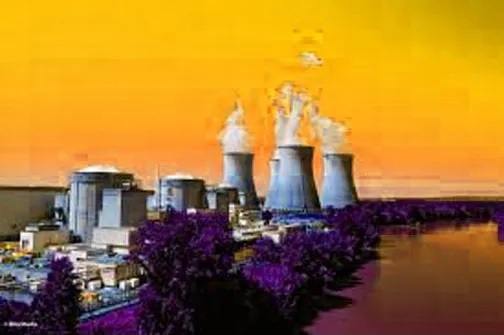
Inside a CANDU reactor there are three cooling circuits of water.
The “primary coolant” goes in a loop through the core of the reactor and it is filled with heavy water.
The “secondary coolant” goes in a loop through the “steam generator” (boiler) and it is made of ordinary “light” water.
The “tertiary coolant” is taken from the environment and returned to the environment at a hotter temperature Because it is used to “condense” the hot steam back into liquid water (all of it in the secondary loop).
Only 1/3 of the nuclear energy is turned into electrical energy. The other 2/3 is rejected back into the environment as “hot water” from the condenser. So 600 megawatts of electricity at Point Lepreau can only be achieved by dumping 1200 megawatts of heat into the environment.
However this has nothing to do with the use of heavy water.
The heavy water is all on the “nuclear side” of the generating station, not on the “conventional side” (where the Electricity is produced by using steam to turn the blades of a turbine to generate electricitiy.)
Beside the primary cooling loop being made of heavy water, the entire core of the reactor sits in a huge vessel called the “calandra” which is also filled with heavy water — this large inventory of heavy water is called the “moderator” and it is not used to cool the fuel, but simply to slow down (“moderate”) the speed of the neutrons
That are flying around inside the reactor core, splitting uranium atoms and releasing nuclear energy.
Heavy water molecules are a bit heavier than ordinary water molecules (H2O) because the hydrogen atoms (H) are twice as heavy as normal. These “heavy hydrogen” atoms are called DEUTERIUM (D). So heavy water is D2O instead of H2O. Deuterium is very hard to collect and so it is very expensive, but it is not radioactive. At Least, not to start with.
However, inside a CANDU reactor, some of those heavy hydrogen atoms D are transformed into radioactive Tritium atoms T. Tritium is a radioactive form of hydrogen. Each tritium atom T is three times heavier than a Normal hydrogen atom H, and these T atoms are UNSTABLE or RADIOACTIVE. That means they will all eventually “disintegrate” (explode) giving off harmful beta radiation.
Year after year, the concentration of tritium builds up higher and higher in the heavy water, and so in that sense the heavy water has become “radioactive”. It would be more correct to say that the heavy water has become radioactively contaminated by the build-up of tritium. Inevitable, some of that tritium gets out into the environment.
Tritium is released into the environment in the form of radioactive water molecules — as radioactive steam (Into the air) or radioactive liquid water (into the terrestrial environment.) Tritium is by far the biggest radioactive release from CANDU reactors into the environment, amounting to about 150-300 TRILLION becquerels per year from each operating CANDU reactor.
A becquerel denotes one radioactive disintegration every second, or 60 disintegrations each minute, 3600 disintegrations each hour, etc.) These “radioactive releases” are entirely separate from the “thermal (hot water) releases” discussed above.
Point Lepreau releases about 300 trillion becquerels of tritium annually. It is the worst tritium emitter in Canada.
No comments yet.
1 This Month

Petition to revoke the licensing of the Near Surface Nuclear Disposal Facility (NSDF) at Chalk River. https://www.ourcommons.ca/petitions/en/Petition/Details?Petition=e-7247


of the week – STOP SMALL MODULAR REACTORS IN CANADA
To see nuclear-related stories in greater depth and intensity – go to https://nuclearinformation.wordpress.com
-
Archives
- March 2026 (153)
- February 2026 (268)
- January 2026 (308)
- December 2025 (358)
- November 2025 (359)
- October 2025 (376)
- September 2025 (258)
- August 2025 (319)
- July 2025 (230)
- June 2025 (348)
- May 2025 (261)
- April 2025 (305)
-
Categories
- 1
- 1 NUCLEAR ISSUES
- business and costs
- climate change
- culture and arts
- ENERGY
- environment
- health
- history
- indigenous issues
- Legal
- marketing of nuclear
- media
- opposition to nuclear
- PERSONAL STORIES
- politics
- politics international
- Religion and ethics
- safety
- secrets,lies and civil liberties
- spinbuster
- technology
- Uranium
- wastes
- weapons and war
- Women
- 2 WORLD
- ACTION
- AFRICA
- Atrocities
- AUSTRALIA
- Christina's notes
- Christina's themes
- culture and arts
- Events
- Fuk 2022
- Fuk 2023
- Fukushima 2017
- Fukushima 2018
- fukushima 2019
- Fukushima 2020
- Fukushima 2021
- general
- global warming
- Humour (God we need it)
- Nuclear
- RARE EARTHS
- Reference
- resources – print
- Resources -audiovicual
- Weekly Newsletter
- World
- World Nuclear
- YouTube
-
RSS
Entries RSS
Comments RSS
 nuclear-news
Leave a comment