Indict US Secretary of State Antony Blinken

Why this petition matters
Started by Hazami Barmada
Antony Blinken, the current US Secretary of State, stands accused of violating US law to offer support to Israel’s genocide and crimes against humanity. US laws stipulate that aid should only be given to countries respecting human rights and principles of sovereignty. Disregarding such principles jeopardizes our commitment to international law and paves the way for grave violations of human rights. We need justice and transparency in our governance, especially from those in key positions such as the Secretary of State. This is why we demand the US Department of Justice investigate and indict Antony Blinken for lying to the American people, lying to Congress, and violating US and international law. A printed copy of the indictment will be delivered to the US Department of Justice in Washington DC on Friday, 10 January 2025………………………………………………………………………………….. more https://www.change.org/p/indict-us-secretary-of-state-antony-blinken?utm_medium=custom_url&utm_source=share_petition&recruited_by_id=28433280-b7dd-11eb-b0a6-b1a6e7634e2c
40 Years Ago: US President Jimmy Carter Pushed For Renewable Energy Funding After Three Mile Island Nuclear Disaster — Mining Awareness +

from 30 March 2019.

Probably because he knew so much about nuclear power from the US nuclear Navy; had helped clean-up the Chalk River Nuclear Disaster in Canada, while serving in the US Navy, and was US President during the Three Mile Island Nuclear Meltdown, Jimmy Carter tried to get massive investment in renewables research (NREL). He even had […]
Genocidal President, Genocidal Politics

The presidential genocide and the active acquiescence of the vast majority of Congress are matched by the dominant media and overall politics of the United States.
Jan 6, 2025, Norman Solomon, https://www.laprogressive.com/war-and-peace/genocidal-president?utm_source=LA+Progressive+NEW&utm_campaign=c01ae947cf-LAP+News+–+%288%29+18+NOVEMBER+2022_COPY_01&utm_medium=email&utm_term=0_61288e16ef-c01ae947cf-287023764&ct=t(EMAIL_CAMPAIGN_11_17_2022_10_46_COPY_01)&mc_cid=c01ae947cf&mc_eid=02629a6e14
Then news broke over the weekend that President Biden just approved an $8 billion deal for shipping weapons to Israel, a nameless official vowed that “we will continue to provide the capabilities necessary for Israel’s defense.” Following the reports last month from Amnesty International and Human Rights Watch concluding that Israeli actions in Gaza are genocide, Biden’s decision was a new low for his presidency.
It’s logical to focus on Biden as an individual. His choices to keep sending huge quantities of weaponry to Israel have been pivotal and calamitous. But the presidential genocide and the active acquiescence of the vast majority of Congress are matched by the dominant media and overall politics of the United States.
Forty days after the Gaza war began, Anne Boyer announced her resignation as poetry editor of the New York Times Magazine. More than a year later, her statement illuminates why the moral credibility of so many liberal institutions has collapsed in the wake of Gaza’s destruction.
While Boyer denounced “the Israeli state’s U.S.-backed war against the people of Gaza,” she emphatically chose to disassociate herself from the nation’s leading liberal news organization: “I can’t write about poetry amidst the ‘reasonable’ tones of those who aim to acclimatize us to this unreasonable suffering. No more ghoulish euphemisms. No more verbally sanitized hellscapes. No more warmongering lies.”
The acclimatizing process soon became routine. It was most crucially abetted by President Biden and his loyalists, who were especially motivated to pretend that he wasn’t really doing what he was really doing.
For mainline journalists, the process required the willing suspension of belief in a consistent standard of language and humanity. When Boyer acutely grasped the dire significance of its Gaza coverage, she withdrew from “the newspaper of record.”
Content analysis of the war’s first six weeks found that coverage by the New York Times, Washington Post and Los Angeles Times had a steeply dehumanizing slant toward Palestinians. The three papers “disproportionately emphasized Israeli deaths in the conflict” and “used emotive language to describe the killings of Israelis, but not Palestinians,” a study by The Intercept showed. “The term ‘slaughter’ was used by editors and reporters to describe the killing of Israelis versus Palestinians 60 to 1, and ‘massacre’ was used to describe the killing of Israelis versus Palestinians 125 to 2. ‘Horrific’ was used to describe the killing of Israelis versus Palestinians 36 to 4.”
After a year of the Gaza war, Arab-American historian Rashid Khalidi said: “My objection to organs of opinion like the New York Times is that they see absolutely everything from an Israeli perspective. ‘How does it affect Israel, how do the Israelis see it?’ Israel is at the center of their worldview, and that’s true of our elites generally, all over the West. The Israelis have very shrewdly, by preventing direct reportage from Gaza, further enabled that Israelocentric perspective.”
Khalidi summed up: “The mainstream media is as blind as it ever was, as willing to shill for any monstrous Israeli lie, to act as stenographers for power, repeating what is said in Washington.”
The conformist media climate smoothed the way for Biden and his prominent rationalizers to slide off the hook and shape the narrative, disguising complicity as evenhanded policy. Meanwhile, mighty boosts of Israel’s weapons and ammunition were coming from the United States. Nearly half of the Palestinians they killed were children.
For those children and their families, the road to hell was paved with good doublethink. So, for instance, while the Gaza horrors went on, no journalist would confront Biden with what he’d said at the time of the widely decried school shooting in Uvalde, Texas, when the president had quickly gone on live television. “There are parents who will never see their child again,” he said, adding: “To lose a child is like having a piece of your soul ripped away. . . . It’s a feeling shared by the siblings, and the grandparents, and their family members, and the community that’s left behind.” And he asked plaintively, “Why are we willing to live with this carnage? Why do we keep letting this happen?”
The massacre in Uvalde killed 19 children. The daily massacre in Gaza has taken the lives of that many Palestinian kids in a matter of hours.
While Biden refused to acknowledge the ethnic cleansing and mass murder that he kept making possible, Democrats in his orbit cooperated with silence or other types of evasion. A longstanding maneuver amounts to checking the box for a requisite platitude by affirming support for a “two-state solution.”
Dominating Capitol Hill, an unspoken precept has held that Palestinian people are expendable as a practical political matter. Party leaders like Senator Chuck Schumer and Representative Hakeem Jeffries did virtually nothing to indicate otherwise. Nor did they exert themselves to defend incumbent House Democrats Jamaal Bowman and Cori Bush, defeated in summer primaries with an unprecedented deluge of multimillion-dollar ad campaigns funded by AIPAC and Republican donors.
The overall media environment was a bit more varied but no less lethal for Palestinian civilians. During its first several months, the Gaza war received huge quantities of mainstream media coverage, which thinned over time; the effects were largely to normalize the continual slaughter. Some exceptional reporting existed about the suffering, but the journalism gradually took on a media ambience akin to background noise, while credulously hyping Biden’s weak ceasefire efforts as determined quests.
Prime Minister Benjamin Netanyahu came in for increasing amounts of criticism. But the prevalent U.S. media coverage and political rhetoric — unwilling to expose the Israeli mission to destroy Palestinians en masse — rarely went beyond portraying Israel’s leaders as insufficiently concerned with protecting Palestinian civilians.
Instead of candor about horrific truths, the usual tales of U.S. media and politics have offered euphemisms and evasions.
When she resigned as the New York Times Magazine poetry editor in mid-November 2023, Anne Boyer condemned what she called “an ongoing war against the people of Palestine, people who have resisted through decades of occupation, forced dislocation, deprivation, surveillance, siege, imprisonment, and torture.” Another poet, William Stafford, wrote decades ago:
I call it cruel and maybe the root of all cruelty
to know what occurs but not recognize the fact.
Japanese yakuza leader pleads guilty to trafficking nuclear materials from Myanmar
US authorities charged Takeshi Ebisawa with conspiring to traffic nuclear materials from Myanmar for expected use by Iran in nuclear weapons, handling nuclear material sourced from Myanmar and seeking to sell it to fund an illicit arms deal, US authorities have said.
Yakuza leader Takeshi Ebisawa and a co-defendant had previously been charged in April 2022 with drug trafficking and firearms offences, and both were remanded.
He was then additionally charged in February 2024 with conspiring to sell weapons-grade nuclear material and lethal narcotics from Myanmar, and to purchase military weaponry on behalf of an armed insurgent group, prosecutors said.
The military weaponry to be part of the arms deal included surface-to-air missiles, the indictment alleged.
“As he admitted in federal court today, Takeshi Ebisawa brazenly trafficked nuclear material, including weapons-grade plutonium, out of Burma,” acting US attorney Edward Kim said on Wednesday, using another name for Myanmar.
“At the same time, he worked to send massive quantities of heroin and methamphetamine to the United States in exchange for heavy-duty weaponry such as surface-to-air missiles to be used on battlefields in Burma.”
Prosecutors alleged that Ebisawa, 60, “brazenly” moved material containing uranium and weapons-grade plutonium, alongside drugs, from Myanmar.
From 2020, Ebisawa boasted to an undercover officer he had access to large quantities of nuclear materials that he sought to sell, providing photographs of materials alongside Geiger counters registering radiation.
During a sting operation including undercover agents, Thai authorities assisted US investigators in seizing two powdery yellow substances that the defendant described as “yellowcake.”
“The (US) laboratory determined that the isotope composition of the plutonium found in the Nuclear Samples is weapons-grade, meaning that the plutonium, if produced in sufficient quantities, would be suitable for use in a nuclear weapon,” the Justice Department said in its statement at the time.
One of Ebisawa’s co-conspirators claimed they “had available more than 2,000 kilograms (4,400 pounds) of Thorium-232 and more than 100 kilograms of uranium in the compound U3O8 – referring to a compound of uranium commonly found in the uranium concentrate powder known as ’yellowcake’.”
The indictment claimed Ebisawa had suggested using the proceeds of the sale of nuclear material to fund weapons purchases on behalf of an unnamed ethnic insurgent group in Myanmar.
Ebisawa faces up to 20 years’ imprisonment for the trafficking of nuclear materials internationally.
Prosecutors describe Ebisawa as a “leader of the Yakuza organised crime syndicate, a highly organised, transnational Japanese criminal network that operates around the world (and whose) criminal activities have included large-scale narcotics and weapons trafficking.”
Sentencing will be determined by the judge in the case at a later date, prosecutors said.
Schneider Electric warns of future where datacenters eat the grid.
Report charts four scenarios from ‘Sustainable AI’ to ‘Who Turned Out The Lights?’
The Register, Dan Robinson, Thu 2 Jan 2025
Policymakers need to carefully guide the future consumption of electricity by AI datacenters, according to a report that considers four potential scenarios and suggests a number of guiding principles to prevent it from spiraling out of control.
The research published by energy infrastructure biz Schneider Electric follows the IEA Global Conference on Energy & AI last month. Titled Artificial Intelligence and Electricity: A System Dynamics Approach, it looks at the emerging schools of thought relating to AI and the associated impact on electricity consumption.
Much has already been reported on the rise of AI, and especially generative AI, which has led to huge investment in high-performance and power-hungry infrastructure for the purposes of developing and training models.
As the report notes, existing datacenter infrastructure requires significant energy to function, and will need extra resources to support the anticipated growth in AI adoption. This has already been causing concerns about the potential strain on electricity grids and the possible environmental impact if energy demand to power AI continues to rise at its current rate.
Schneider has modeled four distinct scenarios, which it has labeled as: Sustainable AI; Limits To Growth; Abundance Without Boundaries; and Energy Crisis. All four forecast a general upward trend in energy consumption for the period 2025 to 2030, but diverge notably after this based on the assumptions underpinning each one.
Sustainable AI looks at the potential outcome of prioritizing efficiency while energy consumption steadily increases, whereas Limits To Growth outlines a constrained path where AI development hits natural or human-related limits. Abundance Without Boundaries considers the potential risks of unchecked growth, while the Energy Crisis scenario examines how mismatched energy demand and generation would potentially lead to widespread shortages…………………………………….
The Abundance Without Boundaries scenario indicates that the rapid and unrestrained development of AI systems poses the risk of a continual arms race towards bigger and more powerful infrastructure, outpacing the capacity for sustainable resource utilization.
Schneider forecasts total AI energy consumption to rise enormously from the 100 TWh in 2025 to 880 TWh by 2030, continuing on an upwards trajectory and reaching a staggering 1,370 TWh in 2035.
This scenario displays the Jevons Paradox, where improvements in AI efficiency paradoxically lead to increased overall energy consumption. It forecasts that AI and datacenters will expand without barriers, as techno-optimists drive rapid AI deployment across all sectors, believing that AI advances will solve any resource constraints.
Finally, the Energy Crisis model foresees the rapid growth of AI leading to its energy demands conflicting with other critical sectors of the economy. This triggers various negative outcomes, including economic downturns and severe operational challenges for AI-dependent industries…………………………………………………………………………
…………………………… The overall message is that governments and industry leaders need to strategically plan to balance AI growth with environmental and economic sustainability. Whether they do so is another matter. https://www.theregister.com/2025/01/02/schneider_datacenter_consumption/?fbclid=IwY2xjawHq2YVleHRuA2FlbQIxMQABHVfvIFP2K80qCEymVUJTwNLMHze1xPomN5JWt_BJUqcjsnJ4ok3ufW7j4A_aem_xPDDvZ99rni2Twb5uri1Tg
—
World’s climate fight needs fundamental reform, UN expert says: ‘Some states are not acting in good faith’

Nina Lakhani, climate justice reporter, Guardian 7th Jan 2025
The international effort to avert climate catastrophe has become mired by misinformation and bad faith actors, and must be fundamentally reformed, according to a leading UN climate expert.
Elisa Morgera, the UN special rapporteur on climate change, said the annual UN climate summits and the consensus-based, state-driven process is dominated by powerful forces pushing false narratives and by tech fixes that divert attention from real, equitable solutions for the countries least responsible and most affected.
“The current climate regime was built in a way, maybe unconsciously, that locked in an ineffective approach that is blind to the disproportionate harms of climate change – and increasingly climate solutions – and the disproportionate benefits that the current situation is accruing to very few states and very few individuals,” said Morgera, in an exclusive interview with the Guardian.
“We can observe that some states are not acting in good faith in very clear ways, which is the basis of any international regime. There is widespread disregard for the rule of international law, and also a very clear pushback on the science, and shrinking of civil spaces at all levels. Basically, the truth is out of the conversation. That is the problem – there is no space at Cop for the truth,” said Morgera.
“Fundamental reform is possible, if there is a willingness by the states and the secretariat, but it’s hard to see that at the moment.”
Special rapporteurs are independent human rights experts appointed by the UN to investigate, report on and advise on specific themes or countries.
The annual UN climate summit, known as the conference of the parties, or Cop, is where states who are signed up to the principal climate treaty, the United Nations Framework Convention on Climate Change (UNFCCC), come together to make consensus-based decisions on climate action. The 2015 Paris agreement, negotiated at Cop21, requires all states to reduce greenhouse gas emissions to help curtail global heating.
But Cop has limited scope for Indigenous experts or ordinary people with lived experience and evidence of climate effects and culturally driven local solutions to participate in the negotiations in any meaningful way – which Morgera argues is among the major weaknesses that could be fixed.
She said: “The dominating assumption in the current process assumes that mass behavioral change is the solution, that this is as much a consumer issue as a production issue – which is a misrepresentation of the causes and the solutions. We’re still not looking at deep, systemic inequalities as the root causes, while also entrenching inequities and worsening negative human rights impacts of climate change – and climate solutions.”
Morgera, a professor of global environmental law at the University of Strathclyde in Glasgow, said: “This is not a blanket condemnation of the whole regime, but if the experiences and evidence of what climate change is doing around the world and how it is affecting people in differentiated ways is not made central to the decision-making, then it’s really hard to see how this process can meaningfully contribute.”
Open sessions should be the norm at Cop – and Indigenous people, UN agencies and others from civil society with different knowledge systems and evidence should be able to make textual suggestions for states to consider in real time, Morgera says. The UNFCCC could also ensure total transparency over corporate interests including the thousands of fossil-fuel, big ag and plastics lobbyists who participate in the annual climate summits, she argues.
After almost three decades, the UN climate summits have failed to come up with a meaningful, fair agreement or plan to transition away from oil, gas and coal – despite overwhelming scientific evidence that this must be done to avoid climate catastrophe. As fossil-fuel expansion continues apace, hopes of keeping global heating to below 1.5C above pre-industrialization levels have been all but crushed…………………………………………………………………………………………………………. https://www.theguardian.com/environment/ng-interactive/2025/jan/07/climate-change-reform-elisa-morgera
Climate crisis ‘wreaking havoc’ on Earth’s water cycle, report finds
Global heating is supercharging storms, floods and droughts, affecting entire ecosystems and billions of people
The climate crisis is “wreaking havoc” on the planet’s water cycle,
with ferocious floods and crippling droughts affecting billions of people,
a report has found.
Water is people’s most vital natural resource but
global heating is changing the way water moves around the Earth. The
analysis of water disasters in 2024, which was the hottest year on record,
found they had killed at least 8,700 people, driven 40 million from their
homes and caused economic damage of more than $550bn (£445bn).
Rising temperatures, caused by continued burning of fossil fuels, disrupt the
water cycle in multiple ways. Warmer air can hold more water vapour,
leading to more intense downpours. Warmer seas provide more energy to
hurricanes and typhoons, supercharging their destructive power. Global
heating can also increase drought by causing more evaporation from soil, as
well as shifting rainfall patterns.
Guardian 6th Jan 2025
https://www.theguardian.com/world/2025/jan/06/climate-crisis-wreaking-havoc-on-earths-water-cycle-report-finds
What a second Trump administration may mean for the Saudi nuclear program
By Nour Eid | Bulletin of Atomic Scientists 6th Jan 2025
Donald Trump’s return to the White House could mean the end of the
nonproliferation regime: As the Iranian-Israeli confrontation intensifies,
and the threat of an Iranian nuclear breakout looms, the Kingdom of Saudi
Arabia could see in a second Trump administration an opportunity to finally
get the nuclear cooperation the Saudis have been yearning for.
The Saudis argue that it is their right, under the Treaty on the Non-Proliferation of
Nuclear Weapons (NPT), to enrich uranium for domestic energy purposes. They
refuse to be subjected to double standards, given that India and Japan
received “blanket consents” to seek enrichment or reprocessing
capabilities under their respective 123 agreements.
Adding insult to injury, in Saudi eyes: Its main rival, Iran, was allowed to enrich uranium
under the 2015 Joint Comprehensive Plan of Action (JCPOA), also known as
the Iran nuclear deal. The Saudis aim to benefit from the same privileges
by developing an indigenous nuclear program………………………………………………….. https://thebulletin.org/2025/01/what-a-second-trump-administration-may-mean-for-the-saudi-nuclear-program/
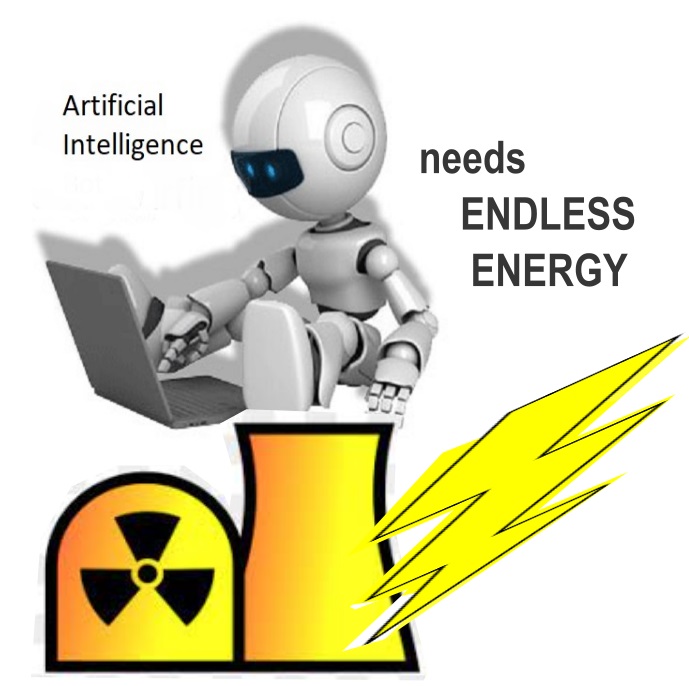
Deep Fission to supply Endeavour data centers with 2GW of nuclear energy from “mile-deep” SMR
The first reactors are expected to come online in 2029
DCD, January 07, 2025 By Zachary Skidmore
Deep Fission, a small modular nuclear reactor (SMR) developer, has partnered with Endeavour Energy, a US sustainable infrastructure developer, to develop and deploy its technology at scale.
As per the agreement, the partners have committed to co-developing 2GW of nuclear energy to supply Endeavour’s global portfolio of data centers which operate under the Endeavour Edged brand. The first reactors are expected to be operational by 2029.
The Deep Fission Borehole Reactor 1 (DFBR-1) is a pressurized water reactor (PWR) that produces 15MWt (thermal) and 5MWe (electric) and has an estimated fuel cycle of between ten to 20 years…………………………………
Deep Fission plans to release white papers throughout the regulatory approval process for discussion direction on key issues surrounding the SMR………………………………..
Based in Berkley, California, Deep Fission was founded in 2023. In August last year, it announced a $4 million pre-seed funding round to accelerate efforts in hiring, regulatory approval, and the commercialization of its SMR.
Edged, Endeavour’s data center arm, will be the primary beneficiary of the power produced by DFBR-1.
The company, which was formed in 2021, has data centers across the US and the Iberian peninsula, with facilities in operation or development in Madrid, Barcelona, Lisbon, and across the US, including Missouri, Arizona, Texas, Georgia, Iowa, Ohio, and Illinois.
The company specializes in data centers built for high-density artificial intelligence, which utilize a waterless cooling system…………………….. https://www.datacenterdynamics.com/en/news/deep-fission-to-supply-endeavour-data-centers-with-2gw-of-nuclear-energy-from-mile-deep-smr/
1 This Month

Petition to revoke the licensing of the Near Surface Nuclear Disposal Facility (NSDF) at Chalk River. https://www.ourcommons.ca/petitions/en/Petition/Details?Petition=e-7247


of the week – STOP SMALL MODULAR REACTORS IN CANADA
To see nuclear-related stories in greater depth and intensity – go to https://nuclearinformation.wordpress.com
-
Archives
- March 2026 (153)
- February 2026 (268)
- January 2026 (308)
- December 2025 (358)
- November 2025 (359)
- October 2025 (376)
- September 2025 (258)
- August 2025 (319)
- July 2025 (230)
- June 2025 (348)
- May 2025 (261)
- April 2025 (305)
-
Categories
- 1
- 1 NUCLEAR ISSUES
- business and costs
- climate change
- culture and arts
- ENERGY
- environment
- health
- history
- indigenous issues
- Legal
- marketing of nuclear
- media
- opposition to nuclear
- PERSONAL STORIES
- politics
- politics international
- Religion and ethics
- safety
- secrets,lies and civil liberties
- spinbuster
- technology
- Uranium
- wastes
- weapons and war
- Women
- 2 WORLD
- ACTION
- AFRICA
- Atrocities
- AUSTRALIA
- Christina's notes
- Christina's themes
- culture and arts
- Events
- Fuk 2022
- Fuk 2023
- Fukushima 2017
- Fukushima 2018
- fukushima 2019
- Fukushima 2020
- Fukushima 2021
- general
- global warming
- Humour (God we need it)
- Nuclear
- RARE EARTHS
- Reference
- resources – print
- Resources -audiovicual
- Weekly Newsletter
- World
- World Nuclear
- YouTube
-
RSS
Entries RSS
Comments RSS
 nuclear-news