TODAY. The polar playground for a suicidal species?
https://theaimn.net/the-polar-playground-for-a-suicidal-species/ 7 January 25
Where to begin on this mind-boggling story about epic changes on a very small planet?
Well, let’s begin on the fun part. The Australian Antarctic Program encourages some pretty innocuous recreational activities, plus of course, encouragement for tourists to come, and to learn about the polar world. So that’s OK, I suppose. But lately, in the news, there is growing concern that tourists, Australians in particular, are taking such a playful attitude to Antarctica, that they are risking their personal safety.
Interesting that the video above puts the blame on TikTok for encouraging the fun and danger. But tourism itself is good for increasing education about Antarctica. As long as individuals personally behave safely, that’s fine, isn’t it?
But what about planetary safety?
What Australians, and most of the world, learn about Antarctica, is that it’s pretty, and has penguins, Oh, and the ice is melting a bit, too. And that’s about it. The media does not trouble our complacent little minds with information about the thermohaline ocean circulation, the atmospheric circulation patterns, the carbon-sequestration of krill, the polar vortex…. Much too hard for us, in this cricket-tennis season.
Right now, Northern Europe and parts of the USA are experiencing extreme cold weather. No doubt some people would say that this disproves global heating, climate change. Alas, these extremes, emanating from the Arctic, by the polar vortex, are exacerbated by global heating. The polar vortex is a complex system, difficult to grasp, for the average news reader, so it is part of the whole poorly known, global climate system.
Antarctica is at the other end of the world – not connected to all this? Well, not if you ignore the global thermohaline circulation, among other things like sea level rise.
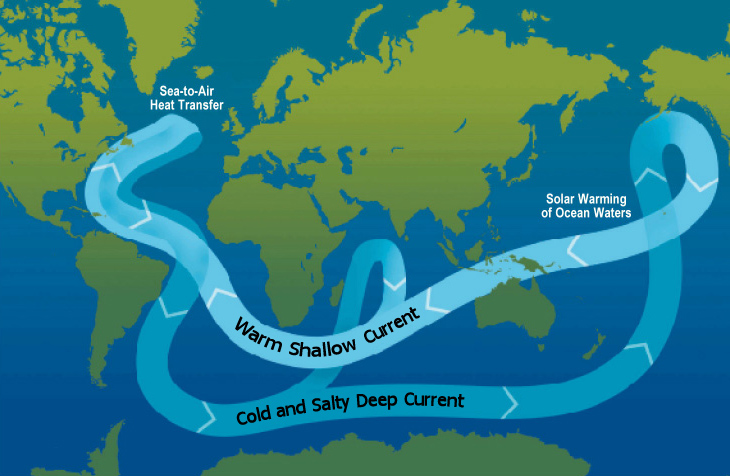
Global thermohaline circulation
Professor Elisabeth Leane, Professor of Antarctic Studies at the University of Tasmania says – What happens in Antarctica doesn’t stay in Antarctica. Its future will shape the future of the planet
Which brings me to the question of safety in relation to Antarctica – planetary, not just personal.
And here’s what the University of Tasmania says about it – Antarctica’s tipping points threaten global climate stability.
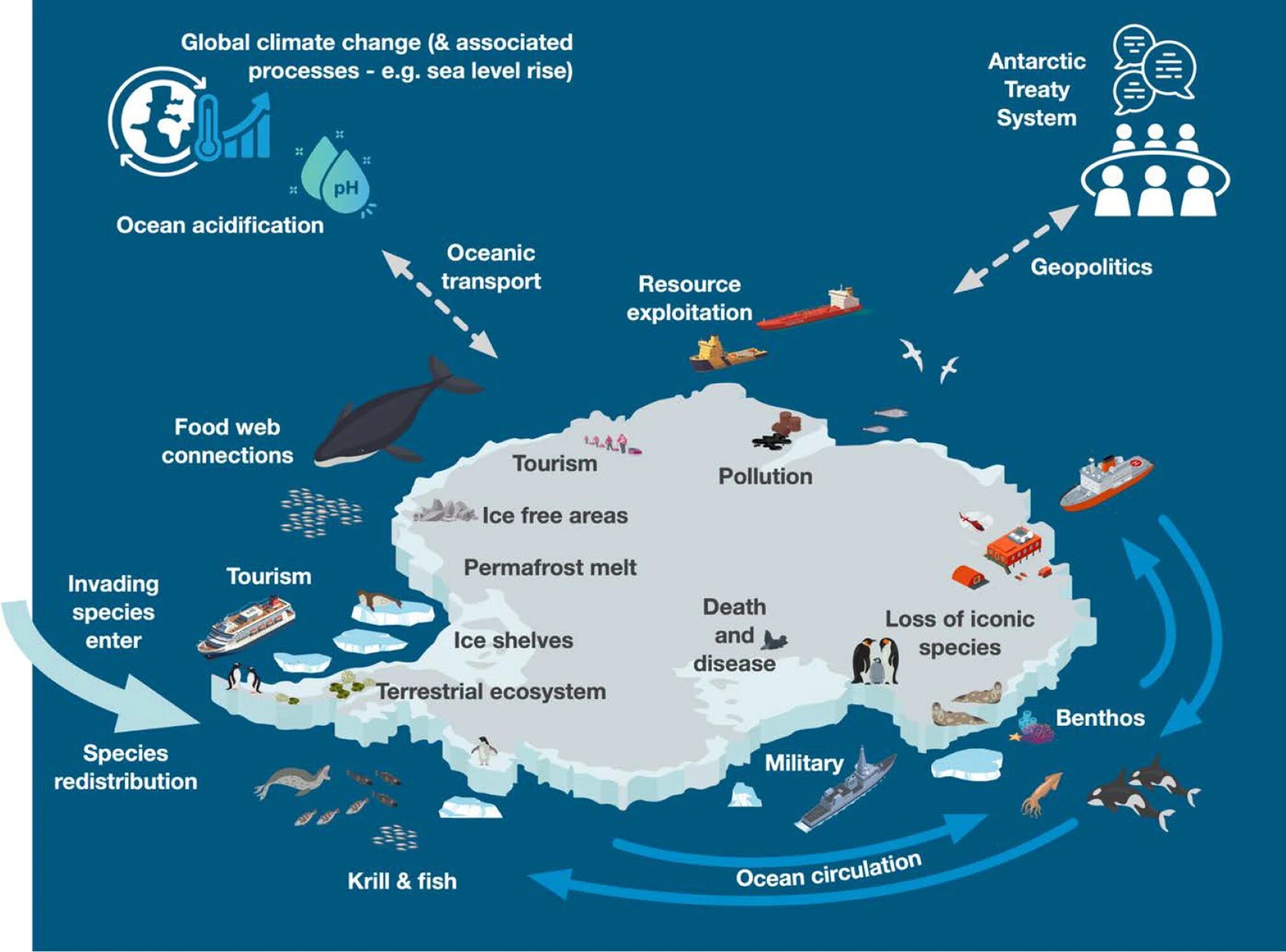
The map above is from the University of Tasmania’s report by international climate scientists . It identifies the various cascading tipping points and their interactions and pressures on the ecosystem.
For those who care about the climate change issue, and about Australia and the Antarctic, I would urge them to watch, and persist with, this brilliant report by climate researcher Paul Beckwith – https://www.youtube.com/watch?v=6WccDhnM8R8
Beckwith explains the potential tipping points identified by the study and their interrelationships , and adds the issue of sea ice loss. Critical issues are ice sheets, ocean acidification, ocean circulation, species redistribution, invasive species, permafrost melting, local pollution, chemical impacts, social impacts, local pollution and the Antarctic Treaty System. He goes on to explain with excellent graphics, the global thermohaline circulation, and then, in-depth, the records on sea ice, and then on to his detailed study on the tiny krill or light shrimp, and their global importance. Finally, Beckwith outlines the politics, the various national claims in the Antarctic Treaty System. The scientists’ conclusion – the urgent need for action on climate. Heavy stuff. Fascinating stuff. He finishes with a reminder of the unique role of that amazing critter the krill.
If you want a more concise discussion of the University of Tasmania’s December remarkable workshop of international marine scientists – go to Radio Ecoshock – World-changing Tipping Points – In Antarctica !
The “mainstream media” rarely covers climate change in any depth. For decades, the public has been informed very superficially on this life and death matter for our survival. The dedicated scientists produce their research results, but the media seem to find these too difficult, or too “political” to bother to report on them properly. The December 2024 “emergency summit” of international polar scientists in Tasmania barely got a mention in the Australian or international press.
You have to go to alternative media, to get any real insight into what is happening to the climate of our planet home. For decades now, Paul Beckwith has being producing his highly informative and wonderfully illustrated videos, on Youtube. Meanwhile Alex Smith has been doing the same sort of thing on radio and podcast, and print, – on Radio Ecoshock, which is heard in Australia on Community Radio 3CR.
In 2025, it is ever more urgent for people to wade through the morass of “social” media, and corporate media, and “alternative” media, to find the facts on climate change. Paul Beckwith and Radio Ecoshock are two examples of a rare and endangered human species – journalists who do their homework on climate change.
An overlooked Supreme Court case could decide the future of nuclear power

Miles Mogulescu, 6 Dec 24, https://beyondnuclearinternational.org/2025/01/05/a-double-edged-sword-of-damocles/
Although barely mentioned in the mainstream media, in granting cert to Interim Storage Partners, LLC v. Texas, a case about the storage of spent radioactive fuel from nuclear power plants, the U.S. Supreme Court may have taken on potentially the most consequential case of its new term.
SCOTUS will decide whether or not to uphold a Fifth Circuit decision that the Nuclear Regulatory Commission (NRC) does not have the legal power to license a private corporation to construct an off-site storage facility to hold deadly radioactive waste from nuclear power plants.
Depending on the legal rationale for SCOTUS’ decision, it could further enhance the power of courts to overturn decisions of regulatory agencies.
The case could determine whether artificial intelligence companies like Microsoft and Google can build a new generation of nuclear power plants to service the voracious hunger of artificial intelligence for electricity. Depending on its rationale, it could also impact the ability of regulatory agencies to function efficiently without being second guessed by courts.
The issues in the case have brought together an unlikely coalition of environmentalists, Texas Republicans, New Mexico Democrats, and the oil and gas industry against an equally unlikely grouping of the Biden administration, the nuclear power industry, and AI tech companies like Microsoft and Google.
The Legal Substance Issues
The environmental and legal issues in the case have a long history. The nuclear power industry has accumulated nearly 100,000 metric tons of radioactive waste that need to be deposited in a place that could be safe for millions of years. Most of the waste is now stored in temporary facilities adjacent to the power plants that create them, but such sites are running out of space and may not be safe long-term. During the 1980s Congress passed and amended the Nuclear Waste Policy Act providing for a permanent waste site and then designating Yucca Mountain, Nevada as the sole site. But plans for the site were abandoned due to environmental and political opposition, leaving no permanent site for disposable nuclear waste.
In response, for the first time the Nuclear Regulatory Commission began to grant licenses for “interim” storage facilities which were off-site (and often hundreds of miles away) from the power plants which generated the waste, claiming authority under the Atomic Energy Act. One such license was for an off-site storage facility in the Permian Basin, Texas. Texas Republican Attorney General Ken Paxton and a private oil and gas company sued, claiming that the federal government lacked the statutory authority to issue a license for interim off-site storage.
The conservative Fifth Circuit agreed with the plaintiffs, opining “Texas is correct. The Atomic Energy Act does not confer on the commission the broad authority it claims to issue licenses for private parties to store spent nuclear fuel away-from-the-reactor. And the Nuclear Waste Policy Act establishes a comprehensive statutory scheme for dealing with nuclear waste generated from commercial nuclear power generation, thereby foreclosing the commission’s claim of authority.”
The Fifth Circuit vacated the license. The U.S. Supreme Court just granted cert and will hear the case this term. Its decision will likely be highly consequential, both for environmental and AI development reasons, and for legal reasons.
Environmentally, the building of new nuclear power plants has been stalled for decades, both because of cost and because of environmental catastrophes like Three Mile Island, Chernobyl, and Fukushima and anti-nuclear films like Mike Nichols’ Silkwood starring Meryl Streep.
The Role of High-Tech Companies in Expanding Nuclear for AI
But largely under the radar, the voracious demand for electricity to power AI is leading top high-tech companies like Microsoft and Google to reinvigorate nuclear energy. Goldman Sachs analysts say it takes nearly 10 times the energy to power a ChatGPT than a Google search—data center power center demand will grow by 160% in the next five years. Morgan Stanley projects global data center emissions to accumulate 2.5 billion metric tons carbon-dioxide equivalent by then.
Microsoft has contracted for the currently mothballed Three Mile Island plant to reopen and access its entire output for Microsoft’s data centers. The operator is seeking hundreds of millions in tax breaks from the federal government under President Joe Bidens’s Inflation Reduction Act, which it says are necessary to make the reopening economically feasible. Energy Secretary Jennifer Granholm has said in the past that federal subsidies could cut the cost of bringing a new plant online by as much as half.
In March an Amazon affiliate purchased a nuclear-powered data center in Pennsylvania for $650 million.
It will be highly consequential if SCOTUS simply upholds the Fifth Circuit’s result, which would greatly slow high tech’s attempts to kick start nuclear power without time to reexamine the environmental dangers.
Google has already announced that it will support building seven small nuclear-power reactors in the U.S., to help power its growing appetite for electricity for AI and jump-start a U.S. nuclear revival.
The tech companies claim that reviving nuclear power will decrease CO2 emissions and help with global climate change. But they ignore the long-standing warnings of environmentalists of the potentially catastrophic dangers of nuclear power.
If SCOTUS upholds the Fifth Circuit decision outlawing the licensing of off-site nuclear waste dumps, it could considerably slow the renewed push for nuclear power, particularly by high-tech companies. That might give more time to evaluate the potential dangers of widespread renewal of nuclear power.
But depending on the legal rationale for SCOTUS’ decision, it could further enhance the power of courts to overturn decisions of regulatory agencies.
The Fifth Circuit used several rationales to block the license of temporary off-site nuclear waste facilities. The first, and least concerning, is its statutory holding that the Atomic Energy Act is “unambiguous” and “nowhere authorizes issuance of a materials license to possess spent nuclear fuel for any reason, let alone for the sole purpose of storing such material in a standalone facility.” If SCOTUS upholds the Fifth Circuit purely on statutory interpretation grounds, it would create few problematic precedents for regulatory agencies in general.
The Major Questions Doctrine
But the Fifth Circuit unnecessarily went further, holding that “even if the statutes were ambiguous, the [government’s] interpretation would not be entitled to deference by the courts” pursuant to the Chevron Doctrine, under which for previous decades, until recently rejected by the Roberts Court, judges deferred to the expertise of regulatory agencies when reasonably interpreting ambiguous statutes.
The Fifth Circuit cited SCOTUS’ precedent-setting 2022 decision in West Virginia v. EPA, in which, for the first time, a conservative majority of SCOTUS justices relied on the “major questions” doctrine to overturn a major Environmental Protection Agency rule. Under the newly invented “major questions” doctrine, SCOTUS ruled that courts should not defer to agencies on matters of “vast economic or political significance” unless the U.S. Congress has explicitly given the agencies the authority to act in those situations.
Citing West Virginia v. EPA, the Fifth Circuit held that “[D]isposal of nuclear energy is an issue of vast ‘economic and political significance.’ What to do with the nation’s ever-growing accumulation of nuclear waste is a major questions that—as the history of the Yucca Mountain repository shows—has been hotly contested for over half a century.”
It’s questionable whether the Fifth Circuit needed to reach the issues concerning the major questions doctrine in order to block the waste depository. It had already decided that the statutes were “unambiguous” and therefore it was not necessary to decide what would happen if they were “ambiguous,” which is the only situation in which the major questions doctrine might arguably apply. If SCOTUS wants to affirm the Fifth Circuit’s result, it can simply agree that the statutes were unambiguous and treat the parts of the decision involving the major questions doctrine as mere dicta. That would set no additional precedent for when courts can question the expertise of regulatory agencies.
What Party Has the Right to Sue?
There’s also a procedural issue in the case, that depending on SCOTUS’ rationale, could set precedent allowing a wider range of entities to legally challenge regulatory agency decisions. Under the Hobbs Act, a “party aggrieved” by an agency’s final order may seek judicial review in a federal appeals court.
The NRC argued, however, that the plaintiffs were not parties aggrieved by the NRC’s licensing order because they were not parties to the underlying administrative proceeding. The Fifth Circuit cited its own precedent asserting that the Hobbs Act contains an “ultra vires” exception to the party aggrieved requirement when the petitioner attacks the agency action as exceeding its authority and therefore the plaintiffs had a right to sue.
In granting cert SCOTUS agreed to rule on two questions. First is the substance issue on whether the government exceeded its authority in granting the off-site nuclear storage license. The second is the procedural issue of whether an allegation of ultra vires can override statutory limitations on jurisdiction, as the Fifth Circuit held. If SCOTUS rules that the Fifth Circuit was wrong to grant jurisdiction to the plaintiffs, the likely result would be that the licenses for off-site nuclear waste facilities would go forward and expand.
It will be highly consequential if SCOTUS simply upholds the Fifth Circuit’s result, which would greatly slow high tech’s attempts to kick start nuclear power without time to reexamine the environmental dangers. At the same time, if SCOTUS also rules that the plaintiffs had an ultra vires right to sue, it could further cripple the ability of regulatory agencies to act to protect the public interest under broad grants of power.
Miles Mogulescu is an entertainment attorney/business affairs executive, producer, political activist and writer.
Could AI soon make dozens of billion-dollar nuclear stealth attack submarines more expensive and obsolete?
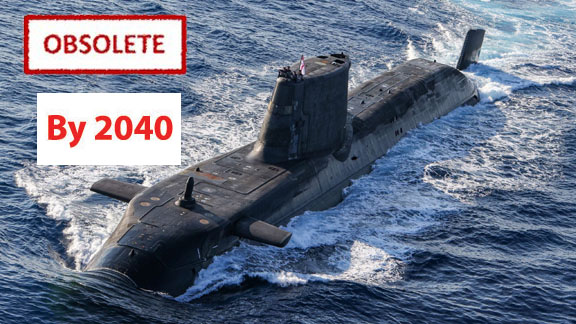
By Wayne Williams, 5 Jan 25, https://www.techradar.com/pro/could-ai-soon-make-dozens-of-billion-dollar-nuclear-stealth-attack-submarines-more-expensive-and-obsolete
Artificial intelligence can detect undersea movement better than humans.
AI can process far more data from a far more sensors than human operators can ever achieve
But the game of cat-and-mouse means that countermeasures do exist to confuse AI
Increase in compute performance and ubiquity of always-on passive sensors need also be accounted for.
The rise of AI is set to reduce the effectiveness of nuclear stealth attack submarines.
These advanced billion-dollar subs, designed to operate undetected in hostile waters, have long been at the forefront of naval defense. However, AI-driven advancements in sensor technology and data analysis are threatening their covert capabilities, potentially rendering them less effective.
An article by Foreign Policy and IEEE Spectrum now claims AI systems can process vast amounts of data from distributed sensor networks, far surpassing the capabilities of human operators. Quantum sensors, underwater surveillance arrays, and satellite-based imaging now collect detailed environmental data, while AI algorithms can identify even subtle anomalies, such as disturbances caused by submarines. Unlike human analysts, who might overlook minor patterns, AI excels at spotting these tiny shifts, increasing the effectiveness of detection systems.
Game of cat-and-mouse
AI’s increasing role could challenge the stealth of submarines like those in the Virginia-class, which rely on sophisticated engineering to minimize their detectable signatures.
Noise-dampening tiles, vibration-reducing materials, and pump-jet propulsors are designed to evade detection, but AI-enabled networks are increasingly adept at overcoming these methods. The ubiquity of passive sensors and continuous improvements in computational performance are increasing the reach and resolution of these detection systems, creating an environment of heightened transparency in the oceans.
Despite these advances, the game of cat-and-mouse persists, as countermeasures are, inevitably, being developed to outwit AI detection.
These tactics, as explored in the Foreign Policy and IEEE Spectrum piece, include noise-camouflaging techniques that mimic natural marine sounds, deploying uncrewed underwater vehicles (UUVs) to create diversions, and even cyberattacks aimed at corrupting the integrity of AI algorithms. Such methods seek to confuse and overwhelm AI systems, maintaining an edge in undersea warfare.
As AI technology evolves, nations will need to weigh up the escalating costs of nuclear stealth submarines against the potential for their obsolescence. Countermeasures may provide temporary degree of relief, but the increasing prevalence of passive sensors and AI-driven analysis suggests that traditional submarine stealth is likely to face diminishing returns in the long term.
First Nations chiefs shouldn’t be duped by ‘nuclear-is-green’ deception
Commentary
by William Eric Altvater, January 6, 2025, : https://nbmediacoop.org/2025/01/06/first-nations-chiefs-shouldnt-be-duped-by-nuclear-is-green-deception/
Some First Nation Chiefs are victims of shenanigans, not unlike the swindle behind the purchase of Manhattan. The federal government needs the support of Indigenous peoples to expand nuclear power generation capacity in Canada.
For millennia, the cornerstones of the Indigenous people that inhabit Turtle Island, now known as North America, held all that is essential to life, in reverence. Every decision considered the next 7 generations. These cornerstones are crumbling.
Newcomers, armed with the Colonizing tool, “The Doctrine of Discovery” and their mentality of superiority, invaded the land of those they called “Savages,” almost totally exterminating Skicinuwok, People of The Earth.
Determined to bestow Christianity and civility to this wild untamed population, old growth forests were cut, rivers and streams were dammed to power sawmills, roads and railroads were built, bridges erected. All to create an infrastructure for capitalism, a system to make a profit, that morphed into greed, a word of foreign root. This unbridled desire for progress has ruined what was once called Paradise.
Now most water is not fit to drink, clean air is scarce, deforestation is rampant, biodiversity loss out of control, plants genetically modified, food manufactured with unpronounceable chemicals, caged fish starved of oxygen while being fed chicken feathers and pig parts, cancer cases in the millions, the list goes on.
As the population increased over this continent the available sources for power generation have not been able to satisfy the insatiable desires of the “bigger, better, faster, more is never enough” mentality. Some have finally acknowledged the fact that fossil fuels are not the golden egg they were once deemed to be.
So-called “Green Energy” is required to slow the blind drive to extinction of man; man, who is considered by some to be the most intelligent creature to ever roam Earth. Unfortunately, the lure of riches and the corruption of self-serving purposes have led man to stray from practices that nurture everything required to sustain life on this tiny blue marble floating through the universe.
Nuclear power is now being touted as being “Green.” It is not. Big money corporations are lobbying legislators to convince them and the public that it is. They are also lobbying to convince the public that they should foot the bill in the form of taxes and rate hikes, for a process that pollutes from the day it starts. Water is life. As soon as uranium is mined from the earth it begins to contaminate the water in surrounding aquifers.
When the uranium is processed sufficiently, it is used as fuel for reactors where it generates heat while delivering electricity, not just for essential needs, but also for many things once considered luxuries. This fission generated heat is then dumped into nearby waters where it kills thousands, if not millions of small beings that form the basis of life itself.
After this radioactive fuel is depleted, it is stored in various containers where it will stay radioactive for eons. Indigenous Grandmothers have labelled it “Forever Dangerous.”
The power generated during the fission process benefits only those who exist today as the process occurs, not those born tomorrow or next week or next month. All the radioactive waste and the inherent danger it creates is left to future generations, kicking the can down the road.
What better place to dump this waste than in an area with a population that has witnessed Newcomers enrich themselves for hundreds of years? Yes, what better place than a population that has been targeted for assimilation, suffered theft of lands, witnessed the taking of naturally bestowed rights? A population that has been subjected to racial Indian Act legislation essentially stripping away all that sustained this population for thousands of years.
Yes, let us give the Indians some more shiny beads and trinkets so that they willingly agree to care for our radioactive garbage. How do we do this? Let’s talk to the Chief and Council. Let’s wine and dine them. Let’s give them some money, take them to dinner, buy some drinks and make them feel all festive and most of all make them think we are looking out for their best interests. Some Chiefs have taken the bait.
Egregious as it may be, this is exactly what is happening in some Indigenous communities contrary to the will of the majority. Elected Chiefs are continuing the deception as they are blinded and professing the “Nuclear is Green” mantra. They have lost connection with the Spirit of Ancestors and traditional values. They need to have a serious introspection and realize that looking forward, we need only look back at what has sustained us to this point in time. We need not do any more than that.
International Atomic Energy Agency (IAEA) staff reported hearing loud blasts near Ukraine’s Zaporizhzhya Nuclear Power Plant (NPP)
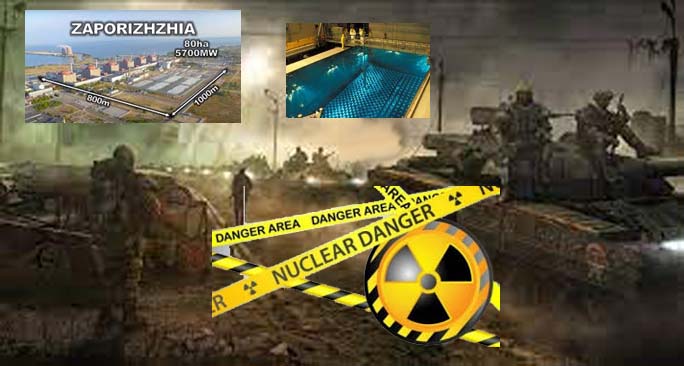
IAEA 5th Jan 2025,
https://www.iaea.org/newscenter/pressreleases/update-269-iaea-director-general-statement-on-situation-in-ukraine
International Atomic Energy Agency (IAEA) staff reported hearing loud blasts near Ukraine’s Zaporizhzhya Nuclear Power Plant (NPP) today, coinciding with reports of a drone attack on the plant’s training center, marking yet another threat to nuclear safety at Europe’s largest NPP, according to Director General Rafael Mariano Grossi.
The IAEA Support and Assistance Mission to Zaporizhzhya (ISAMZ) team stationed at ZNPP reported hearing two loud explosions coming from outside the perimeter of the site at approximately 12:45 and 15:45. For now, the IAEA has not yet been able to confirm any impact. The IAEA team also reported hearing machine gun fire coming from the site on multiple occasions.
The IAEA is aware of reports of an alleged attack by a drone at the ZNPP training center today, just outside of the site’s perimeter. Reports state that there were no casualties and no impact on any NPP equipment.
The ISAMZ team has reported that the intensity of military activities in the vicinity of Europe’s largest NPP – including multiple explosions at various distances from the site – has increased over the last 24 hours. “An attack on any nuclear power plant is completely unacceptable,” Director General Grossi stated. “In light of the increased military activity at ZNPP, I once again call for maximum restraint to avert the clear danger to its safety, and for the strict adherence to the five concrete principles established by the IAEA at the United Nations Security Council to protect the facility and the seven indispensable pillars of nuclear safety during an armed conflict also defined by the IAEA”.
Faslane Peace Camp warns of growing nuclear risks amid rising tensions
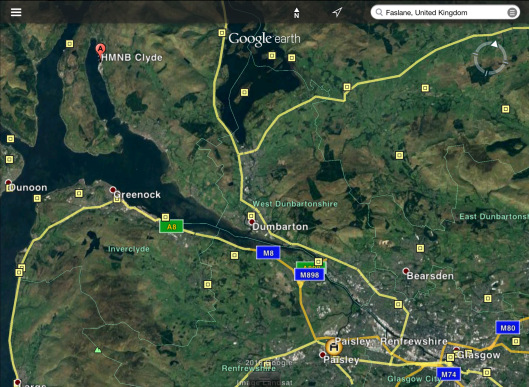
SCOTLAND is on the front line of a new international arms race spurred on
by a rise in frosty nuclear rhetoric. Just last month, the UK was declared
to be “directly involved” in the Ukraine war, meaning HM Naval Base
Clyde at Faslane – only 25 miles outside Glasgow – could be seen as a
“legitimate target”.
For the occupiers of Faslane Peace Camp,
site-sitting over the festive period, action and awareness are needed now
more than ever to pull us back from the brink of a nuclear winter just one
year before the 80th anniversary of the Hiroshima and Nagasaki bombings.
Acknowledging the risk of dealing in nuclear currency, Pete Roche, director
at Edinburgh Energy and Environment Consultancy, advocates for an energy
system throughout Scotland and the UK that runs entirely on renewables. The
previous Greenpeace campaigner said: “It is perfectly feasible to run
Scotland and the UK’s energy system on 100% renewables. This could save
well over £100 billion by 2050 compared to business as usual.”
The National 4th Jan 2025
https://www.thenational.scot/news/24832799.faslane-peace-camp-warns-growing-nuclear-risks-amid-rising-tensions/
A new year – but old policies

Renew Extra 4th Jan 2025
Given the UK’s tight economic situation, there were some concerns about backsliding on renewables and watering down plan to fully decarbonise the power grid by 2030 after PM Starmer said, at the end of last year, that the target was now to have ‘at least 95%’ clean power generation by that year, i.e. lots more renewables plus some new nuclear, but not totalling 100%.
………………..Net Zero Secretary Ed Miliband said nuclear power was vital, and that led some to speculate that Labour might condone higher power bills to pay for Small Modular Reactors, although he didn’t go quite as far as the Tony Blair Institute report which pushed new nuclear hard and said that the impacts of Chernobyl and Fukushima, ‘while serious, have been significantly overestimated’. The report was dismissed as ‘mostly tosh’ by Johnathon Porritt.
Certainly it did feel a bit backward looking, whereas, according to Emma Pinchbeck, one time head of Energy UK and now chair of the Climate Change Committee, private investors were keen to see ambitious new approaches to energy and climate change being backed by the government.
It is true that some ‘big tech’ companies like Amazon, Microsoft and Google, may be looking at Small Modular Reactors and some other nuclear techs, but the bulk of global funding for new energy tech is still going to renewables- and the big IT companies investment in SMRs/AMRs may just be a speculative, but possibly doomed, side bet.
………………………overall, the government does seem to be trying to get it right on pushing ahead rapidly with renewables, even if it is still a bit trapped in what some see as a nuclear dead end and also by its arguably misplaced optimism about CCS. Certainly Dr Doug Parr, Greenpeace UK, said ‘any money earmarked for carbon capture and storage- which is expensive, impossible to make zero carbon and fails to detach electricity prices from the volatile international gas market – would be better spent on the renewables, grid and storage infrastructure that will actually deliver clean power’.
………………………………………………………..based on a Royal Society study last year, it was concluded that, although the UK would need a lot of energy storage capacity, ‘a system based entirely on wind and solar, supported by large-scale hydrogen storage, and a possible mix of other storage options……….. would not be expensive.’
And more recently Dale Vince, Labour-supporting Ecotricty founder, said ‘we can secure a cleaner, cheaper energy future without nuclear’. He noted specifically that the cost of Hinkley Point C had ‘ballooned to £46bn’ after it was ‘originally priced at £18bn’ and argued that ‘if Hinkley Point C is anything to go by, Sizewell C really should have rigorous financial scrutiny.’ Certainly Hinkley Point is running late. It is now scheduled to be complete in 2031, after EDF’s former chief executive Vincent de Rivaz had originally said it would come online by Christmas 2017.
…………………..Clearly he feels we would do better to get on with the new green energy technologies. He is not alone. Hopefully 2025 will see more of that, and less backsliding. https://renewextraweekly.blogspot.com/2025/01/a-new-year-but-old-polices.html
1 This Month


18 March Webinar @ 1 PM EST: An Assessment of SMR Projects: The Case of Canada
register for the zoom:
https://us02web.zoom.us/webinar/register/WN_o8BIIOUvQ2ONJR1nta65DQ#/registration


of the week – STOP SMALL MODULAR REACTORS IN CANADA
To see nuclear-related stories in greater depth and intensity – go to https://nuclearinformation.wordpress.com
-
Archives
- March 2026 (141)
- February 2026 (268)
- January 2026 (308)
- December 2025 (358)
- November 2025 (359)
- October 2025 (376)
- September 2025 (258)
- August 2025 (319)
- July 2025 (230)
- June 2025 (348)
- May 2025 (261)
- April 2025 (305)
-
Categories
- 1
- 1 NUCLEAR ISSUES
- business and costs
- climate change
- culture and arts
- ENERGY
- environment
- health
- history
- indigenous issues
- Legal
- marketing of nuclear
- media
- opposition to nuclear
- PERSONAL STORIES
- politics
- politics international
- Religion and ethics
- safety
- secrets,lies and civil liberties
- spinbuster
- technology
- Uranium
- wastes
- weapons and war
- Women
- 2 WORLD
- ACTION
- AFRICA
- Atrocities
- AUSTRALIA
- Christina's notes
- Christina's themes
- culture and arts
- Events
- Fuk 2022
- Fuk 2023
- Fukushima 2017
- Fukushima 2018
- fukushima 2019
- Fukushima 2020
- Fukushima 2021
- general
- global warming
- Humour (God we need it)
- Nuclear
- RARE EARTHS
- Reference
- resources – print
- Resources -audiovicual
- Weekly Newsletter
- World
- World Nuclear
- YouTube
-
RSS
Entries RSS
Comments RSS
 nuclear-news