‘We need to be prepared’: China adapts to era of extreme flooding

“The Chinese leadership tends to see the long game,” Li said. “To demonstrate their far-sight and to prevent further risks, more should be done to prepare for the impacts of climate change systematically.”
While some residents take to building houses in trees, officials recognise need for national response to climate disasters
Amy Hawkins , Guardian 24th Dec 2024, https://www.theguardian.com/world/2024/dec/24/we-need-to-be-prepared-china-adapts-to-era-of-extreme-flooding
Every summer, Dongting Hu, China’s second-largest freshwater lake, swells in size as flood water from the Yangtze River flows into its borders. Dams and dikes are erected around the lake’s edges to protect against flooding. But this year, not for the first time, they were overwhelmed.
For three days in early July, more than 800 rescue workers in Hunan province scrambled to block the breaches. One rupture alone took 100,000 cubic metres of rock to seal, according to Zhang Yingchun, a Hunan official. At least 7,000 people had to be evacuated. It was one of a series of disasters to hit China as the country grappled with a summer of extreme weather. By August, there had been 25 large floods, the biggest number since records began in 1998, reported state media.
Xi Jinping, China’s president, “urged all-out rescue and relief work” to safeguard the people affected by the flooding in Hunan, state media reported.
One of those people was Ren Benxin, an archaeologist who lives on a small, forested island in the upper tributaries of Dongting Hu. He calls his idyllic home Soultopia. As well as carrying out archaeological research, he provides accommodation for travellers and looks after the herd of stray cats and dogs that he has adopted over the years.
On 5 July, his home was flooded. “First, I rescued the animals. Then, I rescued the supplies,” he said. “It was the first time in 10 years that I’d experienced something like this.”
The wooden huts in Ren’s corner of the islet were nearly completely submerged in muddy water. Chickens used the remnants of destroyed buildings as rafts to avoid drowning. Ren traversed the island in a small plastic dinghy. One of his dogs, Eason, fell ill after drinking dirty flood water, and died a few days later.
“Two years ago, we had a severe drought, and this year it’s been floods. I think we need to be prepared for anything,” Ren said.
Experiences like Ren’s are becoming more common in China, as
global heating makes extreme weather events more likely, as well as undermining communities’ defences against those disasters.
Dongting Hu exemplifies these challenges. It was once China’s largest freshwater lake. But decades of agricultural development meant that huge swathes of its land were reclaimed for farming, reducing the lake’s storage capacity. Both droughts and floods are becoming more serious and severe.
At least six Chinese provinces experienced major flooding in 2024. As well as the floods in Hunan, heavy rainfall in Guangdong, China’s most populous province, forced more than 110,000 people to relocate. After years of treating weather disasters as isolated incidents that require a local response, Chinese officials are becoming increasingly aware of the need to adapt to extreme weather events on a national scale.
“The harsh reality is here: the lack of climate action will cost China and present a social security threat,” said Li Shuo, director of the China Climate Hub at the Asia Society Policy Institute.
At the Cop29 UN climate crisis conference in November, China published an action plan for climate adaptation, vowing to establish a technical platform to monitor and forecast extreme weather events and to share its knowledge of improving early warning mechanisms.
It marked a shift the country which has long acknowledged the science of the climate crisis, but has focused its environmental cleanup efforts on issues such as air pollution – rather than severe but relatively rare floods and droughts.
“The Chinese leadership tends to see the long game,” Li said. “To demonstrate their far-sight and to prevent further risks, more should be done to prepare for the impacts of climate change systematically.”
For flooding victims like Ren, an official recognition of – and compensation for – the damage wrought by the climate crisis cannot come soon enough. The repair work cost him more than 70,000 yuan (£7,600), although the authorities did send some relief workers to help.
For now, Ren is developing his own ways to adapt to climate breakdown. He shuns electrical appliances after his were destroyed in the flood, and uses wood burners for cooking and heating. He plans to build a new home suspended in trees, so as to be safe from floods.
“I think extreme weather is more frequent now. So I have to be prepared for anything. If I like the place, I’ll stay.”
Additional research by Chi-hui Lin and Jason Tzu Kuan Lu
The Guardian view on arms control: essential to prevent the total devastation of nuclear war

Guardian 27th Dec 2024, https://www.theguardian.com/commentisfree/2024/dec/27/the-guardian-view-on-arms-control-essential-to-prevent-the-total-devastation-of-nuclear-war
Next November marks 40 years since the US president Ronald Reagan and the Soviet leader Mikhail Gorbachev declared that “a nuclear war cannot be won and must never be fought”. The statement was striking – not least because their militaries were pouring billions into preparing for an unwinnable conflict.
A year later, at Reykjavik, the two came tantalisingly close to eliminating nuclear weapons entirely. That historic chance slipped away over Reagan’s insistence on his unproven “Star Wars” missile defence system. The moment passed, but its lesson endures: disarmament demands courage – and compromise.
The summit proved a turning point in the cold war. Arms control brought down the number of nuclear weapons held by the two countries from 60,000 to roughly 11,000 today. The most recent new strategic arms reduction treaty (New Start), signed in 2010, capped deployed strategic warheads at 1,550 each. In retrospect, that was a false dawn in nuclear diplomacy. Since George W Bush withdrew the US from the anti-ballistic missile treaty with Moscow in 2002, the risk of a return to an all-out arms race has grown.
On 20 January 2025, Donald Trump will once again hold the keys to a planet-ending arsenal. Mr Trump’s capricious personality sheds new light on an old question: how much of the terrible responsibility to inflict large-scale nuclear destruction should be invested in a single person? He has called the transfer of authority “a very sobering moment” and “very, very scary”. Reassuring words – until one remembers that he also reportedly wondered: “If we have nuclear weapons, why can’t we use them?” Presidential sole authority rightly ensures civilian control over nuclear weapons. But why concentrate such power in just one civilian’s hands?
Close to apocalypse
Without bold action, New Start, the last safeguard of nuclear arms moderation, will expire in February 2026. Mr Trump admires strongmen like Russia’s Vladimir Putin, who has recklessly threatened nuclear strikes and hinted at restarting tests during the Ukraine war. But it would be a catastrophic mistake if the pair decided not to exercise self-restraint. It would mean that for the first time in more than 50 years, the US and Russia – holders of 90% of the world’s nuclear weapons – could begin an unconstrained arms race. That dismal decision would send a message to other states, notably China, further encouraging their buildup of nuclear stockpiles.
Deterrence is not the only way to think about nuclear weapons. For decades, a conflict involving them has been a byword for Armageddon. The fearful legacy of “the bomb” can be felt from Hiroshima and Nagasaki to the testing grounds still contaminated by nuclear fallout decades later. Such sentiment led to Barack Obama, in 2009, advocating a hopeful vision of a nuclear-free world. His speech inspired a coalition of activists, diplomats and developing nations determined to force a global reckoning. Their resistance to the conventional wisdom that nuclear disarmament is unrealistic bore fruit with the treaty on the prohibition of nuclear weapons, adopted by 122 countries at the UN in 2017. Its message: the only way to ensure nuclear weapons are never used again is to do away with them entirely.
The treaty, championed by the Nobel prize-winning International Campaign to Abolish Nuclear Weapons, was a triumph over superpower diplomacy that had long hindered reviews of the nuclear non-proliferation treaty. Nuclear-armed states are sceptical, if not scornful. But their resistance does not diminish the importance of the 2017 UN vote. It represents not only a moral and legal challenge to the status quo but a reminder that much of the world doesn’t accept the logic of mutually assured destruction. This sentiment was amplified this year when Nihon Hidankyo, Japan’s atomic and hydrogen bomb survivors group, won the Nobel peace prize for efforts to abolish nuclear weapons.
Eight decades after its first test, the nuclear bomb remains – its purpose long obsolete, its danger ever present. Built to defeat Hitler, dropped to end Japan’s imperial ambitions and multiplied to outlast the cold war, nuclear weapons have outlived every rationale for their existence. Arsenals have shrunk, but not enough. The world’s stockpile remains dangerously large, and efforts to reduce it further appear stalled. This against a geopolitical backdrop of nuclear proliferation, a multipolar and ideologically diverse UN, and the American desire for global pre-eminence. Little wonder that the Bulletin of the Atomic Scientists has set its Doomsday Clock to 90 seconds to midnight – the closest ever to apocalypse.
A shared responsibility
In 2019, Gorbachev warned, with good reason, that nuclear deterrence keeps the world “in constant jeopardy”. It is obvious that as long as these weapons exist, the risk of nuclear war cannot be erased. The question is no longer why the bomb remains, but whether humanity can survive it for another 80 years.
This December, UN members voted 144-3 to establish an independent scientific panel on the effects of nuclear war. Shamefully, Britain was among the naysayers. Imagination has already outpaced fact. In her book Nuclear War, Annie Jacobson describes how humanity could end in 72 minutes after a North Korean “bolt from the blue” attack sparks a nuclear exchange between the US and Russia. She writes of thousands of warheads raining down on America, Europe, Russia and parts of Asia, obliterating cities, incinerating human life and leaving billions stripped of life, light and hope. Streets turn molten, winds flatten the land and those who endure suffer wounds so terrible that they no longer look – or act – human.
Ms Jacobson’s point is that this apocalyptic vision is the logical conclusion of the world’s current nuclear doctrines. Those that do emerge into the desolation discover what the Soviet leader Nikita Khrushchev warned decades ago: “The survivors will envy the dead.” The devastation is total, offering a future that no one could bear to live through.
The Guardian view on arms control: essential to prevent the total devastation of nuclear war
Over the holidays, this column will explore next year’s urgent issues. Today we look at why an unqualified belief in nuclear deterrence can’t keep us safeSat 28 Dec 2024 04.30 AEDTShare
Next November marks 40 years since the US president Ronald Reagan and the Soviet leader Mikhail Gorbachev declared that “a nuclear war cannot be won and must never be fought”. The statement was striking – not least because their militaries were pouring billions into preparing for an unwinnable conflict.
A year later, at Reykjavik, the two came tantalisingly close to eliminating nuclear weapons entirely. That historic chance slipped away over Reagan’s insistence on his unproven “Star Wars” missile defence system. The moment passed, but its lesson endures: disarmament demands courage – and compromise.
The summit proved a turning point in the cold war. Arms control brought down the number of nuclear weapons held by the two countries from 60,000 to roughly 11,000 today. The most recent new strategic arms reduction treaty (New Start), signed in 2010, capped deployed strategic warheads at 1,550 each. In retrospect, that was a false dawn in nuclear diplomacy. Since George W Bush withdrew the US from the anti-ballistic missile treaty with Moscow in 2002, the risk of a return to an all-out arms race has grown.
On 20 January 2025, Donald Trump will once again hold the keys to a planet-ending arsenal. Mr Trump’s capricious personality sheds new light on an old question: how much of the terrible responsibility to inflict large-scale nuclear destruction should be invested in a single person? He has called the transfer of authority “a very sobering moment” and “very, very scary”. Reassuring words – until one remembers that he also reportedly wondered: “If we have nuclear weapons, why can’t we use them?” Presidential sole authority rightly ensures civilian control over nuclear weapons. But why concentrate such power in just one civilian’s hands?
Close to apocalypse
Without bold action, New Start, the last safeguard of nuclear arms moderation, will expire in February 2026. Mr Trump admires strongmen like Russia’s Vladimir Putin, who has recklessly threatened nuclear strikes and hinted at restarting tests during the Ukraine war. But it would be a catastrophic mistake if the pair decided not to exercise self-restraint. It would mean that for the first time in more than 50 years, the US and Russia – holders of 90% of the world’s nuclear weapons – could begin an unconstrained arms race. That dismal decision would send a message to other states, notably China, further encouraging their buildup of nuclear stockpiles.
Deterrence is not the only way to think about nuclear weapons. For decades, a conflict involving them has been a byword for Armageddon. The fearful legacy of “the bomb” can be felt from Hiroshima and Nagasaki to the testing grounds still contaminated by nuclear fallout decades later. Such sentiment led to Barack Obama, in 2009, advocating a hopeful vision of a nuclear-free world. His speech inspired a coalition of activists, diplomats and developing nations determined to force a global reckoning. Their resistance to the conventional wisdom that nuclear disarmament is unrealistic bore fruit with the treaty on the prohibition of nuclear weapons, adopted by 122 countries at the UN in 2017. Its message: the only way to ensure nuclear weapons are never used again is to do away with them entirely.
The treaty, championed by the Nobel prize-winning International Campaign to Abolish Nuclear Weapons, was a triumph over superpower diplomacy that had long hindered reviews of the nuclear non-proliferation treaty. Nuclear-armed states are sceptical, if not scornful. But their resistance does not diminish the importance of the 2017 UN vote. It represents not only a moral and legal challenge to the status quo but a reminder that much of the world doesn’t accept the logic of mutually assured destruction. This sentiment was amplified this year when Nihon Hidankyo, Japan’s atomic and hydrogen bomb survivors group, won the Nobel peace prize for efforts to abolish nuclear weapons.
Eight decades after its first test, the nuclear bomb remains – its purpose long obsolete, its danger ever present. Built to defeat Hitler, dropped to end Japan’s imperial ambitions and multiplied to outlast the cold war, nuclear weapons have outlived every rationale for their existence. Arsenals have shrunk, but not enough. The world’s stockpile remains dangerously large, and efforts to reduce it further appear stalled. This against a geopolitical backdrop of nuclear proliferation, a multipolar and ideologically diverse UN, and the American desire for global pre-eminence. Little wonder that the Bulletin of the Atomic Scientists has set its Doomsday Clock to 90 seconds to midnight – the closest ever to apocalypse.
A shared responsibility
In 2019, Gorbachev warned, with good reason, that nuclear deterrence keeps the world “in constant jeopardy”. It is obvious that as long as these weapons exist, the risk of nuclear war cannot be erased. The question is no longer why the bomb remains, but whether humanity can survive it for another 80 years.
This December, UN members voted 144-3 to establish an independent scientific panel on the effects of nuclear war. Shamefully, Britain was among the naysayers. Imagination has already outpaced fact. In her book Nuclear War, Annie Jacobson describes how humanity could end in 72 minutes after a North Korean “bolt from the blue” attack sparks a nuclear exchange between the US and Russia. She writes of thousands of warheads raining down on America, Europe, Russia and parts of Asia, obliterating cities, incinerating human life and leaving billions stripped of life, light and hope. Streets turn molten, winds flatten the land and those who endure suffer wounds so terrible that they no longer look – or act – human.
Ms Jacobson’s point is that this apocalyptic vision is the logical conclusion of the world’s current nuclear doctrines. Those that do emerge into the desolation discover what the Soviet leader Nikita Khrushchev warned decades ago: “The survivors will envy the dead.” The devastation is total, offering a future that no one could bear to live through.
Amid historic lows in US-Russian relations, one truth remains: a nuclear war cannot be won and must never be fought. Leaders in Moscow and Washington should reaffirm this in the run-up to negotiating significant arsenal reductions as well as real limits on strategic missile defences. Such a statement, simple but profound, would remind the world that Mr Trump and Mr Putin recognise their shared responsibility to prevent global catastrophe. This will not be easy: rising nationalism, geopolitical rivalry and mutual mistrust between the countries – especially over Ukraine – loom large over disarmament efforts. But try they must. However bitter their disagreements, Washington and Moscow owe it to humanity to talk about – and act on – avoiding the unthinkable.
As construction of first small modular reactor looms, prospective buyers wait for the final tally.
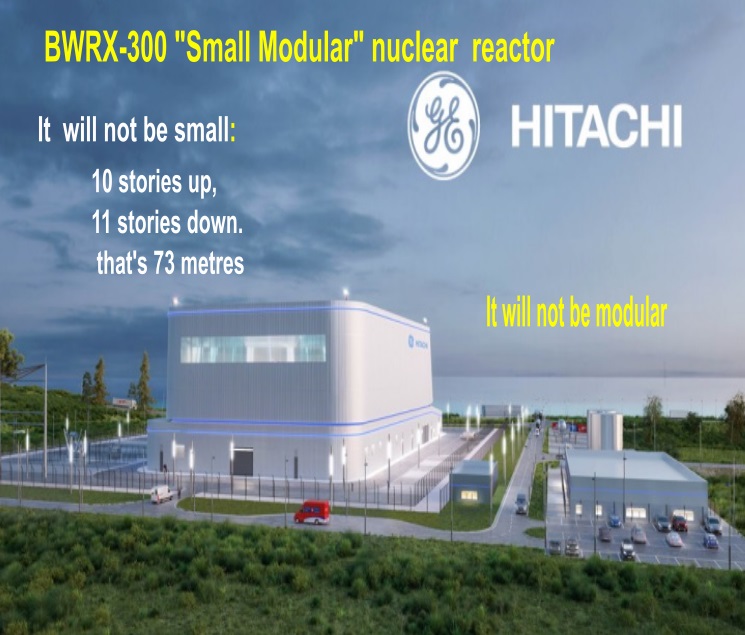
the first BWRX-300 could cost more than five times GE-Hitachi’s original target price.
emerging consensus that SMRs are not economic
“The nuclear people don’t operate in a vacuum, they operate in competition to other technologies,………… “The cost for solar is going down.”
Matthew McClearn, Dec. 27, 2024 , https://www.theglobeandmail.com/business/article-as-construction-of-first-small-modular-reactor-looms-prospective/
The race to construct Canada’s first new nuclear power reactor in 40 years seems to have passed a point of no return. This summer, Ontario Power Generation completed regrading the site for its Darlington New Nuclear Project in Clarington, Ont., and started drilling for the reactor’s retaining wall, which will be buried partly underground. At a regulatory hearing, OPG’s chief executive officer Ken Hartwick, who will retire at the end of this year, promised that this reactor will be “the first of many to come.”
But that will depend on a crucial yet-to-be-revealed detail: its price tag.
It’s no exaggeration to say that the world is waiting for it. The new Darlington reactor would be the first BWRX-300, a small modular reactor (SMR) being designed by an American vendor, GE-Hitachi Nuclear Energy, and the first SMR built in any Western country. Other prospective buyers include the Tennessee Valley Authority (TVA), SaskPower and Great British Nuclear. More BWRX-300s are in early planning stages in Poland and the Czech Republic.
Crucially, however, OPG is the first and only utility worldwide to bind itself contractually to build a BWRX-300. A report published by the U.S. Department of Energy in September said American utilities are waiting to see pricing and construction schedules for early units, and would “prefer to be fifth.” SaskPower also wants to avoid the risks associated with building a “first of a kind” reactor; it won’t decide until 2029 and it hopes SMRs will be less expensive than traditional nuclear plants.
Scheduled for release this winter, the Darlington SMR’s estimated cost will speak volumes about whether SMRs can deliver on their many promises. Yet there are early indications of serious sticker shock: Recently published estimates from the TVA suggest the first BWRX-300 could cost more than five times GE-Hitachi’s original target price. How will OPG and GE-Hitachi drive pricing far below the TVA’s estimate? And if they cannot, what then will be the prospects for SMRs?
Ditching the scaling law
SMRs were conceived as an antidote to the hefty price tags that brought reactor construction to a standstill in Western countries for decades.
Previously, the nuclear industry relied heavily on something called economies of scale or the “scaling law”: As a power plant’s size increases, capital costs also rise, but in a less than linear fashion. So vendors designed ever-larger reactors. Reactors under construction today average about one gigawatt, roughly three times the BWRX-300’s output. They can cost more than US$10-billion, leaving only the largest government-backed utilities as potential purchasers.
SMRs represent a promising but untested new approach to manufacturing reactors – one that emphasizes simplification and mass production techniques. The key term is modular: Rather than building monolithic, one-of-a-kind plants, the industry hoped instead to churn out substantially identical factory-built units; repetition would help drive down costs, as it had for competing technologies such as wind turbines and solar panels.
But modularity requires multiple orders, which in turn demands competitive pricing. Through early discussions with potential customers, GE-Hitachi executives understood the BWRX-300 had to be priced low, not only in absolute terms, but also relative to other power-generation technologies. They told audiences it would cost less than US$1-billion, or US$2,250 per kilowatt hour of power generation capacity – low enough to compete with natural gas-fired power plants.
“The total capital cost of one plant has to be less than $1-billion in order for our customer base to go up,” Christer Dahlgren, a GE-Hitachi executive, said during a talk in Helskini in March, 2019.
Shrinking a giant
GE-Hitachi’s designers began by shrinking a behemoth: the 1,500-megawatt Economic Simplified Boiling Water Reactor (ESBWR). Their objective was to reduce the volume of the building housing the reactor by 90 per cent, to greatly reduce the amount of concrete and steel required during construction.
This was accomplished primarily through eliminating safety systems. Pressure relief valves, common in traditional reactors, were removed. In place of two completely separate emergency shutdown systems, as is customary, the BWRX-300 would have two systems that would propel the same set of control rods into the reactor’s core. GE-Hitachi emphasized that the BWRX-300 featured “passive” safety systems that would keep the reactor safe during an accident, and its simplicity reduced the need for redundant engineered systems.
Sean Sexstone, head of GE-Hitachi’s advanced nuclear team, said the entire facility – which includes the reactor building, the control room and the turbine hall – will measure just 145 metres by 85 metres.
“You can walk that site in a minute-and-a-half,” he said.
GE-Hitachi also sought substitutes for concrete. The reactor building is to be constructed using factory-made steel panels that will be shipped to the site, assembled into modules and lifted by crane into position. These modules essentially serve as forms into which concrete is poured. These steel plates are as strong as concrete, OPG says, yet eliminate the need to use rebar extensively. This approach “lends itself to more modularity, more work in a factory, versus more work in the field,” Mr. Sexstone explained.
The Darlington SMR will be erected using a technique called “open-top construction.” The reactor building’s roof won’t be installed until the very last. The building will be constructed upward, floor by floor, with large components lowered in by crane rather than being moved through doors and hatches.
Many of the BWRX-300’s components would be identical to those used in previous GE power plants, such as its control rods, fuel assemblies and steam separators. Its steam turbine would be the same one used in natural-gas-fired plants. And the plant could be run by as few as 75 staff, far below the nearly 1,000 employed at large single-reactor Canadian nuclear plants.
Historically, utilities tended to build bespoke nuclear plants meeting highly individualized requirements. The result: In the United States alone there are more than 50 commercial reactor designs. Few designs were built twice, limiting opportunities to learn through repetition.
GE-Hitachi intended the BWRX-300 to be highly standardized, constructible in multiple countries with as few tweaks as possible. It assembled an international coterie of utility partners, including OPG, the TVA and a Polish company named Synthos Green Energy, which last year agreed to jointly contribute to the estimated US$400-million cost of the SMR’s standardized design.
Subo Sinnathamby, OPG’s chief projects officer, acknowledged in an interview that the first SMR will be expensive. But lessons learned from building it, including newly identified opportunities for additional modularization, will be applied to three subsequent units at Darlington, bringing down overall costs.
“For us, success is going to be sticking to how we have executed megaprojects at OPG, using the same processes and principles,” she said, citing the continuing refurbishment of Darlington’s existing reactors.
“The last thing we want to do is get into construction and then stop the work force.”
GE-Hitachi’s emphasis on lowering plant costs has been validated by many independent observers, who regard it as essential to SMRs’ future prospects.
In a report published in May, Clean Prosperity, a climate policy think tank, concluded that the BWRX-300 “is the strongest candidate” among SMRs to experience continued cost reductions as more were built – but only at the right price, which it pegged at about $3.3-billion. “Cost curves will only become possible for the BWRX-300 in Ontario and beyond,” it warned, “with a final price tag that is low enough to compel additional expansion.”
In September, the U.S. Department of Energy published a report examining the prospects for widespread deployment of reactors across the U.S., an expansion it strongly supported. But to drive down costs, SMR vendors needed to move more than half of the overall spending on a project into standardized factory-like production – a tall order.
Similarly, a report published last year by the U.S. National Academy of Sciences argued that if nuclear plants are to contribute meaningfully to future electricity systems, they must be cost-competitive with other low-emission technologies. It looked at so-called overnight capital costs – what costs would be if construction were completed overnight, with no charges for financing and no consideration of how long it will last. The academy said capital costs should be US$2,000 or less per kilowatt of generating capacity. At between US$4,000 and US$6,000 a kilowatt, reactors might still be competitive if costs unexpectedly rose for renewable technologies.
Enter the TVA.
In an integrated resource plan published in September, the TVA estimated that a first light water SMR would have an overnight capital cost of nearly US$18,000 a kilowatt.
At that pricing, the first Darlington SMR would cost more than $8-billion. That’s about 10 times the cost of a similarly sized natural-gas-fired plant: SaskPower’s recently completed Great Plains Power Station, a 377 MW natural-gas-fired plant in Moose Jaw, cost just $825-million.

Oregon-based NuScale Power Corp. has already discovered what happens when pricing falls in this range. Founded in 2007, its 77-MW NuScale Power Module was the first SMR to be licensed by regulators in a Western country. But last year its flagship project, undertaken with the Utah Association of Municipal Power Systems (UAMPS), was cancelled after cost soared to about US$20,000 a kilowatt.
There are several important caveats about the TVA’s estimate.
Greg Boerschig, a TVA vice-president, described it as a “Class 5″ estimate. According to standard global practices, cost estimation is based on a five-level system. Class 5 is the least detailed and reliable and is intended for planning purposes; actual costs could be half that much, or double.
The estimate is far higher than the TVA would have liked, Mr. Boerschig said. But since OPG is further along in deploying the BWRX-300, he added, it has a better sense of the reactor’s cost.
“We’re a couple of years behind them,” Mr. Boerschig acknowledged.
Indeed, according to a presentation by Aecon Group Inc., a partner on the Darlington SMR, a Class 4 estimate had already been completed as of February this year. Ms. Sinnathamby said OPG is working on a Class 3 estimate.
“Our number is going to be very specific: What is it going to cost us to build, on this location, these four SMRs?” she said.
Another caveat is that the BWRX-300 was only one of several reactors represented in the estimate, which was based on the TVA’s experience exploring potential SMRs at its Clinch River site near Oak Ridge, Tenn., and by examining recently completed nuclear construction projects.
OPG might enjoy certain cost advantages over the TVA. The Darlington Nuclear Generating Station is a complex that was built during the 1980s and early 1990s on the shore of Lake Ontario, the proximity of which could make cooling reactors there cheaper. Clinch River is a greenfield site, whereas Darlington already has four operating reactors.
“That will automatically reduce the cost to OPG relative to TVA,” said Koroush Shirvan, a professor of energy studies at the Massachusetts Institute of Technology, who has studied the BWRX-300’s economics.
Nonetheless, opponents and skeptics of SMRs in general, and the Darlington SMR in particular, have embraced TVA’s estimate.
Chris Keefer, an emergency medicine physician, has advocated passionately for refurbishment of Ontario’s existing nuclear power plants, which are all based on Canada’s homegrown reactor design, the Candu. He has also argued for modernizing the Candu design and building more. He said the TVA’s estimates reflect a more honest assessment of SMR pricing than Canadians received in the past.
“It points to this emerging consensus that SMRs are not economic, and that shouldn’t be a surprise,” he said.
“TVA, I think they’ve got several hundreds of millions of dollars in the development process on this reactor. I wouldn’t say that those numbers are naive.”
Prof. Shirvan said his own cost estimate for the BWRX-300 reactor is “in line” with the TVA’s.
Chris Gadomski, head of nuclear research at BloombergNEF, said TVA’s estimates are discouragingly high, and imply that reactor sales might be less than anticipated. Contributing factors might include high labour costs in North America, and recent high inflation and high financing costs, factors he expects will persist.
“The nuclear people don’t operate in a vacuum, they operate in competition to other technologies,” he said.
“The cost for solar is going down. The cost of batteries, we anticipate, is going down. And so, when you’re looking at spending billions of dollars and all of a sudden the price tag gets so large, people will say: ‘Hey, listen, you’ve got to look at other options, or buy less of this.’ ”
If there is a silver lining, the TVA estimated follow-on SMRs would cost substantially less than the first, at roughly US$12,500 a kilowatt. But that’s still more than double the upper limit the U.S. National Academy of Sciences deemed necessary to support widespread SMR adoption.
We might learn in a few months whether GE-Hitachi and OPG have succeeded in bringing the BWRX-300’s cost down. But a review of regulatory applications and other documents hint at why the original US$1-billion target price might be difficult to realize.
Prof. Shirvan said GE-Hitachi’s original plan – to slim the reactor down by removing safety systems – encountered resistance from regulators in Canada and the U.S. “When you strip out most of the safety system, you have to come up with very good reasoning how that’s justified,” he said. GE-Hitachi started adding some of those systems back in, he said, which caused the BWRX-300’s reactor building’s diameter to swell.
This dramatic increase, Mr. Keefer said, has greatly reduced the BWRX-300’s economic attractiveness.
“Proportionately, you’re actually doing a lot more civil works than you would for a large reactor,” he said. “And that actually means that the whole SMR paradigm, which is to get all the work into a factory, goes away.”
(GE-Hitachi denied that the plant had grown. “While the design has matured, the overall footprint of the BWRX-300 plant has not changed significantly,” Mr. Sexstone said.)
OPG’s regulatory documents also make clear that some modular construction techniques it seeks to employ at Darlington are in their infancy. As recently as last year, most of the walls and floors of the SMR building were to have been built using a technique developed in Britain known as Steel Bricks. GE-Hitachi recently dropped Steel Bricks in favour of a similar approach known as Diaphragm Plate Steel Composite.
Moreover, OPG’s published construction plans show that the reactor building will be built largely below-grade, requiring significant excavation including into bedrock. Tunnel boring machines will be used to excavate more tunnels, tens of metres wide, to convey cooling water to and from Lake Ontario. Make no mistake, the Darlington SMR remains a complex capital project.
To date there have been no indications that pricing might derail the Darlington SMR. Ontario’s government appears willing to pay a significant premium: It hopes that as a first mover, OPG will be well-poised to sell equipment and expertise in other countries.
During a stump speech in Scarborough in December, Energy Minister Stephen Lecce said Ontario was keen to sell its technology and expertise for building SMRs abroad.
“I was just in Poland and Estonia, literally selling Canadian small modular reactors that will be built here, exported there,” he said.
Yet Mr. Lecce has also vowed to keep Ontarians’ electricity bills low, an objective high SMR price tags might compromise.
GE-Hitachi maintains its creation’s pricing will stack up favourably.
“I think we’re in a really good spot to feel very comfortable about this unit being probably the most cost competitive SMR in the market,” Mr. Sexstone said. “I think your readers will be pleasantly surprised.”
Ms. Sinnathamby, for OPG’s part, said actual costs to construct BWRX-300s should be considerably lower than TVA’s estimate.
“The TVA numbers can only come down,” she said. “That’s how conservative, in our mind, those numbers are.”
Jeremy Corbyn speaks out on danger of Trident in Scotland
JEREMY Corbyn has highlighted the danger posed by the UK’s Trident
nuclear submarines – including having them based in Scotland. The former
Labour leader said there is “no defence” for nuclear weapons, adding
that his dissent from supporting their presence and potential use is
“well-known” – including a pledge in 2015 that, if he were to become
prime minister, he would never use them. On the subject of the UK’s
nuclear arsenal, which is hosted in Scotland at HM Naval Base Clyde, Corbyn
said it put a “target” on the city of Glasgow.
The National 27th Dec 2024, https://www.thenational.scot/news/24819794.jeremy-corbyn-speaks-danger-trident-scotland/
Black Money, Black Flags: How USAID Paved the Way for Syria’s Militant Takeover
By Alex Rubinstein / MintPress News,21 Dec 24
As the designated terrorist group Hayat Tahrir al-Sham (HTS) establishes its proto-government in Idlib, notoriously corrupt NGOs are stepping in to fill the gaps in public services, with some even defecting to work alongside the group.
The United States, which spent two decades and $5.4 trillion overthrowing governments hostile to al-Qaeda, now finds itself in a paradoxical position. Modern al-Qaeda has carved out its own quasi-state in Syria, yet remains on the U.S. list of Foreign Terrorist Organizations. To characterize this as a foreign policy misstep would be reductive; the U.S. has actively facilitated HTS’s conquest of parts of Syria while maintaining its official terrorist designation.
For the past five years, HTS, an al-Qaeda offshoot, has sought to rehabilitate its image. Its leader, Abu Mohammad al-Jolani—a former high-ranking member of both ISIS and al-Qaeda—has led a calculated charm offensive, attempting to rebrand the group from one focused on violence and minority persecution to a more palatable local governance entity.
Since establishing HTS and a proto-government called the Syrian Salvation Government, or SSG, the group’s leader, al-Jolani has expended a good deal of energy talking about topics intended to normalize the idea of a-Qaeda’s statehood; things like ‘institutions,’ and ‘structures.’ This, coupled with al-Jolani’s sudden embrace of Syria’s diverse tapestry of minority groups, has made up the main pillars of the terror group’s rebrand. Al-Jolani himself credits the establishment of quasi-state structures for the group’s sudden success in taking over Syria.
This shift in focus from the elimination of infidels to the establishment of good governance was given the spotlight in an article in the Telegraph entitled ‘How Syria’s ‘diversity-friendly’ jihadists plan on building a state.’ Published five days before President Assad fled the country, the article seemingly understood a total takeover by HTS to be a fait accompli…………………………………………………………………………………………………………………
Al-Jolani would take much of the remainder of the interview as an opportunity to deliver his stump speech on building inclusivity. And, of course, in the immediate aftermath of HTS’ takeover, gruesome videos of torture and executions aimed at Syria’s Alawite community flooded social media, dispelling the terrorist group’s progressive propaganda. And while it has only been a few years since HTS was carrying out suicide bombings, other groups that helped al-Jolani’s offensive have received next to zero coverage in Western media.
These groups include Ahrar al-Sham, which has been accused of war crimes, kidnappings, torture and potential use of chemical weapons by Amnesty International. Also involved in the offensive was Nour al-Din al-Zenki, a “moderate rebel” group supported by the United States until 2017, when footage emerged of its members gleefully beheading a teenager.
Yet, the horrifying history of these al-Qaeda offshoots has not given much pause to the White House. Just days after Assad’s egress, Joe Biden noted that the designated terrorist groups that had hijacked state power in Syria were “saying the right things.” Additionally, Biden promised more humanitarian and to “engage with all Syrian groups” with the goal of establishing a new government and constitution.
Make no mistake, some of the rebel groups that took down Assad have their own grim record of terrorism and humanit- — human right [sic] abuses. We’ve taken note of statements by the leaders of these rebel groups in recent days. And we’re — they’re saying the right things now, but as they take on greater responsibility, we will assess not just their words, but their actions.”
…………………………………………………………….. Implementing Partners – in Crime
Since the start of the war, USAID and the State Department’s Bureau of Humanitarian Assistance (BHA) have spent more than $18 billion on “humanitarian assistance” in Syria and more than $1.2 billion in fiscal year 2024 alone, oftentimes employing notoriously corrupt NGO partners to do the dirty work.
In a PBS interview with James Jeffrey, the United States Special Representative for Syria Engagement, Jeffrey admitted that “in 2018, my focus was — at the very center of everything I was doing was Idlib. And in Idlib, he [al-Jolani] was the strongest force.” Thus, USAID was confronted with a problem: how to deliver aid to a region ruled by a group they were legally prohibited from aiding.
………………………………………………………………….. While these instances of fraud, corruption, and supporting terrorist groups by USAID’s NGO partners are shocking, what is perhaps even more shocking is that these same NGOs continue to enjoy support from USAID despite the scandals. In fact, far from cutting these organizations off from future contracts, USAID continues to this day to actively encourage donations to Catholic Relief Services and the International Medical Corps………………………………………………………………………………………………………………………………………………….. more https://www.mintpressnews.com/black-money-black-flags-how-usaid-paved-the-way-for-syrias-jihadist-takeover/288876/
Earthquake-prone Indonesia considers nuclear power plan as 29 possible plant sites revealed
ABC News, By Natasya Salim, Tri Ardhya and Sally Brooks, 28 Dec 24
In short:
Indonesia’s energy council has proposed 29 sites for nuclear power plants in a bid to secure reliable energy sources and reduce carbon emissions.
Environmental groups say the plan is “dangerous”, partly because the country is prone to earthquakes.
What’s next?
The energy council is searching for foreign investors to back the plan.
…………………………………………………………………………………………………………………….. The new detail on plant site locations has renewed safety concerns among environmental advocates in part because Indonesia is prone to natural disasters.
The archipelago mostly sits along the Pacific Ring of Fire where tectonic plates frequently collide and cause earthquakes and other disasters.
Twenty years ago, a magnitude-9.1 earthquake struck off the coast of Indonesia’s Aceh province and triggered the 2004 Boxing Day tsunami, that killed some 230,000 people across Indonesia, Sri Lanka, India, Thailand, and nine other countries.
Hendrikus Adam, from environmental not-for-profit organisation WALHI, said authorities needed to learn from past nuclear power disasters, including those caused by earthquakes and tsunamis like the Fukushima accident in Japan in 2011.
“We think nuclear plants are risky, dangerous and harmful for humans and the environment,” said Mr Adam.
“The development of a nuclear plant itself is also very expensive and hazardous.”
……………………………………………. Last month, National Development Planning Deputy Minister Vivi Yulaswati said Indonesia was in talks with the US and Russia about acquiring technology to develop nuclear power plants.
Separately, Indonesia’s state-owned electricity firm PLN has reportedly signed agreements with companies in the US and Japan to build small modular reactors, Coordinating Economic Minister Airlangga Hartarto said earlier this month……….
Details of the agreements are scarce and PLN declined to comment for this story………….
Currently none are in commercial operation in any Organisation for Economic Co-operation and Development (OECD) country….. https://www.abc.net.au/news/2024-12-27/earthquake-prone-indonesia-plans-for-nuclear-power/104758008
Second Fukushima nuclear sample removal eyed for March

CNA 26th Dec 2024
Three of Fukushima’s six reactors went into meltdown in 2011 after a huge tsunami swamped the facility.
TOKYO: The operator of Japan’s stricken Fukushima nuclear plant said on Thursday (Dec 26) it will start the second round of a tricky operation to collect samples of radioactive debris from the site this spring.
Around 880 tonnes of hazardous material remain at the Fukushima site, 13 years after a catastrophic tsunami caused by a 9.0-magnitude earthquake triggered one of history’s worst nuclear accidents.
Removing the debris is seen as the most daunting challenge in a decommissioning project due to last decades, because of the dangerously high radiation levels.
Last month, operator Tokyo Electric Power Company (TEPCO) said a trial debris removal operation using a specially developed extendible device had been completed.
The sample weighing just below 0.7g – equivalent to about one raisin – was delivered to a research lab near Tokyo for analysis.
A TEPCO official told a press conference they are now gearing up for a second sample removal due in “March to April”……….
https://www.channelnewsasia.com/east-asia/fukushima-nuclear-plant-sample-removal-march-2025-4826701
The Australian election as a game of cricket: cost of living is the issue, but does Nature bat last?

December 26, 2024 , By Noel Wauchope, https://theaimn.net/the-australian-election-as-a-game-of-cricket-cost-of-living-is-the-issue-but-does-nature-bat-last/
It is not nice to talk about politics at this happy festive time. But you can talk about cricket. Indeed, in Melbourne, it is your patriotic duty. So, I will – sort of.
A prestigious political analyst, Paul Bongiorno, writes in The Saturday Paper about the focus of campaigning for the 2025 Australian federal election. He sees both political parties emphasising the economy, and the “cost of living”. But Bongiorno warns that climate change could suddenly become once more the big factor in the political game, if summer does bring bushfires and floods.
Bongiorno argues that Dutton and the Liberal Coalition are out to stop renewable energy development:
“If the Dutton-led Coalition manages to take the treasury benches, the brakes will be dramatically applied to climate action. The energy transition would be stalled and billions of dollars of new-energy investment put in jeopardy.A key Labor strategist says… it would take only another summer of catastrophic bushfires or floods to significantly jolt public opinion.”
Bongiorno goes on to argue that “The portents here are not favourable for Dutton.” And he cites powerful arguments about “deep flaws” in Dutton’s energy plan’s economic modelling. Bongiorno draws the conclusion that if climate change extremes hit Australia, voters will recognise the value of renewable energy, and vote for the present Labor government’s policies on climate action.
If only that would be the effect of weather disasters – Australian voters embracing action on climate change – the development of renewable energy and energy conservation!
Paul Bongiorno is a much-admired and well-informed analyst. And I am presumptuous to doubt his opinion. But I do doubt it. Look what happened in 2023, with the Australian public first supporting the concept of an Aboriginal Voice to Parliament, but finally voting a resounding “No” to that plan.
How did it happen?
We are in a different era of media and opinion. We are in extraordinary times. When it comes to national elections, people still do vote according to what they see as “their best interest”. It’s just that now, due largely to the power and influence of “social” media, information about “one’s best interest” has become very confusing.
We thought that the Internet would give everyone a voice. And it did. But very soon the new information platforms found money and power could be bought by corporate interests, and indeed, that they themselves could become ultra-lucrative corporations. The media has become a smorgasbord of conflicting information, with so much of it not fact- checked. The “old” media still checks its facts (though I’m not sure about Sky News), but the old media has always been beholden to corporate influence. Even the ABC is circumspect in what it covers, and what it omits – and still makes sure to provide “balance”, even when one side is plainly unreasonable.
Anyway, for the old media to compete – the news has to be preferably exciting, dramatic, even violent. Except for sport and feel-good stuff.
In the new zeitgeist of 24 hour information barrage from so many different outlets, political news can be, and indeed is, swamped by cleverly designed brief messages, from forces like the Atlas Network, from the dominant global fossil fuel corporations. That swamping propelled many Australians to vote against the Aboriginal Voice.
In political news, media emphasis has shifted dramatically away from facts to personalities. In the USA, Donald Trump was seen as a strong, confident, interesting man, as against weak, indecisive, (and female) Kamala Harris. In Australia, there’s an obvious contrast between careful, measured, Anthony Albanese, and strong, outspoken Peter Dutton. In the USA, it didn’t matter that Trump offered few positive policies, so in Australia, the Liberal Coalition does the same.
In the USA, with a population of 334.9 million, approximately 161.42 million people were registered to vote. But only about 64% of these actually did vote in the 2024 general election. in the 2024 general election. So, the majority of Americans don’t vote anyway. Trump was elected by a minority. The rest either didn’t care, or weren’t able to vote.
The Australian election system is so different. With compulsory voting, preferential voting, and the nationwide and highly reliable Australian Electoral Commission (AEC), most Australians do vote. You’d think that with factual news being provided by mainstream media, climate change information would become so important to voters, in the event of summer weather disasters. Paul Bongiorno thinks so.
I think so, too, But the advantage for Peter Dutton in the current national mood might be twofold.
First, Dutton is still that “tough, decisive person” with a tough plan, too – nuclear power instead of renewables. Secondly, the Dutton plan can so easily be marketed as the only real solution to global heating – nuclear power portrayed as “emissions free”, and “cheaper” than solar and wind power.
Never mind that there are substantial greenhouse gas emissions from the total nuclear fuel cycle. Never mind the astronomic cost. Never mind problems of radioactive wastes, safety, and weapons proliferation. The very telling point is that nuclear reactors cannot be up and running in time to have the needed effect on cutting greenhouse emissions. The time for effective action is now, not decades later.
Action on climate change is critical for Australia – and now!
But for the global nuclear lobby, getting Australia as the new poster boy for nuclear power – is critical – now!
Nuclear power should be a dying industry. There is ample evidence of this: reactors shutting down much faster than new ones are built, and of the mind-boggling cost of decommissioning and waste disposal. However, “peaceful” nuclear power is essential to the nuclear weapons industry – with the arms industry burgeoning in tandem with the increasing risk of nuclear war. It seems that the world cannot afford to weaken this war economy.
And the cost and trouble of shutting down the nuclear industry with its tentacles in so many inter-connected industries, and in the media, and in politics, is unimaginable.
The old poster boy, France, has blotted its nuclear copybook recently with its state energy company EDF deep in debt, and things rather crook with its latest nuclear station. But hey! What about Australia, a whole continent, with a national government perhaps ready to institute nuclear power as its prime energy source, and all funded by the tax-payer!
The long-promised nuclear renaissance might really come about – led by Australia, the energetic new nation, with its AUKUS nuclear submarines, with brand-new nuclear waste facilities, and kicking off this exciting new enterprise – nuclear power. This is the opportunity for a global nuclear spin machine to gear up for an onslaught on Australia. They really need the Liberal-National Coalition to win this election.
Dutton will be fed with the right phrases to regurgitate. It’ll be all about a “balanced” economy – nuclear in partnership with renewables and so on, if people have any worries about that. All the same, there are those problems of pesky independent politicians like Monique Ryan and David Pocock, and there’s still the ABC, Channel 9 TV and its print publications.
First, I’m hoping that Australia does avoid bushfires and floods this summer. And second, I’m hoping that in the event of climate disasters, Australians will choose the Labor Party with its real plan for action against climate change, and reject the Coalition with its nuclear power dream. There is a good chance of this result.
I’m hoping that Paul Bongiorno is right, if climate change does bat last in the election game, and that I am wrong about the power of personality politics + slick lies.
Did Israel explode a small nuclear bomb in Syria? Spike in radiation report says…

Story by support@india.com (India.com News Desk), 25 Dec 24, https://www.msn.com/en-in/news/world/did-israel-explode-a-small-nuclear-bomb-in-syria-spike-in-radiation-report-says/ar-AA1wqXyT
In a step that has shocked the whole world, the Israeli Defense Forces (IDF) carried out an airstrike on the weapons depot in Tartus, Syria on 16 December 2024. Through the massive strike, Israel reportedly destroyed the Scud missile facility. However, reports are speculating that the damage caused by the strike was much more and a small nuclear weapon might have been used. Here are the details you need to note about the Israeli strike on Syria.
As a result of the attack, an earthquake of magnitude 3 also occurred along with the massive explosion. The earthquake was so huge that it was felt up to Iznik in Turkey, 820 km away. Moreover, Russian media organization Sputnik had then said that Israel had targeted it with a new missile from a warship. However, some reports also claim that the B61 nuclear bomb developed by America was used here.
Reports have also added that the European Union’s Radioactive Environmental Monitoring surprisingly found that the amount of radiation increased in Turkey and Cyprus 20 hours after the intense blast, pointing towards a small nuclear attack.
Israeli army in the Golan Heights after UN extends peacekeeping mission between Syria, Israel
Israeli forces continued to operate along the Syria-Israel ceasefire line in the Golan Heights on Sunday (December 22) after the United Nations Security Council on Friday (December 20) extended a long-running peacekeeping mission between the two countries.
The UN mission was extended for six months and the security council expressed concern that military activities in the area could escalate tensions.
Ouster of Syrian President Bashar al-Assad
Since a lightning rebel offensive ousted Syrian President Bashar al-Assad earlier this month, Israeli troops have moved into the demilitarized zone – created after the 1973 Arab-Israeli war – that is patrolled by the UN Disengagement Observer Force (UNDOF).
Israeli officials have described the move as a limited and temporary measure to ensure the security of Israel’s borders but have given no indication of when the troops might be withdrawn. Armed forces from Israel and Syria are not allowed in the demilitarized zone – a 400-square-km (155-square-mile) “Area of Separation” – under the ceasefire arrangement.
(With inputs from agencies)
AI bigwigs want to go all-in on nuclear. They also happen to be behind nuclear companies

By Clare Duffy, CNN, December 24, 2024
Sam Altman is the chairman of a company that promises a brighter future for humankind.
No, it’s not OpenAI, the artificial intelligence company he co-founded and now runs as CEO.
It’s a company called Oklo, and it’s developing the kind of nuclear power technology that many tech leaders — including Altman himself — say they will need to fuel future artificial intelligence advancements.
The proliferation of electricity-hungry data centers to power our digital lives – and increasingly, the AI technology that tech giants say is the future – now means that energy demand could soon outstrip supply. And that would be a problem for tech companies who are angling for their AI technology to revolutionize almost everything about the way we live and work.
But while tech leaders have pointed to nuclear energy as essential to a climate friendly future, some industry experts wonder how much their investments will truly benefit the wider public, rather than just protecting their own businesses’ ability to operate.
“I think the tech companies are looking out for their own interests, and whether those nuclear vendors are able to sell additional nuclear power plants for the public is another question,” said Sharon Squassoni, a research professor at George Washington University who’s studied nuclear energy and policy.
t’s clear that more energy will need to come from somewhere. Electricity demand from US data centers has grown 50% since 2020 and now accounts for 4% of the country’s energy consumption; that figure could grow to 9% by 2030, UBS analysts said in a research note earlier this month. And overall power demand in the United States is expected to grow 13% to 15% a year until 2030, potentially turning electricity “into a much scarcer resource,” according to JPMorgan analysts.
The electricity needs of data centers have also threatened to upend tech giants’ sustainability promises.
Tech giants have pointed to the benefit of nuclear energy’s reliability versus other renewable energy sources, such as solar or wind. Microsoft in September secured a deal to reopen a reactor on Three Mile Island, the site of a 1979 partial meltdown in Pennsylvania, aiming to revive a different reactor by 2028 to power its AI ambitions. Amazon and Meta have also begun working to lock in deals to secure future nuclear power for their data centers.
“Data centers operate 24/7 and they need a stable supply of electricity. They can’t shut down because the wind is not blowing or the sun is down,” said Anna Erickson, a professor at Georgia Tech who studies nuclear engineering.
Oklo isn’t Altman’s only nuclear energy investment. The OpenAI CEO has also invested in Helion Energy, a nuclear startup that’s using a different kind of technology from Oklo. Facebook co-founder and now Asana CEO Dustin Moskovitz, LinkedIn co-founder Reid Hoffman and billionaire tech investor Peter Thiel’s venture capital firm, Mithril, have also invested in Helion Energy.
And Altman isn’t the only tech leader trying to cash in on the push toward nuclear.
Separately, TerraPower, which is backed and chaired by Microsoft founder Bill Gates, is in the early phases of building a new nuclear reactor in Wyoming. Google joined a $250 million funding round for nuclear startup TAE Technologies in 2022, and Amazon anchored a $500 million financing round for nuclear startup X-energy in October. Amazon founder Jeff Bezos has also invested in Canadian nuclear startup General Fusion.
As of August, Peter Thiel’s venture capital firm, Mithril, owned 5.3% of Oklo’s shares, and the billionaire tech investor has reportedly backed other nuclear startups. Tech investor Cathie Wood’s Ark Invest also invested in Oklo earlier this year. (President-elect Donald Trump’s pick for energy secretary, Chris Wright, chief executive of the fracking company Liberty Energy, also serves on Oklo’s board.)
The push for nuclear
Already, lawmakers are lining up to support expanding nuclear power. President Joe Biden in July signed into law the Advance Act, a bill designed to make it easier, cheaper and faster to permit and build new nuclear reactors that received bipartisan support. And during this year’s COP28 climate talks, the United States joined more than 20 other countries in pledging to triple global nuclear energy capacity by 2050.
Some experts see the tech industry’s investment as crucial for pushing forward an expensive but clean energy source that could help combat climate change.
“Let’s face it, these guys who are doing AI right now, they’re the ones with the money, right?” Erickson said.
Megan Wilson, chief strategy officer at General Fusion, told CNN that “as we look at the interest by tech companies… in nuclear power, what we’re seeing is really a symptom of the broad recognition that we need clean, baseload power that is free of both carbon dioxide and methane emissions, that’s reliable and affordable.”
Although General Fusion is still in the process of proving its technology works, Wilson added that fusion is expected to be an even safer option than fission, because it is combining atoms rather than separating them, and therefore is “very hard to start and very easy to stop.”
In the future, the company expects its power plants “will have a radiation profile very similar to that of a hospital that uses medical isotopes or has a cancer treatment ward,” Wilson said.
But some experts have raised concerns about heavy investments in nuclear by the leaders of an industry known for pushing back against regulations that could slow it down, even when it is intended to improve safety.
“The problem here is that you have these Silicon Valley giants who have the clout, who have the power, to get a lot of what they want … and the industry’s attitude, first and foremost, is fight any regulation that would interfere with their plans,” said Edwin Lyman, director of nuclear power safety at the Union of Concerned Scientists.
“I am very concerned that the safety and security rules that are really essential for protecting the public could take a real beating,” Lyman said.
Oklo and TerraPower did not respond to requests for comment………………………………………………………….. more https://edition.cnn.com/2024/12/24/tech/nuclear-energy-ai-leaders/index.html
US Military Supported Syrian Rebel Offensive That Toppled Assad Government
Geopolitical Economy, By Ben Norton, 12 Dec 24
Syrian rebel commanders have boasted that the US military helped them overthrow the government of Bashar al-Assad.
They acknowledged this in a report published by major British newspaper The Telegraph, titled “US ‘prepared Syrian rebel group to help topple Bashar al-Assad’”.
The article revealed that a rebel group armed, trained, and funded by the United States, based in the south of Syria, collaborated with rebranded al-Qaeda in the north to jointly topple the Syrian government.
According to the report, the US military helped to create a Syrian militia called the Revolutionary Commando Army (RCA). The US and UK armed and trained the RCA. The Pentagon paid its fighters a salary of $400 per month, which The Telegraph noted was “nearly 12 times what the soldiers in the now defunct Syrian army were paid”. (This was because illegal unilateral Western sanctions on Syria had crushed the country’s economy, causing high rates of inflation that decimated local purchasing power.)
The US military knew that an offensive was being planned to topple Assad, The Telegraph reported. The Pentagon pressured disparate rebel groups and mercenaries in southern Syria to unify behind the US-funded RCA.
In the lead-up to the assault, which was launched in November 2024, US military officers met with Syrian rebel commanders in the Al-Tanf base that the US had built on the border with Iraq………………………………………………………………………………………………………………………………… more https://geopoliticaleconomy.com/2024/12/23/us-military-syria-rebels-assad/
Northwestern Ontario nuclear waste site selection raises concerns
The Hill Times: Canada’s Politics and Government News Source, BY ERIKA SIMPSON | December 12, 2024, https://www-hilltimes-com.proxy1.lib.uwo.ca/story/2024/12/12/northwestern-ontario-nuclear-waste-site-selection-raises-concerns/444838/
The selection process has overlooked the broader impact on local and Indigenous populations near highways that could be used to transport nuclear waste north.
Opinion | BY ERIKA SIMPSON | December 12, 2024
The Nuclear Waste Management Organization selection of two northwestern Ontario communities—Wabigoon Lake Ojibway Nation and Ignace—as host communities for Canada’s proposed Deep Geological Repository raises concerns and controversy. Located approximately 1,500 km from Toronto, the distance highlights the geographical separation between the selected communities and Toronto, home to the Darlington and Pickering nuclear power plants that will eventually be decommissioned.
On Nov. 28—the same day of Nuclear Waste Management Organization’s (NWMO) announcement—the Municipality of South Bruce took many by surprise by announcing it was exiting the site selection process for the proposed Deep Geological Repository (DGR). Despite South Bruce’s proximity—just 46 km from the Bruce reactor, the world’s largest-operating nuclear facility on Lake Huron’s shores—the NWMO decided to pursue the Ignace location.
This raises questions about why the NWMO chose to bypass South Bruce, which, due to its location, appeared to be a more logical choice for Canada’s first DGR.
Despite being presented as a “community-driven, consent-based” process, the selection process launched in 2010 sought to narrow 22 potential sites down to just one willing community. The process has thus far overlooked the broader impact on local and Indigenous populations near highways that could be used to transport nuclear waste northward.
Media outlets like The Globe and Mail and The Hill Times report that the NWMO’s DGR plan involves transporting nuclear waste by truck for over four decades, from all Canada’s reactor sites to the nuclear facility, where the waste could be stored underground. More than 90 per cent of the waste is currently at Pickering, Darlington, and Bruce nuclear stations in Ontario, with the rest located in Point Lepreau, N.B., Quebec, Manitoba, and Ottawa.
With the NWMO selecting the Ignace site and an all-road transportation method, the trucks are expected to travel a total of 84 million km on Canadian roads. There is always the risk that radioactive material will leak while in transit or short-term storage, something that has happened in Germany and New Mexico over the past two decades.
The NWMO’s claims of a rigorous and independent process are undermined by a lack of public dialogue and transparency. Few have been aware of the proposal to build a national underground nuclear waste site. Northwatch and We The Nuclear Free North raised concerns about the NWMO’s decision involving Wabigoon Lake Ojibway Nation (WLON) in the project.
WLON’s Nov. 28 statement clarifies that the First Nation has not approved the project but has agreed to proceed with the next phase of site characterization and regulatory processes. Their “yes” vote reflects a commitment to assess the project’s feasibility through environmental and technical evaluations, not an endorsement of the DGR itself.
South Bruce, the other potential willing community, held a referendum on Oct. 28, which revealed deep divisions. The final tally was 1,604 votes in favor (51.2 per cent) and 1,526 against (48.8 per cent), with a total of 3,130 votes cast. A margin of just 78 votes decided a by-election with far-reaching implications for millions of people across multiple generations.
The decision to allow a local municipality to oversee the referendum on the nuclear waste disposal site has been met with significant controversy. Critics argue that the arrangement posed a conflict of interest, as municipal staff—partially funded by the NWMO—actively promoted the project, casting doubt on their impartiality and raising concerns about financial influence on the referendum’s outcome. The council’s firm opposition to allowing a paper ballot raised further suspicions. Why reject a voting method that could be physically verified?
Located about 19 km southeast of Dryden, WLON faces similar concerns regarding the fairness of the online voting process and voter eligibility. These issues could erode public confidence in municipal referendum processes, and the handling of decisions by councils.
The nuclear waste storage site selection marks an early shift to the regulatory phase, raising concerns about whether the process is premature. Over the coming year, the effectiveness of the Canadian Nuclear Safety Commission and its regulation of all steps in the management of radioactive waste will come under scrutiny, particularly as Ontario’s new energy minister, Stephen Lecce, emphasizes the need to invest in energy infrastructure to meet rising electricity demand over the next 25 years.
Critics argue that despite evaluations with long-term implications, ethical and environmental concerns surrounding nuclear waste disposal remain long unaddressed. Ontario Power Generation’s initial 2005 proposal to the safety commission for a DGR near the Bruce reactor was rejected in 2020 following a Saugeen Ojibway Nation vote.
While many acknowledge the potential benefits of nuclear energy and DGR technology, the NWMO’s approach to the project over the past two decades has drawn significant scrutiny. Questions centre on the decision to place untested DGR technology in populated farmland near the Great Lakes, the world’s largest source of freshwater. The risks of radiation leakage into Hudson’s Bay and the Arctic over thousands of years are particularly troubling, especially as the technology remains unproven in such a critical and sensitive location.
Despite objections, the NWMO pressed forward, with its process viewed as federally approved bribery through financial incentives. South Bruce has already received millions and will receive $4-million more for its involvement, with another $4-million due in 2025. Mayor Mark Goetz has announced plans for alternative development, but critics like W.J. Noll from Protect Our Waterways question why such options weren’t considered earlier, given the risks to farmland, water sources, and the divisions left in the local farming community.
The growing influence of the nuclear industry on international and local governance has left many feeling powerless, fearing that war-torn regions, Indigenous lands, and rural communities are being sacrificed, threatening ecosystems from Ukraine and Russia to the Great Lakes and Arctic rivers.
If no Canadian community agrees to host a permanent nuclear waste depository, it may be necessary to reconsider nuclear energy expansion, halt new plant construction, and scale back capacity at existing reactors. In the interim, managing waste at above-ground sites could offer a safer alternative until technology ensures long-term environmental protection.
Erika Simpson is an associate professor of international politics at Western University, the author of Nuclear Waste Burial in Canada? The Political Controversy over the Proposal to Construct a Deep Geologic Repository, and Nuclear waste: Solution or problem? and NATO and the Bomb. She is also the president of the Canadian Peace Research Association.
The Hill Times
Ontario First Nation challenging selection of underground nuclear waste site in court
Eagle Lake First Nation is seeking a judicial review of the Nuclear Waste Management Organization’s decision to select the Township of Ignace and Wabigoon Lake Ojibway Nation area as the repository site.
Toronto Star, Dec. 24, 2024 , By Sonja Puzic The Canadian Press
A First Nation in northern Ontario is challenging the selection of a nearby region as the site of an underground repository that will hold Canada’s nuclear waste, arguing in a court filing that it should have had a say in the matter as the site falls “squarely” within its territory.
Eagle Lake First Nation has filed an application in Federal Court seeking a judicial review of the Nuclear Waste Management Organization’s decision to build the deep geological repository in the Township of Ignace and Wabigoon Lake Ojibway Nation area.
The decision was announced in November after Ignace’s town council and Wabigoon Lake Ojibway Nation both agreed to move forward, but Eagle Lake First Nation says it was “unjustifiably” rejected as a host community and denied its own right to consent to the project.
“NWMO rejected ELFN as a host community and not for any fair, justifiable or defensible reasons,” but because members of the First Nation had raised concerns about the nuclear waste site, court documents filed last Friday allege.
The court filing, which also names the federal minister of natural resources among the respondents, accuses the NWMO of acting in “bad faith” and seeks to have its decisions quashed.
The NWMO, a non-profit body funded by the corporations that generate nuclear power and waste, said it is reviewing the legal challenge…………………………….
The $26-billion project to bury millions of used nuclear fuel bundles underground will include a lengthy regulatory and construction process, with operations not set to begin until the 2040s. ………………………………………………………. more https://www.thestar.com/news/canada/ontario-first-nation-challenging-selection-of-underground-nuclear-waste-site-in-court/article_375e4d88-c0bd-53e5-ba7a-03a2c2f8e4e1.html?utm_campaign=Nuclear+Free+North++e-news+%7C+Eagle+Lake+First+Nation+is+seeking+a+judicial+review+of+the+NWMO+Site+Selection&utm_medium=email&utm_source=newsletter
FRANCE’S NUCLEAR ENERGY POLICY: A CHRONICLE OF FAILURE – FLAMANVILLE 3.
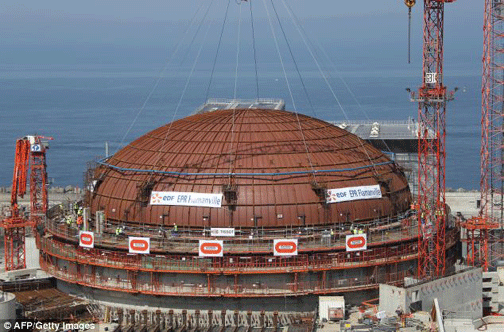
FRANCE’S NUCLEAR ENERGY POLICY: A CHRONICLE OF FAILURE – FLAMANVILLE 3
25 December 2025
France’s ambitious nuclear energy policy, once hailed as a cornerstone of its energy independence, has faced a long series of missteps, delays, and spiralling costs. The Flamanville 3 reactor, emblematic of these challenges, has taken over two decades from decision to anticipated commercial operation, showcasing the systemic failures in planning, execution, and financial management. This timeline highlights the stark realities behind France’s nuclear endeavours.
TIMELINE: 2002 FRENCH NUCLEAR RENAISSANCE
2002: POLITICAL DISCUSSIONS BEGIN
Discussions around a nuclear renaissance gain traction in France. Policymakers and EDF propose new reactor designs to bolster energy independence and address climate goals.
DECISION: 2004
The decision to build the Flamanville 3 reactor marked the beginning of a new chapter for France’s nuclear ambitions. With an estimated cost of €3.3 billion and a planned construction timeline of 56 months, this European Pressurised Reactor (EPR) was touted as a symbol of technological advancement. However, the project’s initial promise soon gave way to setbacks.
INITIAL WORKS: 2006
Preliminary works commenced in 2006, with optimism running high. The EPR design, developed to enhance safety and efficiency, was heralded as the future of nuclear energy. Yet, from the outset, the complexity of the design began to reveal challenges that would compound over time.
REACTOR CONCRETE: 2007
In 2007, construction on the reactor’s concrete base began, symbolising tangible progress. Simultaneously, the cost estimate was revised to €3.3 billion, as technical adjustments and initial delays started to emerge. Early warnings about budget overruns and scheduling issues were largely ignored.
GRID CONNECTION: 2024
After 17 years of setbacks, the reactor was finally connected to the grid. By this point, the budget had ballooned to €13.2 billion, a nearly fourfold increase from the original estimate. The delays and cost overruns underscored critical deficiencies in project management and regulatory compliance, as over 7,000 design changes required significant material additions.
COMMERCIAL OPERATION: 2025 Q1 The reactor is expected to achieve commercial operation in early 2025, over a decade behind schedule. The protracted timeline—more than 20 years from decision to operation—illustrates the systemic inefficiencies plaguing France’s nuclear energy strategy.
COST OVERRUNS AND FINANCIAL STRAIN
The financial fallout from Flamanville 3 is emblematic of broader challenges in the nuclear industry. Initially budgeted at €3.3 billion, the project’s costs had soared to €19.1 billion by 2020, with further increases likely. These overruns mirror similar issues faced by EDF’s international projects, such as Hinkley Point C in the United Kingdom and Olkiluoto 3 in Finland. Hinkley’s budget has nearly doubled to an estimated £46 billion, with completion now pushed to 2029–31.
EDF’S MOUNTING DEBTS AND CHALLENGES
EDF, the state-owned utility tasked with leading France’s nuclear initiatives, has been burdened by mounting debts. With a €65 billion debt load and a near €18 billion loss in 2022, EDF’s financial woes have raised questions about its capacity to handle multiple large-scale projects. Efforts to stabilise its finances through state support and electricity price adjustments have provided temporary relief but have not addressed structural issues.
BROADER IMPLICATIONS
The delays and cost overruns at Flamanville and other EPR projects have cast doubt on the viability of France’s nuclear renaissance. President Macron’s commitment to building six to 14 new reactors appears increasingly untenable given EDF’s financial and operational struggles. Moreover, these challenges have weakened France’s position as a global leader in nuclear technology, with international competitors advancing at a faster pace.
A FAILED STRATEGY
The failure of France’s nuclear energy policy is evident in its inability to deliver projects on time and within budget. The Flamanville 3 reactor, once a beacon of innovation, has become a cautionary tale of mismanagement and overreach. As France doubles down on nuclear energy, it must confront the hard truths of its flawed approach and consider whether a pivot to more agile and cost-effective renewable energy solutions is necessary to ensure its energy security and economic stability.
France connected its first nuclear reactor to the grid this century. Construction was to take 56 months.
2002 TIMELINE STARTS THE
FRENCH NUCLEAR RENAISSANCE
Initial works: construction was to take 56 months.
Timeline:
• decision: 2004
• initial works: 2006
• reactor concrete: 2007
• grid connection: 2024
• commercial operation: 2025 Q1
22 December 2024 Reports
We don’t know the final cost of France’s new #nuclear reactor at Flamanville, but guestimates it’ll be a few hundred $million higher than the 2020 figure:
• 2007 cost estimate: €3.3bn
• 2020 cost estimate: €19.1bn
Workers Seek Shelter As Hanford Nuclear Complex Issues Leak Alert

Oil Price, By Alex Kimani – Dec 23, 2024
Workers at the Hanford nuclear site were ordered to take cover on Friday after a large holding tank with ammonia vapor was discovered to be leaking near the vitrification plant in the 200 East Area. Workers in that area were told to shelter in place with doors, windows and ventilation closed while other workers were told to avoid the 200 East Area. The Hanford Site is a decommissioned nuclear production complex operated by the United States federal government on the Columbia River in Benton County in the U.S. state of Washington
The 200 East Area has a vitrification plant, built and commissioned to treat the tank waste for disposal. The waste was left from the past production of plutonium from World War II through the Cold War for America’s nuclear weapons program. Today, there are 177 underground storage tanks on the Hanford Site, holding about 56 million gallons of highly radioactive and chemically hazardous waste.
The Hanford incident highlights the ongoing challenges of dealing with nuclear waste. Currently, there are thousands of metric tons of used solid fuel from nuclear power plants worldwide and millions of liters of radioactive liquid waste from weapons production sitting in temporary storage containers, some of which have begun leaking their toxic contents. Nuclear waste is notorious for the fact that it can remain dangerously radioactive for many thousands of years. ……………..https://oilprice.com/Latest-Energy-News/World-News/Workers-Seek-Shelter-As-Hanford-Nuclear-Complex-Issues-Leak-Alert.html
1 This Month
29 Jan. Thursday 7-8 p.m. Webinar – World’s Largest Nuclear Station in Port Hope, ON?
To see nuclear-related stories in greater depth and intensity – go to https://nuclearinformation.wordpress.com/



31st January – Challenging the War Machine – a DECLASSIFIED UK SUMMIT


Website of the Week
Now until to February 10, 2026 Radioactive waste storage in France: the debate is finally open! How to participate?
-
Archives
- January 2026 (296)
- December 2025 (358)
- November 2025 (359)
- October 2025 (376)
- September 2025 (258)
- August 2025 (319)
- July 2025 (230)
- June 2025 (348)
- May 2025 (261)
- April 2025 (305)
- March 2025 (319)
- February 2025 (234)
-
Categories
- 1
- 1 NUCLEAR ISSUES
- business and costs
- climate change
- culture and arts
- ENERGY
- environment
- health
- history
- indigenous issues
- Legal
- marketing of nuclear
- media
- opposition to nuclear
- PERSONAL STORIES
- politics
- politics international
- Religion and ethics
- safety
- secrets,lies and civil liberties
- spinbuster
- technology
- Uranium
- wastes
- weapons and war
- Women
- 2 WORLD
- ACTION
- AFRICA
- Atrocities
- AUSTRALIA
- Christina's notes
- Christina's themes
- culture and arts
- Events
- Fuk 2022
- Fuk 2023
- Fukushima 2017
- Fukushima 2018
- fukushima 2019
- Fukushima 2020
- Fukushima 2021
- general
- global warming
- Humour (God we need it)
- Nuclear
- RARE EARTHS
- Reference
- resources – print
- Resources -audiovicual
- Weekly Newsletter
- World
- World Nuclear
- YouTube
-
RSS
Entries RSS
Comments RSS
 nuclear-news