As the Gaza genocide continues, it cannot be a happy 2025

I’m sorry. I can’t rejoice over the New Year and all that stuff. How can we keep pretending – with bells and whistles and fireworks, and worthy preachings from pulpits and parliaments- that it’s all going to be better?
It’s not. It’s going to be worse. Many atrocities have occurred inthe past – and we’ve been shocked to hear about them – afterwards.
Now the atrocity is going on – in Gaza – and we know all about it, while it is happening.
I just remember, when I was a little kid – seeing pictures of Auschwitz. How could people be so cruel to other people? I couldn’t believe it.
I read The Diary of a Young Girl, by Anne Frank , who died at 15 in Auschwitz. Anne Frank had written in her diary “I still believe that people are really good at heart”. That quotation has sustained me for decades.
I wonder what Anne Frank would think about what the Israelis are doing in Gaza. Would she join the many Jews who are trying to make it stop – and are being called “anti-semitic”, some being arrested as “terrorists”?
Jonathon Cook, writing in Middle East Eye, describes how “the wilfully blind, which includes western politicians and their media, are still in denial” . “The West Yawns” as each new research report spells out the genocide that is continuing:
“Nearly 15 months on, the Gaza genocide has become entirely normal, it has become just another minor, routine news item to be buried on the inside pages.”
” those accounts made no impact on the western political and media consensus. Nothing has stuck, even when it is the soldiers themselves documenting their atrocities, and even when it is Israeli Holocaust experts concluding that these crimes amount to genocide.’
The UN Special Committee found Israel’s warfare methods in Gaza to be consistent with genocide, including use of starvation as weapon of war.
Amnesty published a 296-page report concluding that Israel is committing genocide in Gaza. Human Rights Watch issued an 185-page report . Medecins Sans Frontieres (MSF) issued its report, titled Life in the Death Trap That is Gaza.
Of course the USA government immediately rejected the conclusion that Israel is committing genocide. UK and other allies, and the global corporate media dutifully followed suit, and continue to do so.
In 2025, the genocide in Gaza draws to its final stages. It looks as if the global corporate media is going to sigh about it all, spout politicians’ pious statements about the suffering, remind us of the Hamas’ conducted atrocity in October 2023, and of Israel’s “right to defend itself”.
Billionaire- run corporations already dominate the Western media. In the presidency of Joe Biden, it has been bad enough, as Biden continued to support the export of U.S. weaponry to Israel, while his hypocritical Secretary of State, Antony Blinken, said “all the right things” about seeking peace in Gaza.
I wish that I could predict an optimistic development for Gaza, given that there is so much international awareness of the genocide, so many respected researchers who expose it. But there’s the incoming Trump administration in the USA. Trump’s appointees regarding foreign policy and the Middle East form a string of longterm supporters of Israel. Mike Huckabee will be his ambassador to Israel, Marco Rubio his Secretary of State, Steven Witkoff Special Envoy to the Middle East. A further complication, however, might be Trump’s relationship and strong business connections with Saudi Arabia which is not Israel’s best friend and still does not recognize Israeli sovereignty.
The power and influence of a Trump administration over the media is sure to create confusion in the public mind, about many things, but especially about Israel and Gaza. Trump is supposed to have some sort of complex plan for ending Israel’s war on Gaza, but it seems to boil down to open slather on the people of Gaza.
Amidst the confusion the media has a splendid ability to distract attention away from this Gaza horror, making us all, in away, complicit.
Still there are millions, world-wide, who know that this evil should be named and stopped
There will be continued international efforts, including legal ones, to demand a fair cessation of this war. Michael Lynk writes in AA about support for the Palestinians – “a global movement of solidarity – particularly among the young – that will continue to inspire courageous thinking and bold acts. Its lasting impact should never be underestimated.”
Israel Is Killing Civilians In Gaza On Purpose, And It’s Not Even Debatable.
Caitlin Johnstone, Dec 27, 2024
Just so we’re all clear, it is a fully established fact that the IDF is directly, deliberately killing civilians in Gaza. There was a time in the early days of the genocide when this could be disputed, but that is no longer true. The facts are in and the case is closed. It’s happening.
Israeli soldiers are telling the press that they’ve been knowingly killing civilians and then falsely categorizing them as terrorists afterward. Countless doctors have testified to routinely encountering dead and wounded children who’ve been shot in the head by Israeli snipers. Israeli media reports have revealed that the IDF is intentionally targeting civilian infrastructure and using AI systems to specifically target suspected Hamas members when they are at home with their families instead of out on the battlefield.
The debate is over. The “human shields” argument has been completely, thoroughly debunked. If you still deny that this is happening, its because your worldview is so false that it requires you to deny facts and reality.
❖
We were fed lies about what happened on October 7. We were fed lies about the Israeli abuses which led to October 7. We’ve been fed lies about what’s been done for the last 15 months under the justification of October 7. And yet Israel’s defenders still expect to be taken seriously when they babble about October 7 in response to criticisms of Israel’s actions.
It doesn’t have to be this way. We’re fed mountains of stories by the rich and powerful explaining why things must remain as they are — but they are only stories.
Every sociopolitical status quo throughout history has had power-serving narratives explaining why things are as they are and justifying why the people in charge live so much more comfortably than the ordinary folks doing the real work in this world. People used to be told that kings received their authority directly from God, and were therefore better and more worthy than the unwashed masses. Today we have different rulers with different narratives justifying their rule and explaining why vast inequality is fine and good, but those narratives are exactly as fictional as the old stories about the divine right of kings.
Today we are trained to believe that the plutocrats who rule our society attained their vast fortunes through hard work and clever innovation, and are entitled to every penny because they are the most productive members of our society. Just as the peasants of old were taught about the divine right of kings, we are taught that capitalism is the most fair and equitable of all possible systems and that the US-led world order ensures that freedom and democracy will be protected and promoted for the benefit of all.
These are all made-up stories, no truer than the story that monarchs were imbued with magical king powers by an invisible deity because their blood was special. But they are treated as serious facts by those who are responsible for training us how to think, and by those who swallow this indoctrination.
In reality we can change how things are whenever we want, and there’s no good reason not to. There are a whole lot more of us than there are of our rulers, and the oligarchs and empire managers who currently hold the steering wheel are destroying our biosphere while increasing inequality and exploitation and pushing us toward nuclear war on multiple fronts.
We have the ability to wrest that steering wheel away from them any time enough of us work up the will to do so. All the stories to the contrary we might believe are just fictional thought-fluff that our rulers put in our minds for their own benefit.
❖
There’s nothing wrong with being politically homeless at this point in history. Humanity as a whole is still wildly confused and dysfunctional in this particular slice of spacetime, and even the very best political factions are dominated by highly neurotic people who take no responsibility for their psychological state and internal clarity. If you’ve found a political party or faction you trust then that’s great, but if you haven’t then it is perfectly fine to stand as an individual while throwing your support behind worthy causes and movements on a case-by-case basis as they emerge without permanently hitching yourself to anyone else’s wagon.
We’ve still got a long way to go in maturing as a species, and it might be a while before a unified political faction arises that you can trust to consistently move in the highest interest.
Another expert report finds Israel is committing genocide. The West yawns
“Like in every other case of genocide in history, right now we have mass denial. Both here in Israel and around the world.”
a genocidal view widely shared in Israel, that “there are no innocents in Gaza”. Even Israel’s supposedly liberal President Isaac Herzog has said as much.
But like everything about this genocide, those accounts made no impact on the western political and media consensus. Nothing has stuck, even when it is the soldiers themselves documenting their atrocities, and even when it is Israeli Holocaust experts concluding that these crimes amount to genocide.
How is this permanent condition of mass denial possible? There is nothing normal or natural about it. The denial is being actively and furiously manufactured.
Nearly 15 months on, the Gaza genocide has become entirely normal, it has become just another minor, routine news item to be buried on the inside pages.
Jonathan Cook, 24 December 2024 , https://www.middleeasteye.net/opinion/gaza-israel-another-expert-report-committing-genocide-west-yawns
Amnesty, Human Rights Watch, and Medecins Sans Frontieres are all agreed. But the Gaza genocide is now just another routine news item, buried on the inside pages.
hree separate reports published this month by leading international human rights and medical groups have detailed the same horrifying story: that Israel is well advanced in its genocide of the Palestinian population in Gaza.
Or, to be more accurate, they have confirmed what was already patently clear: that, for the past 14 months, Israel has been slaughtering tens of thousands of Palestinians with indiscriminate munitions, while at the same time gradually starving the survivors to death and denying them access to medical care.
Genocides can happen with gas chambers. Or with machetes. Or they can be carried out with 2,000lb bombs and aid blockades. Genocides rarely look the same. But they are all designed to arrive at the same endpoint: the elimination of a people.
Amnesty International, Human Rights Watch and Medecins Sans Frontieres (MSF) agree that Israel is striving for extermination. It has not hidden its intent, and that intent is confirmed by its actions on the ground.
Only the wilfully blind, which includes western politicians and their media, are still in denial. But worse than denial, they continue to actively collude in this, the ultimate crime against humanity, by supplying Israel with the weapons, intelligence and diplomatic cover it needs for the extermination.
Last week, MSF issued its report, titled Life in the Death Trap That is Gaza, concluding that Israel was intentionally “unravelling the fabric of society”.
The medical charity observed: “The violence unleashed by Israeli forces has caused physical and mental damage on a scale that would overwhelm any functioning health system, let alone one already decimated by a crushing offensive and a 17-year-long blockade [by Israel].”
MSF added: “Even if the offensive ended today, its long-term impact would be unprecedented, given the scale of the destruction.”
Rebuilding the society and dealing with the health consequences will “span generations”.
Intention proven
MSF’s findings followed hot on the heels of an 185-page report by Human Rights Watch, which concluded that Israel was committing “acts of genocide”.
The organisation limited its focus to one Israeli policy: its systematic effort to deprive the population of access to water – a clear measure of intentionality, the critical yardstick for judging whether mass killing has crossed into genocide.
At a news conference, Lama Fakih, HRW’s Middle East director, said their research had proved Israel was “intentionally killing Palestinians in Gaza by denying them the water that they need to survive”.
Israel had done so in four coordinated moves. It had blocked pipelines supplying water from outside Gaza. It had then cut off power to run the pumps that Gaza’s own supplies from wells and desalination plants depended on.
Next, it had destroyed the solar panels that were the backup to deal with such power cuts. And finally, it had killed crews trying to repair the supply system and aid agency staff trying to bring in water supplies.
“This is a comprehensive policy preventing people from getting any water,” HRW’s acting Israel and Palestine director, Bill Van Esveld, concluded. He added that the group had made “a very clear finding of extermination”.
‘Pattern of conduct’
HRW echoed a much wider-ranging report by Amnesty International, the world’s best-known international human rights organisation.
In a 296-page report published in early December, Amnesty concluded that Israel had been “brazenly, continuously” committing genocide in Gaza – or “unleashing hell” as the organisation phrased it more graphically.
The period of Amnesty’s research ended in July, five months ago. Since then, Israel has further intensified its destruction of northern Gaza to drive out the population.
Nonetheless, Amnesty described a “pattern of conduct” in which Israel had deliberately obstructed aid and power supplies, and detonated so much explosive power on the tiny enclave – equivalent to more than two nuclear bombs – that water, sanitation, food and healthcare systems had collapsed.
The scale of the attack, it noted, had caused death and destruction at a speed and level unmatched in any other 21st-century conflict.
Budour Hassan, Amnesty’s researcher for Israel and the occupied Palestinian territories, said Israel’s actions went beyond the individual war crimes associated with conflicts: “This is something deeper.”
Agreeing with major Holocaust and genocide scholars, Amnesty concluded that the high bar needed to prove genocidal intent in law was crossed last May when Israel began destroying Rafah, the area in southern Gaza that it had herded Palestinian civilians into as a supposedly “safe zone”.
Israel had been warned not to attack Rafah by the world’s highest court, the International Court of Justice (ICJ), but went ahead anyway.
‘Mass denial’
For some time, leading Holocaust and genocide scholars – among them Israelis – have been speaking up to warn not only that a genocide is unfolding, but that it is nearing completion.
Last week, Omer Bartov even managed to get his message out on CNN. He told Christiane Amanpour that Israel was carrying out “a war of annihilation” on the Gaza Strip. “What the IDF [Israeli military] is doing there is destroying Gaza,” he said.
Amos Goldberg, another Israeli Holocaust expert, noted that Raphael Lemkin, a Jewish-Polish scholar who coined the term “genocide”, described its two phases.
“The first is the destruction of the annihilated group and the second is what he called ‘imposition of the national pattern’ of the perpetrator. We are now witnessing the second phase as Israel prepares ethnically cleansed areas for Israeli settlements.”
Goldberg added: “Like in every other case of genocide in history, right now we have mass denial. Both here in Israel and around the world.”
Bartov’s invitation by CNN appeared to have been provoked by an article in Haaretz, Israel’s most liberal newspaper. It published last week testimonies from Israeli combat soldiers, in which they described committing and witnessing war crimes in Gaza. They paint a picture of systematic erasure that, even from their limited perspective, looks ominously like genocide.
The soldiers describe shooting dead anyone who moves inside undeclared so-called “kill zones”, even children, and then claiming them to be “terrorists”. The dead are left to be eaten by packs of dogs.
The only words one Israeli reservist found to describe Israel’s repeated and intentional killing of children in Gaza was “pure evil”.
According to a senior reserve commander recently returned from the enclave, the Israeli army has created “a lawless space where human life holds no value”.
Another says units compete to see who can kill the greater number of Palestinians, indifferent to whether they are Hamas fighters or civilians.
Others describe these units as operating like “independent militias”, unrestrained by military protocols.
‘Everyone is a terrorist’
How the Israeli army implemented the Gaza genocide is alluded to in the Haaretz article. After the Hamas attack on 7 October 2023, the military leadership devolved normally centralised decision-making to local field commanders.
Many of those commanders live in the most religiously extreme of the illegal Jewish settlements in the West Bank. Not only are they Jewish supremacists, but they follow rabbis who believe all Palestinians, even babies, pose a threat to the Jewish people and must be exterminated.
Notoriously, a group of influential settler rabbis formalised their genocidal teachings into a book called The King’s Torah.
One senior commander identified by Haaretz is Brigadier General Yehuda Vach, a settler from Kiryat Arba, possibly the most extreme of all Israel’s West Bank settlements.
For many years, Vach headed the military’s officers training school, passing on his extreme views to a new generation of officers, presumably some of whom are now making decisions in Gaza.
Today, he heads Division 252, in which many of the soldiers who spoke to Haaretz have served.
One of his officers recounted how, after Hamas’ military leader Yahya Sinwar was killed in October, Vach held an official meeting to determine what to do with his body. He wanted to strip Sinwar’s corpse naked, put it in a public square, dismember it and pour sewage over the remains.
In an address to soldiers, he is reported to have echoed a genocidal view widely shared in Israel, that “there are no innocents in Gaza”. Even Israel’s supposedly liberal President Isaac Herzog has said as much.
But according to one officer, Vach has made this view an “operational doctrine”.
Vach’s view of Palestinians is that “everyone’s a terrorist”. And that means, given Israel’s current, explicit aims in Gaza, everyone must be killed.
Nothing sticks
None of this should surprise us. Israeli leaders from the very start announced their genocidal intent. And more than a year ago, Israeli soldiers serving in Gaza began telling us of the systematic nature of Israel’s war crimes.
But like everything about this genocide, those accounts made no impact on the western political and media consensus. Nothing has stuck, even when it is the soldiers themselves documenting their atrocities, and even when it is Israeli Holocaust experts concluding that these crimes amount to genocide.
It has been nearly a year since the ICJ, comprising more than a dozen internationally respected judges, decided that a “plausible” case had been made that Israel was carrying out a genocide in Gaza.
The judiciary is amongst the most conservative of professions.
The situation in Gaza is incalculably worse than it was last January when the court issued its ruling.
But the wheels of justice are required to turn slowly, even though Gaza does not have time on its side.
How is this permanent condition of mass denial possible? There is nothing normal or natural about it. The denial is being actively and furiously manufactured.
Only because we live in a world where billionaires own our politicians and media do we need courts and human rights groups to confirm what we can already see quite clearly being live-streamed to our devices.
Only because we live in a world owned by billionaires do those same courts and rights organisations spend long months weighing the evidence to protect themselves from the inevitable backlash of smears aimed at discrediting their work.
And only because we live in a world owned by billionaires is it possible, even after all those delays, for our politicians and media to ignore the findings and carry on as before.
The system is rigged to favour the imperial hub of the United States and its client states.
If you are an African dictator, or an official enemy of the so-called West, the most minimal evidence suffices to prove your guilt.
If you are under the protection of the US godfather, no amount of evidence will ever be enough to put you behind bars.
It is known as realpolitik.
Always another story
For many months, the western media’s role has been to gaslight us by pretending the genocide is something else.
First, the mass slaughter of Palestinians was presented simply as a natural desire by Israel to eliminate “terrorism” on its doorstep following the Hamas attack of 7 October 2023.
It was chiefly a story of Israeli “self-defence” that conveniently overlooked the preceding decades in which Israel had driven Palestinians off their land, either out of their homeland entirely or into ghettoes, then colonised the land illegally with apartheid-style Jewish settlements, and subjected the Palestinian ghettoes to brutal Israeli military rule.
In the coverage after 7 October, the Palestinians – long the victims of an illegal occupation – were viewed as squarely to blame for their own suffering. To suggest anything else – to worry that a genocide was unfolding – was a sure sign of antisemitism.
Then, as the slaughter intensified – as Gaza was levelled, hospitals wrecked, the population collectively punished with an aid blockade – the official story faltered.
So a new narrative was advanced: of international efforts to reach a ceasefire ending “the cycle of violence”, of the focus on securing the release of the hostages, of Hamas intransigence.
We were back to the familiar framework of an intractable conflict, in which both sides were to blame – though, of course, the Palestinians more so.
Now, as it becomes impossible to continue pretending that Israel wants peace, to ignore the fact that it is expanding the slaughter, not reining it in, the media strategy has shifted once again.
As the genocide reaches its “final stage” – as the Israeli Holocaust scholars Omer Bartov and Amos Goldberg warn – the media have largely lost interest. If there is no way to both-sides the genocide, then it must be disappeared.
And in media-land, there is always another story that can be promoted. There will always be another front-page lead rather than the most disturbing one of all, in which western leaders and the media are full participants in the live-streamed extermination of a people.
BBC buries the news
That is the context for understanding the media’s collective yawn as the three genocide reports dropped one after another this month.
Israel’s accusations that Amnesty’s report was antisemitic were entirely expected. What should not have been was the media’s largely indifferent response.
The BBC was a case study in how to bury bad news. Its flagship television news programmes – the dominant news source for Britons – ignored the story completely.
Meanwhile, its poor cousin, the 24-hour news channel, which draws a far smaller audience, did mention the Amnesty report, but captioned it: “Israel rejects ‘fabricated’ claims of genocide.”
In other words, when the BBC did offer very limited coverage, it skipped the news story of Amnesty’s findings and went straight to Israel’s predictable, outraged reaction.
In an investigation for Drop Site News last week, Guardian columnist Owen Jones spoke to 13 current and recently departed BBC staff. They said the corporation’s coverage of Gaza was heavily skewed to present Israel’s actions in a favourable light.
In a WhatsApp chat for senior BBC Middle East editors, correspondents and producers, one participant – incensed by the “fabricated claims” caption – wrote: “FFS! – It’s an open goal for those who say we’re frit [afraid] of upsetting the Israelis and keep on couching our stories in an ‘Israel says’ narrative’.”
The BBC’s website, by far the most influential English-language online news source, inexplicably ignored the Amnesty report for 12 hours after the embargo was lifted.
Even then, it appeared as the seventh item. For the following week, it was not included in the “Israel-Gaza” index on the website’s front page, making it unlikely it would be found.
This pattern has long been true in the BBC’s coverage of Israel and Palestine, but it has become far more glaring since the stakes were raised for Israel by its genocide. https://www.youtube.com/watch?v=2vLrmM1KjxE
As Jones’s investigation discloses, BBC management has tightly restricted control over the Gaza coverage to a small number of journalists known to hew closely to Israel’s view of events – and despite their editorial role provoking what Jones calls a “civil war” in the BBC newsroom.
Notably, Jones did not publish his investigation in the Guardian, where there have been similar reports of staff indignant at the paper’s failure to give proper weight to the genocidal nature of Israel’s actions.
Rigged algorithms
What the BBC has been doing is not exceptional. As soon as a light is shone into the dark recesses of the state- and billionaire-owned media, the same picture always emerges.
Last week, an investigation revealed that Meta, the company that owns Facebook and Instagram, intentionally rigged its algorithms to suppress reports from the biggest Palestinian news sources after the Hamas attack of 7 October 2023.
Palestinian news outlets saw their views on Meta platforms fall significantly after the attack – on average by 77 percent – when they should have expected to see far greater interest. By contrast, views of Israeli news outlets rose sharply.
Paradoxically, the investigation was published by the BBC, though notably the research was initiated and carried out by the staff of its Arabic news service.
Also last week, more than a dozen whistleblowers from Deutsche Welle, Germany’s equivalent of state broadcaster the BBC, revealed to Al Jazeera that a culture of fear reigns in the newsroom when it comes to critical coverage of Israel.
Similar reports from whistleblowing staff have exposed the rigged nature of the coverage – always in Israel’s favour – in other major outlets, from CNN to the New York Times and the Associated Press news agency.
In reality, the same skewed news agenda can be found in every newsroom in every corporate media outlet. It just requires whistleblowers to come forward, and for there to be someone willing to listen and in a position to publish.
Why? Because a genocide unfolding in plain sight cannot be made to appear normal without an enormous expenditure of effort from institutional media to close the eyes of their audiences. To hypnotise us into indifference.
State of anxiety
Too many of us are susceptible to this process – and for a number of reasons.
In part, because we still trust these institutions, even though their chief function is to persuade us that they are there for our benefit – rather than the reality that they serve the interests of the larger corporate structures to which they belong.
Those western structures are invested in resource theft, asset-stripping and wealth concentration – all, of course, pursued at the expense of the global south – and the war industries needed to make this pillage possible.
But also, it is part of our psychological makeup that we cannot sustain attention on bad news indefinitely.
To watch a genocide unfold week after week, month after month, and be unable to do anything to stop it, takes a terrible toll on our mental health. It keeps us in a permanent state of anxiety.
The corporate structures that oversee our media understand this only too well. Which is why they cultivate a sense of powerlessness amongst their audiences.
The world is presented as a baffling place, where there are inexplicable forces of evil that act without any comprehensible causation to destroy all that is good and wholesome.
The media suggest international affairs are little different from a game of whack-a-mole. Whenever the good West tries to solve a problem, another evil mole pops up its head, whether it be Hamas terrorists, Hezbollah terrorists, Syria’s former dictator Bashar al-Assad, or the mad mullahs of Iran
With this as the framework for the Gaza genocide, audiences are left sensing either that what is happening to Palestinians, however horrifying, may be deserved or that investing too much concern is a waste of energy and time. Another crisis will be along in a moment equally demanding of our attention.
And so it will. Because that is precisely the way the corporate media works. It offers a conveyor belt of bad news, one bewildering event after another – whether it be another disgraced celebrity, or murdered schoolgirl, or an outbreak of war.
The media’s role – the reason states and corporations keep such a tight grip on it – is to stop us from gaining a wider picture of the world, one on which our hands look far more bloodied than the “terrorists” we sit in judgment on. One where a powerful western elite, its corporate empire headquartered in the US, runs the planet as nothing more than a wealth-extraction machine.
And so we, the publics of the West, shrug our shoulders once again: at “man’s inhumanity to man”, at “the cycle of violence”, at “the barbarians at the gate”, at “the white man’s burden”.
Nearly 15 months on, the Gaza genocide has become entirely normal, it has become just another minor, routine news item to be buried on the inside pages.
Scots to pay ‘£1.5m every day for 30 years’ towards Trident renewal
The National 27th Dec 2024, https://www.thenational.scot/news/24821011.scots-pay–1-5m-every-day-30-years-towards-trident-renewal/
The Alba Party have used the latest National Records of Scotland (NRS) figures available as well as a House of Commons library report to highlight the daily cost of the UK’s so-called nuclear deterrent to Scotland.
The party have also used an estimate by the Campaign for Nuclear Disarmament that up to £205 billion will be spent on replacing the nuclear deterrent that is based at Faslane and Coulport – which considers in-service costs (at 6% of the defence budget) over the 30 years and the cost of additional factors such as infrastructure investment.
Calculated per head of population, Scotland’s share towards the renewal would be over £16 billion – which then comes to over £1.5m every day over the next 30 years.
All three main pro-independence parties have a policy that the Trident would be swiftly removed from a future independent Scotland.
But now, with this new analysis in mind, former defence worker and Alba’s General Secretary Chris McEleny says that the cost of Trident renewal “must be on the table in the here and now”.
He added: “ When we talk about spending over £200 billion on the next generation of nuclear weapons, it is such an abstract and huge number. But what these figures released by Alba Party today show is what the cost will be every single day.
“It is the equivalent of providing free school lunches to around one hundred and fifty classes every single day or paying an additional fifteen thousand pensioners a winter fuel payment every single day.
“When one in four children in Scotland live in poverty it is obscene to be spending so much money every day for the next thirty years on weapons of mass destruction when that money could instead be invested in Scotland’s future.”
Villagers oppose proposed nuclear plant in Arasinkeri
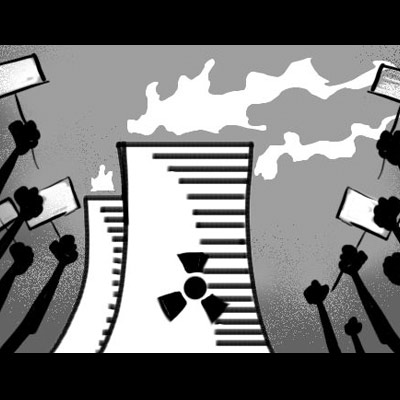
Hindustan Times,By Coovercolly Indresh, Bengaluru, Dec 21, 2024,
https://www.hindustantimes.com/india-news/villagers-oppose-proposed-nuclear-plant-in-arasinkeri-101734721956152.html
The residents of Arasinkeri village in Karnataka’s Koppal district have vowed not to surrender their land for the proposed establishment of a nuclear power plant near their village.
The central government’s initiative to set up a nuclear power plant in the region has caused significant apprehension among the villagers. The Department of Atomic Energy has reportedly directed local authorities to identify at least 1,200 acres of land surrounding Arasinkeri for the project. Revenue department officials have started surveying the area to locate suitable sites.
On December 13, the villagers made an official plea to Koppal deputy commissioner Nalini Atul, urging the government to abandon the project. They warned that failure to address their concerns could result in intensified protests.
“Arasinkeri is already burdened by pollution from over a hundred factories, including steel plants. Living conditions are already difficult. The majority of residents here depend on agriculture and forestry. Adding a nuclear power plant will destroy our livelihoods and pose irreversible risks to our health and the environment,” said M Veerabhadrappa, a local farmer. He is one of the 2,500 villagers who have refused to surrender their land.
The proposed site reportedly includes over 400 acres of forest land in Survey No 80 and another 100 acres in Survey No 9, areas critical to both the local community and biodiversity. Villagers fear the project will disrupt the fragile balance of their environment while threatening their safety and well-being.
On December 13, officials from NTPC (National Thermal Power Corporation) visited Koppal district and conducted an inspection in Arasinkeri village. “The project is still in its preliminary stages. If the site is approved, farmers will be provided with suitable compensation for their land. A technical team from Delhi is expected to visit soon to finalise the location,” Koppal sub-divisional magistrate Mahesh Malagati told Hindustan Times.
Despite these assurances, anxiety among villagers continues to grow. Their primary concern lies in the health risks associated with having a nuclear power plant in close proximity. They worry about potential contamination and other hazards that could affect both people and the environment.
“The government needs to understand that a nuclear power plant near a densely populated area is unacceptable,” said another villager. “We will continue to oppose this project with all our might.”
‘We need to be prepared’: China adapts to era of extreme flooding

“The Chinese leadership tends to see the long game,” Li said. “To demonstrate their far-sight and to prevent further risks, more should be done to prepare for the impacts of climate change systematically.”
While some residents take to building houses in trees, officials recognise need for national response to climate disasters
Amy Hawkins , Guardian 24th Dec 2024, https://www.theguardian.com/world/2024/dec/24/we-need-to-be-prepared-china-adapts-to-era-of-extreme-flooding
Every summer, Dongting Hu, China’s second-largest freshwater lake, swells in size as flood water from the Yangtze River flows into its borders. Dams and dikes are erected around the lake’s edges to protect against flooding. But this year, not for the first time, they were overwhelmed.
For three days in early July, more than 800 rescue workers in Hunan province scrambled to block the breaches. One rupture alone took 100,000 cubic metres of rock to seal, according to Zhang Yingchun, a Hunan official. At least 7,000 people had to be evacuated. It was one of a series of disasters to hit China as the country grappled with a summer of extreme weather. By August, there had been 25 large floods, the biggest number since records began in 1998, reported state media.
Xi Jinping, China’s president, “urged all-out rescue and relief work” to safeguard the people affected by the flooding in Hunan, state media reported.
One of those people was Ren Benxin, an archaeologist who lives on a small, forested island in the upper tributaries of Dongting Hu. He calls his idyllic home Soultopia. As well as carrying out archaeological research, he provides accommodation for travellers and looks after the herd of stray cats and dogs that he has adopted over the years.
On 5 July, his home was flooded. “First, I rescued the animals. Then, I rescued the supplies,” he said. “It was the first time in 10 years that I’d experienced something like this.”
The wooden huts in Ren’s corner of the islet were nearly completely submerged in muddy water. Chickens used the remnants of destroyed buildings as rafts to avoid drowning. Ren traversed the island in a small plastic dinghy. One of his dogs, Eason, fell ill after drinking dirty flood water, and died a few days later.
“Two years ago, we had a severe drought, and this year it’s been floods. I think we need to be prepared for anything,” Ren said.
Experiences like Ren’s are becoming more common in China, as
global heating makes extreme weather events more likely, as well as undermining communities’ defences against those disasters.
Dongting Hu exemplifies these challenges. It was once China’s largest freshwater lake. But decades of agricultural development meant that huge swathes of its land were reclaimed for farming, reducing the lake’s storage capacity. Both droughts and floods are becoming more serious and severe.
At least six Chinese provinces experienced major flooding in 2024. As well as the floods in Hunan, heavy rainfall in Guangdong, China’s most populous province, forced more than 110,000 people to relocate. After years of treating weather disasters as isolated incidents that require a local response, Chinese officials are becoming increasingly aware of the need to adapt to extreme weather events on a national scale.
“The harsh reality is here: the lack of climate action will cost China and present a social security threat,” said Li Shuo, director of the China Climate Hub at the Asia Society Policy Institute.
At the Cop29 UN climate crisis conference in November, China published an action plan for climate adaptation, vowing to establish a technical platform to monitor and forecast extreme weather events and to share its knowledge of improving early warning mechanisms.
It marked a shift the country which has long acknowledged the science of the climate crisis, but has focused its environmental cleanup efforts on issues such as air pollution – rather than severe but relatively rare floods and droughts.
“The Chinese leadership tends to see the long game,” Li said. “To demonstrate their far-sight and to prevent further risks, more should be done to prepare for the impacts of climate change systematically.”
For flooding victims like Ren, an official recognition of – and compensation for – the damage wrought by the climate crisis cannot come soon enough. The repair work cost him more than 70,000 yuan (£7,600), although the authorities did send some relief workers to help.
For now, Ren is developing his own ways to adapt to climate breakdown. He shuns electrical appliances after his were destroyed in the flood, and uses wood burners for cooking and heating. He plans to build a new home suspended in trees, so as to be safe from floods.
“I think extreme weather is more frequent now. So I have to be prepared for anything. If I like the place, I’ll stay.”
Additional research by Chi-hui Lin and Jason Tzu Kuan Lu
The Guardian view on arms control: essential to prevent the total devastation of nuclear war

Guardian 27th Dec 2024, https://www.theguardian.com/commentisfree/2024/dec/27/the-guardian-view-on-arms-control-essential-to-prevent-the-total-devastation-of-nuclear-war
Next November marks 40 years since the US president Ronald Reagan and the Soviet leader Mikhail Gorbachev declared that “a nuclear war cannot be won and must never be fought”. The statement was striking – not least because their militaries were pouring billions into preparing for an unwinnable conflict.
A year later, at Reykjavik, the two came tantalisingly close to eliminating nuclear weapons entirely. That historic chance slipped away over Reagan’s insistence on his unproven “Star Wars” missile defence system. The moment passed, but its lesson endures: disarmament demands courage – and compromise.
The summit proved a turning point in the cold war. Arms control brought down the number of nuclear weapons held by the two countries from 60,000 to roughly 11,000 today. The most recent new strategic arms reduction treaty (New Start), signed in 2010, capped deployed strategic warheads at 1,550 each. In retrospect, that was a false dawn in nuclear diplomacy. Since George W Bush withdrew the US from the anti-ballistic missile treaty with Moscow in 2002, the risk of a return to an all-out arms race has grown.
On 20 January 2025, Donald Trump will once again hold the keys to a planet-ending arsenal. Mr Trump’s capricious personality sheds new light on an old question: how much of the terrible responsibility to inflict large-scale nuclear destruction should be invested in a single person? He has called the transfer of authority “a very sobering moment” and “very, very scary”. Reassuring words – until one remembers that he also reportedly wondered: “If we have nuclear weapons, why can’t we use them?” Presidential sole authority rightly ensures civilian control over nuclear weapons. But why concentrate such power in just one civilian’s hands?
Close to apocalypse
Without bold action, New Start, the last safeguard of nuclear arms moderation, will expire in February 2026. Mr Trump admires strongmen like Russia’s Vladimir Putin, who has recklessly threatened nuclear strikes and hinted at restarting tests during the Ukraine war. But it would be a catastrophic mistake if the pair decided not to exercise self-restraint. It would mean that for the first time in more than 50 years, the US and Russia – holders of 90% of the world’s nuclear weapons – could begin an unconstrained arms race. That dismal decision would send a message to other states, notably China, further encouraging their buildup of nuclear stockpiles.
Deterrence is not the only way to think about nuclear weapons. For decades, a conflict involving them has been a byword for Armageddon. The fearful legacy of “the bomb” can be felt from Hiroshima and Nagasaki to the testing grounds still contaminated by nuclear fallout decades later. Such sentiment led to Barack Obama, in 2009, advocating a hopeful vision of a nuclear-free world. His speech inspired a coalition of activists, diplomats and developing nations determined to force a global reckoning. Their resistance to the conventional wisdom that nuclear disarmament is unrealistic bore fruit with the treaty on the prohibition of nuclear weapons, adopted by 122 countries at the UN in 2017. Its message: the only way to ensure nuclear weapons are never used again is to do away with them entirely.
The treaty, championed by the Nobel prize-winning International Campaign to Abolish Nuclear Weapons, was a triumph over superpower diplomacy that had long hindered reviews of the nuclear non-proliferation treaty. Nuclear-armed states are sceptical, if not scornful. But their resistance does not diminish the importance of the 2017 UN vote. It represents not only a moral and legal challenge to the status quo but a reminder that much of the world doesn’t accept the logic of mutually assured destruction. This sentiment was amplified this year when Nihon Hidankyo, Japan’s atomic and hydrogen bomb survivors group, won the Nobel peace prize for efforts to abolish nuclear weapons.
Eight decades after its first test, the nuclear bomb remains – its purpose long obsolete, its danger ever present. Built to defeat Hitler, dropped to end Japan’s imperial ambitions and multiplied to outlast the cold war, nuclear weapons have outlived every rationale for their existence. Arsenals have shrunk, but not enough. The world’s stockpile remains dangerously large, and efforts to reduce it further appear stalled. This against a geopolitical backdrop of nuclear proliferation, a multipolar and ideologically diverse UN, and the American desire for global pre-eminence. Little wonder that the Bulletin of the Atomic Scientists has set its Doomsday Clock to 90 seconds to midnight – the closest ever to apocalypse.
A shared responsibility
In 2019, Gorbachev warned, with good reason, that nuclear deterrence keeps the world “in constant jeopardy”. It is obvious that as long as these weapons exist, the risk of nuclear war cannot be erased. The question is no longer why the bomb remains, but whether humanity can survive it for another 80 years.
This December, UN members voted 144-3 to establish an independent scientific panel on the effects of nuclear war. Shamefully, Britain was among the naysayers. Imagination has already outpaced fact. In her book Nuclear War, Annie Jacobson describes how humanity could end in 72 minutes after a North Korean “bolt from the blue” attack sparks a nuclear exchange between the US and Russia. She writes of thousands of warheads raining down on America, Europe, Russia and parts of Asia, obliterating cities, incinerating human life and leaving billions stripped of life, light and hope. Streets turn molten, winds flatten the land and those who endure suffer wounds so terrible that they no longer look – or act – human.
Ms Jacobson’s point is that this apocalyptic vision is the logical conclusion of the world’s current nuclear doctrines. Those that do emerge into the desolation discover what the Soviet leader Nikita Khrushchev warned decades ago: “The survivors will envy the dead.” The devastation is total, offering a future that no one could bear to live through.
The Guardian view on arms control: essential to prevent the total devastation of nuclear war
Over the holidays, this column will explore next year’s urgent issues. Today we look at why an unqualified belief in nuclear deterrence can’t keep us safeSat 28 Dec 2024 04.30 AEDTShare
Next November marks 40 years since the US president Ronald Reagan and the Soviet leader Mikhail Gorbachev declared that “a nuclear war cannot be won and must never be fought”. The statement was striking – not least because their militaries were pouring billions into preparing for an unwinnable conflict.
A year later, at Reykjavik, the two came tantalisingly close to eliminating nuclear weapons entirely. That historic chance slipped away over Reagan’s insistence on his unproven “Star Wars” missile defence system. The moment passed, but its lesson endures: disarmament demands courage – and compromise.
The summit proved a turning point in the cold war. Arms control brought down the number of nuclear weapons held by the two countries from 60,000 to roughly 11,000 today. The most recent new strategic arms reduction treaty (New Start), signed in 2010, capped deployed strategic warheads at 1,550 each. In retrospect, that was a false dawn in nuclear diplomacy. Since George W Bush withdrew the US from the anti-ballistic missile treaty with Moscow in 2002, the risk of a return to an all-out arms race has grown.
On 20 January 2025, Donald Trump will once again hold the keys to a planet-ending arsenal. Mr Trump’s capricious personality sheds new light on an old question: how much of the terrible responsibility to inflict large-scale nuclear destruction should be invested in a single person? He has called the transfer of authority “a very sobering moment” and “very, very scary”. Reassuring words – until one remembers that he also reportedly wondered: “If we have nuclear weapons, why can’t we use them?” Presidential sole authority rightly ensures civilian control over nuclear weapons. But why concentrate such power in just one civilian’s hands?
Close to apocalypse
Without bold action, New Start, the last safeguard of nuclear arms moderation, will expire in February 2026. Mr Trump admires strongmen like Russia’s Vladimir Putin, who has recklessly threatened nuclear strikes and hinted at restarting tests during the Ukraine war. But it would be a catastrophic mistake if the pair decided not to exercise self-restraint. It would mean that for the first time in more than 50 years, the US and Russia – holders of 90% of the world’s nuclear weapons – could begin an unconstrained arms race. That dismal decision would send a message to other states, notably China, further encouraging their buildup of nuclear stockpiles.
Deterrence is not the only way to think about nuclear weapons. For decades, a conflict involving them has been a byword for Armageddon. The fearful legacy of “the bomb” can be felt from Hiroshima and Nagasaki to the testing grounds still contaminated by nuclear fallout decades later. Such sentiment led to Barack Obama, in 2009, advocating a hopeful vision of a nuclear-free world. His speech inspired a coalition of activists, diplomats and developing nations determined to force a global reckoning. Their resistance to the conventional wisdom that nuclear disarmament is unrealistic bore fruit with the treaty on the prohibition of nuclear weapons, adopted by 122 countries at the UN in 2017. Its message: the only way to ensure nuclear weapons are never used again is to do away with them entirely.
The treaty, championed by the Nobel prize-winning International Campaign to Abolish Nuclear Weapons, was a triumph over superpower diplomacy that had long hindered reviews of the nuclear non-proliferation treaty. Nuclear-armed states are sceptical, if not scornful. But their resistance does not diminish the importance of the 2017 UN vote. It represents not only a moral and legal challenge to the status quo but a reminder that much of the world doesn’t accept the logic of mutually assured destruction. This sentiment was amplified this year when Nihon Hidankyo, Japan’s atomic and hydrogen bomb survivors group, won the Nobel peace prize for efforts to abolish nuclear weapons.
Eight decades after its first test, the nuclear bomb remains – its purpose long obsolete, its danger ever present. Built to defeat Hitler, dropped to end Japan’s imperial ambitions and multiplied to outlast the cold war, nuclear weapons have outlived every rationale for their existence. Arsenals have shrunk, but not enough. The world’s stockpile remains dangerously large, and efforts to reduce it further appear stalled. This against a geopolitical backdrop of nuclear proliferation, a multipolar and ideologically diverse UN, and the American desire for global pre-eminence. Little wonder that the Bulletin of the Atomic Scientists has set its Doomsday Clock to 90 seconds to midnight – the closest ever to apocalypse.
A shared responsibility
In 2019, Gorbachev warned, with good reason, that nuclear deterrence keeps the world “in constant jeopardy”. It is obvious that as long as these weapons exist, the risk of nuclear war cannot be erased. The question is no longer why the bomb remains, but whether humanity can survive it for another 80 years.
This December, UN members voted 144-3 to establish an independent scientific panel on the effects of nuclear war. Shamefully, Britain was among the naysayers. Imagination has already outpaced fact. In her book Nuclear War, Annie Jacobson describes how humanity could end in 72 minutes after a North Korean “bolt from the blue” attack sparks a nuclear exchange between the US and Russia. She writes of thousands of warheads raining down on America, Europe, Russia and parts of Asia, obliterating cities, incinerating human life and leaving billions stripped of life, light and hope. Streets turn molten, winds flatten the land and those who endure suffer wounds so terrible that they no longer look – or act – human.
Ms Jacobson’s point is that this apocalyptic vision is the logical conclusion of the world’s current nuclear doctrines. Those that do emerge into the desolation discover what the Soviet leader Nikita Khrushchev warned decades ago: “The survivors will envy the dead.” The devastation is total, offering a future that no one could bear to live through.
Amid historic lows in US-Russian relations, one truth remains: a nuclear war cannot be won and must never be fought. Leaders in Moscow and Washington should reaffirm this in the run-up to negotiating significant arsenal reductions as well as real limits on strategic missile defences. Such a statement, simple but profound, would remind the world that Mr Trump and Mr Putin recognise their shared responsibility to prevent global catastrophe. This will not be easy: rising nationalism, geopolitical rivalry and mutual mistrust between the countries – especially over Ukraine – loom large over disarmament efforts. But try they must. However bitter their disagreements, Washington and Moscow owe it to humanity to talk about – and act on – avoiding the unthinkable.
-
Archives
- February 2026 (220)
- January 2026 (308)
- December 2025 (358)
- November 2025 (359)
- October 2025 (376)
- September 2025 (258)
- August 2025 (319)
- July 2025 (230)
- June 2025 (348)
- May 2025 (261)
- April 2025 (305)
- March 2025 (319)
-
Categories
- 1
- 1 NUCLEAR ISSUES
- business and costs
- climate change
- culture and arts
- ENERGY
- environment
- health
- history
- indigenous issues
- Legal
- marketing of nuclear
- media
- opposition to nuclear
- PERSONAL STORIES
- politics
- politics international
- Religion and ethics
- safety
- secrets,lies and civil liberties
- spinbuster
- technology
- Uranium
- wastes
- weapons and war
- Women
- 2 WORLD
- ACTION
- AFRICA
- Atrocities
- AUSTRALIA
- Christina's notes
- Christina's themes
- culture and arts
- Events
- Fuk 2022
- Fuk 2023
- Fukushima 2017
- Fukushima 2018
- fukushima 2019
- Fukushima 2020
- Fukushima 2021
- general
- global warming
- Humour (God we need it)
- Nuclear
- RARE EARTHS
- Reference
- resources – print
- Resources -audiovicual
- Weekly Newsletter
- World
- World Nuclear
- YouTube
-
RSS
Entries RSS
Comments RSS
 nuclear-news