As construction of first small modular reactor looms, prospective buyers wait for the final tally.
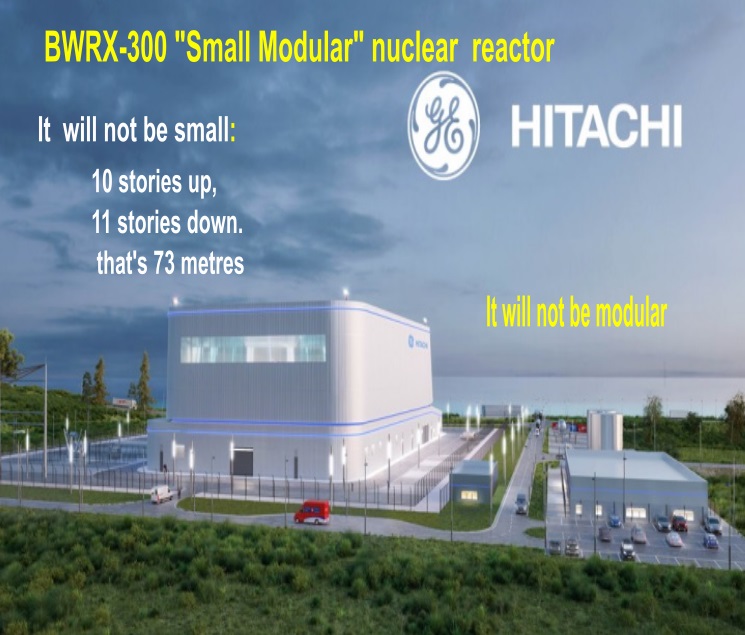
the first BWRX-300 could cost more than five times GE-Hitachi’s original target price.
emerging consensus that SMRs are not economic
“The nuclear people don’t operate in a vacuum, they operate in competition to other technologies,………… “The cost for solar is going down.”
Matthew McClearn, Dec. 27, 2024 , https://www.theglobeandmail.com/business/article-as-construction-of-first-small-modular-reactor-looms-prospective/
The race to construct Canada’s first new nuclear power reactor in 40 years seems to have passed a point of no return. This summer, Ontario Power Generation completed regrading the site for its Darlington New Nuclear Project in Clarington, Ont., and started drilling for the reactor’s retaining wall, which will be buried partly underground. At a regulatory hearing, OPG’s chief executive officer Ken Hartwick, who will retire at the end of this year, promised that this reactor will be “the first of many to come.”
But that will depend on a crucial yet-to-be-revealed detail: its price tag.
It’s no exaggeration to say that the world is waiting for it. The new Darlington reactor would be the first BWRX-300, a small modular reactor (SMR) being designed by an American vendor, GE-Hitachi Nuclear Energy, and the first SMR built in any Western country. Other prospective buyers include the Tennessee Valley Authority (TVA), SaskPower and Great British Nuclear. More BWRX-300s are in early planning stages in Poland and the Czech Republic.
Crucially, however, OPG is the first and only utility worldwide to bind itself contractually to build a BWRX-300. A report published by the U.S. Department of Energy in September said American utilities are waiting to see pricing and construction schedules for early units, and would “prefer to be fifth.” SaskPower also wants to avoid the risks associated with building a “first of a kind” reactor; it won’t decide until 2029 and it hopes SMRs will be less expensive than traditional nuclear plants.
Scheduled for release this winter, the Darlington SMR’s estimated cost will speak volumes about whether SMRs can deliver on their many promises. Yet there are early indications of serious sticker shock: Recently published estimates from the TVA suggest the first BWRX-300 could cost more than five times GE-Hitachi’s original target price. How will OPG and GE-Hitachi drive pricing far below the TVA’s estimate? And if they cannot, what then will be the prospects for SMRs?
Ditching the scaling law
SMRs were conceived as an antidote to the hefty price tags that brought reactor construction to a standstill in Western countries for decades.
Previously, the nuclear industry relied heavily on something called economies of scale or the “scaling law”: As a power plant’s size increases, capital costs also rise, but in a less than linear fashion. So vendors designed ever-larger reactors. Reactors under construction today average about one gigawatt, roughly three times the BWRX-300’s output. They can cost more than US$10-billion, leaving only the largest government-backed utilities as potential purchasers.
SMRs represent a promising but untested new approach to manufacturing reactors – one that emphasizes simplification and mass production techniques. The key term is modular: Rather than building monolithic, one-of-a-kind plants, the industry hoped instead to churn out substantially identical factory-built units; repetition would help drive down costs, as it had for competing technologies such as wind turbines and solar panels.
But modularity requires multiple orders, which in turn demands competitive pricing. Through early discussions with potential customers, GE-Hitachi executives understood the BWRX-300 had to be priced low, not only in absolute terms, but also relative to other power-generation technologies. They told audiences it would cost less than US$1-billion, or US$2,250 per kilowatt hour of power generation capacity – low enough to compete with natural gas-fired power plants.
“The total capital cost of one plant has to be less than $1-billion in order for our customer base to go up,” Christer Dahlgren, a GE-Hitachi executive, said during a talk in Helskini in March, 2019.
Shrinking a giant
GE-Hitachi’s designers began by shrinking a behemoth: the 1,500-megawatt Economic Simplified Boiling Water Reactor (ESBWR). Their objective was to reduce the volume of the building housing the reactor by 90 per cent, to greatly reduce the amount of concrete and steel required during construction.
This was accomplished primarily through eliminating safety systems. Pressure relief valves, common in traditional reactors, were removed. In place of two completely separate emergency shutdown systems, as is customary, the BWRX-300 would have two systems that would propel the same set of control rods into the reactor’s core. GE-Hitachi emphasized that the BWRX-300 featured “passive” safety systems that would keep the reactor safe during an accident, and its simplicity reduced the need for redundant engineered systems.
Sean Sexstone, head of GE-Hitachi’s advanced nuclear team, said the entire facility – which includes the reactor building, the control room and the turbine hall – will measure just 145 metres by 85 metres.
“You can walk that site in a minute-and-a-half,” he said.
GE-Hitachi also sought substitutes for concrete. The reactor building is to be constructed using factory-made steel panels that will be shipped to the site, assembled into modules and lifted by crane into position. These modules essentially serve as forms into which concrete is poured. These steel plates are as strong as concrete, OPG says, yet eliminate the need to use rebar extensively. This approach “lends itself to more modularity, more work in a factory, versus more work in the field,” Mr. Sexstone explained.
The Darlington SMR will be erected using a technique called “open-top construction.” The reactor building’s roof won’t be installed until the very last. The building will be constructed upward, floor by floor, with large components lowered in by crane rather than being moved through doors and hatches.
Many of the BWRX-300’s components would be identical to those used in previous GE power plants, such as its control rods, fuel assemblies and steam separators. Its steam turbine would be the same one used in natural-gas-fired plants. And the plant could be run by as few as 75 staff, far below the nearly 1,000 employed at large single-reactor Canadian nuclear plants.
Historically, utilities tended to build bespoke nuclear plants meeting highly individualized requirements. The result: In the United States alone there are more than 50 commercial reactor designs. Few designs were built twice, limiting opportunities to learn through repetition.
GE-Hitachi intended the BWRX-300 to be highly standardized, constructible in multiple countries with as few tweaks as possible. It assembled an international coterie of utility partners, including OPG, the TVA and a Polish company named Synthos Green Energy, which last year agreed to jointly contribute to the estimated US$400-million cost of the SMR’s standardized design.
Subo Sinnathamby, OPG’s chief projects officer, acknowledged in an interview that the first SMR will be expensive. But lessons learned from building it, including newly identified opportunities for additional modularization, will be applied to three subsequent units at Darlington, bringing down overall costs.
“For us, success is going to be sticking to how we have executed megaprojects at OPG, using the same processes and principles,” she said, citing the continuing refurbishment of Darlington’s existing reactors.
“The last thing we want to do is get into construction and then stop the work force.”
GE-Hitachi’s emphasis on lowering plant costs has been validated by many independent observers, who regard it as essential to SMRs’ future prospects.
In a report published in May, Clean Prosperity, a climate policy think tank, concluded that the BWRX-300 “is the strongest candidate” among SMRs to experience continued cost reductions as more were built – but only at the right price, which it pegged at about $3.3-billion. “Cost curves will only become possible for the BWRX-300 in Ontario and beyond,” it warned, “with a final price tag that is low enough to compel additional expansion.”
In September, the U.S. Department of Energy published a report examining the prospects for widespread deployment of reactors across the U.S., an expansion it strongly supported. But to drive down costs, SMR vendors needed to move more than half of the overall spending on a project into standardized factory-like production – a tall order.
Similarly, a report published last year by the U.S. National Academy of Sciences argued that if nuclear plants are to contribute meaningfully to future electricity systems, they must be cost-competitive with other low-emission technologies. It looked at so-called overnight capital costs – what costs would be if construction were completed overnight, with no charges for financing and no consideration of how long it will last. The academy said capital costs should be US$2,000 or less per kilowatt of generating capacity. At between US$4,000 and US$6,000 a kilowatt, reactors might still be competitive if costs unexpectedly rose for renewable technologies.
Enter the TVA.
In an integrated resource plan published in September, the TVA estimated that a first light water SMR would have an overnight capital cost of nearly US$18,000 a kilowatt.
At that pricing, the first Darlington SMR would cost more than $8-billion. That’s about 10 times the cost of a similarly sized natural-gas-fired plant: SaskPower’s recently completed Great Plains Power Station, a 377 MW natural-gas-fired plant in Moose Jaw, cost just $825-million.
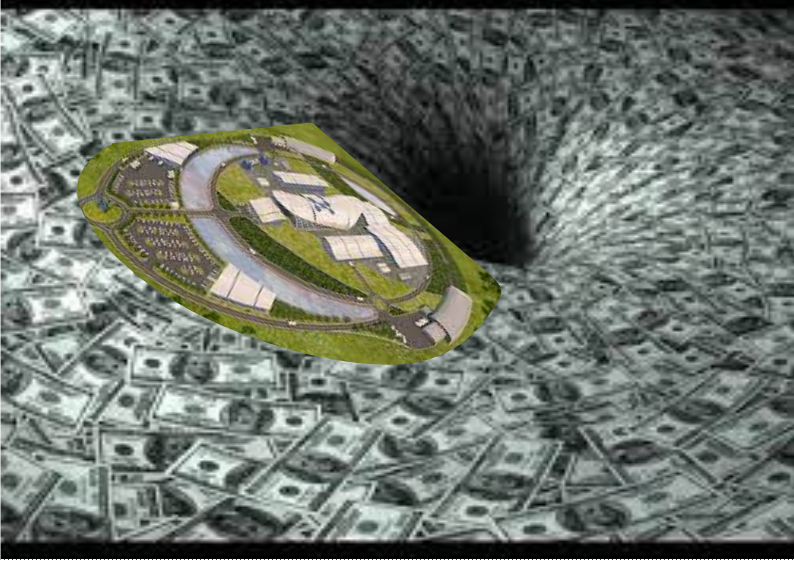
Oregon-based NuScale Power Corp. has already discovered what happens when pricing falls in this range. Founded in 2007, its 77-MW NuScale Power Module was the first SMR to be licensed by regulators in a Western country. But last year its flagship project, undertaken with the Utah Association of Municipal Power Systems (UAMPS), was cancelled after cost soared to about US$20,000 a kilowatt.
There are several important caveats about the TVA’s estimate.
Greg Boerschig, a TVA vice-president, described it as a “Class 5″ estimate. According to standard global practices, cost estimation is based on a five-level system. Class 5 is the least detailed and reliable and is intended for planning purposes; actual costs could be half that much, or double.
The estimate is far higher than the TVA would have liked, Mr. Boerschig said. But since OPG is further along in deploying the BWRX-300, he added, it has a better sense of the reactor’s cost.
“We’re a couple of years behind them,” Mr. Boerschig acknowledged.
Indeed, according to a presentation by Aecon Group Inc., a partner on the Darlington SMR, a Class 4 estimate had already been completed as of February this year. Ms. Sinnathamby said OPG is working on a Class 3 estimate.
“Our number is going to be very specific: What is it going to cost us to build, on this location, these four SMRs?” she said.
Another caveat is that the BWRX-300 was only one of several reactors represented in the estimate, which was based on the TVA’s experience exploring potential SMRs at its Clinch River site near Oak Ridge, Tenn., and by examining recently completed nuclear construction projects.
OPG might enjoy certain cost advantages over the TVA. The Darlington Nuclear Generating Station is a complex that was built during the 1980s and early 1990s on the shore of Lake Ontario, the proximity of which could make cooling reactors there cheaper. Clinch River is a greenfield site, whereas Darlington already has four operating reactors.
“That will automatically reduce the cost to OPG relative to TVA,” said Koroush Shirvan, a professor of energy studies at the Massachusetts Institute of Technology, who has studied the BWRX-300’s economics.
Nonetheless, opponents and skeptics of SMRs in general, and the Darlington SMR in particular, have embraced TVA’s estimate.
Chris Keefer, an emergency medicine physician, has advocated passionately for refurbishment of Ontario’s existing nuclear power plants, which are all based on Canada’s homegrown reactor design, the Candu. He has also argued for modernizing the Candu design and building more. He said the TVA’s estimates reflect a more honest assessment of SMR pricing than Canadians received in the past.
“It points to this emerging consensus that SMRs are not economic, and that shouldn’t be a surprise,” he said.
“TVA, I think they’ve got several hundreds of millions of dollars in the development process on this reactor. I wouldn’t say that those numbers are naive.”
Prof. Shirvan said his own cost estimate for the BWRX-300 reactor is “in line” with the TVA’s.
Chris Gadomski, head of nuclear research at BloombergNEF, said TVA’s estimates are discouragingly high, and imply that reactor sales might be less than anticipated. Contributing factors might include high labour costs in North America, and recent high inflation and high financing costs, factors he expects will persist.
“The nuclear people don’t operate in a vacuum, they operate in competition to other technologies,” he said.
“The cost for solar is going down. The cost of batteries, we anticipate, is going down. And so, when you’re looking at spending billions of dollars and all of a sudden the price tag gets so large, people will say: ‘Hey, listen, you’ve got to look at other options, or buy less of this.’ ”
If there is a silver lining, the TVA estimated follow-on SMRs would cost substantially less than the first, at roughly US$12,500 a kilowatt. But that’s still more than double the upper limit the U.S. National Academy of Sciences deemed necessary to support widespread SMR adoption.
We might learn in a few months whether GE-Hitachi and OPG have succeeded in bringing the BWRX-300’s cost down. But a review of regulatory applications and other documents hint at why the original US$1-billion target price might be difficult to realize.
Prof. Shirvan said GE-Hitachi’s original plan – to slim the reactor down by removing safety systems – encountered resistance from regulators in Canada and the U.S. “When you strip out most of the safety system, you have to come up with very good reasoning how that’s justified,” he said. GE-Hitachi started adding some of those systems back in, he said, which caused the BWRX-300’s reactor building’s diameter to swell.
This dramatic increase, Mr. Keefer said, has greatly reduced the BWRX-300’s economic attractiveness.
“Proportionately, you’re actually doing a lot more civil works than you would for a large reactor,” he said. “And that actually means that the whole SMR paradigm, which is to get all the work into a factory, goes away.”
(GE-Hitachi denied that the plant had grown. “While the design has matured, the overall footprint of the BWRX-300 plant has not changed significantly,” Mr. Sexstone said.)
OPG’s regulatory documents also make clear that some modular construction techniques it seeks to employ at Darlington are in their infancy. As recently as last year, most of the walls and floors of the SMR building were to have been built using a technique developed in Britain known as Steel Bricks. GE-Hitachi recently dropped Steel Bricks in favour of a similar approach known as Diaphragm Plate Steel Composite.
Moreover, OPG’s published construction plans show that the reactor building will be built largely below-grade, requiring significant excavation including into bedrock. Tunnel boring machines will be used to excavate more tunnels, tens of metres wide, to convey cooling water to and from Lake Ontario. Make no mistake, the Darlington SMR remains a complex capital project.
To date there have been no indications that pricing might derail the Darlington SMR. Ontario’s government appears willing to pay a significant premium: It hopes that as a first mover, OPG will be well-poised to sell equipment and expertise in other countries.
During a stump speech in Scarborough in December, Energy Minister Stephen Lecce said Ontario was keen to sell its technology and expertise for building SMRs abroad.
“I was just in Poland and Estonia, literally selling Canadian small modular reactors that will be built here, exported there,” he said.
Yet Mr. Lecce has also vowed to keep Ontarians’ electricity bills low, an objective high SMR price tags might compromise.
GE-Hitachi maintains its creation’s pricing will stack up favourably.
“I think we’re in a really good spot to feel very comfortable about this unit being probably the most cost competitive SMR in the market,” Mr. Sexstone said. “I think your readers will be pleasantly surprised.”
Ms. Sinnathamby, for OPG’s part, said actual costs to construct BWRX-300s should be considerably lower than TVA’s estimate.
“The TVA numbers can only come down,” she said. “That’s how conservative, in our mind, those numbers are.”
Jeremy Corbyn speaks out on danger of Trident in Scotland
JEREMY Corbyn has highlighted the danger posed by the UK’s Trident
nuclear submarines – including having them based in Scotland. The former
Labour leader said there is “no defence” for nuclear weapons, adding
that his dissent from supporting their presence and potential use is
“well-known” – including a pledge in 2015 that, if he were to become
prime minister, he would never use them. On the subject of the UK’s
nuclear arsenal, which is hosted in Scotland at HM Naval Base Clyde, Corbyn
said it put a “target” on the city of Glasgow.
The National 27th Dec 2024, https://www.thenational.scot/news/24819794.jeremy-corbyn-speaks-danger-trident-scotland/
Black Money, Black Flags: How USAID Paved the Way for Syria’s Militant Takeover
By Alex Rubinstein / MintPress News,21 Dec 24
As the designated terrorist group Hayat Tahrir al-Sham (HTS) establishes its proto-government in Idlib, notoriously corrupt NGOs are stepping in to fill the gaps in public services, with some even defecting to work alongside the group.
The United States, which spent two decades and $5.4 trillion overthrowing governments hostile to al-Qaeda, now finds itself in a paradoxical position. Modern al-Qaeda has carved out its own quasi-state in Syria, yet remains on the U.S. list of Foreign Terrorist Organizations. To characterize this as a foreign policy misstep would be reductive; the U.S. has actively facilitated HTS’s conquest of parts of Syria while maintaining its official terrorist designation.
For the past five years, HTS, an al-Qaeda offshoot, has sought to rehabilitate its image. Its leader, Abu Mohammad al-Jolani—a former high-ranking member of both ISIS and al-Qaeda—has led a calculated charm offensive, attempting to rebrand the group from one focused on violence and minority persecution to a more palatable local governance entity.
Since establishing HTS and a proto-government called the Syrian Salvation Government, or SSG, the group’s leader, al-Jolani has expended a good deal of energy talking about topics intended to normalize the idea of a-Qaeda’s statehood; things like ‘institutions,’ and ‘structures.’ This, coupled with al-Jolani’s sudden embrace of Syria’s diverse tapestry of minority groups, has made up the main pillars of the terror group’s rebrand. Al-Jolani himself credits the establishment of quasi-state structures for the group’s sudden success in taking over Syria.
This shift in focus from the elimination of infidels to the establishment of good governance was given the spotlight in an article in the Telegraph entitled ‘How Syria’s ‘diversity-friendly’ jihadists plan on building a state.’ Published five days before President Assad fled the country, the article seemingly understood a total takeover by HTS to be a fait accompli…………………………………………………………………………………………………………………
Al-Jolani would take much of the remainder of the interview as an opportunity to deliver his stump speech on building inclusivity. And, of course, in the immediate aftermath of HTS’ takeover, gruesome videos of torture and executions aimed at Syria’s Alawite community flooded social media, dispelling the terrorist group’s progressive propaganda. And while it has only been a few years since HTS was carrying out suicide bombings, other groups that helped al-Jolani’s offensive have received next to zero coverage in Western media.
These groups include Ahrar al-Sham, which has been accused of war crimes, kidnappings, torture and potential use of chemical weapons by Amnesty International. Also involved in the offensive was Nour al-Din al-Zenki, a “moderate rebel” group supported by the United States until 2017, when footage emerged of its members gleefully beheading a teenager.
Yet, the horrifying history of these al-Qaeda offshoots has not given much pause to the White House. Just days after Assad’s egress, Joe Biden noted that the designated terrorist groups that had hijacked state power in Syria were “saying the right things.” Additionally, Biden promised more humanitarian and to “engage with all Syrian groups” with the goal of establishing a new government and constitution.
Make no mistake, some of the rebel groups that took down Assad have their own grim record of terrorism and humanit- — human right [sic] abuses. We’ve taken note of statements by the leaders of these rebel groups in recent days. And we’re — they’re saying the right things now, but as they take on greater responsibility, we will assess not just their words, but their actions.”
…………………………………………………………….. Implementing Partners – in Crime
Since the start of the war, USAID and the State Department’s Bureau of Humanitarian Assistance (BHA) have spent more than $18 billion on “humanitarian assistance” in Syria and more than $1.2 billion in fiscal year 2024 alone, oftentimes employing notoriously corrupt NGO partners to do the dirty work.
In a PBS interview with James Jeffrey, the United States Special Representative for Syria Engagement, Jeffrey admitted that “in 2018, my focus was — at the very center of everything I was doing was Idlib. And in Idlib, he [al-Jolani] was the strongest force.” Thus, USAID was confronted with a problem: how to deliver aid to a region ruled by a group they were legally prohibited from aiding.
………………………………………………………………….. While these instances of fraud, corruption, and supporting terrorist groups by USAID’s NGO partners are shocking, what is perhaps even more shocking is that these same NGOs continue to enjoy support from USAID despite the scandals. In fact, far from cutting these organizations off from future contracts, USAID continues to this day to actively encourage donations to Catholic Relief Services and the International Medical Corps………………………………………………………………………………………………………………………………………………….. more https://www.mintpressnews.com/black-money-black-flags-how-usaid-paved-the-way-for-syrias-jihadist-takeover/288876/
Earthquake-prone Indonesia considers nuclear power plan as 29 possible plant sites revealed
ABC News, By Natasya Salim, Tri Ardhya and Sally Brooks, 28 Dec 24
In short:
Indonesia’s energy council has proposed 29 sites for nuclear power plants in a bid to secure reliable energy sources and reduce carbon emissions.
Environmental groups say the plan is “dangerous”, partly because the country is prone to earthquakes.
What’s next?
The energy council is searching for foreign investors to back the plan.
…………………………………………………………………………………………………………………….. The new detail on plant site locations has renewed safety concerns among environmental advocates in part because Indonesia is prone to natural disasters.
The archipelago mostly sits along the Pacific Ring of Fire where tectonic plates frequently collide and cause earthquakes and other disasters.
Twenty years ago, a magnitude-9.1 earthquake struck off the coast of Indonesia’s Aceh province and triggered the 2004 Boxing Day tsunami, that killed some 230,000 people across Indonesia, Sri Lanka, India, Thailand, and nine other countries.
Hendrikus Adam, from environmental not-for-profit organisation WALHI, said authorities needed to learn from past nuclear power disasters, including those caused by earthquakes and tsunamis like the Fukushima accident in Japan in 2011.
“We think nuclear plants are risky, dangerous and harmful for humans and the environment,” said Mr Adam.
“The development of a nuclear plant itself is also very expensive and hazardous.”
……………………………………………. Last month, National Development Planning Deputy Minister Vivi Yulaswati said Indonesia was in talks with the US and Russia about acquiring technology to develop nuclear power plants.
Separately, Indonesia’s state-owned electricity firm PLN has reportedly signed agreements with companies in the US and Japan to build small modular reactors, Coordinating Economic Minister Airlangga Hartarto said earlier this month……….
Details of the agreements are scarce and PLN declined to comment for this story………….
Currently none are in commercial operation in any Organisation for Economic Co-operation and Development (OECD) country….. https://www.abc.net.au/news/2024-12-27/earthquake-prone-indonesia-plans-for-nuclear-power/104758008
Second Fukushima nuclear sample removal eyed for March

CNA 26th Dec 2024
Three of Fukushima’s six reactors went into meltdown in 2011 after a huge tsunami swamped the facility.
TOKYO: The operator of Japan’s stricken Fukushima nuclear plant said on Thursday (Dec 26) it will start the second round of a tricky operation to collect samples of radioactive debris from the site this spring.
Around 880 tonnes of hazardous material remain at the Fukushima site, 13 years after a catastrophic tsunami caused by a 9.0-magnitude earthquake triggered one of history’s worst nuclear accidents.
Removing the debris is seen as the most daunting challenge in a decommissioning project due to last decades, because of the dangerously high radiation levels.
Last month, operator Tokyo Electric Power Company (TEPCO) said a trial debris removal operation using a specially developed extendible device had been completed.
The sample weighing just below 0.7g – equivalent to about one raisin – was delivered to a research lab near Tokyo for analysis.
A TEPCO official told a press conference they are now gearing up for a second sample removal due in “March to April”……….
https://www.channelnewsasia.com/east-asia/fukushima-nuclear-plant-sample-removal-march-2025-4826701
1 This Month

of the week – Shut Down Drone Warfare!


Tell the Ukrainian Government to Drop Prosecution of Peace Activist Yurii Sheliazhenko

Petition to revoke the licensing of the Near Surface Nuclear Disposal Facility (NSDF) at Chalk River. https://www.ourcommons.ca/petitions/en/Petition/Details?Petition=e-7247
To see nuclear-related stories in greater depth and intensity – go to https://nuclearinformation.wordpress.com
-
Archives
- April 2026 (68)
- March 2026 (251)
- February 2026 (268)
- January 2026 (308)
- December 2025 (358)
- November 2025 (359)
- October 2025 (376)
- September 2025 (257)
- August 2025 (319)
- July 2025 (230)
- June 2025 (348)
- May 2025 (261)
-
Categories
- 1
- 1 NUCLEAR ISSUES
- business and costs
- climate change
- culture and arts
- ENERGY
- environment
- health
- history
- indigenous issues
- Legal
- marketing of nuclear
- media
- opposition to nuclear
- PERSONAL STORIES
- politics
- politics international
- Religion and ethics
- safety
- secrets,lies and civil liberties
- spinbuster
- technology
- Uranium
- wastes
- weapons and war
- Women
- 2 WORLD
- ACTION
- AFRICA
- Atrocities
- AUSTRALIA
- Christina's notes
- Christina's themes
- culture and arts
- Events
- Fuk 2022
- Fuk 2023
- Fukushima 2017
- Fukushima 2018
- fukushima 2019
- Fukushima 2020
- Fukushima 2021
- general
- global warming
- Humour (God we need it)
- Nuclear
- RARE EARTHS
- Reference
- resources – print
- Resources -audiovicual
- Weekly Newsletter
- World
- World Nuclear
- YouTube
-
RSS
Entries RSS
Comments RSS
 nuclear-news