FRANCE’S NUCLEAR ENERGY POLICY: A CHRONICLE OF FAILURE – FLAMANVILLE 3.
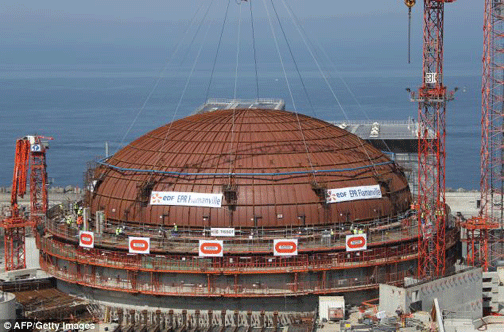
FRANCE’S NUCLEAR ENERGY POLICY: A CHRONICLE OF FAILURE – FLAMANVILLE 3
25 December 2025
France’s ambitious nuclear energy policy, once hailed as a cornerstone of its energy independence, has faced a long series of missteps, delays, and spiralling costs. The Flamanville 3 reactor, emblematic of these challenges, has taken over two decades from decision to anticipated commercial operation, showcasing the systemic failures in planning, execution, and financial management. This timeline highlights the stark realities behind France’s nuclear endeavours.
TIMELINE: 2002 FRENCH NUCLEAR RENAISSANCE
2002: POLITICAL DISCUSSIONS BEGIN
Discussions around a nuclear renaissance gain traction in France. Policymakers and EDF propose new reactor designs to bolster energy independence and address climate goals.
DECISION: 2004
The decision to build the Flamanville 3 reactor marked the beginning of a new chapter for France’s nuclear ambitions. With an estimated cost of €3.3 billion and a planned construction timeline of 56 months, this European Pressurised Reactor (EPR) was touted as a symbol of technological advancement. However, the project’s initial promise soon gave way to setbacks.
INITIAL WORKS: 2006
Preliminary works commenced in 2006, with optimism running high. The EPR design, developed to enhance safety and efficiency, was heralded as the future of nuclear energy. Yet, from the outset, the complexity of the design began to reveal challenges that would compound over time.
REACTOR CONCRETE: 2007
In 2007, construction on the reactor’s concrete base began, symbolising tangible progress. Simultaneously, the cost estimate was revised to €3.3 billion, as technical adjustments and initial delays started to emerge. Early warnings about budget overruns and scheduling issues were largely ignored.
GRID CONNECTION: 2024
After 17 years of setbacks, the reactor was finally connected to the grid. By this point, the budget had ballooned to €13.2 billion, a nearly fourfold increase from the original estimate. The delays and cost overruns underscored critical deficiencies in project management and regulatory compliance, as over 7,000 design changes required significant material additions.
COMMERCIAL OPERATION: 2025 Q1 The reactor is expected to achieve commercial operation in early 2025, over a decade behind schedule. The protracted timeline—more than 20 years from decision to operation—illustrates the systemic inefficiencies plaguing France’s nuclear energy strategy.
COST OVERRUNS AND FINANCIAL STRAIN
The financial fallout from Flamanville 3 is emblematic of broader challenges in the nuclear industry. Initially budgeted at €3.3 billion, the project’s costs had soared to €19.1 billion by 2020, with further increases likely. These overruns mirror similar issues faced by EDF’s international projects, such as Hinkley Point C in the United Kingdom and Olkiluoto 3 in Finland. Hinkley’s budget has nearly doubled to an estimated £46 billion, with completion now pushed to 2029–31.
EDF’S MOUNTING DEBTS AND CHALLENGES
EDF, the state-owned utility tasked with leading France’s nuclear initiatives, has been burdened by mounting debts. With a €65 billion debt load and a near €18 billion loss in 2022, EDF’s financial woes have raised questions about its capacity to handle multiple large-scale projects. Efforts to stabilise its finances through state support and electricity price adjustments have provided temporary relief but have not addressed structural issues.
BROADER IMPLICATIONS
The delays and cost overruns at Flamanville and other EPR projects have cast doubt on the viability of France’s nuclear renaissance. President Macron’s commitment to building six to 14 new reactors appears increasingly untenable given EDF’s financial and operational struggles. Moreover, these challenges have weakened France’s position as a global leader in nuclear technology, with international competitors advancing at a faster pace.
A FAILED STRATEGY
The failure of France’s nuclear energy policy is evident in its inability to deliver projects on time and within budget. The Flamanville 3 reactor, once a beacon of innovation, has become a cautionary tale of mismanagement and overreach. As France doubles down on nuclear energy, it must confront the hard truths of its flawed approach and consider whether a pivot to more agile and cost-effective renewable energy solutions is necessary to ensure its energy security and economic stability.
France connected its first nuclear reactor to the grid this century. Construction was to take 56 months.
2002 TIMELINE STARTS THE
FRENCH NUCLEAR RENAISSANCE
Initial works: construction was to take 56 months.
Timeline:
• decision: 2004
• initial works: 2006
• reactor concrete: 2007
• grid connection: 2024
• commercial operation: 2025 Q1
22 December 2024 Reports
We don’t know the final cost of France’s new #nuclear reactor at Flamanville, but guestimates it’ll be a few hundred $million higher than the 2020 figure:
• 2007 cost estimate: €3.3bn
• 2020 cost estimate: €19.1bn
No comments yet.
1 This Month


Tell the Ukrainian Government to Drop Prosecution of Peace Activist Yurii Sheliazhenko

Petition to revoke the licensing of the Near Surface Nuclear Disposal Facility (NSDF) at Chalk River. https://www.ourcommons.ca/petitions/en/Petition/Details?Petition=e-7247


of the week – STOP SMALL MODULAR REACTORS IN CANADA
To see nuclear-related stories in greater depth and intensity – go to https://nuclearinformation.wordpress.com
-
Archives
- March 2026 (193)
- February 2026 (268)
- January 2026 (308)
- December 2025 (358)
- November 2025 (359)
- October 2025 (376)
- September 2025 (258)
- August 2025 (319)
- July 2025 (230)
- June 2025 (348)
- May 2025 (261)
- April 2025 (305)
-
Categories
- 1
- 1 NUCLEAR ISSUES
- business and costs
- climate change
- culture and arts
- ENERGY
- environment
- health
- history
- indigenous issues
- Legal
- marketing of nuclear
- media
- opposition to nuclear
- PERSONAL STORIES
- politics
- politics international
- Religion and ethics
- safety
- secrets,lies and civil liberties
- spinbuster
- technology
- Uranium
- wastes
- weapons and war
- Women
- 2 WORLD
- ACTION
- AFRICA
- Atrocities
- AUSTRALIA
- Christina's notes
- Christina's themes
- culture and arts
- Events
- Fuk 2022
- Fuk 2023
- Fukushima 2017
- Fukushima 2018
- fukushima 2019
- Fukushima 2020
- Fukushima 2021
- general
- global warming
- Humour (God we need it)
- Nuclear
- RARE EARTHS
- Reference
- resources – print
- Resources -audiovicual
- Weekly Newsletter
- World
- World Nuclear
- YouTube
-
RSS
Entries RSS
Comments RSS
 nuclear-news
Leave a comment