FRANCE’S NUCLEAR ENERGY POLICY: A CHRONICLE OF FAILURE – FLAMANVILLE 3.
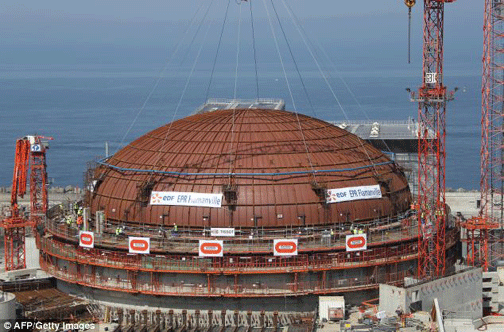
FRANCE’S NUCLEAR ENERGY POLICY: A CHRONICLE OF FAILURE – FLAMANVILLE 3
25 December 2025
France’s ambitious nuclear energy policy, once hailed as a cornerstone of its energy independence, has faced a long series of missteps, delays, and spiralling costs. The Flamanville 3 reactor, emblematic of these challenges, has taken over two decades from decision to anticipated commercial operation, showcasing the systemic failures in planning, execution, and financial management. This timeline highlights the stark realities behind France’s nuclear endeavours.
TIMELINE: 2002 FRENCH NUCLEAR RENAISSANCE
2002: POLITICAL DISCUSSIONS BEGIN
Discussions around a nuclear renaissance gain traction in France. Policymakers and EDF propose new reactor designs to bolster energy independence and address climate goals.
DECISION: 2004
The decision to build the Flamanville 3 reactor marked the beginning of a new chapter for France’s nuclear ambitions. With an estimated cost of €3.3 billion and a planned construction timeline of 56 months, this European Pressurised Reactor (EPR) was touted as a symbol of technological advancement. However, the project’s initial promise soon gave way to setbacks.
INITIAL WORKS: 2006
Preliminary works commenced in 2006, with optimism running high. The EPR design, developed to enhance safety and efficiency, was heralded as the future of nuclear energy. Yet, from the outset, the complexity of the design began to reveal challenges that would compound over time.
REACTOR CONCRETE: 2007
In 2007, construction on the reactor’s concrete base began, symbolising tangible progress. Simultaneously, the cost estimate was revised to €3.3 billion, as technical adjustments and initial delays started to emerge. Early warnings about budget overruns and scheduling issues were largely ignored.
GRID CONNECTION: 2024
After 17 years of setbacks, the reactor was finally connected to the grid. By this point, the budget had ballooned to €13.2 billion, a nearly fourfold increase from the original estimate. The delays and cost overruns underscored critical deficiencies in project management and regulatory compliance, as over 7,000 design changes required significant material additions.
COMMERCIAL OPERATION: 2025 Q1 The reactor is expected to achieve commercial operation in early 2025, over a decade behind schedule. The protracted timeline—more than 20 years from decision to operation—illustrates the systemic inefficiencies plaguing France’s nuclear energy strategy.
COST OVERRUNS AND FINANCIAL STRAIN
The financial fallout from Flamanville 3 is emblematic of broader challenges in the nuclear industry. Initially budgeted at €3.3 billion, the project’s costs had soared to €19.1 billion by 2020, with further increases likely. These overruns mirror similar issues faced by EDF’s international projects, such as Hinkley Point C in the United Kingdom and Olkiluoto 3 in Finland. Hinkley’s budget has nearly doubled to an estimated £46 billion, with completion now pushed to 2029–31.
EDF’S MOUNTING DEBTS AND CHALLENGES
EDF, the state-owned utility tasked with leading France’s nuclear initiatives, has been burdened by mounting debts. With a €65 billion debt load and a near €18 billion loss in 2022, EDF’s financial woes have raised questions about its capacity to handle multiple large-scale projects. Efforts to stabilise its finances through state support and electricity price adjustments have provided temporary relief but have not addressed structural issues.
BROADER IMPLICATIONS
The delays and cost overruns at Flamanville and other EPR projects have cast doubt on the viability of France’s nuclear renaissance. President Macron’s commitment to building six to 14 new reactors appears increasingly untenable given EDF’s financial and operational struggles. Moreover, these challenges have weakened France’s position as a global leader in nuclear technology, with international competitors advancing at a faster pace.
A FAILED STRATEGY
The failure of France’s nuclear energy policy is evident in its inability to deliver projects on time and within budget. The Flamanville 3 reactor, once a beacon of innovation, has become a cautionary tale of mismanagement and overreach. As France doubles down on nuclear energy, it must confront the hard truths of its flawed approach and consider whether a pivot to more agile and cost-effective renewable energy solutions is necessary to ensure its energy security and economic stability.
France connected its first nuclear reactor to the grid this century. Construction was to take 56 months.
2002 TIMELINE STARTS THE
FRENCH NUCLEAR RENAISSANCE
Initial works: construction was to take 56 months.
Timeline:
• decision: 2004
• initial works: 2006
• reactor concrete: 2007
• grid connection: 2024
• commercial operation: 2025 Q1
22 December 2024 Reports
We don’t know the final cost of France’s new #nuclear reactor at Flamanville, but guestimates it’ll be a few hundred $million higher than the 2020 figure:
• 2007 cost estimate: €3.3bn
• 2020 cost estimate: €19.1bn
Workers Seek Shelter As Hanford Nuclear Complex Issues Leak Alert

Oil Price, By Alex Kimani – Dec 23, 2024
Workers at the Hanford nuclear site were ordered to take cover on Friday after a large holding tank with ammonia vapor was discovered to be leaking near the vitrification plant in the 200 East Area. Workers in that area were told to shelter in place with doors, windows and ventilation closed while other workers were told to avoid the 200 East Area. The Hanford Site is a decommissioned nuclear production complex operated by the United States federal government on the Columbia River in Benton County in the U.S. state of Washington
The 200 East Area has a vitrification plant, built and commissioned to treat the tank waste for disposal. The waste was left from the past production of plutonium from World War II through the Cold War for America’s nuclear weapons program. Today, there are 177 underground storage tanks on the Hanford Site, holding about 56 million gallons of highly radioactive and chemically hazardous waste.
The Hanford incident highlights the ongoing challenges of dealing with nuclear waste. Currently, there are thousands of metric tons of used solid fuel from nuclear power plants worldwide and millions of liters of radioactive liquid waste from weapons production sitting in temporary storage containers, some of which have begun leaking their toxic contents. Nuclear waste is notorious for the fact that it can remain dangerously radioactive for many thousands of years. ……………..https://oilprice.com/Latest-Energy-News/World-News/Workers-Seek-Shelter-As-Hanford-Nuclear-Complex-Issues-Leak-Alert.html
Israel to Annex the West Bank – Why Now? And What are the Likely Scenarios?
By Ramzy Baroud / CounterPunch, December 23, 2024
Israel is getting ready to annex the occupied Palestinian West Bank. The annexation will be a major step backward on the road to Palestinian freedom and will likely serve as a catalyst for a new Palestinian uprising.
Though annexation has been on the Israeli agenda for years, this time around a ‘great opportunity’ – in the words of extremist Israeli Finance Minister Bezalel Smotrich – has presented itself and, from an Israeli point of view, cannot be missed.
“I hope we’ll have a great opportunity with the new US administration to create full normalization (of the Israeli occupation),” the minister was quoted as saying by Israeli media.
This is not the first time that Smotrich, among other Israeli extremists, has made the connection between Trump’s advent to the White House and the illegal expansion of Israel’s borders.
Two reasons make Israel’s far-right optimistic about Trump’s arrival: One, the Israeli experience during Trump’s first term in office, where the US president allowed Israel to claim sovereignty over illegal settlements, the Syrian Golan Heights, and occupied East Jerusalem; and, two, Trump’s more recent statement in the run-up to the elections.
Israel is “so tiny” on the map, Trump said while addressing the pro-Israeli group ‘Stop Antisemitism’ at an event last August, wondering: “Is there any way of getting more?” The statement, absurd by any definition, caused joy among Israeli politicians, who understood it to be a green right for further annexations.
Israel’s aims for colonial expansion also received a boost in recent days. Following the fall of Bashar al-Assad’s rule in Syria, Israel immediately began invading large swathes of the country, reaching as far as the Quneitra governorate, less than 20 kilometers away from the capital, Damascus.
What is taking place in Syria serves as a model of what to expect in the West Bank in coming months…………………………………………………………………………………………………
While such annexation will not change the legal status of the West Bank, it will have dire consequences for the millions of Palestinians living there, as annexation is likely to be followed by a violent campaign of ethnic cleansing, if not from the whole of the West Bank, certainly from large parts of it.
Annexation will also render the Palestinian Authority legally irrelevant – as it was created following the Oslo Accords to administer parts of the West Bank in anticipation of a future sovereignty, which never actualized. Will the PA agree to remain functional as part of the Israeli military administration of a newly annexed West Bank?
Palestinians will certainly resist, as they always do. The nature of the resistance will prove critical in the success or failure of the Israeli scheme. A popular Intifada, for example, will overstretch the Israeli military, which will likely use an unprecedented degree of violence to suppress Palestinians but will unlikely succeed.
Annexing the West Bank at a time that Palestine, in fact, the whole region is in turmoil, is a recipe for perpetual war, which, from the viewpoint of Smotrich and his ilk is the actual ‘great opportunity’, as it will secure their political survival for years to come.
Ramzy Baroud is a journalist and the Editor of The Palestine Chronicle. He is the author of five books. His latest is “These Chains Will Be Broken: Palestinian Stories of Struggle and Defiance in Israeli Prisons” (Clarity Press, Atlanta). Dr. Baroud is a Non-resident Senior Research Fellow at the Center for Islam and Global Affairs (CIGA), Istanbul Zaim University (IZU). His website is www.ramzybaroud.net https://www.counterpunch.org/2024/12/23/israel-to-annex-the-west-bank-why-now-and-what-are-the-likely-scenarios/
British energy supplier Centrica is prepared to “walk away” from a planned investment in the Sizewell C nuclear plant
British energy supplier Centrica is prepared to “walk away” from a
planned investment in the Sizewell C nuclear plant, according to its chief
executive. In an exclusive interview with Energy Voice, Centrica chief
executive Chris O’Shea said “there are a number of criteria we have to
consider to invest in the project”. “We’ve said that we are part of the
Sizewell C process but there are a number of criteria we have to consider
to invest in the project,” O’Shea said. “If these are not met, the
right thing to do would be to walk away to protect the business.”
The UK-based supplier owns a 20% stake in the nuclear power stations, amounting
to a 9 terawatt-hour capacity out of a total of 45 TWh. “When the
conditions are right, we’ve seen how good investing in nuclear can be for
Centrica,” said O’Shea. He added that access to that nuclear power
capacity “will be very valuable to the company and to the UK’s energy
system”. “New nuclear will play a crucial role in the future energy
system, however we will only invest if the risks-and-rewards balance is
right for us,” he said. “If it is not right for us, we will not
invest.”
Energy Voice 23rd Dec 2024 https://www.energyvoice.com/renewables-energy-transition/nuclear/564808/centrica-prepared-to-walk-away-from-sizewell-c/
References to ‘inducing a North Korean attack’ found in ex-military official’s notes
2024-12-24 , By Lee Ji-hye, staff reporter, HANKYOREH,
A notebook found at the home of Roh Sang-won, the former Defense Intelligence Command, included jottings about shooting people to death and “concentration and handling” of those who were to be arrested.
A memo written by Roh Sang-won, the former head of the Defense Intelligence Command identified as the secret mastermind of the Dec. 3 insurrection attempt, contained the phrases “inducing a North Korean attack around the Northern Limit Line (NLL),” and “trash balloons.” With evidence pointing to attempts to stoke conflict with North Korea surfacing, police have stated that they are investigating President Yoon Suk-yeol, his former defense chief Kim Yong-hyun, and others on suspicions of treason.
Roh’s notebook also mentioned the “means of concentration and handling” of those who were to be arrested, even going so far as to suggest “execution by shooting.” Such drastic phrases suggest those plotting to punish so-called “anti-state forces” may not have been satisfied with simply detaining these figures.
The special unit investigating the martial law declaration under the Korean National Police Agency’s National Office of Investigation announced on Monday that Roh’s notebook contained the phrase “inducing a North Korean attack around the Northern Limit Line (NLL).”
When asked by Democratic Party lawmaker Youn Kun-young whether “trash balloons” also appeared in Roh’s notebook during a plenary session of the parliamentary Public Administration and Security Committee on the same day, Woo Jong-soo, the head of the National Office of Investigation, confirmed that the phrase was spotted in the notebook.
This is the first time that a plot to provoke North Korea has been confirmed in the investigation into the Dec. 3 insurrection attempt……………………………………………………………………………..more https://english.hani.co.kr/arti/english_edition/e_national/1174701.html
Pentagon Admits It’s Been Lying About the Number of Troops in Both Iraq and Syria
December 25, 2024, By Dave DeCamp / Antiwar.com, https://news.antiwar.com/2024/12/23/pentagon-admits-its-been-lying-about-the-number-of-troops-in-both-iraq-and-syria/
The Pentagon said on Monday that the US has more troops deployed in Iraq than it has been disclosing, an admission that comes after it revealed there are significantly more US troops in Syria than the US has said.
For years, the Pentagon has said there are 900 troops in Syria and 2,500 in Iraq. Last week, Pentagon spokesman Maj. Gen. Pat Ryder revealed the US was lying about the number of troops in Syria, saying the real number is 2,000.
In a statement meant to clarify the situation that was released on Monday, Ryder also said there were more than 2,500 US troops in Iraq but refused to say how many. “However, due to operations security and diplomatic considerations, we do not have any more specifics to provide,” Ryder said.
Ryder’s statement revealed that the number of US troops in Syria has been higher than publicly disclosed since 2020. “In addition to the approximately 900 baseline troops, there are also approximately 1,100 US military personnel in Syria that deploy for shorter durations as temporary enablers in support of force protection, transportation, maintenance, or other emerging operational requirements,” Ryder said.
“The numbers of these additional temporary forces have fluctuated over the past several years based on mission needs but in general have increased over time as the threat has increased to baseline forces,” he added.
Lying about the actual number of US troops in Syria goes back to at least the Trump administration. In 2020, James Jeffrey, the outgoing US envoy for Syria at the time, admitted his team was “always playing shell games to not make clear to our leadership how many troops we had there.” In 2019, after reversing an order to withdraw all troops from Syria, Trump agreed to keep 200 in the country. But Jeffrey said there was “a lot more” than that deployed.
In his statement on Monday, Ryder also said that “some additional temporary enablers” had been deployed alongside the 2,500 US troops in Iraq.
Sources told CNN that the US had been lying about the number of US troops in Syria because it didn’t want to anger neighboring countries, particularly Iraq, where the presence of US troops is strongly opposed by many political factions.
The sources said the US was worried if Iraqi officials found out the US had more troops in Syria than it was disclosing, officials would fear the same is happening in Iraq. Ryder’s statement that there are more than 2,500 US troops in Iraq will likely cause trouble for Iraqi Prime Minister Mohammed Shia al-Sudani, who has been under significant pressure to get the US to leave.
Earlier this year, after a series of US airstrikes on Iraq, al-Sudani called for US troops to leave, and his government entered negotiations with the US. The two sides reached a deal that was announced in September, but it will only formally end the mission of the US-led anti-ISIS coalition and says US troops will remain in the country under a “bilateral security partnership.”
1 This Month


18 March Webinar @ 1 PM EST: An Assessment of SMR Projects: The Case of Canada
register for the zoom:
https://us02web.zoom.us/webinar/register/WN_o8BIIOUvQ2ONJR1nta65DQ#/registration


of the week – STOP SMALL MODULAR REACTORS IN CANADA
To see nuclear-related stories in greater depth and intensity – go to https://nuclearinformation.wordpress.com
-
Archives
- March 2026 (141)
- February 2026 (268)
- January 2026 (308)
- December 2025 (358)
- November 2025 (359)
- October 2025 (376)
- September 2025 (258)
- August 2025 (319)
- July 2025 (230)
- June 2025 (348)
- May 2025 (261)
- April 2025 (305)
-
Categories
- 1
- 1 NUCLEAR ISSUES
- business and costs
- climate change
- culture and arts
- ENERGY
- environment
- health
- history
- indigenous issues
- Legal
- marketing of nuclear
- media
- opposition to nuclear
- PERSONAL STORIES
- politics
- politics international
- Religion and ethics
- safety
- secrets,lies and civil liberties
- spinbuster
- technology
- Uranium
- wastes
- weapons and war
- Women
- 2 WORLD
- ACTION
- AFRICA
- Atrocities
- AUSTRALIA
- Christina's notes
- Christina's themes
- culture and arts
- Events
- Fuk 2022
- Fuk 2023
- Fukushima 2017
- Fukushima 2018
- fukushima 2019
- Fukushima 2020
- Fukushima 2021
- general
- global warming
- Humour (God we need it)
- Nuclear
- RARE EARTHS
- Reference
- resources – print
- Resources -audiovicual
- Weekly Newsletter
- World
- World Nuclear
- YouTube
-
RSS
Entries RSS
Comments RSS
 nuclear-news