Peter Dutton’s nuclear plan: Mad, bad, and extremely dangerous
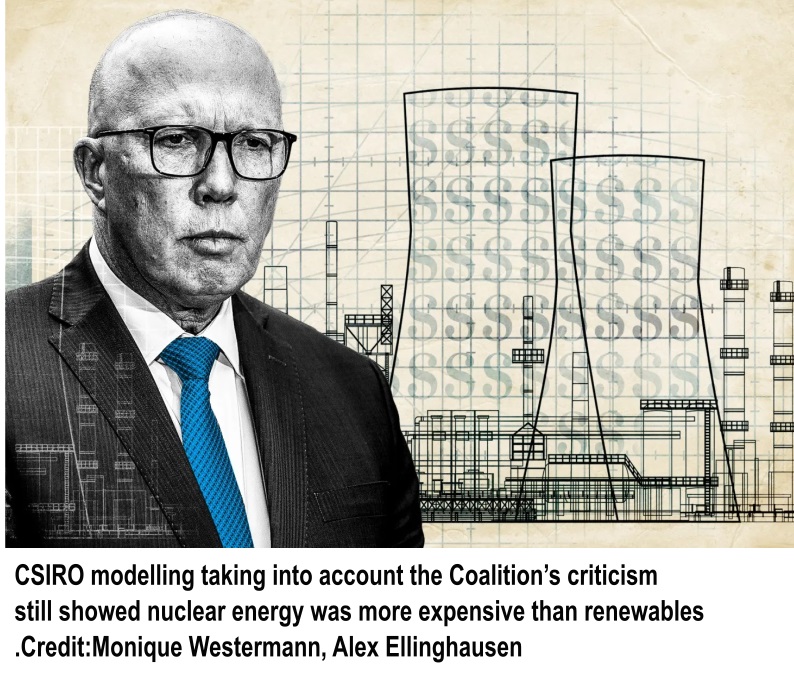
Giles Parkinson, Renew Economy 13th Dec 2024, https://reneweconomy.com.au/peter-duttons-nuclear-plan-mad-bad-and-extremely-dangerous/ [excellent graphs on original]
It might seem weirdly appropriate that the federal Coalition should release its nuclear power policy costings on Friday the 13th, considered an unlucky day in western superstition. But that would be to downplay the sheer lunacy, rank dishonesty, and clear danger in Peter Dutton’s energy plans.
Shows like Edward Scissorhands are horror fantasies played out on a screen. But the Peter Dutton and Ted O’Brien nuclear plan is a horror show we may have to live and breathe. After so many years, the Coalition is still playing culture wars on the most fundamental issues of our time – and all at the behest of the fossil fuel industry.
It doesn’t matter at which level you look at it, this energy policy makes no sense at all. You could look at it backwards, from behind, sideways, leave it out in the sun for a few days, or even bury it in the garden (please do), the only thing that would change is that it might smell more than it does now.
It would likely take until Christmas to go through all the lies, deceptions and misunderstandings that comprise this policy and these costings, but let’s just focus on a couple of the important ones for now.
The reference to the sheer lunacy and the danger of the Coalition policy comes in Dutton’s desire to simply ignore climate science, along with basic engineering and economics.
Emissions reductions are put off to the never never. And, as Dutton revealed in his press conference through his comments on rooftop solar, he simply does not have a clue about the basic concepts of the energy system.
See: “You can’t charge your battery and your car at same time:” Dutton does not have a clue about energy
Dutton and Co simply want to bring a crashing halt to Australia’s only successful emission reductions efforts – the transition to green energy – and walk away from the country’s natural advantages in wind, solar and storage and the industries that are emerging from that.
They even have the chutzpah to claim that it will result in lower emissions. Which, inevitably, is pure bunkum. But, as Donald Trump has demonstrated, if you “flood the zone with shit”, something will stick – mostly to the front pages of mainstream media.
And that’s what we saw on Friday. A planned leak of the findings resulted in claimed headline “savings” – emblazoned across the front pages of the cheer-leading Murdoch media and the AFR this morning – that the nuclear power plan will save $264 billion.
It is of course, a complete nonsense, and obviously so to anyone who is paying attention, or even bothered to read the Coalition document. We are talking about completely different scenarios, and taking traditional accounting methods away from the international norm.
Dutton and his media followers have made a big deal of Frontier Economics costings of the Australian Energy Market Operator’s Integrated System which is the basis of Labor policy.
Frontier concedes, however, that the cost of AEMO’s “step change” plan is about what it says it is – $122 billion, based on the standard accounting practice of “net present value.”
But, at the urging of the Coalition, Frontier has published an additional number, around $600 billion, based on the “real cost” and throwing in some more transmission spending.
Dutton has used that number to insist that AEMO and Labor had lied to the Australian people. But it was the former Coalition government who instructed AEMO to cost it this way. And for good reason – it is standard international accounting practice. It is Dutton and O’Brien who are now spreading the lies.
Indeed, the Frontier Economics report actually reveals that the claimed $264 billion in savings parroted by the mainstream media are from two entirely different scenarios. One is from AEMO’s “Step Change”, the other from the Coalition’s version of “progressive change.”
The actual savings on a like for like basis are much smaller, if you can believe Frontier’s costings of nuclear.
Progressive change assumes that demand will not be as great as forecast by AEMO. It assumes much smaller electrification (thanks to the gas industry) and slower uptake of EVs (thanks to the oil industry). It then ignores the $75 billion a year of extra fuel costs that would result from that.
Now let’s go to the Coalition’s plan to shut down just one third of the main grid’s ageing coal fired generators by 2034 – with the rest trying to stay on line until nuclear power plants can be built.
The Coalition says it still thinks the first nuclear power plant can be built by the mid-2030s. The rest of the industry says this will be pretty much impossible until the mid 2040s.
Keeping the coal fired power stations open will not just increase pollution – both within the grid and the industries that depend on it – it will also puts grid reliability at risk.
This week, AEMO had to issue several lack of reserve alerts as another heatwave approached the eastern states. The main reason was that Origin, despite being promised up to $450 million to keep Australia’s biggest coal generator on line for another two years, reported another breakdown at Eraring.
At Bayswater, a unit is offline because of a tube leak. One third of the coal units in Victoria are also offline due to unplanned outages, and so is the country’s newest and “most efficient” coal generator at Kogan Creek, which is also the country’s largest single generation unit.
Dutton and O’Brien insist that these ageing and increasingly decrepit coal fired power plants will only have to operate “a few years longer”. But they are kidding themselves. Their own modelling confirms that.
They are still setting a timeline of 2035 for the first reactors. Will these be large scale of small commercial small modular reactor. No one has built one, or even got a licence to build one.
The Coalition insists that new nuclear can be built, from scratch, in a country with no nuclear infrastructure or know-how to speak of, no work force and no regulatory base ,in about a dozen years. There’s also a golden replica of the Sydney Harbour Bridge at the bottom of your packet of Cornflakes.
A dozen years is the average “delay” in the big nuclear power plants being built in western democracies – the UK, France, and Finland – all of whom have been operating nuclear power plants for decades.
Dutton and O’Brien are now telling us their nuclear plan will result in 14 gigawatt of nuclear capacity – double what they previously said. And Frontier’s modelling shows that coal is going to have to last a lot longer, beyond the official lifetime limits of the coal generators.
Even the Australian Energy Council, one of the most conservative of lobby groups that represents the coal generator owners, believes this is a bad idea and “could result in reliability issues.”
But let’s go back to the conventional way of measuring costs – net present value. The Frontier report includes it, at the very last page of its report. It shows that the difference in costs, on their calculations, is actually $62 billion over 25 years for the step change scenario.
But even that is on the basis of some heroic assumptions on the costs of nuclear. Frontier puts the total cost, including 14 GW of new nuclear power plants, at $142 billion (see table above).
Let’s look at the cost of Hinkley C, the first nuclear power station to be built in the UK for decades. At just 3.2 GW, its cost has already blown out to $A92 billion and is running at least 14 years late from its promised timeline. What does the Coalition know that the rest of the nuclear world does not know?
The Coalition’s vision for renewables also beggars belief. Under its modelling, it estimates the share of wind, solar and hydro will be less than 50 per cent in 2050. That’s in the “progressive” plan that appears to be their chosen one.
If you take the current level of renewables, the already committed large scale projects, and the continued roll out of rooftop and behind the metre solar, the Coalition is essentially telling everyone that the construction of new large scale wind and solar more or less comes to an end with their election next year.
The stupidity of the idea is frightening. Quite how the Coalition figures it could keep the lights on in the 2030s and 2040s is beyond belief.
The Coalition are also trying to convince people that somehow their plan does not need new transmission, or much back-up.
All generation needs back-up, and all generation needs transmission. A 1.4 GW nuclear power plant will be nearly twice the size of the current biggest unit in Australia’s main grid, the currently broken Kogan Creek coal fired generator.
That means it needs twice as much back-up, because if it trips suddenly – which it inevitably will, just look at the patchy performance of the new nuclear power plant in Finland – then the market operator needs to be able to fill in the gaps at a moment’s notice. That’s expensive.
And then, of course, is what to do with your rooftop solar. If the Coalition wants its fleet of nuclear power plants to run “always on” then there may be no room on the grid for your rooftop solar.
Your best bet might be to buy a battery, or better still an electric vehicle. You don’t have to leave the grid, but you will want to make sure that you can have power without it. And you sure don’t have to believe Dutton’s nonsense about solar not being able to charge EVs and batteries at the same time.
But the safest and cheaper option might be to ensure these idiots don’t get elected.
Six major NATO states sign document on Ukraine’s accession plans
https://www.rt.com/news/609282-nato-declaration-ukraine-membership/ 13 Dec 24
The countries have backed Kiev’s “irreversible path” to eventually joining the bloc.
Six European members of NATO have released a joint statement backing Ukraine’s plan to join the US-led bloc, and promising to support the peace terms offered by Ukrainian leader Vladimir Zelensky to Russia.
Moscow has previously rejected Zelensky’s insistence on restoring Ukraine’s 1991 borders as unacceptable.
The foreign ministers of the UK, France, Spain, Germany, Italy and Poland signed a declaration after meeting with the Ukrainian leader in Berlin on Thursday.
“The goals of a comprehensive, just and lasting peace for Ukraine and durable security for Europe are inseparable. Ukraine must prevail,” the statement said.
The countries pledged to support an end to the conflict in accordance “with full respect for Ukraine’s sovereignty and territorial integrity.”
“We reaffirm our commitment to President Zelensky’s Peace Formula, as a credible path towards a just and lasting peace,” the statement read.
Kiev’s backers vowed to “support Ukraine on its irreversible path to full Euro-Atlantic integration, including NATO membership,” as well as “its path towards accession to the European Union.”
Ukrainian Foreign Minister Andrey Sibiga thanked the six nations and the EU for “candid discussion and readiness to take concrete steps.” He called for additional sanctions, targeting Russia’s metals sector, shipping, and banks.
“We are closely monitoring the increase in trade with the countries that have not imposed sanctions on Russia,” Sibiga said.
The meeting in Berlin took place amid uncertainty over whether US President-elect Donald Trump will continue the previous administration’s unconditional military and financial aid to Kiev.
Trump, who takes office on January 20, has described Zelensky as “the greatest salesman on Earth” and promised to do his best to quickly end the conflict through diplomacy. Although he has not yet produced a concrete plan, during the presidential campaign he appeared open to pressuring Kiev to start negotiations with Moscow.
Trump has also blasted outgoing President Joe Biden for allowing Ukraine to use American-made missiles for strikes deep into internationally recognized Russian territory. “I think that is a very big mistake,” he told Time magazine in an interview published on Thursday.
Russia has rejected Zelensky’s ‘peace formula’ outright, insisting that a peace agreement could only be reached on its terms. Moscow has stressed that Ukraine must renounce claims on Crimea and four other regions, which voted to join Russia in 2014 and 2022.
The Kremlin has also said Ukraine should drop its plan to join the US-led military bloc in favor of becoming a permanently neutral country. President Vladimir Putin has cited NATO’s expansion eastward and military cooperation with Ukraine as one of the root causes of the current conflict.
The Scientists Who Alerted Us To The Dangers of Radiation
While the $1.7 trillion effort to totally rebuild the U.S. nuclear weapons
complex spurs on the new nuclear arms race with Russia and China, and at
the same time, the United States and twenty-one other countries have
pledged to triple nuclear power capacity by 2050, this is a particularly
appropriate time to seriously consider both the public and individual
health impacts of the many complex parts of the nuclear enterprise.
Do we have thorough and accurate information about this existential issue? Cindy
Folkers’ ‘ The Scientists Who Alerted Us To The Dangers of Radiation’ is an eminently readable and rigorously researched book that
illustrates how, from the beginning of the nuclear age almost 100 years
ago, scientists who questioned the public health and safety of the nuclear
enterprise have been systematically attacked and silenced. Twenty-four
individuals comprise the book’s Honor Roll of Radiation Scientists, with
fourteen Honorable Mentions, each biography noting their place in the
scientific history of health concerns from exposure to ionizing radiation.
Some, like J. Robert Oppenheimer and Linus Pauling, are famous. Most are
more publicly obscure while doing very important work, often making
groundbreaking scientific discoveries working in prominent academic and
governmental positions.
Progressive Mag 9th Dec 2024
Murder, mayhem, and minerals: The price of the renewable energy revolution
It’s not as if the human and environmental toll of mining is a
particularly well-kept secret. But the full extent of the damage from
mining for the rare earth elements and other metals that go into electronic
devices, electric vehicles, solar panels, and countless additional
components of modern life can be hard to wrap one’s mind around—unless
the mountain of evidence is laid out end-to-end, as in Vince Beiser’s new
book Power Metal: The Race for the Resources That Will Shape the Future.
The book begins with an overview of what Beiser calls “critical
metals,” where they come from, and the history of their discovery and
extraction, before moving on to the current state of mining and processing
critical metals today.
Bulletin of Atomic Scientists 11th Dec 2024 https://thebulletin.org/2024/12/murder-mayhem-and-minerals-the-price-of-the-renewable-energy-revolution/
1 This Month

of the week – Shut Down Drone Warfare!


Tell the Ukrainian Government to Drop Prosecution of Peace Activist Yurii Sheliazhenko

Petition to revoke the licensing of the Near Surface Nuclear Disposal Facility (NSDF) at Chalk River. https://www.ourcommons.ca/petitions/en/Petition/Details?Petition=e-7247
To see nuclear-related stories in greater depth and intensity – go to https://nuclearinformation.wordpress.com
-
Archives
- April 2026 (68)
- March 2026 (251)
- February 2026 (268)
- January 2026 (308)
- December 2025 (358)
- November 2025 (359)
- October 2025 (376)
- September 2025 (257)
- August 2025 (319)
- July 2025 (230)
- June 2025 (348)
- May 2025 (261)
-
Categories
- 1
- 1 NUCLEAR ISSUES
- business and costs
- climate change
- culture and arts
- ENERGY
- environment
- health
- history
- indigenous issues
- Legal
- marketing of nuclear
- media
- opposition to nuclear
- PERSONAL STORIES
- politics
- politics international
- Religion and ethics
- safety
- secrets,lies and civil liberties
- spinbuster
- technology
- Uranium
- wastes
- weapons and war
- Women
- 2 WORLD
- ACTION
- AFRICA
- Atrocities
- AUSTRALIA
- Christina's notes
- Christina's themes
- culture and arts
- Events
- Fuk 2022
- Fuk 2023
- Fukushima 2017
- Fukushima 2018
- fukushima 2019
- Fukushima 2020
- Fukushima 2021
- general
- global warming
- Humour (God we need it)
- Nuclear
- RARE EARTHS
- Reference
- resources – print
- Resources -audiovicual
- Weekly Newsletter
- World
- World Nuclear
- YouTube
-
RSS
Entries RSS
Comments RSS
 nuclear-news