TODAY. Australia’s coming Dutton-deluge of nuclear propaganda

| Australian Independent Media, 14 Dec 24,https://theaimn.com/australias-coming-deluge-of-nuclear-propaganda/ |
There’s something dramatically splendid about King Louis XV of France’s famous statement in 1757 – “After me, the deluge”, interpreted to mean that he knew his reign would leave France in a terrible mess, but meanwhile, let’s enjoy the wealth and fun.
Well, I’m not sure that the predicted election win in Australia for the Liberal-National Coalition will result in wealth and fun, but I think that its aftermath will be a mess.
But, in the meantime, as Peter Dutton has now delivered the Coalition’s statement on the costs of its nuclear power plan, Australia can expect a deluge of another kind – the pro-nuclear propaganda. Australia has had a preview of how this will work, in 2023, with the highly successful campaign to defeat the referendum on an Indigenous Voice to Parliament.
One must give due credit to an American influence – the Atlas Network – for perfecting the spin system. To very briefly outline the work of the Atlas Network: it is a global infrastructure of 500+ ‘Think-Tanks’ including the Centre for Independent Studies, the Institute of Public Affairs and LibertyWorks. Posing as impartial advisers, these “Think Tanks” provide reports and articles designed to direct governments and educational and other social organisations towards policies that improve the profits of big corporations, and remove barriers to their profits. The barriers would be regulations, especially those involved with protecting the environment, and the rights of Indigenous people.
Apart from some funding, and training support, the real focus of the Atlas Network is on LANGUAGE – teaching the stink tanks how to use words to manipulate thinking. George Orwell alerted the world to the way in which fascism uses language, and wrote of “Newspeak”. Now the Atlas Network perfects the method – repetitively using vague and deceptive words to convey a lying message that is aimed at molding public opinion.

Sometimes these words are straight out lies: sometimes just vague words in which the meaning is distorted. The word “elite” is a good example – now used to discredit scientists and other experts so that the public comes to distrust them, and to rubbish their opinions, and their reports, particularly about regulations to protect the environment and Indigenous rights.
FEAR is indeed the currency of the Atlas Network. Fear and distrust of regulations, of officers and organisations involved in human rights and environmental protection. So these stink tanks work to weaken laws, and discredit agencies of human support – such as the United Nations.
Side by side with those messages of fear, come the lying messages of reassurance – for example the story that global heating is not happening, or, if it is, it has nothing to do with human activities such as greenhouse gas emissions. So we don’t need to worry or to do anything to stop these emissions. So we are reassured that nuclear power is “clean “green” “safe” “cheap” “nothing to do with weapons”.
Jeremy Walker explained the process by which the Atlas Network architecture of influence operated in the lead-up to the Voice referendum in 2023.
But we mustn’t let the Americans take all the glory for destroying the Indigenous Voice to Parliament. We have our own Australian spin network – called “Advance”, (sometimes “Advance Australia”). Advance has been around for some years. Financially and ideologically backed by a group of prominent business leaders, Advance’s membership and funding is obscure. Like Atlas, it teaches the think tanks, and some universities, how to word misinformation campaigns about climate change, indigenous rights, and nuclear power. It also spreads these messages via the conventional, and the social media, especially Facebook. Advance is at present working strenuously to discredit and destroy The Greens, the only political party genuinely opposing the nuclear industry.

So – how to deal with the deluge?
Australia has some fine journalists in the mainstream and the alternative media. They are already pointing out the flaws in the Coalition’s argument for nuclear power. Cost seems to be the main one: it is noted that Dutton’s costing is refuted by the CSIRO and the Institute for Energy Economics and Financial Analysis. Other big factors are delay, the increased greenhouse emissions, the opposition of some rural communities.
So Australia’s reputable commentators are doing a good job, in shining light on what is now the Coalition’s big election policy – nuclear power for Australia.
The anti-nuclear movement has a history of respectfully answering peo-nuclear proponents, sometimes in the same detailed jargonistic language that nuclear physicists and engineers prefer to use. At the political and academic level, they have done so well, providing effective information and detail. However, apart from Helen Caldicott, no-one has been game to spit it out forcefully to the great unwashed. The result is that – being ‘dazzled with science’, we ordinary mortals are inclined to just give up, and “leave it to the experts”.
Australia, the only continent with one national government, is blessed with world-leading renewable energy resources, and is already well on the way to genuinely clean energy, especially in rooftop solar. Australia now has the opportunity to lead the world in this. Our nuclear-free movement can promote the consciousness of a positive clean energy future for Australia, by using clear, forceful, jargon-free messages.
My worry is that there will now be a well-funded barrage of simplistic pro-nuclear propaganda -that will reach people everywhere, of all levels, especially in the outer suburbs and the regions – where everybody is watching Facebook, YouTube etc, and where in the ‘mainstream’, Murdoch media dominates anyway.
Will the nuclear-free movement be able to counteract the Atlas/Advance language methods? Atlas/Advance are so very good at it – using brief, repetitive, misleading language.They have the “hooray” words – “justice”, “life”, “freedom” and those “positives” – “clean” “green” etc. They have the “negatives” – “Hitler, “taxes” – and words used negatively “elites” “bureaucrat”, “government official” and “public servant”. And as well, they use vague, really, almost meaningless words – that waffle, weaken, and obscure the argument- “may” “can” “could” “might”, “arguably”.
We don’t know when the federal election will take place. At the moment, Peter Dutton’s nuclear plan is receiving much media scepticism. But it’s very early days. Advance is already swinging into action – starting with the anti-Greens campaign. The deluge will follow in no time.
But – I’m hoping that sensible people across Australia will have learned from the debacle of the Voice referendum. There are some very sound and thoughtful people out in the regions – where Dutton says that nuclear reactors will be placed, and these people are already resisting in a clear and practical way.
I cannot keep up with Australian nuclear news
Here’s just a few of the current headlines:
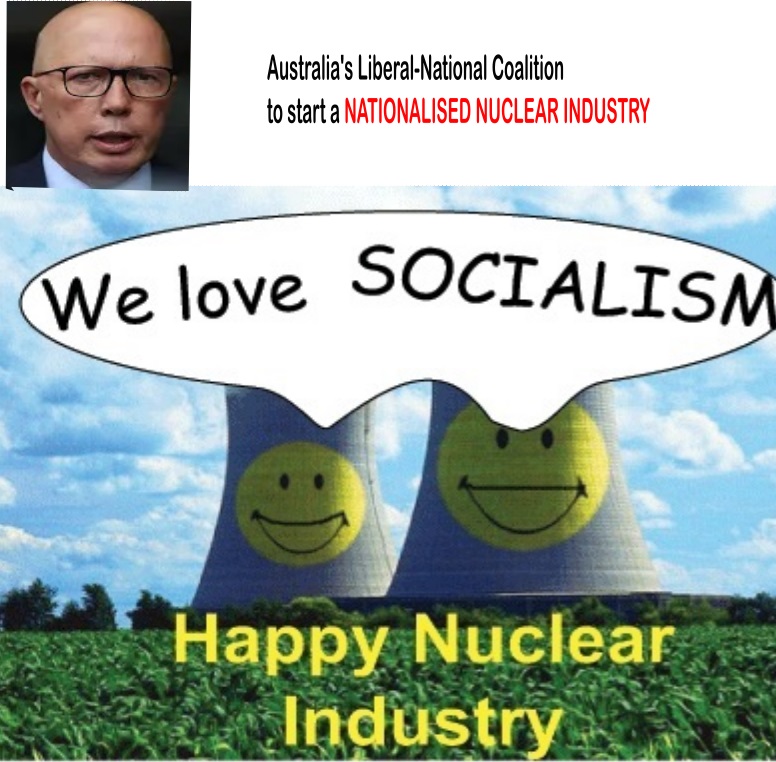
Here’s just a few of the current headlines:
- Energy generators poke holes in Dutton’s nuclear plan as questions over costings pile up
- Peter Dutton’s nuclear fantasy equals soaring power bills.
- Nuclear Neverland: The Lost Boys of Costings | The West Report -masse? https://www.youtube.com/watch?v=fSeaybp9oAA
- The Coalition’s master plan: Bring large scale wind, solar and battery storage installations to a halt.
- Peter Dutton’s nuclear plan: Mad, bad, and extremely dangerous
- The Coalition reveals the cost of its nuclear power plan – but the devil is in the missing detail.
- Dutton’s nuclear plan: An energy grid powered by endless spin.
- Is big tech going all in on nuclear? Google and Microsoft have just pledged $45 billion on renewables
- Fears nuclear power ‘may stop people moving to the bush’ .
- Dutton to reveal just how much he’s gambling on nuclear power,
- Not a hope in hell’ nuclear power can replace Australian coal-fired power by 2040, inquiry hears
- Inquiry into nuclear power generation in Australia: Exposing Ted O’Brien’s dishonesty
- Peter Dutton’s bid to politicise top science agency is ‘absurd’, former CSIRO energy director says.
- CSIRO’s nuclear costings have recklessly ignored construction risk, and the taxpayer will pay
From ‘Terrorist’ to ‘Freedom Fighter’: How the West Rebranded Al-Qaeda’s Jolani as Syria’s ‘Woke’ New Leader
December 13, 2024 By Alan MacLeod / MintPress News, https://www.mintpressnews.com/from-terrorist-to-freedom-fighter-how-the-west-rebranded-al-qaedas-jolani-as-syrias-woke-new-leader/288820/
Corporate media is heralding the fall of Bashar al-Assad and the emergence of Abu Mohammed al-Jolani as the new leader of Syria, despite his deep ties to both al-Qaeda and ISIS.
“How Syria’s ‘diversity-friendly’ jihadists plan on building a state,” runs the headline from an article in Britain’s Daily Telegraph that suggests that Jolani will construct a new Syria, respectful of minority rights. The same newspaper also labeled him a “moderate Jihadist.” The Washington Post described him as a pragmatic and charismatic leader, while CNN portrayed him as a “blazer-wearing revolutionary.”
Meanwhile, an in-depth portrait from Rolling Stone describes him as a “ruthlessly pragmatic, astute politician who has renounced ‘global jihad’” and intends to “unite Syria.” His “strategic acumen is apparent,” writes Rolling Stone, between paragraphs praising Jolani for leading a successful movement against a dictator.
CNN even scored an exclusive, sit-down interview with Jolani, even as his movement was storming Damascus. When asked by host Jomana Karadsheh about his past actions, he responded by saying, “I believe that everyone in life goes through phases and experiences…As you grow, you learn, and you continue to learn until the very last day of your life,” as if he were discussing embarrassing teenage mistakes, not establishing and leading the Al-Nusra Front, Al-Qaeda’s franchise in Syria.
This is a far cry from the first time CNN covered Jolani. In 2013, the network labeled him one of “the world’s 10 most dangerous terrorists,” known for abducting, torturing and slaughtering racial and religious minorities.
Still on the U.S. terrorist list today, the FBI is offering a $10 million reward for information about his whereabouts. Washington and other Western governments consider Jolani’s new organization, Hayʼat Tahrir al-Sham (HTS), as one and the same as Al-Qaeda/Al-Nusra.
This poses a serious public relations dilemma for Western nations, who supported the HTS-led overthrow of President Bashar al-Assad. And thus, Politico and others report there is a “huge scramble” in Washington to remove HTS and Jolani from the terrorist list as quickly as possible.
The Making of a Radical
Jolani has sought to distance himself from his past and present himself as a moderating force that can attempt to unite an intensely divided Syria. While he has, in recent years, displayed a willingness to compromise with other forces and factions, it is far from clear whether the tens of thousands of soldiers he commands – units made up primarily of former fighters from al-Qaeda/al-Nusra and ISIS – will be in a charitable mood once they cement their power.
“Syria is being purified,” he told a crowd in Damascus on Sunday. “This victory is born from the people who have languished in prison, and the fighters broke their chains,” he added.
Jolani – whose real name is Ahmed Hussein al-Shar’a – was born in 1982 in Saudi Arabia to parents who fled the Golan Heights area of Syria after the 1967 Israeli invasion. In 2003, he went to Iraq to fight against American forces. After three years of war, he was captured by the U.S. military and spent over five years in prison, including a stint at the notorious Abu Ghraib torture center.
While in Iraq, Jolani fought with ISIS and was even a deputy to its founder. Immediately upon release in 2011, ISIS sent him to Syria with a rumored $1 billion to found the Syrian wing of al-Qaeda and participate in the armed protest movement against Assad that arose out of the Arab Spring.
Realizing the extremely poor reputation al-Qaeda had in the region and across the world, Jolani attempted to rebrand his forces, officially shuttering the al-Nusra Front in January 2017 and, on the same day, founding HTS. He claimed that HTS preaches a very different ideology and that it will respect Syrian diversity. Not everyone is convinced of this, least of all the British government, who immediately proscribed HTS, describing it as merely an alias of Al-Qaeda.
“Al-Qaeda/ISIS man didn’t ‘reinvent himself.’ He had the whole propaganda and intelligence apparatus of the ‘West,’ including the BBC, doing it for him,” remarked co-founder of The Electronic Intifada, Ali Abunimah.
The New Government: Likes Israel, Hates Hezbollah
The name “al-Jolani” translates to “From the Golan Heights.” And yet, the leader appears distinctly unconcerned with the Israeli invasion of his homeland. The IDF has taken much of southern Syria, including the strategic Mount Hermon, overlooking Damascus. Prime Minister Benjamin Netanyahu has stated that this is part of a permanent operation. “The Golan Heights…will forever be an inseparable part of the State of Israel,” he proclaimed.
Jolani has already said that he has no intention of confronting Israel. “Syria is not ready for war and does not intend to go into another war. The source of concern was the Iranian militias, and Hezbollah, and the danger has passed,” he said – a strange thing to say while Israel is carrying out the largest Air Force operation in its history, pounding military targets all over Syria. Other HTS spokespersons have also categorically refused to comment on Israel’s attack on the country, even when pressed by incredulous Western journalists.
Jolani’s comments, singling out two Shia forces rather than Israel as enemies of the state, will have many concerned that this could signal a return to the process of Shia slaughter ISIS waged over much of Syria and Iraq. In 2016, the U.S. House of Representatives voted 383-0 to classify this process as a genocide.
Fortunately, the new government will likely be a coalition of disparate and moderating forces. However, these groups seem to share a common thread: they all appear to be pro-Israel. A commander of the secular Free Syrian Army, for example, recently gave an interview to The Times of Israel, where he looked forward to a new era of “friendship” and “harmony” with its neighbor to the south. “We will go for full peace with Israel… Since the outbreak of the Syrian civil war, we have never made any critical comments against Israel, unlike Hezbollah, who stated they aim to liberate Jerusalem and the Golan Heights,” he said.
The commander added that “Israel will plant a rose in the Syrian garden” and asked for the country’s financial support in forming a new government.
Other anti-Assad forces have gone even further, with one individual stating that Israel “Isn’t hostile to those who are not hostile toward it. We don’t hate you, we love you very much…we were quite happy when you attacked Hezbollah, really happy, and we’re glad that you won.”
Statements like these might surprise a casual observer. But the reality is that Israel has been funding, training and arming much of the Syrian opposition since its inception. This includes Al-Qaeda, whose wounded fighters are treated by Israel.
And while radical Islamist forces appeared to be enemies with everyone, the one group they fastidiously avoided any confrontation with was Israel. Indeed, in 2016, ISIS fighters accidentally fired upon an Israeli position in the Golan Heights, thinking they were Syrian government forces, then quickly issued an apology for doing so.
From the Golan Heights, the year-long Israeli campaign against Hezbollah and Syrian Army positions also seriously weakened both forces, aiding the opposition in their victory.
Al-Qaeda and the U.S.: A Complicated Relationship
While both journalists and politicians in the U.S. are scrambling to change their opinions on Jolani and HTS, the reality is that, for much of its existence, Washington has enjoyed a very close relationship with al-Qaeda. The organization was born in Afghanistan in the 1980s, thanks in no small part to the CIA. Between 1979 and 1992, the CIA spent billions of dollars funding, arming, and training Afghan Mujahideen militiamen (like Osama bin Laden) in an attempt to bleed the Soviet occupation dry. It was from the ranks of the Mujahideen that bin Laden built his organization.
During the 1990s, bin Laden’s relationship with the U.S. soured, and it eventually became a principal target for al-Qaeda, culminating in the infamous September 11, 2001, attacks on New York City and Washington, D.C.
The Bush administration would use these attacks as a pretext to invade both Afghanistan and Iraq, claiming that America could never be safe if al-Qaeda were not thoroughly destroyed. Bin Laden became perhaps the most notorious individual in the world, and American society was turned upside down in a self-described effort to rout Islamic extremism.
And yet, by the 2010s, even as the U.S. was ostensibly at war with al-Qaeda in Iraq and Afghanistan, it was secretly working with it in Syria on a plan to overthrow Assad. The CIA spent around $1 billion per year training and arming a wide network of rebel groups to this end. As National Security Advisor Jake Sullivan told Secretary of State Hillary Clinton in a leaked 2012 email, “AQ [al-Qaeda] is on our side in Syria.”
Thus, while many casual observers may be shocked to see the media and political class embrace the leader of al-Qaeda in Syria as a modern, progressive champion, the reality is that the U.S. relationship with the group is merely reverting to a position it has previously held. Consequently, it appears that the War on Terror will come to an end with the “terrorists” being redesignated as “moderate rebels” and “freedom fighters.”
Who Gets to Define “Terrorist”?
Of course, many have argued that the U.S. Terrorist List is entirely arbitrary to begin with and is merely a barometer of who is in Washington’s good books at any given time. In 2020, the Trump administration removed Sudan from its state sponsors of terror list in exchange for the country normalizing relations with Israel, proving how transactional the list was.
A few months later, it removed the East Turkestan Islamic Movement (a Uyghur militia currently active in Syria) from its list because of its hardening attitude towards China, seeing ETIM as a useful pawn to play against Beijing.
Washington also continues to keep Cuba on its terror list despite there being no evidence of the island supporting terror groups.
And the U.S. refused to remove Nelson Mandela from its list of the world’s most notorious terrorists until 2008 – 14 years after he became President of South Africa. In comparison, Jolani’s redesignation might take fewer than fourteen days.
A giant rebranding operation is taking place. Both corporate media and the U.S. government have attempted to transform the founder and head of an al-Qaeda affiliate organization into a woke, progressive actor. It remains to be seen how exactly Jolani will govern and whether he can maintain support from a wide range of Syrian groups. Given what we have seen in the past week, however, he can be confident of enjoying strong support from the Western press.
Trump blasts Biden over long-range missile strikes into Russia
https://www.sott.net/article/496629-Trump-blasts-Biden-over-long-range-missile-strikes-into-Russia 13 Dec 24
Ukrainian attacks using Western medium-range missiles are foolish and a major escalation, the US president-elect has said
US President-elect Donald Trump has criticized Ukraine’s strikes deep into Russia using Western-supplied weapons, saying that they only escalate the conflict between Kiev and Moscow.
Trump made the statement on Thursday in an interview with Time magazine, which named him the 2024 Person of the Year.
“I disagree very vehemently with sending missiles hundreds of miles into Russia. Why are we doing that?” he asked rhetorically.
According to the president-elect, such attacks are “just escalating this war and making it worse.”
“That should not have been allowed to be done… And I think that is a very big mistake, very big mistake,” he said of strikes deep into Russia’s internationally recognized territory.
Trump returned to the issue later in the interview, saying that “the most dangerous thing right now” is the fact that “[Ukrainian leader Vladimir] Zelensky has decided, with the approval of, I assume, the President [Joe Biden], to start shooting missiles into Russia.”
“I think that is a major escalation. I think it is a foolish decision,” he stressed.
The US president-elect’s comments came a day after the Russian Defense Ministry reported that Ukrainian forces had fired six US-supplied ATACMS missiles at a military airfield near the southern city of Taganrog.
Two of them were shot down and the rest were diverted using electronic warfare during the attack, the ministry said. The fallen debris resulted in some injuries and minor damage to two buildings and several vehicles, it added.
On Thursday, Kremlin spokesman Dmitry Peskov said that Russia’s response to the strike on Taganrog “will follow at the time and in the way that will be deemed appropriate. But it will definitely follow.”
In late November, Russia used its new Oreshnik hypersonic ballistic missile system for the first time, striking the Yuzhmash military plant in the Ukrainian city of Dnepr.
According to Moscow, the deployment of the state-of-the-art weapon was a response to Washington and its allies allowing Ukraine to target internationally recognized Russian territory with the long-range weapons they supply to Kiev.
Russian President Vladimir Putin warned at the time that if Ukraine’s attacks deep inside Russia continue, Moscow reserves the right “to use our weapons against the military facilities of those countries that allow the use of their weapons against our facilities.”
Australia’s Nuclear Neverland politics: The Lost Boys of Costings | The West Report
It’s hard to take the Coalition’s nuclear energy policy seriously, so we didn’t. And frankly, why would they put taxpayers on the hook for the biggest public funded project in history when renewables are crowding private investment en masse? https://www.youtube.com/watch?v=fSeaybp9oAA
Ukraine conflict updates: Record Russian gains, Kursk encirclement and Donbass push
By Sergey Poletaev, information analyst and publicist, 13 Dec 24 https://www.rt.com/russia/609229-overview-situation-on-front/
An overview of the frontline situation during November and December of 2024
Since October, intense battles have been raging all along the front. In that month and November, the Russian army advanced at its fastest pace since the start of the Special Military Operation, capturing over 1,500 square kilometers.
The Russian army is currently advancing at eight sections of the front, which marks a new record. Below, we’ll focus on four key directions, from north to south.
Kursk direction: Ongoing battles and the encirclement of the AFU
The situation here hasn’t changed much since our last report, and clashes continue. Despite major challenges at other sections of the front, the Armed Forces of Ukraine (AFU) is still sending reserves to Kursk. Kiev believes that retaining control over this section of the front is crucial since it gives it leverage with the new presidential administration in the US.
According to Western and Ukrainian sources, North Korean soldiers have reportedly been deployed to Kursk region, though their presence hasn’t been confirmed.
Interesting fact: The first major encirclement of Ukrainian forces since the battles for Mariupol (which occurred in the spring of 2022) happened at this section of the front – several hundred AFU soldiers found themselves encircled near Olgovskaya grove. Russian President Vladimir Putin relayed this information on October 24, and by November 20, the area had been cleared.
What’s the current situation? This week, battles have become more intense. Kursk remains one of the few directions where Ukrainian forces are actively counterattacking, able to hold their ground and even occasionally advancing.
Pokrovsk direction: Russians advance along the railway
The Pokrovsk (Krasnoarmeysk) urban agglomeration is the second largest urban area in Donbass that remains partially under Ukrainian control (along with the Slaviansk-Kramatorsk urban area).
Before the war, its population was around 200,000 people. Moreover, the city is a crucial logistics hub for supplying Ukrainian forces along the entire southern front.
At the end of summer, the Pokrovsk direction was considered a priority; however, after the city of Novogrodovka was captured with minimal resistance, further progress westward stalled. Selidovo (the pre-war population of the city and its suburbs was about 50,000) held out for nearly two months, but, surrounded from the north and south, it eventually fell without major urban combat. Following a brief pause, the Russian army resumed its advance toward Pokrovsk, moving around the city’s southern flank.
Interesting fact: Russian troops mainly advanced along the main railway line, moving from Avdeevka to Novogrodovka. Now, the Russians are also advancing along another railway line further south, which leads directly to Pokrovsk.
What’s the current situation? Since the end of November, Russian troops have advanced further – breaking through Ukrainian defensive lines near Novotroitskoye, they moved closer to Pokrovsk and are now positioned 10-11 kilometers south of the city.
Civilians have been evacuated from Pokrovsk (pre-war population 60,000) and the supply of electricity and gas to the city has been cut off. Will the AFU be able to hold their flanks and engage in serious urban combat? Most likely, Ukrainians will attempt to do so, driven by the same political motivations as in Kursk region.
Kurakhovo: The main hotspot
The battles for Kurakhovo began right after the fall of Ugledar in early October. The Russians advanced from several directions: from the north toward the reservoir, from the front line via Ostroye-Ostrovskoye, from the south via Bogoyavlenka, and along a broader front from Yasnaya Polyana to Konstaninopol. The latter direction was also useful for encircling Velikaya Novoselka, which we’ll discuss below.
Interesting fact: The Kurakhovo operation has been the biggest one since Mariupol; it involves two groups of troops, and encompasses an area of 1,200 square kilometers. While it may not be a strategic-scale operation, it is quite significant. For example, the area of the Avdeevka operation was less than one tenth the size, and the infamous “Bakhmut meat grinder” was one fifth or one fourth its size. The map shows only the central area of this operation.
What’s the current situation? Over the past week, two significant developments occurred. First, Russian forces have taken control over the entire northern bank of the reservoir and the village of Starye Terny, along with the dam. This gives them complete fire control over both the residential areas and the industrial zone located to the west, where a thermal power station is located.
Second, the Russians are pushing the Ukrainians out of the area along the Sukhie Yaly River south of the city. Their foes have practically been driven into a ravine along the river, with some sources even suggesting that encirclement is imminent.
However, even despite desperate situation, the Ukrainian forces are clinging to their positions along the river since if they lose control over this area, the city will fall within a few days.
Velikaya Novoselka: In memory of Ukraine’s counteroffensive
Velikaya Novoselka is a relatively large settlement with a population of around 6,000 (more than that of Sudzha in Russia’s Kursk region). This area is held by various Ukrainian forces, including half a dozen AFU brigades, territorial defense units, the National Guard, and some marine units.
By the end of November, the situation for the AFU grew a lot worse following the unexpected breakthrough of Russian forces toward the highway near Razdolnoye, north of Velikaya Novoselka.
Once again, the Russian army had employed its preferred strategy – flanking and encircling the settlement and securing control over communications. Combined with continuous pressure from the front, this quickly depletes the enemy’s resources. The AFU has a tendency to hold onto their positions even in desperate circumstances and to withdraw only when it’s too late, so this tactic has been particularly costly for the Ukrainians.
Interesting fact: During the summer of 2023, this was one of two key directions of the Ukrainian counteroffensive. Over four months, the AFU managed to advance only 5-6 kilometers southward, from Velikaya Novoselka to the settlement of Urozhaynoye. In contrast, Russian forces have advanced about 20km on the eastern flank just in the past month.
What’s the current situation? Reports indicate that the AFU has deployed a reserve mechanized brigade to reinforce the flanks around Velikaya Novoselka. This has not been confirmed, but we do know that the Ukrainians managed to launch a series of counterattacks, successfully repelling the advance of the Russian troops in the village of Novy Komar and easing some of the pressure on the northern flank of Velikaya Novoselka.
Finding the Unmentionable: Amnesty International, Israel and Genocide
Binoy Kampmark, https://theaimn.com/finding-the-unmentionable-amnesty-international-israel-and-genocide/ 14 Dec 24
It was bound to happen. With continuing operations in Gaza, and increasingly violent activities being conducted against Palestinians in the occupied territories, human rights organisations are making increasingly severe assessments of Israel’s warring cause. While the world awaits the findings of the International Court of Justice on whether Israel’s campaign, as argued by South Africa, amounts to genocide, Amnesty International has already reached its conclusions.
In a 296-page report sporting the ominous title “You Feel Like You Are Subhuman”, the human rights body, after considering the events in Gaza between October 2023 and July 2024, identified a “pattern of conduct” that indicated genocidal intent. These included, among other things, persistent direct attacks on civilians and objects “and deliberately indiscriminate strikes over the nine-month period, wiping out entire families repeatedly launched at times when these strikes would result in high numbers of casualties”; the nature of the weapons used; the speed and scale of destruction to civilian objects and infrastructure (homes, shelters, health facilities, water and sanitation infrastructure, agricultural land”; the use of bulldozing and controlled demolitions; and the use of “incomprehensible, misleading and arbitrary ‘evacuation’ orders’.”
The report does much to focus on statements made from the highest officials to the common soldiery to reveal the mental state necessary to reveal genocide. 102 statements made by members of the Knesset, government officials and high-ranking commanders “dehumanized Palestinians, or called for, or justified genocidal acts or other crimes under international law against them.” The report also examined 62 videos, audio recordings and photographs posted online featuring gleeful Israeli soldiers rejoicing in the “destruction of Gaza or the denial of essential services to people in Gaza, or celebrated the destruction of Palestinian homes, mosques, schools and universities, including through controlled demolitions, in some cases without apparent military necessity.”
From its alternative universe, the Israeli public relations machine drew from its own agitprop specialists, working on mangling the language of the report. The formula is familiar: attack the authors first, not their premises. “The deplorable and fanatical organisation Amnesty International has once again produced a fabricated response that is entirely based on lies,” came the howl from Israeli Foreign Ministry spokesperson Oren Marmorstein.
Other methods of repudiation involve detaching Hamas and its war with Israel from any historical continuum, not least the fact that it was aided, supported and backed by Israel for years as a counter to Fatah in the West Bank. Isolating Hamas as a terrorist aberration also serves to treat it as alien, artificially foreign and not part of any resistance movement against suffocating Israeli occupation and strangulation. They, so goes this argument, are genocidal, and countering such a body can never be, by any stretch, genocidal. The pro-Israeli group NGO Monitor abides by this line of reasoning, calling allegations of genocide against Israel “a reversal of the actual and clearly established intent of Hamas and its allies (including its patron, Iran), to wipe Israel off the map.”
Israel’s closest ally and sponsor, the United States, proved predictable in rejecting the findings while still claiming to respect the humanitarian line. The US State Department’s principal deputy spokesman, Vedant Patel, expressed disagreement “with the conclusions of such a report. We had said previously and continue to find that the allegations of genocide are unfounded.” Patel did, however, pay lip service to the “vital role that civil society organizations like Amnesty International and human rights groups and NGOs play in providing information and analysis as it relates to Gaza and what’s going on.” Vital, but only up to a point.
Far less guarded assessments can be found in the American pro-Israeli chatter sphere. These follow the usual pattern. Orde Kittrie, senior fellow of the Foundation for Defense of Democracies, a name that can only imply that crimes committed in such a cause are bound to be justifiable, offers a neat illustration. Amnesty, he argues, “systematically and repeatedly mischaracterizes both the facts and the law.” Kittrie suggests his own mischaracterisation by parroting the IDF’s line that Hamas had “increased casualty counts by illegally using Palestinian civilian shields and by hiding weapons and war fighters in and below homes, hospitals, mosques, and other buildings.” This conveniently ignores that point that the numbers are not necessarily proof of genocidal intent, though it helps.
The report also notes that, even in the face of such tactics by Hamas, Israel was still “obligated to take all feasible precautions to spare civilians and avoid attacks that would be indiscriminate or disproportionate.”
Amnesty International’s report is yet another addition to the gloomy literature on the subject. Human Rights Watch, in November, pointed to violations of the laws of war, crimes against humanity, and the provisional measures of the ICJ issued urging Israel to abide by the obligations imposed by the UN Genocide Convention of 1948. The Israeli human rights organisation B’Tselem stated in no uncertain terms in October that “Israel intends to forcibly displace northern Gaza’s residents by committing some of the gravest crimes under the laws of war.”
Battling over the designation of whether a campaign is genocidal can act as a distraction, a field of quibbles for paper pushing pedants. The “specific intent” in proof must be unequivocally demonstrated and beyond any other reasonable inference. A smokescreen is thereby deployed that risks masking the broader ambit of war crimes and crimes against humanity. But no amount of pedantry and disagreement can arrest the sense that Israel’s lethal conduct, whatever threshold it may reach in international law, is directed at destroying not merely Palestinian life but any worthwhile sense of a viable sovereignty. Amnesty Israel, while rejecting the central claim of the parent organisation’s reportdid make one concession: the country’s brutal response following October 7, 2023 “may amount to crimes against humanity and ethnic cleansing.”
1 This Month

of the week – Shut Down Drone Warfare!


Tell the Ukrainian Government to Drop Prosecution of Peace Activist Yurii Sheliazhenko

Petition to revoke the licensing of the Near Surface Nuclear Disposal Facility (NSDF) at Chalk River. https://www.ourcommons.ca/petitions/en/Petition/Details?Petition=e-7247
To see nuclear-related stories in greater depth and intensity – go to https://nuclearinformation.wordpress.com
-
Archives
- April 2026 (79)
- March 2026 (251)
- February 2026 (268)
- January 2026 (308)
- December 2025 (358)
- November 2025 (359)
- October 2025 (376)
- September 2025 (257)
- August 2025 (319)
- July 2025 (230)
- June 2025 (348)
- May 2025 (261)
-
Categories
- 1
- 1 NUCLEAR ISSUES
- business and costs
- climate change
- culture and arts
- ENERGY
- environment
- health
- history
- indigenous issues
- Legal
- marketing of nuclear
- media
- opposition to nuclear
- PERSONAL STORIES
- politics
- politics international
- Religion and ethics
- safety
- secrets,lies and civil liberties
- spinbuster
- technology
- Uranium
- wastes
- weapons and war
- Women
- 2 WORLD
- ACTION
- AFRICA
- Atrocities
- AUSTRALIA
- Christina's notes
- Christina's themes
- culture and arts
- Events
- Fuk 2022
- Fuk 2023
- Fukushima 2017
- Fukushima 2018
- fukushima 2019
- Fukushima 2020
- Fukushima 2021
- general
- global warming
- Humour (God we need it)
- Nuclear
- RARE EARTHS
- Reference
- resources – print
- Resources -audiovicual
- Weekly Newsletter
- World
- World Nuclear
- YouTube
-
RSS
Entries RSS
Comments RSS
 nuclear-news